
AI-Powered RFID Solutions for Modern Corrections
How AI-Powered RFID Is Transforming Correctional Facility Operations
Artificial intelligence combined with RFID technologies is changing how correctional institutions manage inmate movement, facility security, staff safety, asset accountability, and operational efficiency. Modern correctional facilities continuously generate operational data from inmate identification, staff credentials, secured equipment, controlled-access areas, maintenance activities, healthcare operations, and logistics. AI analyzes this continuous stream of RFID-generated information to identify behavioral patterns, predict operational risks, optimize resource allocation, and support faster decision-making while maintaining strict security requirements.
Within corrections, RFID serves as the primary data acquisition technology while AI converts location, movement, identity, and operational events into actionable intelligence. Rather than simply recording inmate locations or equipment inventories, AI-enabled RFID solutions can detect abnormal movement patterns, anticipate overcrowding risks, identify unauthorized access attempts, monitor high-value correctional assets, and improve emergency response coordination.
Correctional agencies increasingly deploy AIoT solutions that combine RFID, intelligent video analytics, edge computing, machine learning, secure networking, and enterprise correctional management software to improve operational visibility while reducing manual administrative workloads. As one of the world’s leading suppliers of RFID and BLE technologies, GAO has helped organizations across North America deploy reliable identification and IoT hardware solutions supported by decades of engineering experience, stringent quality assurance, and technical expertise.
Understanding AI-Driven RFID Systems for Corrections
Correctional institutions operate highly controlled environments where security, accountability, inmate welfare, and regulatory compliance must coexist. Every inmate transfer, officer patrol, healthcare visit, maintenance activity, visitor movement, equipment checkout, and facility inspection produces operational information requiring accurate documentation.
Traditional RFID systems primarily automate identification and tracking. AI extends these capabilities by continuously learning operational behaviors, recognizing anomalies, predicting incidents, and recommending corrective actions before security risks escalate.
Within correctional facilities, AI processes data originating from:
- RFID inmate identification wristbands
- Staff identification badges
- Electronic cell access records
- Secure equipment tracking tags
- Medical asset RFID tags
- Visitor management systems
- Vehicle access control
- Inventory management systems
- Intelligent surveillance systems
- Environmental monitoring sensors
- Perimeter security devices
- Emergency response systems
Instead of operating independently, these information sources become part of an integrated AI decision-support system that continuously evaluates operational conditions across the correctional facility.
The result is improved situational awareness, faster incident detection, enhanced officer safety, better asset accountability, reduced manual reporting, and more informed operational decisions.
AI-Powered RFID System Overview for Modern Correctional Facility Operations
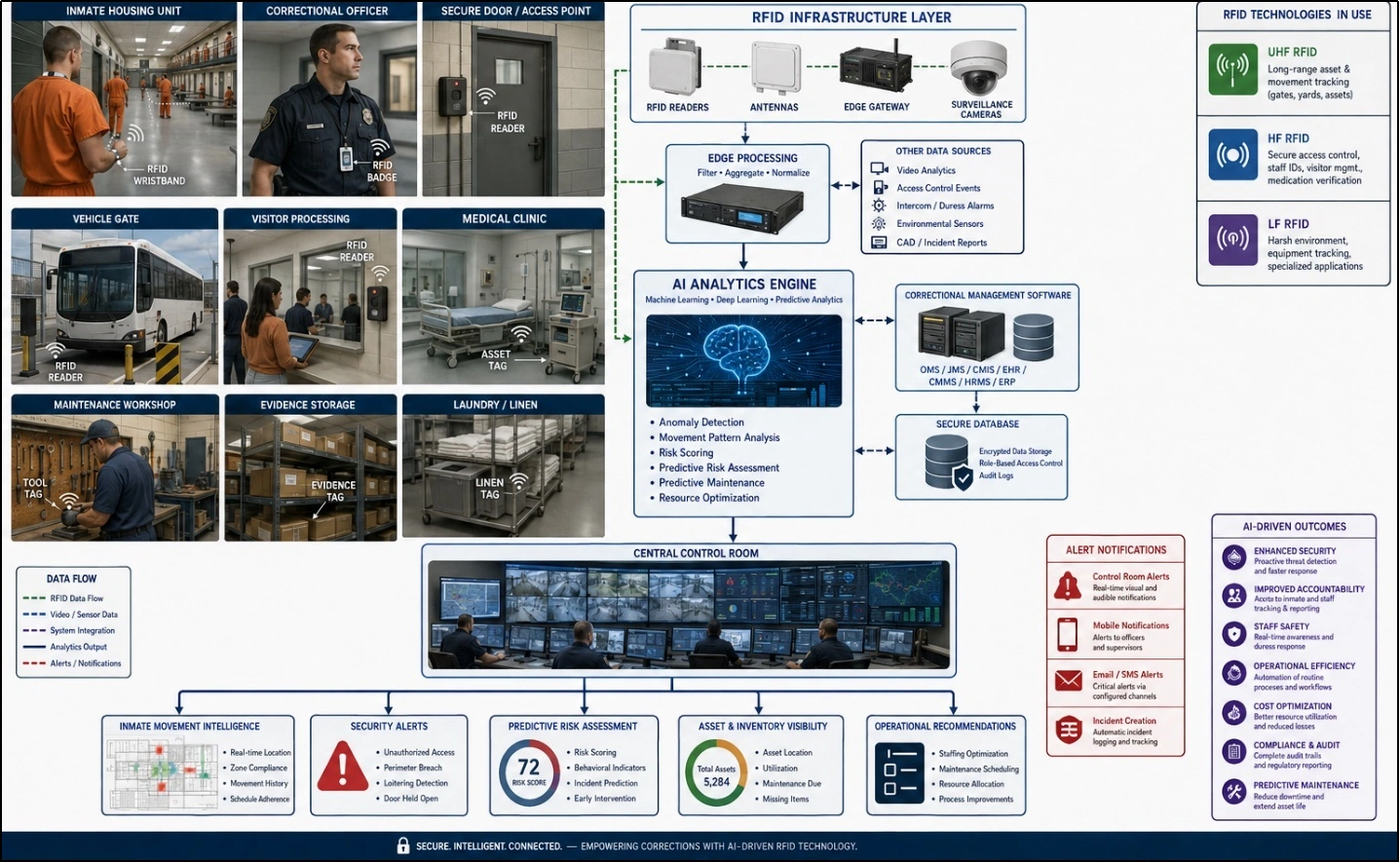
This diagram illustrates how RFID-enabled identification devices, edge computing, AI analytics, and correctional management software work together to improve security, inmate accountability, asset visibility, and operational decision-making within a modern correctional facility. It demonstrates the complete data flow from RFID data capture through AI analysis to real-time alerts, predictive risk assessments, and centralized operational intelligence, highlighting how AI enhances correctional safety and efficiency.
Why Artificial Intelligence Is Becoming Essential in Modern Corrections
Correctional facilities face increasingly complex operational challenges that extend beyond physical security. Institutions must simultaneously manage inmate populations, rehabilitation programs, healthcare delivery, maintenance operations, emergency preparedness, legal compliance, staff shortages, contraband prevention, transportation logistics, and public accountability.
Large correctional complexes often process thousands of daily operational events involving:
- Housing unit transfers
- Meal distribution
- Medical appointments
- Recreation scheduling
- Court transportation
- Educational programs
- Vocational training
- Visitor screening
- Evidence handling
- Property management
- Officer shift changes
- Facility inspections
Managing these activities using manual procedures creates operational bottlenecks, delayed reporting, incomplete visibility, and increased security risks.
Artificial intelligence addresses these challenges by automatically analyzing historical and real-time operational data to identify trends that human operators may overlook.
Examples include:
- Predicting inmate congestion before scheduled movements occur.
- Identifying unusual inmate movement patterns.
- Detecting unauthorized equipment relocation.
- Recognizing repeated access attempts to restricted zones.
- Forecasting maintenance requirements for security equipment.
- Optimizing officer deployment based on historical activity.
- Supporting emergency evacuation planning.
- Detecting healthcare scheduling conflicts.
- Improving utilization of correctional resources.
- Reducing unnecessary inmate escorts.
Rather than replacing correctional officers, AI augments human decision-making by providing timely recommendations supported by continuously updated operational intelligence.
Major AI-Driven RFID Applications in Corrections
Correctional institutions require far more than inmate identification. AI transforms RFID data into operational intelligence supporting nearly every secure workflow throughout the facility.
Intelligent Inmate Movement Management
Every inmate movement generates valuable operational information.
AI continuously analyzes RFID location events to:
- Monitor inmate transfers between housing units.
- Verify scheduled movements.
- Detect unauthorized movement.
- Identify overcrowding risks.
- Optimize escort planning.
- Predict movement bottlenecks.
- Support emergency lockdown procedures.
- Improve inmate accountability.
Historical movement analysis also supports investigations, incident reconstruction, and operational planning.
Smart Staff Safety and Officer Accountability
Correctional officers routinely operate within high-risk environments.
RFID identification badges combined with AI improve officer safety through:
- Real-time location awareness.
- Emergency duress event detection.
- Patrol verification.
- Staffing optimization.
- Restricted-area authorization.
- Incident response coordination.
- Shift workload analysis.
- Emergency evacuation assistance.
AI can recognize abnormal officer movement patterns that may indicate emergencies requiring immediate assistance.
AI-Based Contraband Prevention
Contraband introduces significant operational risks.
AI evaluates RFID access records alongside surveillance information to identify:
- Suspicious movement sequences.
- Unusual storage access.
- Unauthorized equipment handling.
- Repeated restricted-area visits.
- Inventory discrepancies.
- Unexpected asset relocation.
- Visitor-related anomalies.
Risk scores generated by AI assist investigators in prioritizing security reviews without relying solely on manual audits.
Correctional Asset Intelligence
Correctional facilities manage thousands of operational assets including:
- Security keys
- Radios
- Body cameras
- Medical equipment
- Maintenance tools
- Evidence containers
- Firearms in secured armories
- Chemical storage
- Transportation equipment
- Laundry carts
- Food service equipment
- Portable scanners
RFID automatically identifies asset locations while AI predicts utilization trends, maintenance schedules, abnormal usage, and possible asset loss.
This reduces inventory reconciliation time while improving operational readiness.
Healthcare and Medication Management
Correctional healthcare operations require strict accountability.
AI-supported RFID solutions help monitor:
- Medication distribution.
- Medical equipment availability.
- Patient transport scheduling.
- Clinical inventory.
- Laboratory specimen tracking.
- Medical emergency response.
- Vaccine storage monitoring.
- Controlled substance accountability.
AI further assists healthcare administrators by identifying scheduling conflicts and predicting resource demand.
Visitor and Contractor Management
Visitor processing presents both operational and security challenges.
RFID visitor credentials integrated with AI improve:
- Visitor verification.
- Authorized movement monitoring.
- Contractor access control.
- Escort compliance.
- Visit duration analysis.
- Restricted-area enforcement.
- Temporary credential management.
Suspicious access behavior can automatically trigger security alerts before policy violations escalate.
AI-Powered RFID Applications for Smart Correctional Facility Operations
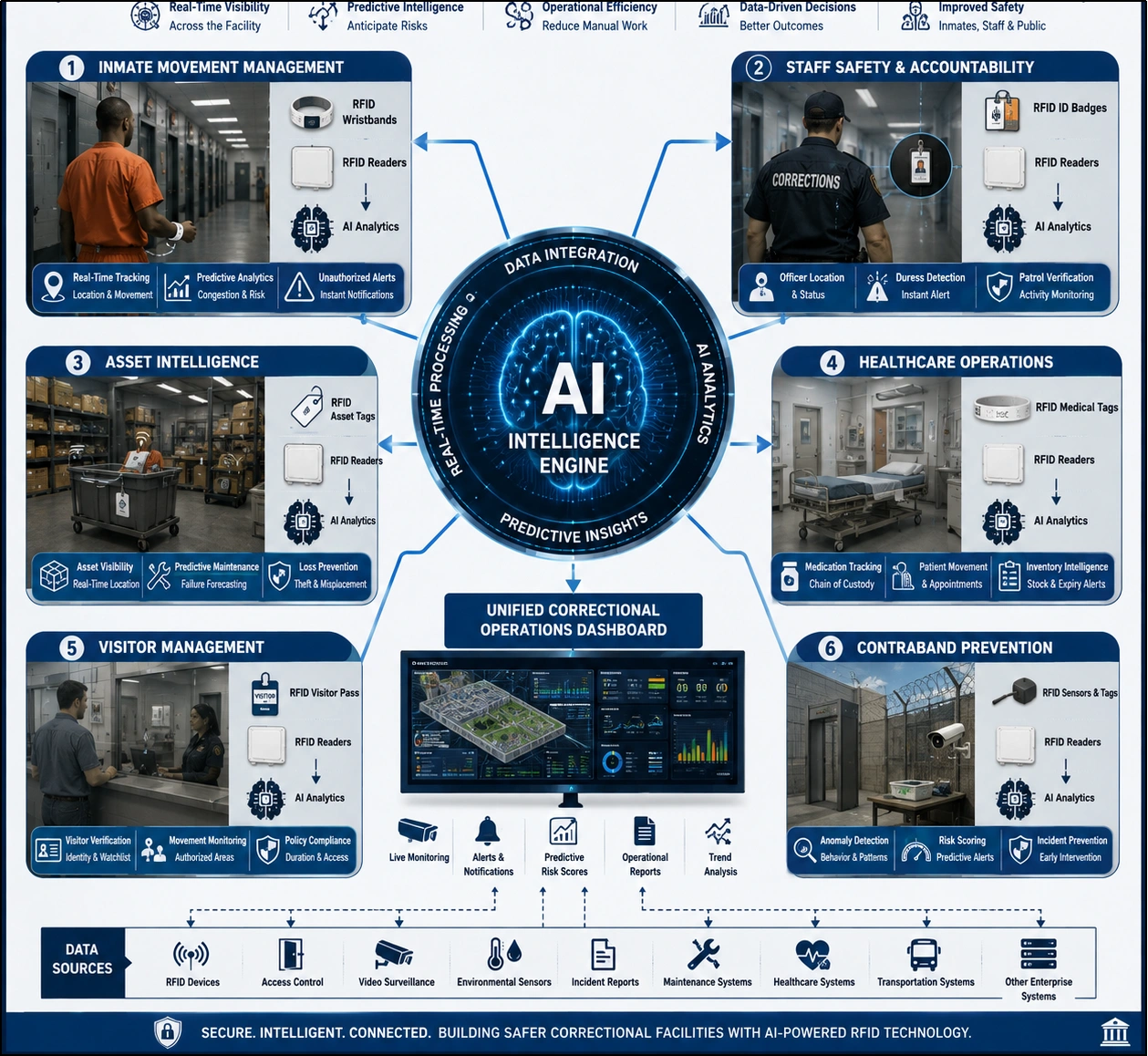
This infographic illustrates how a centralized AI intelligence engine integrates RFID data across six critical correctional operations: inmate movement management, staff safety, asset intelligence, healthcare operations, visitor management, and contraband prevention. It highlights how AI transforms RFID-generated data into predictive insights, real-time alerts, operational dashboards, and informed decision-making to enhance correctional security, efficiency, and accountability.
Operational Workflow of AI-Enabled RFID in Corrections
Modern correctional facilities depend on continuous operational visibility rather than isolated identification events. AI transforms RFID-generated information into intelligent operational workflows spanning the entire correctional environment.
RFID Data Acquisition
The workflow begins with automatic identification across correctional operations.
RFID data originates from:
- Inmate wristbands
- Officer badges
- Asset tags
- Medical equipment
- Vehicle identifiers
- Visitor credentials
- Tool tracking systems
- Supply inventories
- Evidence storage
- Facility checkpoints
Each RFID event records identity, timestamp, location, reader information, movement status, and contextual operational metadata.
Secure Communication Infrastructure
Captured RFID information is securely transmitted through facility communication networks using technologies such as:
- Ethernet
- Secure Wi-Fi
- Fiber backbone
- Industrial switches
- VPN connections
- TLS encryption
- Network segmentation
- Edge gateways
Mission-critical correctional operations typically prioritize redundant communication paths to maintain operational continuity during network interruptions.
Edge Processing for Time-Critical Security Decisions
Certain correctional decisions cannot depend on cloud latency.
Edge servers positioned within secure correctional networks perform immediate processing for:
- Unauthorized door access
- Perimeter breach detection
- Emergency lockdown activation
- Officer duress alerts
- Restricted-area violations
- High-risk inmate movement
- Secure gate authorization
Processing these events locally significantly reduces response times while maintaining operation during temporary external connectivity disruptions.
RFID Middleware and Event Processing
RFID middleware serves as the intelligence layer between hardware devices and correctional software systems.
Its responsibilities include:
- Device management
- Reader health monitoring
- Duplicate event filtering
- Data normalization
- Identity verification
- Event correlation
- Exception handling
- Secure message routing
- Device diagnostics
- Operational logging
Middleware also applies configurable business rules before forwarding validated events to AI analytics systems.
AI Analytics and Decision Intelligence
Once operational events have been normalized, AI models analyze both historical and real-time correctional data to identify patterns, detect anomalies, forecast operational risks, and support decision-making.
Common AI techniques include:
- Machine learning for movement prediction
- Deep learning for behavioral pattern recognition
- Predictive analytics for resource planning
- Anomaly detection for security events
- Natural language processing for incident report analysis
- Reinforcement learning for operational optimization
- Graph analytics for relationship mapping between inmates, assets, locations, and events
Rather than generating static reports, these analytical models continuously adapt to changing correctional conditions, helping security personnel identify elevated risks earlier and allocate resources more effectively.
End-to-End AI-Enabled RFID Operational Workflow for Modern Correctional Facilities
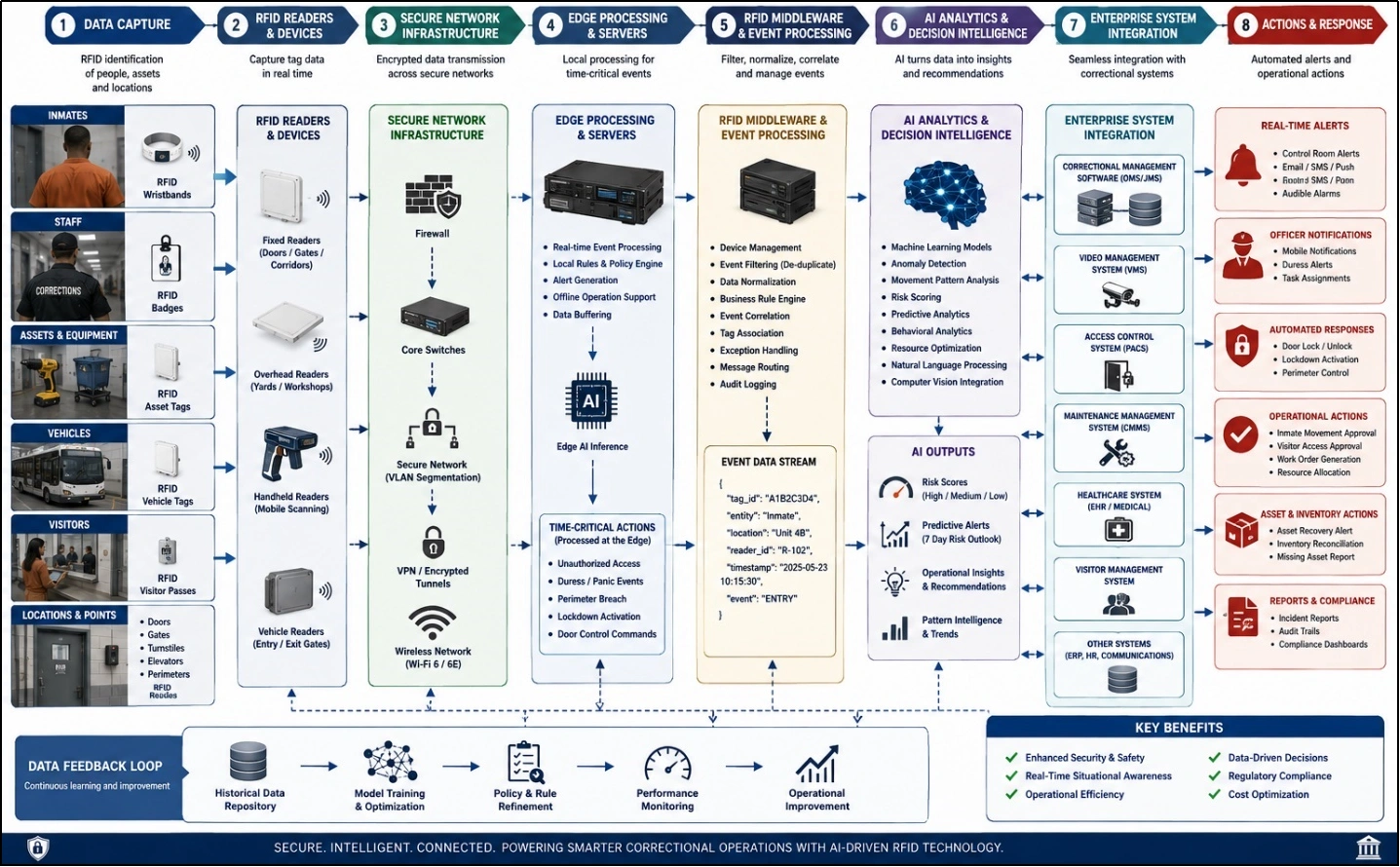
This workflow diagram illustrates the complete lifecycle of AI-enabled RFID operations in a correctional facility, beginning with RFID-based identification of inmates, staff, assets, vehicles, and visitors and progressing through secure network communications, edge processing, RFID middleware, AI analytics, and enterprise software integration. It demonstrates how real-time operational data is transformed into intelligent security alerts, predictive risk assessments, automated workflows, and operational decisions that improve correctional safety, accountability, compliance, and facility efficiency.
Core Technologies Supporting AI-Enabled RFID for Corrections
Delivering reliable AI-assisted correctional operations requires more than RFID hardware. Successful deployments combine identification technologies, secure networking, intelligent software, AI processing, resilient computing infrastructure, cybersecurity controls, and integration with existing correctional information systems. The selection of each component depends on facility size, inmate population, security classification, regulatory requirements, and operational objectives.
RFID Technologies Used in Correctional Facilities
Correctional environments typically employ multiple RFID frequency ranges because different operational tasks require different read distances, environmental characteristics, and security considerations.
UHF RFID for Facility-Wide Visibility
Ultra High Frequency (UHF) RFID is commonly deployed where long read distances and rapid identification of multiple tagged objects are required. Within correctional facilities, UHF RFID supports operational visibility across inmate transportation, warehouse operations, maintenance departments, property rooms, central laundry, food services, logistics, and inventory management.
Typical UHF RFID applications include:
- Correctional inventory management
- Maintenance tool accountability
- Evidence storage monitoring
- Laundry tracking
- Uniform distribution
- Food supply inventory
- Warehouse pallet identification
- Vehicle gate management
- Mobile asset tracking
- Emergency equipment accountability
Proper antenna placement is essential because correctional facilities contain reinforced concrete, steel doors, metal bars, elevators, and secure partitions that can affect RF propagation. Site surveys, read-zone optimization, shielding where appropriate, and controlled transmit power help minimize unintended tag reads between adjacent security zones.
HF RFID for Secure Identification
High Frequency (HF) RFID is well suited for applications requiring shorter read distances and deliberate user interaction. HF RFID is frequently used in correctional environments where controlled authentication is more important than long-range detection.
Typical HF RFID applications include:
- Staff identification cards
- Secure door authentication
- Medication administration verification
- Visitor credential validation
- Electronic document control
- Secure evidence handling
- Library circulation
- Education program attendance
- Commissary verification
Because HF technology operates at a shorter range, it reduces accidental reads and provides greater confidence that authentication events are intentional.
LF RFID for Specialized Correctional Operations
Low Frequency (LF) RFID offers reliable performance around moisture, liquids, and challenging environmental conditions. Although LF supports lower data rates and shorter read distances, it remains valuable for specialized correctional workflows.
Typical LF applications include:
- Personnel identification in harsh environments
- Maintenance equipment tracking
- Utility infrastructure identification
- Mechanical equipment inspection
- Specialized healthcare assets
Many correctional institutions deploy multiple RFID technologies simultaneously, selecting each frequency according to operational requirements rather than attempting to use one technology throughout the entire facility.
AI Models Supporting Intelligent Correctional Operations
Artificial intelligence extends beyond simple automation by continuously interpreting operational information and adapting to changing correctional conditions. Different AI models address different operational objectives.
Common AI methods include:
- Supervised learning for inmate movement prediction
- Unsupervised learning for anomaly detection
- Deep neural networks for behavioral analysis
- Computer vision for intelligent surveillance integration
- Time-series forecasting for occupancy prediction
- Predictive maintenance models for security infrastructure
- Graph-based analytics for relationship analysis
- Natural language processing for incident documentation
- Reinforcement learning for operational scheduling
- Ensemble models for security risk assessment
Rather than operating independently, these models often share information, allowing multiple analytical methods to contribute to operational decision support.
Enterprise Software Integration
AI-assisted RFID deployments deliver the greatest operational value when integrated with existing correctional software rather than functioning as isolated systems. Integration enables operational events to flow automatically into business processes, reducing manual data entry while improving data consistency.
Typical software integrations include:
- Offender Management Systems (OMS)
- Jail Management Systems (JMS)
- Correctional Management Information Systems (CMIS)
- Computerized Maintenance Management Systems (CMMS)
- Physical Access Control Systems (PACS)
- Video Management Systems (VMS)
- Visitor Management Systems
- Electronic Health Record (EHR) software
- Human Resource Management Systems (HRMS)
- Enterprise Resource Planning (ERP) software
- Security Information and Event Management (SIEM) systems
- Identity and Access Management (IAM) software
- Incident Reporting Systems
- Evidence Management Systems
These integrations enable AI to correlate information across operational domains, providing a more comprehensive understanding of facility conditions.
Communication Protocols and Supporting Infrastructure
Reliable communication is fundamental to correctional operations. RFID readers, edge servers, AI software, and enterprise systems must exchange information securely while maintaining high availability.
Frequently used communication technologies include:
- TCP/IP
- HTTPS
- MQTT
- OPC UA where industrial utility systems are present
- REST APIs
- SOAP services for legacy applications
- SNMP for infrastructure monitoring
- LDAP and Active Directory integration
- Syslog for centralized logging
Network infrastructure commonly includes:
- Layer 3 switches
- Fiber-optic backbone networks
- Secure wireless access points
- Redundant firewalls
- Edge computing servers
- Network Access Control (NAC)
- High-availability server clusters
- Virtualized server environments
- Backup power systems
- Disaster recovery infrastructure
Facilities with multiple security perimeters often segment operational networks to isolate critical security functions from administrative traffic, reducing the impact of cyber incidents.
Cloud Version Versus Server Version
Correctional agencies must carefully evaluate deployment models based on operational policies, cybersecurity requirements, regulatory obligations, and network availability.
Cloud Version
Cloud-hosted deployments are typically managed within professionally maintained cloud infrastructure and are well suited for organizations requiring centralized administration across multiple correctional facilities.
Advantages include:
- Simplified software updates
- Elastic computing resources
- Centralized analytics
- Cross-facility reporting
- Reduced local infrastructure management
- Faster software deployment
- Improved disaster recovery capabilities
Cloud deployments are often appropriate for regional correctional systems, probation services, community supervision agencies, and organizations operating multiple geographically distributed facilities.
Server Version
Server deployments place correctional software within customer-managed infrastructure, including secure data centers, private cloud environments, government computing facilities, or dedicated correctional servers. This model is not limited to traditional on-premises deployments and also includes privately hosted enterprise environments.
Advantages include:
- Greater control over sensitive operational data
- Support for isolated government networks
- Lower dependency on external connectivity
- Compliance with agency-specific cybersecurity policies
- Reduced latency for mission-critical workflows
- Integration with existing private infrastructure
Maximum-security institutions, federal correctional agencies, and facilities operating classified or highly restricted networks often prefer privately managed server deployments.
GAO supports organizations implementing either deployment approach by supplying RFID hardware, identification devices, readers, antennas, and supporting IoT technologies that integrate with customer-selected software environments.
Cloud vs. Server Deployment Comparison for AI-Enabled RFID Correctional Systems
| Comparison Criteria | Cloud Version (Cloud-Hosted Deployment) | Server Version (Customer-Managed Deployment) |
|---|---|---|
| Infrastructure Ownership | Hosted and managed within cloud infrastructure by the solution provider or cloud service provider. | Hosted on customer-managed servers, private data centers, government computing facilities, or private cloud infrastructure. |
| Cybersecurity Control | Shared responsibility model with cloud security controls, encryption, identity management, and continuous monitoring. | Full control over cybersecurity policies, firewalls, access controls, network segmentation, encryption, and security operations. |
| Scalability | High scalability with on-demand computing, storage, and AI processing resources that can expand across multiple correctional facilities. | Scalability depends on available server capacity and requires additional hardware or virtualization resources as operational demands increase. |
| Latency | Slightly higher latency due to external network communication, though suitable for centralized reporting and analytics. | Very low latency because processing occurs within the correctional organization’s private infrastructure, making it ideal for time-critical security operations. |
| Software Maintenance | Software updates, security patches, backups, and infrastructure maintenance are typically managed by the provider. | Internal IT personnel manage software updates, operating systems, database maintenance, backups, and hardware lifecycle management. |
| Disaster Recovery | Built-in geographic redundancy, automated backups, and cloud-based disaster recovery capabilities improve business continuity. | Disaster recovery depends on the organization’s backup strategy, redundant servers, secondary data centers, and recovery planning. |
| Integration Flexibility | Easily integrates with cloud-based correctional management systems, analytics services, and centralized reporting applications using secure APIs. | Provides extensive integration flexibility with existing government networks, legacy correctional software, proprietary databases, and isolated operational systems. |
| Compliance Support | Supports industry security certifications and configurable compliance features, depending on the selected cloud environment and regional regulations. | Allows organizations to implement agency-specific security policies and meet strict government compliance, data sovereignty, and classified network requirements. |
| Offline Capability | Limited during extended internet outages unless supported by local edge processing and synchronization mechanisms. | Full operational capability within the local correctional network, even if external internet connectivity is unavailable. |
| Operational Management | Centralized management simplifies administration across multiple correctional institutions through unified monitoring and reporting. | Individual facilities or agency IT teams manage infrastructure, performance, monitoring, and operational policies directly. |
| Implementation Complexity | Generally faster deployment with reduced infrastructure preparation and simplified software provisioning. | Requires server procurement, infrastructure planning, cybersecurity configuration, network preparation, and system commissioning before deployment. |
| Initial Capital Investment | Lower upfront infrastructure investment with operational expenditure focused on subscription or service-based costs. | Higher initial capital investment for servers, storage, networking equipment, virtualization, backup systems, and supporting infrastructure. |
| Long-Term Cost Model | Predictable operational costs with subscription-based pricing and managed infrastructure services. | Higher upfront costs but potentially lower recurring software hosting expenses for long-term deployments. |
| Data Location | Data is stored within approved cloud regions according to organizational policies and regulatory requirements. | Data remains entirely within customer-controlled infrastructure and storage environments. |
| Remote Accessibility | Authorized users can securely access dashboards, reports, and analytics from multiple correctional facilities through secure internet connections. | Remote access typically requires VPNs, secure government networks, or dedicated remote access infrastructure managed by the organization. |
| AI Processing | Cloud computing resources support large-scale AI model training, predictive analytics, and centralized machine learning workloads. | AI processing occurs on private servers or edge infrastructure, offering greater control over sensitive operational data and AI models. |
| Best Suited For | Multi-facility correctional agencies, regional correctional systems, probation services, community corrections, and organizations seeking centralized operational visibility. | Maximum-security prisons, federal correctional institutions, government agencies with isolated networks, facilities handling sensitive operational information, and organizations requiring complete infrastructure control. |
This comparison table evaluates Cloud Version and Server Version deployment models for AI-enabled RFID solutions in correctional facilities. It compares infrastructure ownership, cybersecurity, scalability, latency, software maintenance, disaster recovery, compliance, integration flexibility, and operational management, helping correctional agencies choose the deployment approach that best aligns with their security, regulatory, and operational requirements.
Technical Capabilities and Operational Benefits of AI-Enabled RFID in Corrections
Artificial intelligence significantly expands the value of RFID-generated operational data by transforming routine identification events into actionable intelligence. Rather than responding only after incidents occur, correctional agencies can identify developing risks, improve operational planning, and strengthen institutional security through continuous analysis.
Enhanced Facility Security
AI continuously evaluates RFID movement events, access records, surveillance information, and operational history to identify activities that deviate from expected patterns.
Key improvements include:
- Faster detection of unauthorized movement
- Improved perimeter security
- Early identification of coordinated security risks
- Better restricted-area monitoring
- Enhanced emergency response coordination
- Reduced investigation time
Improved Inmate Accountability
Continuous RFID identification supports accurate inmate accounting while AI validates movement against authorized schedules and institutional policies.
Operational improvements include:
- Reduced manual headcounts
- More accurate transfer verification
- Improved housing assignment management
- Better transportation coordination
- Enhanced emergency accountability
- Reduced administrative workload
Greater Staff Safety
Correctional officers benefit from improved situational awareness through intelligent monitoring of facility conditions.
AI supports:
- Officer location awareness
- Duress event prioritization
- Patrol optimization
- Staffing analysis
- Faster emergency dispatch
- Improved incident coordination
These capabilities supplement existing security procedures rather than replacing established correctional protocols.
Smarter Asset Accountability
Correctional institutions manage thousands of operational assets with varying security classifications.
AI improves:
- Asset utilization
- Equipment availability
- Maintenance scheduling
- Inventory accuracy
- Loss prevention
- Lifecycle management
- Procurement planning
Historical usage trends also assist financial planning and resource allocation.
Predictive Maintenance
Correctional security infrastructure depends upon reliable operation of doors, gates, scanners, surveillance equipment, communication devices, and environmental systems.
AI analyzes maintenance records, RFID asset history, operating hours, and equipment utilization to predict maintenance requirements before failures disrupt operations.
Benefits include:
- Reduced equipment downtime
- Improved maintenance planning
- Extended equipment life
- Better spare parts inventory
- Increased operational reliability
Operational Efficiency
Routine correctional workflows become more efficient when AI automates repetitive administrative activities.
Examples include:
- Automated inventory reconciliation
- Intelligent scheduling support
- Digital audit preparation
- Reduced paperwork
- Faster incident documentation
- Improved resource allocation
- Better facility utilization
- Reduced operational delays
Scalability for Multi-Facility Correctional Systems
AI-assisted RFID solutions can expand from individual correctional institutions to statewide or national correctional organizations.
Scalable deployments support:
- Centralized reporting
- Multi-site operational visibility
- Standardized security procedures
- Shared analytics
- Unified compliance reporting
- Regional resource planning
Organizations can deploy additional readers, tagged assets, software modules, and analytical models without redesigning the overall solution.
Engineering Considerations and Deployment Best Practices
Successful correctional RFID deployments require careful engineering beyond selecting readers and tags. Facility layout, inmate movement patterns, RF interference, cybersecurity, operational policies, and integration requirements should be evaluated during planning and commissioning.
Recommended practices include:
- Conduct comprehensive RF site surveys before installation.
- Define read zones to prevent unintended tag detection across adjacent secure areas.
- Validate antenna placement around reinforced concrete and metal structures.
- Segment operational networks supporting security systems.
- Encrypt RFID communication where supported.
- Apply role-based access controls for administrative software.
- Integrate AI alert thresholds with institutional operating procedures.
- Test emergency scenarios before production deployment.
- Calibrate AI models using correctional operational data rather than generic datasets.
- Establish preventive maintenance schedules for readers, antennas, and edge servers.
- Continuously monitor system health, network performance, and reader diagnostics.
- Perform periodic security assessments and software updates.
Experience from large-scale deployments shows that organizational readiness, staff training, governance, and operational policy alignment are as important as the underlying technology.
AI-Enabled RFID Deployment Diagram for Secure Correctional Facility Operations
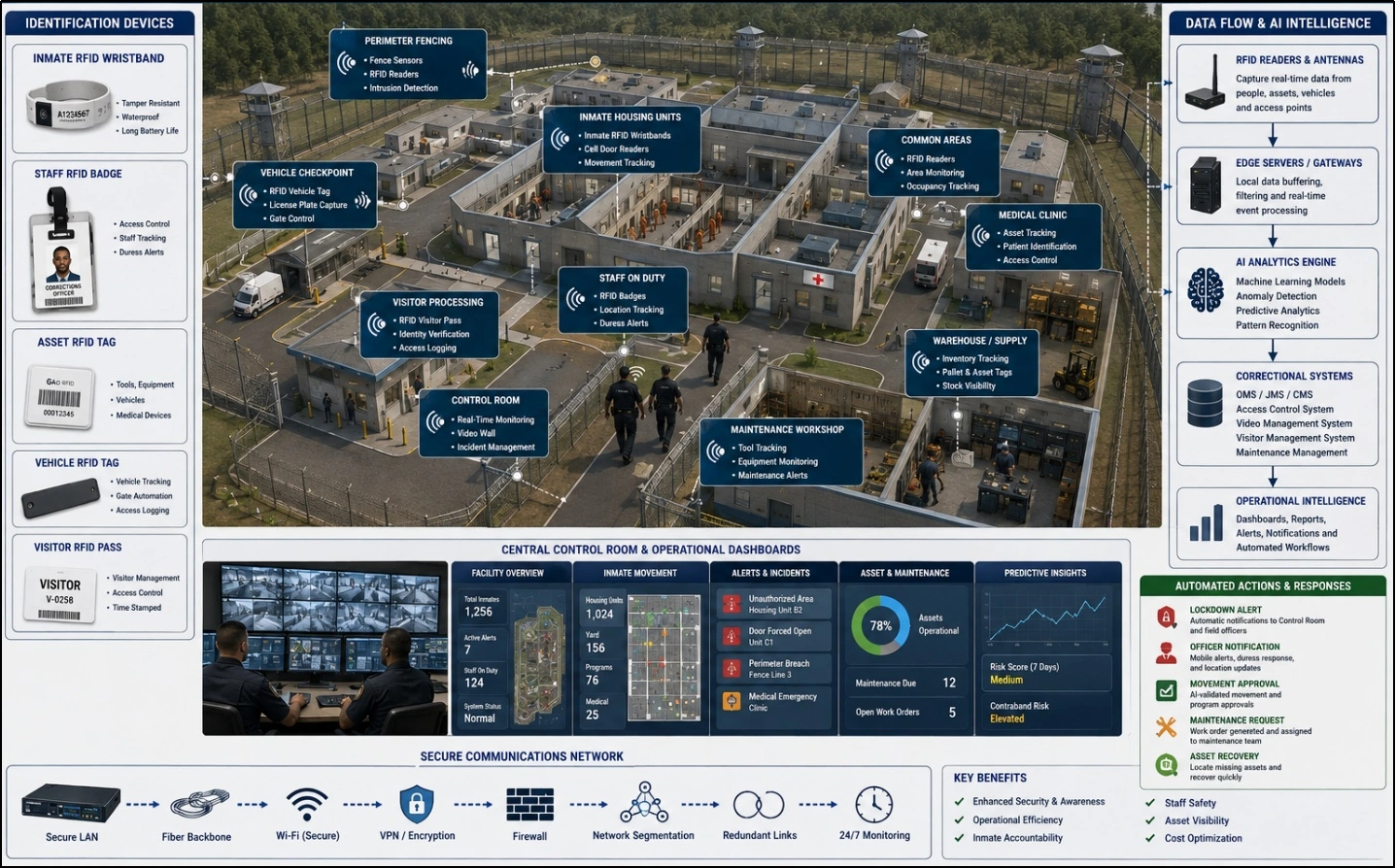
This deployment diagram illustrates how AI-enabled RFID technologies are integrated throughout a modern correctional facility, connecting inmate identification, staff tracking, asset management, visitor processing, vehicle checkpoints, medical services, and facility security into a unified operational system. It demonstrates the end-to-end flow of RFID data through secure communications, edge computing, AI analytics, and correctional management software to deliver real-time security alerts, operational intelligence, predictive maintenance, and centralized decision support.
AI-Powered RFID for Corrections: Key Takeaways
AI-supported RFID solutions are reshaping correctional operations by combining automated identification with intelligent decision support. Through continuous analysis of inmate movement, staff activities, asset utilization, access control events, and operational workflows, correctional agencies can improve institutional safety, strengthen accountability, optimize resources, and enhance regulatory compliance.
Successful implementations depend on careful planning, secure communication infrastructure, well-designed software integration, robust cybersecurity controls, and AI models trained using correctional operational data. Organizations should evaluate deployment strategies based on facility security classifications, infrastructure constraints, and long-term operational objectives.
For more than three decades, GAO has supplied RFID, BLE, and IoT hardware products and systems to customers across the United States and Canada, including Fortune 500 organizations, leading research institutions, prestigious universities, and government agencies. Headquartered in New York City and Toronto, Canada, GAO is recognized among the world’s leading B2B and B2G RFID and BLE suppliers. Our engineering teams assist organizations in selecting reliable identification technologies, integrating them into secure correctional environments, and supporting long-term operational success through expert technical guidance and comprehensive product support.
Building the Future of Industrial AI and IoT with Aperture Venture Studio and GAO
For more than three decades, GAO Group of Companies has invested extensively in research and development of industrial RFID, BLE, and IoT technologies. As artificial intelligence has become increasingly valuable in correctional operations and other government applications, we have expanded our work in AI-enabled IoT solutions and established Aperture Venture Studio to accelerate the development and growth of advanced AI and IoT solutions addressing complex operational challenges across multiple industries. Aperture has brought together leading AI and IoT experts, experienced business executives, investors, and technology organizations. Through initiatives such as the Aperture Ventures Summit and TekSummit, we continue to foster strong technical communities dedicated to advancing AI and IoT innovation. We welcome advisors, employees, investors, and customers who share our commitment to shaping the future of intelligent connected technologies.