
AI and BLE for Clinical Trial Centers
AI-Enabled Clinical Trial Operations with BLE Connectivity
Artificial intelligence is helping clinical trial centers improve how they monitor research environments, manage trial assets, support participant workflows, and analyze operational data. BLE provides a practical connectivity layer for collecting location, proximity, environmental, and equipment-status information from connected devices. When BLE beacons, gateways, and sensors are combined with AI software, clinical trial centers can turn continuously collected operational data into actionable information for research coordinators, laboratory personnel, facilities teams, and trial managers.
For clinical trial centers, the value of AI-enabled monitoring extends beyond simply locating an item. AI can identify unusual movement patterns, detect environmental conditions that may require attention, predict equipment or workflow issues, and correlate operational events across multiple data sources. BLE sensors can provide the underlying observations, while gateways transmit those observations to edge servers or cloud software for processing and analysis. GAO supplies BLE, RFID, and IoT hardware products and systems that can support these connected clinical research applications.
AI and BLE System for Clinical Trial Centers: Asset Tracking, Environmental Monitoring, and AI Analytics
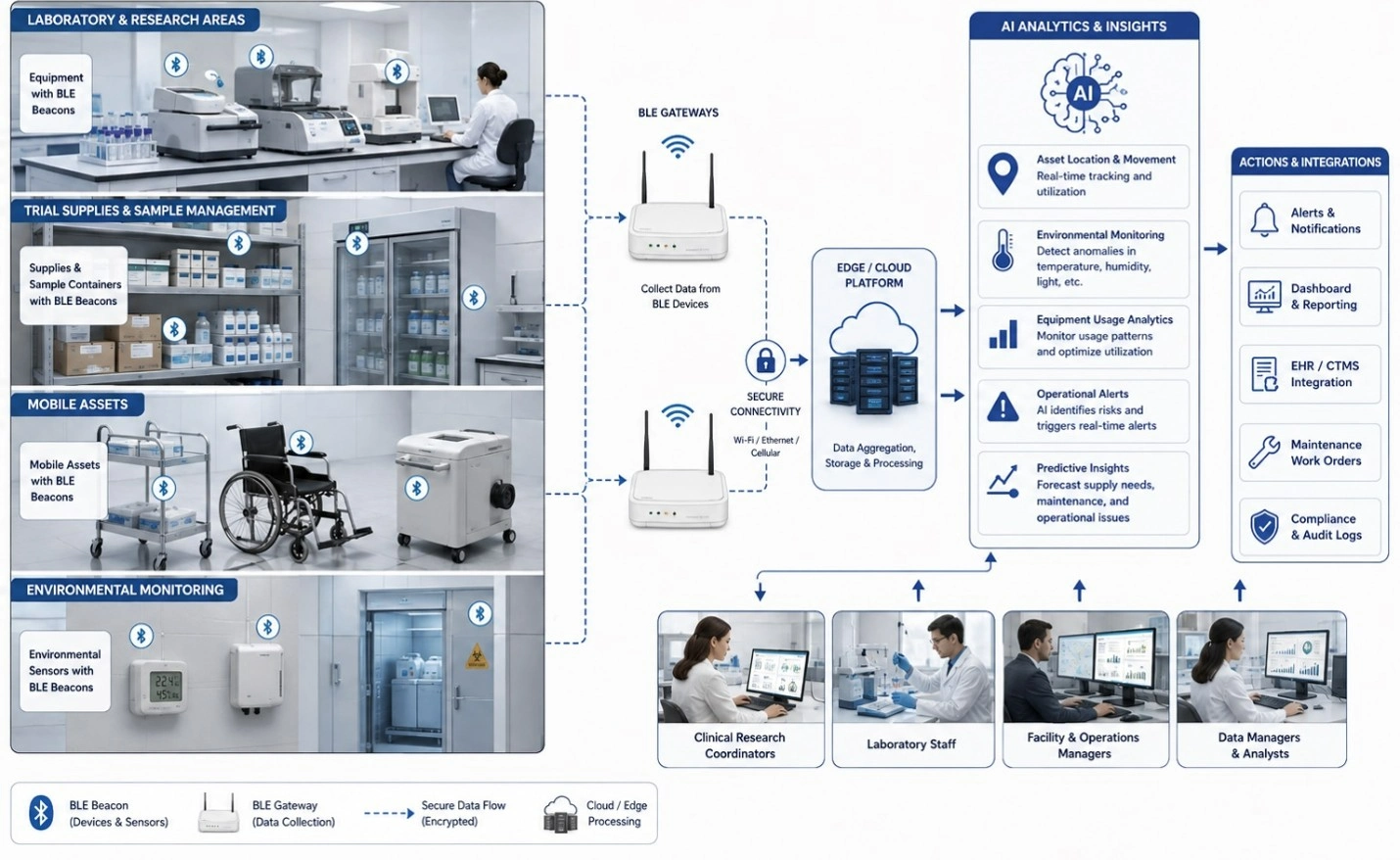
This visual illustrates how BLE-enabled laboratory equipment, trial supplies, mobile assets, and environmental sensors connect through BLE gateways to an edge/cloud platform. AI analytics process the collected data to provide asset tracking, environmental monitoring, equipment usage insights, predictive intelligence, operational alerts, dashboards, and compliance support for clinical trial teams.
What AI and BLE Enable in Clinical Trial Centers
Clinical trial centers operate across interconnected environments that may include participant areas, examination rooms, laboratories, pharmacies, specimen processing areas, equipment storage, controlled-temperature storage, and administrative workspaces. Research coordinators and laboratory personnel must often coordinate people, equipment, specimens, study materials, and time-sensitive activities while maintaining appropriate records.
AI and BLE can support these activities by creating a continuous source of operational data.
BLE beacons can be associated with equipment, containers, rooms, personnel badges, or other authorized assets. BLE sensors can capture measurements such as temperature or other environmental parameters depending on the selected hardware. BLE gateways receive nearby device transmissions and forward the information to software for processing.
AI software can then analyze this information to identify operational patterns. For example, a clinical trial center could use historical equipment-location data to understand utilization patterns or identify unusual movement. Environmental sensor data can be analyzed for abnormal conditions or recurring deviations. Asset movement data can also help research personnel determine whether a required device or study resource is available in the expected location.
The important engineering principle is that AI does not replace the sensing and communication layer. AI depends on reliable data acquisition. BLE devices provide observations, gateways provide connectivity, and software provides storage, processing, analytics, and integration. The resulting system can connect operational events to business actions.
GAO’s experience supplying BLE, RFID, and IoT hardware products and systems can support organizations evaluating this type of connected clinical research environment.
Clinical Trial Center Applications for AI-Driven Monitoring
AI Asset Tracking for Clinical Research Equipment
Clinical trial centers may manage centrifuges, analyzers, refrigerators, freezers, infusion-related equipment, examination equipment, mobile carts, sample-processing equipment, and other research assets. Equipment can move between rooms or departments, making manual tracking inefficient.
BLE tags and beacons can provide location or proximity information for selected assets. AI software can analyze historical movement and usage information to identify unusual movement, prolonged inactivity, or utilization patterns. This can help research operations teams improve equipment availability and reduce time spent searching for shared resources.
A practical deployment should distinguish between equipment that requires room-level visibility and assets that require more precise location information. BLE signal behavior can vary according to room construction, equipment density, interference, gateway placement, and the physical environment. Site surveys and gateway positioning therefore become important during commissioning.
AI Environmental Monitoring for Research and Storage Areas
Temperature-sensitive research materials, specimens, reagents, and other controlled resources may require continuous environmental monitoring. BLE-enabled sensors can collect measurements and transmit them through gateways to centralized software.
AI can evaluate historical measurements rather than treating every reading as an isolated event. The software may identify recurring temperature patterns, unusual changes, prolonged excursions, or conditions that differ from expected operating behavior.
This approach can support earlier intervention. Instead of relying exclusively on personnel to discover a problem during a periodic inspection, the system can generate alerts when sensor data indicates an abnormal condition.
Environmental monitoring should be engineered according to the actual requirements of the clinical trial process. Sensor accuracy, calibration, sampling intervals, gateway coverage, battery life, data retention, alert thresholds, and backup procedures should all be considered during system design.
AI Environmental Monitoring in Clinical Trial Centers Using BLE Sensors
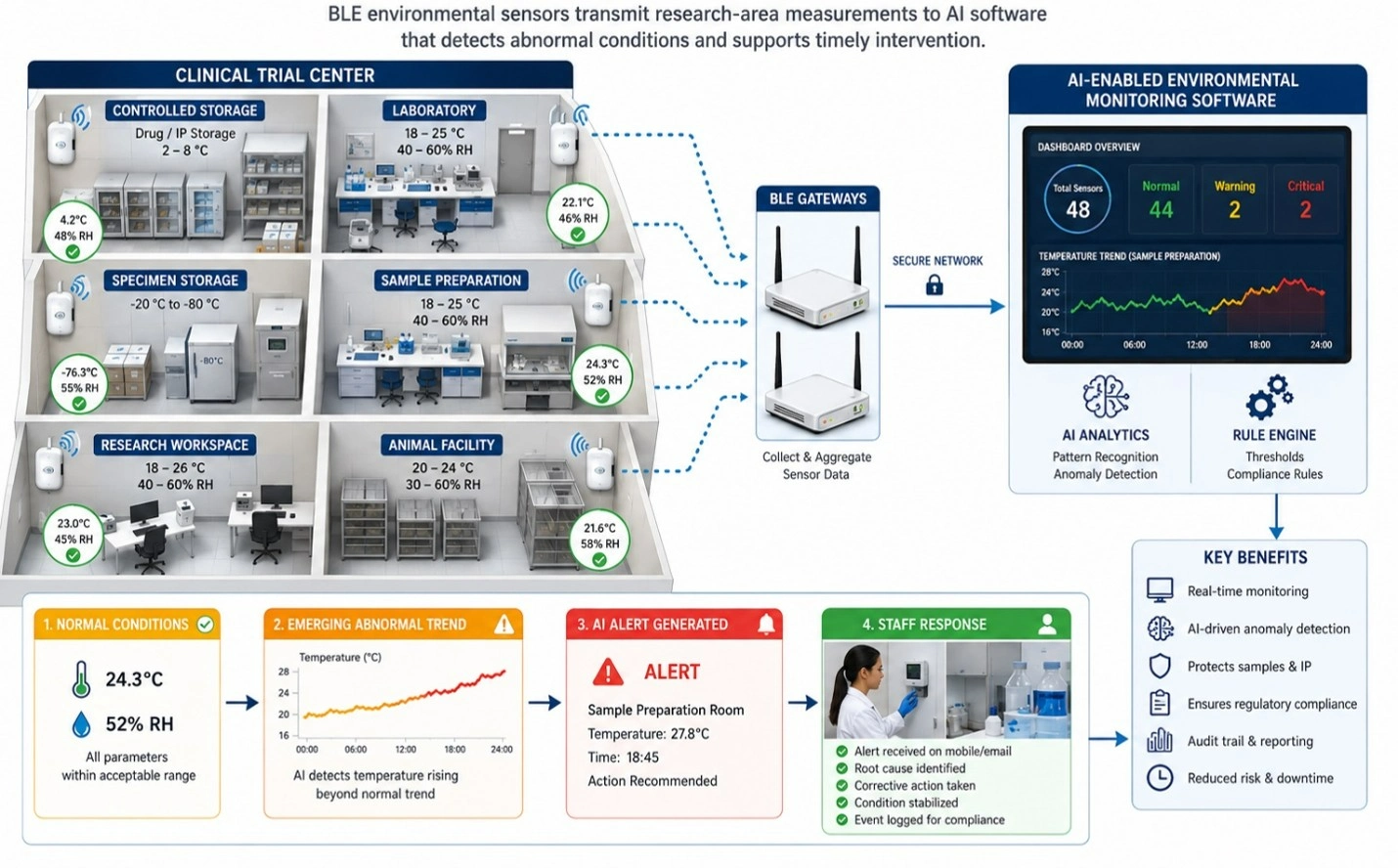
This visual illustrates how BLE environmental sensors monitor temperature and humidity across controlled storage, laboratories, specimen areas, and research workspaces. Sensor data is transmitted through BLE gateways to AI-enabled monitoring software, which detects emerging abnormal trends, generates alerts, and enables staff to take timely corrective action.
AI Support for Trial Supply and Study Material Management
Clinical trial centers can also apply connected monitoring to study supplies and research materials. BLE identification can provide visibility into the movement and location of selected containers, kits, or other trackable items.
AI can analyze historical movement records to identify unusual consumption rates, unexpected movement, or operational bottlenecks. When combined with inventory information, these insights can help teams plan replenishment and reduce unnecessary searching.
The exact use case depends on the material being tracked. High-value or highly controlled materials may require additional identification, access-control, or audit mechanisms. BLE can serve as one data source within a larger tracking system rather than functioning as the sole source of operational truth.
AI Equipment Utilization and Maintenance Insights
Equipment utilization is another area where connected data can provide operational value. A BLE-enabled system can collect information associated with equipment presence, movement, or usage events when the selected hardware and integration method support those observations.
AI models can analyze historical patterns to identify underused equipment, frequently moved assets, or changes in operating behavior. Maintenance teams can use these insights alongside equipment logs, service records, manufacturer information, and other available data.
Predictive maintenance should not be assumed simply because an asset is BLE-connected. Meaningful predictive models require appropriate historical data and relevant equipment-condition variables. Where those data are unavailable, AI may initially provide descriptive or anomaly-detection capabilities rather than reliable failure prediction.
From BLE Data Capture to AI-Driven Decisions
A clinical trial center AIoT solution typically begins with data acquisition. BLE beacons and sensors transmit device information over short-range wireless communication. BLE gateways positioned throughout the facility receive transmissions from nearby devices.
The gateway layer can aggregate observations and forward them to edge servers or cloud-based software. Depending on the deployment requirements, initial processing may occur near the source of the data. Edge processing can reduce unnecessary data transmission and support applications where rapid local response is important.
Middleware then connects device data with application software. The middleware may normalize device identifiers, timestamps, sensor measurements, gateway information, and location-related observations before sending the information to databases, analytics systems, or clinical operations software.
AI models can operate on this structured information to identify trends, anomalies, correlations, or predictions. The output should then be connected to an operational action. A detected environmental anomaly, for example, may result in an alert to authorized personnel. An unusual equipment movement pattern may trigger an investigation. A recurring utilization pattern may support equipment allocation decisions.
This data-to-action cycle is more valuable than simply collecting large volumes of sensor data. Clinical trial centers should define the operational decision before selecting the AI model and determine what data are required to support that decision.
Clinical Trial Center AI and BLE Data Workflow for Real-Time Monitoring
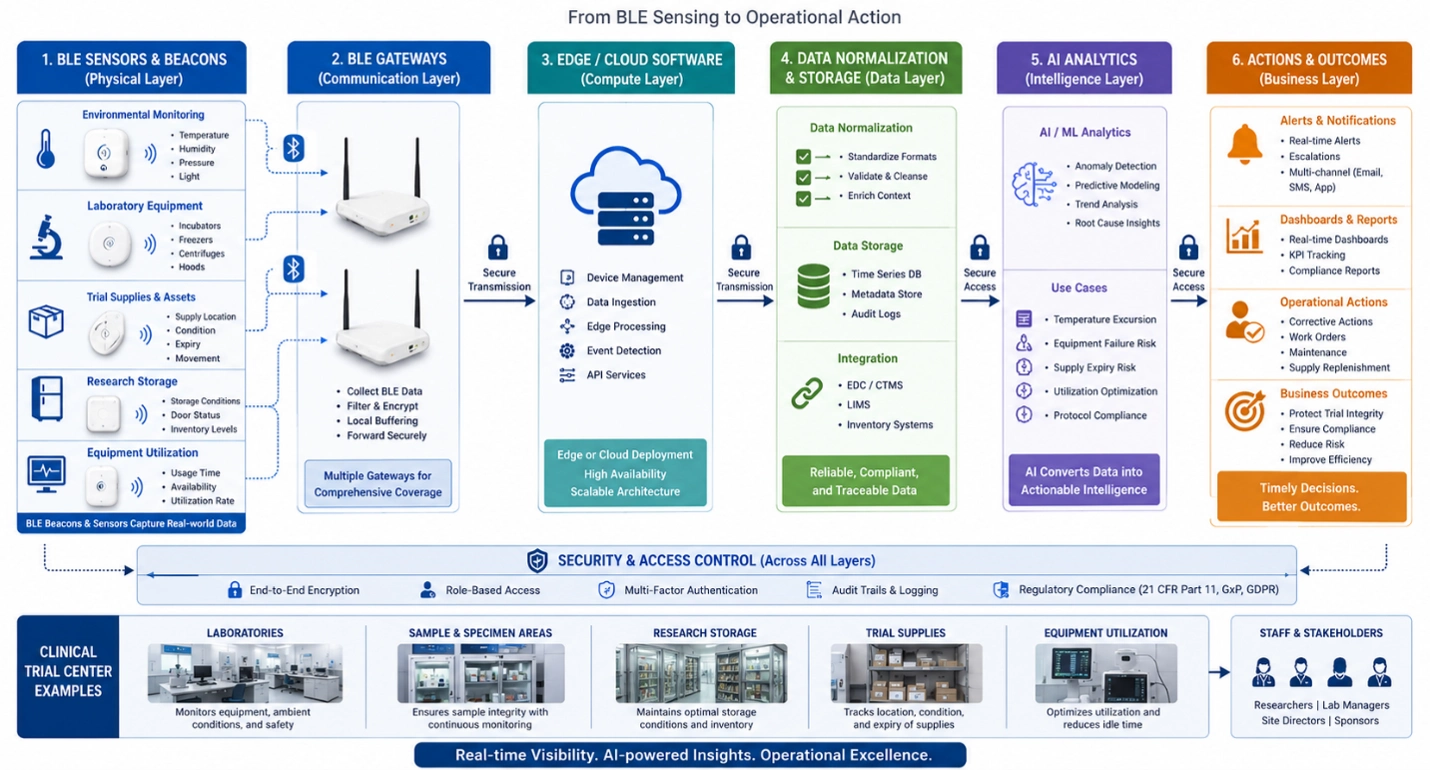
This visual illustrates the end-to-end data workflow from BLE sensors and gateways through edge/cloud processing, data storage, and AI analytics to operational actions. It demonstrates how clinical trial centers can securely transform real-time environmental, equipment, storage, and supply data into alerts, dashboards, compliance insights, and timely decisions.
BLE Hardware and Software for Clinical Research Environments
BLE-based clinical trial systems normally include several technical layers. Each layer should be selected according to the physical environment, data requirements, security controls, and intended application.
BLE Beacons and Sensors
BLE beacons can provide identifiers associated with assets, rooms, or other authorized objects. BLE sensors extend the system by collecting measurements that can be analyzed by software. Battery-powered devices can be useful where fixed wiring is impractical, although battery replacement and expected transmission intervals should be included in maintenance planning.
BLE Gateways
BLE gateways act as the communication bridge between local BLE devices and backend software. Gateway placement directly affects coverage and data reliability. Clinical facilities with dense walls, specialized equipment, shielded rooms, or large numbers of devices may require more detailed radio-frequency planning.
Gateways can forward information through available network infrastructure to a private server, edge computer, or cloud environment. Network segmentation and access controls should be considered when gateways connect to clinical facility networks.
AI and Analytics Software
The software layer can store device observations, associate identifiers with authorized assets, process sensor information, visualize operational status, and run AI models. Depending on the use case, AI techniques may include anomaly detection, time-series analysis, classification, forecasting, clustering, and predictive modeling.
The appropriate model depends on the available data and the decision being supported. A simple anomaly-detection model may be more useful than a complex predictive model when a clinical trial center has limited historical failure data.
Cloud Version and Server Version
A Cloud Version can host software within cloud infrastructure and provide centralized access to data and analytics. This model can be appropriate for organizations managing multiple clinical trial locations or requiring centralized operational visibility. Connectivity, data governance, identity management, and access policies should be evaluated before deployment.
A Server Version can be deployed on an edge server, customer-managed server, private data center, or other privately hosted enterprise infrastructure. This approach can be appropriate when clinical organizations require greater control over data location, network connectivity, software access, or internal IT policies.
The choice should be based on operational and governance requirements rather than assuming that one deployment model is universally better.
Cloud vs. On-Premises Server Deployment for Clinical Trial AI and BLE Systems
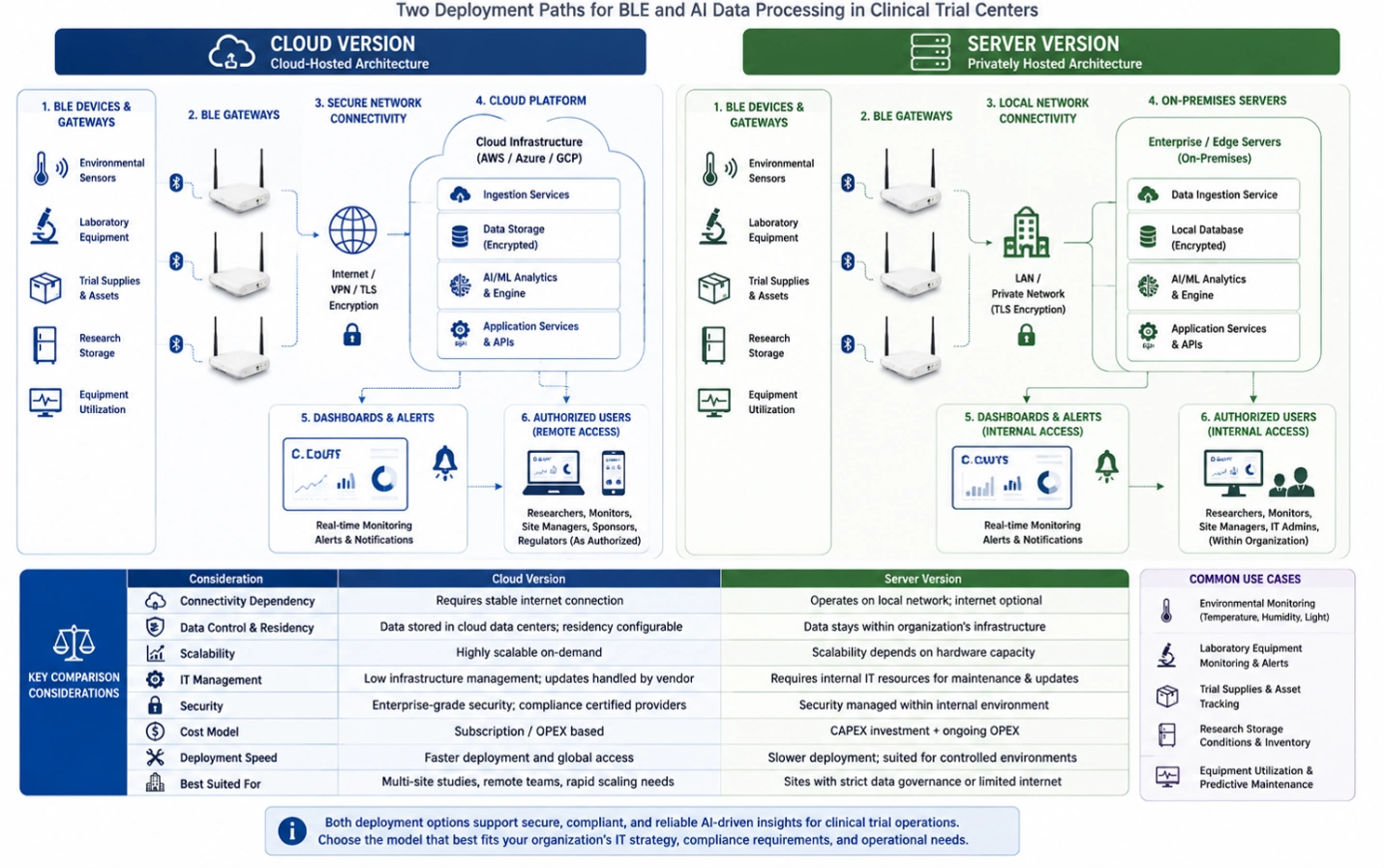
This visual compares cloud-hosted and privately hosted server architectures for BLE and AI monitoring in clinical trial centers. It highlights key trade-offs in connectivity, data control, scalability, IT management, security, cost, and deployment while showing how both approaches support secure monitoring, analytics, alerts, and operational decision-making.
Part 2: AI and BLE for Clinical Trial Centers
Technical Capabilities and Operational Improvements
Combining AI with connected clinical research systems can improve visibility across equipment, storage areas, laboratories, and trial-support workflows. The strongest results come when the system is designed around a defined operational problem rather than simply collecting additional sensor data.
Real-Time Asset Visibility
BLE-enabled tracking can provide room-level or zone-level visibility for selected clinical research assets. This can help coordinators and laboratory personnel determine whether equipment is available, identify where shared equipment was last observed, and reduce unnecessary searches.
AI adds value by analyzing historical location and utilization information. Repeated movement between specific rooms, unusually long periods of inactivity, or unexpected movement outside normal workflows can become signals for investigation.
Clinical research environments can also combine BLE information with existing asset management or facility systems. This allows location observations to become part of a broader equipment record rather than remaining isolated tracking data.
Environmental Anomaly Detection
Environmental monitoring is particularly relevant to clinical trial centers because storage and laboratory conditions can affect research materials and operational continuity. BLE-enabled temperature and environmental sensors can provide frequent measurements that are analyzed over time.
AI-based anomaly detection can identify changes in the shape or duration of a temperature trend, not only whether a single measurement crossed a fixed threshold. This can support earlier investigation of refrigeration problems, HVAC irregularities, sensor failures, or other abnormal conditions.
Any alerting system should still be validated against the applicable study, facility, equipment, and quality requirements. AI-generated alerts should support qualified personnel rather than automatically replacing established investigation procedures.
Improved Equipment Utilization
Clinical trial centers may have expensive equipment that is shared among studies or departments. Utilization data can reveal which assets are heavily used, rarely used, repeatedly relocated, or concentrated in particular areas.
These insights can support decisions about equipment allocation, scheduling, maintenance planning, and future procurement. A center can potentially reduce unnecessary duplicate purchases when reliable utilization information shows that existing equipment has sufficient capacity.
Workflow Visibility
Research workflows often involve multiple handoffs between coordinators, laboratory personnel, pharmacists, couriers, facilities staff, and other authorized personnel. Connected asset and environmental data can provide additional context about where an operational event occurred and when it occurred.
AI can correlate these observations with timestamps and workflow records to identify recurring delays or unusual process patterns. This can help teams investigate bottlenecks without relying exclusively on manual observations.
Clinical research organizations and facilities increasingly operate under formal research governance requirements. For example, the Abu Dhabi Department of Health maintains processes for authorization of human-subject research and identifies clinical trials among research activities requiring appropriate review. (Department of Health)
Integration with Clinical Research Software
BLE data should not operate as an isolated information stream. A useful clinical trial solution should be capable of exchanging relevant information with the software already used by the organization.
Potential integration targets include:
- Laboratory Information Management Systems (LIMS)
- Electronic Data Capture (EDC) systems
- Clinical Trial Management Systems (CTMS)
- Electronic Quality Management Systems (eQMS)
- Computerized Maintenance Management Systems (CMMS)
- Facility Management Systems
- Inventory and warehouse management software
- Environmental monitoring software
- Identity and access management systems
- Business intelligence and reporting software
- Notification and incident-management systems
Application programming interfaces (APIs), webhooks, message brokers, database interfaces, or other integration mechanisms can connect BLE-derived events with these systems.
The integration design should establish a clear source of truth for each type of information. For example, BLE may provide an observed asset location, while the organization’s asset management system remains authoritative for asset ownership, service status, and maintenance history.
This separation reduces duplicate records and makes system behavior easier to audit.
AI and BLE Integration with Clinical Research Software Systems
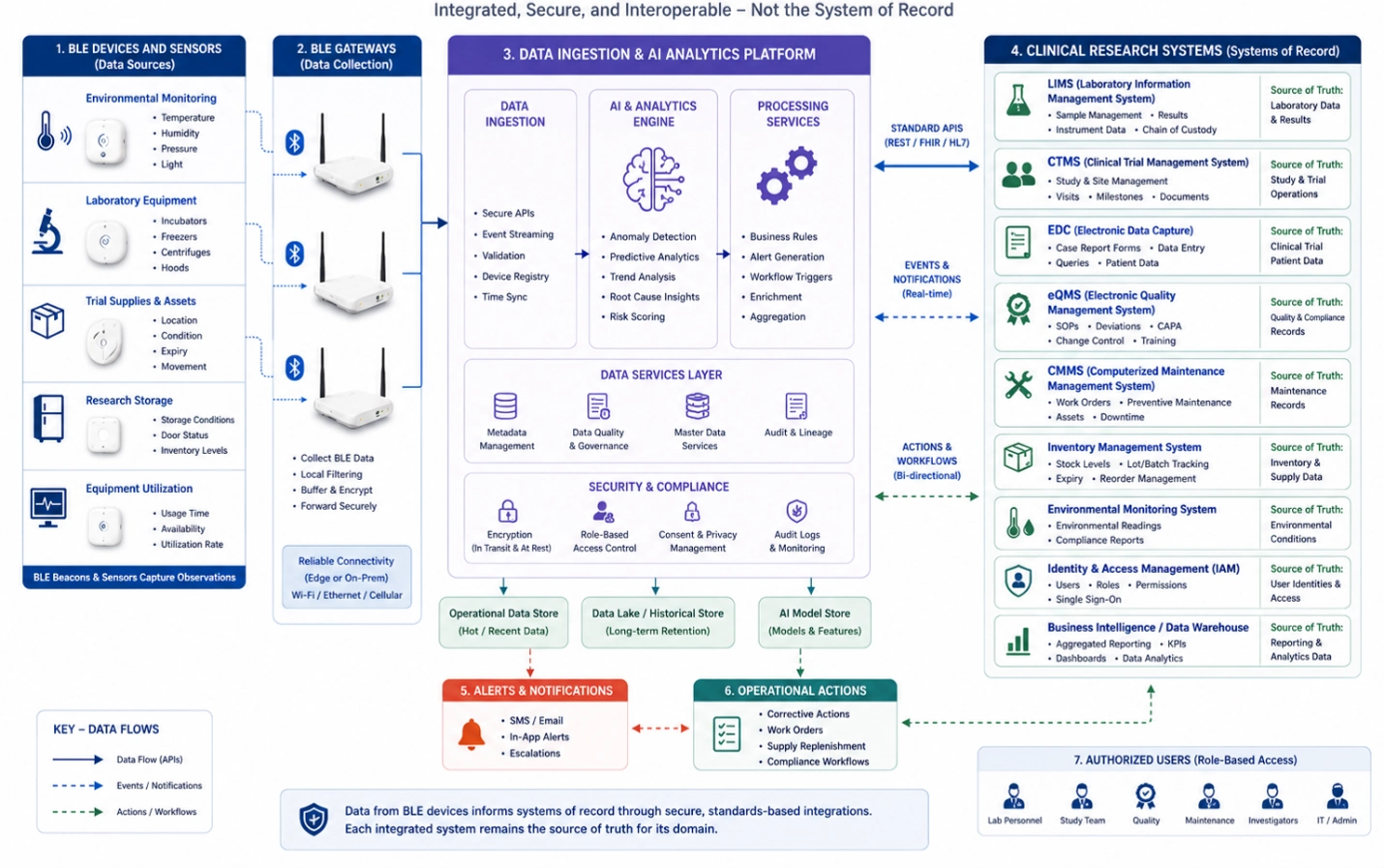
This visual illustrates how BLE sensor data and AI analytics integrate securely with clinical research platforms such as LIMS, CTMS, EDC, eQMS, CMMS, inventory, environmental monitoring, and business intelligence systems. It highlights API and event-based data flows while ensuring each integrated platform remains the authoritative source of truth for its respective domain.
Security, Privacy, and Data Governance
Clinical trial centers require careful separation between operational telemetry and sensitive research information. A BLE asset identifier does not inherently contain clinical information, but the associated database could potentially connect that identifier with people, studies, locations, or other sensitive records.
Security controls should therefore be applied across the complete data path.
Key engineering considerations include:
- Device identity and authentication
- Secure gateway configuration
- Network segmentation
- Encryption for data in transit
- Encryption for stored data where appropriate
- Role-based access control
- Least-privilege permissions
- Centralized identity management
- Audit logging
- Secure API authentication
- Software and firmware update procedures
- Device lifecycle management
- Battery and hardware replacement procedures
- Data retention and deletion policies
- Backup and recovery procedures
- Incident response processes
Personnel tracking requires additional care because location information can become sensitive when associated with identifiable individuals. A clinical trial center should define the legitimate operational purpose, access rights, retention period, and governance process before deploying personnel-location capabilities.
The same principle applies to participant-related applications. BLE technology can technically support proximity or location functions, but any deployment involving identifiable research participants should be evaluated against the applicable ethical, privacy, security, and study-specific requirements. The technology should not be treated as automatically appropriate simply because it is technically feasible.
Deployment Engineering for Clinical Trial Centers
A successful deployment normally begins with a site assessment rather than immediate hardware installation.
The assessment should consider:
- Facility floor plans
- Laboratory room layouts
- Controlled storage areas
- Equipment locations
- Wall and partition materials
- Gateway mounting positions
- Wireless interference
- Network availability
- Power availability
- Required tracking granularity
- Environmental sensor placement
- Battery replacement access
- IT security requirements
- Data retention requirements
- Existing software interfaces
BLE radio performance can vary substantially between an open office and a laboratory containing dense equipment, metal structures, refrigeration equipment, specialized shielding, or multiple partitions. A design that works well in one room may not provide identical performance elsewhere.
A pilot deployment is therefore useful before full-scale installation. The pilot should test actual hardware in representative rooms and measure coverage, message reception, location accuracy, latency, battery expectations, network reliability, and alert behavior.
Commissioning and Validation
Commissioning should confirm that every installed device is correctly identified and associated with the intended asset or location.
Testing can include:
- BLE beacon and sensor registration
- Gateway connectivity
- Device-to-gateway communication
- Data transmission
- Timestamp accuracy
- Sensor measurement validation
- Location-zone assignment
- Alert generation
- API communication
- User permissions
- Audit logging
- Data backup
- Failure and recovery scenarios
Environmental sensors may require calibration and documented verification according to the organization’s quality procedures and the intended application.
AI models also require validation. A model should be evaluated against representative historical or test data before its output is used for operational decision-making. Performance should be monitored after deployment because environmental conditions, equipment behavior, study workflows, and data distributions can change.
AI Model Selection and Operational Trade-Offs
Not every clinical trial application requires a sophisticated AI model.
For asset tracking, descriptive analytics may initially be sufficient to show utilization, movement, and availability. Anomaly detection becomes useful when the organization wants to identify behavior that differs from an established baseline.
Time-series models can support analysis of environmental measurements and recurring patterns. Classification models may help categorize operational events when suitable labeled data are available. Forecasting models can support resource planning when sufficient historical observations exist.
The engineering trade-off is between model complexity, data availability, explainability, maintenance requirements, and operational value.
A highly complex model trained on limited clinical facility data may perform worse than a simpler model with clearly defined inputs and validated thresholds. Clinical trial centers should therefore prioritize data quality and operational relevance before model sophistication.
Key KPIs for AI-Enabled Clinical Trial Operations
Performance measurement should connect technical system behavior to measurable operational outcomes.
Useful KPIs may include:
- Asset search time
- Asset location accuracy
- Asset availability rate
- Equipment utilization rate
- Unplanned equipment downtime
- Environmental excursion frequency
- Environmental excursion response time
- Mean time to acknowledge alerts
- Mean time to resolve alerts
- Sensor data completeness
- Gateway communication availability
- BLE device battery life
- Data ingestion latency
- AI anomaly detection precision
- AI false-alert rate
- Maintenance response time
- Inventory discrepancy rate
- Workflow cycle time
- Number of manual tracking activities
- System integration success rate
The exact KPI set should be selected according to the clinical trial center’s operational objectives. A system designed primarily for environmental monitoring should not be evaluated using the same metrics as a system designed primarily for equipment utilization.
Clinical Trial Center AI and BLE KPI Dashboard for Real-Time Operations Monitoring
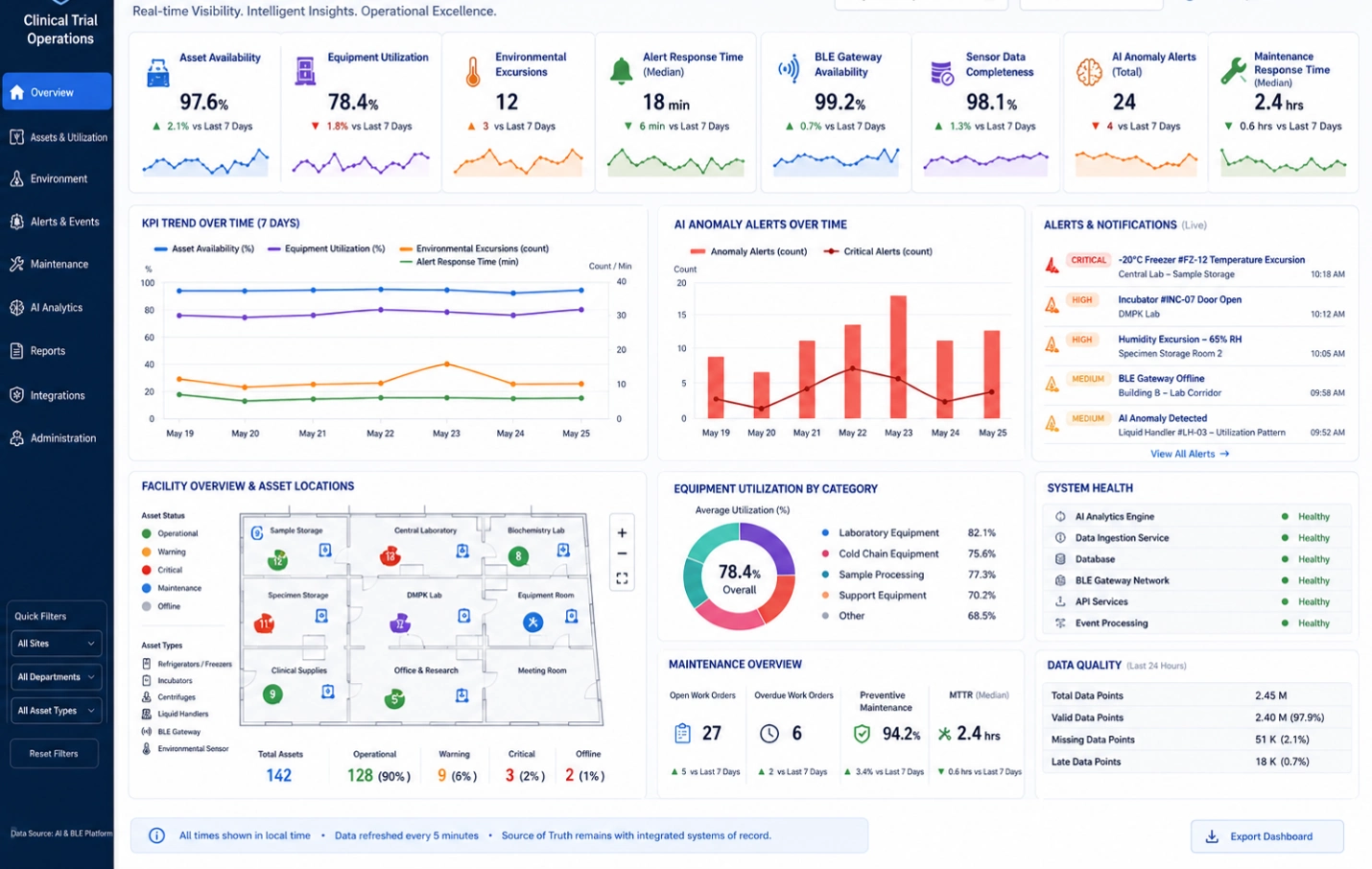
This dashboard combines AI, BLE system health, and clinical research operational KPIs in a single monitoring interface. It tracks asset availability, equipment utilization, environmental excursions, alert response times, sensor data quality, AI anomaly alerts, maintenance performance, and facility asset locations to support faster operational decisions.
Scaling from a Pilot to Multiple Clinical Trial Sites
A pilot should establish technical feasibility and measurable operational value before expansion. Once the initial deployment is stable, additional rooms, asset categories, sensors, or clinical trial locations can be added using standardized deployment procedures.
Multi-site deployments introduce additional requirements. Device naming conventions, asset identifiers, gateway configuration, user permissions, data models, APIs, and reporting structures should remain consistent enough to support centralized management while allowing for site-specific requirements.
Organizations conducting research across multiple locations may benefit from centralized analytics because data from separate facilities can be compared using common KPIs. However, centralized processing should not eliminate appropriate local controls for network availability, data governance, and site-level operational response.
The Department of Health Abu Dhabi’s current research infrastructure includes a centralized research registry and oversight processes for approved studies, demonstrating the importance of structured governance and research accountability within the local clinical research environment.
GAO can support organizations evaluating BLE, RFID, and IoT hardware requirements for single-site or multi-site deployments, including system-level considerations around device selection, connectivity, integration, and technical support.
Practical Implementation Recommendations
Clinical trial centers considering AI-enabled BLE solutions should begin with a clearly defined operational requirement.
Recommended engineering practices include:
- Start with one measurable workflow problem rather than attempting to connect every asset simultaneously.
- Identify the required location accuracy before selecting the BLE deployment design.
- Conduct an RF and physical site survey before installing gateways.
- Select sensor sampling intervals according to the actual monitoring requirement and battery constraints.
- Separate device identifiers from sensitive research information wherever practical.
- Define data ownership and source-of-truth responsibilities before integration.
- Test APIs and downstream software integrations during the pilot rather than after deployment.
- Establish cybersecurity and access-control requirements before connecting gateways to production networks.
- Validate environmental sensors and document calibration requirements.
- Establish alert escalation procedures so that AI-generated notifications lead to defined operational actions.
- Measure false alerts as well as successful detections.
- Keep human review in the decision loop where an automated action could affect research quality, safety, compliance, or controlled materials.
- Establish firmware, battery, gateway, and software maintenance procedures before scaling.
- Review AI model performance periodically and retrain or recalibrate models when operating conditions change.
These practices help prevent a common implementation problem: deploying connected hardware successfully but failing to convert the resulting data into reliable operational decisions.
Why GAO for Clinical Trial Center IoT Solutions
GAO provides BLE, RFID, and IoT hardware products and systems for organizations that require connected sensing, identification, monitoring, and tracking capabilities. Its work spans applications where physical assets and operational processes need to be connected with software-based monitoring and analytics.
Headquartered in New York City and Toronto, Canada, GAO serves B2B and B2G customers and has supplied technology to organizations including Fortune 500 companies, research and development firms, universities, and government agencies. GAO’s product and system development is supported by R&D investment, quality assurance processes, and technical support capabilities.
For clinical trial centers, this experience is relevant when selecting BLE beacons, BLE gateways, BLE sensors, RFID products, and related IoT hardware for laboratory, asset-management, environmental-monitoring, and research operations.
Organizations can evaluate the required sensing points, tracking objectives, communication requirements, software interfaces, deployment model, and cybersecurity controls before selecting the appropriate hardware and system configuration.
Building the Future of Industrial AI and IoT with Aperture Venture Studio and GAO RFID Inc.
For more than three decades, GAO Group of Companies has invested heavily in R&D covering industrial BLE, RFID, and IoT. As generative AI became increasingly useful for industrial and research applications, we expanded our work on AI and IoT solutions, including connected technologies that can support clinical trial centers, laboratories, and biotechnology research operations. We founded Aperture Venture Studio to help advance practical AI and IoT solutions relevant to areas such as connected research environments and intelligent operational systems.
Aperture has attracted AI and IoT technical experts, entrepreneurial and operational executives, investors, and leading companies. We have also developed Aperture Ventures Summit and TekSummit to discuss advanced AI and IoT topics.
We welcome you to join us as:
- Advisors, Co-founders, or Employees
- Investors
- Customers
Moving from Connected Data to Smarter Clinical Research Operations
AI-enabled clinical trial operations depend on more than installing BLE devices. The strongest solutions connect reliable sensing with appropriate gateways, secure data handling, validated analytics, software integration, and clearly defined operational actions.
Clinical trial centers can begin with focused applications such as equipment visibility, environmental monitoring, asset utilization, or workflow analysis and expand after demonstrating measurable value. BLE can provide an efficient connectivity layer for these applications, while AI can turn accumulated operational data into anomaly detection, forecasting, and decision-support capabilities.
GAO can help organizations evaluate BLE, RFID, and IoT hardware and system requirements for connected research environments. To explore suitable technologies, deployment approaches, and technical support for your clinical trial center, contact GAO and discuss your operational requirements with our technical team.