
AI-Powered Cash-in-Transit Services with BLE Tracking and IoT
AI and BLE for Cash-in-Transit Services: Operational Overview
AI-powered cash-in-transit services use artificial intelligence, connected sensors, and real-time operational data to improve the security, visibility, and control of cash collection, processing, transportation, and delivery. BLE gateways, BLE beacons, and BLE sensors provide localized identification and condition data that AI software can correlate with vehicle movements, personnel assignments, route schedules, access events, cash containers, and exception records. For cash-in-transit companies, this combination can help identify unauthorized movement, delayed transfers, route deviations, missing equipment, abnormal handling, and other operational exceptions earlier. AIoT combines artificial intelligence with IoT devices, sensors, connected equipment, and industrial systems, with Industrial AI, Edge AI, machine learning, computer vision, and Physical AI applicable according to the operational requirement. GAO supplies BLE, RFID, and IoT hardware products and systems that can support these data-driven cash logistics workflows.
Why AI Matters in Modern Cash-in-Transit Operations
Cash-in-transit operations involve controlled movement of high-value physical assets through multiple custody points. A typical process can include cash collection from banks, retailers, ATMs, branches, casinos, financial institutions, or commercial customers, followed by secure vehicle transportation, cash-center processing, reconciliation, vault storage, ATM replenishment, and return collection.
Traditional security controls remain important, but physical security alone does not provide complete operational visibility. AI adds analytical capabilities by correlating data from multiple sources and identifying relationships that may not be obvious from individual alarms or manual records.
Relevant AI capabilities include:
- Anomaly detection for unusual movement, timing, access, or custody events.
- Predictive analytics for identifying operational conditions associated with delays, equipment failures, or recurring route exceptions.
- Computer vision for controlled facility entrances, loading zones, vehicle areas, vault approaches, and other monitored locations.
- Machine learning for analyzing historical route, collection, delivery, and incident data.
- Risk scoring for prioritizing operational exceptions that require investigation.
- Edge AI for processing selected events close to the point of data capture where low latency or limited connectivity is important.
- AI-assisted operational reporting that correlates vehicle, personnel, container, access, and location information.
- Physical AI applications where autonomous or semi-autonomous systems interact with physical equipment and controlled environments.
BLE acts as an enabling identification and sensing technology within these workflows rather than being the AI itself. A BLE beacon attached to a cash container, equipment case, key asset, or authorized item can provide a wireless identity that nearby BLE gateways detect. BLE sensors can additionally report selected environmental or physical conditions. AI software can then combine those observations with information from other systems to determine whether an event is expected, suspicious, delayed, or operationally significant.
AIoT Cash-in-Transit Workflow: BLE & RFID Tracking, AI Analytics & Secure Custody Intelligence
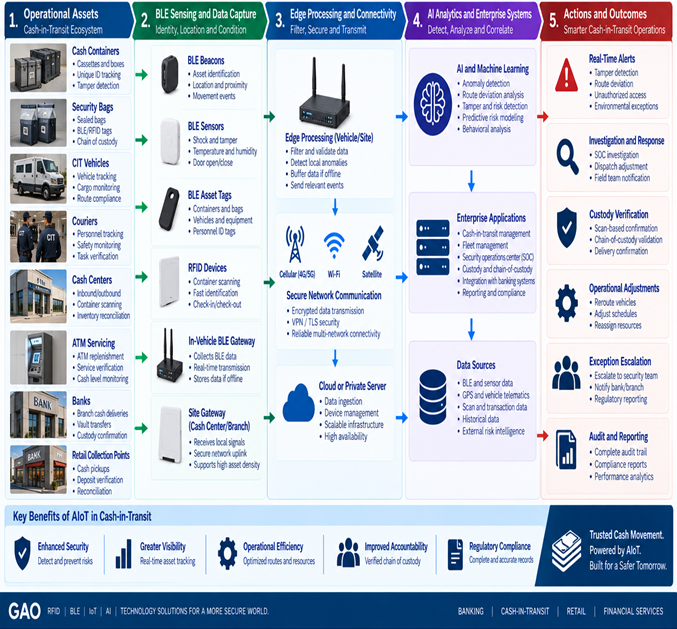
This workflow illustrates how data from cash containers, security bags, CIT vehicles, couriers, cash centers, ATM servicing, banks, and retail collection points is captured through BLE and RFID technologies. Edge processing and secure communications feed enterprise systems and AI analytics that detect anomalies and support real-time alerts, investigations, custody verification, operational adjustments, exception escalation, and audit reporting.
Cash-in-Transit Applications for AI-Driven Operational Control
AI Cash Collection and Pickup Verification
Cash collection frequently involves scheduled pickups from distributed locations. AI can compare planned collection schedules with actual arrival, personnel, vehicle, container, and handoff events. BLE identification can provide additional evidence that the expected cash container, equipment case, or assigned operational asset is present at the appropriate location.
A BLE beacon associated with a container can be detected by a gateway installed at a cash center, secure loading area, or vehicle. The resulting event can be correlated with route management, dispatch records, access-control events, and custody documentation.
This can help operations teams identify:
- A scheduled pickup where the expected container is not detected.
- A container detected at an unexpected facility.
- An unusual dwell time during a collection cycle.
- A mismatch between assigned personnel, vehicle, and operational equipment.
- Repeated deviations from normal collection timing.
AI does not replace formal custody procedures. Instead, it provides additional evidence that can support reconciliation and exception investigation.
Secure Cash-in-Transit Vehicle Monitoring
CIT vehicles operate as controlled mobile environments where route timing, crew assignments, equipment status, and cargo custody must be coordinated. AI can analyze vehicle-related operational data to identify deviations from expected behavior.
BLE gateways installed inside a vehicle can detect tagged containers, equipment, security cases, or other authorized assets. BLE sensors can monitor selected conditions when environmental or physical measurements are required. Vehicle telematics, GNSS, electronic access systems, and dispatch software can supply complementary information.
A useful implementation correlates:
- Vehicle identification.
- Crew assignment.
- Scheduled route and stop sequence.
- Cash container identity.
- BLE detection events.
- Vehicle location and travel history.
- Door or compartment access events.
- Planned versus actual dwell time.
- Incident and exception records.
The objective is not simply to locate an asset. The greater value comes from determining whether the asset is being handled within the expected operational context.
AI Cash Container and Security Equipment Tracking
Cash-in-transit companies manage many physical assets beyond cash itself. These may include secure containers, cash bags, deposit bags, tamper-evident equipment, hand carts, scanners, keys, communication equipment, protective equipment, and specialized handling devices.
BLE identification can provide an additional digital identity for selected reusable assets. AI software can analyze movement histories and identify unusual patterns such as assets remaining at the wrong facility, missing equipment before dispatch, or repeated unexplained transfers.
For high-value or security-sensitive assets, BLE can also complement RFID, barcode identification, access control, video surveillance, and electronic seal technologies rather than replacing them.
AI-Assisted Cash Center and Vault Operations
Cash centers require strict control of receiving, counting, sorting, reconciliation, storage, dispatch, and transfer activities. AI can analyze process events to identify bottlenecks and exceptions while BLE provides localized visibility for tagged equipment and containers.
BLE gateways positioned at controlled operational zones can establish detection points around receiving areas, processing rooms, secure staging locations, vault approaches, and dispatch zones. AI software can compare observed movement with authorized workflows.
For example, if a container is expected to move from receiving to processing and then to a designated secure staging area, an unexpected detection sequence can become an exception for review. This approach creates an operational event trail without requiring every physical movement to be manually recorded.
AIoT-Enabled Cash Center: BLE Tracking, Secure Workflow & Real-Time Anomaly Detection
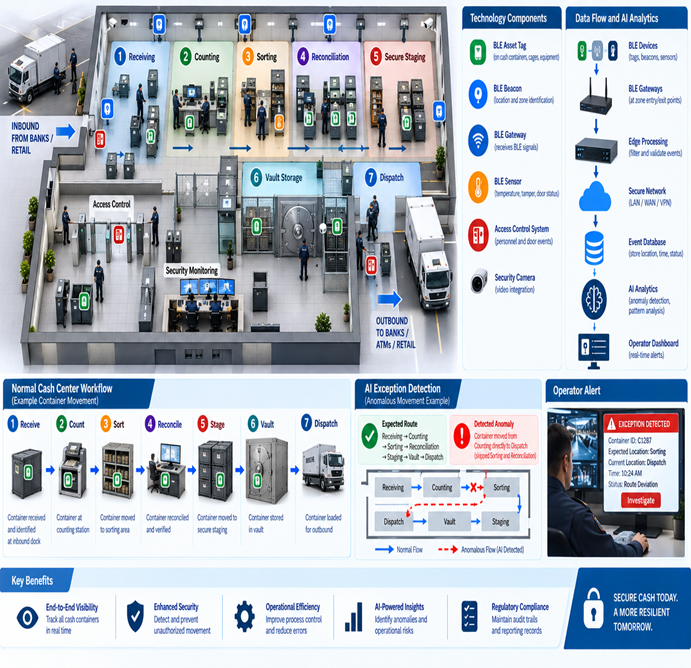
This visual maps BLE-enabled cash containers and equipment through receiving, counting, sorting, reconciliation, secure staging, vault storage, and dispatch zones. BLE gateways, sensors, access control, edge processing, and AI analytics provide continuous event visibility while distinguishing normal movements from anomalous sequences that trigger real-time operator alerts.
AI for ATM Cash Replenishment and Servicing
ATM replenishment introduces another controlled custody workflow. Cash must move from a secure facility to a designated ATM location and be handled by authorized personnel according to predefined procedures.
AI can correlate scheduled ATM servicing with vehicle, crew, container, and location events. BLE can provide proximity-based confirmation that the expected container or equipment is present near the relevant gateway.
Operational analytics can help identify:
- Delayed ATM replenishment.
- Unexpected equipment movement.
- Missing servicing equipment.
- Repeated deviations from planned servicing sequences.
- Unusual dwell times at servicing locations.
- Exceptions between dispatch records and physical detection events.
These insights can support route planning, operational investigation, and service-level management.
Cash-in-Transit Operational Workflow from Data Capture to Action
A technically effective AIoT solution should connect physical cash-handling activities with trustworthy digital events. The workflow begins with data acquisition and continues through communications, event processing, analytics, integration, and operational action.
Data Acquisition at Cash Handling Points
Data sources can include BLE beacons, BLE sensors, BLE gateways, RFID readers and tags, barcode scanners, vehicle telematics, GNSS devices, access-control systems, video surveillance, electronic seals, mobile applications, and cash management software.
BLE identifiers should be associated with controlled asset records rather than treated as anonymous radio signals. Asset IDs, device IDs, gateway IDs, timestamps, location zones, and assignment information should be maintained consistently.
BLE Detection and Local Processing
BLE gateways receive advertising packets or sensor information from nearby BLE devices. Gateway placement is important because vehicle compartments, metal containers, walls, reinforced structures, and other physical conditions can influence radio performance.
For CIT deployment, engineering teams should evaluate:
- Detection coverage inside vehicles.
- Gateway placement around loading and receiving areas.
- Radio interference and congestion.
- Battery life of BLE devices.
- Required detection frequency.
- Gateway connectivity availability.
- Physical protection of installed equipment.
- False-positive and false-negative detection rates.
BLE should generally be treated as proximity and telemetry evidence rather than automatically interpreted as precise positioning. Where precise positioning is required, BLE may be combined with GNSS, Wi-Fi, UWB, inertial data, or other location technologies according to the operational requirement.
Secure Communications and Event Transport
Gateway data can be transferred through cellular networks, Wi-Fi, Ethernet, private networks, or other approved communications infrastructure. Message transport should use authenticated connections and encryption appropriate to the organization’s security policy.
A CIT system should also account for intermittent connectivity. Gateways may require local buffering so that important detection events are retained when cellular or network connectivity temporarily fails.
Event records should normally include information such as:
- Device or asset identifier.
- Gateway identifier.
- Detection timestamp.
- Zone or location identifier.
- Signal information where applicable.
- Sensor measurements where applicable.
- Vehicle or facility assignment.
- Event classification.
- Communication status.
- Relevant security or access event references.
Edge Processing and AI Analytics
Edge processing can reduce unnecessary data transmission by filtering duplicate detections, validating device messages, applying local rules, and identifying selected events before transmission to central software.
Central AI processing can combine BLE events with historical operational records, route information, access logs, vehicle data, incident records, and other authorized data sources. Machine-learning models can then establish normal operating patterns and flag significant deviations.
Human review remains important for security-related decisions. An AI-generated anomaly should normally be treated as an investigative signal rather than unquestioned proof of an incident.
Enterprise Software Integration
Cash-in-transit AI solutions become more useful when operational events can be associated with existing business records. Integration targets may include:
- Cash management systems.
- Fleet management software.
- Route planning and dispatch systems.
- Workforce management systems.
- Access-control software.
- Video management systems.
- Warehouse or cash-center management software.
- Asset management systems.
- Incident management software.
- Business intelligence and reporting systems.
- ERP and financial reconciliation systems.
APIs, secure message interfaces, database integration, and event-driven middleware can be selected according to the customer’s existing software environment.
AI-Driven Business Actions
The final stage is operational response. An AI-generated exception can trigger an alert, investigation task, workflow escalation, dispatch review, maintenance action, or management report.
The most useful implementations distinguish between routine events and actionable exceptions. Excessive alerts can create alarm fatigue, while overly aggressive filtering can hide important events. Thresholds and AI models should therefore be validated using historical CIT operating data and continuously reviewed after deployment.
BLE Hardware and Software Components for Cash-in-Transit Systems
Cash-in-transit deployments require hardware selection based on operating conditions rather than nominal wireless specifications alone. BLE beacons can provide identity for reusable containers and equipment, while BLE sensors can add measurements such as temperature, motion, vibration, or other supported parameters when those measurements have a defined operational purpose.
BLE gateways act as collection points between local wireless devices and the wider software environment. Gateway selection should consider vehicle installation constraints, cellular or Ethernet connectivity, power availability, enclosure requirements, device management, local storage, and security controls.
Software should provide device registration, asset association, event ingestion, rules, monitoring, reporting, API integration, and administrative controls. AI functions can operate as analytical services within the same software environment or as connected applications consuming validated operational events.
Cloud Version for Distributed Cash-in-Transit Operations
A cloud-hosted SaaS deployment can be appropriate for cash-in-transit organizations operating multiple branches, cash centers, vehicle fleets, ATM service regions, or geographically distributed customer locations.
Cloud deployment can simplify centralized data aggregation and support common analytics across multiple operating locations. It can also facilitate controlled software updates and centralized device management.
Security design should address identity management, role-based access, encryption, API security, logging, tenant isolation where applicable, backup, retention, and incident response. Cloud deployment does not eliminate the need for local resilience because vehicles and secure facilities can experience intermittent connectivity.
Server Version for Controlled Financial Infrastructure
A Server Version can be deployed on customer-managed servers, private data centers, edge servers, or other privately hosted infrastructure. This model can be appropriate where organizational policies require tighter control over data location, network connectivity, system integration, or operational availability.
Private deployment can also be useful when cash-in-transit operations need integration with restricted internal systems that are not directly exposed to external services.
The engineering trade-off is greater responsibility for server capacity, operating-system maintenance, backups, patching, cybersecurity, monitoring, redundancy, and disaster recovery. A hybrid arrangement may also be considered when local processing is needed at facilities while selected analytics or consolidated reporting are hosted centrally.
Engineering Capabilities That Improve Cash-in-Transit Performance
Combining AI with BLE-based identification and sensing can strengthen cash-in-transit operations when the resulting data is connected to established security procedures and operational systems. The value comes from correlating physical events with planned activities, rather than from wireless identification alone.
Real-Time Asset and Custody Visibility
BLE detection can provide additional visibility into the movement of cash containers, security equipment, handling equipment, and other tagged assets. AI can correlate those events with route schedules, personnel assignments, vehicle records, facility zones, and custody transactions.
This supports a more complete operational picture across collection, transportation, cash-center processing, ATM replenishment, and dispatch activities. Operations teams can investigate exceptions using time-stamped event histories instead of relying exclusively on manual reports.
Anomaly Detection for Cash-in-Transit Operations
Normal CIT activity produces recognizable patterns. Vehicles follow defined routes, containers pass through expected custody points, and assigned equipment should appear in designated locations.
AI models can establish operational baselines and identify deviations such as:
- Unexpected container movement.
- Detection of an asset at an unauthorized facility.
- Unusual time spent at a collection or delivery location.
- Repeated deviations from standard operating sequences.
- Unexpected equipment separation from its assigned vehicle.
- Inconsistent combinations of vehicle, personnel, asset, and location events.
Detection thresholds should be tuned to actual operating conditions. A single unusual BLE detection should not automatically indicate theft, tampering, or employee misconduct. Physical verification, access records, video evidence, and established incident procedures remain important.
Predictive Maintenance for CIT Equipment
Cash-in-transit companies depend on vehicles, secure compartments, communication equipment, scanners, gateways, sensors, and other operational equipment. Equipment failures can disrupt routes and introduce security or service risks.
AI-based predictive maintenance can analyze historical maintenance records, equipment utilization, sensor readings, fault events, battery status, and operating conditions to identify equipment requiring attention.
BLE sensors can contribute localized condition data where technically appropriate. For example, motion, vibration, temperature, or battery information can help establish equipment health indicators. The specific measurements should be selected according to the failure modes being investigated rather than collecting data without an operational purpose.
Route and Schedule Optimization
Route optimization for CIT differs from ordinary delivery logistics because security, service windows, crew procedures, customer requirements, vehicle constraints, and risk controls must all be considered.
AI can analyze historical travel times, service durations, route exceptions, customer schedules, traffic information, vehicle availability, and operational constraints to recommend schedule adjustments.
BLE events can provide additional evidence about actual arrival, departure, staging, and equipment-handling times. These observations can improve the quality of historical operational data used by route optimization models.
Any AI-generated route recommendation should remain subject to established security policies and dispatch controls. The shortest route is not necessarily the most appropriate route for a high-value cash movement.
Automated Exception Management
Exception management is one of the most practical applications of AI in CIT operations. Instead of sending identical alerts for every abnormal event, an AI system can classify events according to severity, operational context, recurrence, and available supporting evidence.
A useful workflow can distinguish:
- Routine operational variance.
- Service-level exception.
- Equipment-related exception.
- Custody discrepancy.
- Security-related anomaly.
- Communications failure.
- Sensor or gateway malfunction.
- Event requiring immediate human investigation.
This prioritization can help security operations centers and CIT control rooms concentrate attention on events with the greatest operational significance.
Security, Privacy, and Reliability Considerations
Cash-in-transit systems process information associated with valuable physical assets, employees, vehicles, customers, locations, and security events. Cybersecurity and data governance therefore need to be considered alongside wireless deployment.
BLE devices should use appropriate authentication and security mechanisms supported by the selected hardware. Device identifiers should not expose unnecessary sensitive information. Where persistent asset identifiers are used, access to the mapping between device identity and business records should be controlled.
Important security controls include:
- Role-based access control.
- Strong administrator authentication.
- Encryption for data in transit and at rest.
- Secure API authentication.
- Device registration and lifecycle management.
- Gateway access control.
- Security logging and audit trails.
- Firmware and software update procedures.
- Network segmentation where appropriate.
- Backup and recovery controls.
- Vulnerability management.
- Incident detection and response procedures.
Privacy considerations are particularly relevant when operational systems associate employee identities with vehicle movements or location events. Organizations should define legitimate operational purposes, data retention requirements, access privileges, and appropriate employee-data governance before deployment.
BLE Radio Security and Deployment Reliability
BLE operates in the 2.4 GHz ISM band, where other wireless systems can create congestion or interference. CIT deployments should therefore be validated under actual operating conditions.
Metal vehicle bodies, secure containers, reinforced structures, doors, and equipment cabinets can affect propagation and detection behavior. Gateway placement should be tested rather than determined solely from theoretical radio range.
Battery-powered BLE beacons and sensors also require lifecycle planning. Battery replacement schedules should consider advertising intervals, transmission power, temperature, device configuration, and actual operating conditions.
A commissioning test should measure detection performance at the locations that matter operationally, including vehicle loading areas, secure staging zones, cash-center entrances, processing areas, dispatch points, and relevant ATM servicing environments.
Integration with Cash-in-Transit Systems
AI and BLE deployments are most effective when they complement existing CIT software instead of creating an isolated source of information.
Fleet and Telematics Integration
Fleet management systems can provide vehicle location, mileage, engine information, route history, driver assignment, and maintenance records. Correlating these data with BLE events can help establish whether tagged assets are associated with the expected vehicle and route.
For example, a container detection event inside a vehicle becomes more meaningful when the system also knows the vehicle’s assignment, scheduled destination, current location, and dispatch status.
Access Control and Video Management
Access-control systems provide evidence about authorized entry into cash centers, vault areas, restricted processing rooms, loading zones, and other controlled locations.
Video management systems can provide visual evidence for events identified through AI analytics. A BLE anomaly can therefore become a trigger for reviewing the relevant camera footage rather than requiring security personnel to continuously watch every operational area.
The strongest design treats BLE, access control, video, and AI analytics as complementary evidence sources.
Cash Management and Reconciliation Systems
Cash management systems maintain information concerning collections, deposits, transfers, counting, reconciliation, ATM servicing, and other financial workflows.
Integration can allow physical asset events to be associated with corresponding business transactions. This can improve investigation of discrepancies where a digital transaction record does not align with the expected physical movement.
Incident and Security Operations Software
Security events should feed established incident management processes rather than remain isolated inside a BLE monitoring application.
An AI-generated alert can include the relevant asset, vehicle, location, time, event sequence, and supporting system references. Investigators can then use the incident record to document verification, response, resolution, and follow-up actions.
GAO can support organizations evaluating BLE and RFID hardware and systems for integration into broader IoT and operational technology environments, with hardware selection and deployment requirements matched to the customer’s use case.
Implementation and Commissioning Recommendations for CIT
Successful deployment depends on disciplined engineering and operational validation. A proof-of-concept should begin with a narrowly defined workflow rather than attempting to instrument every CIT asset simultaneously.
Define the Operational Event Model
Start by defining which physical events matter to the business. Examples include container arrival, vehicle loading, vehicle departure, secure-facility receipt, processing transfer, dispatch staging, ATM servicing, and asset return.
Each event should have a defined source, expected timing, location context, responsible workflow, and business response.
Select Assets and BLE Devices by Risk and Value
Not every asset needs a BLE device. Prioritize assets where improved visibility has a measurable operational or security benefit.
Suitable candidates can include reusable cash containers, specialized handling equipment, secure equipment cases, selected tools, and other high-value operational assets.
Device selection should consider:
- Required battery life.
- Operating temperature.
- Enclosure requirements.
- Physical mounting method.
- Tamper considerations.
- Required sensing capability.
- Advertising interval.
- Transmission power.
- Gateway compatibility.
- Maintenance requirements.
Conduct a Site and Vehicle Radio Survey
Radio behavior should be validated at actual operating sites. A CIT vehicle should be tested while empty and loaded because cargo arrangement and metal structures can alter wireless conditions.
Cash-center testing should cover receiving, processing, staging, dispatch, and restricted areas. Engineers should document detection reliability, dead zones, unwanted cross-zone detections, gateway placement, and network availability.
Establish Baselines Before Activating AI Models
AI models require representative operational data. Initial deployments should collect sufficient historical observations to distinguish normal operational variation from genuinely significant anomalies.
A baseline may include normal route timing, typical container movement, common facility dwell times, vehicle assignments, expected personnel workflows, and ordinary gateway detection patterns.
Rules can be used initially while machine-learning models are being evaluated. This staged approach allows operations teams to validate event quality before relying heavily on automated anomaly scoring.
Test Failure and Recovery Scenarios
Commissioning should include controlled failure testing.
Examples include:
- Gateway connectivity loss.
- Temporary cellular outage.
- BLE device battery depletion.
- Unexpected asset movement.
- Missing expected container.
- Duplicate device detection.
- Incorrect asset assignment.
- Vehicle reassignment.
- Network recovery after an outage.
- Software service interruption.
- Time synchronization errors.
The system should preserve appropriate events during connectivity interruptions and recover without producing misleading duplicate or out-of-sequence records.
Scaling AI and BLE Across Cash-in-Transit Operations
Scaling should occur after the initial workflow demonstrates reliable detection and useful operational outcomes. Additional vehicles, facilities, routes, and asset classes can then be introduced according to measured requirements.
A scalable deployment should maintain consistent device naming, asset identifiers, gateway configuration, software interfaces, security controls, event schemas, and maintenance procedures.
Multi-site CIT organizations should also establish centralized governance for:
- Device provisioning.
- Firmware management.
- Gateway configuration.
- Asset registration.
- User permissions.
- Data retention.
- AI model updates.
- Alert thresholds.
- Incident classification.
- KPI definitions.
- Backup and disaster recovery.
- Cybersecurity monitoring.
Local operating teams should retain enough control to handle site-specific requirements while maintaining common technical standards.
AIoT & BLE Roadmap for Cash-in-Transit Operations: From Requirements to Multi-Site Scaling
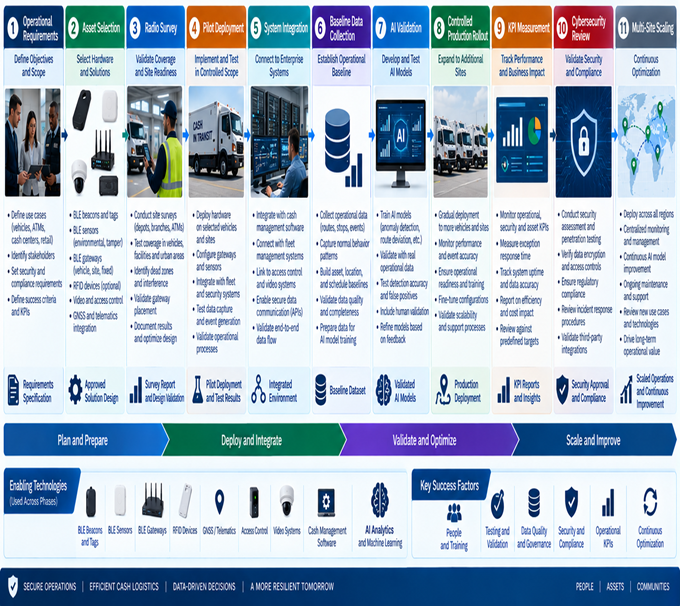
This roadmap presents an 11-phase progression for deploying AI and BLE across cash-in-transit operations, beginning with requirements, technology selection, radio surveys, and pilot testing. It advances through system integration, baseline data collection, AI validation, controlled production rollout, KPI measurement, cybersecurity review, and multi-site scaling, with continuous testing, human validation, maintenance, and optimization.
Practical Recommendations for Cash-in-Transit Technology Teams
AI and BLE should be deployed according to clearly defined CIT operational problems rather than as standalone technology projects. A well-designed solution connects physical custody events with trusted digital records and gives security and operations teams actionable information.
Key recommendations include:
- Start with one or two measurable cash-in-transit workflows.
- Define the required operational events before selecting hardware.
- Use BLE as an enabling identification or sensing layer rather than treating it as a complete location solution.
- Combine BLE evidence with GNSS, RFID, access control, telematics, video, and other systems where they provide complementary information.
- Validate gateway placement under real vehicle and facility conditions.
- Build local buffering into deployments exposed to intermittent connectivity.
- Establish cybersecurity controls for devices, gateways, APIs, servers, and users.
- Collect baseline operating data before deploying complex machine-learning models.
- Keep human verification within security-related decision processes.
- Measure false positives and missed detections rather than evaluating AI solely by the number of alerts generated.
- Establish battery replacement and device maintenance procedures before large-scale deployment.
- Integrate alerts with existing incident-management and dispatch workflows.
- Use Cloud Version, Server Version, or a hybrid arrangement according to data governance, connectivity, integration, resilience, and operational requirements.
- Review AI model performance periodically as routes, vehicles, facilities, personnel procedures, and customer requirements change.
GAO Support for AI and BLE Cash-in-Transit Solutions
GAO provides BLE, RFID, and IoT hardware products and systems that can support asset identification, sensing, monitoring, and connected operational workflows. Headquartered in New York City and Toronto, Canada, GAO is ranked among the top 10 leading B2B and B2G BLE and RFID suppliers globally, with a lesser degree of B2B2C and B2D business. GAO, GAO Research, and GAO Tek form GAO Group, with operations based in New York City and Toronto.
For three decades, GAO Group has served organizations across the United States and Canada, including Fortune 500 companies, leading R&D organizations, prestigious universities, and U.S. and Canadian government agencies. Its investment in product and system R&D is supported by stringent quality assurance processes and expert technical support available remotely or onsite.
For cash-in-transit organizations, the practical objective is to select technologies that fit established custody, security, fleet, cash-center, and compliance processes. GAO’s experience supplying hardware products and systems can support engineering teams as they evaluate BLE gateways, beacons, sensors, RFID technologies, and related IoT components for these operational requirements.
Building the Future of Industrial AI and IoT with Aperture Venture Studio and GAO RFID Inc.
For more than three decades, GAO Group of Companies has invested heavily in R&D of industrial BLE, RFID, and IoT. As generative AI has become useful in industrial applications, we have developed AI and IoT technologies and founded Aperture Venture Studio to advance AI and IoT solutions relevant to areas such as secure cash logistics and financial infrastructure.
Aperture has attracted AI and IoT technical experts, entrepreneurial and operational executives, influential investors, and leading companies. We have also developed Aperture Ventures Summit and TekSummit to discuss advanced AI and IoT topics and foster technical communities.
We welcome you to join us as:
- Advisors, Co-founders, or Employees
- Investors
- Customers