
AI and BLE for Biologics Production
How AI Improves Biologics Production with Connected Process Data
AI-enabled biologics production combines Industrial AI, machine learning, Edge AI, connected sensors, equipment data, and manufacturing software to improve visibility across cell culture, fermentation, purification, formulation, filling, cold-chain handling, and facility operations. BLE sensors, beacons, and gateways can provide a practical wireless data layer for selected equipment, mobile assets, environmental conditions, and material movements without requiring every measurement point to be directly connected to a wired control system.
For biologics manufacturers, the value of AI is not simply collecting more sensor readings. The objective is to convert process, equipment, environmental, and asset data into earlier warnings, better batch decisions, improved maintenance planning, and more consistent execution. AI can identify abnormal trends in bioreactor parameters, detect developing equipment problems, correlate environmental conditions with process deviations, and improve asset utilization.
GAO provides BLE, RFID, and IoT hardware and systems that can support these data-collection requirements. The resulting solution can connect physical operations with MES, historian, SCADA, CMMS, LIMS, ERP, quality systems, and analytics software while keeping GMP requirements, data integrity, validation, cybersecurity, and operational segregation in view.
Why AI Matters in Biologics Manufacturing
Biologics production differs from conventional high-volume manufacturing because the process is highly sensitive to biological variability, contamination risk, environmental conditions, raw-material characteristics, equipment performance, and tightly controlled process parameters. A relatively small change in a critical process condition can require investigation, additional testing, or batch disposition decisions.
AI provides value by analyzing relationships that are difficult to identify through manual review of isolated measurements. A machine-learning model can compare current process behavior with historical batch data, identify multivariable patterns, and alert operators when a process is moving away from an expected operating envelope.
Relevant AI applications include:
- Bioreactor process monitoring for temperature, pH, dissolved oxygen, agitation, pressure, gas flow, and other available process variables.
- Cell culture trend analysis to identify abnormal growth or process behavior.
- Fermentation monitoring and anomaly detection.
- Predictive maintenance for pumps, motors, agitators, compressors, HVAC equipment, chillers, freezers, centrifuges, and other critical assets.
- Cleanroom environmental monitoring and deviation detection.
- Cold-chain condition monitoring for biologic materials, intermediates, and finished products.
- AI-assisted material and asset tracking across manufacturing, warehouse, laboratory, and staging areas.
- Batch genealogy and contextual analysis by correlating equipment, operator, material, environmental, and process events.
- Utility optimization involving purified water, water-for-injection systems, clean steam, compressed gases, HVAC, and refrigeration.
- Quality trend analysis using process and laboratory information.
- Computer vision for selected inspection, packaging, labeling, and equipment-status applications.
- Maintenance prioritization based on asset criticality, condition indicators, failure history, and production schedules.
The important engineering principle is that AI should complement validated control and quality processes rather than silently replace established process controls. A model can identify a developing condition or recommend an investigation, while qualified personnel and approved procedures remain responsible for regulated decisions.
AI-Enabled Data Collection in Biologics Manufacturing
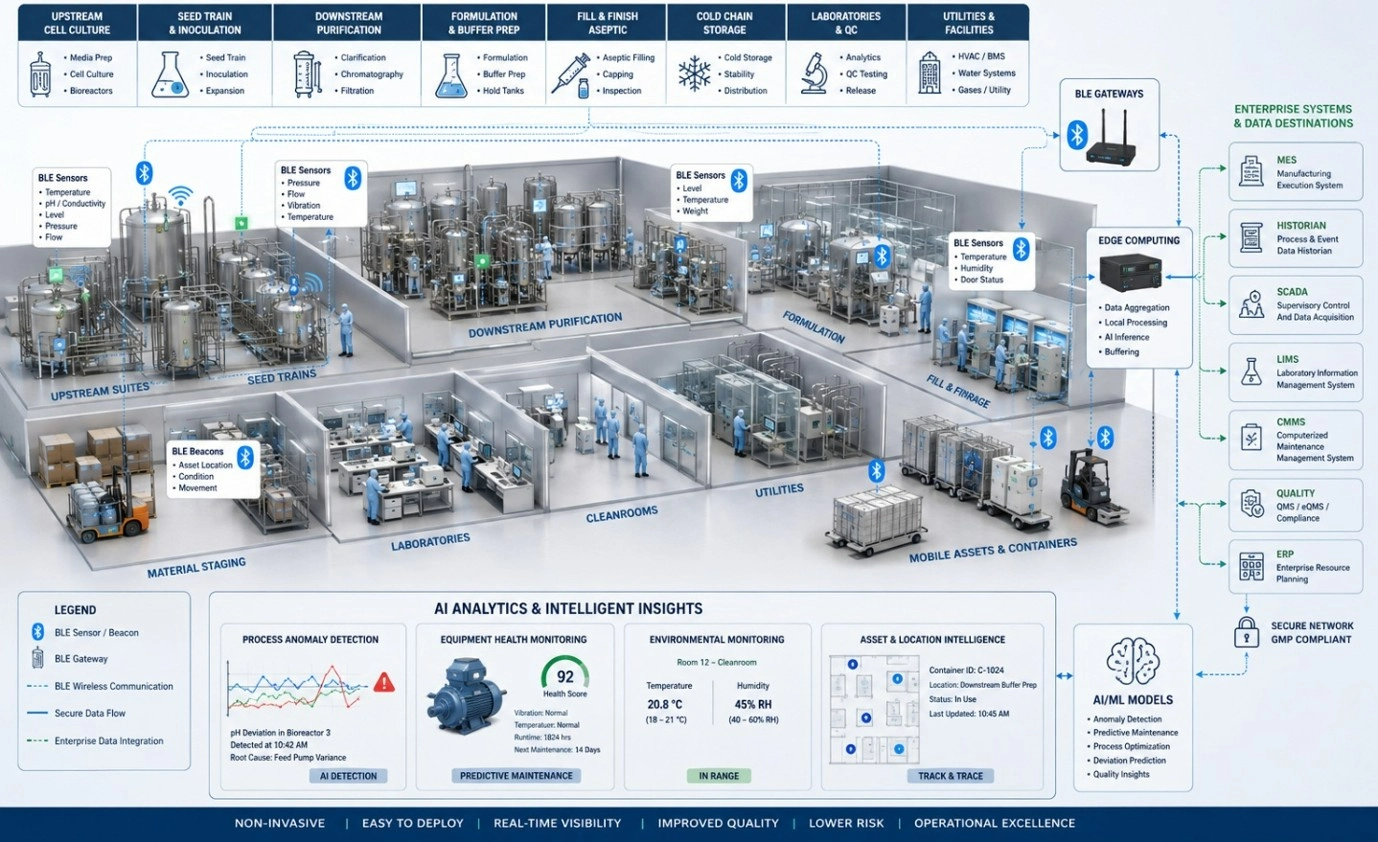
Illustration of AI-enabled data collection across a biologics manufacturing facility using BLE sensors, beacons, gateways, edge computing, and AI analytics. The visual shows real-time monitoring across production, purification, formulation, aseptic filling, laboratories, cold storage, and connected enterprise systems.
Biologics Production Workflows Most Suitable for AI
AI opportunities should be selected according to process criticality, data availability, failure consequences, and the manufacturer’s quality risk strategy. A useful deployment does not attempt to instrument every item of equipment. Instead, it identifies processes where additional context can improve operational decisions.
Upstream Processing and Cell Culture
Upstream operations can include media preparation, buffer preparation, seed expansion, inoculation, cell culture, and bioreactor operation. These processes generate continuous and batch-oriented data that can be valuable for machine-learning models.
AI can evaluate time-series data from bioreactors and associated equipment to identify deviations from expected batch trajectories. BLE sensing can supplement existing automation where additional monitoring is useful, particularly for equipment condition, mobile equipment, environmental observations, and non-critical measurements that do not need to become part of a closed-loop control function.
Engineering teams should distinguish between a BLE measurement used for operational awareness and a validated critical process parameter. Critical control functions normally require appropriately qualified instrumentation and control infrastructure rather than relying on a general-purpose wireless sensor.
Downstream Processing and Purification
Downstream biologics processing can involve harvest, clarification, filtration, chromatography, viral inactivation, ultrafiltration, diafiltration, concentration, and intermediate storage.
AI can correlate equipment condition, process trends, batch history, and operating parameters to identify unusual behavior. For example, abnormal pump vibration combined with changing flow characteristics can provide an earlier maintenance signal than a single alarm.
BLE devices can add condition-monitoring information to selected pumps, motors, mobile skids, carts, and support equipment. This information can be associated with equipment IDs and production context so that maintenance personnel can investigate the correct asset without manually searching through disconnected records.
Formulation, Fill-Finish, and Aseptic Operations
Formulation and fill-finish introduce additional requirements involving environmental control, equipment status, material traceability, line clearance, personnel movement, and contamination control.
AI can help analyze equipment states, environmental trends, inspection results, and operational events. Computer vision may support selected inspection activities, while connected asset information can improve the visibility of filling components, mobile equipment, containers, and staging activities.
For aseptic manufacturing, wireless devices must be evaluated against cleanroom requirements, cleaning and disinfection procedures, material compatibility, electromagnetic considerations, battery management, and contamination-control procedures. The presence of a BLE device should never compromise the validated manufacturing environment.
Cold Storage and Biologic Material Handling
Many biologic materials require tightly controlled storage and transportation conditions. AI can analyze temperature histories, excursion duration, door events, equipment condition, and location information to identify emerging risks.
BLE temperature sensors and beacons can support monitoring of refrigerators, freezers, cold rooms, transport containers, racks, carts, and other mobile assets. Gateway placement should be designed around refrigeration enclosures, insulated rooms, metallic structures, and areas where radio propagation can be attenuated.
The AI layer can combine sensor readings with asset identity and location data to distinguish a genuine equipment problem from a temporary operational event.
AI Use Cases Across the Biologics Production Floor
| Biologics Production Area | AI Application | Data Inputs | Operational Outcome |
|---|---|---|---|
| Cell culture | Batch trend anomaly detection | Bioreactor and batch history | Earlier investigation of abnormal trajectories |
| Fermentation | Process-condition prediction | Temperature, pH, gas, agitation, historical batches | Better process visibility |
| Purification | Equipment anomaly detection | Flow, pressure, vibration, runtime | Earlier maintenance intervention |
| Aseptic filling | Inspection analytics | Images, equipment states, environmental data | Improved inspection support |
| Cleanrooms | Environmental anomaly detection | Temperature, humidity, pressure, particle-related data | Faster deviation investigation |
| Cold storage | Excursion prediction | Temperature, door events, equipment status | Reduced cold-chain risk |
| Utilities | Predictive maintenance | Vibration, temperature, runtime, alarms | Better maintenance scheduling |
| Materials handling | AI asset tracking | BLE location, RFID identity, workflow events | Improved asset utilization |
| Quality operations | Process-quality correlation | Batch, laboratory, equipment data | Faster trend investigation |
| Maintenance | Failure-risk scoring | Condition data, work orders, asset history | Prioritized maintenance |
AI-BLE Workflow for Biologics Manufacturing Data
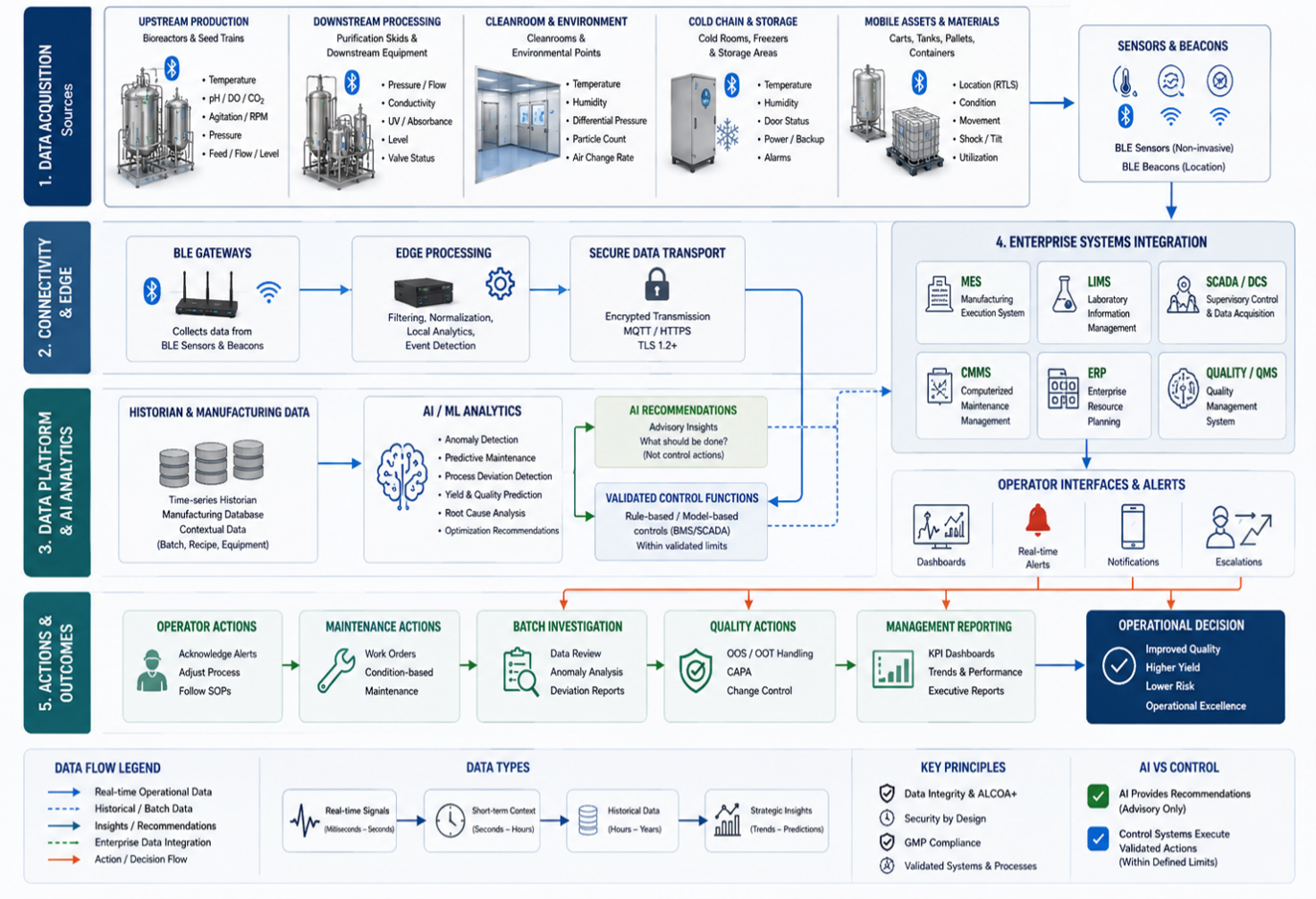
End-to-end workflow showing how biologics production data moves from BLE sensors and beacons through gateways, edge processing, secure data transport, AI/ML analytics, and enterprise systems. The diagram connects AI recommendations to operator alerts, maintenance, batch investigation, quality actions, and management decisions.
Operational Challenges AI Must Address in Biologics Production
Biologics facilities have several characteristics that make AI deployment technically demanding. The primary challenge is not model selection. It is obtaining trustworthy, contextualized, time-aligned data without disrupting validated manufacturing processes.
Common challenges include:
- Batch-to-batch biological variability that makes simple threshold-based analytics insufficient.
- Sparse failure data for high-value equipment because critical assets may rarely fail.
- Data fragmentation among historians, MES, LIMS, CMMS, SCADA, building management systems, spreadsheets, and laboratory systems.
- Inconsistent asset identifiers across maintenance, production, quality, and warehouse records.
- Time synchronization problems between independent systems.
- Environmental monitoring requirements in controlled and classified areas.
- Wireless attenuation caused by stainless-steel equipment, cleanroom structures, refrigeration units, tanks, and process skids.
- Battery maintenance for wireless sensors installed in difficult-to-access locations.
- Validation requirements for computerized systems and electronic records.
- Cybersecurity requirements for connected devices and industrial networks.
- Difficulty distinguishing process anomalies from sensor faults.
- Limited availability of labeled data for supervised machine-learning models.
- Change-control requirements when connected monitoring is introduced into regulated operations.
A practical deployment therefore starts with data lineage, asset identity, measurement purpose, and risk classification before selecting an AI model.
GMP, Data Integrity, and Validation Considerations
AI-enabled biologics production must be designed around applicable GMP requirements rather than treating regulatory compliance as a later software feature. FDA states that CGMP requirements apply to drugs and biologics, with relevant requirements including 21 CFR Parts 210 and 211 and biologics-specific requirements in Parts 600 through 680. (U.S. Food and Drug Administration)
Electronic records and electronic signatures also require careful consideration. FDA’s Part 11 guidance addresses electronic records and signatures used under applicable predicate rules and highlights controls such as authorized access, operational checks, authority checks, device checks, personnel qualification, documentation controls, and electronic-signature controls. (U.S. Food and Drug Administration)
For organizations operating under EU GMP, EudraLex Volume 4 includes Annex 2 for biological active substances and medicinal products for human use and Annex 1 for sterile medicinal products. Annex 1 has been fully applicable since August 25, 2024. (Public Health)
For AI and BLE solutions, these requirements translate into practical engineering controls:
- Define whether each sensor measurement is informational, quality-relevant, or part of a regulated electronic record.
- Establish data ownership and a clear source of truth for each measurement.
- Maintain synchronized timestamps across gateways, edge servers, historians, and enterprise applications.
- Record sensor identity, calibration status, firmware version, battery condition, and installation location where appropriate.
- Maintain auditability for data changes and system events.
- Apply role-based access and least-privilege permissions.
- Validate intended use rather than assuming that every AI component requires identical validation treatment.
- Document model purpose, input variables, expected operating boundaries, performance monitoring, and change control.
- Keep AI recommendations distinguishable from operator-entered decisions and validated control actions.
- Perform risk assessments before placing wireless devices in classified or aseptic environments.
AI and BLE Solution Components for Biologics Facilities
A practical solution typically contains several coordinated layers. BLE should be treated as an enabling communication technology rather than the primary business objective.
BLE Sensors
BLE sensors can measure parameters such as temperature, humidity, vibration, differential pressure where an appropriate device is available, equipment state, or other operational variables. In biologics facilities, sensor selection should consider measurement accuracy, calibration requirements, enclosure design, cleaning compatibility, battery life, installation method, and whether the measurement is appropriate for the intended GMP use.
BLE Beacons
BLE beacons provide an identity or location reference for mobile assets such as carts, portable equipment, containers, maintenance tools, racks, and selected material-handling resources. Their value increases when the beacon identifier is mapped to a controlled asset master rather than treated as an anonymous Bluetooth address.
BLE Gateways
BLE gateways receive nearby BLE broadcasts and forward selected information to edge or server software. Gateway density should be determined through a radio survey rather than a simple distance calculation because stainless-steel equipment, walls, refrigerators, tanks, and cleanroom construction can significantly influence RF performance.
Edge Processing
Edge processing can filter noisy readings, perform basic validation, buffer data during temporary network outages, normalize timestamps, and forward only useful events to centralized systems. This is particularly valuable when wireless connectivity is intermittent or when the facility requires local processing.
AI and Machine Learning Software
The AI layer can include statistical process monitoring, anomaly detection, supervised classification, regression, time-series forecasting, clustering, predictive-maintenance models, and computer vision. Model selection should follow the operational problem and available data rather than beginning with a preferred algorithm.
Manufacturing and Enterprise Software
The solution may exchange information with MES, SCADA, historians, LIMS, CMMS, ERP, building management systems, warehouse software, quality management systems, and data lakes or analytics environments.
AI-Enabled Biologics Manufacturing Solution Architecture
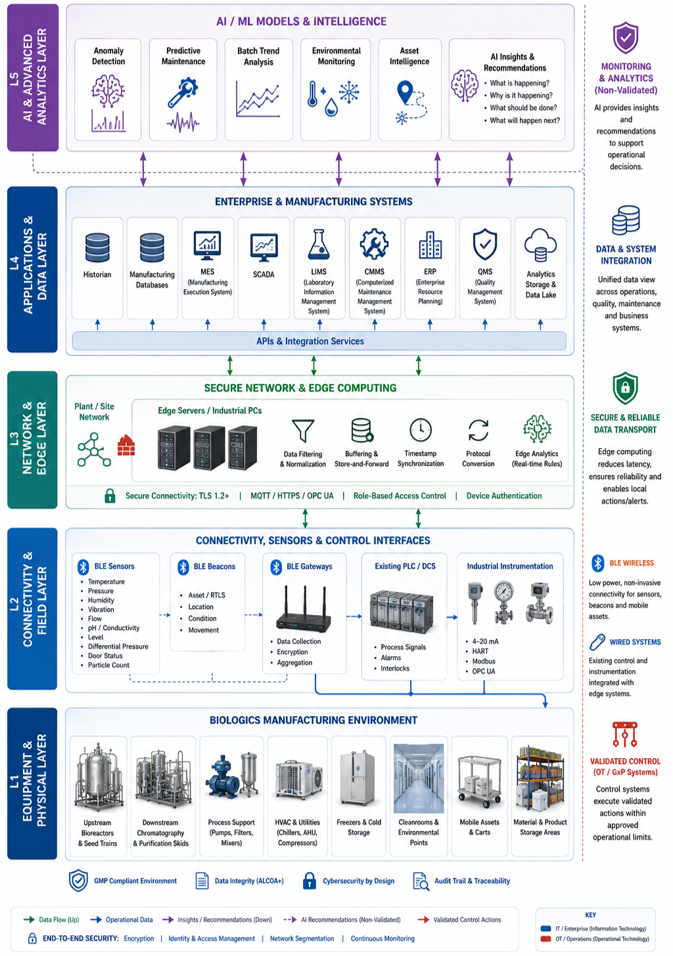
Layered architecture showing how biologics manufacturing equipment connects through BLE sensors, gateways, secure edge computing, enterprise systems, and AI/ML analytics. The diagram highlights data flows, cybersecurity, monitoring, predictive insights, and the separation between AI recommendations and validated control functions.
Cloud and Server Deployment for Biologics Production
A cloud-hosted deployment can centralize analytics across multiple manufacturing sites, provide scalable computational resources, and support long-term historical analysis. It can be appropriate for non-real-time analytics, cross-site benchmarking, asset intelligence, fleet-level maintenance analysis, and centralized reporting when the organization’s cybersecurity and data-governance policies permit the required data flow.
A Server Version can run on customer-managed edge servers, private data centers, manufacturing servers, or other privately hosted enterprise infrastructure. This approach can be preferable where production data must remain within controlled networks, where latency is important, or where site policies restrict external connectivity.
A hybrid approach is often technically practical. Local servers can retain operational data and perform time-sensitive processing while approved datasets or derived analytics are transferred to centralized cloud services.
For regulated biologics production, deployment selection should consider:
- Data residency and retention requirements.
- Network segmentation and firewall rules.
- Disaster recovery and backup strategy.
- System validation and change control.
- Identity and access management.
- Cybersecurity monitoring.
- Availability requirements for production operations.
- Integration with existing validated systems.
- Latency requirements for operational alerts.
- Separation between development, test, and production environments.
GAO’s experience supplying BLE, RFID, and IoT hardware and systems can support the physical data-collection portion of such deployments, while the final software and validation design should be aligned with the manufacturer’s quality, IT, OT, engineering, and regulatory requirements.
Deployment Engineering Priorities
Before installation, biologics manufacturers should create an equipment and process inventory identifying which assets require monitoring, what data is already available, which measurements need additional sensing, and how each data stream will be used.
A strong implementation normally evaluates:
- Asset criticality and failure consequences.
- Process and environmental measurement requirements.
- Existing instrumentation and control-system availability.
- BLE radio propagation and gateway placement.
- Sensor calibration and maintenance requirements.
- Cleanroom and contamination-control constraints.
- Network segmentation and cybersecurity.
- Data retention and auditability.
- Integration with existing manufacturing software.
- AI model training and monitoring requirements.
- Validation and change-control boundaries.
- Operator workflow and alarm-management requirements.
The most useful AI system is not necessarily the one with the largest number of sensors. It is the one that produces reliable, contextual information that a manufacturing, quality, engineering, or maintenance team can act upon.
AI and BLE Application Selection Decision Tree for Biologics
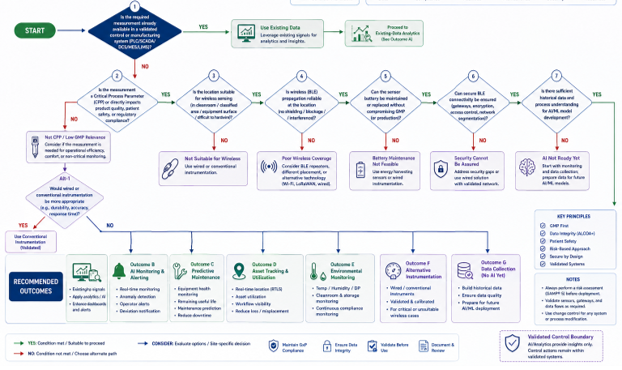
Decision tree helping biologics manufacturers determine when to use existing validated data, BLE wireless sensing, alternative instrumentation, or AI analytics. It evaluates GMP relevance, wireless suitability, battery maintenance, cybersecurity, data integrity, and AI readiness before recommending monitoring, predictive maintenance, asset tracking, environmental monitoring, or validated instrumentation.
Sources used for regulatory accuracy
- FDA, Developing and Manufacturing Drugs Including Biologics (U.S. Food and Drug Administration)
- FDA, Part 11, Electronic Records; Electronic Signatures (U.S. Food and Drug Administration)
- European Commission, EudraLex Volume 4 (Public Health)
- European Commission, Good Manufacturing and Distribution Practices (Public Health)
Technical Capabilities and Operational Value of AI-Enabled Biologics Production
The combination of AI analytics, connected equipment data, and BLE-enabled sensing can improve biologics production by adding operational context to information that is otherwise distributed across manufacturing systems, maintenance records, laboratory results, and physical assets. The strongest value comes from correlating multiple data sources rather than treating individual sensor readings as isolated events.
Predictive Maintenance for Biologics Manufacturing Equipment
Predictive maintenance can identify developing equipment problems before they become production interruptions. Vibration, temperature, operating hours, motor condition, pump behavior, alarm history, and maintenance records can be analyzed together to estimate abnormal equipment behavior.
For biologics facilities, this approach is particularly useful for pumps, agitators, centrifuges, compressors, HVAC equipment, refrigeration systems, chillers, filtration support equipment, and other assets whose failure could interrupt a batch or controlled environment.
BLE vibration or temperature sensors can supplement existing condition-monitoring systems where additional wireless measurements are practical. AI models can then distinguish normal operating variation from patterns associated with bearing wear, imbalance, overheating, or abnormal mechanical behavior.
The objective is not simply to predict failure. Maintenance teams need actionable information such as:
- Which asset is showing abnormal behavior.
- How the current condition differs from its historical operating profile.
- Whether the asset is associated with an upcoming batch or production campaign.
- Whether the condition requires immediate investigation or can be monitored.
- What maintenance history is relevant to the observed condition.
AI-Based Batch and Process Trend Analysis
Biologics batches can produce large quantities of time-series information. AI can compare current batch trajectories with historical production data and identify deviations involving combinations of variables rather than relying exclusively on individual alarm limits.
For example, a model could evaluate the relationship among temperature, pH, dissolved oxygen, agitation, gas flow, process time, and historical batch behavior. A deviation in one parameter may not be significant by itself, while a coordinated change across several parameters could warrant investigation.
AI should therefore be implemented as a decision-support capability with clearly defined operating boundaries. Model outputs should be traceable to their input data and presented in a form that manufacturing and quality personnel can interpret.
Environmental Monitoring and Facility Intelligence
Cleanrooms and controlled manufacturing environments depend on stable environmental conditions. Temperature, humidity, differential pressure, equipment status, room conditions, and HVAC behavior can be analyzed together to identify abnormal trends.
AI can help detect:
- Gradual environmental drift.
- Repeated pressure excursions.
- HVAC performance degradation.
- Unusual temperature or humidity behavior.
- Recurring environmental events associated with specific operating periods.
- Equipment conditions that precede facility-level deviations.
BLE sensors may be appropriate for selected supplemental monitoring points, while validated environmental monitoring systems remain responsible for measurements and controls that have defined GMP or quality significance.
AI-Assisted Asset and Material Visibility
Biologics manufacturing involves numerous mobile assets, including carts, portable equipment, racks, containers, tools, sampling equipment, and other resources that move among production, laboratories, warehouses, maintenance areas, and staging locations.
BLE beacons can associate a physical asset with a digital identity, while BLE gateways provide location observations. AI can use these events to identify utilization patterns, prolonged inactivity, unusual movement, and workflow bottlenecks.
The resulting information can support:
- Equipment utilization analysis.
- Asset availability monitoring.
- Search-time reduction.
- Maintenance coordination.
- Staging-area optimization.
- Material-handling analysis.
- Improved accountability for mobile equipment.
Where item-level identity, serialized traceability, or controlled material genealogy is required, BLE can be combined with RFID or other identification technologies rather than treated as a replacement for every identification method.
AI, BLE, RFID, and Existing Manufacturing Systems
Biologics production rarely operates as a single software environment. A practical solution must coexist with established systems and should avoid creating an isolated data repository.
Common integration points include:
- MES for batch execution, electronic workflows, and production records.
- SCADA for supervisory monitoring and equipment status.
- Historians for time-series process information.
- LIMS for laboratory and analytical results.
- CMMS or EAM software for maintenance history and work orders.
- ERP systems for materials, procurement, inventory, and planning.
- QMS software for deviations, CAPA, change control, and quality workflows.
- Building management systems for HVAC and facility conditions.
- Warehouse management systems for inventory and material movement.
- Data lakes and analytics environments for historical analysis.
BLE data should normally be normalized before integration. A gateway identifier is not a useful manufacturing identifier by itself. The software should associate sensor identity, equipment ID, location, measurement type, timestamp, calibration status, and operational context.
A common integration sequence is:
- BLE sensor or beacon captures a physical observation.
- BLE gateway receives the wireless transmission.
- Edge software validates, timestamps, filters, and buffers the information.
- Middleware maps device identifiers to controlled asset identifiers.
- Data is transferred through approved interfaces.
- Historian or operational database stores time-series information.
- AI services analyze historical and current information.
- Relevant findings are presented through dashboards, alerts, maintenance workflows, or manufacturing applications.
- Authorized personnel investigate and document the resulting action.
AI-Enabled Biologics Manufacturing Integration Architecture
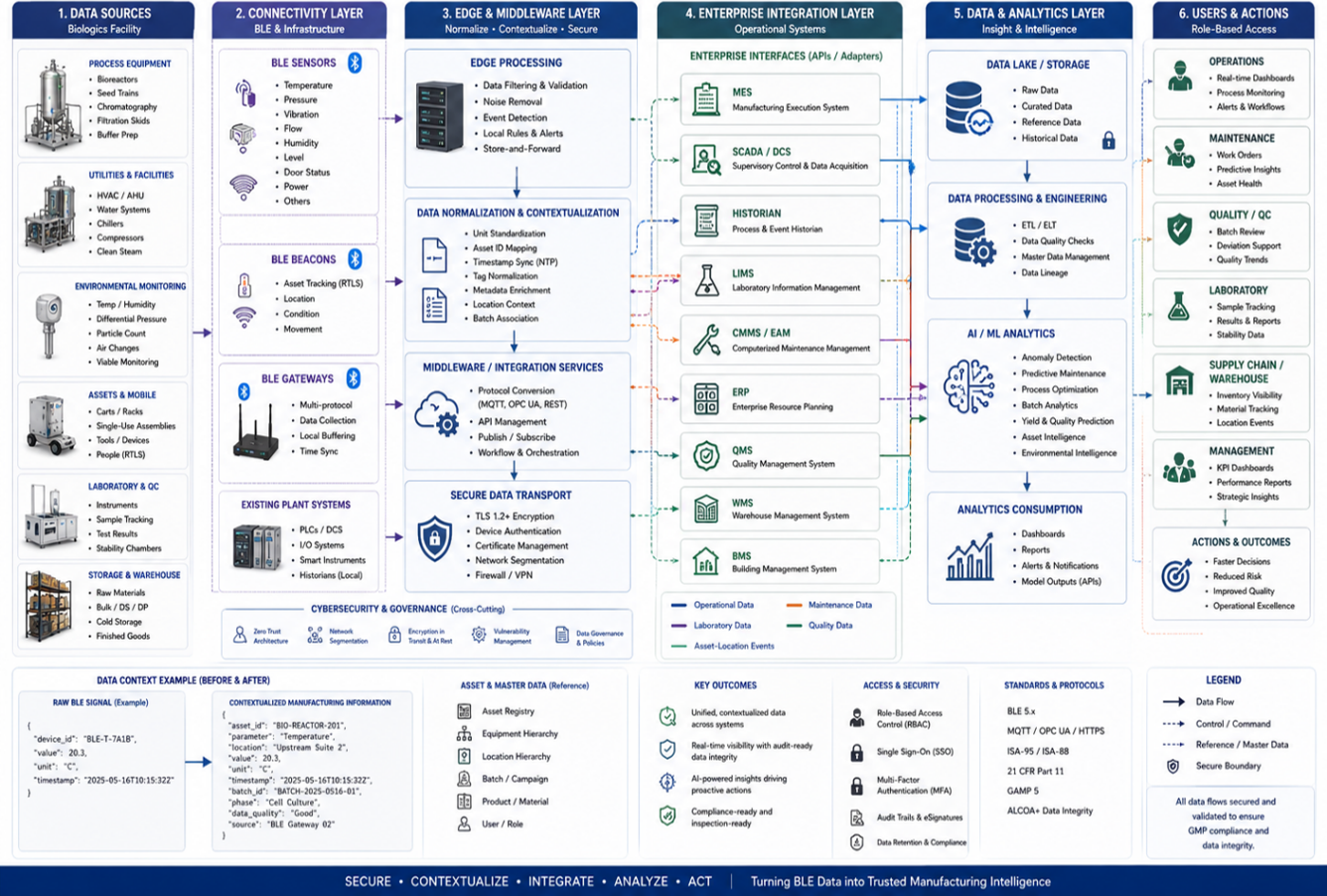
Architecture diagram showing how BLE sensor and beacon data flows through gateways, edge processing, middleware, and secure enterprise interfaces before reaching MES, SCADA, LIMS, CMMS, ERP, QMS, WMS, BMS, data lakes, and AI analytics. It highlights asset ID and timestamp normalization, data contextualization, cybersecurity, role-based access, and conversion of raw BLE signals into actionable manufacturing intelligence.
Cybersecurity and Wireless Security for Biologics Facilities
Wireless sensing introduces additional endpoints that must be considered within the facility’s cybersecurity program. The objective is to prevent unauthorized device access, protect transmitted information, restrict gateway connectivity, and maintain visibility into device health.
Important controls include:
- Unique device identities.
- Strong authentication for gateways and management interfaces.
- Encryption appropriate to the communication path.
- Network segmentation between wireless infrastructure, OT systems, and corporate IT.
- Least-privilege access.
- Secure gateway configuration.
- Controlled firmware updates.
- Device inventory and lifecycle tracking.
- Monitoring for unauthorized devices.
- Logging of security-relevant events.
- Battery and device-health monitoring.
- Secure credential management.
- Defined procedures for lost, replaced, or decommissioned devices.
BLE itself should not be treated as the complete security boundary. The security of a biologics monitoring solution depends on the sensor, gateway, edge server, network, middleware, application, identity system, and downstream interfaces.
Facilities should also determine whether wireless devices can be installed in particular cleanrooms, classified areas, hazardous locations, refrigeration spaces, or other controlled environments. Physical installation requirements can be as important as cybersecurity controls.
Implementation Lifecycle for AI in Biologics Production
A controlled implementation reduces technical and validation risk by separating proof of value from production deployment.
Process and Asset Assessment
The first step is identifying the manufacturing process that has a measurable business or quality problem. Candidate processes can include equipment maintenance, environmental monitoring, cold storage, mobile asset visibility, or batch trend analysis.
The assessment should document:
- Critical equipment and process steps.
- Existing sensors and data sources.
- Available historical data.
- Current failure and deviation patterns.
- Asset identifiers.
- Existing network infrastructure.
- GMP and validation boundaries.
- Personnel responsible for operational decisions.
Sensor and Gateway Engineering
Sensor selection should be based on measurement requirements rather than wireless availability. Engineers should evaluate accuracy, operating range, installation method, battery life, calibration, enclosure characteristics, cleaning requirements, and environmental compatibility.
Gateway placement should then be verified through an RF survey. Metallic vessels, process equipment, cold rooms, walls, doors, and other structures can affect signal strength and reliability.
A pilot should measure actual packet reception, latency, battery behavior, gateway coverage, and data continuity under operating conditions.
Data and AI Model Preparation
AI performance depends strongly on data quality. Historical data should be checked for missing values, inconsistent timestamps, sensor replacements, calibration events, maintenance activities, batch changes, and changes in operating procedures.
For predictive maintenance, labeled failure events may be limited. Unsupervised anomaly detection, statistical process monitoring, and hybrid models can therefore be useful where extensive failure datasets are unavailable.
For batch analytics, models should account for batch phase and process context rather than comparing measurements solely by clock time.
Testing and Commissioning
Testing should cover both technical performance and operational usefulness.
Recommended tests include:
- Sensor measurement verification.
- Gateway communication testing.
- Network interruption and recovery testing.
- Data buffering and retransmission testing.
- Timestamp verification.
- Asset-identity mapping.
- Alert generation.
- AI model output verification.
- Access-control testing.
- Audit and logging verification.
- Integration testing with connected systems.
- Battery and device-health monitoring.
- Failure-mode and recovery testing.
Production commissioning should use approved procedures and documented acceptance criteria.
Optimization and Lifecycle Management
AI performance should be monitored after deployment. A model that performs well during commissioning can degrade when equipment, raw materials, operating procedures, sensors, software, or production campaigns change.
Model monitoring should therefore consider:
- Prediction accuracy.
- False-positive frequency.
- False-negative risk.
- Data drift.
- Sensor drift.
- Process changes.
- Equipment replacement.
- Batch-profile changes.
- Changes in maintenance practices.
- Changes in operating limits.
A model update should follow the organization’s established change-control process when the model contributes to a regulated or quality-relevant workflow.
AI-Enabled Monitoring Lifecycle for Biologics Manufacturing
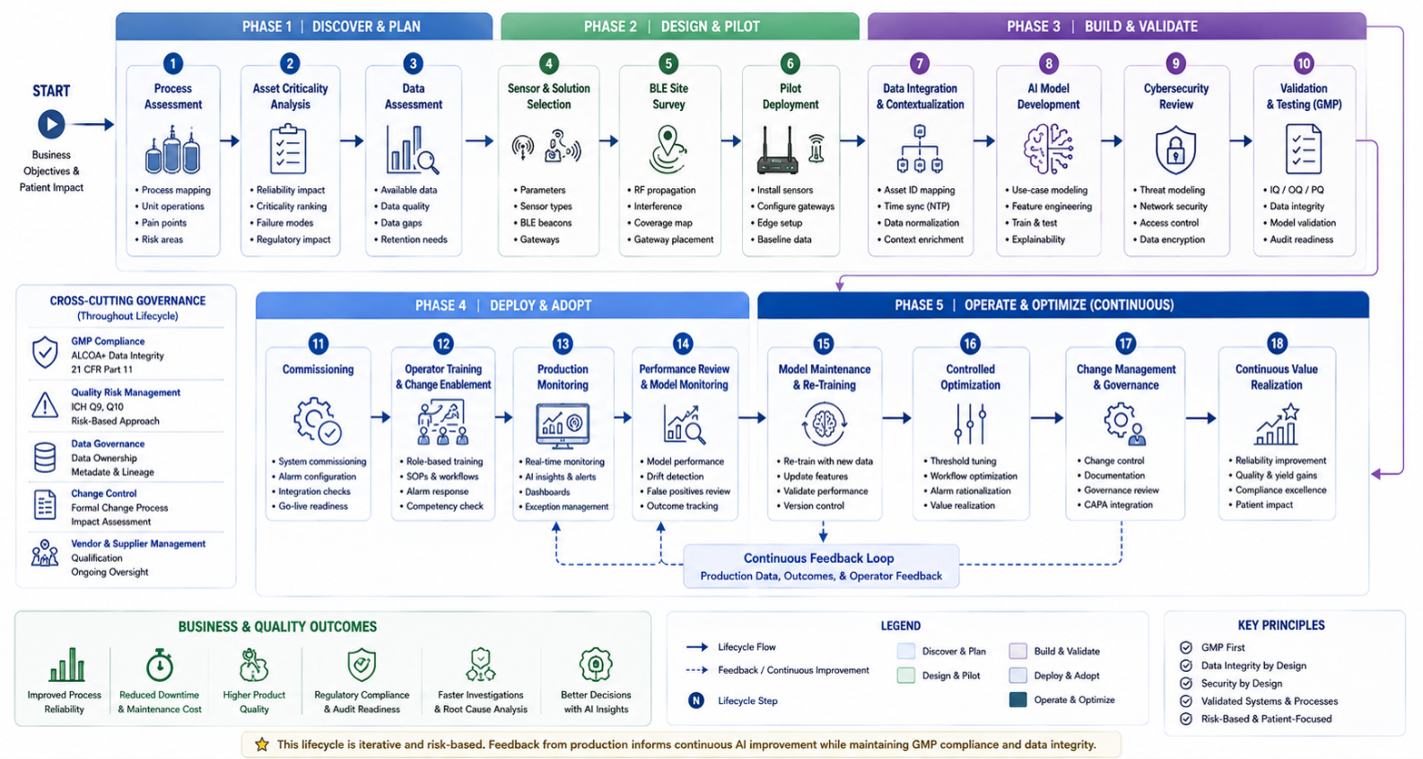
Lifecycle diagram showing the complete implementation path from process assessment, asset criticality, data evaluation, BLE site surveys, and pilot deployment through AI model development, GMP validation, commissioning, and operator training. It also illustrates production monitoring, model maintenance, controlled optimization, change management, and continuous AI improvement.
KPIs for AI-Enabled Biologics Production
The success of an AI and BLE deployment should be measured through manufacturing outcomes rather than the number of connected devices.
| KPI | What It Measures | AI Contribution |
|---|---|---|
| Batch deviation rate | Frequency of production deviations | Detects abnormal process patterns |
| Unplanned equipment downtime | Production interruption | Predicts equipment deterioration |
| Mean time between failures | Equipment reliability | Identifies recurring condition patterns |
| Mean time to repair | Maintenance responsiveness | Improves fault context |
| Maintenance schedule adherence | Planned maintenance execution | Supports prioritization |
| Cold-chain excursion rate | Storage-condition performance | Detects emerging temperature risks |
| Asset utilization | Use of mobile equipment | Identifies underused resources |
| Asset search time | Time spent locating equipment | Uses location intelligence |
| Environmental excursion frequency | Controlled-area stability | Detects abnormal facility trends |
| Batch cycle time | Production efficiency | Identifies process bottlenecks |
| First-pass yield | Successful production outcome | Correlates process conditions with quality |
| Alert precision | Usefulness of AI alerts | Measures actionable detection |
| Sensor availability | Monitoring continuity | Identifies device or network problems |
| Data completeness | Reliability of analytics input | Detects missing measurements |
A useful KPI program should also measure operator workload. An AI system that produces a large volume of low-value alerts can reduce rather than improve operational performance.
Practical Engineering Recommendations for Biologics Manufacturers
The following principles can help reduce deployment risk:
- Start with a clearly defined manufacturing or maintenance problem rather than deploying sensors simply to increase connectivity.
- Reuse existing validated process data wherever it is adequate before adding wireless measurements.
- Use BLE where wireless sensing or asset visibility provides a practical advantage.
- Separate monitoring applications from closed-loop control unless the complete control solution has been appropriately engineered and validated.
- Maintain a controlled asset master so BLE identifiers, equipment IDs, and manufacturing records remain consistent.
- Conduct RF surveys before final gateway placement.
- Treat cleanroom compatibility, cleaning procedures, battery replacement, and physical installation as engineering requirements.
- Design cybersecurity before connecting gateways to production networks.
- Preserve data lineage from the physical sensor through AI analysis.
- Use edge buffering where network interruptions could otherwise cause data loss.
- Begin AI development with measurable operational outcomes and available data.
- Select model types according to the data characteristics and decision being supported.
- Include maintenance, production, quality, IT, OT, engineering, and validation personnel in the deployment process.
- Monitor AI performance after commissioning instead of treating model deployment as the end of the project.
- Document assumptions, limitations, data sources, and model boundaries so users understand what an AI recommendation does and does not indicate.
GAO’s BLE, RFID, and IoT hardware and system experience can be useful when organizations need sensing, identification, gateway, and connected-device components that can be evaluated as part of a broader biologics manufacturing solution. GAO has served customers across the United States and Canada, including Fortune 500 companies, R&D organizations, universities, and government agencies, supported by R&D investment and quality-assurance processes.
Scaling AI Across Biologics Manufacturing Operations
Once a use case demonstrates measurable value, the same engineering principles can be extended to additional production areas or facilities. Scaling should not mean automatically installing identical hardware everywhere. Each manufacturing site may have different equipment, cleanroom layouts, network policies, process configurations, and validation requirements.
A scalable deployment should maintain consistent:
- Device naming conventions.
- Asset identifiers.
- Data schemas.
- Gateway management procedures.
- Cybersecurity controls.
- AI model governance.
- Maintenance procedures.
- Calibration records.
- Software version management.
- Integration interfaces.
- Performance KPIs.
Multi-site analytics can then compare equipment behavior, maintenance patterns, environmental trends, and operational performance while preserving the local context required for each manufacturing facility.
For global biologics organizations, this approach can support centralized engineering analysis while allowing individual manufacturing sites to retain appropriate operational control.
Business Value of AI-Enabled Biologics Production
The business value of AI becomes meaningful when technical improvements translate into manufacturing and quality outcomes. Better equipment visibility can reduce unexpected interruptions. Earlier environmental warnings can support faster investigation. Improved asset visibility can reduce time spent locating mobile equipment. More contextualized process data can help engineers investigate recurring deviations.
Potential benefits include:
- Improved equipment reliability.
- Reduced unplanned production interruptions.
- Faster maintenance investigation.
- Better utilization of mobile manufacturing assets.
- Improved visibility into cold-storage conditions.
- Earlier identification of abnormal process behavior.
- More efficient engineering investigations.
- Better use of historical batch data.
- Improved operational decision support.
- More consistent data availability across manufacturing systems.
- Greater visibility into equipment and environmental conditions.
These benefits depend on appropriate instrumentation, reliable connectivity, useful historical data, well-designed AI models, and effective integration with manufacturing workflows. AI should therefore be evaluated as part of an operational system rather than as an isolated analytics application.
Conventional vs AI-Enabled Biologics Manufacturing Monitoring
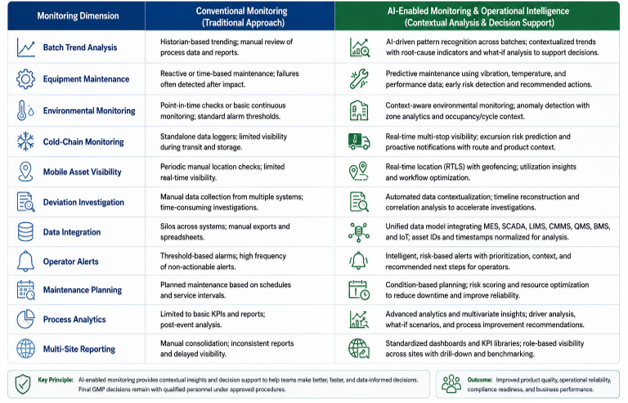
Comparison of conventional biologics production monitoring with AI-enabled operational intelligence across batch analysis, equipment maintenance, environmental and cold-chain monitoring, asset visibility, deviation investigation, data integration, alerts, and reporting. The AI-enabled approach emphasizes contextual insights, predictive analytics, and decision support while keeping GMP decisions with qualified personnel.
Conclusion: Building More Intelligent Biologics Production Systems
AI-enabled biologics production can connect process information, equipment condition, environmental conditions, asset movements, maintenance history, laboratory information, and manufacturing events into a more useful operational picture. BLE sensors, BLE beacons, and BLE gateways can provide supplemental wireless data collection where it is technically appropriate, while existing automation and validated instrumentation continue to perform their established functions.
The strongest implementations begin with specific manufacturing problems such as predictive maintenance, batch anomaly detection, cold-chain monitoring, environmental intelligence, or asset utilization. They then establish reliable data collection, secure integration, AI analytics, validation boundaries, and measurable KPIs.
GAO can support organizations evaluating BLE, RFID, and IoT hardware products and systems for these applications. With headquarters in New York City and Toronto, Canada, GAO is ranked among the world’s leading B2B and B2G suppliers of BLE and RFID technologies. GAO’s engineering and product experience can help organizations evaluate sensing, identification, gateway, and connected-system requirements for biologics production.
For organizations planning AI-enabled biologics manufacturing initiatives, the next step is to map priority production workflows, critical assets, existing data sources, and operational decisions before selecting the appropriate hardware and software. Learn more about GAO’s technology solutions, engineering capabilities, and technical support for connected manufacturing applications.
Building the Future of Industrial AI and IoT with Aperture Venture Studio and GAO
For more than three decades, GAO Group of Companies has invested heavily in R&D for industrial BLE, RFID, and IoT. As generative AI has become useful for industrial applications, we have expanded our work across AI and IoT technologies, including BLE and RFID, and we have founded Aperture Venture Studio to advance practical AI and IoT solutions relevant to applications such as biologics production, connected manufacturing, and industrial operations.
Aperture has attracted AI and IoT technical experts, operational executives, investors, and leading companies. We have also developed the Aperture Ventures Summit and TekSummit to discuss advanced AI and IoT topics and foster technical communities around these technologies.
GAO RFID Inc., GAO Research Inc., and GAO Tek Inc. form GAO Group, with operations based in New York City and Toronto, Canada. GAO Group has served customers throughout the United States and Canada, including Fortune 500 companies, leading R&D firms, prestigious universities, and U.S. and Canadian government agencies. Our substantial R&D investment, stringent quality-assurance processes, and remote and onsite technical support help customers evaluate and deploy connected technology for demanding applications.
We welcome you to join us as:
- Advisors, co-founders, or employees.
- Investors.
- Customers seeking AI, BLE, RFID, and IoT technology solutions.