
AI and BLE for Financial Service Facilities
AI-Enabled Operations for Financial Service Facilities
Artificial Intelligence of Things, commonly called AIoT or AI and IoT, combines artificial intelligence with IoT devices, sensors, connected equipment, and industrial systems. For financial service facilities, AIoT can connect operational data from branch offices, bank headquarters, vault areas, cash-handling rooms, records storage, server rooms, ATM support areas, and other controlled facilities with AI-driven analytics and automated workflows. BLE beacons, gateways, and sensors provide location, presence, environmental, and equipment-state data that can support these applications without requiring every operational asset to have a wired connection.
AI can analyze BLE-derived location and sensor information to identify unusual movement, optimize staff and service workflows, monitor sensitive equipment, improve facility utilization, and support security investigations. Edge AI can process time-sensitive events locally, while centralized software can correlate information across branches and financial service facilities. GAO supplies BLE, RFID, and other IoT hardware products and systems that organizations can use as part of these operational solutions.
Why AI Matters for Financial Service Facility Operations
Financial service facilities operate under stringent requirements for physical security, controlled access, business continuity, information protection, auditability, and operational resilience. A facility may contain cash, negotiable instruments, customer records, authentication equipment, networking equipment, surveillance infrastructure, payment-related systems, and other assets whose location and condition matter to daily operations.
Traditional facility monitoring often depends on access-control logs, CCTV review, manual inspections, spreadsheets, fixed sensors, and periodic asset audits. These sources can be useful individually but may provide limited context when an incident involves movement through several rooms, temporary equipment relocation, environmental changes, or unusual activity.
AI can turn these disconnected observations into operational intelligence. For example, a financial institution can correlate BLE location events with access-control records and scheduled work orders to distinguish an authorized movement of a portable device from an unexpected movement. Machine learning can identify recurring patterns, while rules-based analytics can trigger immediate alerts when a predefined security or operational condition occurs.
Key applications include:
- AI-assisted asset tracking for portable financial-service equipment, mobile workstations, inspection devices, maintenance tools, and high-value facility equipment
- AI-driven personnel and workflow analysis for facility operations, maintenance, security, and authorized service activities
- Location-aware monitoring of restricted rooms and controlled operational zones
- Environmental monitoring for server rooms, network rooms, records storage, equipment rooms, and other sensitive areas
- AI-assisted detection of abnormal equipment movement or unexpected presence
- Automated reconciliation of physical asset records with observed facility activity
- Facility utilization analysis for offices, meeting areas, service zones, and operational support spaces
- Maintenance intelligence based on equipment location, operating conditions, and service history
- Incident investigation using correlated location, sensor, access, and operational records
- Business continuity support through monitoring of critical equipment and facility conditions
AIoT-Enabled Financial Services Facility: Secure Operations, Asset Intelligence & Predictive Insights
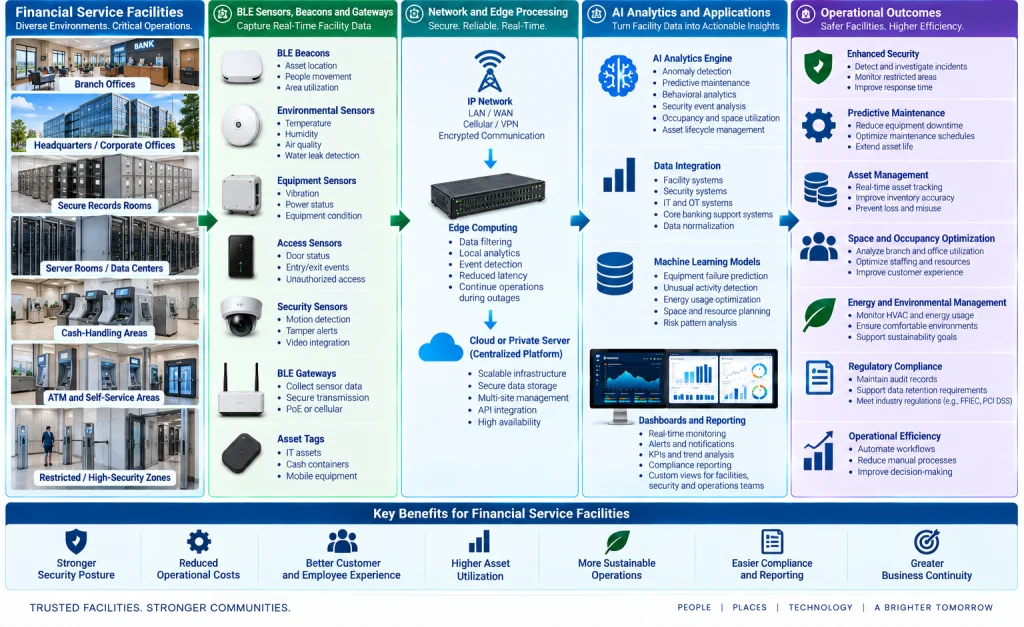
A financial service facility AIoT overview shows branch offices, headquarters, secure records rooms, server rooms, cash-handling areas, ATMs, and restricted zones connected through BLE sensors, gateways, edge processing, and centralized AI analytics. The system supports security monitoring, predictive maintenance, asset management, occupancy optimization, environmental management, compliance, and operational efficiency.
Financial Service Facility Use Cases for AI and Connected Sensing
AI Asset Tracking for Banking and Financial Facilities
Portable assets frequently move between offices, secure rooms, service areas, and maintenance locations. Examples include laptops, mobile workstations, diagnostic equipment, handheld devices, security equipment, facility tools, and specialized operational equipment.
BLE tags or beacons can provide location observations through strategically positioned gateways. AI software can combine these observations with asset registers, employee assignments, work orders, access events, and historical movement patterns.
This enables financial service organizations to move beyond periodic manual inventories toward continuous or event-driven asset visibility. A system can flag an asset that remains in an unexpected zone, detect an unusual movement sequence, or identify repeated movements that differ from normal operational patterns.
The engineering objective is not simply to locate an asset. It is to establish sufficient confidence in the asset’s identity, location, timestamp, and operational context to support a useful business decision.
AI-Assisted Restricted-Zone Monitoring
Financial service facilities often contain areas requiring additional physical controls, including vault-adjacent areas, cash operations rooms, security equipment rooms, network rooms, records storage, and infrastructure spaces.
BLE presence and location data can supplement existing access-control systems. A useful implementation correlates:
- BLE device identity
- Estimated location or zone
- Timestamp
- Door or access-control event
- Employee or contractor authorization
- Work-order status
- Scheduled maintenance activity
- CCTV event references where integration is available
AI can then identify inconsistencies. For example, a maintenance device may be authorized for a server room but appear in another restricted area without an associated work order. Rather than treating every location event as a security incident, the analytics layer can evaluate contextual information and assign an appropriate alert priority.
Environmental Intelligence for Sensitive Facility Areas
Environmental conditions can directly affect technology rooms and records storage. Temperature, humidity, water presence, power-related conditions, and other parameters may need monitoring depending on the facility and equipment involved.
BLE sensors can provide wireless measurements from locations where installing new cabling would be disruptive. AI-based anomaly detection can establish normal operating ranges and identify gradual changes that may warrant inspection before a threshold-based alarm occurs.
For example, a server room with gradually increasing temperature may indicate cooling degradation. AI analytics can correlate temperature trends with equipment operation, maintenance records, and historical events to help facilities teams prioritize investigation.
AI for Facility Maintenance and Service Workflows
Maintenance teams supporting financial service facilities may handle HVAC equipment, UPS systems, generators, networking equipment, security systems, access-control equipment, environmental sensors, and other facility infrastructure.
BLE location information can associate technicians, tools, equipment, and work areas with service events. When integrated with computerized maintenance management software, AI can identify recurring service patterns, unusual equipment movement, delayed maintenance activities, or location-related workflow inefficiencies.
The resulting workflow can connect:
- Asset identification
- Location observation
- Maintenance request
- Technician assignment
- Work-order execution
- Inspection result
- Corrective action
- Maintenance history
This provides stronger operational traceability than relying exclusively on manually entered location or service records.
From BLE Signals to AI-Driven Financial Facility Decisions
A practical financial service facility solution begins with physical observations and progressively converts them into information that operational teams can act upon.
Data Acquisition
BLE beacons, tags, and sensors provide identification, presence, location, environmental, or equipment-state observations. Beacon placement and sensor selection should reflect the physical characteristics of the facility, including walls, elevators, metal structures, equipment cabinets, and areas with radio interference.
Wireless Communication
BLE devices communicate with gateways or compatible receiving infrastructure. Gateway placement should be engineered according to the required location accuracy, coverage area, device density, transmission frequency, and battery-life requirements.
For zone-level asset tracking, a smaller number of carefully positioned receivers may be sufficient. More demanding location applications may require additional receivers and calibration.
Edge Processing
Edge software can filter duplicate observations, normalize sensor readings, perform preliminary event detection, and reduce unnecessary upstream traffic. Time-sensitive alerts can be generated locally when the solution is designed for low-latency operation.
Edge processing is particularly useful for financial facilities where network availability, response time, and data-minimization requirements need to be considered.
Centralized Analytics and AI
Validated observations can be forwarded to server software or cloud-hosted services for historical analysis, dashboards, machine learning, anomaly detection, reporting, and integration with facility systems.
AI models may include:
- Anomaly detection for unusual asset or personnel movement
- Classification models for operational events
- Time-series models for environmental conditions
- Predictive models for maintenance planning
- Pattern recognition for facility utilization
- Correlation models combining location, access, maintenance, and environmental events
AI should not replace deterministic security controls where those controls are required. Rules-based controls remain valuable for clearly defined conditions, while AI adds contextual analysis and pattern recognition.
Business Action
The final stage converts an analytical result into an operational response. Depending on the use case, this may involve notifying security personnel, generating a maintenance work order, requesting an asset reconciliation, escalating an environmental condition, updating an asset record, or creating an investigation trail.
BLE Hardware and Software for Financial Service Facility Solutions
BLE is an enabling layer rather than the business objective. The appropriate hardware configuration depends on whether the financial service facility needs asset identification, room-level presence, environmental monitoring, equipment-state information, or more precise location intelligence.
BLE Beacons and Tags
BLE beacons can transmit identifiers that receivers use to establish the presence or approximate location of an object or person-associated device. Battery-powered tags can be attached to movable equipment and selected operational assets.
Device selection should consider battery life, transmission interval, enclosure requirements, mounting method, operating temperature, maintenance access, and the consequences of missed or delayed location observations.
BLE Sensors
BLE sensors can measure conditions such as temperature, humidity, motion, contact state, or other supported parameters. Financial service facilities can use these measurements in areas where environmental or equipment conditions require continuous or periodic observation.
Sensor sampling intervals should be selected carefully. Higher reporting frequency can improve temporal resolution but may increase battery consumption and communication traffic.
BLE Gateways
BLE gateways receive signals from multiple nearby devices and forward relevant observations to local or centralized software. Gateway deployment requires consideration of radio propagation, physical obstructions, receiver density, network connectivity, power availability, and installation access.
GAO provides BLE hardware products and IoT systems that can be incorporated into financial service facility deployments where wireless asset visibility and sensor data are required.
Cloud Version and Server Version
A Cloud Version can host application software and analytics within cloud infrastructure. This approach can suit financial organizations operating multiple branches or geographically distributed facilities when centralized monitoring, remote administration, and scalable data processing are priorities.
A Server Version can run on customer-managed servers, private data centers, edge servers, or other privately hosted infrastructure. This model can be appropriate when internal IT teams require greater control over data location, network boundaries, integration points, or operational policies.
Financial institutions should evaluate both models against cybersecurity requirements, data governance, network connectivity, integration complexity, latency requirements, disaster recovery procedures, and internal IT operating capabilities.
Secure Integration with Financial Facility Systems
Financial service facilities rarely operate as isolated technology environments. AI-based facility solutions may need to exchange information with physical access-control systems, video management systems, asset management databases, computerized maintenance management systems, building management systems, service-desk software, identity systems, security information and event management systems, and business continuity tools.
Integration should use controlled interfaces and clearly defined data ownership. Common technical mechanisms may include REST APIs, MQTT, HTTPS, secure message queues, database interfaces, webhooks, and enterprise identity services, depending on the software environment.
Security engineering should address:
- Device authentication and gateway authorization
- Encryption for data transmitted across facility networks
- Network segmentation for IoT devices
- Least-privilege access to facility data
- Secure credential and certificate management
- Firmware and software update procedures
- Audit logging
- Time synchronization
- Data retention policies
- Role-based access control
- Monitoring for anomalous device behavior
- Secure API authentication and authorization
Financial service organizations should also assess whether location data could become sensitive when associated with identifiable employees, contractors, customers, or security personnel. Data minimization and appropriate access controls therefore matter alongside radio and network security.
Secure Financial Facility AIoT Architecture: BLE Integration, Edge Security, AI Analytics & Enterprise Systems
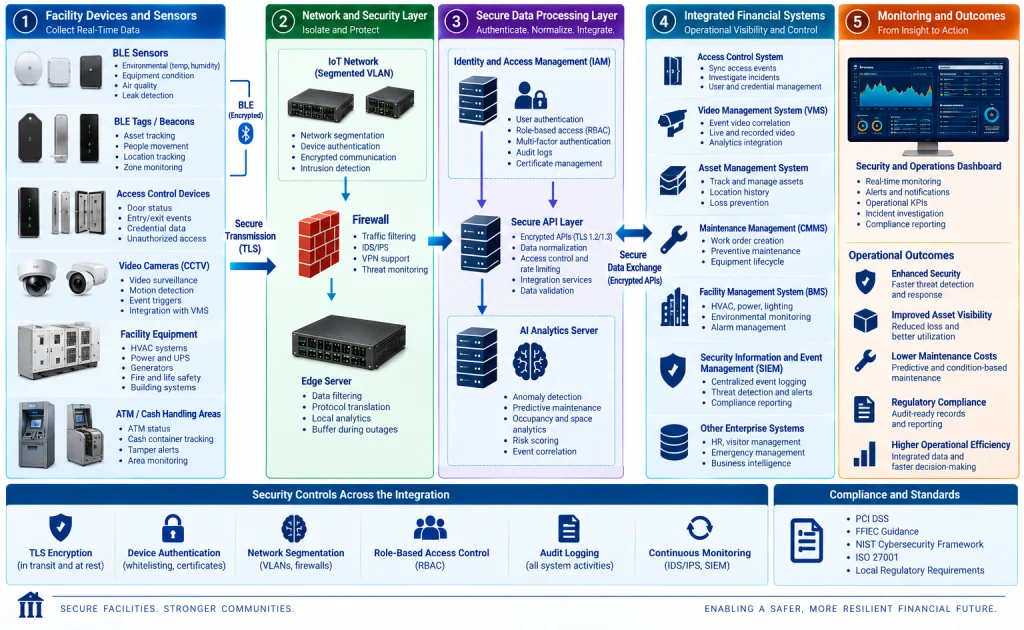
A secure financial facility integration diagram shows BLE sensors, tags, access devices, cameras, and facility equipment connecting through segmented networks, firewalls, edge servers, identity management, secure APIs, and AI analytics. The architecture integrates with access control, video, asset, maintenance, facility, and SIEM systems while applying encryption, authentication, RBAC, audit logging, and continuous security monitoring.
Engineering Considerations Before Deployment
A successful financial service facility deployment requires more than installing BLE devices and connecting them to software. Engineers should first define the operational question that the system must answer.
A requirement such as “track assets” is insufficient by itself. The implementation team should determine which assets require monitoring, what location precision is needed, how frequently location changes must be detected, which users can access the information, how long records should be retained, and what action should occur when an anomaly is detected.
Site surveys should assess radio-frequency behavior, gateway mounting locations, network connectivity, power availability, physical obstructions, secure installation requirements, and areas where wireless performance may be affected.
Commissioning should include device inventory, identifier validation, gateway connectivity testing, sensor calibration where applicable, coverage verification, alert testing, time synchronization, integration testing, and documented acceptance criteria.
GAO’s experience supplying BLE, RFID, and IoT hardware and systems supports organizations that require practical technical guidance in selecting and deploying connected sensing technologies for operational environments.
BLE Deployment Decision Tree for Financial Facilities: Smart Tracking, Sensing & Secure Infrastructure Choices
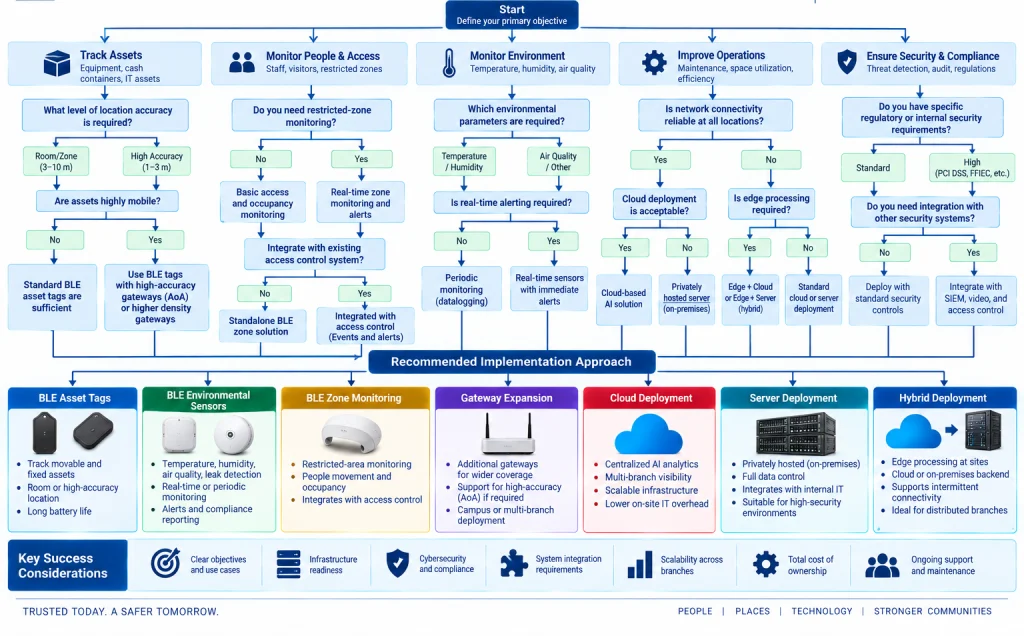
A structured BLE deployment decision tree guides financial facility teams through choices for asset tracking, access monitoring, environmental sensing, operational improvement, and security compliance. Decision paths evaluate location accuracy, mobility, network connectivity, edge processing, integration, and security requirements before recommending BLE tags, sensors, zone monitoring, gateway expansion, cloud, server, or hybrid deployment.
Technical Capabilities and Operational Value for Financial Service Facilities
Combining AI with BLE-enabled sensing gives financial service facilities a way to move from isolated physical observations toward continuously analyzed operational information. The greatest value comes when location, environmental, maintenance, access, and asset records are correlated rather than treated as separate data sources.
Higher Asset Visibility and Accountability
AI-assisted BLE tracking can provide a continuously updated view of selected movable assets. Instead of depending entirely on periodic physical inventories, facility teams can investigate asset status using recent location observations.
This is particularly useful for assets that move between branches, secure storage, technical rooms, service areas, and administrative offices. Historical location records can also support reconciliation after an asset is reported missing or incorrectly assigned.
Relevant KPIs can include:
- Asset location accuracy
- Asset inventory accuracy
- Percentage of tracked assets with current location information
- Asset search time
- Unaccounted asset rate
- Asset utilization rate
- Average asset dwell time by zone
- Time required to complete physical reconciliation
Faster Detection of Operational Anomalies
Rule-based alerts can identify explicit conditions, while AI can identify patterns that are difficult to define manually. A model could learn normal movement patterns for selected equipment and flag deviations for investigation.
For example, repeated movement of a particular device between authorized technical rooms may be normal. A movement sequence involving an unexpected restricted area, unusual time, and absence of a corresponding maintenance work order may deserve a higher priority.
AI should therefore be treated as a decision-support mechanism rather than an unquestioned source of truth. Human review remains important for security-sensitive events.
Improved Facility Maintenance
Location-aware maintenance information can reduce time spent finding equipment, identifying the correct asset, and reconstructing service history. When BLE observations are linked to maintenance records, technicians can receive better context before beginning work.
Predictive analytics can also use historical sensor measurements, equipment condition, service intervals, and environmental information to identify assets that may require inspection.
Potential outcomes include:
- Reduced mean time to repair
- Improved preventive maintenance compliance
- Lower equipment downtime
- Faster technician response
- Fewer duplicate maintenance requests
- Better maintenance history completeness
- Improved critical equipment availability
Better Environmental Monitoring
Continuous sensor data can provide more visibility than periodic manual readings. AI-based time-series analysis can identify gradual deviations from normal operating conditions and distinguish short-lived fluctuations from persistent problems.
For financial service facilities, this can be useful for server rooms, network equipment areas, records storage, equipment rooms, and other locations where environmental conditions can affect operations.
The engineering design should distinguish between informational analytics and safety-critical controls. Where a temperature or environmental threshold must trigger an immediate protective response, an appropriately engineered deterministic alarm should not depend exclusively on an AI model.
Financial Facility Security and Compliance Considerations
Physical security and cybersecurity are closely connected in modern financial facilities. A connected sensor can provide useful operational intelligence, but every additional device also introduces another component that must be inventoried, authenticated, monitored, updated, and protected.
Physical Security Integration
BLE location information can complement, rather than replace, established physical security controls. Access-control events can establish whether a credential was used at a door, while location observations can provide additional information about where an associated device or authorized individual was subsequently observed.
Video management systems can provide visual confirmation when an investigation requires additional evidence. Security teams should define which source is authoritative for each event and establish procedures for resolving conflicting information.
Cybersecurity Controls
A financial service facility BLE deployment should be evaluated within the organization’s broader information-security program.
Important controls include:
- Asset inventory covering BLE gateways, sensors, tags, and servers
- Secure device provisioning
- Strong authentication
- Encryption for applicable communications
- Network segmentation
- Restricted administrative interfaces
- Role-based permissions
- Security event logging
- Vulnerability management
- Firmware and software update procedures
- Backup and recovery procedures
- Configuration management
- Incident-response procedures
- Controlled remote administration
NIST Cybersecurity Framework practices can provide a useful structure for identifying, protecting, detecting, responding to, and recovering from risks associated with connected facility systems. Financial organizations should also evaluate applicable regulatory and contractual requirements based on their jurisdiction, services, data, and operating model.
Standards and Regulatory Considerations
Financial service facilities in the United States and Canada operate under overlapping requirements covering cybersecurity, privacy, physical security, records, operational resilience, and technology risk. The exact obligations depend on the institution and the information or services involved.
Relevant frameworks and requirements may include:
- NIST Cybersecurity Framework for organizing cybersecurity risk-management activities
- NIST SP 800-53 for security and privacy controls where applicable
- NIST SP 800-61 for incident-response planning
- ISO/IEC 27001 for information-security management
- ISO/IEC 27002 for information-security controls
- PCI DSS where payment-card data environments are within scope
- GLBA requirements applicable to U.S. financial institutions
- FFIEC cybersecurity and technology-risk guidance relevant to covered financial institutions
- NYDFS Cybersecurity Regulation, where applicable to regulated entities in New York
- SOC-related control frameworks where relevant to service providers and assurance requirements
- PIPEDA where applicable to Canadian private-sector personal-information handling
- Provincial privacy requirements where applicable
- OSFI technology and cyber-risk expectations for federally regulated Canadian financial institutions
- Canadian Centre for Cyber Security guidance where relevant
- Applicable state, provincial, federal, and contractual privacy requirements
- Local building, electrical, fire, occupational-safety, and facility-security requirements
BLE and AI deployments should be reviewed against the organization’s existing control environment rather than treated as a separate technology project. Privacy impact assessments may also be appropriate where location information can be associated with identifiable employees, contractors, visitors, or customers.
Software Systems and Data Integration
The usefulness of AI-driven financial facility monitoring increases when physical observations can be correlated with systems already used by operations and security teams.
Relevant integrations may include:
- Computerized maintenance management systems for work orders and preventive maintenance
- Enterprise asset management systems for asset ownership and lifecycle records
- Physical access-control systems for doors, credentials, and restricted areas
- Video management systems for incident verification
- Building management systems for facility conditions
- Security information and event management systems for security-event correlation
- Service-desk systems for operational incidents
- Identity and access-management systems for authorized users
- Environmental monitoring software
- Business continuity and disaster recovery systems
- Data warehouses and analytics systems
- Enterprise reporting and dashboard software
A robust integration should preserve timestamps, device identifiers, asset identifiers, location or zone information, event type, confidence information where applicable, and source-system references. Time synchronization is especially important when reconstructing a sequence of events from multiple systems.
AI Methods That Fit Financial Service Facility Operations
Different facility problems require different analytical methods. Selecting a model should follow the operational requirement rather than starting with a particular AI technology.
Anomaly Detection
Anomaly detection can identify behavior that differs from established operational patterns. Applications include unusual asset movement, abnormal environmental readings, unexpected equipment activity, and unusual facility utilization.
Predictive Analytics
Predictive models can estimate future maintenance requirements or environmental trends using historical sensor and operational data. Prediction quality depends heavily on data completeness, sensor reliability, maintenance history, and appropriate model validation.
Classification
Classification models can categorize events such as normal asset movement, maintenance-related movement, potential unauthorized movement, or environmental warning conditions.
Time-Series Analysis
Time-series models can examine temperature, humidity, equipment condition, and other measurements over time. Trend analysis can identify gradual deterioration that may not produce an immediate threshold violation.
Edge AI
Edge AI can perform selected analytics near the point where BLE data is collected. This can reduce latency and limit the amount of raw information transmitted to centralized systems.
For financial facilities, edge processing can be particularly useful when connectivity is intermittent, response requirements are strict, or organizational policies favor local preprocessing.
Implementation Lifecycle for AI-Enabled BLE Facilities
Requirements Definition
Start with specific operational problems rather than hardware selection. Define the assets, rooms, workflows, events, users, KPIs, required location accuracy, retention requirements, and business actions.
A requirement such as “real-time tracking” should be translated into measurable engineering criteria. For example, a project may require zone-level visibility every few minutes rather than room-level coordinates every second. Such distinctions have major effects on gateway density, battery consumption, network traffic, software complexity, and project cost.
Site Survey and Radio Planning
A physical survey should document:
- Building layout
- Walls and partitions
- Metal structures
- Elevator shafts
- Equipment cabinets
- Radio-frequency interference
- Gateway mounting locations
- Available power
- Network connectivity
- Restricted installation areas
- Areas requiring additional coverage
Pilot testing should verify actual BLE behavior in representative rooms before large-scale deployment.
Hardware Selection
BLE beacons, tags, sensors, and gateways should be selected according to the use case. Battery-operated devices should be evaluated for expected service life under the intended transmission interval and environmental conditions.
Gateway specifications should be matched to device density, communication interfaces, processing requirements, and network conditions.
GAO can support organizations evaluating BLE and RFID hardware products and IoT systems for asset visibility, sensing, and connected operational applications.
Commissioning and Testing
Commissioning should verify that every deployed device is correctly identified and associated with the appropriate asset or location.
Testing should cover:
- Device discovery
- Gateway connectivity
- BLE coverage
- Location accuracy
- Sensor measurement behavior
- Battery status
- Data transmission
- Time synchronization
- API integration
- Alert generation
- User permissions
- Failure recovery
- Network interruption behavior
- Security logging
Acceptance testing should use measurable criteria rather than relying only on demonstrations.
Optimization and Scaling
Performance data from the pilot should guide subsequent deployment. Engineers may adjust gateway placement, transmission intervals, sensor sampling, filtering rules, alert thresholds, or AI model parameters.
Multi-branch deployments should standardize device naming, asset identifiers, configuration policies, software versions, security controls, and operational procedures while allowing for physical differences between facilities.
Financial Services AIoT Lifecycle: From BLE Planning and Validation to Secure Multi-Branch Scaling
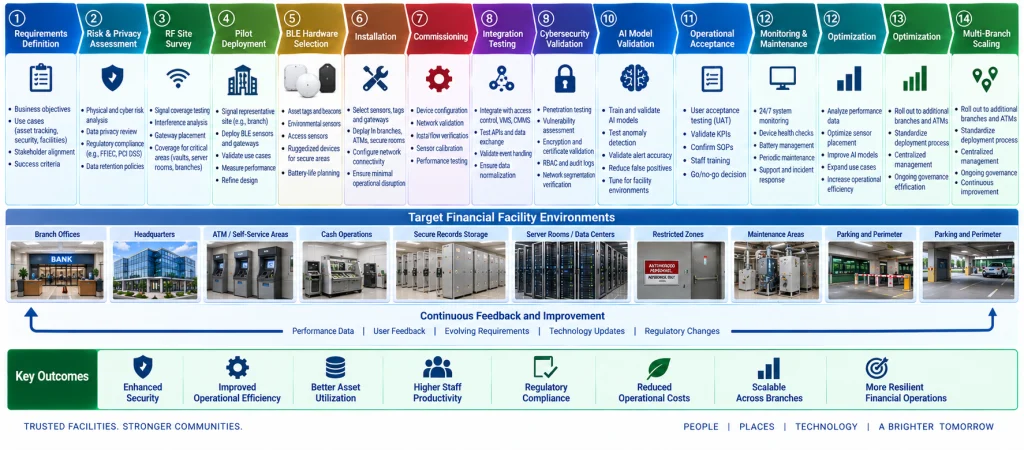
A financial service facility deployment lifecycle maps AI-enabled BLE implementation from requirements definition, risk assessment, RF surveying, and pilot deployment through installation, integration, cybersecurity and AI validation, operational acceptance, monitoring, optimization, and multi-branch scaling. The lifecycle incorporates continuous feedback across branch offices, ATMs, cash operations, secure storage, server rooms, restricted zones, and maintenance areas.
Practical Trade-Offs in Financial Facility Deployments
No BLE deployment provides every capability at minimum cost and complexity. Engineering decisions should balance operational requirements against implementation constraints.
Higher location precision generally requires more receiving infrastructure, better calibration, and potentially greater installation and maintenance effort. Longer BLE transmission intervals can extend battery life but reduce the frequency of location observations. More frequent sensing provides greater temporal detail but increases power consumption and data volume.
Cloud deployment can simplify centralized management across geographically distributed facilities, while privately hosted server deployments can provide greater organizational control over data processing and network boundaries. Hybrid implementations can combine local event processing with centralized analytics.
AI can improve contextual decision-making, but it requires representative data, model validation, monitoring, and appropriate human oversight. A deterministic rule may be preferable for a simple threshold, while machine learning can be valuable where the operational pattern is complex.
These trade-offs should be documented during requirements engineering rather than discovered after installation.
GAO Expertise in BLE, RFID, and Connected Facility Systems
GAO provides BLE, RFID, and IoT hardware products and systems that organizations can use for asset identification, location monitoring, sensing, and connected operational workflows. Our technical approach emphasizes selecting the appropriate sensing technology for the physical environment and integrating device data with software systems that support actual operational decisions.
Headquartered in New York City and Toronto, Canada, GAO is ranked among the top 10 leading B2B and B2G BLE and RFID suppliers in the world. GAO and sister companies GAO Research and GAO Tek form GAO Group, with operations based in New York City and Toronto.
For three decades, GAO Group has served organizations across the United States and Canada, including Fortune 500 companies, major R&D organizations, prestigious universities, and U.S. and Canadian government agencies. Its investment in research and development, quality assurance, and technical support provides a foundation for supplying connected technology to demanding operational environments.
Key Takeaways for Financial Service Facility Decision-Makers
AI-enabled BLE solutions can help financial service facilities establish better visibility into movable assets, environmental conditions, maintenance activities, restricted areas, and operational workflows. The technology becomes more valuable when BLE observations are correlated with access-control, asset-management, maintenance, security, and facility systems.
Successful implementation depends on clearly defined requirements, appropriate RF planning, reliable hardware, secure data flows, validated AI models, controlled system integration, and measurable acceptance criteria. Financial organizations should also address cybersecurity, privacy, regulatory obligations, data retention, and long-term device management before deployment.
GAO can help organizations evaluate BLE, RFID, sensors, gateways, and related IoT systems for financial facility applications. Readers can learn more about GAO’s technology solutions, engineering capabilities, products, and technical support when planning asset visibility, sensing, security-support, and facility intelligence initiatives.
Building the Future of Industrial AI and IoT with Aperture Venture Studio and GAO RFID Inc.
For more than three decades, GAO Group of Companies has invested heavily in R&D of industrial BLE, RFID, and IoT. As generative AI became increasingly useful for industrial applications, we expanded our work across AI and IoT, including BLE and RFID, and founded Aperture Venture Studio to build, launch, and scale next-generation AI and IoT companies and solutions relevant to fields such as financial service facility operations.
Aperture has attracted AI and IoT technical experts, entrepreneurial and operational executives, influential investors, and leading companies. We have also developed the Aperture Ventures Summit and TekSummit to discuss advanced AI and IoT topics. These activities have helped develop diversified technical communities around AI and IoT.
We welcome you to join us as:
- Advisors, Co-founders, or Employees
- Investors
- Customers