
AI and BLE for Industrial Fabrication
AI-Driven Industrial Fabrication with BLE Asset and Process Visibility
Artificial intelligence is changing industrial fabrication by turning production, equipment, material, and workforce data into actionable operating decisions. AI systems can analyze machine conditions, welding parameters, fabrication cycle times, material movement, work-in-process status, inspection results, and maintenance records to identify conditions that conventional reporting may miss. BLE beacons, BLE sensors, and BLE gateways provide a practical wireless data layer for tracking fabricated components, tooling, mobile equipment, material racks, work-in-process, and selected machine conditions. For metal fabrication operations, this combination can support predictive maintenance, production monitoring, quality management, material traceability, and safer workflows. The strongest deployments do not treat BLE as the objective. BLE is the enabling connectivity used to capture operational signals that AI can correlate with MES, ERP, CMMS, quality, and production data. GAO supplies BLE, RFID, and IoT hardware and systems that can be incorporated into these industrial fabrication workflows.
AI and BLE for Industrial Fabrication: Connected Production and Analytics
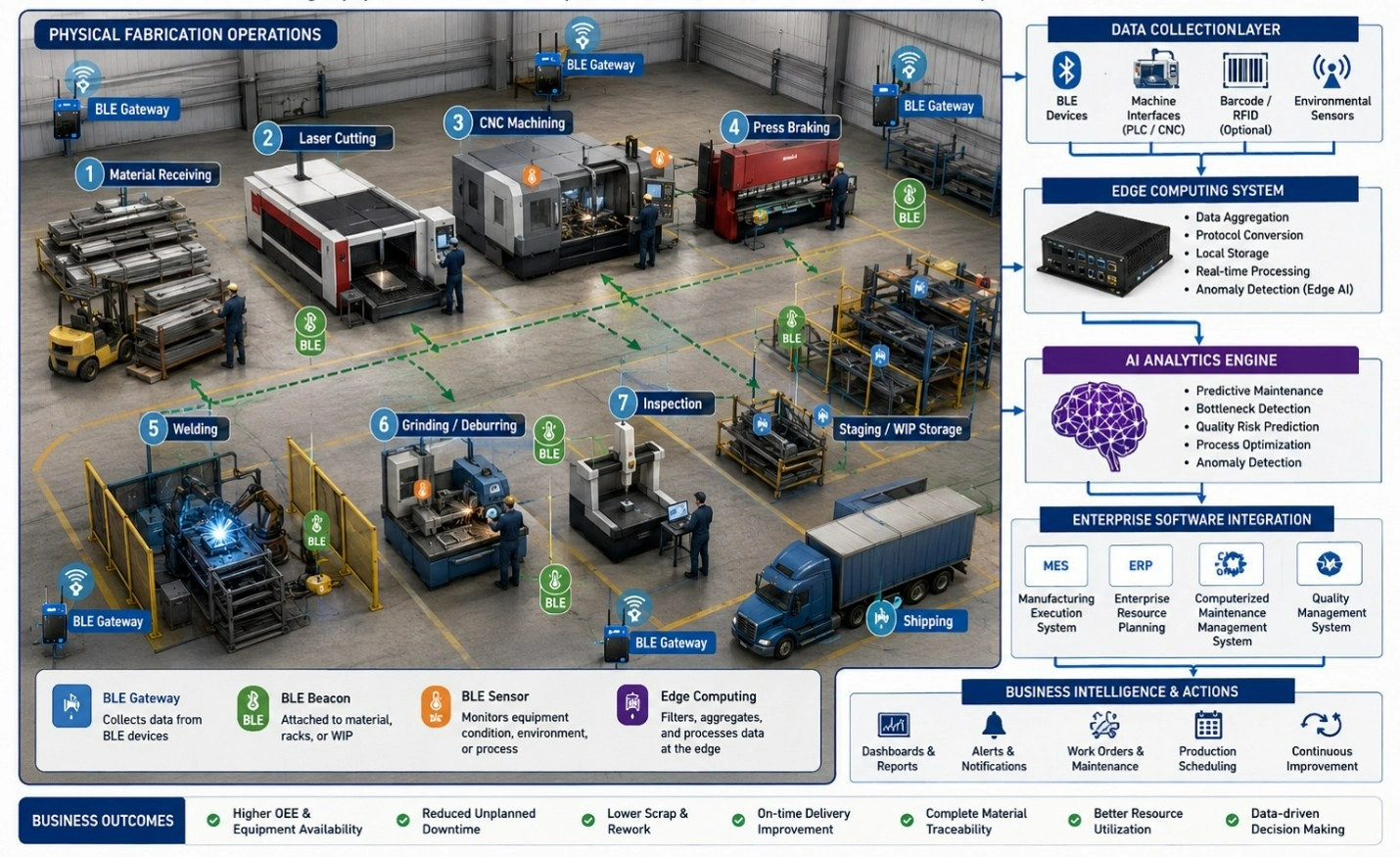
This infographic shows how BLE gateways, beacons, and sensors connect industrial fabrication processes such as material receiving, laser cutting, CNC machining, press braking, welding, grinding, inspection, WIP staging, and shipping. The visual traces operational data through edge computing and AI analytics into MES, ERP, CMMS, and quality management systems, highlighting predictive maintenance, bottleneck detection, quality prediction, traceability, and production optimization.
What AI Means for Modern Industrial Fabrication
Industrial fabrication converts raw metal, engineered designs, and production instructions into finished components, assemblies, frames, enclosures, pressure-related components, structural parts, machined pieces, and other fabricated products. The operating environment combines discrete manufacturing with highly variable material, tooling, process, and quality conditions.
Typical workflows include:
- Material receiving and identification
- Heat, coil, plate, sheet, tube, bar, and structural material staging
- Material cutting and nesting
- Laser, plasma, waterjet, oxyfuel, or mechanical cutting
- CNC milling, turning, drilling, and machining
- Press brake forming
- Roll forming and plate rolling
- Welding and weld inspection
- Grinding, deburring, and surface preparation
- Heat treatment where applicable
- Painting, coating, plating, or other finishing
- Dimensional inspection
- Non-destructive testing
- Assembly and kitting
- Work-in-process staging
- Final inspection
- Packaging and shipment
AI becomes valuable when these activities generate enough structured and contextual data to support decisions rather than merely producing historical reports.
A predictive maintenance model, for example, can correlate vibration, temperature, operating hours, maintenance history, machine utilization, and production load to identify abnormal behavior in motors, pumps, compressors, conveyors, extraction systems, welding equipment, or other machinery. Research into industrial predictive maintenance consistently identifies sensor-generated operational data as an important input for AI-based failure prediction.
AI can also support quality prediction. Welding is a particularly relevant example because weld quality depends on interacting variables such as current, voltage, travel conditions, material characteristics, shielding conditions, and process parameters. Research has demonstrated the feasibility of combining multi-sensor welding data with machine learning to predict quality-related outcomes.
The practical objective is not to replace fabrication engineers, weld inspectors, maintenance technicians, or production supervisors. The objective is to provide them with earlier and better evidence.
Where AI Creates Operational Value in Metal Fabrication
AI Predictive Maintenance for Fabrication Equipment
Unexpected failure of a laser cutter, CNC machine, press brake, welding system, compressor, dust collector, overhead crane, or material-handling system can disrupt multiple downstream jobs.
AI predictive maintenance can analyze:
- Vibration trends
- Bearing temperature
- Motor temperature
- Operating cycles
- Runtime
- Energy consumption
- Maintenance events
- Alarm history
- Machine utilization
- Production load
- Environmental conditions
BLE sensors can collect selected condition measurements without requiring every monitoring point to be permanently wired. BLE gateways can forward those measurements to local or cloud software for aggregation.
The important engineering distinction is that a BLE sensor should not be treated as a replacement for a machine’s safety control system, PLC, emergency stop, interlock, or other safety-rated mechanism. AI recommendations should remain advisory unless a properly engineered control system has been designed, validated, and certified for automatic action.
AI Asset Tracking for Fabrication Tools and Work-in-Process
Industrial fabrication facilities commonly lose time locating welding machines, inspection instruments, fixtures, dies, jigs, carts, material racks, lifting accessories, tooling, and partially completed assemblies.
BLE asset tracking can provide location or proximity information for:
- Welding machines
- Portable inspection equipment
- Fixtures and jigs
- Press brake tooling
- Cutting tools
- Material racks
- Fabricated assemblies
- Work-in-process carts
- Gas cylinders where permitted and appropriate
- Maintenance equipment
- Mobile production equipment
AI adds value by interpreting movement history rather than simply displaying the current location. A system can identify recurring staging delays, excessive travel, abnormal dwell time, equipment underutilization, or repeated movement between fabrication cells.
Bluetooth SIG documentation describes BLE asset tracking using locator devices and tags, including RSSI-based positioning and Bluetooth Direction Finding technologies such as Angle of Arrival. Accuracy, infrastructure cost, RF conditions, and application requirements must be evaluated together rather than assuming that one positioning method is appropriate for every fabrication facility.
AI Production Flow and Work-in-Process Visibility
A fabrication job can move through multiple cells before completion. A supervisor may know that a job is “in production” without knowing whether it is waiting for cutting, forming, welding, inspection, rework, coating, or final assembly.
AI can combine:
- BLE location events
- Job traveler information
- Machine status
- MES records
- Operator inputs
- Inspection results
- Production schedules
- Material availability
- Work-order status
The resulting model can estimate process dwell time and identify bottlenecks.
For example, repeated WIP dwell between laser cutting and press braking may indicate scheduling imbalance, material staging problems, tooling availability issues, or downstream capacity constraints. AI does not automatically determine the root cause. It narrows the investigation by connecting events that are otherwise stored in separate systems.
AI Quality Inspection and Fabrication Defect Detection
Computer vision can support inspection of:
- Weld appearance
- Surface defects
- Burrs
- Scratches
- Coating defects
- Hole presence and position
- Part geometry
- Markings and labels
- Assembly completeness
- Dimensional characteristics
Computer vision should be integrated with established inspection procedures rather than treated as an unconditional replacement for qualified inspection personnel.
For fabrication operations, model performance can also degrade when lighting, material finish, camera position, weld appearance, part geometry, or production mix changes. A production-grade system therefore requires representative training data, validation datasets, confidence thresholds, exception handling, model monitoring, and human review for uncertain cases.
AI Material and Work-in-Process Traceability
Material traceability is especially important when fabricated components require documented material identity, heat information, certifications, job association, inspection records, or controlled processing.
BLE can help establish physical location and movement events, while RFID, barcode, machine data, and operator records can provide additional identity information.
A practical traceability record can associate:
Material identity → fabrication job → processing cell → machine/process event → inspection result → WIP location → finished assembly → shipment
AI can then identify missing records, unusual movement patterns, process delays, or mismatches between expected and observed workflow.
GAO provides BLE and RFID hardware that can support these identification and tracking requirements, allowing organizations to select the appropriate wireless technology according to material, distance, read requirements, environmental conditions, and workflow.
Industrial Fabrication WIP Traceability Workflow from Material to Shipment
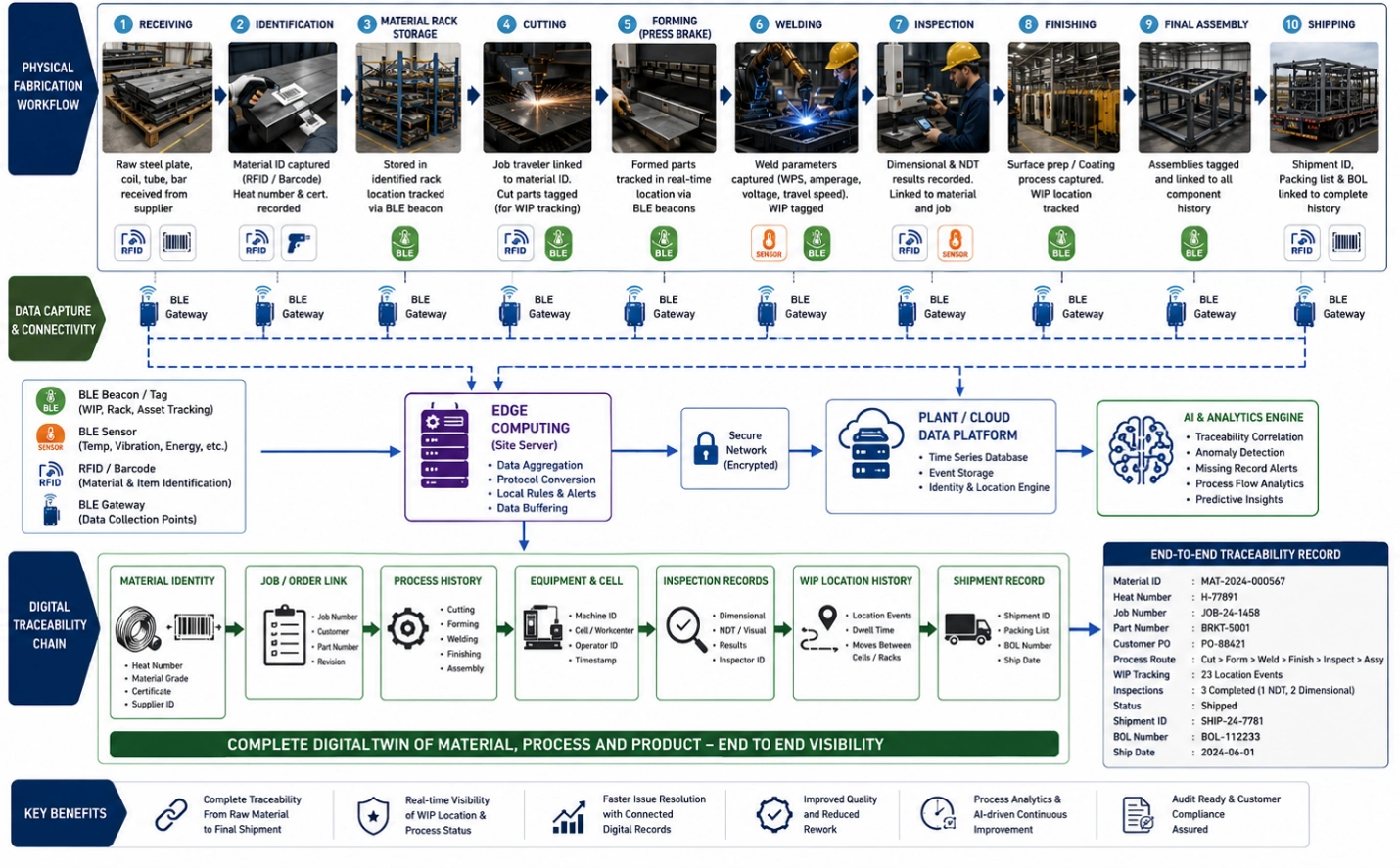
This workflow illustrates end-to-end traceability across receiving, material identification, cutting, forming, welding, inspection, finishing, assembly, and shipping. BLE gateways, BLE beacons, sensors, RFID/barcodes, edge computing, plant or cloud data services, and AI analytics connect physical production events into a unified digital traceability record.
Industrial Fabrication Applications That Benefit from AIoT
The strongest use cases are those where physical conditions change faster than manual reporting can capture them.
| Industrial fabrication application | Data captured | AI function | Operational decision |
|---|---|---|---|
| Equipment predictive maintenance | Vibration, temperature, runtime, alarms | Anomaly detection and failure-risk scoring | Schedule maintenance before probable failure |
| WIP tracking | Location, dwell time, job identity | Process-flow analysis | Investigate bottlenecks and stalled jobs |
| Tool utilization | Location, movement, usage events | Utilization modeling | Reallocate or purchase tooling |
| Welding quality | Current, voltage, process signals, images | Quality prediction and anomaly detection | Trigger inspection or process review |
| Material traceability | Identity, location, job association | Record correlation and exception detection | Resolve missing or inconsistent traceability |
| Production scheduling | Machine state, WIP, job priority | Constraint and delay prediction | Adjust production sequencing |
| Safety monitoring | Location, environmental data, machine context | Pattern and anomaly analysis | Generate alerts for defined conditions |
| Energy optimization | Machine runtime, load, temperature | Consumption modeling | Identify abnormal or inefficient operation |
Industrial Fabrication Deployment Challenges
AI implementation in fabrication is not primarily a model-selection problem. The difficult part is creating trustworthy operational data.
RF Conditions Around Metal Equipment
Metal structures, machinery, enclosures, racks, welding areas, and dense equipment can influence wireless propagation. Bluetooth SIG specifically identifies metal environments and industrial interference as engineering considerations for industrial wireless deployments.
A deployment should therefore begin with an RF survey rather than assuming that a gateway installed at a convenient location will provide uniform coverage.
Important factors include:
- Gateway placement
- Antenna orientation
- Metal obstruction
- Equipment movement
- RF interference
- Required location accuracy
- Sensor transmission interval
- Battery life
- Environmental temperature
- Enclosure requirements
- Network availability
RSSI-based location can be appropriate for zone-level visibility, but tighter positioning requirements may justify Bluetooth Direction Finding or another positioning technology. Bluetooth SIG’s Asset Tracking Profile defines BLE-based Angle of Arrival operation using locator antenna arrays and asset tags.
Data Quality and Model Reliability
AI cannot compensate for systematically poor source data.
Fabrication environments commonly produce:
- Missing machine records
- Inconsistent job identifiers
- Manual status updates
- Uncalibrated sensors
- Incorrect asset assignments
- Incomplete maintenance histories
- Changing production recipes
- Inconsistent inspection classifications
Data engineering should therefore be treated as part of the AI project, not as a later software task.
Safety and Control Boundaries
AI systems must remain clearly separated from safety-critical controls unless the complete control function has been engineered for the required safety integrity.
Machine guarding requirements apply to hazards including point-of-operation hazards, rotating components, flying chips, sparks, and other machine-related risks. OSHA’s general machine guarding requirements include 29 CFR 1910.212, while welding operations are addressed under additional requirements including 29 CFR 1910.252.
Consequently, an AI system can identify an abnormal condition or recommend an intervention, but that recommendation should not bypass established machine guarding, lockout/tagout, emergency-stop, interlock, or other safety procedures.
From Fabrication Data Capture to AI-Driven Decisions
A practical AIoT deployment for industrial fabrication typically follows a data path rather than a single software installation.
Physical Data Acquisition
Data originates from the fabrication process.
Possible sources include:
- BLE condition sensors
- BLE beacons
- BLE asset tags
- BLE gateways
- PLCs
- CNC controllers
- Welding equipment
- Machine sensors
- Vision cameras
- Barcode scanners
- RFID readers
- RFID tags
- Environmental sensors
- Inspection equipment
- Operator terminals
- MES
- ERP
- CMMS
BLE is most useful where low-power wireless connectivity provides an economical way to capture location, movement, condition, or environmental information. Bluetooth technology is increasingly used for industrial monitoring, tracking, and predictive maintenance because low-power sensors can operate without the installation burden associated with wiring every monitoring point.
Gateway and Edge Processing
BLE gateways receive sensor and beacon data and pass it toward local or remote software.
An industrial gateway may perform:
- Device discovery
- Packet reception
- Data filtering
- Timestamping
- Local buffering
- Protocol conversion
- Basic validation
- Secure network transmission
Edge processing becomes particularly useful when fabrication operations require rapid responses, intermittent connectivity, local data retention, or reduced bandwidth.
A gateway can also prevent unnecessary raw data transmission. For example, a sensor transmitting frequent vibration measurements may be filtered locally so that only relevant features or abnormal events are sent to the AI service.
AI and Analytics Layer
The AI layer can use several methods depending on the problem.
- Supervised machine learning for known defect or failure classifications
- Unsupervised anomaly detection when failure labels are limited
- Time-series models for equipment and process behavior
- Computer vision for visual inspection
- Regression models for quality or process prediction
- Classification models for defect categories
- Optimization methods for scheduling and resource allocation
- Forecasting models for production and maintenance planning
- Generative AI for controlled access to maintenance records, work instructions, engineering documentation, and operational knowledge
A fabrication organization should select the simplest model that meets the required accuracy, latency, explainability, and maintenance requirements. A complex neural network is not automatically superior to a well-designed statistical or tree-based model.
Enterprise Software Integration
AI becomes operationally useful when its output reaches the people and systems responsible for action.
Typical integration targets include:
- MES for production execution
- ERP for orders, materials, purchasing, and financial records
- CMMS or EAM for maintenance
- QMS for inspection and nonconformance management
- WMS for material movement where warehouse functions are involved
- SCADA for industrial monitoring
- Historian databases for time-series process data
- PLM for engineering and product lifecycle information
- Workforce systems for operational assignments
The integration objective should be specific. A predictive-maintenance alert should create or enrich a maintenance workflow. A WIP bottleneck prediction should reach production planning. A quality anomaly should reach the responsible inspection or process-engineering workflow.
AIoT Data Pipeline Architecture for Industrial Fabrication
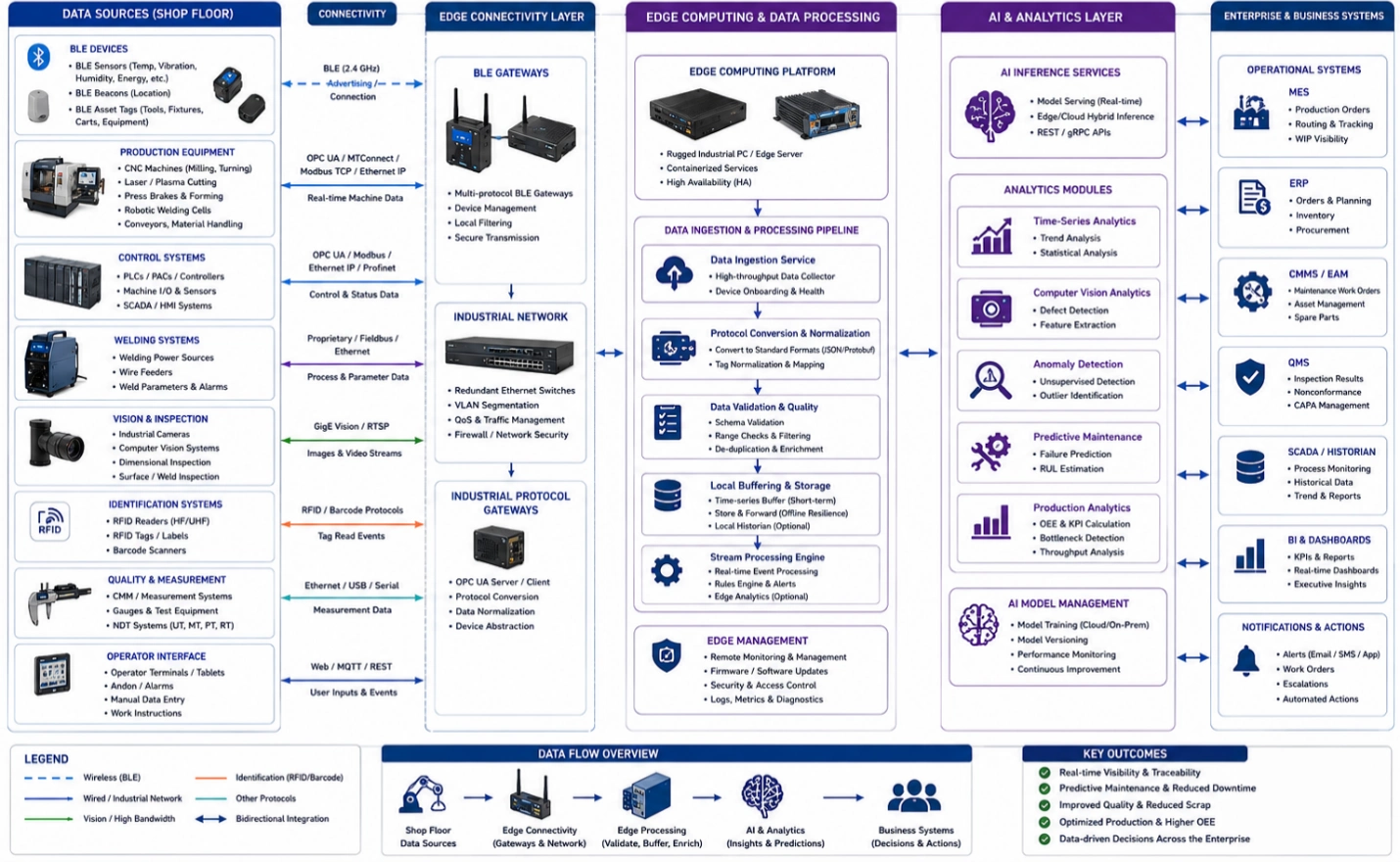
This technical diagram maps industrial fabrication data from BLE devices, CNC machines, PLCs, welding systems, vision systems, RFID, inspection equipment, and operator interfaces through gateways, industrial networking, edge processing, and AI analytics. It shows integration with MES, ERP, CMMS, QMS, SCADA, dashboards, and notification systems to support predictive maintenance, quality improvement, production optimization, traceability, and data-driven decisions.
BLE Hardware and Software for Industrial Fabrication
BLE should be selected according to the operational requirement rather than treated as a universal connectivity method.
BLE Beacons and Asset Tags
BLE beacons can identify mobile assets, WIP carriers, fixtures, tooling, and other objects whose location or movement is operationally significant.
For fabrication, the enclosure and mounting method matter as much as the radio. Devices may encounter:
- Metal surfaces
- Welding sparks
- Dust
- Oil
- Coolant
- Temperature changes
- Mechanical impact
- Repeated cleaning
- Outdoor staging areas
Battery selection also affects total maintenance cost. A beacon with an unnecessarily high transmission rate may create shorter battery life without providing meaningful additional operational value.
BLE Sensors
BLE sensors can capture selected variables such as temperature, humidity, vibration, motion, acceleration, or other application-specific measurements.
The engineering decision should consider:
- Measurement range
- Accuracy
- Sampling interval
- Transmission interval
- Battery life
- Calibration
- Environmental rating
- Mounting method
- Sensor drift
- Required data retention
BLE Gateways
BLE gateways bridge local BLE devices and the industrial network.
A fabrication facility may use gateways to transmit information through Ethernet, Wi-Fi, cellular connectivity, or another supported network path depending on site constraints.
Gateway placement should be based on RF coverage and operational requirements rather than simply installing one gateway per room. Bluetooth asset-tracking guidance emphasizes that location accuracy, infrastructure cost, and radio technology selection must be evaluated together.
GAO supplies BLE gateways, beacons, sensors, RFID equipment, and related IoT hardware that can be incorporated into industrial tracking and monitoring systems.
Cloud and Server Deployment for Industrial Fabrication AI
Industrial fabrication organizations generally have two practical deployment directions: cloud-hosted software or privately hosted server software.
Cloud Version
A cloud-hosted deployment is appropriate when fabrication operations need centralized visibility across multiple plants, remote access, elastic computing resources, centralized analytics, or easier aggregation of data from geographically distributed facilities.
Typical characteristics include:
- Cloud-hosted application services
- Centralized databases
- Remote dashboards
- Cloud AI inference or model training
- API-based integration
- Centralized device management
- Multi-site analytics
- Remote software maintenance
The primary advantage is centralized scalability. The primary engineering concern is dependence on network availability, data governance requirements, cybersecurity controls, and the suitability of transmitting operational data outside the facility.
Server Version
A privately hosted deployment can place software on a factory server, edge server, customer-managed infrastructure, private data center, or another controlled enterprise environment.
This model can be appropriate when fabrication operations require:
- Local processing
- Low-latency decisions
- Restricted data movement
- Existing private IT infrastructure
- Integration with local MES or SCADA systems
- Operation during internet outages
- Customer-controlled data retention
- Internal cybersecurity policies
A hybrid arrangement is also possible. Edge servers can perform immediate processing while selected historical data and analytics are synchronized with a central cloud environment.
NIST’s current IoT cybersecurity guidance emphasizes that IoT manufacturers should address cybersecurity capabilities, customer security needs, maintenance, support, and end-of-life considerations across the product lifecycle. Those principles are directly relevant when selecting BLE sensors, gateways, edge software, and AI-connected IoT systems for fabrication environments.
Cloud vs Private Server AIoT Deployment for Industrial Fabrication
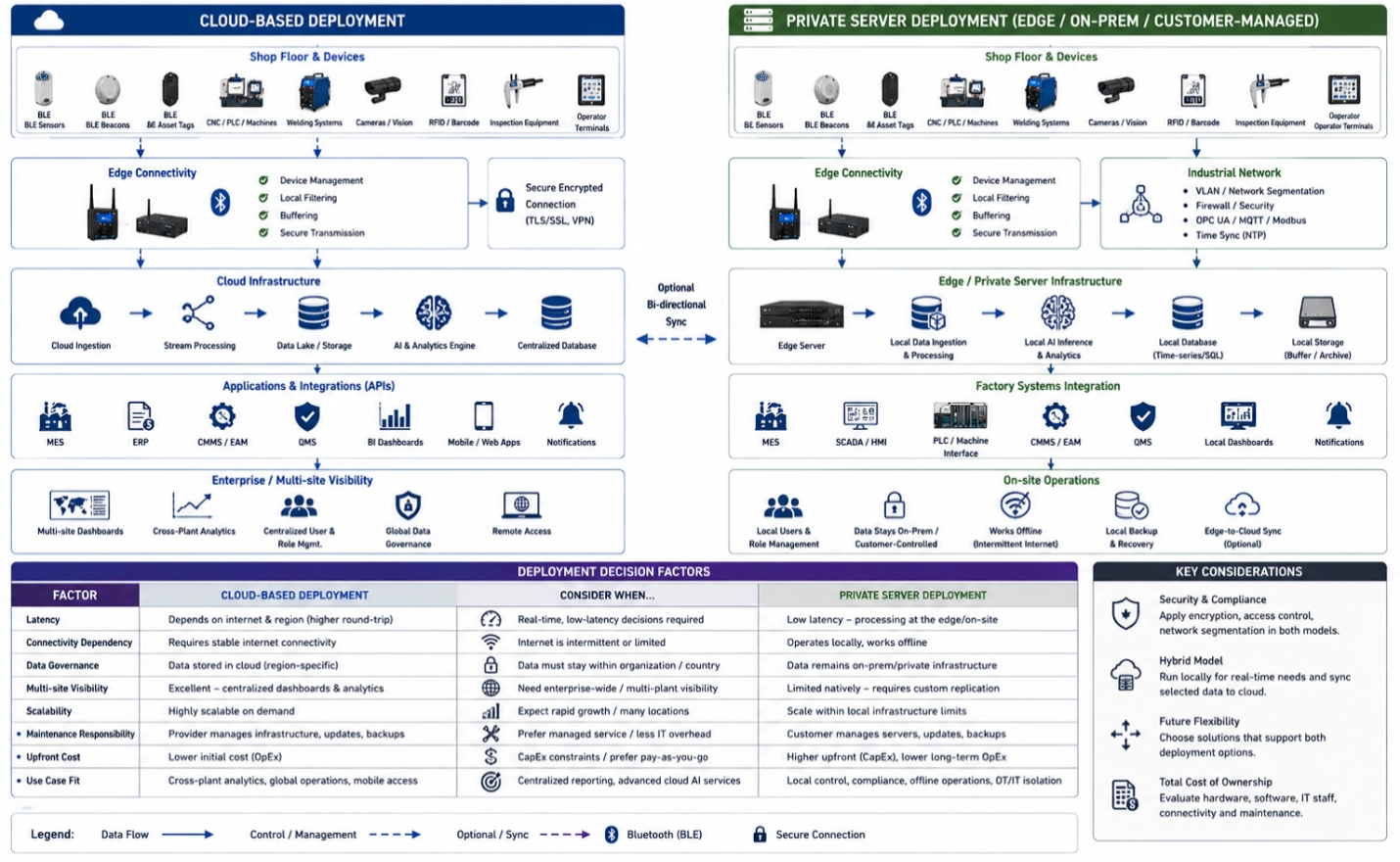
This comparison diagram shows how BLE sensors, beacons, asset tags, gateways, fabrication equipment, and inspection systems connect through cloud-based or private server deployments. It compares latency, connectivity, data governance, scalability, maintenance responsibility, cost, multi-site visibility, and integration with MES, ERP, CMMS, QMS, SCADA, and local factory systems.
Engineering Considerations Before Deployment
A successful industrial fabrication deployment should begin with operational requirements rather than hardware selection.
Define the Business Event First
Start with the decision the system must improve.
Examples include:
- “Which WIP jobs have remained outside their expected process window?”
- “Which welding assets show abnormal thermal behavior?”
- “Which fabrication tools are repeatedly unavailable when scheduled?”
- “Which machines have a rising probability of maintenance intervention?”
- “Which material movements do not match the expected job workflow?”
- “Which inspection records are incomplete before shipment?”
This approach prevents the common mistake of collecting large quantities of sensor data without a defined operational use.
Establish the Required Accuracy
Location requirements should be expressed operationally.
Zone-level information may be sufficient to determine whether a welding machine is in fabrication cell A or cell B. A more precise requirement may be necessary to distinguish several adjacent WIP carts.
Bluetooth-based asset tracking can use RSSI, while Bluetooth Direction Finding can provide more precise directional information. The correct choice depends on the required accuracy, physical layout, RF environment, device density, and cost.
Design for Maintenance
The cheapest sensor is not necessarily the cheapest system.
A fabrication deployment should estimate:
- Battery replacement frequency
- Calibration requirements
- Device failure rate
- Gateway maintenance
- Network support
- Firmware management
- Spare inventory
- Environmental damage
- Sensor mounting labor
- Cybersecurity updates
- Data-storage costs
These lifecycle factors should be included in total cost of ownership before large-scale deployment.
Protect Operational and Industrial Networks
BLE devices and gateways should not become an uncontrolled path into production networks.
Security controls should include appropriate device identity, authentication, access control, network segmentation, encrypted communications where supported, credential management, firmware lifecycle management, logging, vulnerability management, and controlled administrative access.
NIST’s manufacturing cybersecurity work emphasizes a risk-based approach for reducing cybersecurity exposure in manufacturing environments.
The practical rule is straightforward: connect only the data that the AI and fabrication workflows actually require, and isolate the connectivity path from safety-critical controls unless a formally engineered integration requires otherwise.
Industrial Fabrication AI Deployment Decision Tree
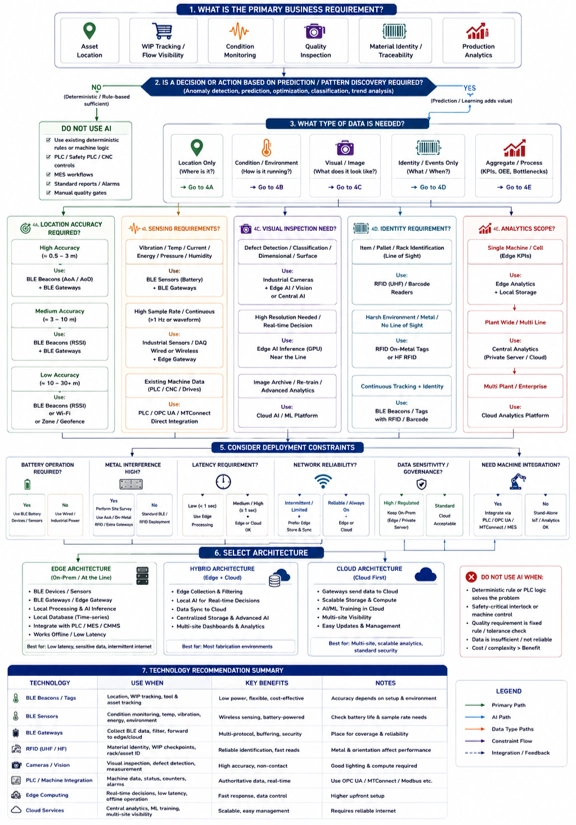
This decision tree helps fabrication teams select AI, BLE, RFID, computer vision, PLC integration, edge computing, hybrid systems, or cloud services based on the operational requirement and data characteristics. It also evaluates battery operation, metal interference, latency, network reliability, data governance, machine integration, and cases where deterministic rules are more appropriate than AI.
Industrial Fabrication AI Capabilities and Business Outcomes
AI delivers measurable value in industrial fabrication when it converts disconnected production signals into decisions that improve throughput, quality, equipment availability, traceability, and resource utilization. BLE provides one possible data-acquisition layer, while machine interfaces, RFID, computer vision, PLCs, MES, ERP, CMMS, and inspection systems provide additional context.
Predictive Maintenance and Equipment Availability
Predictive maintenance can move fabrication maintenance from predominantly calendar-based servicing toward condition-informed intervention.
AI models can establish normal operating patterns for equipment and identify deviations associated with developing problems. For example, increasing vibration combined with rising motor temperature and extended operating cycles can provide stronger evidence of mechanical deterioration than any single measurement.
The practical workflow is:
- Capture equipment condition and operating data
- Establish a baseline for normal machine behavior
- Detect statistical or machine-learning anomalies
- Correlate anomalies with maintenance and production history
- Estimate maintenance risk
- Prioritize inspection
- Create or update a CMMS maintenance action
- Record the technician’s finding
- Feed the result back into the model-development process
The objective is not simply to predict failure. A useful system must reduce unplanned downtime without generating excessive false alarms.
Production Bottleneck Detection
Fabrication throughput is frequently constrained by the interaction between processes rather than by the nominal capacity of an individual machine.
A laser cutter may have sufficient capacity while downstream press brakes are overloaded. Welding may become the bottleneck after a large batch of formed parts reaches fabrication. Inspection can subsequently become the constraint when completed work accumulates faster than inspectors can process it.
AI can analyze:
- WIP dwell time
- Machine utilization
- Queue duration
- Job priority
- Processing time
- Changeover time
- Material availability
- Operator assignments
- Rework frequency
- Inspection delays
This enables production managers to identify where the actual constraint is developing rather than relying exclusively on scheduled capacity.
Quality and Rework Reduction
Rework is expensive because its cost includes additional labor, machine time, consumables, inspection, scheduling disruption, and sometimes material loss.
AI can identify correlations between process conditions and quality outcomes.
Potential inputs include:
- Weld process parameters
- Machine settings
- Material characteristics
- Tool condition
- Operator-entered process information
- Environmental conditions
- Inspection measurements
- Historical nonconformance records
- Images from inspection stations
A model can then estimate defect probability or identify process combinations associated with elevated risk.
Human inspection remains important for acceptance decisions where applicable. AI should provide evidence, prioritization, and consistency rather than bypassing engineering specifications, inspection procedures, or customer requirements.
Improved Tool and Fixture Utilization
Press brake tooling, welding fixtures, jigs, gauges, inspection instruments, and specialized cutting tools can represent significant capital expenditure.
BLE-based tracking can identify where frequently needed assets are located and how long they remain idle or outside their assigned fabrication area.
AI can extend this capability by identifying:
- Underutilized tools
- Repeated tool-search events
- Excessive movement
- Unbalanced tool distribution
- Long periods of inactivity
- Recurring shortages at particular fabrication cells
This information can support decisions about tool allocation, maintenance, replacement, and procurement.
Better Material Traceability
Material traceability becomes increasingly important when customers require documented material identity, processing history, inspection records, certificates, or controlled manufacturing processes.
A connected traceability system can associate:
Material → Job → Process → Equipment → Operator/Cell → Inspection → WIP Location → Finished Component → Shipment
BLE can provide location and movement context. RFID or barcode identification can provide item identity. MES can provide production status. QMS can retain inspection and nonconformance information. ERP can provide order and material records.
AI can then detect inconsistencies across these records.
Examples include:
- Material assigned to an unexpected job
- WIP remaining in a process area beyond its expected duration
- Missing inspection events
- Unexpected movement between fabrication cells
- Incomplete traceability records before shipment
Industrial Fabrication KPIs for AI and IoT Programs
Technology deployment should be measured against operational indicators rather than device counts.
| KPI | What it measures | AI contribution |
|---|---|---|
| Overall Equipment Effectiveness | Availability, performance, and quality | Identifies recurring loss patterns |
| Unplanned downtime | Production time lost to unexpected failures | Predicts abnormal equipment behavior |
| Mean Time Between Failures | Equipment reliability | Identifies failure-related operating conditions |
| Mean Time to Repair | Maintenance response and restoration | Improves maintenance prioritization |
| WIP dwell time | Time spent waiting between processes | Detects bottlenecks |
| First-pass yield | Output meeting requirements without rework | Identifies quality-risk conditions |
| Scrap rate | Material and production loss | Finds process variables associated with defects |
| Rework hours | Labor consumed correcting defects | Identifies recurring defect patterns |
| Schedule adherence | Actual production versus planned schedule | Predicts delays |
| Tool utilization | Productive use of tooling | Identifies idle or misplaced assets |
| Material traceability completeness | Availability of required production records | Detects missing data |
| Inspection turnaround time | Time from production completion to inspection disposition | Identifies quality-process constraints |
| Energy consumption per part | Energy efficiency | Detects abnormal machine consumption |
| Maintenance response time | Time from alert to maintenance action | Measures operational response |
| Asset search time | Time employees spend locating equipment or tooling | Quantifies tracking value |
The baseline should be recorded before deployment. Otherwise, a later improvement cannot reliably be attributed to the AI or IoT system.
Industrial Fabrication AI Implementation Lifecycle
Planning and Process Selection
The initial project should focus on a constrained operational problem rather than attempting to digitize an entire fabrication facility simultaneously.
Good candidates generally have:
- A measurable business problem
- Accessible operational data
- A defined process owner
- A repeatable workflow
- A meaningful financial or production impact
- A feasible integration path
- A clear success metric
A predictive-maintenance pilot for a small group of high-impact machines is usually easier to validate than attempting to instrument every machine immediately.
Site Survey and RF Validation
The physical facility should be surveyed before installing BLE gateways and sensors.
The assessment should document:
- Fabrication cells
- Machine locations
- Material storage
- WIP staging
- Gateway mounting positions
- Network access
- RF obstructions
- Electrical availability
- Environmental conditions
- Areas with high welding activity
- Outdoor or semi-outdoor staging
- Required location zones
A small pilot should test real conditions rather than relying exclusively on laboratory specifications.
Hardware Commissioning
Every deployed device should receive a controlled identity.
Commissioning records can include:
- Device identifier
- Asset identifier
- Sensor type
- Installation location
- Associated production cell
- Battery condition
- Firmware version
- Gateway assignment
- Calibration status
- Installation date
- Maintenance history
This information becomes part of the operational device inventory.
Data Validation
Before training AI models, validate the underlying data.
Engineering teams should verify:
- Timestamp accuracy
- Device identity
- Sampling intervals
- Missing data
- Duplicate events
- Sensor drift
- Gateway connectivity
- Asset association
- Machine-state correlation
- Production-order correlation
A model trained on incorrect asset associations can produce highly convincing but completely wrong conclusions.
Pilot and Model Validation
The pilot should compare AI predictions against actual operational outcomes.
For predictive maintenance, this could mean comparing predicted anomalies against technician inspections and subsequent equipment behavior.
For WIP analytics, predicted bottlenecks should be compared with actual queue formation.
For quality applications, model predictions should be evaluated against verified inspection results.
Important model metrics can include:
- Precision
- Recall
- False-positive rate
- False-negative rate
- Mean absolute error
- Prediction latency
- Detection lead time
- Model drift
- Confidence distribution
The appropriate metric depends on the operational risk. A false negative may be much more costly than a false positive in some maintenance or quality applications.
Production Commissioning
Production deployment should include operational ownership.
The responsible teams may include:
- Production engineering
- Maintenance
- Quality
- IT
- OT engineering
- Cybersecurity
- Plant management
- Procurement
- Machine operators
- System integrators
The project should define who receives an alert, who validates it, who takes action, and where the resulting action is recorded.
An AI alert with no accountable workflow is merely another notification.
Optimization and Scale-Up
Once the pilot demonstrates measurable value, additional fabrication cells can be added.
Scale-up should reuse validated:
- Device configurations
- Gateway designs
- Network controls
- Data models
- Integration methods
- Security policies
- AI pipelines
- Maintenance procedures
- KPI definitions
Scaling should not mean installing more devices without validating whether the additional data improves decisions.
AIoT Implementation Lifecycle for Industrial Fabrication
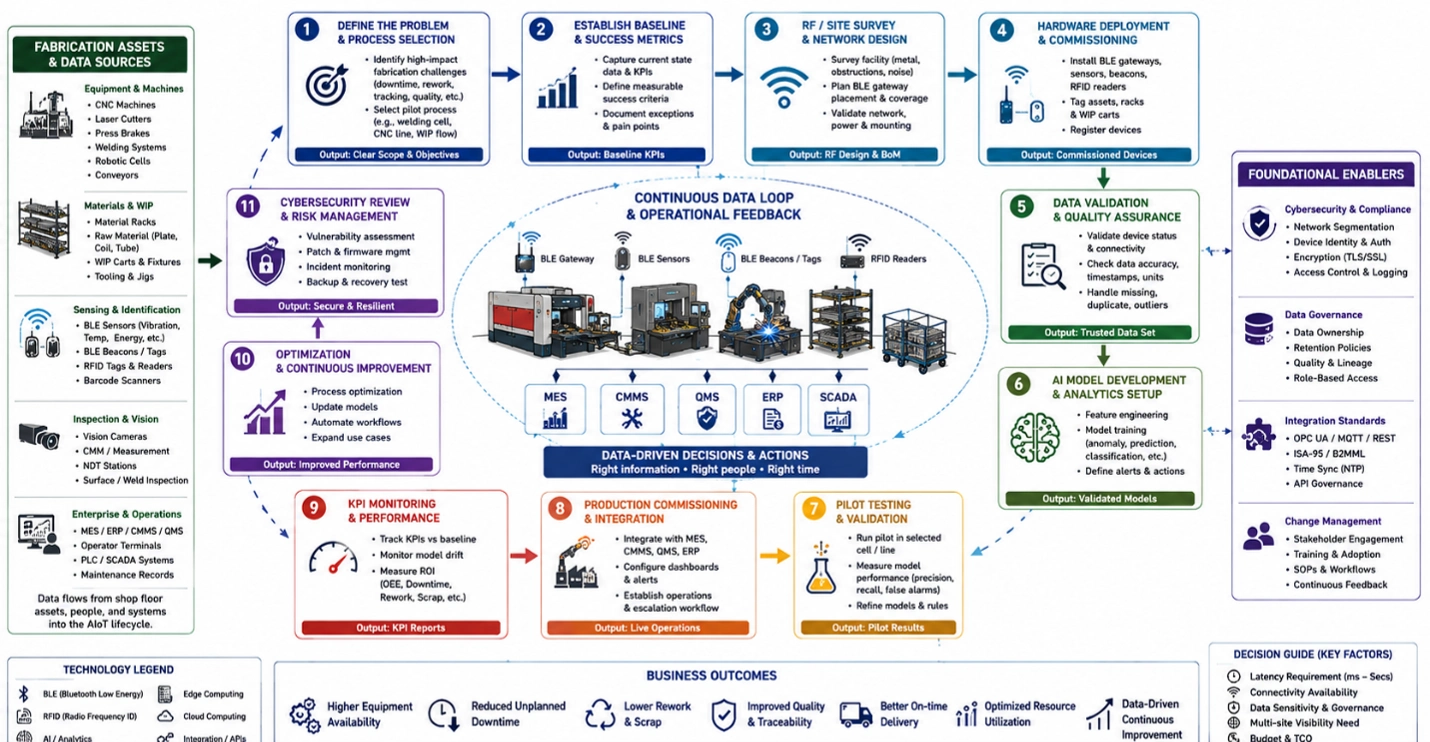
This lifecycle diagram maps the deployment of AIoT across metal fabrication, from problem selection, KPI baselining, RF and network planning, and hardware commissioning through data validation, AI model development, pilot testing, production integration, and performance monitoring. It also connects cybersecurity, data governance, interoperability, continuous optimization, and scale-up with fabrication assets, BLE and RFID devices, MES, CMMS, QMS, ERP, and SCADA systems.
Interoperability with Fabrication Systems
AI and BLE systems should not create another isolated database.
Interoperability should be designed around stable operational identifiers and well-defined interfaces.
A practical integration may look like:
BLE Gateway → IoT ingestion service → normalized event data → AI analytics → API → MES/CMMS/QMS/ERP
Machine data may follow a separate path:
PLC/CNC → industrial protocol or gateway → historian/edge service → analytics
Relevant industrial technologies can include:
- OPC UA
- MQTT
- REST APIs
- SQL databases
- Industrial Ethernet
- Ethernet/IP
- Modbus where applicable
- JSON-based application interfaces
- Time-series databases
- Message brokers
The correct protocol depends on the equipment, existing control system, integration requirements, and cybersecurity policy.
BLE should also coexist with RFID rather than automatically replace it.
RFID can be advantageous where reliable identity reads are more important than continuous location information. BLE can be advantageous where battery-powered wireless location or sensor telemetry is required. Barcode can remain the most economical option for operator-mediated identification in many workflows.
The technologies should therefore be selected according to the operational requirement.
Cybersecurity and Reliability for Industrial Fabrication AIoT
Security needs to cover the entire path from sensor to business application.
Relevant controls include:
- Unique device identities
- Secure credential management
- Network segmentation
- Least-privilege access
- Encrypted communications
- Gateway hardening
- Secure firmware management
- Vulnerability monitoring
- Centralized logging
- Administrative access controls
- Backup and recovery
- Incident-response procedures
- Controlled remote access
BLE security should also be evaluated according to the application. A location beacon used only for approximate WIP visibility does not have the same security implications as a sensor whose data influences maintenance decisions or production records.
AI systems introduce additional concerns.
Model inputs should be protected against unauthorized manipulation, and model outputs should be treated according to their operational consequences. Production teams should also retain the ability to override or investigate AI-generated recommendations.
For critical operations, fail-safe behavior should be defined before deployment.
The AI system should not become a single point of failure for production.
Practical Engineering Recommendations for Industrial Fabrication
Several implementation principles consistently improve the probability of a successful deployment.
- Start with a measurable fabrication problem instead of starting with a sensor purchase.
- Establish baseline KPIs before introducing AI.
- Use BLE where wireless location or sensing provides a practical advantage.
- Use RFID or barcode where item identity is the primary requirement.
- Use machine interfaces where authoritative machine-state information already exists.
- Perform an RF survey before installing large numbers of BLE gateways.
- Test wireless performance around real metal equipment and active fabrication processes.
- Keep AI recommendations separate from safety-rated machine controls unless a formally engineered control solution requires integration.
- Validate sensor data before training models.
- Integrate AI alerts into MES, CMMS, QMS, or production workflows instead of relying only on dashboards.
- Design battery replacement and device maintenance into the operating budget.
- Maintain a controlled inventory of deployed BLE devices and gateways.
- Use edge processing where latency, connectivity, or data-governance requirements justify it.
- Use cloud deployment where centralized multi-site analytics and remote access provide measurable value.
- Use private server deployment where local processing, data control, or existing factory infrastructure is more appropriate.
- Measure false positives and false negatives instead of evaluating AI only by overall accuracy.
- Keep humans responsible for decisions where engineering judgment, inspection authority, or safety requirements apply.
- Scale only after the pilot demonstrates measurable operational improvement.
How GAO Supports Industrial Fabrication IoT Deployments
GAO provides BLE, RFID, and IoT hardware products and systems that can support industrial tracking, sensing, identification, and connected-equipment applications. For industrial fabrication organizations, these technologies can be combined with existing production equipment, industrial networks, AI software, and enterprise applications rather than requiring every operational process to be replaced.
GAO has supplied hardware products and systems to organizations requiring remote or onsite technical support, with solutions covering wireless identification, asset tracking, sensing, gateways, and related IoT applications.
The broader GAO Group includes GAO RFID Inc., GAO Research Inc., and GAO Tek Inc., with operations based in New York City and Toronto, Canada. For three decades, the companies have served customers across the United States and Canada, including Fortune 500 companies, R&D organizations, universities, and government agencies.
GAO’s engineering-oriented approach emphasizes product selection, system integration, quality assurance, deployment support, and technical assistance. That is particularly relevant to fabrication projects where wireless hardware must operate alongside machinery, industrial networks, production processes, and existing information systems.
Key Takeaways for AI and BLE in Industrial Fabrication
AI has practical value in industrial fabrication when it is connected to measurable operational decisions.
BLE can provide useful wireless data for asset location, WIP visibility, equipment condition monitoring, and environmental sensing. Its role is strongest when combined with other data sources rather than used as an isolated tracking technology.
The highest-value applications generally include:
- Predictive maintenance for high-impact fabrication equipment
- AI-assisted production bottleneck detection
- WIP and asset visibility
- Material and process traceability
- AI-assisted quality monitoring
- Tool and fixture utilization
- Production-delay prediction
- Operational anomaly detection
A technically sound implementation begins with the fabrication workflow, establishes measurable KPIs, validates the physical deployment, integrates data with existing software, and then introduces AI where it can improve a defined decision.
Organizations evaluating these applications should also consider BLE, RFID, industrial sensors, gateways, edge computing, AI software, and integration requirements together. GAO can provide technical information about relevant hardware products and systems and help organizations evaluate appropriate technology options for industrial fabrication applications.
Building the Future of Industrial AI and IoT with Aperture Venture Studio and GAO RFID Inc.
For more than three decades, GAO Group of Companies has invested heavily in R&D covering industrial BLE, RFID, and IoT. As generative AI became increasingly useful for industrial applications, we expanded our work across AI and IoT technologies and founded Aperture Venture Studio to develop, launch, and scale next-generation AI and IoT solutions relevant to industrial applications such as fabrication, asset tracking, sensing, and connected operations.
Aperture has attracted AI and IoT technical experts, entrepreneurial and operational executives, investors, and leading companies.
We have also developed the Aperture Ventures Summit and TekSummit to discuss advanced AI and IoT topics and practical technology applications.
These activities have helped us develop technical communities around AI and IoT.
We welcome you to join us as:
- Advisors, co-founders, or employees
- Investors
- Customers
Explore AI, BLE, RFID, and IoT Solutions for Industrial Fabrication
Industrial fabrication organizations do not need more disconnected technology. They need reliable operational data, appropriately engineered connectivity, useful AI models, secure integration, and measurable improvements in production and maintenance performance.
GAO’s BLE, RFID, sensor, gateway, and IoT technologies can provide components for these systems. Organizations can evaluate individual hardware requirements, complete tracking and sensing systems, private server or cloud deployments, and integration approaches according to their fabrication processes.
Learn more about GAO’s technology solutions, engineering capabilities, products, and technical support when planning an AI-enabled industrial fabrication project.