
AI-Driven BLE Solutions for Rubber Products Manufacturing
Rubber products manufacturing depends on precise control of mixing, calendaring, extrusion, molding, curing, inspection, and material handling to achieve consistent product quality while minimizing waste and production downtime. Artificial Intelligence (AI) combined with Bluetooth Low Energy (BLE) technologies enables manufacturers to transform production data into actionable operational intelligence. BLE sensors, BLE beacons, and BLE gateways continuously capture information from machinery, environmental conditions, production assets, mobile equipment, and manufacturing personnel, allowing AI models to detect anomalies, predict failures, optimize production parameters, and improve quality consistency.
For manufacturers producing industrial rubber components, seals, hoses, gaskets, tires, conveyor belts, medical rubber products, and engineered elastomer components, AI-enabled BLE solutions support continuous monitoring throughout production while integrating with manufacturing software for automated decision making. Rather than simply collecting operational data, AI helps interpret manufacturing behavior, enabling faster responses to production deviations, reducing scrap rates, improving Overall Equipment Effectiveness (OEE), and enhancing operational visibility across the entire rubber manufacturing process. GAO supplies BLE hardware and industrial IoT solutions that support these intelligent manufacturing initiatives across diverse rubber production environments.
Why AI-Enabled BLE is Transforming Rubber Products Manufacturing
Rubber manufacturing is highly sensitive to variations in raw materials, mixing temperatures, curing cycles, compound formulations, humidity, machine calibration, and equipment condition. Small process deviations may lead to defective products, increased scrap, shortened equipment life, or inconsistent mechanical properties.
Traditional production monitoring often relies on periodic inspections and manual data collection, making it difficult to identify developing process issues before product quality deteriorates.
AI-powered manufacturing intelligence supported by BLE-connected industrial devices allows production teams to continuously evaluate manufacturing conditions across every stage of production. Instead of reacting after quality failures occur, engineers can identify abnormal production behavior in real time and implement corrective actions before defects propagate throughout production batches.
BLE technology serves as the communication layer connecting distributed production assets, while AI transforms operational measurements into predictive insights supporting manufacturing optimization.
For rubber manufacturers, this combination enables:
- Continuous production monitoring
- AI-assisted process optimization
- Predictive equipment maintenance
- Automated quality analysis
- Intelligent environmental monitoring
- Production traceability
- Workforce safety monitoring
- Material flow optimization
- Energy consumption analysis
- Production scheduling improvements
GAO has supported industrial organizations by providing BLE hardware products and connected monitoring solutions that help organizations modernize manufacturing operations while maintaining reliable industrial communication across production facilities.
AI-Enabled BLE Monitoring Across a Rubber Products Manufacturing Facility
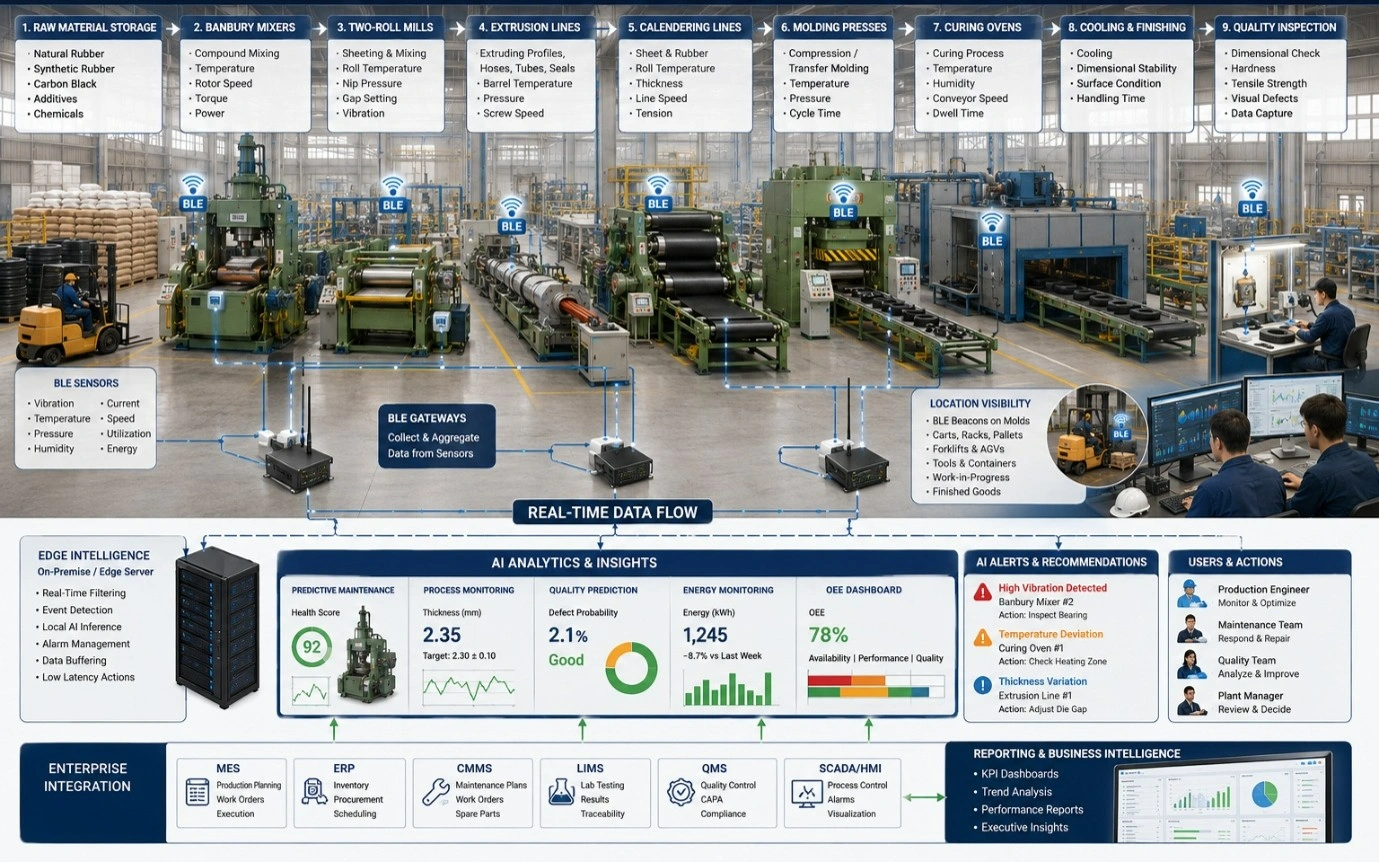
This illustration depicts an AI-enabled BLE monitoring solution integrated throughout a modern rubber products manufacturing facility. It shows how BLE sensors, BLE gateways, and edge computing collect operational data from mixing, milling, extrusion, calendaring, molding, curing, cooling, and quality inspection processes. AI analytics transform this data into predictive maintenance insights, quality optimization, production monitoring, energy management, and enterprise reporting through integration with MES, ERP, CMMS, LIMS, QMS, and SCADA systems.
Fundamental Concepts of AI-Enabled BLE in Rubber Products Manufacturing
AI-enabled industrial monitoring combines artificial intelligence with connected industrial devices to improve manufacturing decisions using continuous operational data.
Within rubber manufacturing, BLE sensors collect information from equipment, environmental conditions, tooling, production assets, and manufacturing workstations. BLE beacons provide precise location awareness for mobile assets, production carts, molds, pallets, forklifts, and work-in-progress inventory. BLE gateways aggregate information from hundreds or thousands of connected devices and securely forward operational data to industrial software for AI processing.
Artificial Intelligence analyzes historical production data together with live operational information to recognize complex production patterns that would be difficult for human operators to detect consistently.
Depending on manufacturing objectives, AI may utilize:
- Machine Learning
- Deep Learning
- Time-series forecasting
- Predictive analytics
- Reinforcement learning
- Computer vision
- Statistical process control
- Anomaly detection
- Digital twin modeling
- Explainable AI for manufacturing decisions
Rather than replacing experienced production engineers, AI continuously supports manufacturing teams by providing data-driven recommendations that improve process consistency and production efficiency.
The relationship between AI and BLE is complementary.
BLE provides reliable low-power industrial communication between connected manufacturing assets, while AI extracts operational intelligence from the collected production data.
This combination forms an important component of Artificial Intelligence of Things (AIoT), where connected industrial equipment generates continuous operational information that AI converts into manufacturing intelligence supporting better business and engineering decisions.
Rubber Products Manufacturing Operations That Benefit Most from AI and BLE
Every rubber manufacturing operation generates operational data that can be analyzed to improve productivity, equipment reliability, product quality, and resource utilization.
The greatest value is achieved where production variability directly affects manufacturing costs or customer quality requirements.
Rubber Mixing Operations
BLE-connected sensors monitor mixer temperatures, motor loads, vibration levels, rotor speed, compound mixing duration, energy consumption, and cooling cycles.
AI evaluates mixing consistency across production batches, identifies abnormal equipment behavior, predicts maintenance requirements, and recommends optimal operating parameters to maintain compound quality.
Calendaring Operations
Calendaring machines require precise roller alignment, temperature control, pressure regulation, and sheet thickness consistency.
BLE monitoring enables AI to detect developing process drift before dimensional tolerances exceed specification limits.
Extrusion Lines
Rubber extrusion performance depends upon:
- Barrel temperature
- Screw speed
- Material flow
- Die pressure
- Cooling conditions
- Product dimensions
AI analyzes these variables simultaneously, identifying subtle interactions that influence dimensional stability and production throughput.
Compression, Injection, and Transfer Molding
BLE-connected mold monitoring helps manufacturers optimize:
- Mold temperatures
- Cycle times
- Press utilization
- Clamp pressure
- Heating consistency
- Product release timing
AI predicts process instability before defective molded products are produced.
Vulcanization and Curing
Curing represents one of the most critical manufacturing stages.
AI evaluates curing profiles, oven performance, press utilization, curing temperatures, and dwell times to improve product consistency while minimizing energy consumption.
Quality Inspection
BLE-connected inspection stations collect production measurements from dimensional inspection equipment, laboratory instruments, hardness testers, tensile testing machines, and visual inspection systems.
AI identifies emerging quality trends before customer specifications are violated.
Material Handling and Warehouse Operations
BLE beacons improve visibility of:
- Rubber compounds
- Work-in-progress inventory
- Finished goods
- Molds
- Production tooling
- Mobile equipment
- Forklifts
- Shipping containers
AI optimizes warehouse movement while reducing search time for critical production assets.
AI-Enabled BLE Workflow for Rubber Products Manufacturing from Raw Material Receiving to Shipping
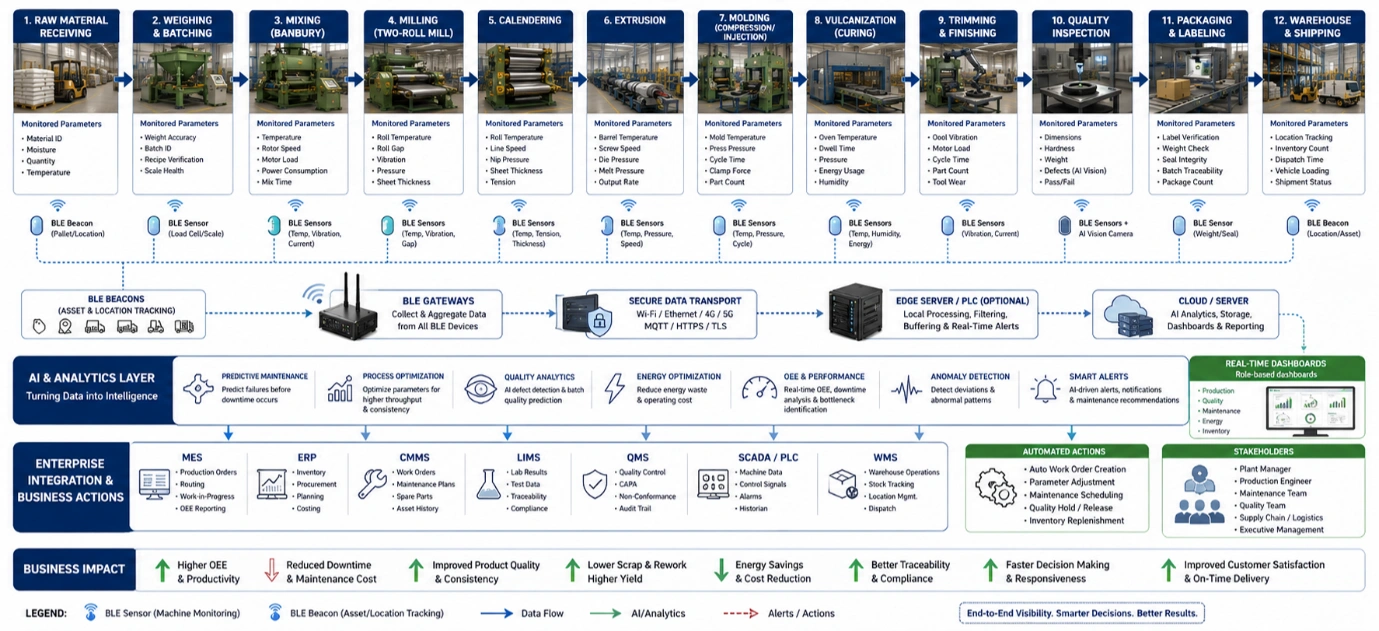
This workflow diagram illustrates the complete rubber products manufacturing process enhanced by AI-enabled BLE monitoring. It shows how BLE sensors, BLE beacons, BLE gateways, AI analytics, MES integration, maintenance alerts, and quality dashboards provide continuous visibility and intelligent decision-making across every production stage, from raw material receiving to warehouse storage and shipping.
Operational Workflow of AI-Enabled BLE Solutions in Rubber Products Manufacturing
Successful AI implementation depends on continuous data acquisition from production equipment combined with intelligent analytics that support operational decisions.
Production Data Acquisition
BLE sensors continuously capture manufacturing information from:
- Banbury mixers
- Internal mixers
- Two-roll mills
- Calendaring machines
- Extruders
- Hydraulic presses
- Injection molding machines
- Compression molding presses
- Curing ovens
- Autoclaves
- Air compressors
- Chillers
- Dust collection systems
- Conveyor systems
- Environmental monitoring stations
Typical monitored parameters include:
- Temperature
- Humidity
- Motor current
- Vibration
- Pressure
- Rotational speed
- Energy consumption
- Equipment runtime
- Production count
- Machine utilization
- Downtime events
Industrial Communication
BLE Gateways receive information from distributed BLE devices across production facilities.
Gateways securely aggregate production information before forwarding operational data using industrial Ethernet, Wi-Fi, or cellular communication into manufacturing software.
This communication layer supports reliable monitoring across large production buildings while minimizing infrastructure complexity.
Edge Processing
Certain manufacturing decisions require immediate responses.
Edge computing systems process selected operational data locally to:
- Detect abnormal vibration
- Monitor critical temperatures
- Generate equipment alarms
- Identify communication failures
- Perform preliminary AI inference
- Reduce network bandwidth usage
Local processing helps reduce response latency for time-sensitive manufacturing operations.
Cloud and Private Server Processing
After operational data is collected, AI software processes information using either cloud-hosted environments or privately managed server deployments.
Cloud-hosted software is well suited for organizations operating multiple rubber manufacturing facilities that require centralized production visibility, remote analytics, software scalability, and enterprise-wide reporting.
Privately managed server deployments are often preferred when production data confidentiality, low-latency processing, regulatory requirements, or internal IT governance policies require manufacturing information to remain within customer-controlled infrastructure.
Both deployment approaches support AI-driven production optimization while integrating with existing manufacturing systems according to organizational requirements.
Enterprise Software Integration
AI delivers the greatest value when manufacturing intelligence is shared across operational systems.
Typical software integrations include:
- Manufacturing Execution Systems (MES)
- Enterprise Resource Planning (ERP)
- Computerized Maintenance Management Systems (CMMS)
- Laboratory Information Management Systems (LIMS)
- Quality Management Systems (QMS)
- Warehouse Management Systems (WMS)
- Supervisory Control and Data Acquisition (SCADA)
- Distributed Control Systems (DCS)
- Product Lifecycle Management (PLM)
- Industrial historians
These integrations enable production scheduling, maintenance planning, quality assurance, inventory control, and executive reporting to utilize AI-generated operational insights.
AI Analytics and Operational Decision Making
Once production data has been consolidated, AI continuously evaluates relationships between equipment condition, manufacturing parameters, environmental conditions, production quality, maintenance history, and historical production performance.
Instead of evaluating individual variables independently, AI identifies complex operational patterns that influence manufacturing performance.
Typical AI-generated recommendations include:
- Adjust mixer operating parameters
- Schedule predictive maintenance
- Investigate abnormal vibration
- Optimize curing profiles
- Balance production workloads
- Improve energy utilization
- Detect production bottlenecks
- Predict equipment failure risks
- Improve batch consistency
- Reduce product scrap
These recommendations help production engineers make informed decisions supported by continuously updated operational intelligence rather than isolated production measurements.
AI-Enabled BLE Data Flow for Rubber Products Manufacturing
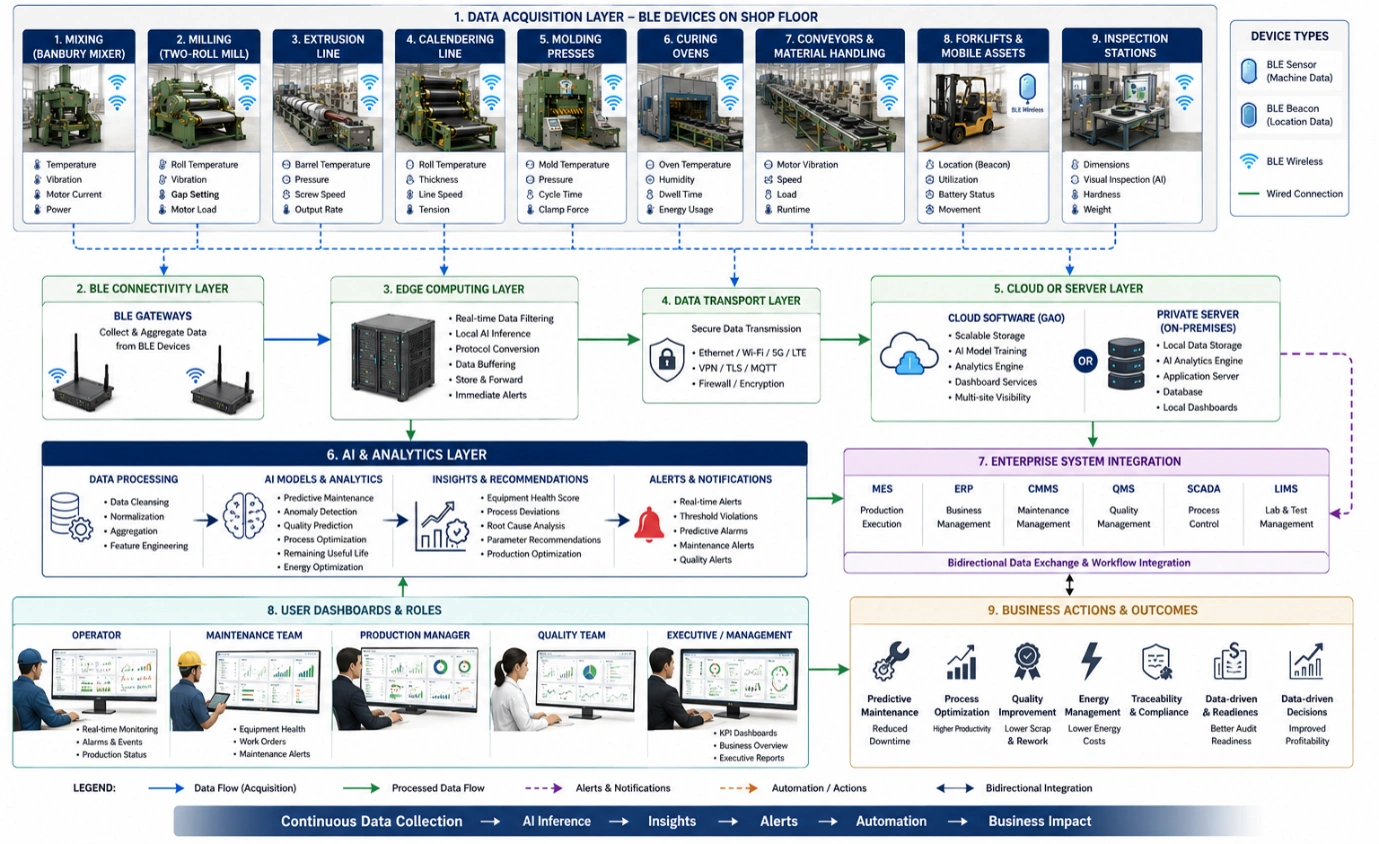
This solution flow diagram illustrates how BLE sensors and BLE beacons collect operational and location data from rubber manufacturing equipment, which is then transmitted through BLE gateways to edge computing systems, cloud software, or private servers for AI analytics. The processed insights integrate with MES, ERP, CMMS, QMS, and SCADA systems to deliver predictive maintenance, quality optimization, automated alerts, operational dashboards, and data-driven business decisions.
BLE Infrastructure, AI Technologies, Software, and Deployment Considerations for Rubber Products Manufacturing
An AI-enabled BLE solution for rubber products manufacturing combines industrial hardware, communication software, analytics, cybersecurity, and manufacturing systems into a unified operational solution. Each component contributes to improving production reliability, product quality, asset visibility, and maintenance efficiency.
BLE Hardware Components
BLE hardware provides the operational data required for AI-driven manufacturing decisions.
Core components include:
- BLE sensors for monitoring machine vibration, temperature, humidity, pressure, motor current, energy consumption, rotational speed, and equipment utilization.
- BLE beacons attached to molds, production carts, pallets, forklifts, mobile tools, work-in-progress containers, and finished product racks for real-time location awareness.
- BLE gateways that aggregate data from hundreds of BLE devices and securely forward information to local servers or cloud-hosted software.
- Industrial edge computers that perform local analytics, filtering, buffering, and AI inference when immediate responses are required.
- Industrial tablets, operator HMIs, engineering workstations, and mobile devices used for visualization, alarm management, and maintenance activities.
GAO supplies industrial BLE hardware designed for demanding manufacturing environments, helping rubber manufacturers deploy reliable monitoring systems with long operating life and remote management capabilities.
AI Software and Analytics
AI software transforms operational measurements into actionable manufacturing intelligence.
Common analytical capabilities include:
- Predictive maintenance models
- Time-series forecasting
- Process anomaly detection
- Statistical process control
- Root cause analysis
- Production optimization
- Energy optimization
- Remaining Useful Life (RUL) prediction
- Equipment health scoring
- Quality prediction models
Machine learning continuously compares current production behavior with historical manufacturing data to identify trends that indicate deteriorating equipment performance, process instability, or quality risks.
Computer vision systems may also inspect molded rubber components, extruded profiles, seals, gaskets, hoses, and conveyor belts to identify surface defects, dimensional deviations, flash, voids, bubbles, contamination, or incomplete curing.
Communication Protocols
Although BLE provides local wireless connectivity, industrial communication typically extends beyond the production floor.
Common communication technologies include:
- Bluetooth Low Energy (BLE)
- Ethernet/IP
- PROFINET
- Modbus TCP
- OPC UA
- MQTT
- HTTPS
- TLS-encrypted communication
- Wi-Fi
- 4G LTE
- 5G where available
These communication methods allow manufacturing information to move securely between production equipment, AI software, and business applications.
Cloud-Hosted Software
Cloud-hosted software is well suited for organizations operating multiple rubber manufacturing facilities or geographically distributed production sites.
Typical advantages include:
- Centralized production monitoring
- Fleet-wide equipment analytics
- Simplified software updates
- Enterprise-wide KPI reporting
- Remote engineering support
- Elastic computing resources for AI model training
- Long-term historical data retention
This deployment model is appropriate when internet connectivity is reliable and organizations require centralized visibility across multiple facilities.
Private Server Deployment
Many rubber manufacturers prefer privately managed server deployments to satisfy internal cybersecurity policies, regulatory requirements, or low-latency operational needs.
Privately hosted server software may reside within:
- Factory data centers
- Customer-managed servers
- Industrial edge servers
- Regional private cloud environments
- Corporate IT infrastructure
Benefits include:
- Greater control of manufacturing data
- Reduced external network dependency
- Lower latency for production analytics
- Custom integration with existing manufacturing software
- Alignment with internal cybersecurity governance
Security Considerations
Cybersecurity is essential because manufacturing systems increasingly exchange operational data between production equipment and enterprise software.
Recommended practices include:
- Device authentication
- Secure BLE pairing
- Role-based access control
- TLS encryption
- VPN connectivity for remote access
- Network segmentation
- Multi-factor authentication
- Security event logging
- Firmware validation
- Regular vulnerability assessments
- Backup and disaster recovery procedures
GAO works with customers to deploy BLE-based industrial monitoring solutions that align with established cybersecurity practices while supporting reliable manufacturing operations.
AI-Enabled BLE Solution for Rubber Products Manufacturing
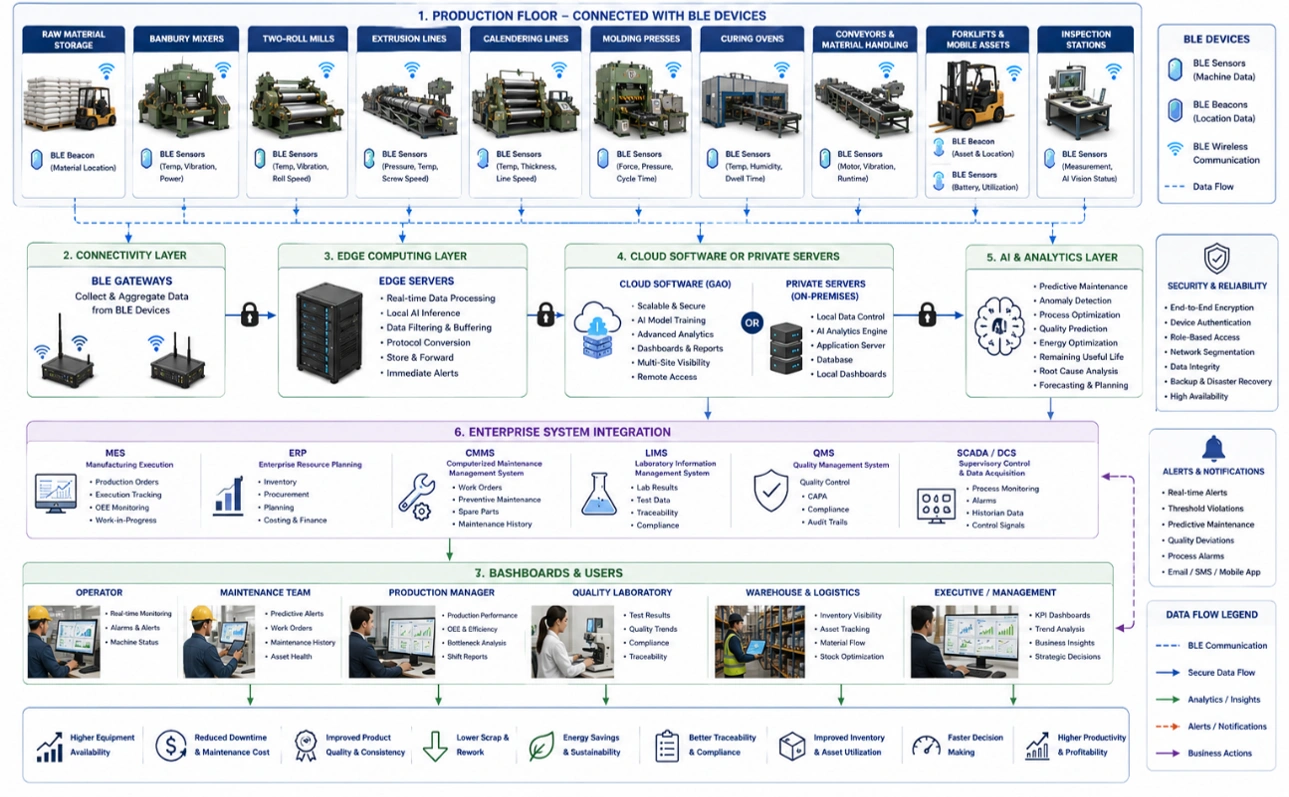
This solution diagram illustrates how BLE sensors, BLE beacons, and BLE gateways connect production equipment across a rubber products manufacturing facility to edge servers, cloud software, or private servers for AI-driven analysis. It also demonstrates secure integration with MES, ERP, CMMS, LIMS, QMS, and SCADA systems, enabling real-time dashboards, predictive maintenance, quality management, warehouse visibility, and data-driven operational decision-making.
Technical Capabilities and Business Value of AI-Enabled BLE Solutions
AI supported by BLE communication enables measurable operational improvements throughout rubber manufacturing.
Predictive Maintenance
AI evaluates vibration signatures, motor current, bearing temperatures, gearbox behavior, and equipment runtime to predict failures before unplanned downtime occurs.
Benefits include:
- Reduced emergency maintenance
- Longer equipment life
- Improved spare parts planning
- Higher equipment availability
Process Optimization
AI continuously analyzes relationships between compound formulation, mixing time, temperature, pressure, curing duration, and production output.
This helps production engineers maintain tighter process control while reducing variability between manufacturing batches.
Product Quality Improvement
Continuous monitoring enables earlier identification of process deviations affecting hardness, elasticity, tensile strength, compression set, dimensional accuracy, and curing consistency.
Quality improvements include:
- Lower scrap rates
- Reduced customer returns
- Better first-pass yield
- Improved batch traceability
- Faster root cause investigations
Asset Visibility
BLE beacons improve the visibility of:
- Production molds
- Mixing containers
- Material carts
- Forklifts
- Inspection fixtures
- Finished goods
- Maintenance tools
AI analyzes asset movement to reduce search time, improve utilization, and optimize material flow throughout the production facility.
Energy Management
Rubber manufacturing consumes significant electrical and thermal energy during mixing, extrusion, curing, and material handling.
AI evaluates energy usage patterns to identify:
- Idle equipment
- Peak demand periods
- Inefficient operating schedules
- Excessive power consumption
These insights support lower operating costs without compromising production capacity.
Workforce Safety
BLE wearables and location-aware monitoring can assist safety teams by detecting restricted area entry, monitoring lone workers, tracking emergency evacuation status, and improving personnel accountability during maintenance activities.
Engineering Best Practices for Successful Deployment
Organizations planning AI-enabled BLE solutions for rubber products manufacturing should consider the complete deployment lifecycle rather than focusing only on hardware installation.
Recommended practices include:
- Define measurable operational objectives before deployment.
- Identify production assets with the greatest impact on quality and downtime.
- Perform wireless site surveys to optimize BLE gateway placement.
- Validate sensor accuracy through calibration procedures.
- Establish data governance policies for production information.
- Integrate AI outputs with MES, ERP, CMMS, and QMS software.
- Begin with pilot production lines before scaling facility-wide.
- Continuously retrain AI models using updated production data.
- Monitor AI prediction accuracy against actual production outcomes.
- Maintain firmware, cybersecurity controls, and backup procedures throughout the system lifecycle.
These practices improve long-term reliability while supporting scalable deployment across multiple manufacturing facilities.
Cloud-Hosted vs. Private Server Deployment for AI-Enabled BLE Solutions in Rubber Products Manufacturing
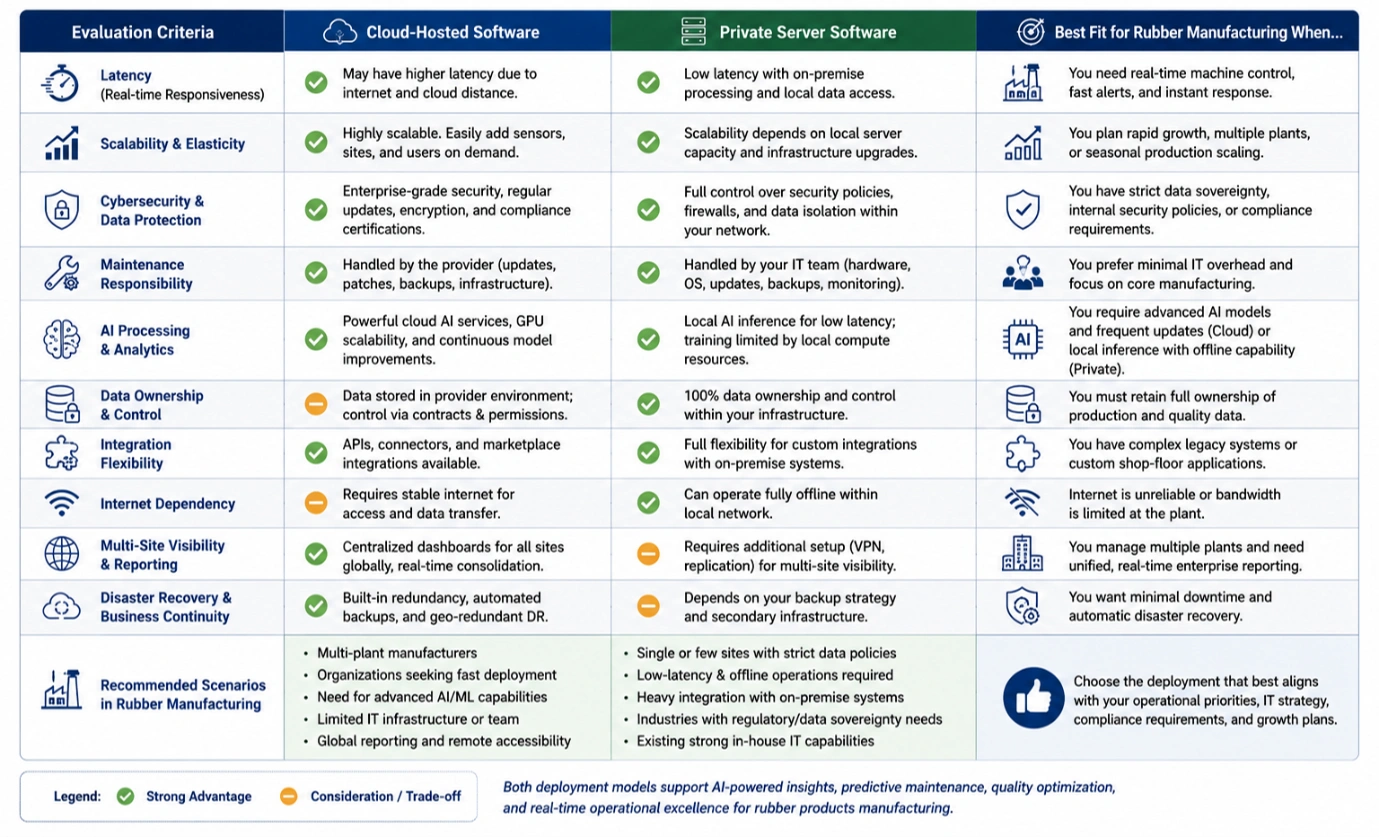
This comparison table evaluates cloud-hosted and private server software deployments for AI-enabled BLE solutions used in rubber products manufacturing. It compares key decision factors including latency, scalability, cybersecurity, AI processing, data ownership, integration flexibility, internet dependency, disaster recovery, and recommended deployment scenarios to help manufacturers select the most suitable solution for their operational and business requirements.
Key Performance Indicators Improved by AI-Enabled BLE Solutions
Organizations commonly evaluate project success using manufacturing and operational KPIs such as:
- Overall Equipment Effectiveness (OEE)
- Mean Time Between Failures (MTBF)
- Mean Time to Repair (MTTR)
- First Pass Yield (FPY)
- Scrap rate
- Rework percentage
- Batch consistency
- Machine utilization
- Production throughput
- Energy consumption per production batch
- Maintenance cost
- Inventory accuracy
- Asset utilization
- Quality inspection cycle time
- Unplanned downtime
- Schedule adherence
- On-time delivery performance
Monitoring these KPIs helps manufacturers quantify operational improvements and identify additional optimization opportunities.
Implementation Recommendations for Rubber Products Manufacturers
Successful implementation begins by identifying production processes where equipment failures, process variability, or limited operational visibility have the greatest financial impact. Pilot projects should focus on critical assets such as Banbury mixers, extrusion lines, molding presses, curing systems, or quality inspection stations where AI can deliver measurable improvements within a defined production scope.
Manufacturers should establish collaboration between production engineering, maintenance, quality assurance, operations, and information technology teams to ensure data quality, software integration, cybersecurity, and organizational adoption are addressed together. As confidence in AI recommendations grows, additional production lines and facilities can be incorporated into the solution using the same deployment principles.
GAO has supported organizations across the United States and Canada by supplying BLE hardware products, industrial IoT systems, and technical expertise that enable reliable monitoring, manufacturing visibility, and long-term operational improvement.
The Future of AI-Driven Rubber Products Manufacturing
AI-enabled BLE solutions provide rubber products manufacturers with greater visibility into production processes, equipment health, material movement, and operational performance. By combining connected BLE devices with artificial intelligence, organizations can reduce downtime, improve product consistency, optimize maintenance activities, strengthen quality assurance, and support data-driven manufacturing decisions.
Organizations planning modernization initiatives should evaluate communication infrastructure, AI objectives, software integration, cybersecurity requirements, and long-term scalability during project planning. Headquartered in New York City and Toronto, GAO is recognized among the leading global B2B suppliers of BLE, RFID, and industrial IoT technologies. For more than three decades, we have supported Fortune 500 companies, leading research organizations, universities, and government agencies through extensive research and development, rigorous quality assurance, and expert remote and on-site technical support.
Building the Future of Industrial AI and IoT with Aperture Venture Studio and GAO RFID Inc.
For more than three decades, GAO Group of Companies has invested extensively in research and development for industrial BLE, RFID, and IoT technologies that support advanced manufacturing and connected operations. As generative AI demonstrated significant value in industrial environments such as rubber products manufacturing, we expanded our work in AIoT solutions that combine AI, BLE, RFID, and industrial connectivity to solve complex operational challenges. To further accelerate innovation in industrial AI and IoT, we established Aperture Venture Studio to help advance, commercialize, and scale emerging AI and IoT technologies for manufacturing and other industrial sectors.
Aperture has attracted highly experienced AI researchers, IoT specialists, operational leaders, investors, and industry collaborators. We also organize the Aperture Ventures Summit and TekSummit, where experts discuss advanced developments in industrial AI, BLE, RFID, automation, and connected manufacturing. These initiatives have strengthened collaborative technical communities focused on practical industrial innovation.
We welcome you to join us as:
- Advisors, co-developers, or employees
- Investors
- Customers seeking advanced AI and industrial IoT solutions