
AI-Powered Public Works Operations Using RFID for Intelligent Infrastructure, Asset Management, and Field Services
AI-Powered Public Works Operations Using RFID for Intelligent Infrastructure Management
Public Works departments are responsible for maintaining critical civic infrastructure including roads, bridges, water distribution systems, wastewater networks, stormwater assets, street lighting, public buildings, parks, fleet vehicles, heavy equipment, and utility facilities. These organizations manage thousands to millions of physical assets distributed across large geographic areas while balancing regulatory compliance, aging infrastructure, workforce shortages, budget limitations, emergency response requirements, and increasing public service expectations.
Artificial intelligence combined with RFID technology enables Public Works organizations to transform traditional asset management into intelligent, data-driven operations. RFID provides highly accurate identification and location data for infrastructure assets, maintenance equipment, spare parts, tools, and mobile resources. Artificial intelligence converts this continuous stream of operational data into predictive maintenance recommendations, asset health assessments, workforce optimization, inventory forecasting, and infrastructure risk analysis.
Rather than replacing existing Public Works systems, RFID serves as a reliable source of real-world operational data that enhances AI decision-making across maintenance management, inspection scheduling, fleet operations, warehouse management, capital planning, and emergency response. Supported by decades of engineering experience serving government agencies, municipalities, Fortune 500 organizations, universities, and research institutions throughout North America, GAO supplies RFID hardware and IoT solutions that help Public Works organizations modernize infrastructure management while improving operational visibility and long-term asset performance.
AI-Enabled RFID Public Works System for Intelligent Municipal Asset Management
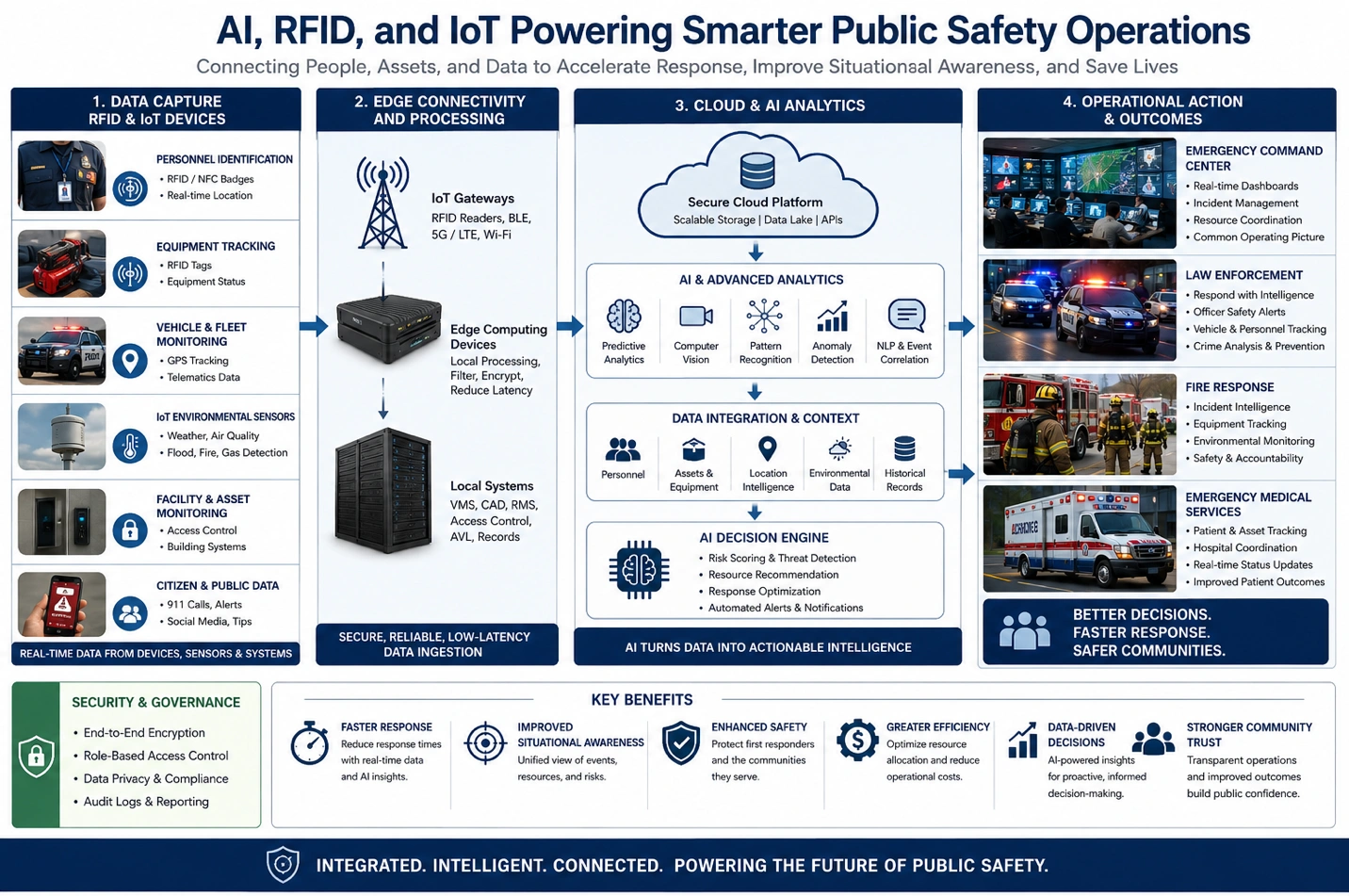
This illustration demonstrates how AI-powered RFID solutions connect Public Works infrastructure, maintenance assets, municipal fleets, warehouses, and field personnel into a unified operational system. It highlights RFID data capture, edge gateways, communication networks, cloud-based AI analytics, GIS and CMMS integration, predictive maintenance, and asset lifecycle management. The key takeaway is that combining RFID with AI enables real-time infrastructure visibility, proactive maintenance planning, and more efficient municipal operations.
Understanding AI-Driven RFID Solutions for Public Works
Public Works organizations oversee some of the most geographically dispersed and operationally diverse infrastructure portfolios within government operations. Assets often remain in service for decades, requiring continuous inspection, maintenance, rehabilitation, replacement planning, and regulatory documentation. Manual recordkeeping and disconnected databases frequently create incomplete asset histories, inconsistent inventory records, delayed maintenance, and reduced visibility into field operations.
RFID technology establishes a reliable digital identity for physical infrastructure and operational resources.
Depending on operational requirements, Public Works organizations typically deploy multiple RFID technologies.
- UHF RFID for long-range identification of fleet assets, construction materials, storage yards, traffic control equipment, and municipal inventories.
- HF RFID for maintenance documentation, inspection verification, secure identification, and facility management.
- LF RFID for harsh environmental conditions involving metallic equipment, underground infrastructure components, utility assets, and specialized maintenance tools.
Artificial intelligence analyzes RFID-generated operational data together with information collected from:
- Geographic Information Systems (GIS)
- Computerized Maintenance Management Systems (CMMS)
- Enterprise Asset Management (EAM) software
- Supervisory Control and Data Acquisition (SCADA)
- Building Management Systems (BMS)
- Work order systems
- Maintenance histories
- Financial systems
- Weather information
- Remote sensors
- Mobile workforce applications
- Utility monitoring systems
Instead of relying solely on scheduled inspections, AI continuously evaluates infrastructure conditions, predicts maintenance priorities, identifies operational inefficiencies, forecasts inventory demand, and recommends optimal resource allocation across municipal operations.
The result is improved service delivery, reduced maintenance costs, increased infrastructure reliability, and more informed capital investment decisions.
Public Works Applications Where AI and RFID Deliver the Greatest Value
AI-enhanced RFID solutions support nearly every operational function performed by modern Public Works departments.
Municipal Asset Lifecycle Management
Municipal agencies manage extensive inventories of infrastructure assets distributed across cities and counties.
RFID enables unique identification throughout each asset’s lifecycle while AI evaluates utilization patterns, maintenance history, expected service life, rehabilitation costs, and replacement priorities.
Common managed assets include:
- Road barriers
- Traffic signs
- Streetlights
- Utility poles
- Fire hydrants
- Water valves
- Sewer access covers
- Storm drains
- Public benches
- Park equipment
- Snow removal equipment
- Portable generators
- Construction machinery
- Fleet vehicles
Public Infrastructure Inspection
Routine inspection programs often involve thousands of inspections each year.
RFID tags verify inspection locations while AI evaluates inspection trends to identify deteriorating infrastructure before failures occur.
Typical inspection programs include:
- Bridge inspections
- Pavement condition assessments
- Culvert inspections
- Sidewalk surveys
- Water treatment facilities
- Pump stations
- Lift stations
- Retaining walls
- Public buildings
- Traffic signal cabinets
Fleet Maintenance Management
Municipal fleets include:
- Snowplows
- Street sweepers
- Refuse trucks
- Excavators
- Backhoes
- Bucket trucks
- Dump trucks
- Utility service vehicles
- Emergency generators
- Portable compressors
RFID automatically identifies vehicles entering maintenance facilities while AI predicts maintenance intervals based on equipment utilization, repair histories, fuel consumption, operator behavior, and environmental conditions.
Municipal Warehouse and Inventory Operations
Public Works warehouses store thousands of maintenance components including:
- Water pipe fittings
- Electrical components
- Traffic signs
- Safety equipment
- Asphalt materials
- Concrete supplies
- Utility repair kits
- Personal protective equipment
- Replacement pumps
- Mechanical parts
RFID automates inventory movement while AI forecasts seasonal demand, identifies slow-moving inventory, predicts shortages, and recommends replenishment schedules.
Construction and Capital Improvement Projects
Infrastructure improvement projects involve continuous movement of equipment, contractors, materials, and temporary assets.
RFID tracks equipment utilization, construction materials, portable tools, and temporary traffic control devices.
AI evaluates schedule performance, resource utilization, equipment productivity, contractor efficiency, and project risks.
Emergency Response Coordination
Natural disasters, severe weather, floods, water main breaks, and infrastructure failures require rapid deployment of municipal resources.
RFID provides immediate visibility into emergency equipment locations while AI recommends equipment assignments, predicts resource shortages, and prioritizes repair activities according to operational impact.
AI-Enabled RFID Public Works Operations Workflow for Smart Municipal Infrastructure Management
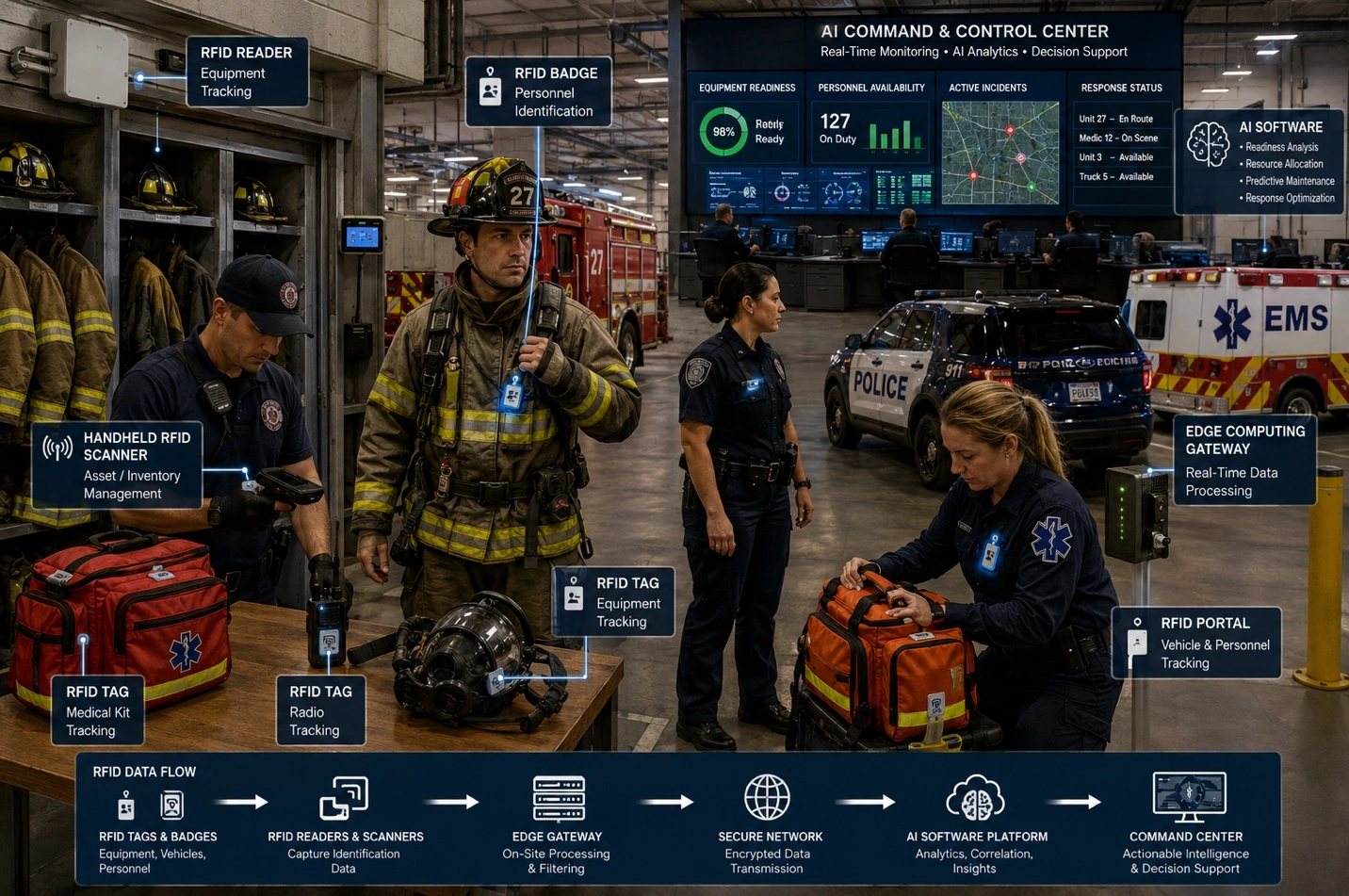
This workflow diagram illustrates how AI-enabled RFID streamlines municipal public works operations by connecting infrastructure assets with handheld, vehicle-mounted, and fixed RFID readers, edge gateways, AI analytics, GIS software, and CMMS platforms. It demonstrates the end-to-end workflow from asset identification and data collection to predictive maintenance, automated work order generation, mobile field operations, supervisory oversight, and executive dashboards. The key takeaway is that integrating RFID, AI, and enterprise systems enables proactive maintenance, improved asset visibility, faster service delivery, and data-driven municipal decision-making.
Operational Workflow for AI-Enabled RFID Public Works Solutions
Successful deployments integrate physical infrastructure, field operations, communication systems, business software, and artificial intelligence into a unified operational workflow.
Asset Identification
Infrastructure assets receive RFID tags during installation, rehabilitation, or inventory audits.
Examples include:
- Water valves
- Utility vaults
- Electrical cabinets
- Maintenance tools
- Fleet vehicles
- Portable equipment
- Construction materials
- Spare parts
- Inspection instruments
- Safety assets
Each RFID identifier becomes the permanent digital identity for that asset.
Data Collection
Information is collected using:
- Fixed RFID readers
- Vehicle-mounted readers
- Handheld RFID readers
- Mobile inspection devices
- RFID-enabled kiosks
- Smart cabinets
- Warehouse portals
- Maintenance facilities
Additional operational information may originate from:
- IoT sensors
- GPS receivers
- Environmental monitoring devices
- SCADA systems
- Utility monitoring equipment
- Traffic monitoring systems
- Weather stations
Communication Infrastructure
Collected information moves securely through multiple communication technologies depending on operational requirements.
Typical communication methods include:
- Ethernet
- Wi-Fi
- Private LTE
- 5G
- Fiber optic networks
- LoRaWAN
- NB-IoT
- MQTT
- HTTPS
- OPC UA
- REST APIs
- VPN connections
Edge gateways aggregate RFID events before securely transmitting operational information to municipal servers or cloud-hosted software.
Edge Processing
Edge computing reduces communication latency by processing operational events near the infrastructure being monitored.
Typical edge functions include:
- RFID event filtering
- Duplicate removal
- Local caching
- Device authentication
- Reader health monitoring
- Temporary offline storage
- Event prioritization
- Initial AI inference for rapid operational decisions
This approach minimizes bandwidth consumption while maintaining uninterrupted operations during temporary network outages.
RFID, AI Technologies, Software, Infrastructure, and Deployment Models for Public Works
Public Works organizations typically require multiple technology layers working together to deliver reliable infrastructure intelligence. RFID serves as the physical identification technology, while artificial intelligence transforms collected operational data into actionable recommendations. Supporting components include communication networks, middleware, edge computing, cybersecurity controls, analytics software, and integration with municipal information systems.
RFID Hardware Components
A comprehensive Public Works RFID solution commonly includes:
- UHF RFID tags for fleet vehicles, road maintenance assets, traffic control equipment, and warehouse inventory.
- HF RFID tags for facility access control, inspection verification, maintenance records, and secure document tracking.
- LF RFID tags for underground utilities, metallic infrastructure components, water system assets, and harsh operating environments.
- Fixed RFID readers installed at maintenance depots, warehouse portals, vehicle service bays, and municipal facilities.
- Handheld RFID readers used by inspectors, maintenance technicians, warehouse personnel, and field supervisors.
- Vehicle-mounted RFID readers installed on maintenance trucks, utility service vehicles, and inventory transport equipment.
- RFID printer-encoders for creating durable identification labels designed to withstand moisture, UV exposure, vibration, chemicals, and extreme outdoor conditions.
GAO supplies RFID hardware and related IoT technologies designed to support demanding Public Works environments where equipment must remain reliable despite dust, vibration, rain, snow, temperature fluctuations, and continuous field use.
AI-Enabled RFID System Block Diagram for Public Works Asset Management and Municipal Operations
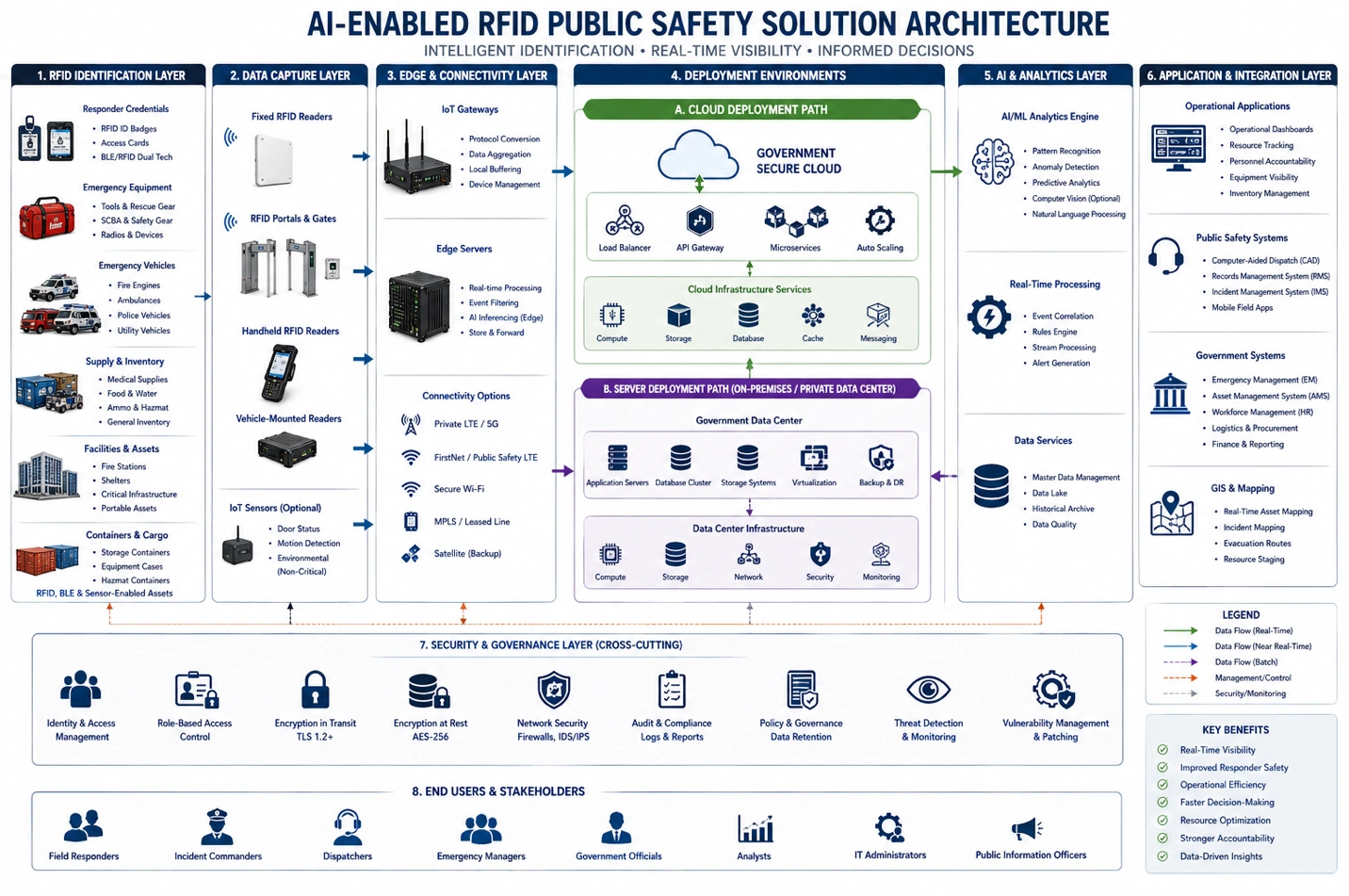
This engineering block diagram illustrates the complete data flow of an AI-enabled RFID solution for Public Works, from RFID-tagged infrastructure assets and field data capture through edge gateways, communication networks, AI analytics, and municipal software integration. It demonstrates how GIS, CMMS, EAM, fleet management, and operational dashboards work together to support predictive maintenance, asset lifecycle management, workforce coordination, and data-driven decision-making. The diagram highlights the end-to-end interaction between physical infrastructure, intelligent software, and municipal operations to improve efficiency, reliability, and service delivery.
AI Software and Machine Learning for Public Works
Artificial intelligence transforms RFID event data into operational intelligence by identifying patterns that are difficult to detect through manual analysis. Public Works organizations can prioritize maintenance, allocate resources more effectively, and improve service reliability by combining RFID data with operational, environmental, and financial information.
Common AI methods include:
- Predictive maintenance models for forecasting infrastructure failures.
- Time-series forecasting for seasonal inventory and workforce planning.
- Computer vision for road, bridge, and facility inspections using drones and mobile imaging.
- Anomaly detection for identifying unusual equipment behavior or unauthorized asset movement.
- Classification models for infrastructure condition assessment.
- Natural language processing (NLP) for analyzing inspection reports, work orders, and citizen service requests.
- Optimization algorithms for routing maintenance crews, scheduling repairs, and balancing workloads.
- Digital twin modeling for simulating infrastructure performance and evaluating maintenance scenarios.
Rather than relying on calendar-based maintenance schedules, AI continuously updates recommendations as RFID events, inspection findings, weather conditions, and operational data change.
Enterprise Software Integration
RFID and AI solutions deliver the greatest operational value when integrated with existing municipal software. Middleware normalizes RFID events and exchanges information with business applications through secure APIs and standardized interfaces.
Common integration targets include:
- Computerized Maintenance Management Systems (CMMS)
- Enterprise Asset Management (EAM) software
- Geographic Information Systems (GIS)
- Asset lifecycle management software
- Financial and procurement systems
- Fleet management software
- Work order management systems
- Warehouse management software
- Document management systems
- SCADA for water and wastewater operations
- Building Management Systems (BMS)
- Citizen service request portals
This integration enables maintenance records, asset histories, inventory transactions, and inspection results to remain synchronized across departments, reducing duplicate data entry and improving decision-making.
Cloud Version and Server Version Deployment
Organizations should select a deployment model that aligns with operational, cybersecurity, regulatory, and infrastructure requirements.
Cloud Version
A cloud-hosted deployment is appropriate for municipalities seeking rapid implementation, centralized software updates, scalable storage, and remote access across multiple facilities.
Advantages include:
- Simplified software maintenance.
- Elastic computing resources for AI processing.
- Centralized dashboards for geographically distributed operations.
- Faster deployment of new analytics features.
- Reduced local server administration.
This model is particularly beneficial for municipalities managing numerous remote maintenance yards, satellite offices, and field teams.
Server Version
Some Public Works agencies require software hosted on customer-managed servers, regional government data centers, or private cloud infrastructure because of cybersecurity policies, data residency requirements, or operational preferences.
Benefits include:
- Greater control over sensitive operational data.
- Integration with existing government infrastructure.
- Lower dependence on external internet connectivity.
- Custom security controls and network segmentation.
- Compliance with agency-specific governance requirements.
Many organizations also adopt a hybrid deployment where edge servers process RFID events locally while selected datasets are synchronized with cloud software for advanced analytics and long-term reporting.
Cybersecurity and Data Protection
Public Works infrastructure forms part of a municipality’s critical services, making cybersecurity an essential design consideration.
Recommended practices include:
- Role-based access control (RBAC).
- Multi-factor authentication.
- Device identity management.
- Encrypted communications using TLS.
- Secure VPN connectivity for remote facilities.
- Network segmentation between operational technology and information technology.
- Digital certificates for reader authentication.
- Continuous security monitoring.
- Audit logging for regulatory compliance.
- Secure firmware updates.
Security should be integrated throughout deployment rather than added after implementation, particularly when systems connect to utility infrastructure or municipal networks.
Cloud vs. On-Premises Server Deployment for AI-Enabled RFID Public Works Systems: Enterprise Comparison
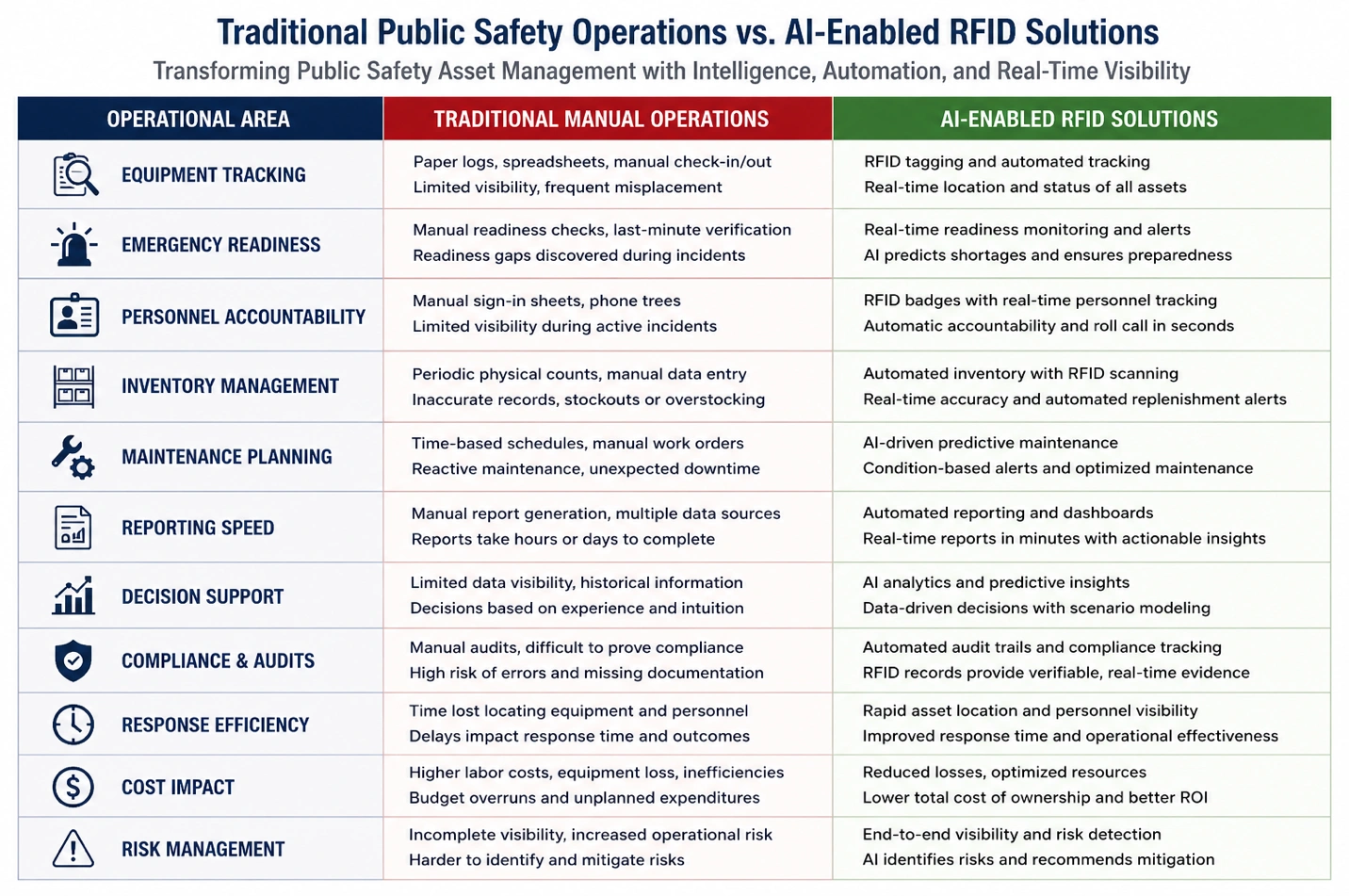
This comparison table contrasts cloud-hosted and customer-managed server deployments for AI-enabled RFID public works systems. It compares infrastructure ownership, scalability, maintenance responsibilities, cybersecurity, latency, offline capabilities, integration flexibility, cost considerations, disaster recovery, and ideal deployment scenarios. The visual helps municipal organizations evaluate the deployment model that best fits their operational, security, and regulatory requirements.
Technical Capabilities and Operational Benefits of AI-Enabled RFID for Public Works
Combining AI with RFID enables Public Works organizations to move from reactive maintenance toward proactive infrastructure management. The value extends beyond asset identification by improving operational efficiency, reducing costs, and supporting data-driven planning.
Improved Asset Visibility
RFID establishes a persistent digital identity for infrastructure assets, tools, and equipment. AI consolidates this information into actionable insights, enabling supervisors to locate resources quickly, verify inventories, and monitor utilization across multiple worksites.
Predictive Infrastructure Maintenance
Historical RFID events, inspection records, environmental conditions, and maintenance histories enable AI models to forecast asset deterioration. Maintenance can be scheduled before failures disrupt essential public services, reducing emergency repairs and extending asset life.
Smarter Inventory Management
Municipal warehouses often support road maintenance, water utilities, parks, sanitation, and fleet operations simultaneously. AI analyzes RFID inventory movement to forecast seasonal demand, recommend reorder points, and minimize stock shortages without excessive inventory carrying costs.
Increased Workforce Productivity
RFID reduces manual asset searches and paperwork while AI optimizes technician scheduling based on skill availability, equipment location, travel distance, and work order priority. Maintenance crews spend more time performing productive work and less time locating materials or updating records.
Enhanced Regulatory Compliance
Many Public Works activities require documented inspections, maintenance histories, and asset traceability. RFID automates record collection while AI identifies missing documentation, overdue inspections, and compliance risks before audits occur.
Better Capital Planning
AI analyzes lifecycle costs, maintenance frequency, failure trends, and utilization to help engineering teams prioritize rehabilitation and replacement projects. Capital budgets can be directed toward the highest-risk infrastructure based on objective operational evidence rather than assumptions.
Stronger Emergency Preparedness
During floods, severe storms, or infrastructure failures, RFID provides real-time visibility into available equipment and supplies. AI assists decision-makers by recommending resource deployment priorities, estimating repair timelines, and identifying operational bottlenecks.
GAO has supported organizations by supplying RFID hardware products and IoT solutions that improve asset visibility, inventory accuracy, and operational efficiency across demanding government and infrastructure environments.
AI-Enabled RFID Infographic for Public Works Asset Management and Operational Performance
This infographic highlights the measurable operational improvements achieved by combining AI with RFID across Public Works operations. It illustrates how intelligent asset tracking, predictive maintenance, fleet utilization, inventory optimization, inspection compliance, emergency response, workforce productivity, infrastructure lifecycle management, cybersecurity, and executive dashboards work together to improve municipal infrastructure management. The key takeaway is that AI-powered RFID solutions enable data-driven decision-making, higher operational efficiency, lower maintenance costs, and more resilient Public Works services.
Engineering Best Practices and Implementation Recommendations
Successful Public Works deployments depend on careful planning, phased implementation, and close alignment with operational objectives.
Recommended engineering practices include:
- Develop a comprehensive asset inventory before tagging infrastructure.
- Select RFID tag types based on environmental conditions, read distance, and asset material.
- Perform radio frequency site surveys to identify potential interference.
- Standardize asset naming conventions and metadata across departments.
- Integrate RFID events with CMMS, GIS, EAM, and work order software early in the project.
- Validate AI models using historical maintenance and inspection data before operational deployment.
- Implement governance policies for data quality, cybersecurity, and lifecycle management.
- Train field personnel on RFID procedures, mobile applications, and data collection standards.
- Establish performance metrics and continuously monitor system effectiveness.
- Expand deployments incrementally after validating operational improvements in pilot projects.
GAO’s engineering teams support organizations throughout hardware selection, solution design, deployment planning, testing, and ongoing technical assistance, helping Public Works agencies implement RFID and IoT systems that align with operational and infrastructure management objectives.
Key Takeaways for AI-Driven Public Works Asset Management
Artificial intelligence supported by RFID is reshaping Public Works operations by providing accurate, real-time visibility into infrastructure assets, maintenance activities, inventory, fleet resources, and field operations. RFID supplies reliable identification and tracking information, while AI converts operational data into predictive insights that improve maintenance planning, optimize workforce utilization, strengthen regulatory compliance, and support long-term capital investment decisions.
Organizations planning modernization initiatives should evaluate existing asset management processes, identify high-value use cases, integrate RFID with established municipal software, and implement strong cybersecurity controls from the beginning of the project. A phased deployment strategy, supported by measurable performance indicators and continuous optimization, provides a practical path toward more resilient, efficient, and data-driven Public Works operations.
Headquartered in New York City and Toronto, Canada, GAO is recognized among the leading global suppliers of RFID and BLE technologies for B2B and public sector organizations. Together with its sister companies, GAO Research and GAO Tek, GAO has served Fortune 500 companies, leading research institutions, universities, and government agencies throughout the United States and Canada for more than three decades. This experience, combined with sustained investment in research and development, rigorous quality assurance, and expert remote and onsite technical support, enables GAO to help Public Works organizations deploy reliable RFID and IoT solutions tailored to real-world operational requirements.
Building the Future of Industrial AI and IoT with Aperture Venture Studio and GAO RFID Inc.
For more than three decades, GAO Group of Companies has invested extensively in research and development of industrial RFID, BLE, and IoT technologies. As generative AI has matured into a practical technology for infrastructure management, predictive maintenance, and intelligent asset operations, we have expanded our AI and IoT capabilities while establishing Aperture Venture Studio to accelerate the advancement and adoption of AI and IoT innovations across Public Works and other critical infrastructure sectors.
Aperture has attracted leading AI and IoT technical experts, experienced operational executives, influential investors, and established industry organizations. Through initiatives such as the Aperture Ventures Summit and TekSummit, we foster collaboration on advanced AI and IoT technologies while strengthening diverse technical communities. We welcome you to connect with us as:
- Advisors, co-founders, or employees
- Investors
- Customers seeking advanced AI, RFID, BLE, and IoT solutions for Public Works and other infrastructure applications