
AI-Driven RFID Solutions for Military Aircraft Manufacturing
Understanding AI-Powered RFID in Military Aircraft Manufacturing
Artificial intelligence for military aircraft manufacturing refers to intelligent software systems that continuously analyze manufacturing, logistics, engineering, inspection, and operational information to improve production decisions. RFID serves as one of the primary automatic identification technologies that supplies trusted, real-time asset visibility across production facilities.
Military aircraft manufacturing differs significantly from commercial manufacturing because every serialized component must comply with rigorous defense standards, engineering documentation, quality requirements, export regulations, and configuration baselines. Every structural assembly, avionics module, hydraulic subsystem, composite panel, fastener kit, electronic warfare module, radar component, engine assembly, landing gear system, and mission equipment package requires documented traceability.
AI transforms RFID-generated identification data into actionable operational intelligence by correlating information across numerous manufacturing systems, including:
- Manufacturing Execution Systems (MES)
- Product Lifecycle Management (PLM)
- Enterprise Resource Planning (ERP)
- Quality Management Systems (QMS)
- Manufacturing Operations Management (MOM)
- Warehouse Management Systems (WMS)
- Digital Twin software
- Computerized Maintenance Management Systems (CMMS)
- Supply Chain Management software
- Industrial analytics software
Instead of merely identifying where a component is located, AI determines whether production schedules remain achievable, identifies bottlenecks, predicts inspection failures, recommends production adjustments, detects abnormal manufacturing behavior, and improves factory resource utilization.
Military aircraft manufacturers increasingly adopt AI-enabled RFID because production programs involve:
- Long production cycles
- Extremely complex Bills of Materials (BOM)
- High-value serialized assets
- Strict configuration management
- Classified production environments
- Continuous supplier qualification
- Multi-tier defense supply chains
- Extensive documentation requirements
- Lifetime asset traceability
- Mission readiness requirements
AI enables manufacturers to convert these enormous datasets into operational intelligence while RFID provides the reliable identification layer needed to maintain digital continuity throughout production.
AI-Powered RFID Solution for Secure Military Aircraft Manufacturing and Digital Production Traceability
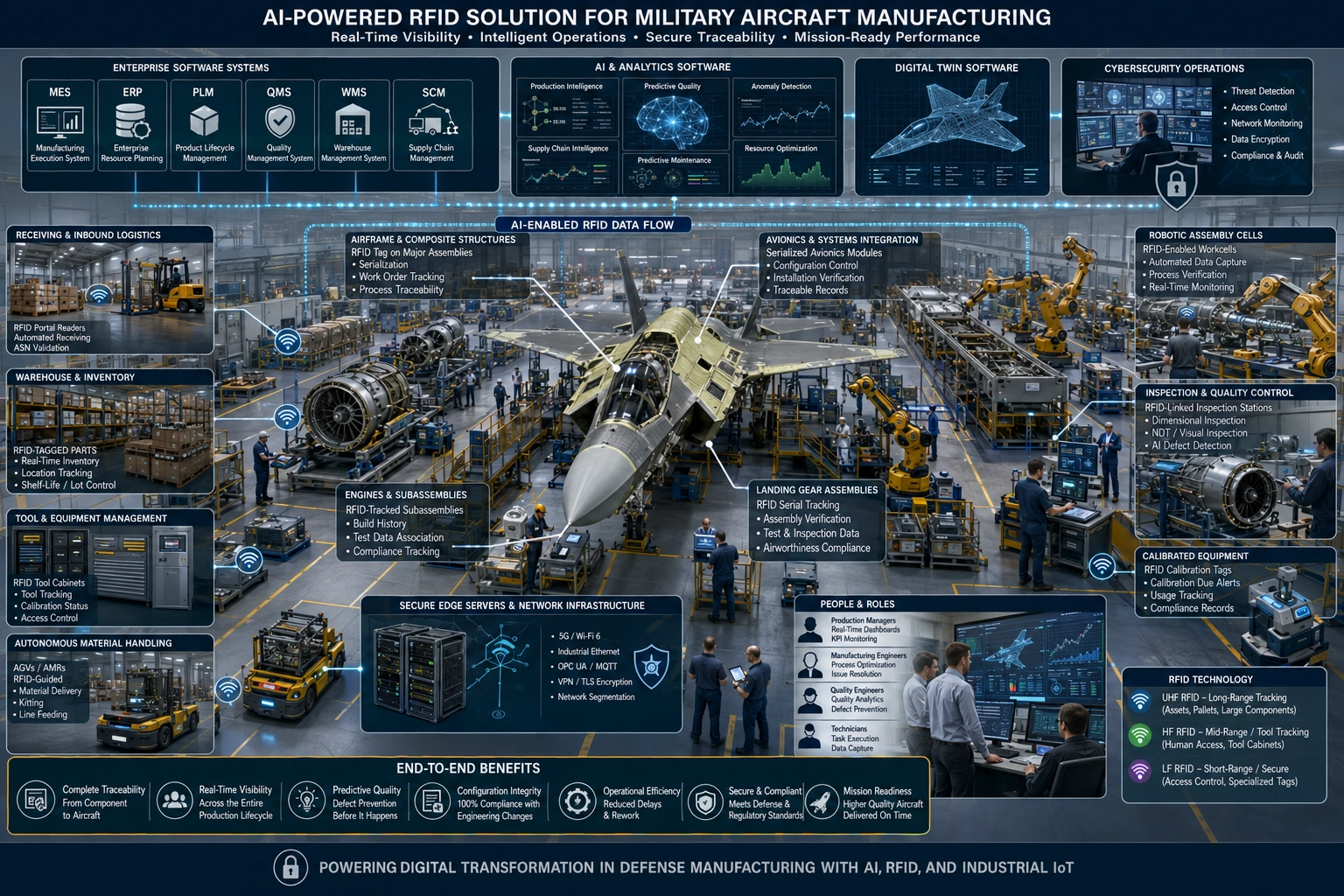
This illustration presents a comprehensive AI-enabled RFID solution deployed across a secure military aircraft manufacturing facility. It demonstrates how RFID-tagged aircraft components, intelligent automation, enterprise software, digital twin technology, and AI analytics work together to deliver real-time traceability, predictive quality management, secure configuration control, and end-to-end production visibility throughout the aircraft manufacturing lifecycle.
Why AI Is Transforming Military Aircraft Manufacturing
Military aircraft production has evolved from isolated manufacturing operations into digitally connected production systems where engineering, manufacturing, quality assurance, logistics, cybersecurity, and sustainment share operational information.
Several trends have accelerated AI adoption within military aircraft manufacturing:
- Increasing aircraft complexity
- Rising defense quality requirements
- Advanced composite structures
- Smart factories
- Digital engineering initiatives
- Model-Based Systems Engineering (MBSE)
- Digital Thread implementation
- Predictive quality programs
- Automated inspection systems
- Supply chain resilience initiatives
Traditional barcode-based identification often requires direct operator interaction. RFID allows components, tooling, transport containers, fixtures, calibrated instruments, and production assets to be automatically identified without direct line-of-sight scanning.
Artificial intelligence significantly extends the operational value of RFID by detecting manufacturing patterns that human operators cannot easily recognize. AI algorithms identify hidden relationships between supplier quality, machine utilization, environmental conditions, workforce scheduling, and production outcomes.
Typical AI applications include:
- Predictive production scheduling
- Intelligent material flow optimization
- Automated quality inspection prioritization
- Anomaly detection for production assets
- Predictive tooling maintenance
- Digital work instruction optimization
- Inventory forecasting
- Supplier performance analysis
- Workforce utilization optimization
- Automated compliance monitoring
These capabilities support military aircraft programs where production delays, quality escapes, or undocumented configuration changes can significantly impact operational readiness.
AI Asset Tracking Applications Across Military Aircraft Manufacturing
AI-supported RFID solutions address nearly every stage of military aircraft production.
Airframe Manufacturing
AI continuously monitors RFID-tagged fuselage sections, wing assemblies, empennage structures, composite panels, titanium components, and structural subassemblies.
Operational improvements include:
- Automated work-in-progress visibility
- Production bottleneck prediction
- Assembly sequence verification
- Structural configuration validation
- Intelligent production scheduling
Composite Manufacturing
Composite fabrication introduces strict environmental requirements.
AI evaluates RFID data together with:
- Cure cycle information
- Autoclave utilization
- Resin batch records
- Material shelf life
- Environmental monitoring
- Tool availability
Manufacturers reduce material waste while maintaining certification requirements for composite aircraft structures.
Engine Manufacturing
Military aircraft engines involve thousands of serialized precision components.
AI-supported RFID enables:
- Serialized turbine blade tracking
- Rotor assembly verification
- Heat treatment traceability
- Precision machining workflow monitoring
- Assembly validation
- Final engine configuration management
Avionics Production
Defense avionics require strict component traceability because electronic modules often contain export-controlled technologies.
AI analyzes RFID information to improve:
- PCB assembly tracking
- Electronic module verification
- Calibration scheduling
- Functional testing workflows
- Secure inventory control
Weapons Integration
Mission systems require verified installation of:
- Radar modules
- Electro-optical sensors
- Electronic warfare equipment
- Secure communications systems
- Navigation units
- Mission computers
AI verifies installation sequences while RFID confirms component identity throughout integration.
Tool Control
Lost tooling creates significant production and safety risks.
RFID-tagged tools combined with AI provide:
- Automated tool accountability
- Calibration monitoring
- Tool utilization analysis
- Missing tool detection
- Predictive replacement planning
Warehouse Operations
Military aircraft manufacturers maintain large inventories of:
- Fasteners
- Composite materials
- Titanium stock
- Aluminum alloys
- Electronic assemblies
- Hydraulic components
- Wiring harnesses
- Seals
- Bearings
- Consumables
AI predicts inventory requirements while RFID automates warehouse visibility.
AI-Enabled RFID Workflow for Military Aircraft Manufacturing and Digital Production Management
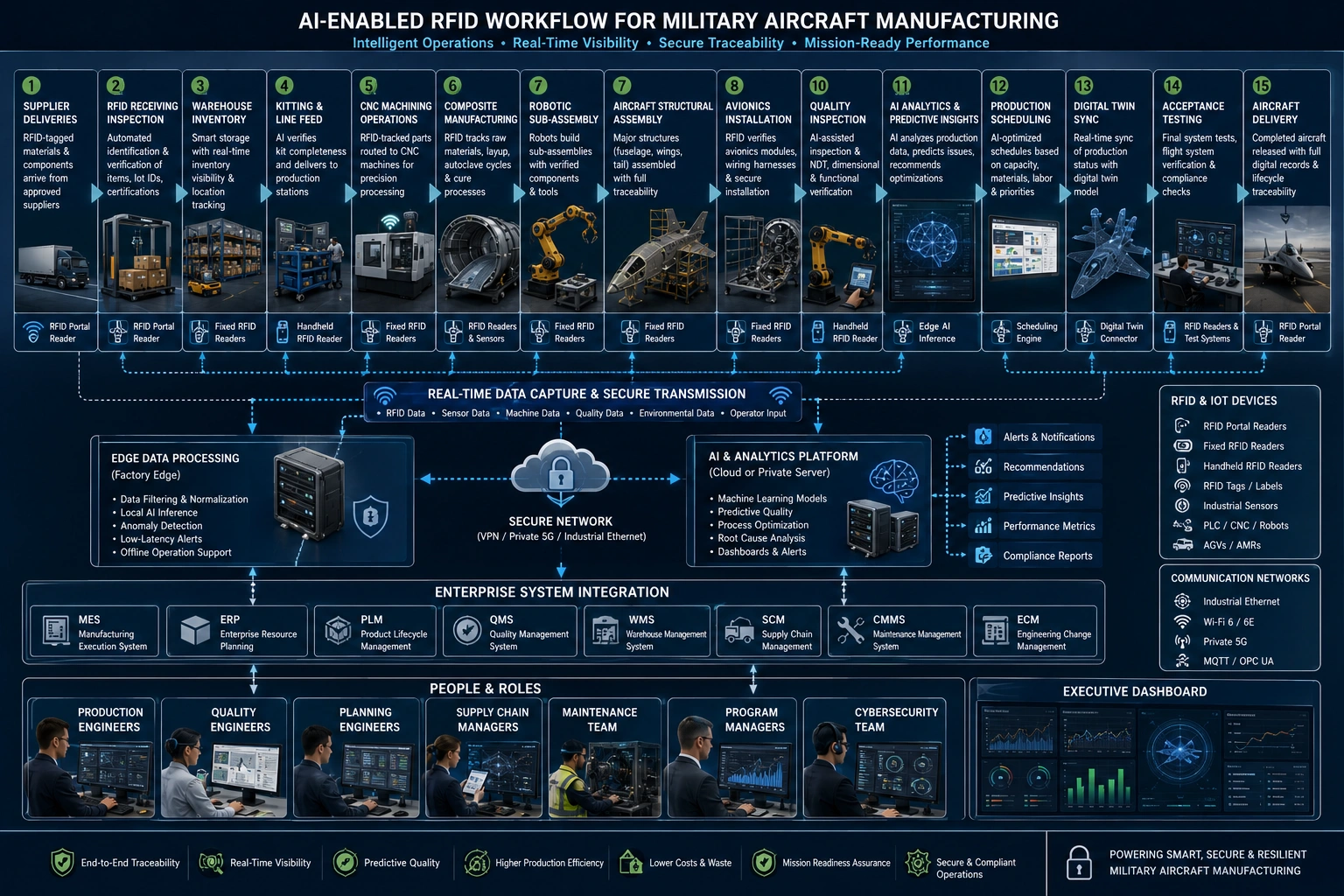
This workflow diagram illustrates the complete AI-enabled RFID production lifecycle in military aircraft manufacturing, from supplier deliveries and RFID receiving inspection through machining, assembly, avionics integration, quality inspection, AI analytics, digital twin synchronization, acceptance testing, and aircraft delivery. It highlights how RFID data, edge computing, AI software, enterprise systems, and secure communications work together to improve production visibility, predictive quality, traceability, and manufacturing efficiency.
End-to-End Operational Workflow for AI-Enabled RFID in Military Aircraft Manufacturing
Military aircraft production involves thousands of synchronized manufacturing activities performed across multiple secure production facilities. AI continuously processes RFID-generated operational data throughout each manufacturing stage to optimize production performance.
Material Receiving and Supplier Verification
Raw materials, forgings, castings, electronics, composite materials, engines, landing gear assemblies, avionics modules, hydraulic components, and supplier kits arrive with serialized RFID identification.
Receiving operations validate:
- Purchase orders
- Supplier certifications
- Lot traceability
- Material certifications
- Environmental storage requirements
- Defense compliance documentation
AI automatically identifies supplier anomalies by comparing incoming materials against historical supplier performance and quality records.
Intelligent Material Storage
RFID portals automatically record inventory movement into secured warehouses.
AI continuously evaluates:
- Storage utilization
- Material aging
- Shelf-life expiration
- Demand forecasting
- Inventory balancing
- Warehouse congestion
The software recommends inventory relocation before shortages affect production schedules.
Production Kitting
Production kits are assembled for specific aircraft work orders.
AI verifies:
- Correct serialized components
- Assembly sequence
- Kit completeness
- Missing hardware
- Production priorities
Incorrect kits are automatically flagged before reaching assembly stations.
Manufacturing Operations
RFID readers positioned throughout production facilities identify:
- Aircraft sections
- Workstations
- Tooling
- Operators
- Mobile equipment
- Inspection devices
AI combines identification data with:
- CNC machining status
- Robot operations
- Machine utilization
- Production timing
- Environmental sensors
- Quality inspection systems
The software predicts production delays before they affect downstream manufacturing operations.
Automated Quality Assurance
Inspection stations automatically identify serialized aircraft assemblies.
AI correlates RFID identification with:
- Non-destructive testing results
- Coordinate Measuring Machine (CMM) inspections
- Laser tracker measurements
- Surface finish analysis
- Torque verification
- Digital inspection records
Quality engineers receive prioritized inspection recommendations based on predicted production risk rather than fixed inspection schedules.
AI-Enabled RFID Data Flow Architecture for Military Aircraft Manufacturing Systems
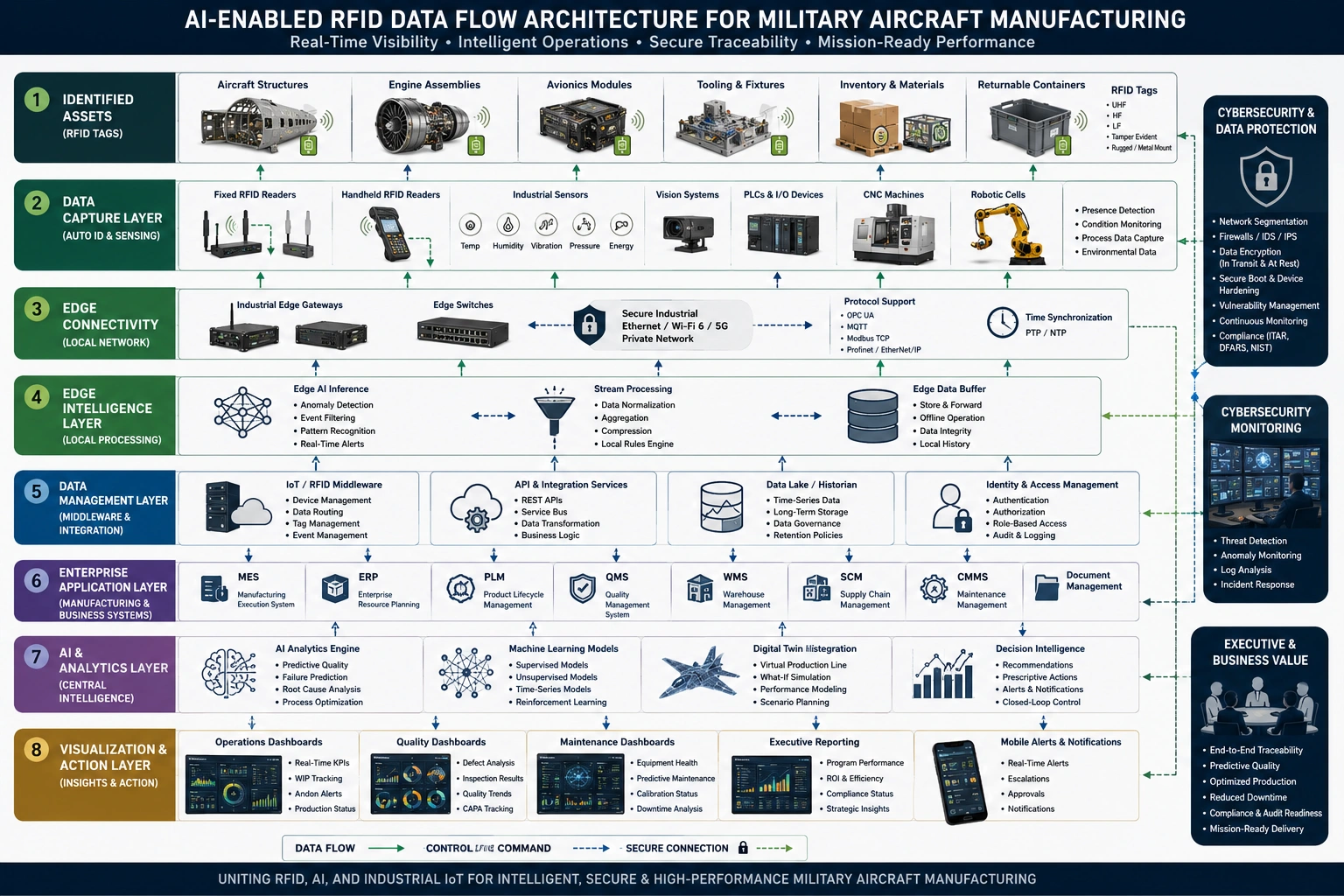
This layered block diagram illustrates the end-to-end operational data flow of an AI-enabled RFID solution used in military aircraft manufacturing. It shows how RFID-tagged assets, industrial devices, edge computing, secure communication networks, enterprise software, AI analytics, digital twin technology, and executive dashboards interact to deliver real-time traceability, predictive insights, cybersecurity, and intelligent manufacturing decision-making.
AI-Enabled RFID System Components for Military Aircraft Manufacturing
Successful deployment requires coordinated integration of industrial hardware, secure communications, intelligent software, and manufacturing information systems. Military aircraft manufacturers typically implement modular solutions that support highly regulated production environments while maintaining cybersecurity, configuration control, and long-term lifecycle traceability.
RFID Technologies
Depending on operational requirements, manufacturers deploy multiple RFID technologies:
- UHF RFID for work-in-progress tracking, warehouse logistics, large assemblies, returnable transport items, and portal-based identification.
- HF RFID for electronic modules, maintenance records, tool identification, and controlled manufacturing cells requiring shorter read ranges.
- LF RFID for specialized industrial identification tasks where metal interference, harsh environments, or short-range reliability are priorities.
Each technology is selected according to read distance, environmental conditions, material characteristics, interference tolerance, and security requirements rather than using a single RFID method across every manufacturing process.
Industrial Hardware Supporting AI-Driven RFID Solutions
Military aircraft manufacturing environments combine automated production equipment, precision metrology, secure manufacturing cells, and industrial identification devices. AI depends on reliable operational data generated from these connected systems.
Typical hardware includes:
- Fixed RFID readers installed at receiving docks, warehouse portals, assembly stations, paint facilities, and final acceptance areas
- Handheld RFID readers used by quality inspectors, logistics personnel, manufacturing engineers, and inventory specialists
- RFID-enabled tool cabinets and smart storage systems
- Industrial edge gateways for local data aggregation
- Industrial PCs and edge AI computers
- CNC machining centers
- Robotic drilling, fastening, and assembly systems
- Automated Guided Vehicles (AGVs) and Autonomous Mobile Robots (AMRs)
- Coordinate Measuring Machines (CMMs)
- Laser trackers and laser scanners
- Vision inspection systems
- Torque verification equipment
- Environmental monitoring sensors
- PLCs controlling automated manufacturing equipment
- Secure industrial networking equipment
- High-availability storage systems
- Factory visualization displays
Each device contributes operational intelligence while RFID establishes a trusted identity for components, assemblies, tools, containers, equipment, and work orders.
AI Software and Analytics
Artificial intelligence transforms manufacturing visibility by processing RFID observations together with production, engineering, logistics, and quality information.
Common AI methods include:
- Machine learning for production forecasting
- Predictive analytics for quality assurance
- Deep learning for anomaly detection
- Computer vision for automated inspection
- Reinforcement learning for production optimization
- Time-series forecasting for equipment utilization
- Graph analytics for supply chain dependency analysis
- Natural language processing for engineering documentation
- Explainable AI supporting manufacturing decisions
AI continuously evaluates:
- Work-in-progress movement
- Component availability
- Machine utilization
- Production throughput
- Supplier quality
- Workforce allocation
- Inspection performance
- Inventory trends
- Configuration deviations
- Production risks
Rather than replacing engineering judgment, AI prioritizes exceptions requiring immediate attention, allowing manufacturing teams to focus on higher-value decision-making.
Communication Infrastructure
Reliable communication is essential because military aircraft manufacturing facilities often span multiple secure buildings and restricted production areas.
Typical communication technologies include:
- Industrial Ethernet
- Fiber-optic backbone networks
- Secure Wi-Fi 6/6E
- Private 5G where appropriate
- OPC UA
- MQTT
- HTTPS APIs
- RESTful services
- Time-sensitive networking for synchronized manufacturing systems
- VPN connectivity for authorized remote engineering support
Network segmentation separates manufacturing systems, engineering software, quality systems, and business applications while supporting cybersecurity policies required by defense manufacturers.
Enterprise Software Integration
AI-enabled RFID solutions become significantly more valuable when integrated with existing manufacturing software.
Common integrations include:
- Manufacturing Execution Systems (MES)
- Enterprise Resource Planning (ERP)
- Product Lifecycle Management (PLM)
- Manufacturing Operations Management (MOM)
- Quality Management Systems (QMS)
- Warehouse Management Systems (WMS)
- Supply Chain Management (SCM)
- Computerized Maintenance Management Systems (CMMS)
- Digital Twin software
- Configuration Management software
- Engineering Change Management systems
- Document Management Systems
These integrations create a continuous digital thread connecting engineering design, procurement, manufacturing, inspection, logistics, acceptance testing, and long-term sustainment.
For more than three decades, GAO has supplied RFID, BLE, and industrial IoT hardware products and systems that integrate with existing manufacturing software used by organizations across North America, helping customers improve operational visibility while minimizing disruption to established production processes.
Cloud Version
Cloud-hosted deployments are well suited for organizations operating multiple manufacturing facilities or geographically distributed supplier networks.
Cloud deployment advantages include:
- Centralized AI model management
- Enterprise-wide production visibility
- Multi-site analytics
- Centralized software updates
- Elastic computing resources
- Cross-facility performance benchmarking
- Simplified disaster recovery
- Secure remote engineering collaboration
Cloud-hosted software is particularly valuable for defense contractors managing suppliers across numerous manufacturing locations while maintaining standardized reporting and analytics.
Server Version
Many military aircraft manufacturers prefer privately managed server deployments because production environments frequently involve classified programs, export-controlled information, and strict cybersecurity requirements.
Server deployments may operate on:
- Factory edge servers
- Customer-managed data centers
- Secure defense cloud environments
- Private enterprise server infrastructure
- Regional manufacturing computing facilities
Server-hosted deployments provide:
- Greater control over sensitive manufacturing information
- Reduced external network dependency
- Lower latency for production analytics
- Local AI inference
- Support for isolated production environments
- Compliance with internal defense security policies
Many organizations adopt hybrid deployments where local servers process sensitive operational data while selected analytics are synchronized with centralized enterprise software.
Business Value and Technical Benefits of AI-Driven RFID in Military Aircraft Manufacturing
Combining AI with RFID delivers measurable operational improvements across defense aerospace production by increasing manufacturing intelligence rather than simply automating identification.
Production Visibility
AI continuously interprets RFID-generated movement data to provide near real-time visibility into aircraft assemblies, production assets, tooling, materials, and work orders.
Benefits include:
- Improved work-in-progress monitoring
- Reduced production uncertainty
- Faster bottleneck identification
- Better resource utilization
Configuration Management
Military aircraft programs require strict configuration control throughout manufacturing.
AI validates:
- Serialized component installation
- Approved engineering revisions
- Configuration baselines
- Assembly sequence compliance
- Engineering change implementation
This reduces the likelihood of undocumented configuration deviations.
Predictive Quality Management
Quality assurance shifts from reactive inspections to proactive risk management.
AI identifies:
- High-risk production batches
- Supplier quality trends
- Equipment-related defects
- Process instability
- Inspection prioritization
Manufacturers can intervene before nonconforming assemblies progress to subsequent production stages.
Supply Chain Intelligence
RFID visibility combined with AI strengthens supply chain resilience.
Capabilities include:
- Supplier performance analysis
- Material availability forecasting
- Inventory optimization
- Logistics planning
- Shortage prediction
These insights support uninterrupted aircraft production despite complex global supply chains.
Manufacturing Efficiency
Operational improvements include:
- Reduced manual scanning
- Faster inventory reconciliation
- Improved production scheduling
- Shorter search times for assets
- Lower administrative workload
- Increased equipment utilization
Security and Compliance
Defense manufacturing demands comprehensive traceability and secure handling of sensitive assets.
AI-enabled RFID supports:
- Controlled access to restricted materials
- Audit-ready production records
- Automated chain-of-custody documentation
- Compliance reporting
- Tamper detection
- Secure asset accountability
Scalability
Solutions can expand from a single production line to multiple factories while maintaining standardized identification, analytics, and reporting.
Organizations may gradually introduce:
- Additional RFID readers
- AI models
- Manufacturing software integrations
- Production facilities
- Supplier networks
without requiring complete system replacement.
Engineering Considerations and Implementation Best Practices
Successful AI-enabled RFID implementations require careful planning beyond hardware installation.
Recommended engineering practices include:
- Define traceability objectives before selecting RFID technologies.
- Establish standardized serialization schemes for aircraft components and production assets.
- Validate RF performance around metallic airframes, composite structures, and high-interference manufacturing equipment.
- Perform site surveys to determine optimal reader placement and antenna orientation.
- Integrate RFID data with MES, ERP, PLM, and QMS through well-defined APIs.
- Apply role-based access control, encryption, and secure authentication for all connected systems.
- Implement continuous monitoring for reader health, network availability, and AI model performance.
- Periodically retrain AI models using updated manufacturing, inspection, and supply chain data.
- Develop exception-handling procedures for unreadable tags, damaged labels, and network interruptions.
- Conduct pilot deployments on selected production lines before factory-wide implementation.
- Measure success using KPIs such as first-pass yield, work-in-progress accuracy, inventory accuracy, production cycle time, schedule adherence, asset utilization, and configuration compliance.
Organizations also benefit from multidisciplinary collaboration among manufacturing engineers, quality specialists, cybersecurity teams, production planners, logistics personnel, and systems integrators to ensure long-term operational success.
GAO supports customers by providing RFID hardware products, industrial identification systems, and technical expertise that help organizations implement reliable AIoT solutions aligned with demanding manufacturing requirements.
AI-Driven RFID for Military Aircraft Manufacturing: Key Takeaways
AI-powered asset tracking, intelligent production management, predictive quality assurance, and automated configuration control are becoming fundamental capabilities within modern military aircraft manufacturing. RFID provides dependable identification and traceability, while AI transforms manufacturing, engineering, and logistics data into actionable intelligence that improves production performance, quality, security, and lifecycle visibility.
As defense aerospace programs continue adopting digital engineering, smart manufacturing, and AIoT initiatives, organizations that integrate intelligent RFID solutions with manufacturing software, secure communications, and advanced analytics will be better positioned to increase operational efficiency and maintain stringent regulatory compliance.
Headquartered in New York City and Toronto, Canada, GAO is recognized among the world’s leading B2B and B2G suppliers of RFID and BLE technologies. Together with its sister companies, GAO Research and GAO Tek, GAO has served Fortune 500 companies, leading research institutions, universities, and U.S. and Canadian government agencies for more than three decades through sustained investment in research and development, rigorous quality assurance, and expert remote and onsite technical support. We invite you to learn more about GAO’s RFID products, AIoT solutions, engineering expertise, and technical services for military aircraft manufacturing.
Building the Future of Industrial AI and IoT with Aperture Venture Studio and GAO
For more than three decades, GAO Group of Companies has invested extensively in research and development for industrial RFID, BLE, and IoT technologies. As generative AI demonstrated its value in defense manufacturing, aerospace production, and other industrial environments, we expanded our AI and IoT capabilities and established Aperture Venture Studio to accelerate the advancement and adoption of intelligent industrial AI and IoT solutions for sectors such as military aircraft manufacturing.
Aperture has attracted leading AI and IoT technical experts, experienced operational executives, influential investors, and prominent industry organizations. We have also developed the successful Aperture Ventures Summit and TekSummit to facilitate discussions on advanced AI and IoT technologies while fostering strong technical communities. We welcome advisors, co-founders or employees, investors, and customers to engage with us in advancing the future of industrial AI and IoT.