
AI and RFID for Public Safety: Intelligent Solutions for Emergency Response, Asset Tracking, and Government Operations
AI-Driven Public Safety Solutions Using RFID for Smarter Government Operations
AI and RFID for Public Safety combines artificial intelligence, connected identification technologies, and IoT-based sensing systems to improve emergency response, personnel coordination, asset visibility, and operational decision-making for government safety organizations. Public safety agencies are increasingly adopting AI-powered solutions that use RFID-enabled data capture, edge computing, machine learning, and analytics to understand operational conditions in real time.
For police departments, fire and rescue agencies, emergency medical services, disaster management teams, and government security organizations, AI-enabled RFID solutions help manage critical assets, monitor equipment availability, improve incident response coordination, and enhance accountability. GAO provides RFID, BLE, and IoT hardware products and systems that support public safety organizations requiring reliable data collection, identification, and connected operational workflows. These technologies enable government agencies to transform manual processes into data-driven operations while maintaining security, scalability, and operational resilience.
AI, RFID, and IoT Public Safety Operations Infographic: Intelligent Emergency Response and Real-Time Decision Support
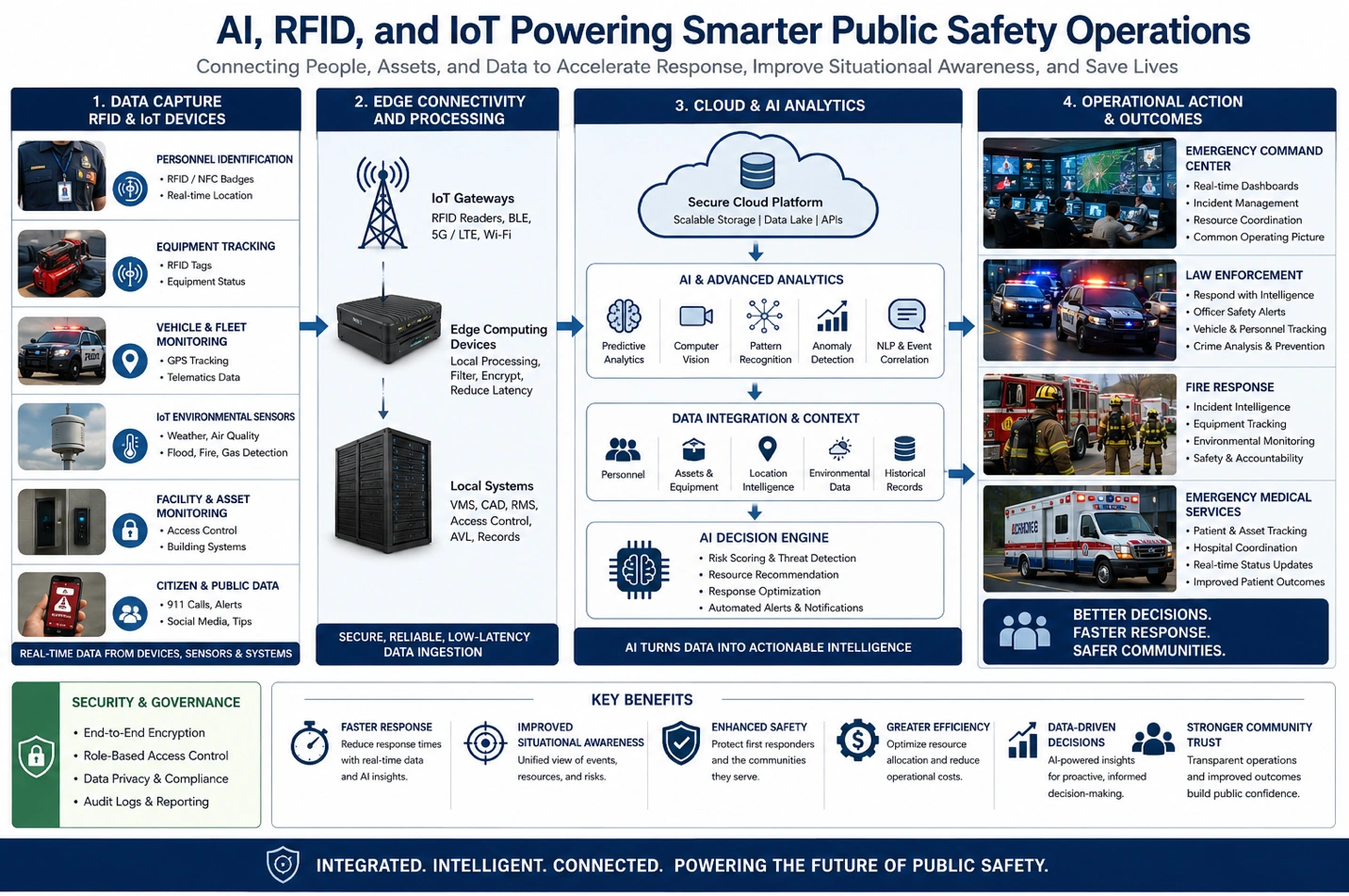
This enterprise infographic illustrates how RFID identification, IoT devices, edge computing, cloud analytics, and AI decision systems work together to support modern public safety operations. It shows the complete flow of operational data from personnel, equipment, vehicles, and sensors through AI analytics to emergency command centers, police, fire, and emergency medical services, highlighting how intelligent technologies improve situational awareness, response times, and operational efficiency.
Understanding AI and RFID Applications in Public Safety
What AI-Powered Public Safety Systems Mean
AI-powered public safety systems apply artificial intelligence methods to operational data collected from connected devices, sensors, identification systems, communication networks, and government information systems. These solutions help agencies analyze complex situations, identify patterns, automate routine decisions, and improve response coordination.
Within public safety environments, AIoT (Artificial Intelligence of Things) combines artificial intelligence with IoT devices, RFID systems, connected equipment, and operational software. AIoT solutions may include:
- Machine learning models for predicting resource requirements and identifying operational trends
- Edge AI processing for rapid decision-making during emergency situations
- Computer vision systems for situational awareness and infrastructure monitoring
- Natural language processing for analyzing incident reports and communication records
- Predictive analytics for emergency preparedness and asset availability planning
RFID acts as an important data acquisition technology within these solutions by providing automated identification and location-related information for personnel, emergency equipment, vehicles, medical supplies, and government-owned assets.
Why AI Is Transforming Public Safety Operations
Public safety organizations manage large volumes of operational information across emergency response, law enforcement, disaster management, and government security activities. Traditional manual tracking methods often create challenges such as delayed information availability, incomplete asset records, inefficient resource allocation, and limited visibility during emergency events.
AI-enabled public safety solutions address these challenges by converting operational data into actionable intelligence.
Key transformation areas include:
- Real-time visibility of emergency equipment, vehicles, and response resources
- Automated identification of personnel and authorized users
- Faster emergency resource allocation through predictive analytics
- Improved accountability of critical government assets
- Enhanced disaster response coordination through connected information systems
- Reduced administrative workload through automated reporting and monitoring
For example, a fire department can combine RFID-tagged breathing apparatus, protective equipment, vehicles, and personnel identification records with AI analytics to understand equipment readiness before emergency deployment. Similarly, emergency management agencies can use connected asset information to improve disaster preparedness and response planning.
AI-Powered RFID Emergency Response Station for Public Safety Equipment and Personnel Management
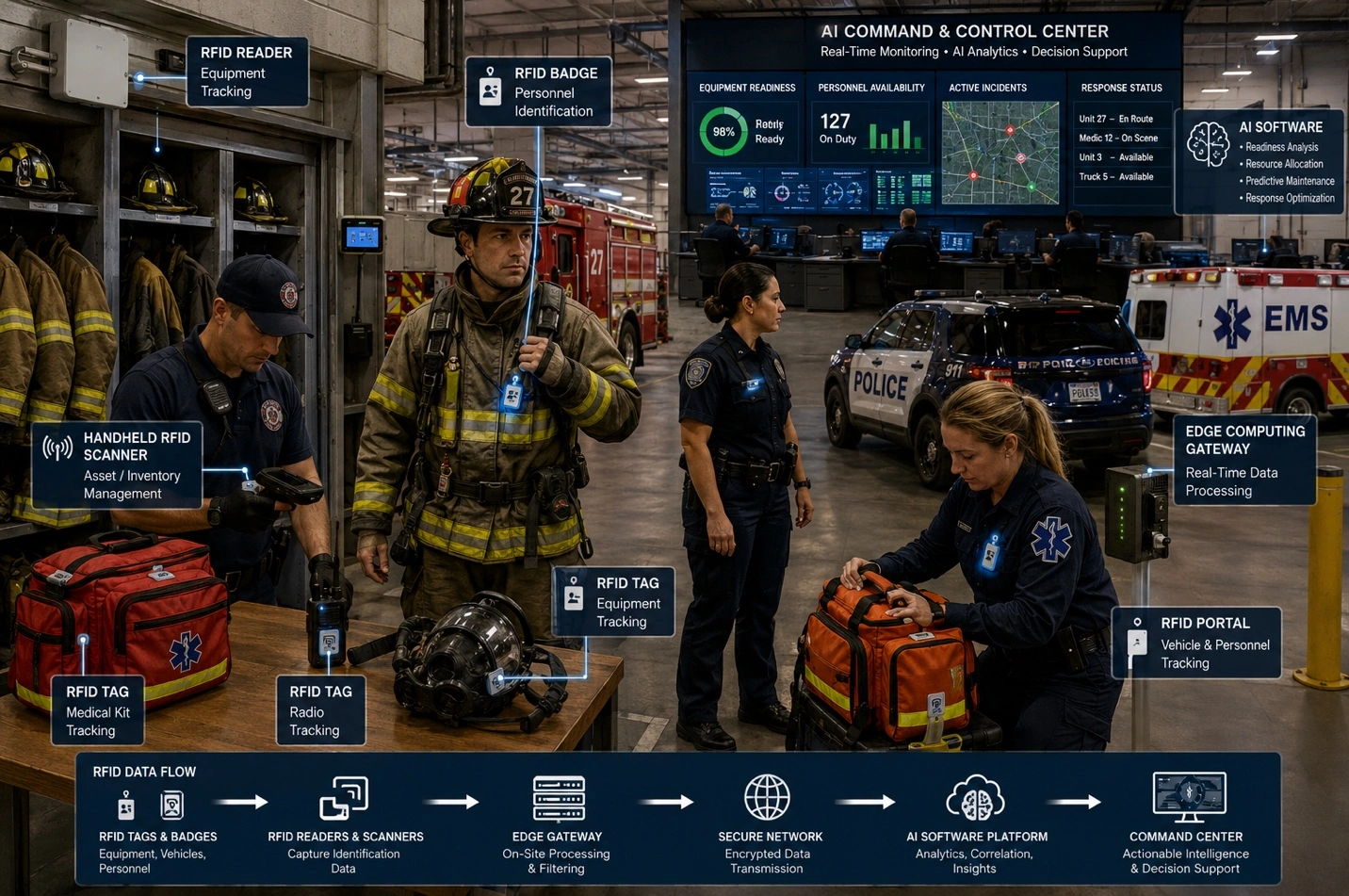
This illustration depicts a realistic government emergency response station where firefighters, police officers, and emergency medical personnel use RFID-enabled identification badges and RFID-tagged equipment to maintain operational readiness. RFID readers, handheld scanners, edge computing devices, and an AI-powered emergency command center work together to provide real-time visibility into personnel availability, equipment readiness, and emergency response status. The visual demonstrates how AI and RFID technologies improve preparedness, accountability, and decision-making across modern public safety operations.
Key AI and RFID Applications for Public Safety Organizations
Public safety agencies require reliable information about people, equipment, vehicles, facilities, and emergency resources. AI-supported RFID solutions address specific operational challenges across multiple government safety functions.
Emergency Response Equipment Tracking and Readiness Management
Emergency response organizations depend on immediate access to operational equipment such as:
- Firefighting gear
- Respiratory protection equipment
- Medical response kits
- Rescue tools
- Communication devices
- Tactical equipment
- Disaster relief supplies
RFID identification enables automated equipment registration, inspection tracking, and availability monitoring. AI analytics can evaluate equipment usage patterns, identify maintenance requirements, and support predictive readiness management.
Operational improvements include:
- Faster equipment verification before emergency deployment
- Automated inventory reconciliation
- Improved maintenance scheduling
- Reduced risk of unavailable critical equipment
- Better accountability after emergency operations
First Responder Identification and Personnel Management
Public safety agencies must maintain accurate information about responders entering hazardous or restricted environments. AI-enabled RFID systems can support:
- Personnel identification through RFID-enabled badges
- Automated access verification
- Emergency team assignment tracking
- Shift management
- Training certification monitoring
- Incident participation records
During large-scale emergencies, such as natural disasters or major public events, real-time personnel visibility helps command centers understand available resources and coordinate response teams more effectively.
Emergency Vehicle and Mobile Asset Management
Government safety organizations operate fleets including:
- Police vehicles
- Fire engines
- Ambulances
- Rescue trucks
- Mobile command units
- Disaster response vehicles
AI-powered asset management systems can combine RFID identification, GPS data, telematics, and operational analytics to improve fleet utilization.
Applications include:
- Vehicle assignment optimization
- Equipment verification before dispatch
- Maintenance prediction
- Emergency resource allocation
- Historical usage analysis
GAO supplies RFID and IoT-based hardware solutions that help organizations integrate physical assets with digital management systems for improved operational visibility.
Disaster Management and Public Emergency Coordination
Disaster response requires coordination among multiple government departments, including emergency management agencies, healthcare organizations, transportation authorities, and security services.
AI and RFID solutions support disaster operations by enabling:
- Relief supply tracking
- Temporary shelter resource management
- Emergency personnel coordination
- Medical inventory monitoring
- Field equipment identification
- Distribution workflow visibility
During flood response, wildfire management, or humanitarian operations, RFID-enabled identification can provide reliable information about resource movement while AI analytics helps decision-makers prioritize actions.
Secure Facility Access and Government Infrastructure Protection
Government facilities require controlled access for personnel, contractors, and authorized visitors. AI-enhanced RFID access solutions support:
- Personnel authentication
- Restricted area monitoring
- Visitor management
- Security event analysis
- Automated access reporting
When combined with AI analytics, access data can help identify unusual activity patterns and support security investigations while maintaining operational compliance.
Public Safety Operational Workflow Enabled by AI and RFID
AI-powered RFID solutions for public safety require coordinated data movement across physical devices, communication networks, software systems, and decision-making processes. A complete deployment typically follows a structured operational workflow.
Data Acquisition From Public Safety Assets and Personnel
The workflow begins with automated identification and data collection from operational resources.
Common data sources include:
- RFID-tagged emergency equipment
- RFID-enabled responder identification cards
- Ambulance and rescue vehicle assets
- Medical supply containers
- Security credentials
- Government facility access points
UHF RFID, HF RFID, and LF RFID technologies may be selected based on operational requirements. UHF RFID is commonly suitable for long-range inventory identification, while HF and LF RFID may support applications requiring shorter-range authentication or specialized identification environments.
Communication Infrastructure and Edge Processing
Collected RFID data is transmitted through communication infrastructure including:
- Industrial Ethernet networks
- Wi-Fi networks
- Cellular communication
- IoT gateways
- Edge computing devices
Edge processing allows public safety organizations to analyze critical information close to the operational environment. This is particularly important for emergency response scenarios where connectivity may be limited or immediate decisions are required.
Examples include:
- Verifying emergency equipment availability before dispatch
- Confirming responder access during incidents
- Monitoring resource movement during disaster operations
AI Analytics and Government System Integration
After data collection and processing, AI software analyzes operational information and integrates results with existing government systems.
Common integrations include:
- Computer-aided dispatch (CAD) systems
- Emergency management software
- Geographic information systems (GIS)
- Asset management systems
- Maintenance management software
- Government databases
AI models can identify trends such as equipment shortages, unusual access activity, maintenance requirements, and resource allocation opportunities.
Technical Components Behind AI-Enabled RFID Public Safety Solutions
AI-enabled RFID solutions for public safety require integration between identification hardware, IoT connectivity, AI software, government information systems, and secure data management processes. The effectiveness of these solutions depends on selecting suitable components based on operational requirements, environmental conditions, security policies, and response workflows.
RFID Hardware and Identification Technologies for Public Safety
RFID hardware provides automated identification and data capture capabilities for public safety operations. Different RFID frequency ranges support different deployment scenarios.
Key RFID components include:
- UHF RFID readers and tags for identifying large volumes of emergency equipment, vehicles, supply containers, and stored resources from longer distances
- HF RFID systems for controlled identification applications such as personnel credentials, equipment authentication, and facility access
- LF RFID systems for specialized applications requiring close-range identification and robust operation near challenging environments
- Fixed RFID readers installed at equipment storage rooms, emergency stations, checkpoints, and government facilities
- Handheld RFID readers used by emergency personnel for field inventory verification and mobile asset inspections
- RFID tags designed for durable operation on protective equipment, vehicles, containers, and outdoor assets
Public safety deployments require careful RFID hardware selection because emergency environments may involve extreme temperatures, moisture, metal interference, physical impact, and rapid operational changes.
GAO provides RFID and IoT hardware products and systems that support organizations requiring dependable identification, monitoring, and asset visibility capabilities across government and safety operations.
AI Models and Intelligent Data Processing
Artificial intelligence provides analytical capabilities that transform RFID-generated operational information into actionable insights.
Common AI methods used in public safety solutions include:
- Machine learning models for identifying resource utilization patterns and predicting operational requirements
- Predictive analytics for equipment maintenance planning and emergency resource preparation
- Anomaly detection algorithms for identifying unusual access events or asset movement patterns
- Computer vision combined with IoT data for improved situational awareness
- Natural language processing for analyzing emergency reports, communication records, and operational documentation
- Optimization algorithms for improving resource allocation during complex incidents
For example, AI models can analyze historical equipment usage data to predict when rescue equipment requires inspection or replacement. Emergency management organizations can also analyze resource movement patterns to improve disaster preparedness plans.
Software Systems and Data Management
AI-powered RFID public safety solutions typically connect with multiple software systems to support operational decision-making.
Important software components include:
- RFID middleware for managing reader communication and device data processing
- Asset management software for tracking government-owned equipment
- Emergency management systems for coordinating response activities
- Computer-aided dispatch systems for emergency call handling and resource assignment
- Geographic information systems for location-based analysis
- Maintenance management software for inspection scheduling and service records
- Cloud or server-based analytics software for AI processing and reporting
Effective integration requires standardized data exchange methods, reliable APIs, secure authentication mechanisms, and compatibility with existing government information systems.
Cloud Version and Server Version Deployment Models
AI and RFID public safety solutions can be deployed using cloud-hosted or privately managed server environments depending on government requirements.
Cloud Version Deployment
Cloud-based deployment hosts AI software, databases, analytics services, and system management tools within cloud infrastructure.
Cloud deployment is suitable for:
- Government agencies requiring multi-location visibility
- Regional emergency management coordination
- Organizations needing rapid scalability
- Public safety departments with limited internal IT resources
- Distributed operations involving multiple facilities
Advantages include:
- Centralized data management
- Easier software updates
- Remote system monitoring
- Flexible computing resources
- Improved collaboration between authorized departments
Server Version Deployment
Server-based deployment installs software on customer-managed infrastructure, including edge servers, private data centers, government facilities, or dedicated organizational servers.
Server deployment is suitable for:
- Agencies requiring greater control over operational data
- Security-sensitive public safety environments
- Organizations with strict data governance requirements
- Locations with limited external connectivity
- Mission-critical applications requiring local processing
Advantages include:
- Greater control over data storage
- Local processing capabilities
- Custom security configurations
- Integration with private government networks
Public safety organizations often select hybrid approaches, combining local edge processing for emergency operations with centralized analytics for long-term planning and reporting.
AI-Enabled RFID Public Safety System Architecture for Cloud and Government Server Deployments
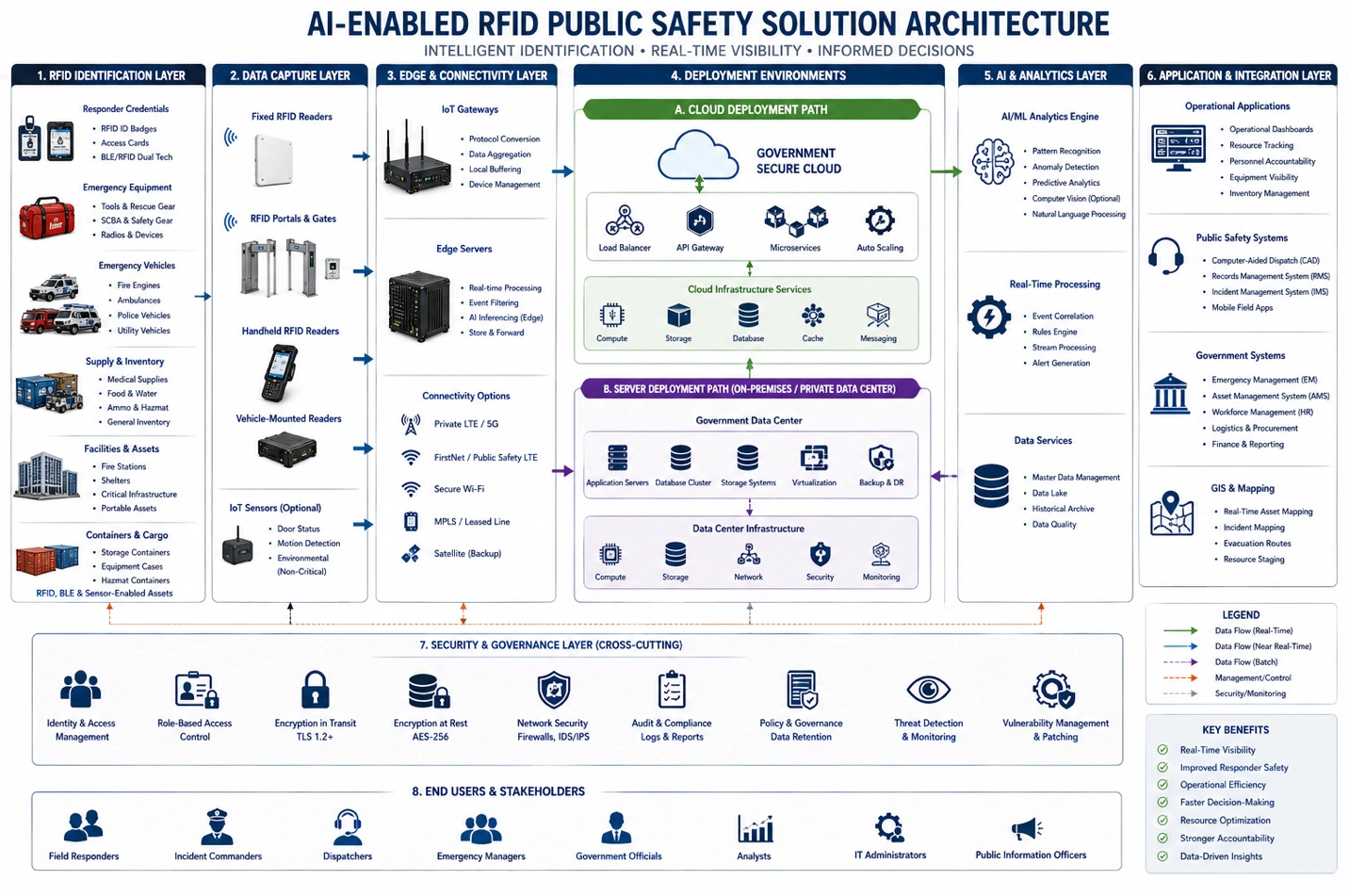
This enterprise system architecture diagram illustrates how RFID hardware, edge computing, AI analytics, and secure communications integrate with cloud and private government server deployments to support public safety operations. It highlights the complete data flow from RFID-tagged assets and responders through enterprise AI platforms into CAD, GIS, emergency management, asset management, and executive dashboards, enabling secure, real-time operational visibility and decision-making.
Security and Reliability Considerations for Public Safety RFID Systems
Public safety organizations require strong cybersecurity and operational reliability because the collected information may involve emergency resources, personnel activities, restricted facilities, and government operations.
Important security considerations include:
- Encryption of data transmitted between RFID devices, gateways, servers, and software systems
- Role-based access control for authorized personnel
- Secure authentication of RFID readers and connected devices
- Network segmentation for critical public safety systems
- Audit logging for asset access and operational events
- Regular software updates and vulnerability management
- Protection against unauthorized asset tracking or data manipulation
System reliability considerations include:
- Selecting industrial-grade RFID hardware for harsh environments
- Providing backup communication methods for emergency situations
- Designing offline data collection capabilities where connectivity is unavailable
- Performing operational testing before full deployment
- Establishing maintenance procedures for readers, tags, and connected devices
GAO applies engineering-focused quality assurance processes and provides technical support to help organizations deploy reliable RFID, BLE, and IoT-based solutions.
Key Benefits of AI and RFID Solutions for Public Safety
Combining AI analytics with RFID-based identification improves public safety operations by connecting physical resources with intelligent decision-making systems.
Improved Emergency Response Readiness
AI-enabled RFID solutions improve readiness by providing accurate information about:
- Available emergency equipment
- Personnel assignments
- Vehicle status
- Medical supply inventory
- Field resource availability
This reduces delays caused by manual searches and improves confidence that required resources are available before deployment.
Enhanced Asset Accountability and Lifecycle Management
Public safety organizations manage expensive and mission-critical assets. AI-powered RFID tracking supports complete lifecycle visibility from acquisition through retirement.
Benefits include:
- Automated inventory records
- Inspection history tracking
- Maintenance scheduling
- Reduced asset loss
- Improved equipment utilization
Faster Operational Decision-Making
AI analytics converts large volumes of operational data into meaningful recommendations.
Examples include:
- Predicting equipment shortages before emergencies
- Identifying inefficient resource allocation
- Detecting unusual operational patterns
- Supporting emergency command decisions
Command personnel gain improved visibility without relying entirely on manual reporting.
Scalable Government Safety Operations
AI-enabled RFID systems can expand from individual facilities to regional or national public safety operations.
Scalability advantages include:
- Supporting additional emergency facilities
- Adding new equipment categories
- Integrating additional government departments
- Expanding AI analytics capabilities
- Connecting new IoT devices
Traditional vs. AI-Enabled RFID Public Safety Asset Management Comparison Table
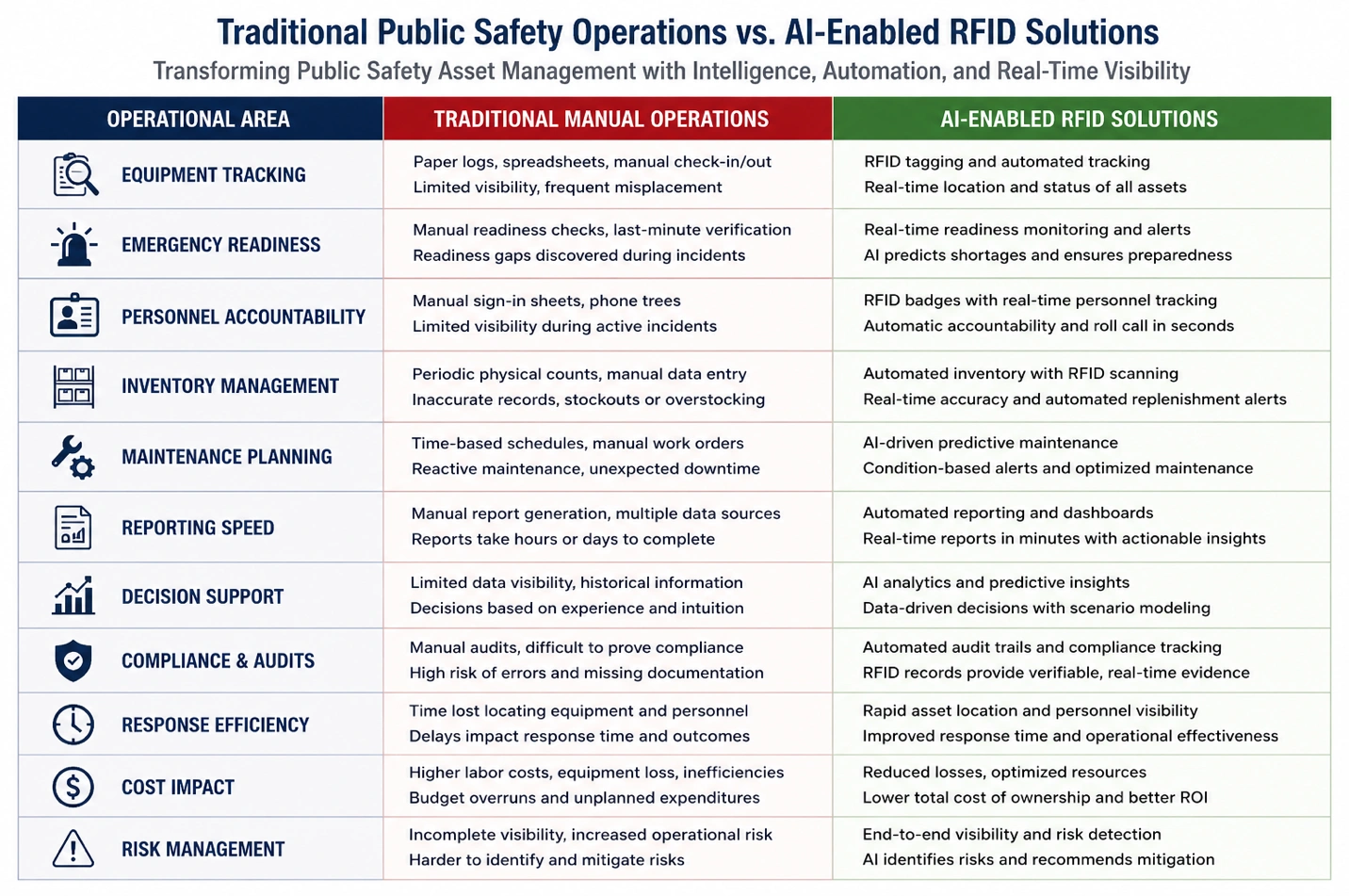
This comparison table illustrates the differences between traditional manual public safety asset management processes and AI-enabled RFID operations across key functional areas. It highlights how RFID automation and AI analytics improve equipment tracking, emergency readiness, personnel accountability, maintenance planning, reporting, and operational decision-making. The key takeaway is that AI-powered RFID systems provide greater visibility, faster response, and more efficient public safety operations.
Implementation Recommendations for AI and RFID Public Safety Projects
Successful public safety deployments require structured planning, technical validation, and operational alignment.
Recommended implementation practices include:
- Define operational objectives before selecting RFID hardware or AI software
- Conduct site assessments to evaluate environmental conditions, communication availability, and workflow requirements
- Select RFID frequency options based on asset type, reading distance, and deployment environment
- Test RFID performance with actual emergency equipment and operational scenarios
- Integrate with existing government software systems through secure data interfaces
- Establish cybersecurity policies before connecting devices and applications
- Train emergency personnel on operational procedures and system usage
- Monitor system performance using measurable KPIs
Important public safety KPIs may include:
- Emergency equipment availability rate
- Asset inventory accuracy
- Response preparation time
- Equipment inspection compliance
- Resource allocation efficiency
- Maintenance completion rate
- Unauthorized access detection rate
AI and RFID for Public Safety: Building More Intelligent Government Operations
AI-powered RFID solutions are helping public safety organizations improve emergency preparedness, asset visibility, personnel coordination, and operational intelligence. By combining AIoT technologies, RFID identification, edge computing, analytics software, and secure government system integration, agencies can move from manual tracking processes toward proactive and data-driven operations.
GAO supports organizations by providing RFID, BLE, and IoT hardware products and systems designed for reliable identification, monitoring, and connected workflows. Headquartered in New York City and Toronto, Canada, GAO is recognized among the top suppliers of B2B and B2G RFID and BLE solutions worldwide. Through decades of research and development, GAO has supported Fortune 500 companies, research organizations, universities, and government agencies across the United States and Canada.
Public safety organizations exploring AI-enabled RFID solutions can work with GAO to evaluate hardware requirements, deployment approaches, integration options, and technical implementation strategies.
Building the Future of Industrial AI and IoT with Aperture Venture Studio and GAO RFID Inc.
GAO has invested for more than three decades in research and development of industrial RFID, BLE, and IoT technologies supporting applications such as intelligent public safety operations, connected assets, and AI-enabled government solutions. As AI continues transforming IoT applications, we have expanded our efforts through Aperture Venture Studio to advance AI and IoT solutions relevant to industries requiring intelligent automation and data-driven decision-making.
Aperture brings together AI and IoT technical experts, operational leaders, investors, and technology organizations while supporting knowledge exchange through initiatives such as Aperture Ventures Summit and TekSummit.
We welcome you to join us as:
- Advisors, Co-founders, or Employees
- Investors
- Customers