
AI and BLE for Commercial Building Projects
AI-Powered Visibility and Project Intelligence for Commercial Building Projects
Commercial building projects involve complex coordination among general contractors, subcontractors, equipment suppliers, project managers, field engineers, safety teams, and facility owners. Maintaining visibility into workforce activities, material movement, equipment utilization, project milestones, and site safety remains one of the largest challenges throughout the project lifecycle.
AI-driven construction intelligence solutions supported by BLE gateways, BLE beacons, and BLE sensors help project teams monitor resources, improve schedule performance, reduce delays, and enhance operational efficiency. AI analyzes real-time data generated across construction sites to identify bottlenecks, predict project risks, optimize workflows, and improve decision-making.
By combining AI with connected sensing technologies, commercial building projects gain greater control over labor productivity, equipment utilization, material availability, safety compliance, and project execution. Organizations increasingly deploy AIoT solutions to improve delivery performance while reducing costs and operational uncertainty.
Understanding AI-Enabled Commercial Building Project Operations
Commercial building projects generate large volumes of operational data throughout planning, construction, commissioning, and handover phases.
Key project activities include:
- Site preparation
- Structural construction
- Mechanical installation
- Electrical installation
- Plumbing installation
- Interior fit-out
- Equipment commissioning
- Quality inspections
- Safety management
- Project closeout
AI helps construction teams convert operational data into actionable insights that improve project outcomes.
BLE-enabled systems support:
- Workforce location awareness
- Equipment utilization monitoring
- Material movement tracking
- Restricted-area access monitoring
- Environmental condition monitoring
- Site logistics visibility
GAO has helped organizations deploy BLE-based hardware products and systems that support construction monitoring, workforce visibility, and project intelligence initiatives.
Comprehensive Construction Operations Workflow: Field Data to AI-Driven Decisions
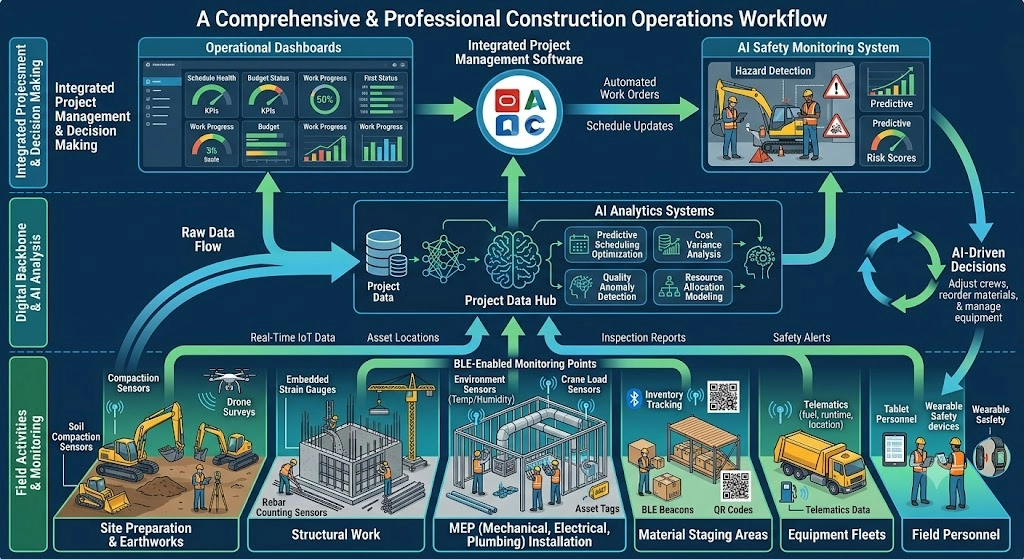
A professional infographic diagram illustrating an integrated, AI-enabled construction project lifecycle. It shows the flow of real-time data from BLE sensors and field activities (site prep, structural, MEP) into centralized AI analytics, which then informs project management, safety systems, and operational dashboards for optimal decision-making.
High-Value AI Applications in Commercial Building Projects
AI Workforce Productivity Management
Construction productivity directly impacts project schedules and budgets.
AI analyzes:
- Workforce movement patterns
- Task completion times
- Crew utilization
- Trade coordination activities
- Schedule adherence
Benefits include:
- Improved labor efficiency
- Better workforce allocation
- Reduced idle time
- Enhanced schedule performance
AI Equipment Utilization Optimization
Commercial building projects rely heavily on cranes, lifts, generators, compressors, earthmoving equipment, and specialty construction machinery.
AI supports:
- Utilization monitoring
- Predictive maintenance
- Equipment scheduling
- Resource allocation
Benefits include:
- Reduced downtime
- Improved equipment availability
- Lower operating costs
- Better project productivity
AI Material Flow Management
Material shortages and delivery delays frequently impact project schedules.
AI helps optimize:
- Material deliveries
- Inventory levels
- Storage utilization
- Material movement
- Installation sequencing
Benefits include:
- Reduced material waste
- Improved installation readiness
- Lower project delays
- Better logistics coordination
Operational Workflow from Data Collection to AI-Driven Decisions
Data Acquisition
Operational information may be collected from:
- BLE beacons attached to equipment
- BLE-enabled material tracking devices
- Workforce identification tags
- Environmental sensors
- Mobile field applications
- Construction management software
- Safety monitoring systems
Communication and Edge Processing
Construction project data is transmitted through:
- BLE communications
- Wi-Fi infrastructure
- Cellular connectivity
- Edge computing devices
- Secure project networks
Edge processing supports:
- Event filtering
- Data normalization
- Alert generation
- Device monitoring
- Local analytics
Enterprise Software Integration
AI solutions commonly integrate with:
- Construction Management Software
- Building Information Modeling (BIM) systems
- Project Scheduling Software
- ERP software
- Asset Management Systems
- Safety Management Software
Technology Components Supporting AI-Powered Commercial Building Projects
Commercial building projects require coordinated hardware, software, communication systems, analytics engines, and cybersecurity controls to support AI-driven project management and operational visibility.
BLE Infrastructure Components
BLE technologies commonly deployed across commercial construction sites include:
- Equipment tracking beacons
- Workforce identification beacons
- Material tracking devices
- Environmental monitoring sensors
- Fixed-location BLE gateways
- Mobile gateway devices
- Site monitoring sensors
These devices provide visibility into workforce movement, equipment usage, material flow, and site activities throughout project execution.
AI and Analytics Technologies
AI solutions for commercial building projects commonly utilize:
- Machine learning models
- Predictive analytics
- Resource optimization algorithms
- Workforce productivity analytics
- Project risk forecasting
- Time-series analysis
- Computer vision systems
- Operational intelligence software
These technologies help project teams identify risks earlier and improve project execution.
Cloud Deployment Model
Cloud-hosted deployments are often selected when organizations require:
- Multi-site project visibility
- Centralized reporting
- Scalable computing resources
- Remote stakeholder access
- Portfolio-wide analytics
Cloud deployments are commonly used by contractors managing multiple commercial building projects across different regions.
Server Deployment Model
Privately hosted server deployments may be preferred when organizations require:
- Enhanced data governance
- Local processing capabilities
- Integration with private infrastructure
- Regulatory compliance requirements
- Reduced external hosting dependencies
Server-based deployments are frequently implemented on project-specific infrastructure, regional data centers, or privately managed computing environments.
Security and Site Protection
Construction project data often contains sensitive operational information.
Security measures may include:
- Device authentication
- Data encryption
- Role-based access control
- Secure communication channels
- Network segmentation
- Security monitoring
- Audit logging
These controls help protect project information while maintaining operational visibility.
AI Construction Solution Matrix: Challenges to Operational Outcomes
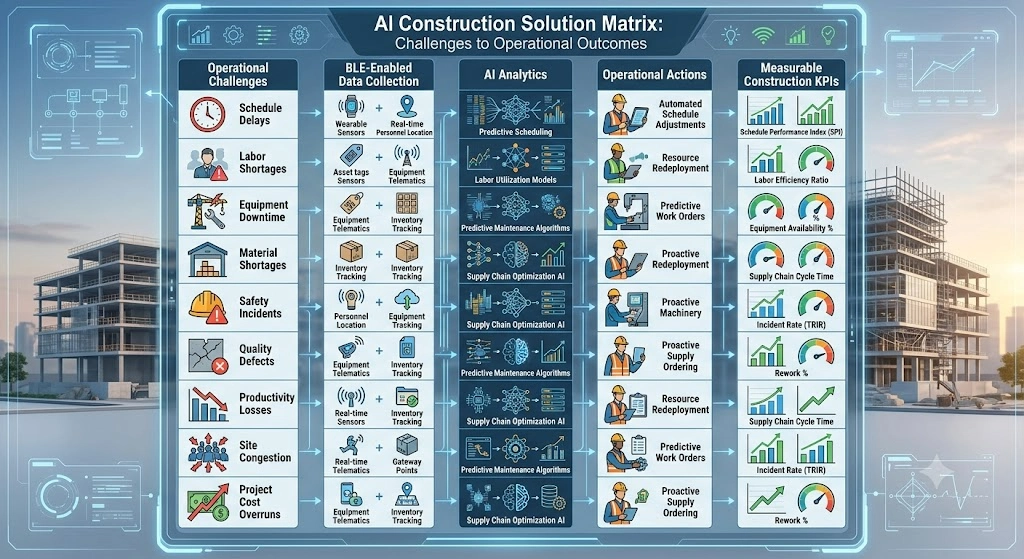
A professional infographic matrix connecting nine common commercial construction challenges with AI-driven operational solutions, data collection methods, and measurable construction KPIs.
Benefits of AI-Powered Commercial Building Project Solutions
Improved Project Visibility
AI enables project stakeholders to monitor project progress using real-time operational information.
Benefits include:
- Better milestone tracking
- Faster issue identification
- Improved project transparency
- Enhanced reporting accuracy
- Improved decision-making
Higher Workforce Productivity
AI-driven workforce analytics help construction managers optimize labor deployment.
Benefits include:
- Reduced idle labor
- Improved crew utilization
- Better trade coordination
- Enhanced schedule adherence
- Increased productivity
Better Equipment Utilization
Construction equipment represents a major project investment.
AI supports:
- Equipment scheduling
- Utilization optimization
- Predictive maintenance
- Resource balancing
Benefits include:
- Reduced downtime
- Improved availability
- Lower maintenance costs
- Better project efficiency
Enhanced Safety Performance
Safety remains a critical priority for commercial building projects.
AI helps identify:
- Unsafe work conditions
- Restricted-area violations
- Environmental hazards
- Workforce exposure risks
Benefits include:
- Improved worker safety
- Reduced incidents
- Better compliance
- Enhanced risk management
Improved Material Management
AI-driven material visibility supports:
- Inventory optimization
- Delivery coordination
- Material availability forecasting
- Installation readiness planning
Benefits include:
- Reduced waste
- Fewer delays
- Improved logistics
- Better resource utilization
Better Cost Control
Project managers can use AI-generated insights to identify inefficiencies and reduce project risks.
Benefits include:
- Improved budget control
- Reduced rework
- Better forecasting
- Lower operational costs
- Improved project profitability
GAO has supported organizations by supplying BLE, RFID, and IoT hardware products and systems that enable visibility, monitoring, and operational intelligence across complex project environments.
Deployment Best Practices for Commercial Building Projects
Successful AI deployment requires careful planning, stakeholder alignment, and operational readiness.
Recommended practices include:
- Define measurable project objectives before deployment
- Establish baseline project KPIs
- Conduct site coverage assessments
- Validate equipment and workforce tracking requirements
- Integrate construction software systems early
- Implement cybersecurity controls during deployment
- Conduct pilot testing before large-scale rollout
- Train project teams on new workflows
- Continuously evaluate AI model performance
- Develop long-term scalability strategies
Practical experience shows that phased implementation approaches often achieve stronger user adoption and more predictable project outcomes.
AI-Driven Transformation of Commercial Building Projects
AI is transforming commercial building projects by improving visibility into workforce activities, equipment utilization, material availability, project schedules, and safety performance. Through the combination of AI analytics and connected sensing technologies, project teams gain faster access to operational insights that support informed decision-making.
AIoT solutions enable project managers, field supervisors, and construction stakeholders to improve productivity, reduce delays, enhance safety, optimize resource utilization, and improve project delivery performance. Organizations that adopt these technologies can improve project outcomes while maintaining greater control over costs, schedules, and operational risks.
GAO supplies BLE, RFID, and IoT hardware products and systems that help organizations improve visibility, monitoring, and operational intelligence across commercial building projects and other infrastructure development initiatives.
Building the Future of Industrial AI and IoT with Aperture Venture Studio and GAO
For more than three decades, GAO Group of Companies has invested heavily in research and development involving BLE, RFID, IoT, and industrial monitoring technologies. As AI continues to improve commercial building project execution, workforce visibility, safety monitoring, equipment management, and project intelligence, we have expanded our focus on AI and IoT solutions that address the operational needs of modern construction environments.
To accelerate innovation in construction technology, connected infrastructure, and intelligent project management, we established Aperture Venture Studio to support the development and growth of AI and IoT solutions for commercial building projects and infrastructure development.
Aperture has attracted experienced AI specialists, IoT engineers, operational leaders, investors, and industry participants who contribute to advancing AI-enabled construction technologies.
Through initiatives such as Aperture Ventures Summit and TekSummit, we continue to foster discussions surrounding AI, IoT, construction intelligence, project visibility, and connected operational systems.
We welcome you to join us as:
- Advisors, co-founders, or employees
- Investors
- Customers