
AI and BLE for Residential Development
Intelligent Residential Development Operations with AI-Driven BLE Systems
Residential development projects increasingly rely on connected technologies to improve resident experiences, strengthen property security, optimize facility operations, and enhance long-term asset management. AI-powered solutions supported by BLE beacons, BLE sensors, and BLE gateways provide continuous visibility into residential communities, apartment complexes, condominiums, mixed-use developments, gated communities, and smart housing projects.
Artificial Intelligence of Things (AIoT) combines artificial intelligence with connected BLE devices to transform raw operational data into actionable insights. Within residential developments, AI can analyze occupancy patterns, common-area utilization, maintenance requirements, access activities, environmental conditions, and asset movements to support informed operational decisions.
Property owners, developers, facility managers, security teams, maintenance personnel, and building operations teams use AI-enabled BLE solutions to improve safety, optimize energy consumption, streamline maintenance activities, and increase resident satisfaction. GAO has supported organizations by providing BLE and IoT hardware products and systems that help enable these operational improvements.
Comprehensive Smart Residential Development operations diagram: Physical Assets to AI Insights
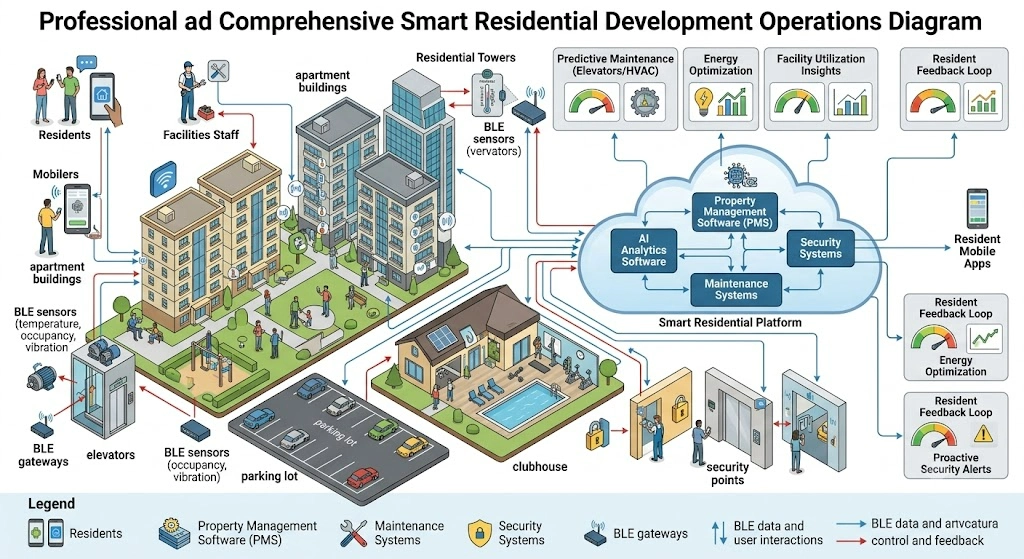
A professional infographic overview diagram illustrating the integration of physical residential assets, residents, and systems via a BLE sensor network, feeding operational data into central AI analytics to drive intelligent decision-making and automated actions across a modern residential development.
Understanding AI-Enabled BLE Solutions for Residential Development
BLE technology provides low-power wireless communication throughout residential environments. BLE beacons, BLE sensors, and BLE gateways collect location, environmental, occupancy, access-control, and operational data from buildings and community facilities.
Artificial intelligence enhances this data by performing:
- Occupancy analysis
- Resident movement pattern analysis
- Predictive maintenance modeling
- Access anomaly detection
- Energy optimization
- Asset utilization analysis
- Security event classification
- Environmental monitoring analysis
- Parking utilization forecasting
- Facility demand prediction
Rather than relying solely on manual inspections and reactive management practices, residential development operators can use AI-generated insights to identify developing issues before they affect residents or property operations.
Residential developments commonly deploy AI-enabled BLE systems across:
- Residential towers
- Apartment communities
- Condominium complexes
- Student housing developments
- Senior living communities
- Mixed-use residential properties
- Gated communities
- Workforce housing developments
- Luxury residential developments
- Master-planned communities
Key Residential Development Applications for AI and BLE
Smart Resident Access Management
BLE-enabled credentials and AI-based access analytics help monitor entry activities across:
- Main entrances
- Parking facilities
- Clubhouses
- Fitness centers
- Shared workspaces
- Recreational amenities
AI software can identify unusual access patterns, detect unauthorized access attempts, and assist security personnel in responding more effectively.
Residential Asset Tracking
Residential developments contain numerous operational assets including:
- Maintenance carts
- Cleaning equipment
- Security devices
- Mobile generators
- Landscaping equipment
- Emergency response equipment
- Pool maintenance tools
- Inspection equipment
BLE-based asset identification combined with AI analytics helps maintenance teams locate equipment quickly while reducing loss and improving utilization.
Predictive Building Maintenance
AI models can analyze data collected from BLE sensors monitoring:
- HVAC systems
- Pumps
- Elevators
- Water systems
- Electrical infrastructure
- Ventilation equipment
- Lighting systems
Maintenance teams receive early warnings regarding abnormal operating conditions, reducing emergency repairs and minimizing service disruptions.
Occupancy and Amenity Optimization
Residential amenities often include:
- Swimming pools
- Fitness centers
- Community rooms
- Business centers
- Co-working spaces
- Outdoor recreational areas
AI systems analyze BLE-generated occupancy data to determine utilization patterns, helping property managers optimize staffing levels, maintenance schedules, and facility availability.
Smart Parking Management
Parking operations are a major challenge for many residential developments.
AI-driven parking management solutions can:
- Monitor parking occupancy
- Detect unauthorized vehicle activity
- Identify congestion patterns
- Improve resident parking allocation
- Support visitor parking management
- Optimize traffic flow
GAO has helped organizations implement BLE-based solutions that improve visibility into parking and access operations.
Residential Development AI Application Matrix
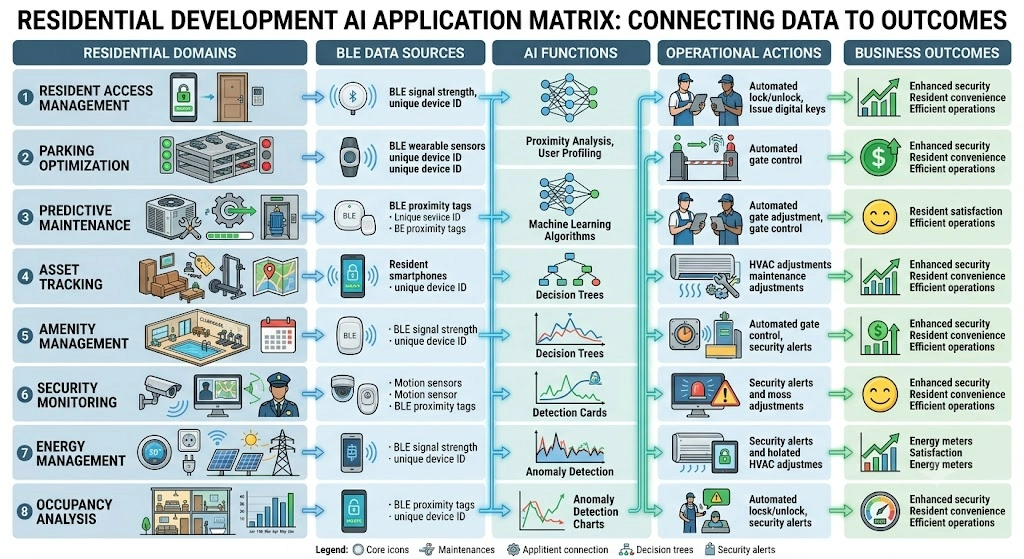
A structured matrix evaluating eight residential domains across BLE data sources, AI analytics, actions, and business outcomes.
Residential Development Operational Workflow from Data Collection to AI Decision-Making
AI-driven residential development solutions depend on a structured operational workflow that transforms physical events into actionable operational intelligence.
Data Acquisition Layer
Data originates from:
- BLE beacons
- BLE sensors
- BLE gateways
- Access-control systems
- Parking systems
- Building automation systems
- HVAC systems
- Elevators
- Utility meters
- Security devices
- Resident mobile applications
Communication and Processing Layer
Collected data is transmitted through secure wireless communication networks and processed through:
- Gateway software
- Edge computing systems
- Event processing engines
- Middleware services
- Data normalization systems
- Security monitoring services
Enterprise Software Integration
Operational data is integrated with:
- Property management software
- Building management systems
- Maintenance management software
- Security management software
- Resident engagement software
- Utility management systems
- Workforce management software
AI Analytics Layer
AI engines perform:
- Pattern recognition
- Forecasting
- Classification
- Optimization
- Anomaly detection
- Predictive maintenance analysis
- Resource allocation analysis
- Utilization analysis
Operational Decision Layer
AI-generated insights support:
- Maintenance scheduling
- Security intervention
- Resident service improvements
- Energy optimization
- Staffing adjustments
- Asset deployment decisions
- Parking management actions
- Facility utilization planning
BLE Infrastructure, AI Technologies, and Deployment Components for Residential Development
Successful AI-enabled residential development solutions depend on coordinated interaction between BLE hardware, communication infrastructure, software systems, and AI analytics engines.
BLE Hardware Components
BLE hardware commonly deployed throughout residential developments includes:
- BLE beacons for location awareness and proximity detection
- BLE sensors for environmental monitoring
- BLE gateways for data aggregation and communication
- Occupancy sensors
- Environmental sensors
- Temperature sensors
- Humidity sensors
- Parking sensors
- Access-control readers
- Smart locks
- Utility monitoring devices
Each device contributes operational data that supports AI-driven decision making throughout the residential development lifecycle.
Software Systems
Residential development operations frequently integrate with:
- Property Management Systems (PMS)
- Building Management Systems (BMS)
- Computerized Maintenance Management Systems (CMMS)
- Security Information Management Software
- Utility Management Software
- Resident Engagement Applications
- Visitor Management Systems
- Workforce Management Software
- Asset Management Software
These systems provide the operational context necessary for AI analytics.
AI Technologies Used in Residential Development
AI solutions commonly employ:
- Machine learning
- Predictive analytics
- Computer vision
- Pattern recognition
- Time-series forecasting
- Anomaly detection
- Resource optimization algorithms
- Occupancy modeling
- Energy optimization models
- Predictive maintenance algorithms
These technologies help transform operational data into actionable recommendations.
Communication Protocols and Connectivity
Residential developments often utilize:
- BLE communication
- Wi-Fi networks
- Ethernet infrastructure
- Cellular connectivity
- MQTT messaging
- REST APIs
- Secure web services
- Edge communication software
Reliable communication infrastructure is essential for continuous monitoring and analytics.
Cloud Software Deployment
Cloud-hosted deployments are frequently selected when residential development operators require:
- Multi-property visibility
- Centralized reporting
- Simplified software management
- Faster deployment timelines
- Scalable storage and processing
- Remote accessibility
Cloud deployments are commonly used by property management organizations operating multiple residential communities.
Server-Based Deployment
Server-based deployments are often preferred when organizations require:
- Greater data control
- Private infrastructure management
- Custom integration requirements
- Regulatory compliance requirements
- Local processing capabilities
- Reduced dependence on external cloud services
Private server deployments may operate within residential management offices, private data centers, or customer-managed hosting environments.
Cybersecurity and Data Protection
Residential development solutions should incorporate:
- Role-based access controls
- Multi-factor authentication
- Device authentication
- Data encryption
- Secure communication channels
- Security monitoring
- Audit logging
- Network segmentation
- Vulnerability management
Security planning becomes increasingly important as connected residential infrastructure expands.
Business Benefits and Operational Improvements
Improved Property Security
AI-powered analysis of access events, occupancy patterns, and BLE-generated activity data can improve visibility into unusual activities and security incidents.
Benefits include:
- Faster incident detection
- Improved situational awareness
- Better visitor management
- Enhanced access governance
- Improved security staffing efficiency
Reduced Maintenance Costs
Predictive maintenance models help identify emerging equipment issues before failures occur.
Benefits include:
- Reduced emergency repairs
- Lower maintenance expenses
- Improved equipment reliability
- Extended asset life
- Improved resident satisfaction
Improved Resource Utilization
AI-based utilization analysis helps residential operators understand how facilities and resources are being used.
Benefits include:
- Better amenity planning
- Improved staffing allocation
- More effective scheduling
- Reduced operational waste
- Improved resident experiences
Enhanced Energy Management
Residential developments can use AI to analyze:
- HVAC performance
- Lighting consumption
- Occupancy patterns
- Utility demand
- Environmental conditions
Potential outcomes include:
- Lower energy costs
- Reduced utility waste
- Improved sustainability initiatives
- Better environmental performance
Increased Operational Visibility
By combining BLE-generated operational data with AI analytics, management teams gain improved visibility across:
- Buildings
- Common areas
- Parking facilities
- Maintenance operations
- Resident services
- Security operations
GAO has supplied BLE and IoT hardware products that help organizations improve operational visibility and decision support capabilities.
Engineering Considerations and Deployment Best Practices
Residential development deployments should consider several important factors before implementation.
Site Assessment
Evaluation should include:
- Building layouts
- Construction materials
- Coverage requirements
- Network availability
- Utility infrastructure
- Resident traffic patterns
Device Placement Strategy
Proper placement of BLE devices significantly affects performance.
Key considerations include:
- Signal propagation
- Environmental conditions
- Equipment accessibility
- Maintenance requirements
- Coverage overlap
Integration Planning
Organizations should plan integrations with existing:
- Property management systems
- Building management software
- Security systems
- Maintenance software
- Resident applications
Scalability Planning
Residential developments often expand over time.
Scalable solutions should support:
- Additional buildings
- New amenities
- Additional devices
- Increased data volumes
- Expanded analytics requirements
Operational Governance
Successful deployments require:
- Defined ownership responsibilities
- Device management procedures
- Security policies
- Maintenance schedules
- Performance monitoring processes
Implementation Recommendations for Residential Development Organizations
Organizations planning AI-enabled BLE deployments should focus on:
- Defining operational objectives before deployment
- Prioritizing measurable business outcomes
- Integrating operational and building systems
- Establishing cybersecurity controls early
- Selecting scalable hardware and software solutions
- Monitoring performance metrics continuously
- Supporting ongoing optimization initiatives
Successful residential development projects typically begin with clearly defined operational challenges and measurable improvement goals rather than technology-first initiatives.
Advancing Residential Development Operations Through AI and BLE
AI-enabled residential development solutions provide meaningful improvements across security, maintenance, resident experiences, facility utilization, energy management, and operational efficiency. BLE devices deliver the operational visibility necessary to support AI-driven analytics and automation. Combined with appropriate software integration, cybersecurity controls, and deployment planning, these solutions help residential operators improve decision-making while supporting long-term operational objectives.
Drawing on decades of experience serving organizations throughout the United States and Canada, GAO continues to support residential development projects through BLE, RFID, and IoT hardware products, systems, technical expertise, quality assurance processes, and deployment support.
Building the Future of Industrial AI and IoT with Aperture Venture Studio and GAO
For more than three decades, GAO has invested heavily in research and development involving industrial BLE, RFID, and IoT technologies. As AI capabilities have matured for real-world residential development applications, we have expanded our focus on AI and IoT solutions that help improve building operations, resident experiences, maintenance efficiency, security monitoring, and operational visibility.
To accelerate innovation across AI and IoT markets, we have established Aperture Venture Studio to help advance AI and IoT solutions addressing evolving operational requirements across industries, including residential development. Through ongoing collaboration with technical experts, operational leaders, investors, and industry organizations, we continue contributing to AI and IoT advancement. We also support technical knowledge sharing through Aperture Ventures Summit and TekSummit and welcome engagement from advisors, employees, investors, and customers seeking to participate in the future of industrial AI and IoT.