
AI and BLE for Transit Infrastructure Development
Enhancing Transit Infrastructure Development with AI-Driven Operational Intelligence
AI-powered transit infrastructure development combines advanced analytics with connected sensing technologies to improve the planning, construction, operation, maintenance, and modernization of public transportation assets. Transit agencies, transportation authorities, rail operators, metropolitan transit planners, infrastructure developers, and engineering firms increasingly use AI-driven monitoring and decision support systems to improve service reliability, passenger safety, asset utilization, and lifecycle management.
BLE-enabled sensing devices deployed throughout transit infrastructure environments provide valuable operational information from stations, rail corridors, bus terminals, maintenance depots, signaling assets, passenger facilities, tunnels, bridges, and transit-oriented developments. AI analyzes this information to support predictive maintenance, workforce coordination, passenger flow management, infrastructure condition monitoring, and operational planning.
AIoT solutions are becoming increasingly important as transit infrastructure operators seek to reduce service disruptions, improve infrastructure resilience, optimize maintenance resources, and support growing passenger demand while maintaining safety and regulatory compliance.
Comprehensive Transit Infrastructure Development Operations Overview Diagram
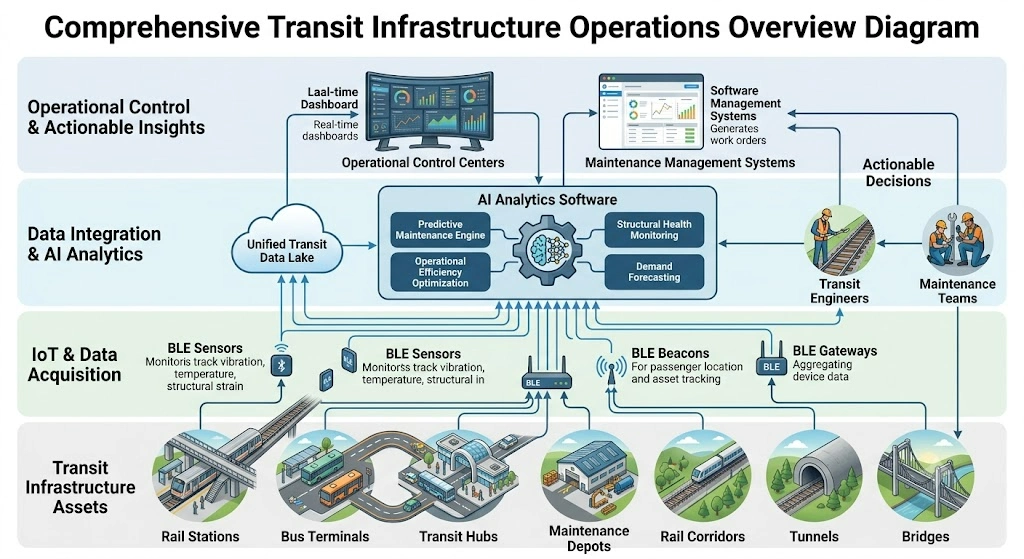
A detailed infographic illustrating how transit infrastructure assets, passengers, and operational systems are interconnected via a BLE sensor network, feeding data into AI analytics for optimized operations and maintenance.
Understanding AI-Enabled BLE Solutions for Transit Infrastructure Development
Transit infrastructure development involves a complex combination of transportation assets, passenger facilities, signaling systems, maintenance operations, safety requirements, and long-term capital investment planning. Managing these interconnected systems requires continuous visibility into asset performance, operational conditions, passenger movement patterns, and maintenance requirements.
BLE devices support data collection across transit environments by providing location awareness, asset identification, workforce visibility, equipment monitoring, and operational event tracking. AI software processes these datasets to identify patterns, forecast infrastructure needs, optimize maintenance schedules, and support transportation planning decisions.
Within transit infrastructure development, AI-driven solutions are commonly used for:
- Passenger flow analysis
- Transit asset tracking
- Station utilization monitoring
- Infrastructure condition assessment
- Rail corridor maintenance planning
- Fleet support operations
- Workforce coordination
- Safety monitoring
- Transit hub optimization
- Service reliability improvement
GAO has helped organizations implement BLE and IoT hardware solutions that support transportation visibility, operational awareness, and infrastructure management initiatives.
Key Applications of AI in Transit Infrastructure Development
Transit Asset Management
Transit infrastructure projects involve extensive physical assets distributed across large geographic areas.
Assets commonly monitored include:
- Rail signaling equipment
- Trackside systems
- Communication cabinets
- Maintenance vehicles
- Inspection equipment
- Escalators
- Elevators
- Power distribution assets
- Fare collection devices
- Passenger information systems
AI-powered asset management solutions help identify maintenance priorities, improve utilization, and reduce asset downtime.
Passenger Flow Optimization
Transit agencies continuously seek to improve passenger movement through stations, terminals, and transit hubs.
AI models can evaluate:
- Platform occupancy
- Concourse congestion
- Boarding patterns
- Passenger circulation routes
- Ticketing demand
- Peak-period utilization
Operational teams can use these insights to improve service planning and passenger experiences.
Predictive Infrastructure Maintenance
Transit infrastructure includes numerous critical assets requiring continuous monitoring.
Examples include:
- Rail switches
- Signal systems
- Traction power systems
- Tunnel ventilation systems
- Platform equipment
- Station facilities
- Bridge structures
- Communication systems
AI-driven maintenance planning helps identify developing issues before they result in operational disruptions.
Workforce Coordination and Safety
Transit infrastructure projects involve engineers, inspectors, maintenance crews, contractors, operations personnel, and safety specialists working across distributed environments.
AI-assisted workforce monitoring can support:
- Personnel allocation
- Field activity coordination
- Restricted-area management
- Emergency response planning
- Safety compliance monitoring
- Work-zone awareness
These capabilities contribute to improved operational safety and project execution.
Transit Hub Operations
Major transit hubs serve as critical transportation nodes connecting multiple transportation modes.
AI systems can support:
- Passenger throughput analysis
- Resource allocation
- Facility utilization management
- Equipment monitoring
- Service coordination
- Operational forecasting
These insights help transit authorities manage increasingly complex transportation networks.
Transit Infrastructure AI Application Matrix: Challenges to Outcomes
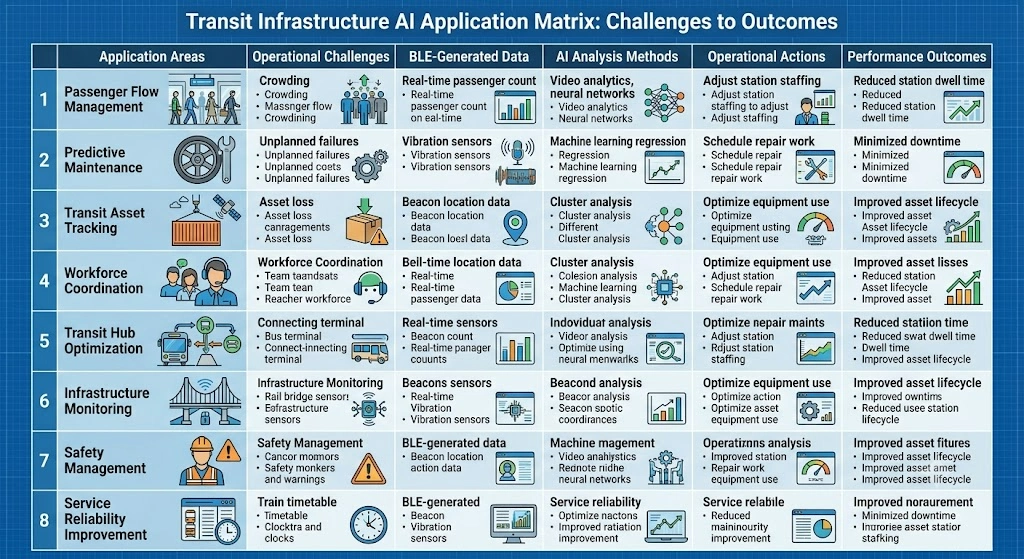
A detailed infographic matrix comparing common transit infrastructure application areas across five distinct categories to show how AI-driven solutions are applied to generate operational and performance benefits.
Operational Workflow from Infrastructure Monitoring to AI-Driven Transit Decisions
AI-enabled transit infrastructure development depends on a structured workflow that transforms operational events into actionable transportation intelligence.
Data Acquisition Across Transit Infrastructure
Data originates from multiple sources throughout the transit environment including:
- BLE beacons
- BLE sensors
- BLE gateways
- Passenger information systems
- Fare collection systems
- Station monitoring devices
- Signaling systems
- Rail infrastructure monitoring equipment
- Maintenance records
- Inspection systems
- Transit operations software
These sources generate information related to infrastructure condition, operational performance, passenger demand, equipment health, and workforce activities.
Communication Infrastructure and Data Transport
Transit infrastructure monitoring solutions often rely on:
- BLE communications
- Fiber-optic networks
- Transit communications systems
- Cellular connectivity
- Ethernet networks
- Secure transportation communications networks
Reliable communications are essential because transit operations often depend on real-time situational awareness across geographically distributed assets.
Edge Processing and Event Management
Before data reaches centralized analytics systems, transit monitoring solutions commonly perform:
- Event filtering
- Signal processing
- Device health validation
- Data normalization
- Communication optimization
- Alert generation
Edge processing reduces unnecessary network traffic while supporting faster operational response.
Enterprise System Integration
Transit infrastructure development solutions frequently integrate with:
- Enterprise Asset Management (EAM) software
- Computerized Maintenance Management Systems (CMMS)
- Transit Operations Management Systems
- Geographic Information Systems (GIS)
- Passenger Information Systems
- Workforce Management Software
- Infrastructure Inspection Software
- Capital Planning Systems
Integration enables AI models to evaluate operational data within broader transportation and infrastructure management contexts.
AI Analytics and Transportation Intelligence
AI engines process operational information using:
- Predictive maintenance models
- Time-series forecasting
- Pattern recognition
- Demand forecasting
- Anomaly detection
- Resource optimization algorithms
- Service reliability analysis
- Infrastructure risk assessment
These capabilities support engineering, maintenance, planning, and operational decision-making across transit infrastructure environments.
Technology Components Supporting AI-Driven Transit Infrastructure Development
Modern transit infrastructure development solutions combine connected sensing technologies, operational software, AI analytics, and transportation management systems to improve visibility across complex transportation environments.
BLE Hardware Components
BLE devices serve as important data acquisition elements within transit infrastructure projects.
Key components include:
- BLE beacons for location identification
- BLE sensors for environmental monitoring
- BLE gateways for data aggregation
- Mobile workforce devices
- Transit asset monitoring devices
- Equipment tracking tags
- Passenger flow sensing devices
- Infrastructure condition monitoring sensors
These components provide operational visibility across rail corridors, transit stations, bus depots, maintenance facilities, tunnels, bridges, and transportation hubs.
AI Software and Analytics Systems
AI-driven transit infrastructure development solutions commonly utilize:
- Machine learning models
- Predictive maintenance engines
- Demand forecasting software
- Infrastructure risk assessment tools
- Computer vision systems
- Operational optimization algorithms
- Workforce scheduling analytics
- Service reliability monitoring software
These systems transform operational information into actionable transportation intelligence.
Communication Technologies
Transit infrastructure deployments frequently incorporate:
- BLE communications
- Wi-Fi networks
- Fiber-optic communications
- LTE and 5G connectivity
- Ethernet infrastructure
- Transportation communication systems
- Secure VPN connections
Reliable communication systems are essential because transit assets are often distributed across extensive geographic regions.
Cloud Version Deployment
Cloud-hosted transit monitoring solutions are often selected when organizations require:
- Rapid deployment
- Centralized visibility
- Multi-site monitoring
- Reduced infrastructure management
- Scalable analytics processing
- Centralized reporting
Cloud-based solutions are particularly useful for regional transit authorities operating multiple stations, terminals, maintenance facilities, and transportation corridors.
Server Version Deployment
Privately hosted server deployments are often preferred when organizations require:
- Strict data governance
- Regulatory compliance controls
- Dedicated infrastructure resources
- Internal cybersecurity management
- Local processing requirements
- Private transportation data management
Server deployments may operate within transportation control centers, transit authority data centers, or privately managed infrastructure facilities.
Security and Cybersecurity Considerations
Transit infrastructure development projects require comprehensive cybersecurity controls.
Important security measures include:
- Device authentication
- Identity management
- Network segmentation
- Role-based access control
- Data encryption
- Security monitoring
- Software patch management
- Vulnerability assessment programs
Transit operators must protect operational technology systems while maintaining reliable transportation services.
GAO has supported organizations by supplying BLE and IoT hardware solutions designed to support secure operational deployments across transportation environments.
Operational and Business Benefits of AI-Driven Transit Infrastructure Development
Improved Asset Visibility
Transit infrastructure operators often manage thousands of distributed assets.
AI-supported monitoring helps improve:
- Asset utilization
- Asset location awareness
- Maintenance planning
- Equipment accountability
- Lifecycle management
Enhanced Infrastructure Reliability
Predictive analytics support proactive maintenance planning by identifying emerging equipment issues before service disruptions occur.
Benefits include:
- Reduced failures
- Increased asset availability
- Improved service continuity
- Better maintenance prioritization
- Lower emergency repair requirements
Passenger Experience Improvements
AI-driven transit intelligence helps improve passenger operations through:
- Reduced congestion
- Better service planning
- Improved station utilization
- Enhanced passenger information delivery
- Increased transportation efficiency
Workforce Productivity
Transit maintenance and operations teams benefit from:
- Better task allocation
- Improved field coordination
- Reduced manual inspections
- Faster issue identification
- Enhanced safety management
Infrastructure Planning Support
AI analytics can help transit authorities evaluate:
- Capacity requirements
- Expansion opportunities
- Infrastructure investment priorities
- Demand growth trends
- Service optimization opportunities
Scalability for Large Transportation Networks
Transit infrastructure development initiatives often expand over time.
AI-enabled monitoring solutions support:
- Multi-site deployments
- Regional transportation networks
- Metropolitan transit systems
- National transportation projects
Implementation Considerations and Engineering Best Practices
Successful transit infrastructure development projects require careful planning across operational, technical, and organizational areas.
Recommended practices include:
- Define measurable operational objectives before deployment
- Establish infrastructure asset inventories
- Standardize data collection processes
- Validate communication coverage across transportation assets
- Integrate maintenance and operational software early
- Establish cybersecurity governance policies
- Develop workforce training programs
- Perform pilot testing before large-scale deployment
- Continuously evaluate AI model performance
- Implement ongoing maintenance and optimization procedures
Engineering teams should also consider interoperability requirements between transportation systems, signaling environments, maintenance software, and operational control systems.
Organizations planning large transit modernization programs often benefit from phased implementation approaches that gradually expand monitoring coverage while validating operational performance improvements.
GAO’s experience supplying BLE and IoT hardware solutions has helped transportation organizations improve visibility, monitoring, and operational awareness across complex infrastructure environments.
Future Trends in AI-Driven Transit Infrastructure Development
Several emerging trends are shaping future transit infrastructure initiatives:
- Digital twin technologies
- Edge AI processing
- Autonomous inspection systems
- Computer vision-based infrastructure assessment
- AI-assisted transportation planning
- Intelligent maintenance scheduling
- Real-time passenger analytics
- Multi-modal transportation optimization
- Advanced infrastructure resilience monitoring
- Integrated smart city transportation systems
These technologies are expected to improve transportation efficiency while supporting infrastructure sustainability and long-term operational resilience.
Advancing Transit Infrastructure Development with AI and BLE Solutions
AI-driven transit infrastructure development enables transportation organizations to improve operational visibility, infrastructure reliability, passenger experiences, maintenance efficiency, and long-term planning. By combining AI analytics with connected sensing technologies, transit authorities can transform operational data into actionable insights that support better decision-making across transportation networks.
Successful deployments require careful planning, secure communications, software integration, operational alignment, and ongoing performance optimization. Organizations that implement these solutions effectively can improve asset management, reduce service disruptions, increase workforce productivity, and support infrastructure modernization initiatives.
GAO continues to support transportation organizations through BLE, RFID, and IoT hardware products and systems, helping customers improve monitoring, operational awareness, and infrastructure management capabilities. Readers seeking additional information about AI-driven transit infrastructure development solutions, technical implementation guidance, or BLE-enabled monitoring technologies are encouraged to explore GAO’s products, technical resources, and expert support services.
Building the Future of Industrial AI and IoT with Aperture Venture Studio and GAO RFID Inc.
For more than three decades, GAO Group of Companies has invested heavily in research and development of industrial BLE, RFID, and IoT technologies. As AI becomes increasingly important in transit infrastructure development, we have expanded our focus on AI and IoT solutions that support transportation modernization, infrastructure monitoring, predictive maintenance, and operational intelligence. We have also established Aperture Venture Studio to help accelerate innovation in AI and IoT applications for transportation and infrastructure sectors.
Aperture has attracted leading AI and IoT experts, operational executives, investors, and technology organizations. Through Aperture Ventures Summit and TekSummit, advanced discussions continue around industrial AI, connected infrastructure, transportation technologies, and digital transformation.
We welcome participation as:
- Advisors, Co-founders, or Employees
- Investors
- Customers
Headquartered in New York City and Toronto, GAO is recognized among the leading global suppliers of BLE and RFID technologies and has served Fortune 500 companies, leading research institutions, universities, and government agencies throughout North America while maintaining strong quality assurance processes and expert technical support.