
AI and BLE for Bridge Engineering
Transforming Bridge Engineering Through AI-Driven Infrastructure Intelligence
Bridge engineering is increasingly adopting AI-powered monitoring and decision-support systems to improve structural safety, maintenance efficiency, lifecycle management, and operational performance. AI-driven bridge engineering combines advanced analytics with connected sensing technologies to continuously evaluate bridge conditions, detect anomalies, forecast maintenance requirements, and support infrastructure resilience programs.
BLE-enabled monitoring devices deployed across bridges collect information related to structural movement, vibration, environmental conditions, maintenance activities, inspection workflows, and asset utilization. AI software analyzes these data streams to identify trends, predict deterioration patterns, optimize maintenance scheduling, and support engineering decision-making.
Bridge owners, transportation authorities, infrastructure operators, consulting engineers, and maintenance contractors are increasingly using AIoT solutions to address aging infrastructure challenges, improve public safety, reduce lifecycle costs, and support regulatory compliance. By integrating AI with connected monitoring technologies, bridge engineering teams can improve infrastructure visibility while enhancing long-term asset performance.
Comprehensive AI-Driven Structural Health Monitoring and Management Ecosystem for Bridge Engineering
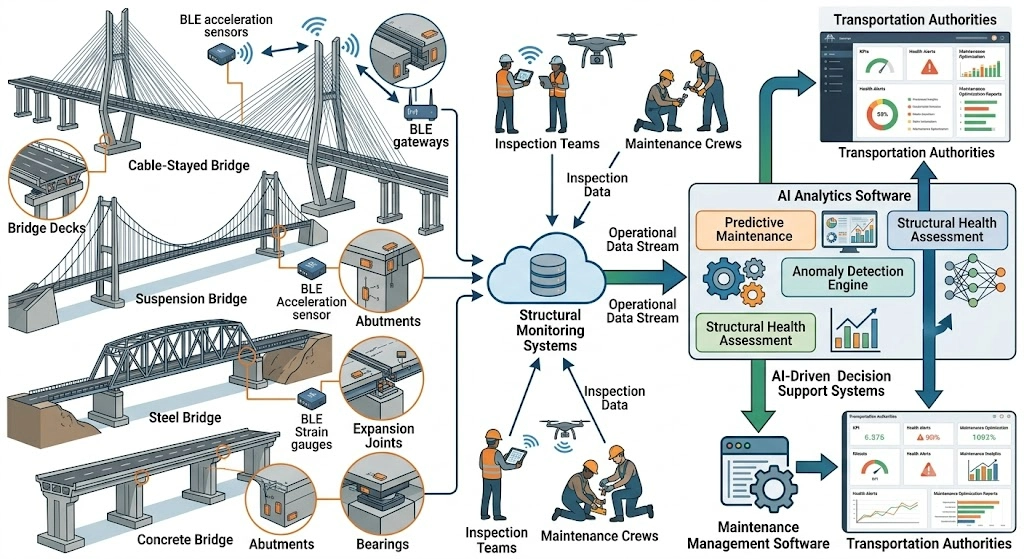
A detailed infographic illustrating the end-to-end integration of physical bridge assets, BLE sensor networks, human inspection/maintenance crews, and AI analytics software to support data-driven decision-making for transportation authorities and maintenance management.
Understanding AI-Enabled Monitoring in Bridge Engineering
Bridge engineering involves the design, construction, operation, inspection, rehabilitation, and maintenance of critical transportation structures. These structures must withstand traffic loads, environmental conditions, seismic activity, wind forces, temperature fluctuations, corrosion, fatigue, and aging-related deterioration throughout their operational life.
Traditional bridge inspection programs often rely on periodic manual inspections. While these inspections remain essential, they may not always provide continuous visibility into structural conditions. AI-enabled monitoring systems enhance traditional inspection practices by providing continuous infrastructure intelligence.
BLE technologies contribute to bridge engineering projects by supporting:
- Structural condition monitoring
- Asset identification
- Maintenance activity tracking
- Workforce coordination
- Equipment monitoring
- Inspection management
- Environmental monitoring
- Infrastructure utilization analysis
AI software processes operational information collected from these systems to improve infrastructure management and support engineering assessments.
GAO has supported infrastructure organizations by supplying BLE, RFID, and IoT hardware solutions that improve monitoring visibility across transportation and civil infrastructure environments.
Key Applications of AI in Bridge Engineering
Structural Health Monitoring
Structural health monitoring is one of the most important applications of AI in bridge engineering.
AI systems help evaluate:
- Structural strain
- Load distribution
- Vibration characteristics
- Structural displacement
- Deflection behavior
- Fatigue development
- Material degradation indicators
- Long-term performance trends
Continuous monitoring helps engineers identify changes that may require further investigation.
Predictive Maintenance Planning
Bridge maintenance programs must balance safety requirements, operational constraints, and budget limitations.
AI-supported predictive maintenance helps identify:
- Corrosion progression
- Bearing deterioration
- Expansion joint degradation
- Concrete cracking trends
- Steel fatigue indicators
- Drainage system issues
- Protective coating failures
These insights help prioritize maintenance activities before conditions worsen.
Infrastructure Inspection Optimization
Bridge inspection programs generate large volumes of data from field observations, photographs, inspection reports, and monitoring systems.
AI-assisted inspection management supports:
- Defect classification
- Inspection scheduling
- Risk prioritization
- Asset condition scoring
- Maintenance forecasting
- Documentation management
These capabilities improve inspection efficiency while supporting regulatory compliance.
Construction and Rehabilitation Monitoring
Bridge construction and rehabilitation projects often involve complex coordination among contractors, engineers, inspectors, and transportation agencies.
AI solutions can support:
- Construction progress monitoring
- Workforce coordination
- Equipment utilization tracking
- Material logistics management
- Quality assurance activities
- Safety monitoring
These capabilities improve project execution while reducing operational risks.
Transportation Network Resilience
Bridges serve as critical components of transportation systems.
AI-driven resilience programs help evaluate:
- Structural vulnerability
- Traffic impacts
- Environmental risks
- Emergency response planning
- Disaster recovery preparedness
- Infrastructure redundancy planning
These insights support long-term transportation reliability.
Professional Bridge Engineering AI Applications and Outcomes Matrix
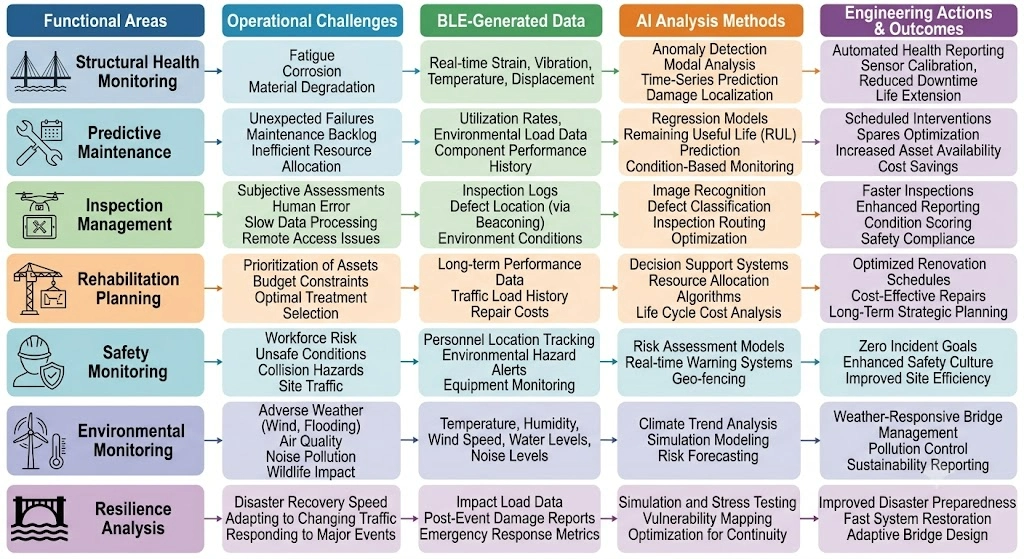
A structured diagram detailing the intersection of bridge engineering challenges, BLE technologies, and AI analytics. It compares seven key functional areas—Structural Health Monitoring, Predictive Maintenance, Inspection Management, Rehabilitation Planning, Safety Monitoring, Environmental Monitoring, and Resilience Analysis—across operational challenges, data types, analysis methods, and final engineering actions.
Operational Challenges in Modern Bridge Engineering
Bridge owners and infrastructure agencies face numerous operational challenges that influence long-term infrastructure performance.
Common challenges include:
- Aging bridge inventories
- Increasing traffic loads
- Corrosion-related deterioration
- Environmental exposure
- Budget limitations
- Workforce shortages
- Inspection complexity
- Maintenance scheduling constraints
- Safety compliance requirements
- Extreme weather impacts
Many transportation agencies manage thousands of bridge assets distributed across extensive geographic regions. Maintaining visibility across these assets requires advanced monitoring and analytics capabilities.
AI helps bridge engineering organizations address these challenges through data-driven infrastructure management and predictive decision support.
Operational Workflow from Structural Monitoring to AI-Driven Decisions
AI-enabled bridge engineering solutions follow a structured operational workflow that converts field observations and infrastructure data into actionable engineering intelligence.
Data Acquisition
Bridge monitoring systems collect information from multiple sources including:
- BLE sensors
- BLE gateways
- Structural monitoring devices
- Accelerometers
- Strain gauges
- Vibration sensors
- Environmental sensors
- Inspection records
- Maintenance logs
- Traffic monitoring systems
These sources generate information related to structural conditions, environmental influences, operational loads, and maintenance activities.
Communication Infrastructure
Bridge monitoring systems commonly utilize:
- BLE communications
- Fiber-optic networks
- Cellular communications
- Ethernet infrastructure
- Secure wireless networks
- Transportation communications systems
Reliable communications are critical for maintaining visibility across distributed infrastructure assets.
Edge Processing
Before information reaches centralized analytics systems, local processing functions often perform:
- Signal filtering
- Data validation
- Event normalization
- Quality assessment
- Device health monitoring
- Alert generation
Edge processing improves efficiency while reducing unnecessary data transmission.
Enterprise Software Integration
Bridge engineering monitoring solutions frequently integrate with:
- Asset management software
- Maintenance management systems
- Geographic Information Systems (GIS)
- Inspection management software
- Engineering analysis tools
- Infrastructure planning systems
- Transportation management software
Integration enables engineers to evaluate structural information alongside maintenance, operational, and planning data.
AI Analytics and Engineering Intelligence
AI systems analyze bridge engineering data using:
- Predictive maintenance models
- Structural performance analytics
- Pattern recognition algorithms
- Risk assessment models
- Failure prediction techniques
- Anomaly detection systems
- Lifecycle optimization tools
These capabilities support maintenance planning, infrastructure prioritization, engineering assessments, and long-term asset management strategies.
AI-Driven Benefits and Operational Value for Bridge Engineering
Bridge engineering organizations are increasingly using AI-supported monitoring systems to improve structural reliability, maintenance planning, asset lifecycle management, and public safety. BLE-enabled sensing infrastructure provides continuous visibility into bridge conditions, while AI software transforms raw engineering data into actionable intelligence.
Structural Health Monitoring Enhancement
AI continuously evaluates data from strain sensors, displacement sensors, vibration monitoring devices, tilt sensors, corrosion sensors, and environmental monitoring systems deployed throughout bridge structures.
Key advantages include:
- Early identification of fatigue cracks
- Detection of abnormal vibration patterns
- Structural movement analysis
- Corrosion progression monitoring
- Expansion joint deterioration detection
- Cable tension anomaly identification
- Foundation settlement assessment
- Bearing condition monitoring
Bridge operators can identify developing structural issues before they become critical failures.
Predictive Maintenance Optimization
Traditional bridge inspections often follow fixed schedules regardless of actual asset condition.
AI enables condition-based maintenance by:
- Predicting deterioration rates
- Estimating remaining useful life
- Prioritizing repair activities
- Forecasting maintenance budgets
- Identifying high-risk bridge components
- Optimizing inspection intervals
- Reducing unnecessary field inspections
- Supporting long-term capital planning
Maintenance teams can focus resources where intervention is most needed.
Construction Quality Improvement
During bridge construction projects, AI analyzes data collected from BLE-connected equipment and monitoring devices.
Applications include:
- Concrete curing verification
- Structural alignment monitoring
- Material quality assessment
- Construction progress tracking
- Equipment utilization analysis
- Workforce productivity measurement
- Safety compliance monitoring
- Environmental condition management
Project managers gain improved visibility throughout the bridge construction lifecycle.
Operational Safety Improvements
AI-supported monitoring systems help transportation authorities improve safety across bridge networks.
Capabilities include:
- Structural risk assessment
- Vehicle impact detection
- Flood event monitoring
- Seismic response analysis
- Wind load evaluation
- Emergency response support
- Public safety alert generation
- Infrastructure resilience assessment
These capabilities support safer transportation corridors and more informed operational decisions.
Scalability Across Bridge Portfolios
Transportation agencies frequently manage hundreds or thousands of bridges.
AI software enables:
- Portfolio-wide condition monitoring
- Asset prioritization
- Risk-based budgeting
- Maintenance resource allocation
- Inspection workforce optimization
- Regional performance benchmarking
- Infrastructure resilience planning
- Multi-bridge analytics
This scalability is particularly valuable for state transportation departments, municipal agencies, rail operators, and toll authorities.
Technical Capabilities of AI-Powered Bridge Monitoring Solutions
Modern bridge engineering systems integrate multiple analytical functions.
Machine Learning Functions
Common AI methods include:
- Predictive analytics
- Time-series forecasting
- Pattern recognition
- Anomaly detection
- Classification models
- Risk scoring
- Structural deterioration modeling
- Asset lifecycle prediction
Computer Vision Applications
Computer vision software assists bridge engineering teams through:
- Crack identification
- Surface deterioration analysis
- Corrosion detection
- Concrete spalling recognition
- Structural deformation assessment
- Construction progress verification
- Safety compliance inspection
- Drone imagery analysis
Edge AI Processing
Edge processing provides:
- Local event analysis
- Reduced communication costs
- Faster alert generation
- Operational continuity during network interruptions
- Enhanced cybersecurity control
- Real-time monitoring capabilities
Cybersecurity Considerations
Bridge infrastructure monitoring systems require strong security controls.
Recommended measures include:
- Device authentication
- Secure communication channels
- Data encryption
- Access management
- Network segmentation
- Event logging
- Vulnerability management
- Security auditing
GAO has supported organizations by supplying BLE hardware products and monitoring solutions that align with modern infrastructure security requirements.
Implementation Recommendations for AI and BLE in Bridge Engineering
Organizations planning AI-enabled bridge monitoring initiatives should consider the following practices:
- Define structural monitoring objectives before deployment
- Select sensing technologies based on bridge type and risk profile
- Establish communication coverage requirements
- Integrate monitoring software with asset management systems
- Develop cybersecurity governance procedures
- Implement phased deployment strategies
- Validate AI models using engineering inspection data
- Establish long-term maintenance and calibration programs
- Monitor data quality continuously
- Train engineering teams on AI-assisted decision making
Successful projects typically combine engineering expertise, reliable monitoring infrastructure, AI software, and disciplined asset management practices.
Conclusion
AI-driven bridge engineering solutions supported by BLE sensing infrastructure are transforming how transportation agencies, engineering firms, and infrastructure operators manage bridge assets. Continuous condition monitoring, predictive maintenance, structural health assessment, construction quality management, and risk-based decision making provide measurable improvements in safety, operational efficiency, and asset longevity.
As bridge networks continue aging and maintenance budgets face increasing pressure, AI-supported monitoring systems provide practical tools for prioritizing investments, reducing risk, and improving infrastructure resilience. Organizations seeking to modernize bridge asset management programs can benefit from combining AI analytics, connected sensing technologies, and engineering expertise to support data-driven bridge lifecycle management.
GAO continues to support bridge engineering organizations through advanced BLE hardware products, monitoring systems, and technical expertise designed for demanding infrastructure environments.
Building the Future of Industrial AI and IoT with Aperture Venture Studio and GAO RFID Inc.
For more than three decades, GAO has invested heavily in research and development of industrial BLE, RFID, and IoT technologies. As AI becomes increasingly important for bridge engineering, structural health monitoring, predictive maintenance, and transportation infrastructure management, we have expanded our focus on AI and IoT solutions that support critical infrastructure modernization. We have also established Aperture Venture Studio to help advance AI and IoT innovation across infrastructure and engineering sectors.
Aperture has attracted leading AI and IoT experts, experienced executives, investors, and industry participants. Through Aperture Ventures Summit and TekSummit, we continue fostering technical collaboration and knowledge sharing around advanced AI and IoT applications.
We welcome you to join us as:
- Advisors, Co-founders, or Employees
- Investors