
AI and BLE for Advanced Therapeutics
AI-Driven Advanced Therapeutics: From Experimental Data to Operational Intelligence
AI for Advanced Therapeutics combines machine learning, connected sensing, laboratory data, and operational systems to improve how novel therapies are researched, developed, tested, manufactured, stored, and monitored. Within biotechnology and research environments, AI can analyze experimental, environmental, equipment, process, and location data to identify patterns that are difficult to detect through manual review.
BLE gateways, BLE beacons, and BLE sensors provide one practical source of real-time contextual data. They can monitor laboratory equipment, controlled environments, materials, samples, mobile assets, personnel workflows, and temperature-sensitive research materials. AI then converts this data into predictions, anomaly detection, workflow optimization, and decision support.
For Advanced Therapeutics organizations, the value is not simply connecting more devices. The objective is to create reliable operational evidence around highly sensitive processes such as cell and gene therapy development, biologics research, assay development, preclinical studies, clinical trial logistics, and controlled material handling.
GAO supplies BLE, RFID, and IoT hardware and systems that can support these connected research environments. GAO’s published capabilities include BLE gateways and beacons alongside customized software and technical support.
AI and BLE for Advanced Therapeutics Research Operations
image
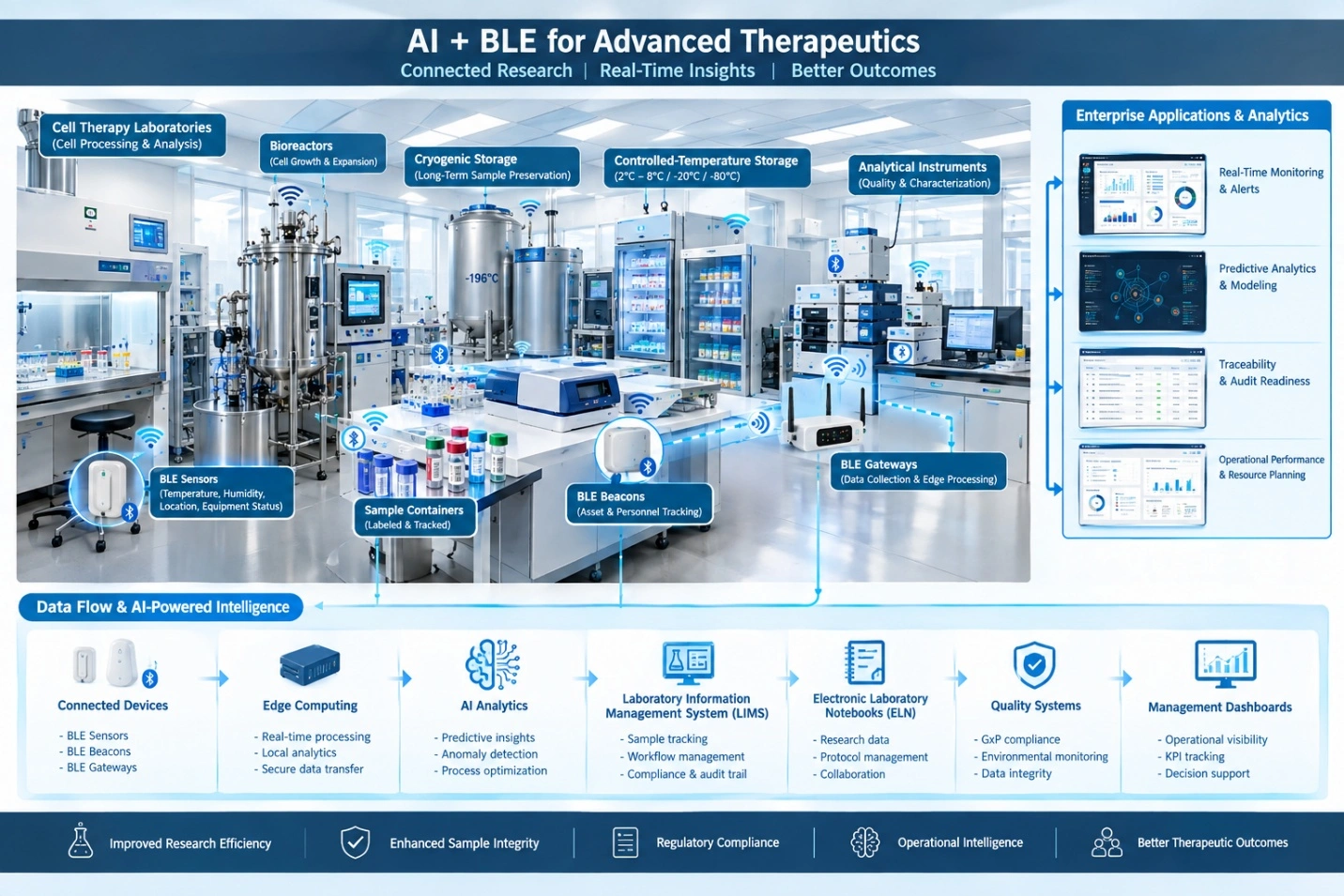
This visual illustrates how BLE sensors, beacons, and gateways connect Advanced Therapeutics laboratory equipment, cryogenic storage, sample containers, and controlled environments to edge computing and AI analytics. It shows how operational data can support LIMS, ELN, quality systems, predictive analytics, traceability, and real-time monitoring.
Why AI Matters Across the Advanced Therapeutics Lifecycle
Advanced Therapeutics includes highly specialized development activities where biological variability, environmental sensitivity, complex experimental protocols, and strict documentation requirements intersect. Cell and gene therapies, engineered cell products, viral-vector research, biologics, personalized therapies, and related modalities can involve processes that are substantially more sensitive to deviations than conventional laboratory workflows.
AI can help researchers and operations teams move from retrospective analysis toward continuous operational awareness.
Important applications include:
- Predictive maintenance for incubators, freezers, centrifuges, bioreactors, analytical instruments, and laboratory HVAC systems
- Environmental anomaly detection for temperature, humidity, differential pressure, and other controlled conditions
- Sample and material location intelligence across laboratories, controlled storage rooms, staging areas, and research facilities
- Monitoring of cold-chain and cryogenic workflows for temperature-sensitive materials
- Detection of abnormal equipment utilization and operating patterns
- Optimization of laboratory workflows and equipment scheduling
- Identification of process deviations before they become larger operational problems
- AI-assisted analysis of equipment telemetry and environmental time-series data
- Digital traceability for research materials, instruments, samples, and process-support equipment
- Automated alerts for excursions involving critical research environments
- Resource utilization analysis across laboratories and specialized equipment
- Support for investigation of deviations by correlating time, location, equipment, environmental conditions, and workflow events
The distinction between monitoring and intelligence is important. A sensor may report that a freezer temperature has increased. An AI-enabled system can correlate that excursion with door openings, compressor behavior, ambient temperature, maintenance history, equipment utilization, and historical failure patterns to determine whether the event resembles an emerging equipment fault or a transient operational condition.
That distinction becomes particularly valuable when research operations contain hundreds or thousands of simultaneous observations.
Advanced Therapeutics Applications for AI-Enabled Operational Intelligence
Cell and Gene Therapy Research
Cell and gene therapy workflows can involve highly controlled handling of biological materials, specialized laboratory equipment, cryogenic storage, controlled environments, and complex chain-of-custody requirements.
AI can analyze operational data around these processes to identify deviations and improve resource planning.
BLE sensors can provide environmental measurements while BLE beacons can associate equipment, storage containers, mobile carts, or other assets with locations. BLE gateways collect these transmissions and forward data to local or cloud software.
Potential applications include:
- Cryogenic storage monitoring
- Laboratory equipment utilization analysis
- Controlled-room environmental monitoring
- Sample movement visibility
- Equipment maintenance prediction
- Workflow bottleneck detection
- Cold-chain excursion analysis
- Research asset location tracking
- Correlation of environmental events with experimental records
The engineering objective should be to separate identity, location, telemetry, and regulatory records rather than treating all data as one undifferentiated stream. For example, a BLE signal indicating that a mobile container is near a processing room should not by itself be interpreted as proof that a particular biological sample was processed there.
That distinction is essential when designing trustworthy AI workflows.
Viral Vector and Biologics Research
Viral-vector development, biologics research, and associated laboratory processes depend on controlled operating conditions and repeatable experimental procedures.
AI can support these environments by correlating:
- Equipment operating conditions
- Incubator and freezer telemetry
- Environmental measurements
- Equipment utilization
- Maintenance events
- Laboratory location
- Material movement
- Experimental timestamps
- Operator workflow events
- Quality observations
Machine-learning models can identify unusual combinations of conditions that may not trigger a conventional threshold alarm.
For example, a simple rules engine might alert when temperature exceeds a defined limit. An anomaly-detection model can instead identify an unusual temperature recovery pattern following repeated access events. That can provide an earlier indication of deteriorating equipment performance or an operational change.
Preclinical Research and Translational Laboratories
Preclinical laboratories frequently contain expensive analytical instruments and shared research equipment. Scheduling conflicts, underutilization, equipment downtime, and incomplete visibility into asset location can create unnecessary delays.
AI-enabled asset intelligence can combine equipment location, utilization, maintenance history, environmental conditions, and laboratory scheduling information.
This can support:
- Equipment utilization forecasting
- Preventive maintenance optimization
- Laboratory capacity planning
- Instrument availability analysis
- Research asset tracking
- Environmental compliance monitoring
- Investigation support
- Automated operational reporting
The most useful AI models are not necessarily the most complex models. A well-designed time-series anomaly detector operating on high-quality equipment data can provide more operational value than a sophisticated model trained on poorly calibrated or incomplete sensor data.
Advanced Therapeutics AI and BLE Use-Case Matrix
image
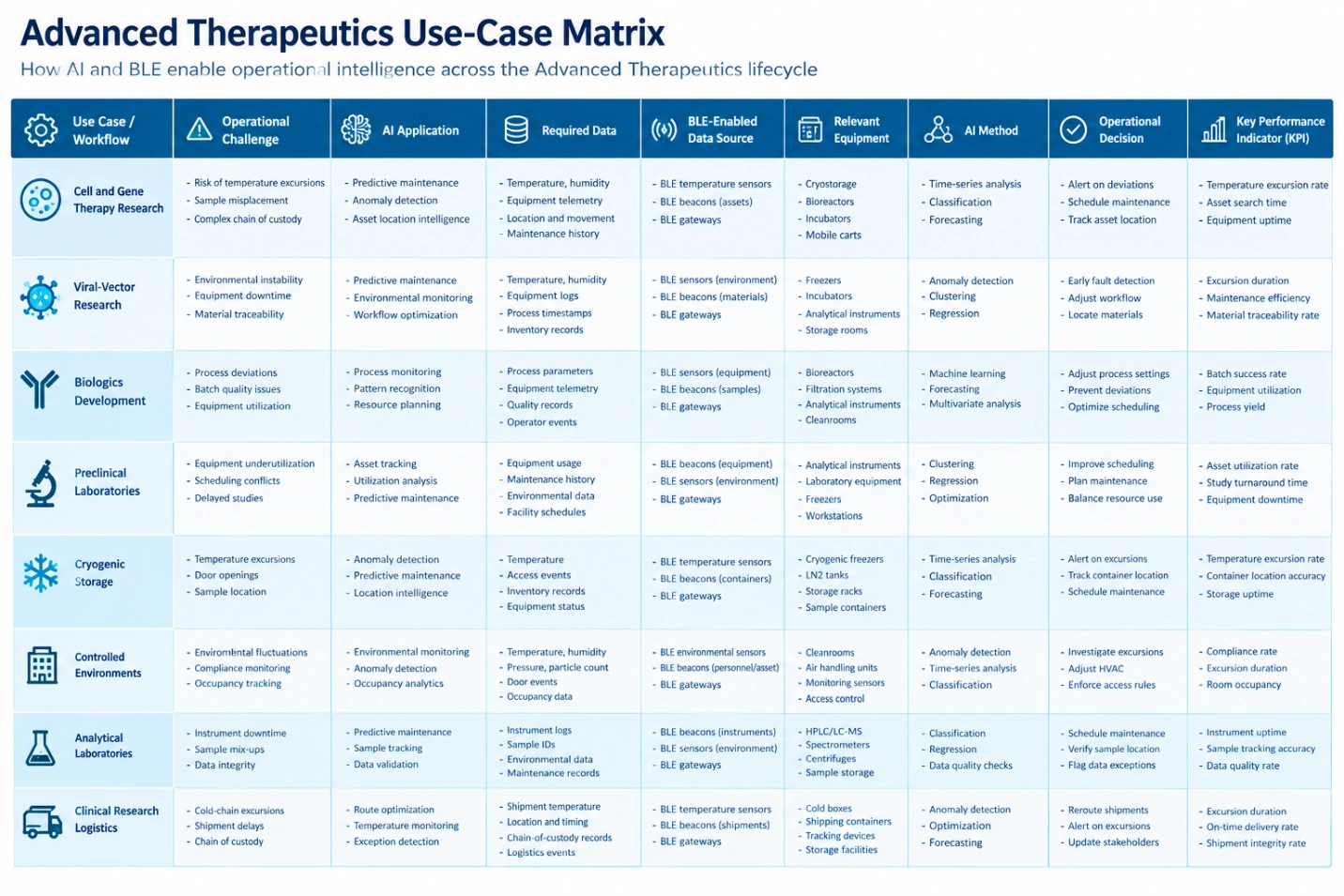
This matrix compares eight Advanced Therapeutics workflows, including cell and gene therapy research, viral-vector research, biologics development, preclinical laboratories, cryogenic storage, controlled environments, analytical laboratories, and clinical research logistics. It connects operational challenges with AI applications, required data, BLE-enabled data sources, relevant equipment, AI methods, operational decisions, and measurable KPIs.
From Sensor Data to AI-Driven Decisions in Advanced Therapeutics
A reliable AI solution for Advanced Therapeutics should be designed as a complete data workflow rather than as an isolated machine-learning application.
Data Acquisition
The first layer contains the physical observations generated by laboratory and research operations.
Relevant data sources may include:
- BLE temperature sensors
- BLE humidity sensors
- BLE environmental sensors
- BLE beacons
- Equipment telemetry
- Laboratory instruments
- Freezer and refrigerator monitoring systems
- Incubators
- Bioreactors
- HVAC monitoring
- Access-control events
- Laboratory information systems
- Electronic laboratory notebooks
- Quality management systems
- Maintenance systems
- Inventory systems
- RFID or barcode identification systems
BLE is particularly useful when wireless deployment is preferred and cabling individual assets would be operationally disruptive. The appropriate sensor selection depends on the measurement accuracy, sampling interval, battery life, environmental conditions, enclosure requirements, and validation strategy.
BLE Connectivity and Gateway Processing
BLE sensors and beacons transmit measurements or identification data over Bluetooth Low Energy. Gateways receive those transmissions and provide the bridge between local devices and the organization’s data infrastructure.
Gateway placement should be engineered rather than based solely on theoretical radio range.
Research laboratories may contain:
- Refrigerated equipment
- Metal cabinets
- Stainless-steel surfaces
- Concrete walls
- Shielded rooms
- Dense equipment clusters
- Mechanical systems
- Multiple floors
- Controlled-access areas
These conditions can affect radio propagation and gateway coverage.
A commissioning process should therefore include actual RF surveys, packet-reception testing, battery-life verification, sensor calibration checks, gateway failover testing, and representative operating-condition validation.
Edge Processing and Data Quality
Edge processing can reduce unnecessary network traffic and provide local resilience.
Typical edge functions include:
- Timestamp normalization
- Sensor validation
- Duplicate-event suppression
- Data buffering
- Connectivity monitoring
- Local threshold evaluation
- Device health monitoring
- Protocol conversion
- Secure forwarding
Edge buffering is particularly valuable where connectivity to the central server is intermittent. The gateway or edge server should retain data locally and forward it after connectivity is restored, while maintaining event timestamps and sequence information.
AI Analytics
The AI layer can use several methods depending on the problem.
Common approaches include:
- Time-series anomaly detection
- Predictive maintenance models
- Regression
- Classification
- Clustering
- Forecasting
- Bayesian inference
- Pattern recognition
- Multivariate anomaly detection
- Natural-language interfaces for operational records
- Generative AI for investigation assistance and knowledge retrieval
For regulated research environments, AI should generally be treated as decision support unless its specific use has been appropriately validated for a regulated function.
A model that predicts an abnormal freezer condition, for example, can generate an alert for an engineer or laboratory manager. It should not silently modify a validated process without suitable controls, validation, authorization, and change management.
Enterprise and Laboratory Software Integration
AI-generated insights become operationally useful when connected to the systems already used by research organizations.
Potential integration targets include:
- Laboratory Information Management Systems
- Electronic Laboratory Notebooks
- Quality Management Systems
- Computerized Maintenance Management Systems
- Enterprise Resource Planning systems
- Manufacturing Execution Systems
- Building Management Systems
- Environmental Monitoring Systems
- Inventory management software
- Data historians
- Identity and access-management systems
- Research data repositories
APIs, message queues, database interfaces, MQTT, HTTPS, REST APIs, OPC UA where appropriate, and other integration mechanisms can connect device data with business and laboratory software.
The integration design should preserve source timestamps, device identity, calibration information, data lineage, and auditability.
AIoT for Advanced Therapeutics: The Technical Building Blocks
Artificial Intelligence of Things, commonly called AIoT, combines artificial intelligence with connected devices, sensors, equipment, and operational systems. For Advanced Therapeutics, this means linking physical research conditions with software capable of interpreting large volumes of operational data.
BLE Gateways
BLE gateways receive transmissions from BLE sensors and beacons and forward the information to edge or central software.
Their selection should consider:
- BLE version and supported profiles
- Concurrent device capacity
- Ethernet, Wi-Fi, cellular, or other backhaul
- Local storage
- Processing capability
- Power requirements
- Operating temperature
- Encryption capabilities
- Remote configuration
- Firmware management
- Physical mounting requirements
GAO provides BLE gateway and beacon hardware intended for integration into broader BLE and IoT systems. Its published product portfolio includes BLE gateways, beacons, accessories, and related software resources.
BLE Beacons
BLE beacons can provide location or proximity context for equipment, mobile assets, carts, containers, rooms, or personnel-associated workflows where appropriate.
For Advanced Therapeutics, beacon-based location should be engineered around the required accuracy.
A room-level location requirement is fundamentally different from sub-meter asset localization. If an organization only needs to determine whether equipment is inside a laboratory, dense beacon deployment may be unnecessary. If the use case requires precise movement analysis, additional positioning technologies or sensor fusion may be required.
BLE Sensors
BLE sensors provide measurements such as:
- Temperature
- Humidity
- Pressure
- Motion
- Door state
- Vibration
- Light
- Battery condition
- Other environmental parameters supported by the selected device
Sensor selection must begin with the measurement requirement rather than the wireless protocol.
Accuracy, calibration, response time, sampling rate, environmental rating, battery chemistry, enclosure, mounting method, and maintenance interval can have a greater effect on system performance than the choice of BLE version itself.
AI and Edge Computing
Edge computing is useful where Advanced Therapeutics facilities require rapid local detection, reduced dependence on wide-area connectivity, or local data buffering.
An edge system can perform first-stage processing before forwarding information to centralized AI services.
This creates a practical division:
- Device layer: measurement and identification
- BLE layer: local wireless communication
- Gateway layer: collection and protocol conversion
- Edge layer: filtering, buffering, and local analytics
- AI layer: anomaly detection, prediction, classification, and forecasting
- Application layer: dashboards, alerts, investigations, and workflows
- Enterprise layer: LIMS, ELN, QMS, CMMS, ERP, MES, and related systems
End-to-End AIoT Data Flow for Advanced Therapeutics
image
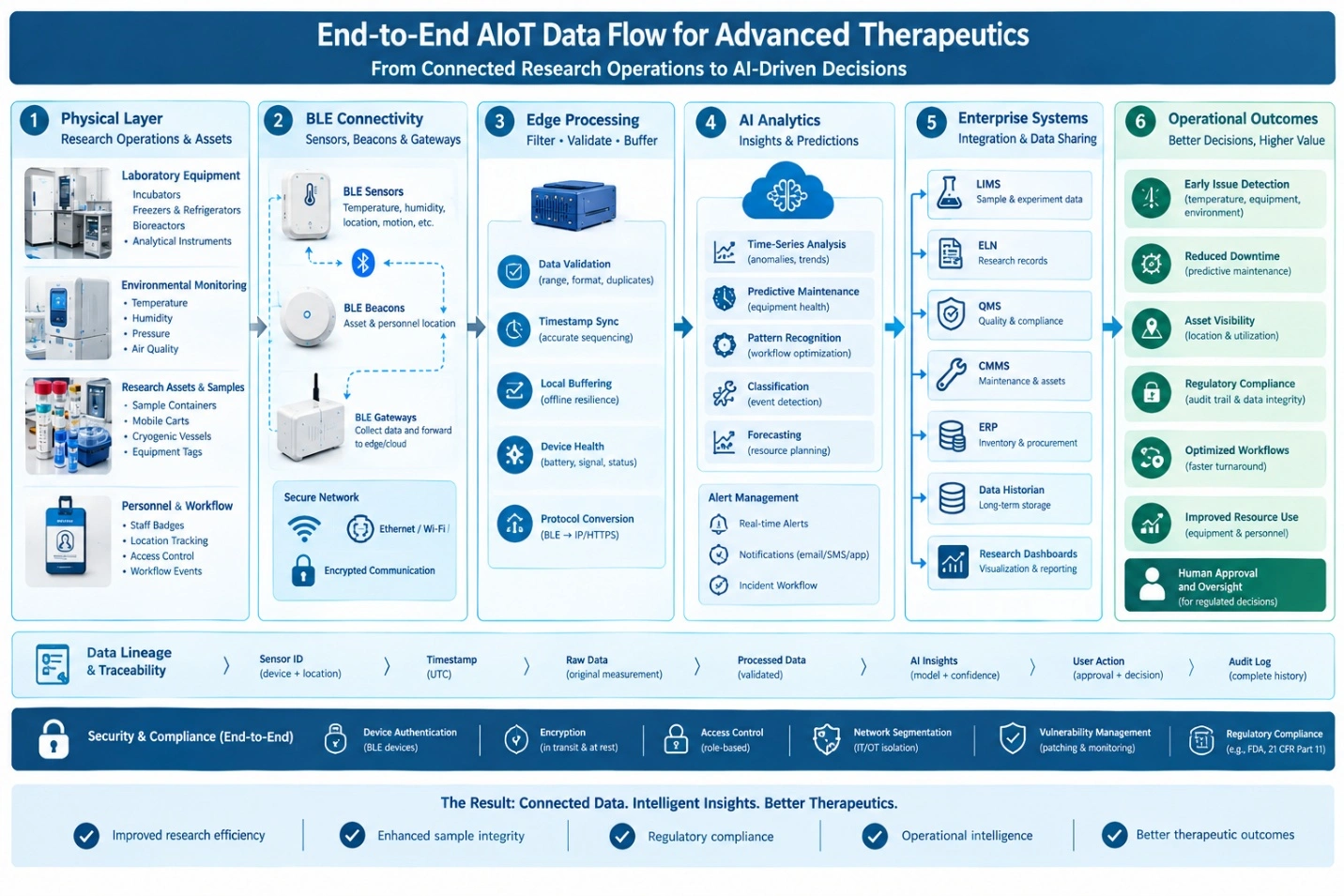
This diagram shows how Advanced Therapeutics research data moves from laboratory equipment, environmental sensors, research assets, and BLE devices through gateways, edge processing, AI analytics, and enterprise systems. It highlights data validation, timestamp synchronization, cybersecurity, data lineage, human oversight, and operational outcomes such as early issue detection, asset visibility, and reduced equipment downtime.
Cloud Version and Server Version
A Cloud Version is appropriate when Advanced Therapeutics organizations need centralized monitoring across multiple laboratories, research sites, or facilities and can use an approved cloud environment.
Cloud deployment can provide:
- Centralized data storage
- Elastic computing resources
- Remote monitoring
- Multi-site analytics
- Centralized model management
- Automated software updates
- Integration APIs
- Long-term analytics
A Server Version is appropriate when data must remain within customer-managed infrastructure, private data centers, controlled research networks, or other privately hosted environments.
This approach can be preferable when organizations have strict data-residency requirements, isolated laboratory networks, internal cybersecurity policies, specialized validation procedures, or limited external connectivity.
The decision should not be based solely on whether cloud or server deployment is considered more modern. Data classification, regulatory obligations, network topology, cybersecurity controls, operational ownership, validation requirements, disaster recovery, and integration constraints should determine the appropriate model.
FDA guidance on electronic records and electronic signatures emphasizes the importance of trustworthy, reliable electronic systems and appropriate controls. Where electronic records fall within applicable regulatory requirements, organizations need to determine how the records are created, maintained, secured, retrieved, and relied upon.
Cybersecurity and Data Integrity
Cybersecurity for AI-enabled Advanced Therapeutics systems should cover the complete data path rather than only the cloud application.
Relevant controls include:
- Device authentication
- Gateway authentication
- Encryption in transit
- Encryption at rest
- Role-based access control
- Network segmentation
- Secure API authentication
- Certificate management
- Firmware management
- Vulnerability management
- Audit logging
- Backup and recovery
- Time synchronization
- Data integrity checks
- User access reviews
- Secure configuration management
For regulated environments, cybersecurity should also be integrated with computerized-system validation and change-control procedures.
21 CFR Part 11 remains relevant to electronic records and electronic signatures within its applicable scope, while FDA guidance also emphasizes access controls, operational checks, authority checks, device checks, documentation, and controls surrounding electronic signatures.
Technical Capabilities and Operational Benefits for Advanced Therapeutics
The combination of AI with connected sensing can improve Advanced Therapeutics operations when the underlying data is sufficiently accurate, contextualized, and available at the right time. The strongest results generally come from applying AI to specific operational decisions rather than deploying machine learning simply because large quantities of data are available.
Predictive Maintenance for Critical Research Equipment
Equipment failure can interrupt experiments, compromise temperature-sensitive materials, and reduce laboratory capacity. AI-based predictive maintenance can analyze historical telemetry, vibration, temperature behavior, operating cycles, alarms, and maintenance records to identify patterns associated with developing faults.
Relevant equipment may include:
- Ultra-low-temperature freezers
- Cryogenic storage systems
- CO₂ incubators
- Centrifuges
- Bioreactors
- Refrigerated centrifuges
- Laboratory refrigerators
- Vacuum systems
- HVAC equipment
- Pumps and compressors
- Analytical instruments
A useful implementation distinguishes between equipment health prediction and simple alarm generation. Threshold alarms identify known limit violations. Predictive models attempt to identify abnormal behavior before a threshold is crossed.
GAO-supplied IoT and BLE hardware can provide the connected sensing layer needed to capture selected equipment and environmental observations for these applications.
AI Environmental Monitoring for Research Facilities
Temperature and humidity excursions are among the most straightforward applications for connected sensing, but AI can provide additional value by examining the behavior surrounding an excursion.
A model can correlate:
- Temperature trends
- Humidity trends
- Door openings
- Equipment operating cycles
- Ambient conditions
- Sensor battery state
- Historical excursions
- Maintenance events
- Laboratory occupancy patterns
- Time of day
This can help differentiate a genuine equipment problem from a short-duration event caused by normal laboratory activity.
The engineering design should retain the original sensor readings. AI-derived classifications should supplement, not overwrite, the underlying measurement history.
AI-Assisted Sample and Asset Tracking
Advanced Therapeutics research often involves expensive instruments, specialized containers, sample-handling equipment, mobile carts, cryogenic accessories, and other assets distributed across laboratories.
BLE beacons can associate physical assets with locations while gateways collect proximity information.
AI can subsequently analyze movement patterns to identify:
- Unusual asset movements
- Equipment congestion
- Frequently relocated instruments
- Underutilized equipment
- Workflow bottlenecks
- Excessive transport distances
- Unexpected dwell times
- Repeated movement between incompatible locations
RFID, barcode identification, BLE, and other technologies can also be combined where different identification requirements exist. For example, RFID may provide item-level identification while BLE provides location or environmental context.
Research Workflow Optimization
AI can analyze operational events to determine where research workflows consume excessive time.
Examples include:
- Instrument preparation
- Sample staging
- Material retrieval
- Equipment cleaning
- Environmental recovery
- Batch preparation
- Laboratory changeover
- Maintenance
- Sample transfer
- Cryogenic storage access
The resulting models can support scheduling and resource allocation without directly controlling regulated experimental processes.
A practical deployment should begin with descriptive analytics, establish a reliable baseline, and then introduce predictive or prescriptive models after sufficient historical data has accumulated.
KPIs for AI-Enabled Advanced Therapeutics Operations
A successful implementation should be measured using operational outcomes rather than the number of sensors installed.
Useful KPIs include:
| KPI | What it measures | AI/BLE contribution |
|---|---|---|
| Temperature excursion rate | Frequency of environmental deviations | Continuous sensing and anomaly detection |
| Mean time to detect | Speed of identifying abnormal conditions | Automated monitoring |
| Mean time to respond | Speed of operational response | Automated alerts and workflow routing |
| Equipment uptime | Availability of critical laboratory equipment | Predictive maintenance |
| Unplanned downtime | Unexpected equipment outages | Failure-risk prediction |
| Asset utilization | Productive use of equipment | Location and utilization analytics |
| Asset search time | Time spent locating equipment | BLE location intelligence |
| Sensor data availability | Completeness of telemetry | Gateway and device monitoring |
| False alarm rate | Quality of alerting | AI-assisted event classification |
| Maintenance efficiency | Effectiveness of maintenance planning | Predictive analytics |
| Cold-chain excursion duration | Duration of temperature deviations | Continuous monitoring |
| Laboratory throughput | Research activity completed within a period | Workflow analytics |
| Mean time between failures | Equipment reliability | Historical equipment modeling |
| Environmental compliance rate | Percentage of readings within required limits | Continuous monitoring |
| Data integrity exceptions | Quality of collected records | Validation and data-quality controls |
Advanced Therapeutics AI and BLE Operations KPI Dashboard
image
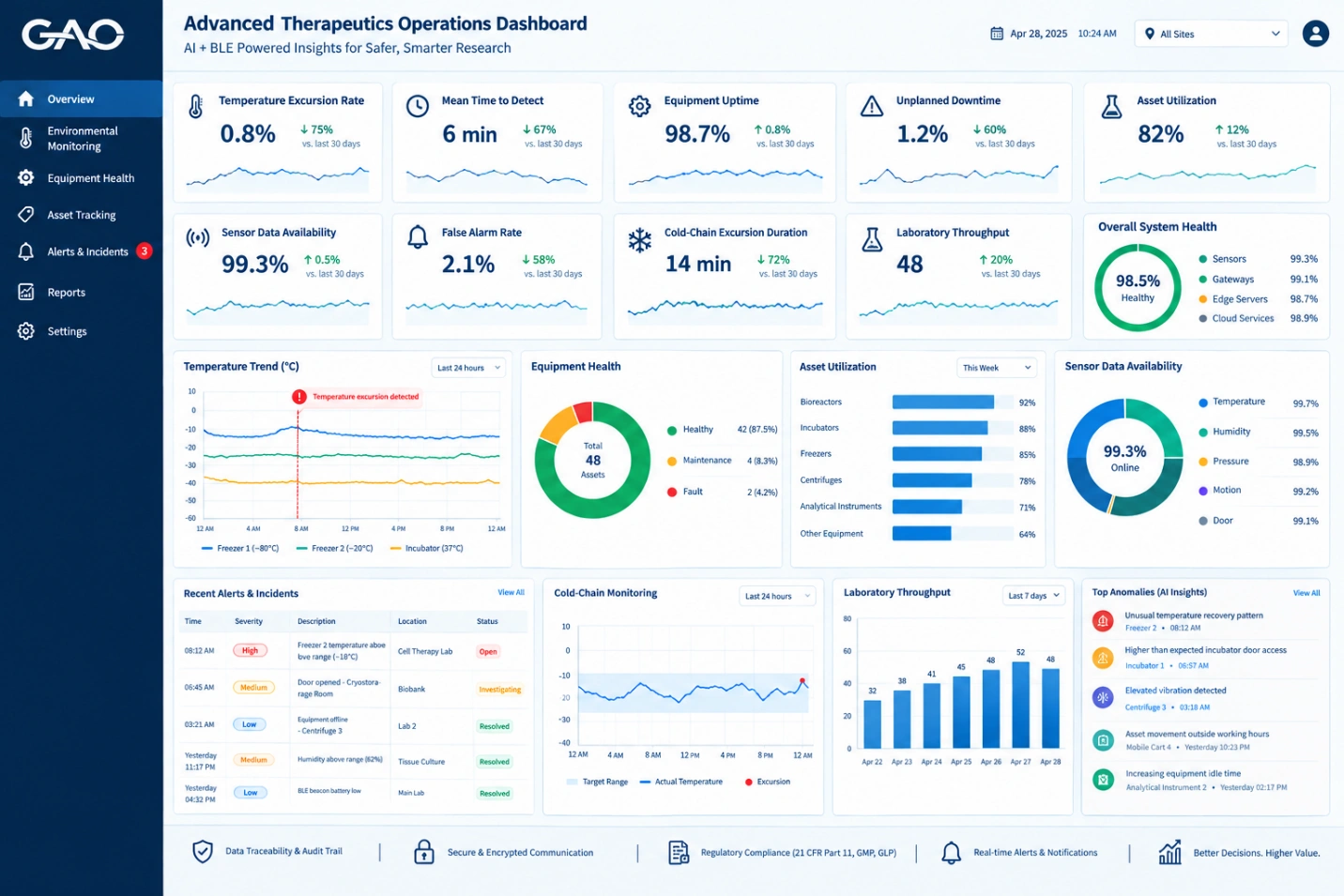
This dashboard illustrates how AI and BLE data can be used to monitor Advanced Therapeutics research operations, including temperature excursions, equipment uptime, asset utilization, cold-chain conditions, sensor availability, and laboratory throughput. AI-detected anomalies and equipment-health indicators support faster operational response, maintenance planning, and data-driven research facility management.
Engineering Design and Deployment Considerations
AI for Advanced Therapeutics should be implemented as an engineered operational system with clearly defined requirements, interfaces, acceptance criteria, and ownership.
Start With the Operational Failure Mode
The first question should not be “Which AI model should we use?”
The better question is:
Which Advanced Therapeutics operational problem requires earlier, more accurate, or more contextual information?
Examples include:
- Repeated freezer excursions
- Difficulty locating shared equipment
- Unpredictable instrument downtime
- Excessive laboratory equipment idle time
- Incomplete environmental records
- Slow investigation of deviations
- Inefficient material movement
- Poor visibility across distributed research facilities
The failure mode determines the data requirements, sensor specifications, AI approach, and success criteria.
Sensor Selection and Calibration
Sensor specifications should reflect the actual operating environment.
Important engineering parameters include:
- Measurement accuracy
- Measurement range
- Resolution
- Sampling interval
- Calibration interval
- Response time
- Battery life
- Enclosure rating
- Mounting method
- Wireless range
- Data retention
- Environmental compatibility
A temperature sensor mounted immediately beside a refrigeration outlet, for example, may produce technically accurate measurements that do not represent the temperature experienced by stored materials.
Sensor placement is therefore part of the measurement system design.
BLE Coverage and RF Commissioning
BLE deployment should account for attenuation and interference caused by laboratory construction and equipment.
Commissioning should include:
- Gateway coverage surveys
- Received-signal measurements
- Packet-loss testing
- Device density testing
- Battery verification
- Gateway failover testing
- Network connectivity testing
- Data timestamp verification
- Sensor calibration verification
- Alarm testing
- Extended-duration reliability testing
A laboratory with dense metal equipment may require substantially different gateway placement from an open office-style research area.
Data Quality and Time Synchronization
AI models are only as reliable as their input data.
Data-quality controls should detect:
- Missing readings
- Duplicate readings
- Impossible values
- Sensor drift
- Battery-related measurement degradation
- Clock discrepancies
- Communication gaps
- Device replacement events
- Calibration changes
Time synchronization deserves particular attention.
If an environmental excursion is recorded at 10:05:20, an equipment alarm at 10:05:15, and a maintenance event at 10:04:55, the AI system needs reliable timestamps to determine the likely sequence of events.
Poor timestamp integrity can make otherwise sophisticated analytics misleading.
Integration With LIMS, ELN, QMS and Maintenance Systems
Advanced Therapeutics organizations rarely operate from one software application. Research data, quality records, equipment information, inventory, maintenance, and environmental monitoring may exist in separate systems.
A connected AI solution should therefore use controlled integration rather than creating another isolated data repository.
LIMS Integration
A Laboratory Information Management System can contain sample identifiers, test information, laboratory workflows, and analytical records.
Environmental or asset data can provide supporting context without automatically modifying validated sample records.
ELN Integration
Electronic Laboratory Notebooks contain experimental information and researcher observations.
AI-generated operational observations can assist researchers in reviewing environmental or equipment conditions associated with an experiment, subject to organizational validation and data-governance policies.
QMS Integration
Quality Management Systems may contain deviations, CAPA records, change controls, training records, and quality events.
AI can help identify correlations between recurring environmental or equipment anomalies and quality events, potentially reducing investigation time.
Human quality personnel should retain authority over formal quality decisions.
CMMS Integration
A Computerized Maintenance Management System can provide work orders, maintenance history, spare-parts information, and equipment status.
Combining CMMS data with BLE and equipment telemetry enables more sophisticated maintenance analytics.
For example, a model can evaluate whether abnormal temperature behavior occurs repeatedly before compressor-related maintenance events.
Advanced Therapeutics LIMS, ELN, QMS and CMMS Integration
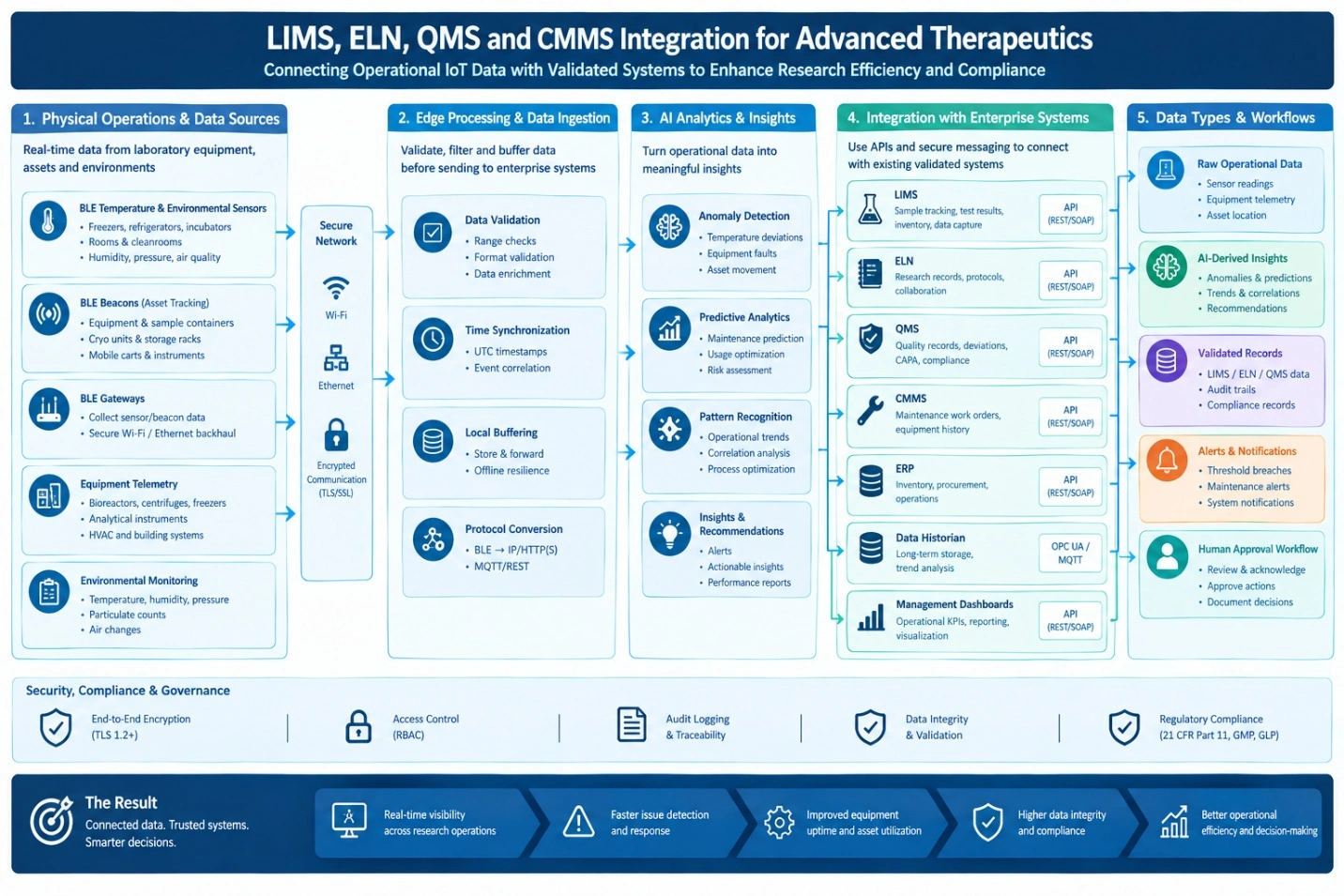
image
This integration diagram illustrates how BLE sensors, beacons, gateways, laboratory equipment, and environmental monitoring feed operational data through secure edge processing and AI analytics. It shows how insights connect with LIMS, ELN, QMS, CMMS, ERP, data historians, and dashboards while preserving data validation, traceability, cybersecurity, regulatory controls, and human approval.
Validation, Compliance and Data Governance
Advanced Therapeutics organizations should determine early whether a proposed AI-enabled system supports regulated activities or simply provides operational intelligence.
The distinction affects validation, documentation, access control, auditability, change management, and data retention.
Relevant considerations can include:
- FDA requirements applicable to the organization’s activities
- 21 CFR Part 11 where applicable
- Good Laboratory Practice requirements
- Good Manufacturing Practice requirements where applicable
- Electronic records controls
- Electronic signatures
- Data integrity
- Audit trails
- Computerized-system validation
- Change control
- User access management
- Cybersecurity
- Data retention
- Backup and recovery
- Model governance
The system should maintain clear separation between:
- Original sensor measurements
- Processed measurements
- AI predictions
- AI confidence scores
- Human decisions
- Automated actions
- Regulatory records
This separation improves traceability and makes later investigation substantially easier.
AI models also require lifecycle management. A model that performs well during commissioning may degrade when equipment changes, sensors are replaced, laboratory procedures change, or operating conditions evolve.
Model performance should therefore be monitored after deployment.
Cloud or Private Server Deployment for Advanced Therapeutics
Deployment selection should reflect the organization’s network and data requirements.
Cloud Deployment
Cloud deployment can be suitable for:
- Multiple research sites
- Centralized operational monitoring
- Large-scale historical analytics
- Distributed laboratory operations
- Central AI model management
- Remote engineering support
- Elastic data processing
Organizations should evaluate cloud identity management, encryption, network segmentation, backup strategy, regional data hosting, API security, and vendor access controls.
Private Server Deployment
A privately hosted server can be appropriate where research networks are isolated or where the organization requires greater control over data location and system administration.
Potential environments include:
- Private data centers
- Customer-managed servers
- Research facility servers
- Restricted laboratory networks
- Private cloud environments
- Dedicated edge servers
A hybrid design is also possible. Local servers can retain operational data and provide immediate analytics while approved information is transferred to centralized cloud services for longer-term analysis.
The appropriate design depends on the organization’s security model, data classification, connectivity, validation requirements, and operational resources.
Cybersecurity for Connected Advanced Therapeutics Systems
Security should be designed from the sensor through the application layer.
Important controls include:
- Unique device identities
- Strong gateway authentication
- Network segmentation
- Encrypted communications
- Secure API authentication
- Role-based access control
- Least-privilege permissions
- Firmware lifecycle management
- Security patching
- Centralized logging
- Intrusion monitoring
- Backup and recovery
- Certificate management
- Asset inventory
- Vulnerability assessment
BLE itself should not be treated as the complete cybersecurity solution.
The complete communication path may include BLE, gateway software, Ethernet or Wi-Fi, IP networking, cloud or private servers, APIs, databases, dashboards, and enterprise applications. Each layer needs appropriate controls.
Scaling AI and BLE Across Advanced Therapeutics Facilities
A pilot should be deliberately small but technically representative.
A useful pilot may involve:
- One laboratory
- Several critical assets
- A representative controlled environment
- A limited number of BLE sensors
- One or more gateways
- Existing maintenance records
- Existing environmental data
- A defined AI use case
- Measurable operational KPIs
The objective is not simply to demonstrate that sensors can transmit data.
The pilot should answer:
- Are measurements sufficiently accurate?
- Is BLE coverage adequate?
- Is gateway capacity sufficient?
- Does data remain available during network interruptions?
- Can the system integrate with existing software?
- Does AI reduce false alarms?
- Can engineers interpret model outputs?
- Are users responding to alerts?
- Does the system produce measurable operational improvement?
- Can the deployment satisfy applicable validation and cybersecurity requirements?
Once those questions are answered, the organization can scale by laboratory, building, research program, or geographic location.
Practical Implementation Roadmap for AI in Advanced Therapeutics
A disciplined deployment sequence reduces technical and operational risk.
- Define the Advanced Therapeutics operational problem and measurable outcome
- Map the relevant research workflow and critical assets
- Identify required data sources
- Determine sensor accuracy and sampling requirements
- Select BLE sensors, beacons, and gateways
- Conduct an RF and network assessment
- Define edge, cloud, or private server requirements
- Establish data models and device identities
- Integrate with relevant laboratory and maintenance systems
- Establish cybersecurity controls
- Build baseline analytics
- Train and validate AI models where appropriate
- Commission the system against defined acceptance criteria
- Monitor data quality and model performance
- Measure operational KPIs
- Document lessons learned
- Expand deployment to additional laboratories or sites
GAO’s experience supplying BLE, RFID, and IoT hardware and systems can support organizations that need a practical connected-device layer for these deployments. GAO states that its customer base has included Fortune 500 companies, R&D organizations, universities, and government agencies in the United States and Canada, supported by product R&D and technical support capabilities.
Why AI-Enabled Operational Intelligence Matters for Advanced Therapeutics
The strategic value of AI in Advanced Therapeutics is ultimately determined by whether it improves decisions around sensitive research operations.
A well-engineered system can provide:
- Earlier identification of equipment degradation
- Better visibility into environmental conditions
- Faster investigation of operational anomalies
- Reduced equipment search time
- Improved utilization of expensive laboratory assets
- Better maintenance planning
- More consistent operational records
- Improved cold-chain visibility
- More scalable monitoring across facilities
- Stronger correlation between physical operations and digital records
BLE is one enabling technology within this broader system. Its value comes from supplying reliable contextual data that AI can analyze alongside other sources.
The strongest deployments therefore avoid treating wireless sensing as the final objective. The objective is better operational intelligence for Advanced Therapeutics research and development.
Key Takeaways for Advanced Therapeutics AI Deployment
AI can provide meaningful value to Advanced Therapeutics when it is connected to reliable operational data and deployed around clearly defined research and engineering problems.
The most important implementation lessons are:
- Start with a measurable operational problem rather than an AI model
- Select sensors according to measurement requirements
- Engineer BLE coverage using actual laboratory conditions
- Preserve original measurements and data lineage
- Combine environmental, equipment, location, maintenance, and workflow data where appropriate
- Use edge processing for resilience and rapid local decisions
- Integrate with LIMS, ELN, QMS, CMMS, and other existing systems rather than creating isolated information
- Treat AI outputs as decision support unless the specific application has been appropriately validated for automated operation
- Monitor model performance after deployment
- Apply cybersecurity across the complete data path
- Select cloud, private server, or hybrid deployment according to data, security, network, and validation requirements
- Measure the deployment using operational KPIs
GAO can help organizations evaluate and implement BLE, RFID, IoT sensing, gateways, and related hardware systems for Advanced Therapeutics applications. With headquarters in New York City and Toronto, Canada, GAO is ranked among the world’s top 10 leading B2B and B2G BLE and RFID suppliers. Its sister companies, GAO Research and GAO Tek, form the GAO Group.
For organizations evaluating AI-enabled laboratory monitoring, asset intelligence, environmental sensing, or connected research operations, the appropriate next step is a requirements assessment covering the target workflow, measurement requirements, connectivity environment, software interfaces, cybersecurity controls, and deployment model.
Building the Future of Industrial AI and IoT with Aperture Venture Studio and GAO RFID Inc.
For more than three decades, GAO Group of Companies has invested heavily in R&D for industrial BLE, RFID, and IoT. As generative AI has become increasingly useful for industrial and research applications, we have developed AI and IoT solutions that incorporate BLE, RFID, sensing, and connected systems. We have also established Aperture Venture Studio to advance AI and IoT solutions relevant to specialized fields such as Advanced Therapeutics and biotechnology research.
Aperture has attracted AI and IoT technical experts, entrepreneurial and operational executives, investors, and leading companies.
We have also developed the Aperture Ventures Summit and TekSummit to facilitate discussion of advanced AI and IoT technologies.
GAO welcomes organizations interested in collaborating as advisors, co-founders or employees, investors, or customers.