
AI and BLE for Consumer Electronics Stores
AI-Driven Operations for Consumer Electronics Stores
AI for consumer electronics stores uses real-time operational data to improve inventory visibility, replenishment, asset tracking, fulfillment, anomaly detection, and store execution. BLE beacons, BLE sensors, and BLE gateways provide a practical data-capture layer for locating merchandise, monitoring environmental conditions, tracking mobile equipment, and understanding movement across sales floors, stockrooms, service areas, and distribution facilities. AI and machine learning can then correlate this information with point-of-sale, inventory, order, workforce, and warehouse data to identify exceptions and recommend actions.
For consumer electronics retailers, the value is not simply knowing where an item is. A connected solution can help determine whether a high-value laptop is available for a customer order, whether a mobile device has remained in the wrong area, whether a stockroom discrepancy requires investigation, or whether fulfillment activity is creating an unusual operational pattern. This creates a practical path from connected data to AI-assisted decisions while keeping store associates and operations teams in control. GAO provides BLE, RFID, and IoT hardware products and systems that can support these types of connected retail deployments.
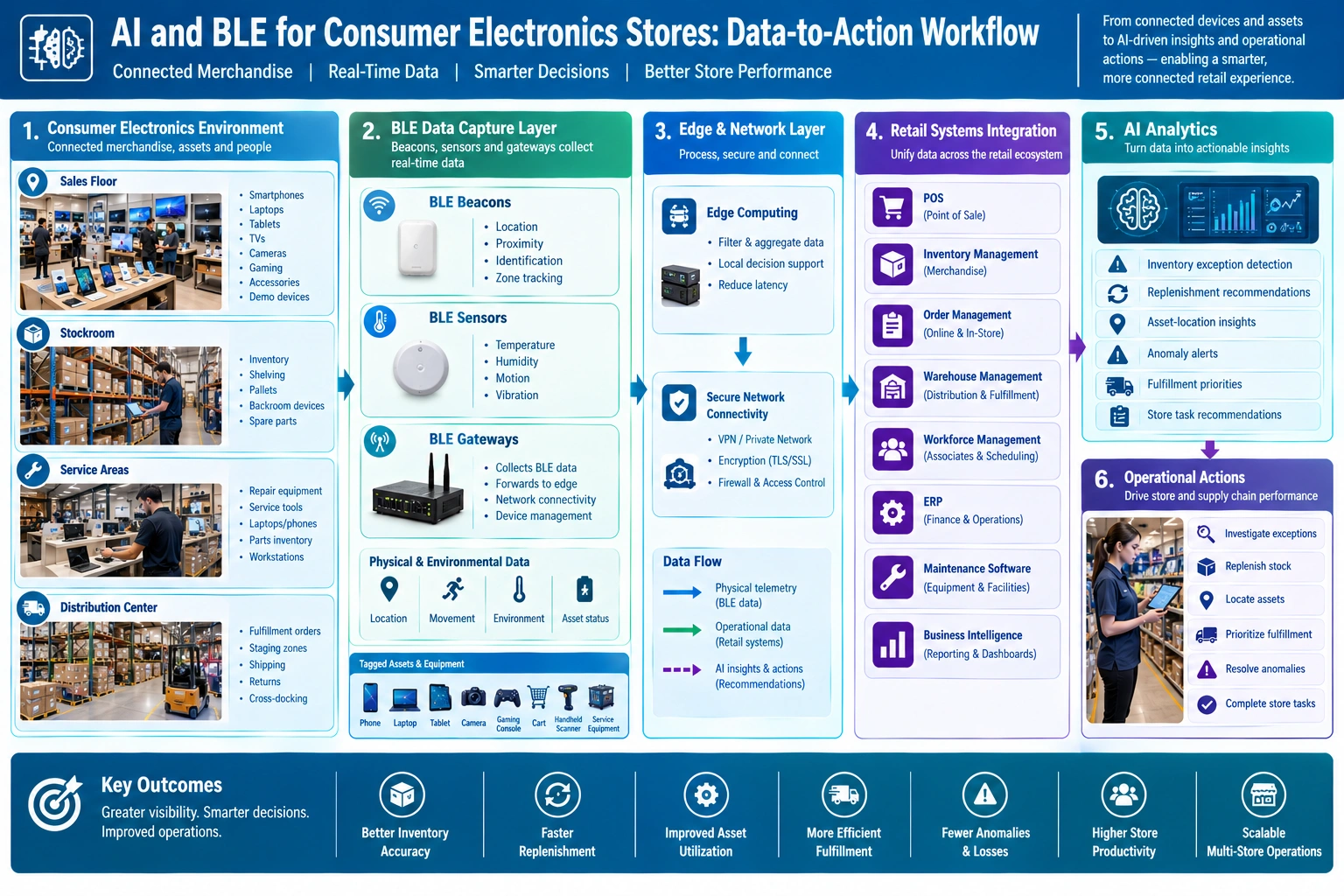
AI and BLE for Consumer Electronics Stores: Data-to-Action Workflow
This workflow infographic illustrates how connected smartphones, laptops, tablets, cameras, gaming equipment, accessories, and retail assets generate BLE location, movement, environmental, and asset-status data. The data moves through gateways, edge processing, secure connectivity, and retail systems before AI analytics produces inventory exceptions, replenishment recommendations, asset insights, anomaly alerts, fulfillment priorities, and store tasks.
What AI and BLE Mean for Consumer Electronics Retail
Consumer electronics stores have operating characteristics that make real-time location and condition data particularly useful. Merchandise can range from small accessories and boxed devices to high-value laptops, smartphones, cameras, gaming consoles, televisions, and specialized demonstration equipment. Many products have serial numbers, model numbers, SKUs, IMEIs, or other identifiers that must remain aligned with inventory records.
BLE supports this environment by providing wireless identification, proximity, location, and sensor telemetry. A BLE beacon can provide an identifier associated with an item, fixture, zone, cart, or other asset. BLE sensors can capture information such as temperature, humidity, motion, vibration, or other supported measurements. BLE gateways collect transmissions from these devices and forward usable data to retail software.
AI provides the decision layer above this operational information. Machine learning can identify patterns in stock movement, detect unusual behavior, forecast demand, classify exceptions, and prioritize operational responses. Edge processing can be used where low latency, local filtering, intermittent connectivity, or data minimization is important.
The relationship is therefore complementary:
- BLE beacons and sensors capture identification, location, movement, and environmental information.
- BLE gateways collect and forward device data from stores, stockrooms, service areas, and distribution facilities.
- Edge computing can filter, aggregate, validate, and process selected data locally.
- Retail software combines BLE information with transactional and operational records.
- AI and machine learning identify patterns, predict conditions, detect anomalies, and recommend actions.
- Store and supply-chain teams execute replenishment, investigation, recovery, fulfillment, maintenance, and other operational tasks.
For GAO deployments, the appropriate combination depends on store layout, product density, required location accuracy, gateway placement, connectivity, integration requirements, and the operational decision that the retailer wants to improve.
High-Value AI Use Cases in Consumer Electronics Stores
AI applications become more useful when they are connected to specific retail workflows rather than treated as isolated analytics projects.
AI Inventory Management and Stock Visibility
Consumer electronics retailers frequently manage products distributed between sales displays, locked cabinets, stockrooms, service areas, fulfillment staging zones, and distribution centers. BLE location information can supplement conventional inventory records by providing additional evidence about where tagged merchandise or assets are located.
AI can combine this information with POS transactions, stock movements, cycle counts, transfers, returns, and order activity to identify discrepancies. Examples include:
- Detecting a mismatch between recorded inventory and observed merchandise movement.
- Identifying products that remain in unexpected zones.
- Prioritizing inventory investigations based on value, demand, or discrepancy severity.
- Supporting more frequent visibility for high-value or operationally sensitive merchandise.
- Providing location context for online-order pickup and store fulfillment.
AI Replenishment and Demand Response
Replenishment decisions in electronics retail can involve fast-moving accessories, popular devices, seasonal products, promotional merchandise, and products with highly variable demand.
AI can evaluate historical sales, current inventory, open orders, product movement, promotions, and other available operational signals. BLE-derived movement information can provide additional context where physical product activity is relevant.
The resulting recommendations can help determine:
- Which products require replenishment.
- Which stockroom quantities should be moved to the sales floor.
- Which exceptions warrant associate attention.
- Which products require investigation before replenishment.
- Where demand and physical availability appear inconsistent.
The objective is AI-assisted replenishment rather than unrestricted automated ordering.
AI Asset Tracking and Store Equipment Management
Consumer electronics stores contain many operational assets beyond sellable merchandise. These can include shopping carts, mobile computers, handheld scanners, demo equipment, charging stations, tools, fixtures, service equipment, and other movable resources.
BLE asset tracking can provide location and movement information while AI can analyze utilization and recurring movement patterns. This can support asset recovery, maintenance prioritization, equipment allocation, and investigation of missing or misplaced assets.
AI Anomaly Detection and Loss Investigation
Unusual movement can be operationally significant in an electronics store. A product may move between sales floor zones, stockrooms, service areas, fulfillment staging locations, and exits. A mobile asset may also move outside its expected area.
AI anomaly detection can establish expected patterns and flag deviations for human investigation. Depending on the available data, examples include:
- Unusual movement of tagged merchandise.
- Unexpected movement between restricted and public areas.
- Repeated inventory discrepancies.
- Abnormal stockroom activity.
- Unusual asset movement.
- Sensor readings outside configured operating ranges.
AI alerts should be treated as investigation signals. Detection quality depends on tag placement, gateway coverage, data quality, business rules, model design, and operational context.
AI Use Cases for Consumer Electronics Stores: BLE, Retail Data, and AI Applications
This B2B use-case matrix connects common consumer electronics retail challenges with BLE inputs, retail data sources, AI methods, and resulting business actions. It covers inventory exceptions, replenishment, merchandise location, asset tracking, anomaly detection, fulfillment, service-area monitoring, and multi-store analytics.
Consumer Electronics Store Workflow from Data Capture to AI-Assisted Action
A practical AI and BLE deployment begins with operational events rather than with the AI model itself. The system must first establish reliable data capture, device identity, location context, and integration with existing retail applications.
Merchandise, Asset, and Sensor Data Capture
BLE beacons and sensors can be associated with selected merchandise, equipment, fixtures, carts, service tools, or defined store zones. Selection should be based on the operational question being answered.
For example, a retailer may prioritize high-value electronics, frequently misplaced accessories, mobile fulfillment equipment, or assets that are difficult to locate manually. Not every item necessarily requires an individual BLE device. Zone-level sensing, gateway telemetry, and existing inventory identifiers can sometimes provide sufficient operational context.
Gateway Collection and Edge Processing
BLE gateways receive transmissions from nearby BLE devices and provide the connection between the wireless sensing layer and the retail data environment. Gateway placement should account for floor plan geometry, shelving, cabinets, walls, interference, device density, and required location performance.
Edge processing can reduce unnecessary traffic by filtering duplicate events, aggregating readings, applying local rules, or temporarily buffering data when upstream connectivity is interrupted. This is particularly useful for stores or distribution facilities where continuous cloud connectivity cannot be assumed.
Secure Network and Data Transport
Processed events can be transmitted through the retailer’s approved wired or wireless network using appropriate security controls. Depending on the implementation, the solution may use encrypted transport, network segmentation, authenticated devices, secure gateway management, role-based access, and controlled API access.
Security should cover the entire path from BLE device provisioning through gateway communication, data storage, application integration, and administrative access. BLE itself should not be treated as the sole security boundary.
Retail System Integration
BLE information becomes operationally valuable when it can be correlated with existing consumer electronics retail records. Common integration targets include:
- POS and transaction systems.
- Inventory management and merchandise systems.
- Order management systems.
- Warehouse management systems.
- Enterprise resource planning systems.
- Workforce management software.
- Service and maintenance systems.
- Business intelligence and reporting tools.
- APIs, middleware, and event-processing services.
A normalized data model should preserve relationships between BLE device identifiers, SKU or asset identifiers, store locations, zones, timestamps, transactions, and operational events. This makes downstream analytics more reliable and helps prevent location data from becoming another isolated data source.
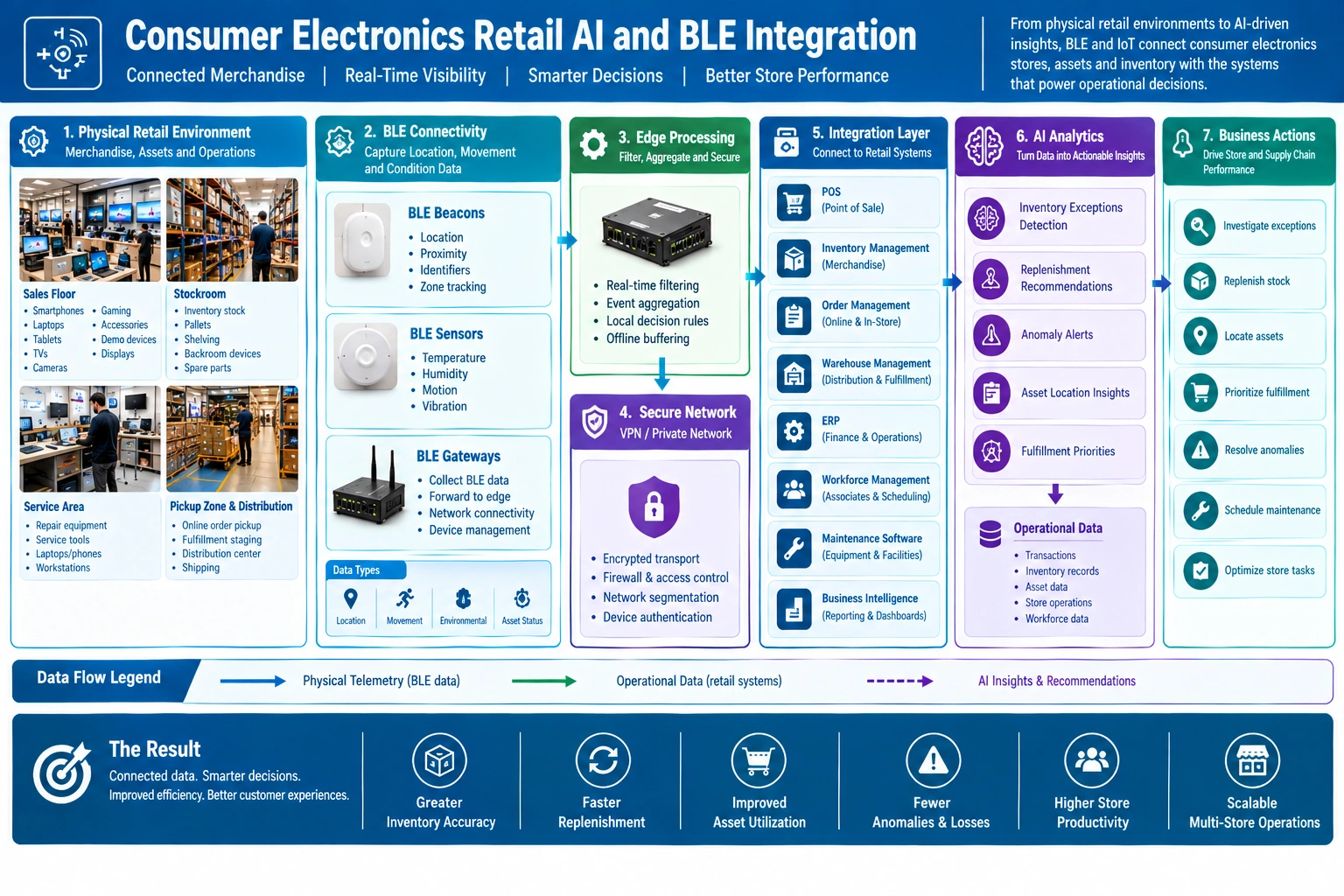
Consumer Electronics Retail AI and BLE Integration Architecture
This enterprise integration diagram shows how consumer electronics stores, stockrooms, service areas, pickup zones, and distribution centers connect BLE beacons, sensors, and gateways with edge processing and secure networking. Retail systems such as POS, inventory, order, warehouse, ERP, workforce, and maintenance platforms feed AI analytics that generate actionable recommendations and operational priorities.
BLE Hardware, AI Software, and Deployment Options
A consumer electronics retail solution normally combines BLE hardware, gateway software, data-processing components, integration services, analytics, and existing business applications. The correct configuration depends on the required location behavior, store connectivity, data volume, security requirements, and operational workflow.
BLE Beacons, Sensors, and Gateways
BLE beacons are appropriate for transmitting identifiers associated with merchandise, equipment, zones, or other tracked objects. BLE sensors extend this capability by measuring supported physical conditions or activity.
BLE gateways serve as collection points. They should be selected according to expected BLE device density, communication range, network interfaces, processing requirements, environmental conditions, and management capabilities. Gateway deployment should be validated through an RF survey or site assessment where location performance is important.
GAO supplies BLE and IoT hardware products and systems that can be incorporated into retail tracking and sensing solutions, with configuration determined by the specific operating environment.
AI and Machine Learning
AI methods relevant to consumer electronics retail include:
- Time-series forecasting for demand and replenishment planning.
- Classification models for operational exceptions.
- Anomaly detection for unusual merchandise or asset behavior.
- Clustering for identifying recurring operational patterns.
- Predictive models for prioritizing inventory or fulfillment conditions.
- Optimization methods for allocating inventory or operational resources.
- Rule-based and machine-learning hybrid approaches for controlled operational alerts.
Model selection should follow the business problem and available data. A sophisticated model cannot compensate for inconsistent SKU identifiers, incomplete event streams, inaccurate zone definitions, or poor gateway coverage.
Cloud-Hosted Deployment
A cloud-hosted deployment places application and analytics software within managed cloud infrastructure. It can be appropriate for consumer electronics retailers operating many stores that need centralized analytics, shared reporting, remote administration, and cross-store comparison.
The main engineering considerations include network dependency, API security, data residency requirements, cloud operating costs, latency requirements, and integration with corporate IT controls.
Privately Hosted Server Deployment
A privately hosted server deployment places the software on customer-managed servers, private data centers, edge servers, or other controlled infrastructure. This approach can be useful where the retailer requires greater control over data processing, network isolation, local operation, or existing enterprise infrastructure.
The retailer assumes greater responsibility for server capacity, operating system maintenance, application updates, backups, monitoring, cybersecurity controls, and disaster recovery.
Edge and Hybrid Deployment
Edge processing is useful when selected decisions must occur close to the store or distribution operation. A hybrid model can combine local event processing with centralized analytics, allowing latency-sensitive or connectivity-sensitive functions to remain local while broader multi-store analytics operate centrally.
The appropriate model should be selected according to:
| Requirement | Cloud-Hosted | Privately Hosted Server | Edge | Hybrid |
|---|---|---|---|---|
| Multi-store analytics | Strong fit | Strong fit | Limited alone | Strong fit |
| Local processing | Limited | Possible | Strong fit | Strong fit |
| Dependence on WAN connectivity | Higher | Configurable | Lower for local functions | Configurable |
| Centralized administration | Strong | Moderate | More distributed | Strong |
| Local resilience | Depends on design | Depends on design | Strong | Strong |
| Data control | Provider/customer policy dependent | Higher direct control | High local control | Configurable |
| Scalability across stores | Strong | Requires capacity planning | Requires distributed management | Strong with local processing |
| Maintenance responsibility | More provider-managed | More customer-managed | Shared/distributed | Shared |
Consumer Electronics Retail BLE Deployment Models: Cloud, Server, Edge, and Hybrid
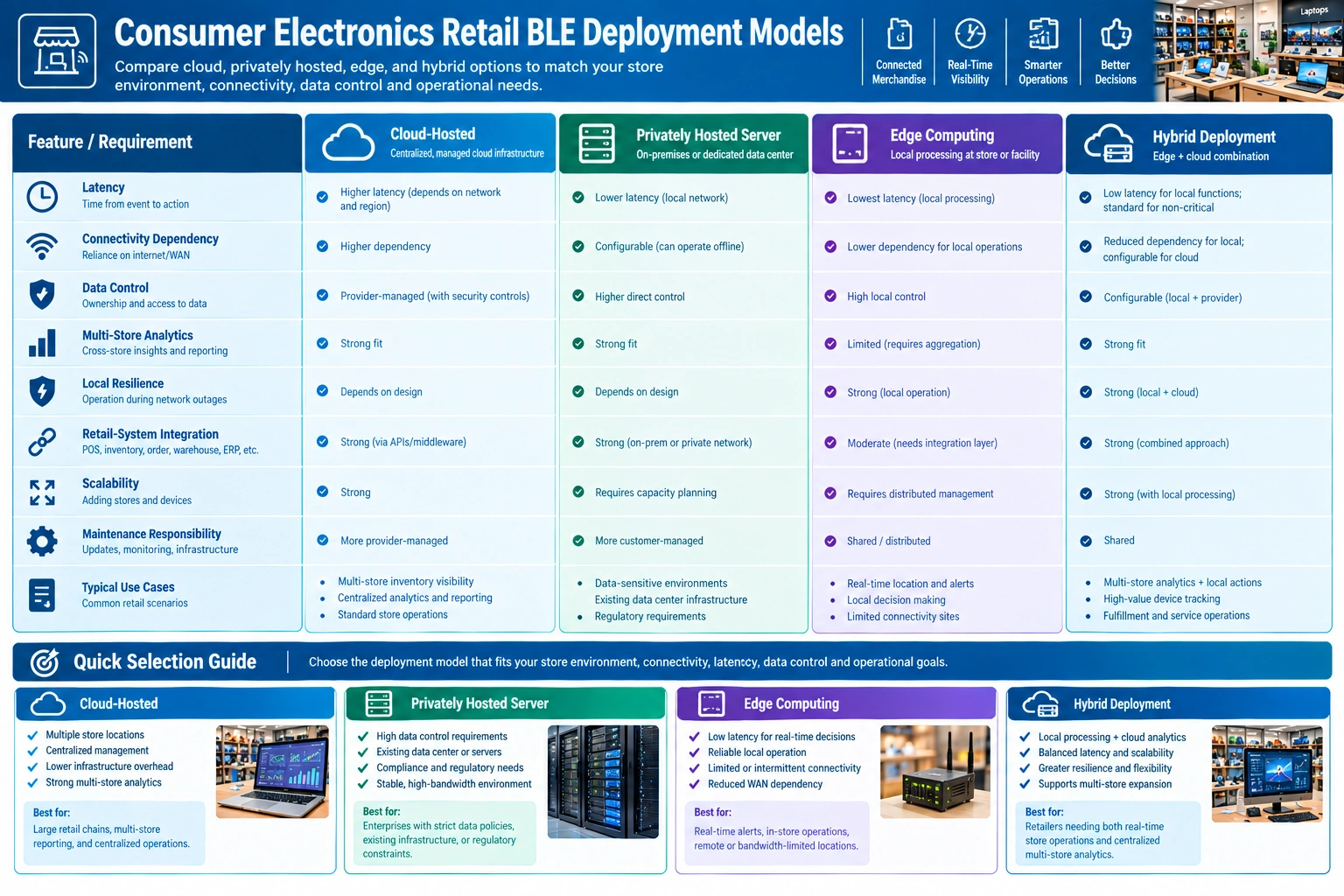
This comparison infographic evaluates four BLE deployment architectures across latency, connectivity dependency, data control, multi-store analytics, resilience, integration, scalability, and maintenance. A quick-selection guide highlights suitable scenarios for cloud-hosted, privately hosted, edge, and hybrid deployments in consumer electronics retail.
Engineering Considerations for Consumer Electronics BLE Deployments
BLE performance should be evaluated in the actual operating environment. Metal shelving, security fixtures, dense merchandise, display cabinets, walls, people, interference, and gateway placement can affect radio behavior and location results. A deployment intended to distinguish between a sales floor, stockroom, service counter, and pickup area requires different engineering considerations from a simple proximity-detection application.
Important design factors include:
- Required location granularity, such as room, zone, aisle, or gateway proximity.
- BLE device density and expected transmission intervals.
- Gateway coverage and physical placement.
- Battery life and maintenance access.
- Network availability and failover behavior.
- Identifier mapping between BLE devices and retail SKUs or assets.
- Timestamp synchronization and event ordering.
- Data retention and privacy requirements.
- API throughput and integration latency.
- Alert thresholds and escalation workflows.
- Model monitoring and false-alert handling.
- Cybersecurity controls for gateways, APIs, servers, and cloud services.
Testing should include representative store conditions rather than an empty test area. Commissioning should validate device registration, gateway connectivity, zone definitions, event timestamps, inventory correlation, alert behavior, and recovery after network or device interruptions.
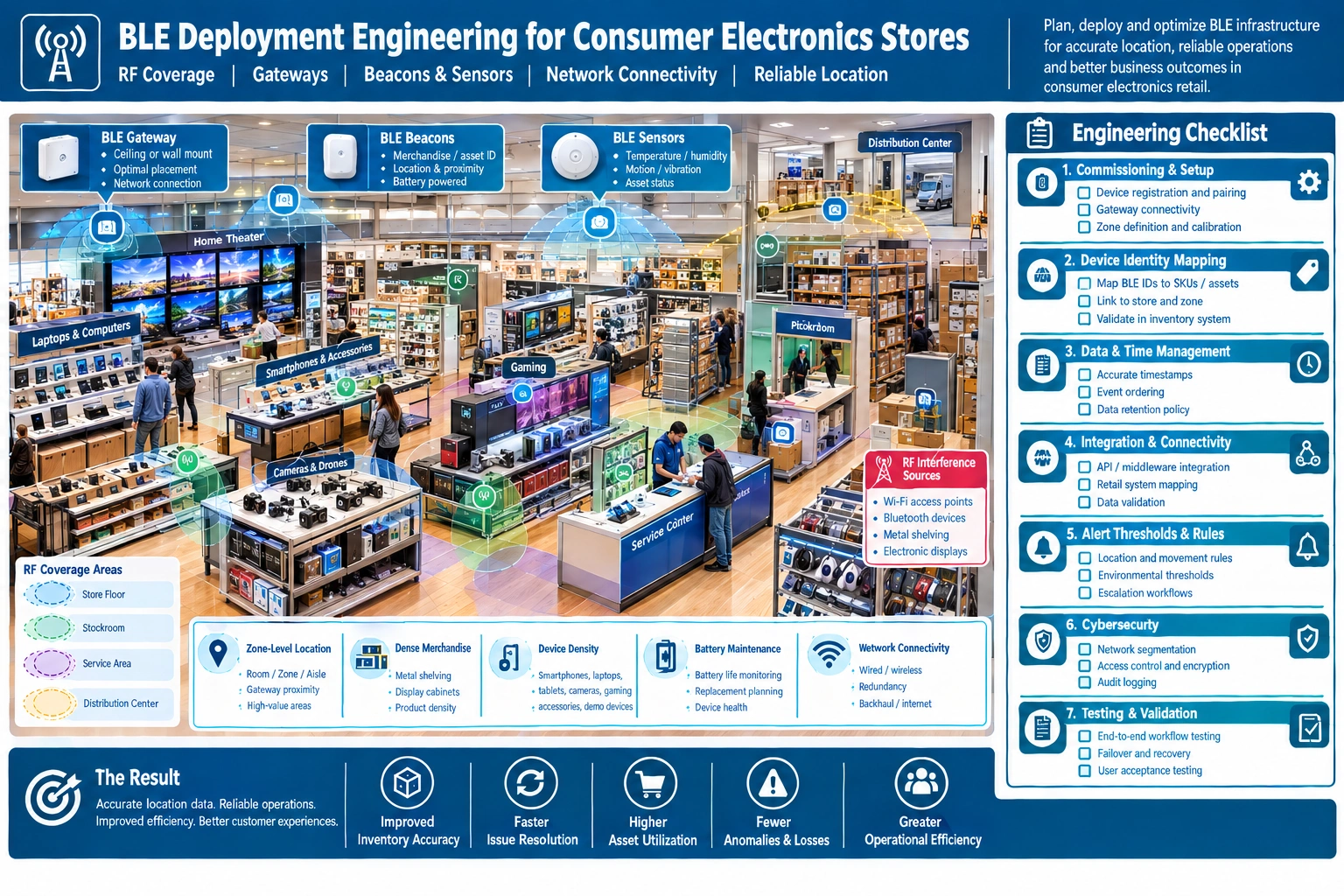
Consumer Electronics Retail BLE Deployment Models: Cloud, Server, Edge, and Hybrid
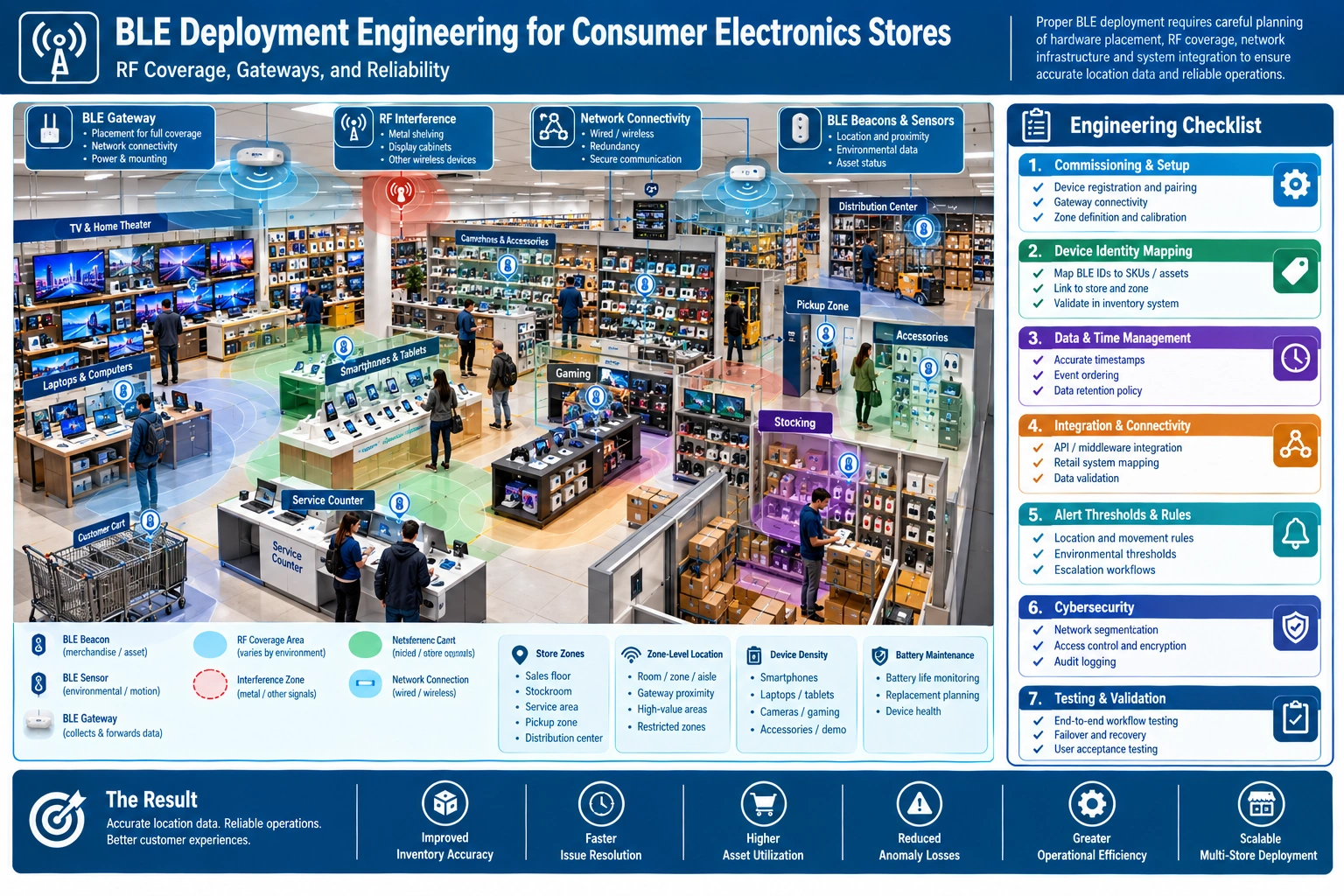
This technical illustration shows how gateway placement, RF interference, dense merchandise, device density, battery health, network connectivity, and zone requirements affect BLE deployment performance. It also presents an engineering checklist covering commissioning, device mapping, timestamps, API integration, alert thresholds, cybersecurity, and system testing.
AI-Enabled Operational Improvements for Consumer Electronics Stores
The combination of AI with BLE-derived operational data can improve how consumer electronics retailers identify exceptions, prioritize work, and coordinate merchandise across stores, stockrooms, service areas, fulfillment zones, and distribution facilities. The strongest results generally come from connecting physical activity with existing retail transactions and workflows rather than deploying BLE or AI as a standalone system.
Better Inventory Visibility and Exception Management
BLE can add physical-location context to conventional inventory records. AI can use that context alongside POS activity, transfers, returns, cycle counts, and fulfillment data to identify conditions that deserve investigation.
For example, a retailer may have an inventory record showing a particular laptop in a stockroom while BLE observations indicate that the tagged unit has remained in a sales-floor demonstration area. The system can surface the discrepancy rather than requiring an associate to discover it during a periodic count.
This approach can support:
- Location-aware inventory investigation.
- Identification of unexpected merchandise movement.
- Prioritization of high-value inventory exceptions.
- Improved visibility of stockroom and fulfillment staging areas.
- More informed store-to-store inventory decisions.
- Reconciliation of physical activity with transactional records.
Faster Replenishment Decisions
AI-assisted replenishment can combine demand signals with physical inventory information. Sales velocity, current stock, open orders, transfers, promotions, product attributes, and BLE observations can contribute to a replenishment decision.
For electronics retailers, this is especially relevant to products that experience rapid demand changes, including smartphones, gaming products, accessories, storage devices, chargers, headphones, and other high-turnover merchandise.
BLE does not determine demand by itself. Its contribution is physical visibility. AI can then determine whether observed conditions are consistent with expected inventory and demand patterns.
Improved Merchandise Recovery
Merchandise recovery involves locating products that are misplaced, incorrectly staged, left in service areas, or otherwise outside their expected operating zone.
A location-aware system can provide associates with more useful information than a generic exception alert. Instead of simply reporting that an item requires attention, the application can provide the last known zone, relevant timestamp, item identifier, and associated operational context.
For high-value electronics, this can reduce the time required to investigate discrepancies while providing an auditable event history.
More Effective Asset Utilization
Consumer electronics stores depend on operational equipment that can become unavailable when misplaced or underutilized. Examples include handheld scanners, tablets, mobile computers, carts, charging equipment, service tools, and demonstration equipment.
AI can analyze movement and utilization patterns to identify:
- Assets that spend excessive time outside their assigned areas.
- Equipment that is frequently moved between departments.
- Underutilized operational resources.
- Recurring asset-recovery events.
- Equipment requiring maintenance or inspection.
- Locations where additional equipment may be operationally justified.
GAO’s BLE and IoT hardware can support the underlying identification and sensing requirements, while the retailer’s software determines how those events are incorporated into asset-management workflows.
Fulfillment and Pickup Operations
Buy-online-pickup-in-store and ship-from-store processes require accurate coordination between inventory, order status, associates, staging areas, and customer pickup activity.
BLE location information can help establish where selected merchandise or fulfillment assets are located. AI can combine this information with order priorities, promised pickup times, inventory availability, and workload information to prioritize tasks.
Potential applications include:
- Identifying orders whose merchandise is difficult to locate.
- Prioritizing fulfillment tasks based on operational constraints.
- Detecting merchandise remaining too long in staging areas.
- Supporting pickup-area inventory visibility.
- Identifying discrepancies between order records and physical merchandise.
Store Workforce and Task Prioritization
AI-generated recommendations become more useful when they connect directly to store workflows. Instead of producing another dashboard that associates must constantly monitor, the system can prioritize specific tasks.
Examples include:
- Investigate an inventory discrepancy involving a high-value device.
- Locate an asset that has moved outside its expected zone.
- Replenish a product whose sales-floor availability requires attention.
- Verify merchandise staged for an online pickup order.
- Inspect an environmental sensor alert in a sensitive storage area.
- Recover equipment assigned to another department.
Human staff remain responsible for validating and executing these actions. This approach provides decision support without assuming that every AI recommendation should become an automated operational command.
Consumer Electronics Retail AI and BLE KPIs
A useful KPI program should measure both business performance and technical reliability. Measuring only AI model accuracy can miss problems caused by incomplete BLE observations, incorrect asset mappings, gateway outages, or inconsistent retail-system data.
Inventory KPIs
Relevant inventory measures include:
- Inventory accuracy.
- Stockout rate.
- Inventory discrepancy rate.
- Cycle-count exception rate.
- Time to investigate inventory exceptions.
- Time to locate selected merchandise.
- Stockroom-to-sales-floor replenishment response time.
- Inventory availability by store and zone.
Store Operations KPIs
Store operations teams can monitor:
- Merchandise recovery time.
- Store task completion time.
- High-priority task aging.
- Fulfillment staging duration.
- Pickup-order exception rate.
- Asset recovery time.
- Equipment utilization.
- Service-area exception resolution time.
AI Performance KPIs
AI should be evaluated using measures appropriate to the particular model and business process:
- Anomaly detection precision.
- False-alert rate.
- Alert resolution rate.
- Recommendation acceptance rate.
- Forecast accuracy.
- Exception prioritization accuracy.
- Model drift indicators.
- Time from data event to recommendation.
A high alert count is not necessarily evidence of a successful AI implementation. Excessive false positives can cause alert fatigue and reduce associate trust. Thresholds should therefore be evaluated using actual store workflows and reviewed as operational conditions change.
BLE and System Reliability KPIs
Technical operations should monitor:
- Gateway availability.
- BLE device battery health.
- Device connectivity.
- Event-processing latency.
- Data completeness.
- Missing-event rate.
- Data synchronization status.
- API availability.
- Integration error rate.
- Edge-processing health.
- Network connectivity.
- Device provisioning status.
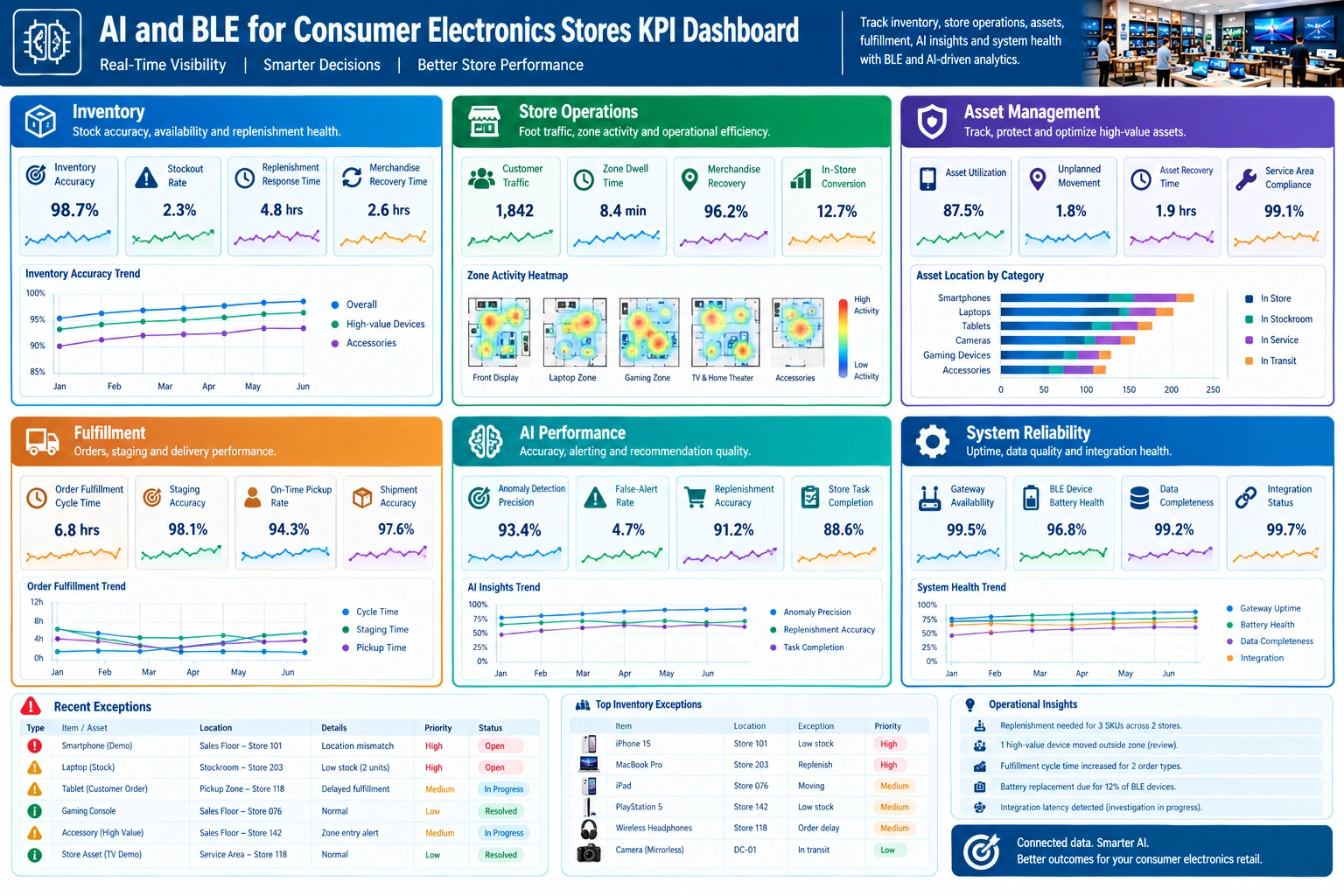
AI and BLE for Consumer Electronics Stores KPI Dashboard
This executive dashboard visualizes key performance indicators across inventory, store operations, asset management, fulfillment, AI performance, and system reliability. It combines KPI cards, trend charts, activity heatmaps, exception tables, and operational insights to provide a practical view of connected retail performance.
Consumer Electronics Retail Deployment Lifecycle
Successful implementation requires more than installing BLE devices and connecting a dashboard. Retailers should establish the operational requirements, validate the physical environment, commission devices and gateways, integrate business systems, test decision workflows, and continuously monitor system quality.
Planning and Use-Case Definition
Begin with measurable operational problems. A retailer should define whether the initial deployment is intended to improve inventory investigation, high-value merchandise visibility, asset recovery, fulfillment, stockroom operations, or another specific workflow.
The definition should include:
- Items or assets that require monitoring.
- Required location granularity.
- Store and facility zones.
- Required event frequency.
- Expected data retention.
- Existing system identifiers.
- Users and operational roles.
- Required alerts and escalation paths.
- Success metrics.
A narrowly defined pilot can reveal engineering and workflow issues before expansion to additional stores.
Hardware Selection and Site Assessment
BLE device selection should reflect the physical characteristics and operating conditions of the consumer electronics environment. Battery-powered devices may be appropriate for movable assets, while fixed BLE devices can support zone identification or equipment monitoring.
A site assessment should examine shelving, display cabinets, walls, checkout areas, stockroom layouts, service counters, fulfillment staging, and potential sources of RF interference. Gateway placement should be validated against the desired location behavior rather than based solely on theoretical radio range.
Installation and Commissioning
Commissioning should establish a reliable relationship between physical devices and software records. Each deployed device should have an appropriate identifier and association with the relevant merchandise, asset, location, or zone.
Testing should verify:
- BLE device detection.
- Gateway communication.
- Device-to-asset mapping.
- Zone identification.
- Timestamp integrity.
- Data transmission.
- Edge buffering where applicable.
- API integration.
- Alert generation.
- User permissions.
- Failure and recovery behavior.
Integration and Validation
Retail integration should be tested using realistic transactions and operational events. A system may successfully receive BLE data while still failing to provide useful business information if identifiers do not match inventory records or if events cannot be correlated with orders and locations.
Validation should therefore include complete workflows such as merchandise movement, inventory adjustment, order fulfillment, return processing, asset relocation, and exception resolution.
Optimization and Expansion
After deployment, retailers can examine false alerts, missing data, gateway utilization, battery consumption, integration failures, and user feedback. These observations can guide changes to device placement, transmission intervals, alert thresholds, data-processing rules, and AI models.
Multi-store expansion should account for differences in store layouts, network conditions, merchandise density, security controls, operating procedures, and local integration requirements. A configuration that performs well in one store should not automatically be assumed to behave identically in another.
Security, Privacy, and Data Governance
Consumer electronics retailers should treat BLE and AI data as part of their broader information-security program. The exact controls depend on the information being processed and the retailer’s policies, but several technical principles are broadly applicable.
BLE gateways should use authenticated administration and controlled network access. Communication between gateways, edge systems, integration services, and centralized software should use appropriate encryption and authentication. Network segmentation can limit the impact of a compromised device or gateway.
Access to location and operational information should follow role-based permissions. Store associates may require task-specific information, while regional operations teams may require multi-store visibility and system administrators may require device-management access.
Data governance should also define:
- Which BLE events are retained.
- How long historical location information is stored.
- Which systems can access the data.
- How device identifiers are associated with merchandise or assets.
- How administrative activity is logged.
- How retired devices and credentials are removed.
- How integration credentials are rotated.
- How AI model inputs and outputs are audited.
AI recommendations should remain traceable to relevant source data where practical. This helps operations teams understand why an alert or recommendation was generated and supports troubleshooting when the recommendation is incorrect.
Interoperability and Retail Software Integration
Interoperability is particularly important when BLE data must coexist with established retail software. Consumer electronics retailers may already operate POS, inventory, order, warehouse, ERP, workforce, service, and business-intelligence applications from different vendors.
An integration layer can normalize BLE events before they reach downstream applications. Depending on the environment, integration can use APIs, message queues, middleware, webhooks, database interfaces, or other approved mechanisms.
A useful normalized event can include information such as:
- Device identifier.
- Associated SKU or asset identifier.
- Store or facility identifier.
- Zone.
- Event timestamp.
- Event type.
- Gateway identifier.
- Sensor reading where applicable.
- Confidence or quality information.
- Processing status.
This structure allows applications to use the same operational event for different purposes. A location event, for example, may contribute to inventory reconciliation, asset tracking, fulfillment visibility, and AI anomaly detection without requiring separate physical sensing systems for every workflow.
Scaling AI and BLE Across Consumer Electronics Stores
Scaling requires standardization without assuming that every location is physically identical. Retailers should establish common device-management procedures, naming conventions, asset identifiers, gateway configuration practices, security policies, and integration interfaces.
A scalable deployment should also support remote monitoring of device health and gateway status. Battery-powered BLE devices require lifecycle management, including battery replacement planning, device inventory, provisioning, decommissioning, and replacement.
Multi-store analytics can then aggregate operational information while preserving store-level context. AI can compare patterns across locations, identify recurring exception types, and support regional operations without requiring every store to run identical physical configurations.
GAO’s experience supplying BLE, RFID, and IoT hardware products and systems to organizations in the United States and Canada supports the practical hardware side of these deployments. GAO Group companies have served Fortune 500 companies, R&D organizations, universities, and government agencies for three decades, with product R&D, quality assurance, and remote or onsite technical support forming part of that experience.
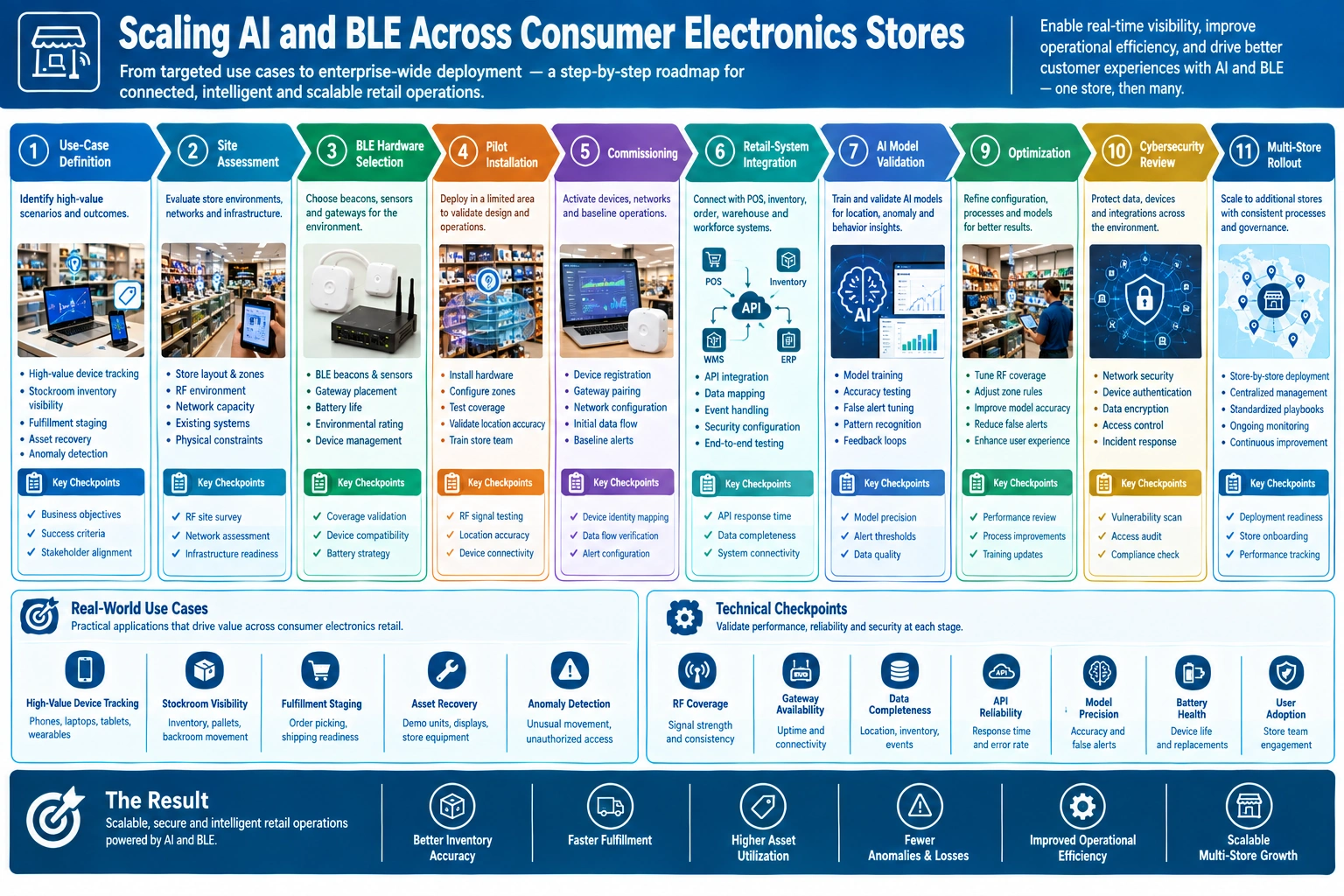
Scaling AI and BLE Across Consumer Electronics Stores: Deployment Roadmap
This roadmap illustrates the progression from use-case definition and site assessment through BLE hardware selection, pilot deployment, retail-system integration, AI validation, optimization, cybersecurity review, and multi-store rollout. It highlights practical use cases and technical checkpoints for building a reliable, secure, and scalable connected retail operation.
Practical Recommendations for AI and BLE in Consumer Electronics Stores
A technically sound deployment should align sensing capabilities with actual retail decisions. The following principles help reduce implementation risk:
- Start with a defined consumer electronics workflow rather than deploying BLE broadly without an operational objective.
- Prioritize high-value merchandise, fulfillment bottlenecks, stockroom discrepancies, or difficult-to-locate assets where additional visibility has clear operational value.
- Perform an RF and physical site assessment before finalizing gateway locations.
- Maintain a reliable mapping between BLE identifiers, SKUs, serialized products, assets, zones, and store locations.
- Integrate BLE events with existing POS, inventory, order, warehouse, workforce, and ERP information rather than creating an isolated data store.
- Use edge processing where local filtering, buffering, or low-latency decisions justify it.
- Select cloud-hosted, privately hosted, edge, or hybrid deployment according to connectivity, data-control, latency, resilience, and multi-store requirements.
- Establish AI evaluation criteria before deployment, including precision, false-alert rate, recommendation quality, and operational resolution time.
- Monitor BLE battery health, gateway availability, data completeness, integration errors, and event latency alongside business KPIs.
- Design alerts around associate workflows so that AI recommendations result in actionable tasks rather than excessive notifications.
- Test failure conditions, including gateway outages, network interruptions, missing BLE events, incorrect asset mappings, and unavailable retail-system APIs.
- Apply security controls to devices, gateways, networks, APIs, servers, cloud services, and administrative interfaces.
- Expand from validated use cases to additional stores only after confirming that the operating model can accommodate different layouts and connectivity conditions.
Key Takeaways for Consumer Electronics Retail AI
AI can provide meaningful operational value to consumer electronics stores when it is connected to reliable physical and transactional data. BLE beacons, BLE sensors, and BLE gateways can supply location, movement, environmental, and asset information that complements POS, inventory, order, warehouse, workforce, and ERP records.
The most practical applications include inventory exception detection, AI-assisted replenishment, high-value merchandise visibility, asset tracking, fulfillment prioritization, anomaly detection, and store task management. Edge processing, cloud or privately hosted software, secure networking, and integration middleware can be selected according to operational requirements rather than treated as one universal deployment model.
GAO can support organizations evaluating BLE, RFID, and IoT hardware products and systems for consumer electronics retail applications. Readers can learn more about GAO’s technical capabilities, products, deployment considerations, and support when planning a connected retail solution.
Building the Future of Industrial AI and IoT with Aperture Venture Studio and GAO RFID Inc.
For more than three decades, GAO Group of Companies has invested heavily in R&D for industrial BLE, RFID, and IoT. As generative AI became increasingly useful in industrial applications, we expanded our work in AI and IoT technologies and founded Aperture Venture Studio to build, launch, and scale next-generation AI and IoT companies for various industries, including applications relevant to connected retail and consumer electronics operations.
Aperture has attracted AI and IoT technical experts, entrepreneurial and operational executives, influential investors, and leading companies. We have also developed the Aperture Ventures Summit and TekSummit to discuss advanced AI and IoT topics.
We welcome you to join us as:
- Advisors, Co-founders, or Employees
- Investors
- Customers