
AI and BLE for Consumer Electronics Stores
AI-Powered Automation for Automated Storage Facilities
AI is transforming automated storage facilities by turning continuous operational data into decisions for inventory control, asset movement, equipment monitoring, order fulfillment, and workforce coordination. In these environments, BLE gateways, beacons, and sensors provide location, identification, environmental, and equipment-condition data that can feed AI and machine learning models. The resulting AIoT solution can connect storage locations, automated storage and retrieval systems (AS/RS), conveyors, mobile robots, pallets, totes, bins, and other material-handling assets with warehouse management and control software. For distribution and fulfillment operations, this enables more accurate inventory visibility, exception detection, predictive maintenance, dynamic workflow optimization, and faster response to operational disruptions. GAO supplies BLE, RFID, and IoT hardware products and systems that can support these connected workflows, with deployment choices suited to different facility sizes, layouts, integration requirements, and data-governance needs.
AI and BLE Workflow for Automated Storage Facilities
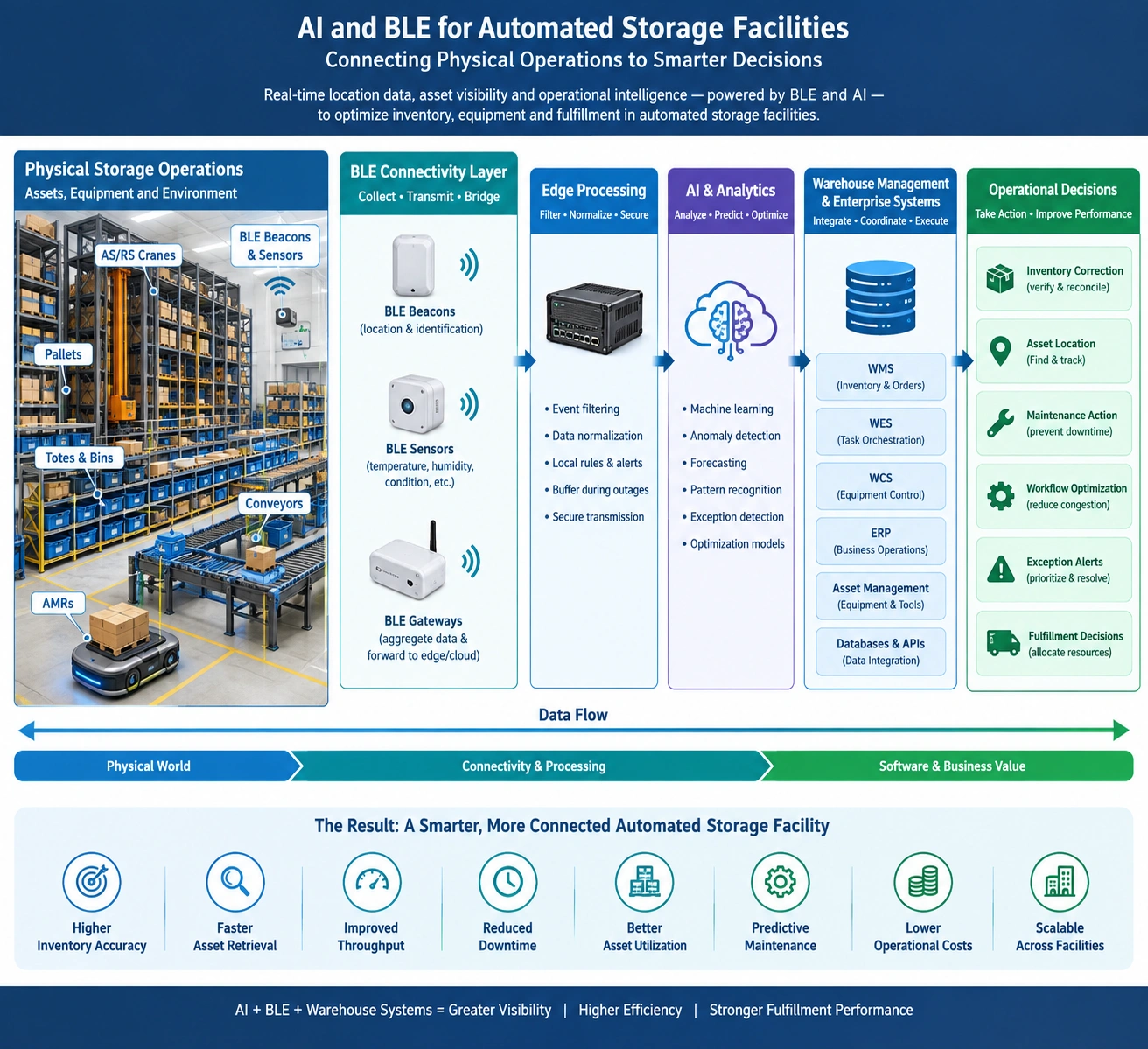
This enterprise workflow visual illustrates how BLE beacons and sensors collect data from AS/RS cranes, pallets, totes, bins, conveyors, and AMRs through BLE gateways. Edge processing and AI analytics transform this operational data into insights for WMS, WES, WCS, and other enterprise systems, supporting faster decisions, predictive maintenance, higher inventory accuracy, and improved fulfillment performance.
Alt Text
AI and BLE workflow connecting AS/RS, pallets, totes and AMRs to warehouse analytics and decisions.
What AI Means for Automated Storage Facilities
AI in automated storage facilities refers to the use of machine learning, computer vision, Industrial AI, Edge AI, and related analytical methods to interpret operational data and improve storage and fulfillment decisions. AIoT combines artificial intelligence with IoT devices, sensors, connected equipment, and industrial systems.
The practical value comes from combining AI models with real-time information from storage and material-handling processes. A BLE-enabled system can provide data about the presence or location of tagged assets, while BLE sensors can report conditions such as temperature or equipment state. Gateways collect this information and transmit it to software where rules, analytics, or machine learning models can identify patterns.
For example, an automated storage facility may use location information to determine whether a tote is positioned in its expected storage zone. AI can then correlate that information with warehouse orders, inventory records, conveyor activity, and AS/RS transactions. An unexpected location can become an exception rather than requiring an operator to discover the problem manually.
This approach is particularly useful where thousands of storage movements occur continuously. Rather than treating every sensor event independently, AI can analyze historical and current operational data to identify abnormal movement patterns, predict equipment problems, prioritize exceptions, and improve fulfillment decisions.
GAO’s BLE and IoT hardware can serve as the data-acquisition layer for these applications, while enterprise software and AI models provide the analytical and decision-making functions.
Core AI Use Cases in Automated Storage and Fulfillment
AI Inventory Visibility and Location Intelligence
Automated storage facilities depend on accurate inventory records and precise knowledge of where goods are located. BLE-enabled location data can supplement warehouse transactions by providing an additional physical observation of assets such as totes, pallets, containers, tools, and mobile equipment.
AI can compare expected and observed locations to detect:
- Misplaced totes or containers
- Unexpected movement between storage zones
- Inventory remaining in staging areas
- Repeated location discrepancies
- Assets approaching restricted or incorrect zones
- Movement patterns inconsistent with normal fulfillment workflows
This creates a useful distinction between what the warehouse management system says should exist and what the physical operation indicates is actually happening.
AI-Assisted Asset Tracking
Distribution centers frequently manage reusable assets such as pallets, cages, totes, carts, and containers. Losing track of these assets creates replacement costs, workflow interruptions, and unnecessary manual searches.
BLE tags or beacons attached to suitable assets can provide location observations through strategically positioned gateways. AI can analyze historical movement to identify recurring bottlenecks, unusual dwell times, or assets that repeatedly disappear from expected process paths.
The result is more than simple location tracking. The system can help determine why an asset is not progressing through a fulfillment process.
Predictive Maintenance for Material-Handling Equipment
Automated storage facilities contain equipment such as conveyors, sortation systems, AS/RS machinery, automated guided vehicles, autonomous mobile robots, lifts, motors, and other mechanical systems.
AI can combine equipment telemetry with sensor observations and maintenance history to identify patterns associated with abnormal operation. BLE sensors can contribute condition or environmental measurements where appropriate, while existing PLC, SCADA, or equipment-control data can provide additional signals.
Potential outcomes include:
- Earlier detection of abnormal operating conditions
- Maintenance prioritization based on predicted risk
- Reduced unplanned equipment downtime
- Better spare-parts planning
- More informed maintenance scheduling
BLE should not be treated as a replacement for machine-control networks. Its value is strongest when it supplies complementary operational or asset information to the maintenance and analytics system.
AI for Storage-Zone and Workflow Optimization
Storage facilities can develop recurring congestion around receiving, putaway, picking, staging, packing, and dispatch areas. Location and movement information can help AI models identify these patterns.
For example, historical movement data can reveal that particular storage zones experience longer dwell times during specific fulfillment periods. AI can use these observations alongside order volumes and equipment availability to support decisions about inventory placement, replenishment priorities, staging, and resource allocation.
The objective is to reduce unnecessary movement and improve throughput without compromising inventory accuracy or safety requirements.
Exception Detection and Operational Alerts
Exception management is one of the most practical AI applications for automated storage facilities.
A system can establish normal operational patterns and flag deviations such as:
- A tote remaining in a staging area longer than expected
- A pallet entering an unexpected zone
- An asset moving through an unusual sequence
- A repeated inventory-location mismatch
- Equipment operating under abnormal conditions
- A high-frequency congestion pattern
- A process step that repeatedly exceeds its expected cycle time
Rather than generating an alert for every event, AI can help prioritize exceptions according to operational impact.
Automated Storage Facility Data-to-Decision Workflow
An effective AIoT deployment begins with physical data acquisition and ends with an operational action. The complete workflow typically involves several connected layers.
Data Acquisition
BLE beacons and sensors are attached or positioned according to the tracking requirement. Depending on the use case, devices may be associated with totes, pallets, containers, mobile equipment, storage zones, or facility infrastructure.
Sensors can capture relevant environmental or equipment-related measurements, while beacons can provide identifiers for tracked assets.
The installation design should consider storage-rack construction, metal interference, gateway coverage, device mounting, battery life, RF propagation, and the movement patterns of forklifts, AMRs, pallets, and other equipment.
BLE Gateway Communication
BLE gateways receive transmissions from nearby devices and forward collected information to the processing environment. Gateway placement is an engineering decision rather than simply a matter of installing one device per area.
Rack density, ceiling height, obstructions, radio interference, required location accuracy, and gateway backhaul connectivity all influence deployment.
For large automated storage facilities, a site survey and pilot installation are useful before full deployment. They allow engineers to validate coverage, packet reception, location accuracy, battery performance, and gateway placement.
Edge Processing and Data Normalization
Raw device events may contain identifiers, timestamps, signal information, sensor readings, and gateway information. Middleware can normalize these records and associate them with operational entities.
For example, a device identifier can be mapped to a particular tote or pallet, while a gateway identifier can correspond to a storage zone.
Edge processing can also filter duplicate events, perform preliminary validation, buffer data during connectivity interruptions, and execute low-latency rules.
AI and Analytics
Normalized data can then be processed by analytics software and AI models. Depending on the application, models may perform classification, anomaly detection, forecasting, clustering, or predictive analysis.
The AI layer should receive meaningful operational context. BLE location information alone may not explain why an asset is delayed. Combining it with order status, WMS transactions, equipment availability, and process timestamps can provide a much more useful operational picture.
Enterprise Software Integration
The AIoT solution can exchange information with systems such as:
- Warehouse Management Systems (WMS)
- Warehouse Control Systems (WCS)
- Warehouse Execution Systems (WES)
- Enterprise Resource Planning (ERP) systems
- Manufacturing or maintenance systems where applicable
- Asset management software
- Database systems
- Analytics and reporting software
Integration can use APIs, message brokers, databases, web services, or other supported interfaces depending on the existing software environment.
Business and Operational Action
The final stage is an operational response. An AI-generated insight has value only when it leads to an appropriate action.
Possible actions include changing a replenishment priority, investigating an asset-location discrepancy, scheduling maintenance, redirecting an operational task, escalating an exception, or adjusting storage and fulfillment workflows.
This closed loop is important for distribution and fulfillment operations because the goal is not simply to collect more sensor data. The goal is to improve measurable operational performance.
End-to-End AIoT Workflow for Automated Storage Facilities
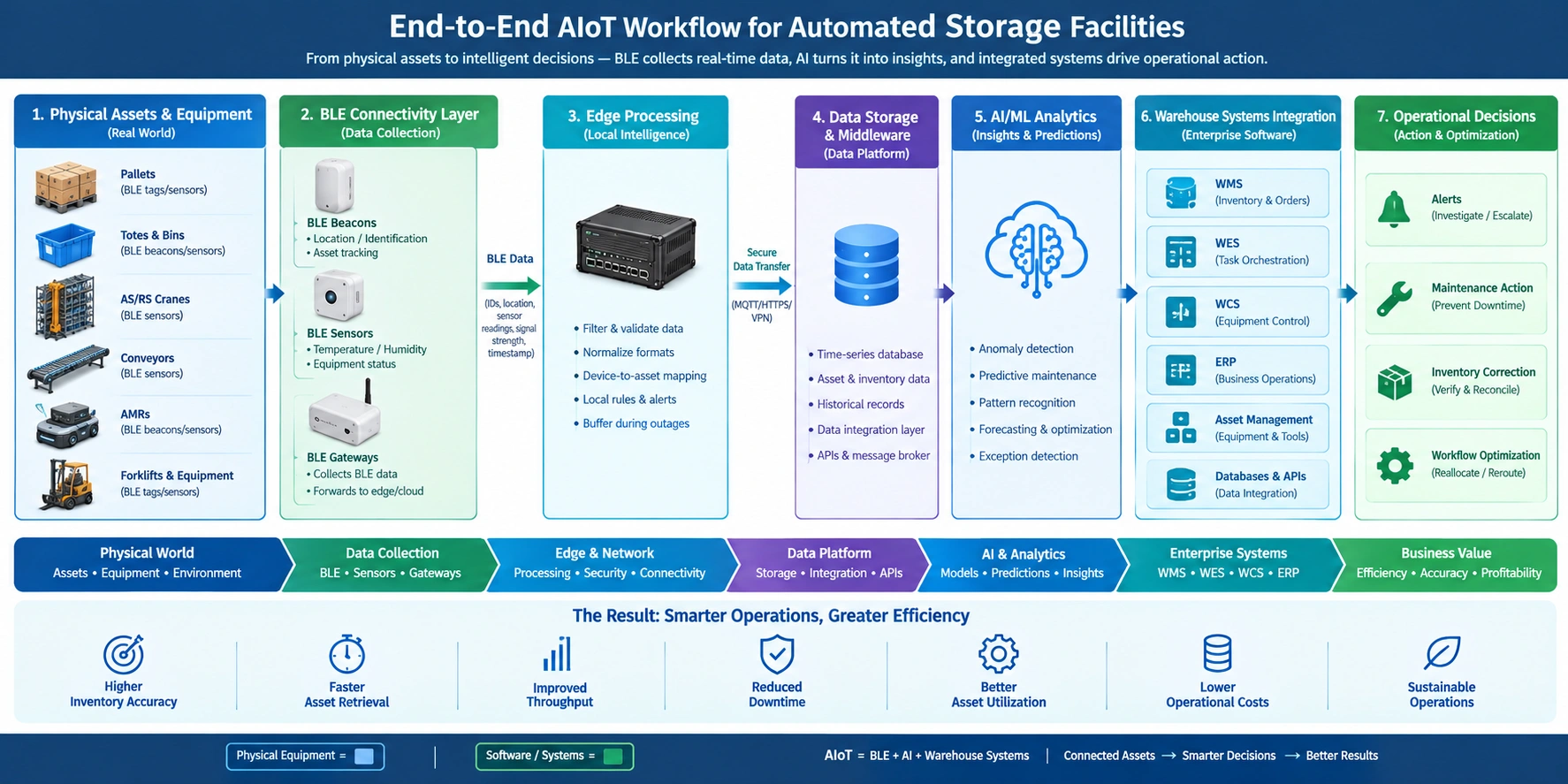
This technical workflow illustrates the complete AIoT data journey from physical assets such as pallets, totes, AS/RS cranes, conveyors, AMRs, and forklifts through BLE connectivity, edge processing, secure networking, data storage, AI/ML analytics, and warehouse system integration. The workflow shows how AI-driven insights lead to alerts, maintenance actions, inventory corrections, and workflow optimization.
Alt Text
AIoT workflow connecting BLE-enabled storage assets to AI analytics, warehouse systems, and operational actions.
Deployment Considerations for AI-Enabled Storage Operations
Successful deployment requires more than selecting BLE hardware and an AI model. The solution must fit the facility’s physical layout, operating procedures, software environment, cybersecurity requirements, and maintenance practices.
Key engineering considerations include:
- Define the business problem before selecting sensors or AI models.
- Identify which assets actually require continuous tracking.
- Establish required location accuracy before determining gateway density.
- Conduct an RF survey in representative storage zones.
- Test BLE performance around metal racks and automated equipment.
- Determine battery-replacement intervals for mobile assets.
- Integrate device identifiers with WMS or asset master data.
- Establish data retention requirements for historical movement records.
- Validate AI alerts against real operational events before automating actions.
- Provide monitoring for gateway health, device battery status, and communication failures.
- Separate safety-critical control functions from non-safety AI analytics unless the complete system has been engineered and validated for that purpose.
GAO’s experience supplying BLE, RFID, and IoT products and systems is relevant when organizations need to translate these requirements into practical hardware and deployment decisions. GAO Group companies have served organizations in the U.S. and Canada for three decades, including Fortune 500 companies, research organizations, universities, and government agencies, with R&D investment, quality processes, and remote or onsite technical support.
Automated Storage Facility BLE Deployment and RF Coverage
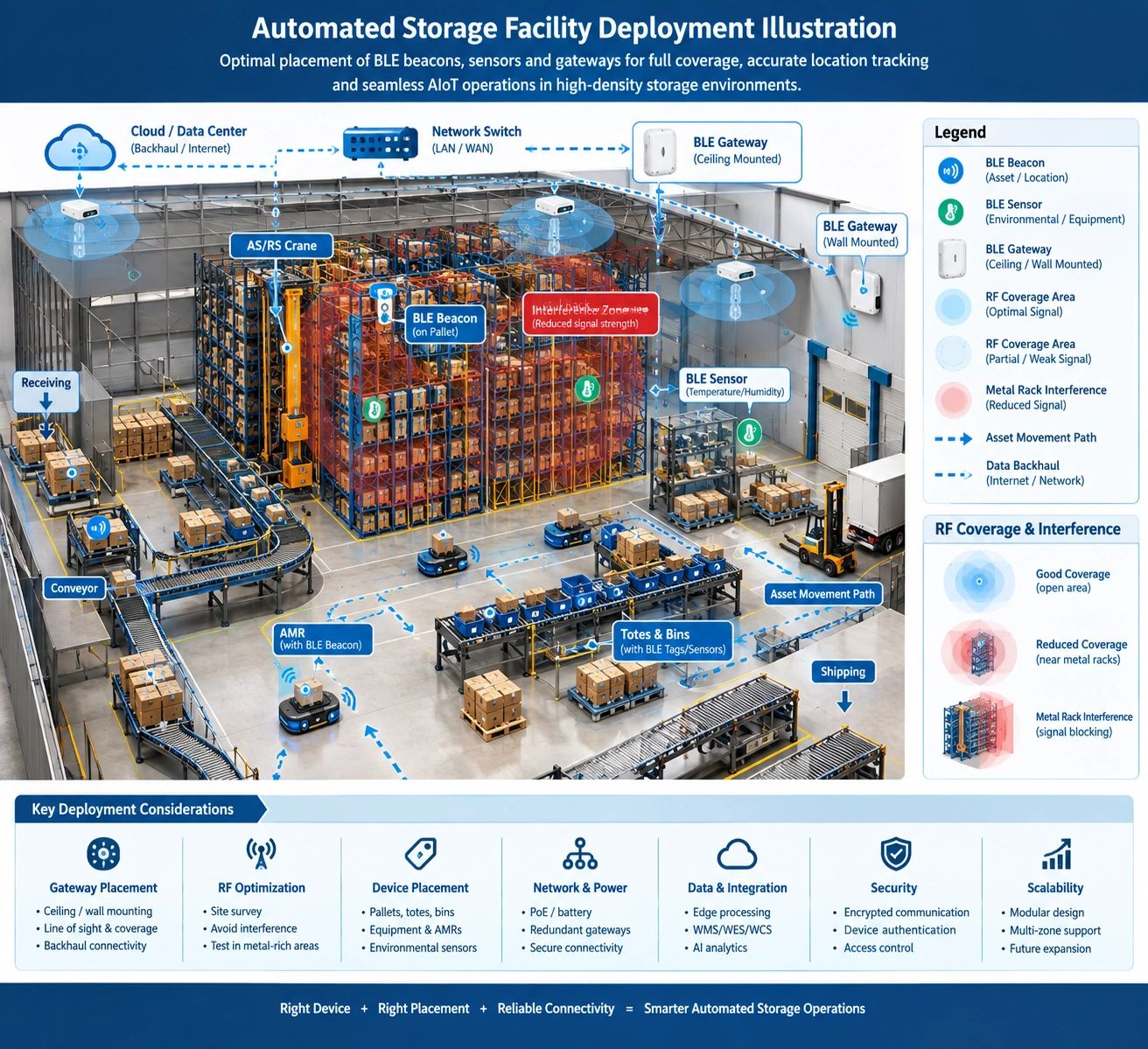
This technical cutaway illustrates BLE deployment across a high-density automated storage facility, including AS/RS racks, conveyors, totes, pallets, AMRs, BLE beacons, sensors, and ceiling- or wall-mounted gateways. It highlights RF coverage zones, metal rack interference, asset movement paths, network backhaul, and key placement considerations for reliable AIoT operations.
Alt Text
BLE deployment in an automated storage facility showing gateways, RF coverage, rack interference, and asset paths.
BLE Hardware, AI Software, and System Components
An AI-enabled automated storage facility requires coordinated hardware, communication, software, and data-processing components. BLE is primarily the sensing and connectivity layer, while AI converts operational observations into predictions, classifications, and recommendations.
BLE Beacons and Sensors
BLE beacons can provide an identifiable wireless signal from assets, containers, or defined operational locations. BLE sensors extend this capability by collecting measurements relevant to storage and fulfillment operations.
Typical deployment considerations include device enclosure, mounting method, battery capacity, transmission interval, environmental conditions, and required maintenance frequency.
For example, a reusable tote that moves repeatedly between picking, packing, staging, and storage may use a BLE beacon for location visibility. A temperature-sensitive storage area may additionally use BLE sensors to monitor environmental conditions.
BLE Gateways
BLE gateways act as collection points between field devices and the software environment. They receive BLE transmissions and forward relevant information through available network connectivity.
Gateway selection should consider:
- Required BLE coverage
- Number of connected devices
- Facility dimensions
- RF interference
- Ethernet or wireless backhaul
- Local processing requirements
- Environmental operating conditions
- Gateway redundancy requirements
The gateway does not need to perform every AI function. For many deployments, it is more effective to perform lightweight filtering and validation close to the facility while sending normalized data to centralized AI software.
Edge Computing
Edge processing is useful when an automated storage facility needs low-latency event handling or continued operation during temporary network interruptions.
An edge server can process gateway events, maintain a local event queue, execute rules, and forward selected data to centralized software. This approach can reduce unnecessary network traffic and allow certain operational alerts to be generated locally.
Edge processing is especially useful when facility connectivity to a remote cloud environment is limited or when operational requirements call for local data processing.
AI and Machine Learning Software
AI software can operate on historical and real-time operational data. Depending on the problem, suitable techniques may include anomaly detection, time-series forecasting, classification, clustering, and predictive maintenance models.
Model selection should follow the operational requirement rather than the availability of a particular AI technology. A simple rules engine may be more appropriate than machine learning for a deterministic threshold, while machine learning can provide value when patterns are complex and difficult to describe manually.
Cloud Version and Server Version
A cloud-hosted deployment can provide centralized software management, remote analytics, scalable storage, and access across multiple automated storage facilities. This model is appropriate when distribution networks operate multiple facilities and need centralized visibility.
A privately hosted server deployment can be more appropriate where operational data must remain within customer-controlled infrastructure or where network connectivity to external cloud services is restricted.
A hybrid model is also possible. Facility-level edge processing can handle immediate events, while selected operational data is transmitted to centralized cloud or privately hosted analytical software.
The choice should consider latency, cybersecurity, data governance, connectivity, maintenance responsibility, integration requirements, and the number of facilities being monitored.
Cybersecurity and Data Protection
Connected storage systems introduce additional cybersecurity considerations because gateways, sensors, servers, and enterprise applications become part of the operational data path.
Security measures can include:
- Device authentication
- Encrypted communications where supported
- Network segmentation
- Role-based access control
- Secure API authentication
- Gateway and server hardening
- Firmware and software patch management
- Logging and security monitoring
- Backup and recovery procedures
- Controlled administrative access
AI models should also be protected from poor-quality or manipulated input data. Data validation and anomaly detection should therefore apply not only to warehouse operations but also to the integrity of the data pipeline.
AI and BLE Integration with Warehouse Software
AI-driven storage optimization is most effective when sensor observations are connected to the systems that already manage fulfillment operations.
A WMS may contain the logical inventory record, while BLE provides physical observations. A WCS may manage automated material-handling equipment, while AI analyzes historical movement and operational performance. A WES may coordinate workflows, while AI helps prioritize exceptions or predict congestion.
This separation of responsibilities is important. The BLE system should not independently become the source of truth for every warehouse transaction. Instead, it should provide additional operational evidence that can be correlated with existing transaction data.
For example, when the WMS records that a tote has been placed into a particular storage location, BLE observations can help verify that the physical asset remains within the expected area. If the asset later appears elsewhere without a corresponding transaction, the software can generate an exception for investigation.
GAO can supply the BLE, RFID, and IoT hardware required to collect these physical-world observations, while integration software connects the resulting data to the customer’s existing operational systems.
WMS/WES/WCS Integration with BLE and AI for Automated Storage Facilities
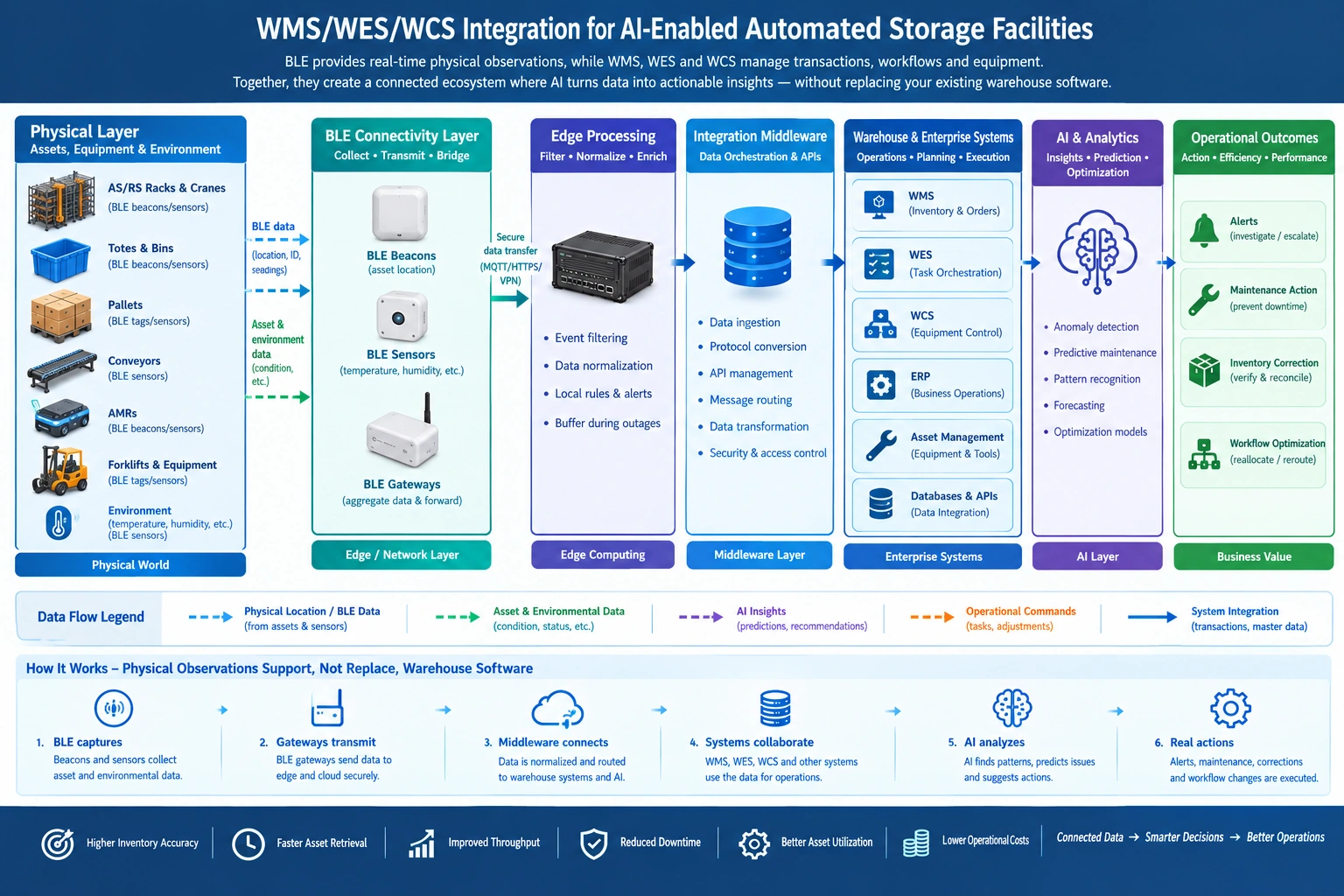
This enterprise integration diagram shows how BLE beacons and sensors collect physical-location and asset data, which gateways transmit through edge processing and middleware to WMS, WES, WCS, ERP, asset management, databases, and AI analytics. It emphasizes that BLE observations complement existing warehouse software, enabling AI-driven alerts, maintenance actions, inventory corrections, and workflow optimization.
Alt Text
BLE and AI integration with WMS, WES, WCS, ERP, and warehouse operations for automated storage facilities.
Operational Benefits and Performance Improvements
Higher Inventory Accuracy
AI can identify inconsistencies between expected inventory states and physical observations. This can reduce the time required to investigate misplaced inventory and improve confidence in storage records.
The greatest value is achieved when location observations are correlated with WMS transactions, order activity, and storage-zone information rather than evaluated independently.
Reduced Search and Retrieval Time
Manual searches for missing totes, pallets, containers, or equipment can consume valuable fulfillment labor. Location-aware BLE systems can narrow the search area, while AI can identify the most likely recent location based on movement history.
This can reduce non-value-added searching and help operators focus on exceptions requiring human judgment.
Improved Throughput
AI can identify recurring congestion and workflow bottlenecks by analyzing movement events, dwell times, order volumes, and equipment activity.
Potential improvements include better staging management, improved task prioritization, and more efficient allocation of material-handling resources.
Predictive Maintenance
Instead of relying exclusively on fixed maintenance intervals, AI can analyze equipment behavior and historical failure patterns to identify conditions associated with elevated maintenance risk.
This can support maintenance teams in prioritizing inspections and planning downtime around fulfillment requirements.
Better Asset Utilization
Reusable totes, pallets, carts, and containers represent operational assets that must remain available for fulfillment. Tracking their movement and dwell time can identify underutilized or stranded assets.
AI can further distinguish normal temporary inactivity from recurring operational problems.
Scalability Across Storage Zones
A properly designed BLE system can be expanded from a pilot zone to additional storage areas. Standardized device identifiers, gateway configurations, data models, and software interfaces make expansion easier to manage.
However, scalability should not mean installing devices without measurement. Each expansion should validate RF performance, gateway capacity, network bandwidth, battery requirements, and integration behavior.
Key KPIs for AI-Enabled Automated Storage Facilities
Performance should be measured using operational KPIs rather than the number of connected devices.
Useful metrics include:
- Inventory accuracy rate
- Asset location accuracy
- Order fulfillment cycle time
- Pick cycle time
- Putaway cycle time
- Storage retrieval time
- Asset dwell time
- Conveyor throughput
- AS/RS utilization
- AMR utilization
- Equipment availability
- Mean time between failures
- Mean time to repair
- Unplanned downtime
- Exception resolution time
- Staging-area congestion
- Inventory discrepancy rate
- Replenishment response time
- Tote and pallet utilization
- Energy consumption per operational unit
AI projects should establish baseline measurements before deployment. This allows the facility to determine whether improved visibility actually produces measurable operational gains.
AI-Powered Warehouse Operations KPI Dashboard for Automated Storage
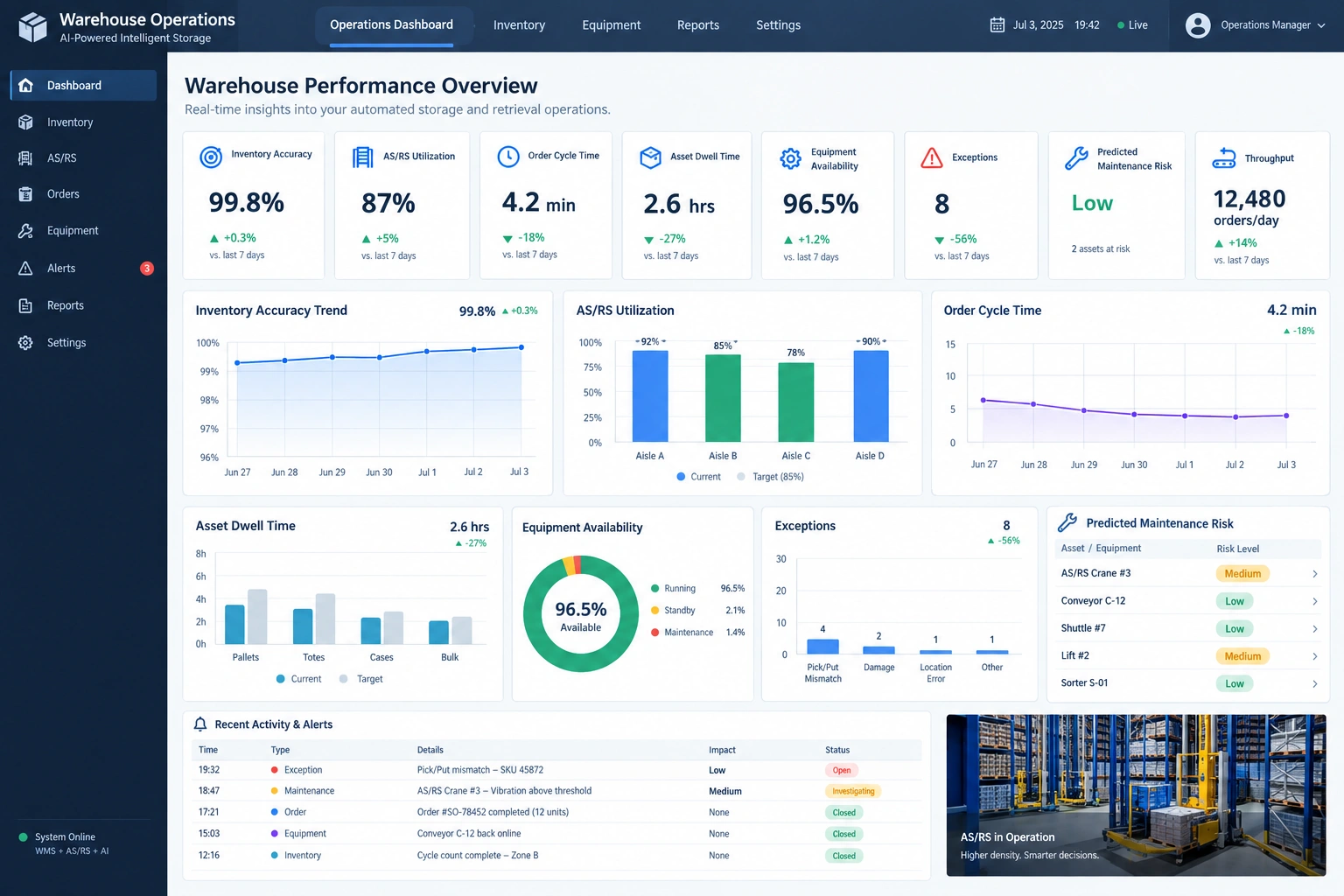
An enterprise warehouse dashboard visualizes key AI-enabled storage KPIs, including inventory accuracy, AS/RS utilization, order cycle time, asset dwell time, equipment availability, exceptions, maintenance risk, and throughput. The interface helps operations managers monitor performance, identify issues, and make data-driven maintenance and optimization decisions.
Alt Text
Warehouse KPI dashboard showing AS/RS utilization, inventory accuracy, throughput, exceptions, and maintenance risk.
Implementation, Testing, and Lifecycle Management
A successful deployment should progress from a defined operational problem through pilot testing, commissioning, integration, and continuous optimization.
Planning and Site Assessment
Begin by documenting the physical workflow and identifying where information gaps affect fulfillment performance.
The assessment should document storage racks, conveyors, AS/RS equipment, staging areas, AMR routes, receiving and dispatch areas, network connectivity, existing WMS/WCS/WES interfaces, and the assets requiring visibility.
Pilot Deployment
A representative pilot zone should be selected rather than testing only under ideal conditions.
The pilot should evaluate:
- BLE coverage
- Location accuracy
- Gateway placement
- Battery performance
- Data transmission reliability
- Integration with warehouse software
- Alert accuracy
- AI model performance
- Operator response procedures
Commissioning and Validation
Commissioning should verify that every physical device maps correctly to the corresponding asset or operational location.
Testing should include normal movement, unexpected movement, network interruption, gateway failure, device battery conditions, high-density traffic, and representative fulfillment peaks.
AI alerts should also be validated against known operational events before they are allowed to trigger automated business actions.
Maintenance and Optimization
Operational performance can change as storage layouts, inventory profiles, equipment, and workflows change. BLE gateway placement and AI models may therefore require periodic review.
Maintenance procedures should include device replacement, battery management, gateway health monitoring, software updates, cybersecurity patching, data-quality checks, and periodic model-performance evaluation.
Scaling to Additional Facilities
Multi-site distribution operations should standardize device naming, asset identifiers, data schemas, integration interfaces, security policies, and operational KPIs.
This creates a consistent foundation for comparing facilities while still allowing site-specific RF and workflow requirements.
Engineering Trade-Offs in AI and BLE Deployment
There is no universal configuration for every automated storage facility. Engineering decisions involve trade-offs.
Higher gateway density can improve location resolution but increases hardware and installation requirements. More frequent beacon transmissions can improve responsiveness but may reduce battery life. Cloud processing can simplify centralized management but introduces dependence on external connectivity. Local processing can reduce latency and improve operational independence but increases responsibility for maintaining edge computing infrastructure.
AI also introduces a trade-off between model complexity and maintainability. A sophisticated model is not automatically better if its predictions cannot be explained, validated, or maintained by the facility’s technical team.
The preferred design is therefore the one that meets the required operational accuracy, response time, reliability, security, and total cost requirements.
GAO Solutions for Connected Automated Storage Facilities
GAO provides BLE, RFID, and IoT hardware products and systems that can support asset identification, location monitoring, sensing, and connected operational workflows. Its R&D focus and experience across BLE and RFID applications can help organizations evaluate hardware requirements alongside their storage and fulfillment processes.
For automated storage facilities, the appropriate solution may combine BLE gateways, beacons, sensors, RFID technologies, edge computing, databases, and integration software rather than relying on a single technology.
The recommended approach is to begin with a measurable operational problem, establish baseline KPIs, conduct a representative pilot, validate the data pipeline, and then expand the system according to demonstrated operational value.
Organizations evaluating AI for inventory management, asset tracking, predictive maintenance, automated storage optimization, or fulfillment exception management can learn more about GAO’s technology solutions, hardware capabilities, and technical support to determine which approach fits their facility requirements.
AIoT Deployment Lifecycle for AI-Enabled Automated Storage Facilities
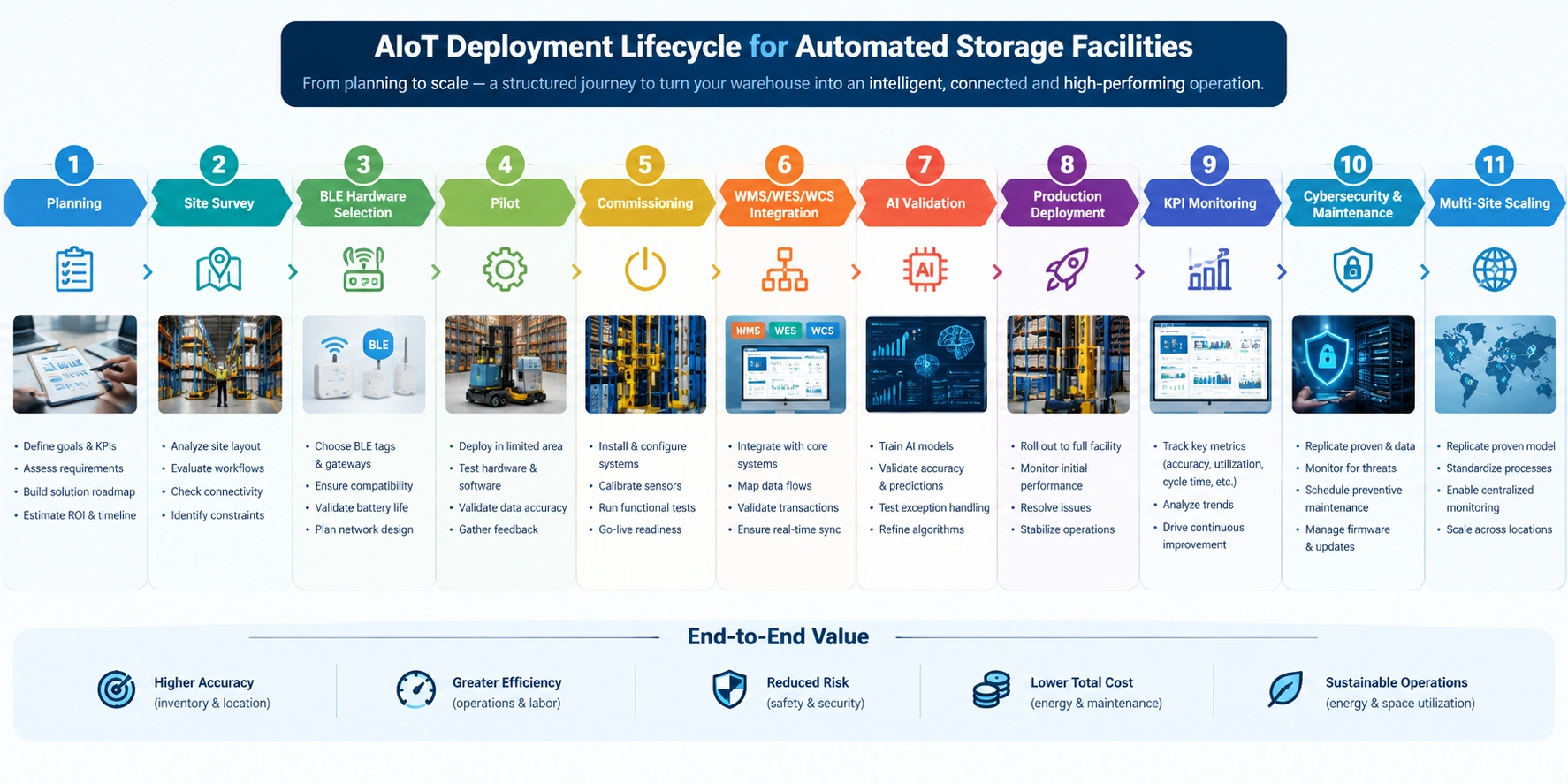
This lifecycle graphic illustrates the end-to-end implementation journey for AIoT-enabled automated storage, from planning and site surveys through BLE hardware selection, piloting, system integration, AI validation, production deployment, KPI monitoring, cybersecurity, and multi-site scaling. It highlights how a structured deployment approach supports accuracy, efficiency, risk reduction, cost optimization, and sustainable warehouse operations.
Alt Text
AIoT lifecycle graphic showing planning, BLE selection, pilot, integration, AI validation, monitoring and scaling.
Key Takeaways for AI-Enabled Automated Storage Facilities
AI can improve automated storage operations when it is connected to reliable physical-world data and existing fulfillment systems. BLE provides a practical method for collecting asset-location and sensor information, while AI can interpret that information alongside WMS, WES, WCS, equipment, and order data.
The strongest implementations focus on measurable operational problems such as inventory discrepancies, asset search time, equipment downtime, congestion, and fulfillment cycle time. Site surveys, pilot deployments, cybersecurity controls, data-quality validation, and lifecycle maintenance are essential to achieving reliable results.
GAO’s BLE, RFID, and IoT hardware products and systems can form part of this connected infrastructure, supporting organizations as they evaluate and deploy AI-enabled solutions for automated storage and distribution operations.
Building the Future of Industrial AI and IoT with Aperture Venture Studio and GAO RFID Inc.
For more than three decades, GAO Group of Companies has invested heavily in industrial BLE, RFID, and IoT R&D. As AI became increasingly useful in industrial applications, we expanded our work across AIoT, connected sensing, and intelligent operational systems. We founded Aperture Venture Studio to advance AI and IoT solutions relevant to industries such as distribution and fulfillment, including automated storage facilities. Aperture brings together AI and IoT technical experts, executives, investors, and leading companies. We also develop the Aperture Ventures Summit and TekSummit to encourage discussion around advanced AI and IoT technologies. We welcome advisors, co-founders or employees, investors, and customers to participate in these efforts.