
AI and BLE for Fashion Retail
AI and BLE for Fashion Retail: Smarter Inventory, Stores, and Customer Operations
AI and BLE for Fashion Retail combines artificial intelligence with BLE gateways, beacons, sensors, and connected retail systems to improve how fashion retailers track merchandise, manage stores, monitor assets, and analyze customer and operational activity. BLE provides short-range wireless identification and location data, while AI converts that operational data into predictions, classifications, anomaly detection, and optimization recommendations. Fashion retailers can apply these capabilities to inventory accuracy, fitting-room operations, product movement, staff workflows, loss prevention, store analytics, and distribution processes. A practical deployment connects BLE data with edge processing, retail software, inventory systems, POS, workforce applications, and analytics tools. GAO provides BLE, RFID, and other IoT hardware products and systems that can support data collection and identification requirements for fashion retail environments. The resulting AIoT solution helps retailers move from periodic manual observations toward continuously informed operational decisions.
AI and BLE for Fashion Retail: Connected Operations and Analytics
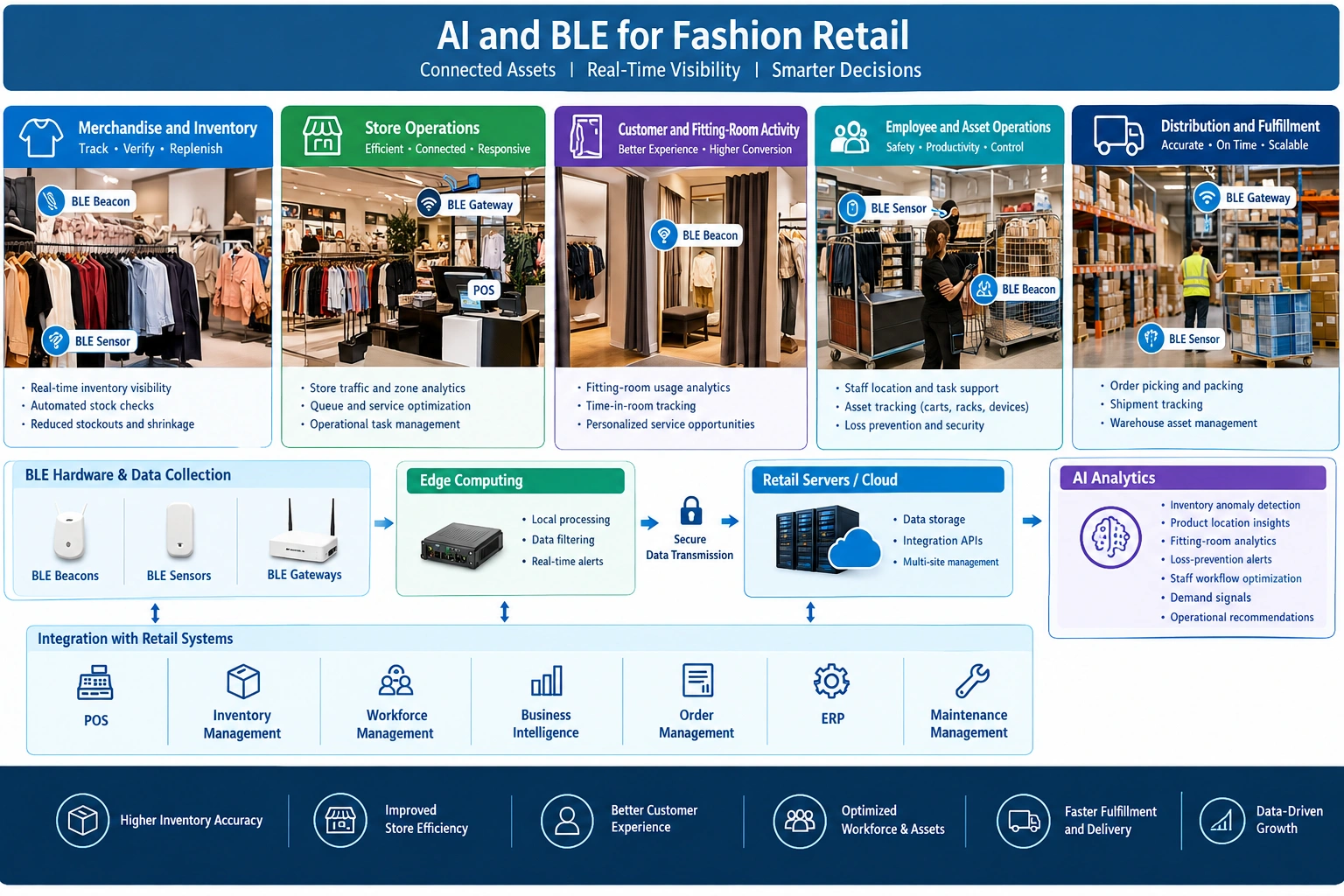
This executive infographic shows how BLE beacons, sensors, and gateways connect fashion retail merchandise, store operations, fitting rooms, employee assets, and distribution workflows. It illustrates the flow through edge computing, secure data transmission, retail servers or cloud software, enterprise systems, and AI analytics, with outputs such as inventory anomaly detection, product-location insights, operational alerts, and workflow optimization.
How AI and BLE Work Together in Fashion Retail
BLE is most useful to fashion retailers when its location, identification, proximity, and environmental data can be associated with a specific business process. A BLE beacon can advertise an identifier from a fixed location, while BLE sensors can report conditions or movement-related information. BLE gateways collect nearby transmissions and forward relevant information to retail software or local computing resources.
AI adds the analytical layer required to interpret this continuous stream of retail data. Machine learning models can identify unusual product movement, estimate operational patterns, detect deviations from expected store activity, and prioritize events for employees. Computer vision can complement BLE when visual information is required, while predictive analytics can combine BLE observations with sales, inventory, staffing, and fulfillment records.
The practical relationship is therefore:
- BLE devices generate identification, proximity, location, or sensor observations.
- BLE gateways collect wireless transmissions from merchandise-related devices, store areas, equipment, or personnel assets where appropriate.
- Edge computing can filter, aggregate, normalize, and analyze data close to the store or stockroom.
- Retail servers or cloud software provide broader storage, integration, analytics, and multi-store reporting.
- AI models identify patterns, anomalies, predictions, and optimization opportunities.
- Retail applications convert analytical results into alerts, tasks, reports, inventory actions, or operational recommendations.
GAO’s BLE hardware can serve as a data acquisition component within these workflows, with final system design determined by store layout, radio conditions, merchandise requirements, software integration, privacy policies, and operational objectives.
Fashion Retail Applications for AI and BLE
AI Inventory Management and Merchandise Visibility
Fashion inventory is difficult to manage when garments move between receiving areas, stockrooms, sales floors, fitting rooms, returns areas, and shipment staging locations. Manual counting and barcode scans can provide valuable control points, but they do not necessarily provide continuous visibility between those events.
BLE can add proximity and location observations to the inventory process. AI can then correlate those observations with inventory records, sales transactions, replenishment activity, and expected product movement.
Potential applications include:
- Detecting unusual merchandise movement within a store.
- Identifying products that remain in stockroom areas longer than expected.
- Supporting replenishment decisions based on product location and sales activity.
- Improving visibility of high-value merchandise or selected product categories.
- Detecting discrepancies between expected and observed merchandise locations.
- Supporting cycle-count prioritization by identifying inventory records that require investigation.
- Providing location context for returns, transfers, and fulfillment activities.
The engineering objective should not simply be to locate every item continuously. A more useful design defines which merchandise, store zones, and business events require location intelligence and selects BLE deployment density accordingly.
AI-Powered Store Operations and Fitting-Room Insights
Fitting rooms generate operational signals that can be valuable for fashion retailers. Garments can enter fitting rooms, remain there after customers leave, or require staff intervention for recovery and replenishment. BLE-based proximity information can help identify movement between defined store zones when appropriate.
AI can analyze these observations alongside sales transactions and staffing information to identify recurring operational patterns. For example, the system can highlight periods when fitting-room recovery activity is consistently high or identify store zones associated with unusual merchandise movement.
Applications may include:
- Fitting-room merchandise recovery monitoring.
- Store-zone activity analysis.
- Staff task prioritization.
- Product replenishment recommendations.
- Queue and service-demand analysis when combined with appropriate operational data.
- Identification of unusual movement patterns for review.
- Analysis of merchandise dwell time across defined store zones.
Privacy and data minimization should be considered during system design. BLE-based retail analytics should focus on legitimate operational requirements and avoid collecting unnecessary personally identifiable information.
AI Asset Tracking for Fashion Retail Operations
Fashion retailers operate more than merchandise. Stores and distribution facilities also use carts, rolling racks, handheld equipment, fixtures, reusable containers, maintenance equipment, and other operational assets. Locating these assets manually can consume staff time and can reduce operational efficiency when equipment is misplaced between departments or facilities.
BLE beacons or BLE sensors can provide identification and proximity information for selected assets. AI can analyze utilization patterns, movement frequency, dwell time, and abnormal location changes.
Useful applications include:
- Tracking reusable store equipment.
- Monitoring movement of rolling racks and carts.
- Identifying underutilized or frequently misplaced assets.
- Supporting maintenance scheduling for connected equipment.
- Monitoring asset transfers between defined retail locations.
- Generating alerts when selected assets remain outside approved zones.
- Supporting inventory and facilities teams with asset-location information.
GAO can supply BLE beacons, gateways, sensors, and related IoT hardware that can be considered when developing asset-monitoring solutions for retail environments.
AI and BLE Asset and Inventory Monitoring in Fashion Retail
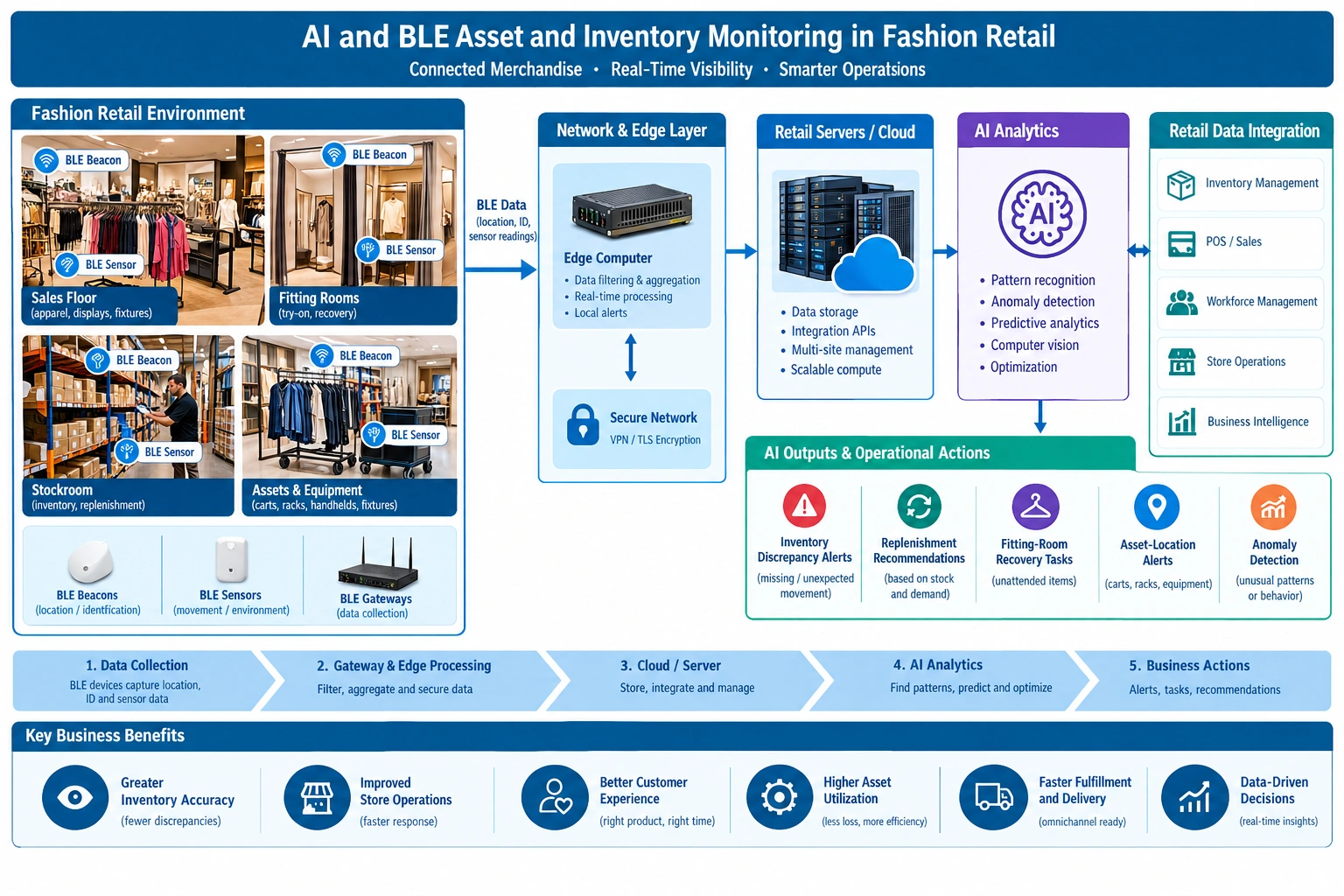
This technical infographic illustrates how BLE beacons, sensors, and gateways connect fashion retail environments with edge computing, secure networking, cloud or server infrastructure, AI analytics, and retail business systems. It highlights AI-driven outputs including inventory discrepancy alerts, replenishment recommendations, fitting-room recovery tasks, asset-location alerts, anomaly detection, staff workflow optimization, and demand signals.
AI-Driven Fashion Retail Workflows From Data Capture to Business Action
A successful AI and BLE deployment should be designed around a defined retail workflow rather than around wireless hardware alone. The complete process normally connects physical retail activity with data collection, communication, analytics, enterprise software, and employee action.
Merchandise and Asset Data Capture
BLE beacons and sensors provide the initial observations. Depending on the use case, a device may provide an identifier, proximity information, sensor measurement, or other operational signal. Device placement is important because shelving, metal fixtures, dense merchandise, walls, people, and other radio-frequency conditions can influence BLE performance.
Store and distribution environments should therefore be surveyed before finalizing gateway locations. The survey should consider stockroom density, sales-floor configuration, fitting-room construction, receiving docks, elevators, back-of-house areas, and expected merchandise movement.
BLE Gateway Collection and Local Processing
BLE gateways receive transmissions from nearby devices and forward data to an appropriate processing location. Edge processing can reduce unnecessary traffic by filtering duplicate observations, applying thresholds, normalizing device identifiers, and buffering data during connectivity interruptions.
Local processing is particularly useful for retail locations that require rapid operational alerts or have variable WAN connectivity. Gateway and edge equipment should also be managed through controlled configuration, secure credentials, software updates, and network segmentation.
Data Integration With Retail Software
BLE observations become more valuable when correlated with business records. Relevant systems can include:
- POS systems.
- Inventory management software.
- Warehouse management systems.
- Order management systems.
- Workforce management software.
- Retail ERP systems.
- Store operations applications.
- Loss-prevention software.
- Business intelligence and reporting systems.
- Maintenance management software.
Middleware or APIs can normalize device data and map BLE identifiers to merchandise categories, asset records, store zones, or operational events. Data models should distinguish between raw observations and business events so that AI models are trained on meaningful operational records rather than unprocessed radio transmissions.
AI Analytics and Retail Decisions
AI models can consume BLE-derived data alongside sales, inventory, staffing, and fulfillment information. Anomaly detection can identify activity outside established patterns. Predictive models can estimate future operational conditions. Classification models can categorize events, while optimization algorithms can help prioritize replenishment or employee tasks.
The final step is operational action. A useful AI system should connect predictions to defined responsibilities, such as notifying a store associate, creating an investigation task, prioritizing a cycle count, recommending replenishment, or escalating an exception to an inventory manager.
Fashion Retail AI and BLE Data-to-Action Workflow
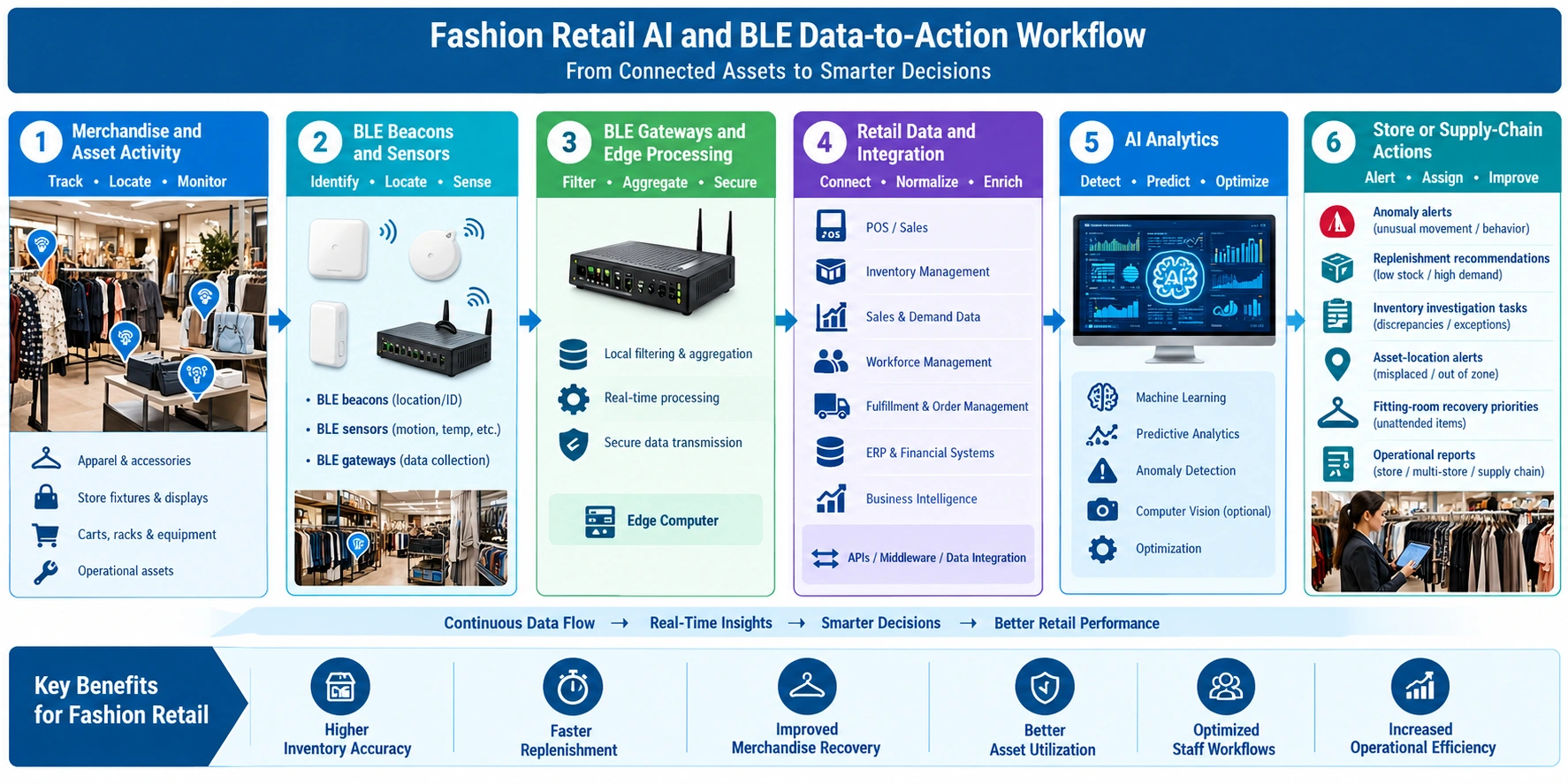
This visual illustrates how BLE beacons and sensors capture merchandise and asset activity, with edge gateways processing data before integration with retail systems and AI analytics. The workflow shows how real-time insights drive store and supply-chain actions, improving inventory accuracy, replenishment, asset utilization, staff workflows, and operational efficiency.
BLE Hardware and Supporting Systems for Fashion Retail AI
BLE deployment requirements differ between a sales floor, stockroom, fitting-room area, distribution center, and corporate retail operation. Device selection should therefore follow the operational requirement rather than treating BLE as a single standardized component.
BLE Beacons
BLE beacons can provide fixed identifiers associated with store zones, shelves, departments, fixtures, entrances, stockrooms, or other defined locations. Their value comes from establishing consistent reference points for proximity and location analytics.
BLE Sensors
BLE sensors can capture selected environmental or operational measurements where those measurements contribute to a fashion retail use case. Temperature, humidity, motion, contact, occupancy-related signals, or equipment condition may be relevant depending on the application.
BLE Gateways
BLE gateways collect transmissions from multiple BLE devices and provide connectivity to edge computers, servers, or cloud-hosted software. Gateway selection should account for coverage, device density, network interfaces, processing requirements, security controls, and installation constraints.
Edge Computing
Edge computing can perform local filtering, event detection, buffering, and preliminary analytics. This approach can reduce latency for store-level workflows and allow selected functions to continue during temporary WAN interruptions.
AI and Retail Analytics Software
AI software transforms connected observations into operational intelligence. Useful methods include anomaly detection, classification, clustering, forecasting, predictive analytics, optimization, and computer vision when visual evidence is required.
GAO supports organizations with BLE, RFID, and other IoT hardware products and systems that can form part of broader retail data-collection and monitoring solutions. The appropriate configuration depends on the retailer’s store format, merchandise characteristics, operating model, integration requirements, and security controls.
Cloud and Server Deployment for Fashion Retail BLE Systems
Fashion retailers with many stores often need centralized visibility across locations, while individual stores may also require local processing for operational resilience. Cloud-hosted software can simplify centralized data aggregation, multi-store reporting, remote analytics, and model management. A privately hosted server deployment can provide greater control over data storage and integration, particularly where corporate IT policies require customer-managed infrastructure.
A hybrid approach can combine local edge processing with centralized retail analytics. Store-level gateways can process time-sensitive BLE events locally while sending normalized operational data to centralized servers or cloud software for cross-store analysis.
Deployment selection should consider:
- Store network reliability and WAN availability.
- Data retention requirements.
- Corporate cybersecurity policies.
- Integration with POS and inventory systems.
- Required response time for store alerts.
- Number of stores and geographic distribution.
- Centralized AI model management requirements.
- Local resilience during network outages.
- IT ownership and support responsibilities.
- Data governance and privacy requirements.
Fashion Retail BLE Deployment Models: Cloud, Server, Edge, and Hybrid Comparison
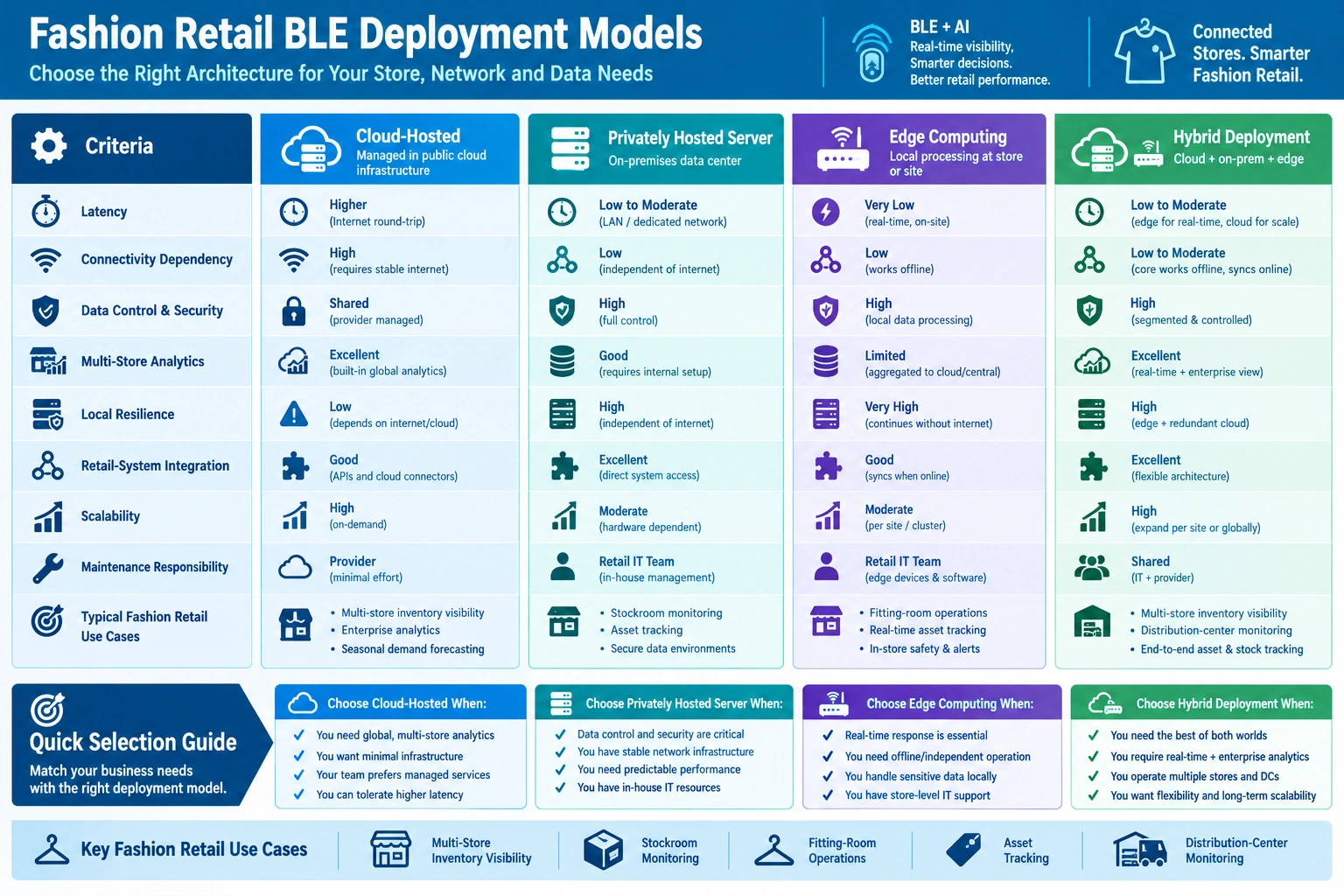
This infographic compares Cloud-Hosted, Privately Hosted Server, Edge Computing, and Hybrid BLE deployment models across latency, connectivity, data control, analytics, resilience, integration, scalability, and maintenance. A quick-selection guide helps fashion retail IT and operations teams choose the architecture best suited to their operational and data requirements.
Retail System Integration for AI and BLE
BLE data becomes operationally useful when it is connected to the systems that already manage fashion retail processes. A BLE deployment should therefore be designed around the retailer’s existing application landscape rather than operating as an isolated monitoring system.
Common integration points include:
- POS systems: Correlate merchandise activity with sales transactions and store events.
- Inventory management systems: Compare observed merchandise activity with expected stock records.
- Warehouse management systems: Associate BLE observations with receiving, put-away, picking, staging, and shipping workflows.
- Order management systems: Provide location context for store fulfillment and omnichannel orders.
- ERP systems: Connect inventory, purchasing, financial, and operational records.
- Workforce management systems: Help associate operational events with staffing levels and task assignments.
- Maintenance management systems: Link equipment condition observations with maintenance work orders.
- Business intelligence software: Combine BLE events with sales, inventory, and store performance data.
APIs, message brokers, middleware, and standardized data models can transfer information between BLE gateways and enterprise applications. Data normalization is particularly important when a retailer operates different store formats or uses equipment from multiple suppliers.
GAO’s BLE and IoT hardware can be incorporated into these connected workflows as data collection and identification components, while application integration should follow the retailer’s existing IT governance, security, and data-management practices.
AI Models for Fashion Retail Operations
AI should address a measurable retail problem rather than simply process a large volume of BLE observations. Model selection depends on the decision that the retailer wants to improve.
Anomaly Detection
Anomaly detection can identify merchandise or asset activity that differs substantially from normal patterns. Examples include unusual movement between store zones, unexpected asset relocation, abnormal dwell time, or inventory activity inconsistent with historical operating patterns.
The model should be trained against representative store conditions because normal behavior can vary significantly between flagship stores, outlet locations, department-store environments, and smaller retail formats.
Predictive Analytics
Predictive models can combine BLE-derived activity with historical sales, inventory, staffing, and fulfillment information. Potential outputs include anticipated replenishment requirements, expected operational workload, and identification of locations likely to experience inventory-management exceptions.
Optimization
Optimization methods can help prioritize store associate tasks when several operational events occur simultaneously. A retailer could combine product location, sales velocity, inventory status, staffing, and task urgency to determine which replenishment or recovery activity should receive attention first.
Computer Vision With BLE
Computer vision can complement BLE when location or proximity information alone cannot explain an event. Cameras may provide visual confirmation of merchandise movement, fitting-room conditions, shelf activity, or selected operational events, while BLE supplies identification or proximity context.
These technologies should not automatically be combined everywhere. Camera deployment introduces additional privacy, storage, cybersecurity, and governance considerations. The lowest-complexity sensing method that can reliably support the business requirement is generally preferable.
Engineering Considerations for Fashion Retail BLE Deployment
Retail environments create several practical challenges that can affect BLE performance. Metal shelving, display fixtures, dense apparel inventory, glass, walls, elevators, human traffic, and changing store layouts can influence radio propagation and received-signal behavior.
Key engineering considerations include:
- Gateway placement: Position gateways to provide appropriate coverage for the intended store zones rather than relying solely on theoretical radio range.
- Device density: Determine beacon and sensor density from the required location resolution and business process.
- Battery management: Establish replacement intervals, battery monitoring, and maintenance procedures for battery-powered devices.
- Identifier management: Maintain accurate mappings between BLE identifiers, merchandise categories, assets, store zones, and system records.
- RF interference: Assess competing wireless systems and physical conditions before deployment.
- Data quality: Filter duplicate, stale, missing, or inconsistent observations before feeding data into AI models.
- Store changes: Revalidate coverage after major fixture, shelving, stockroom, or floor-plan changes.
- Network resilience: Define local buffering and recovery behavior for WAN or gateway connectivity interruptions.
- Cybersecurity: Protect gateway credentials, communication channels, device configurations, APIs, and management interfaces.
- Privacy: Apply data minimization and access controls when BLE analytics can be associated with employees or customers.
The appropriate BLE configuration should therefore be validated through a representative pilot before large-scale rollout.
Fashion Retail AI and BLE System Integration Architecture
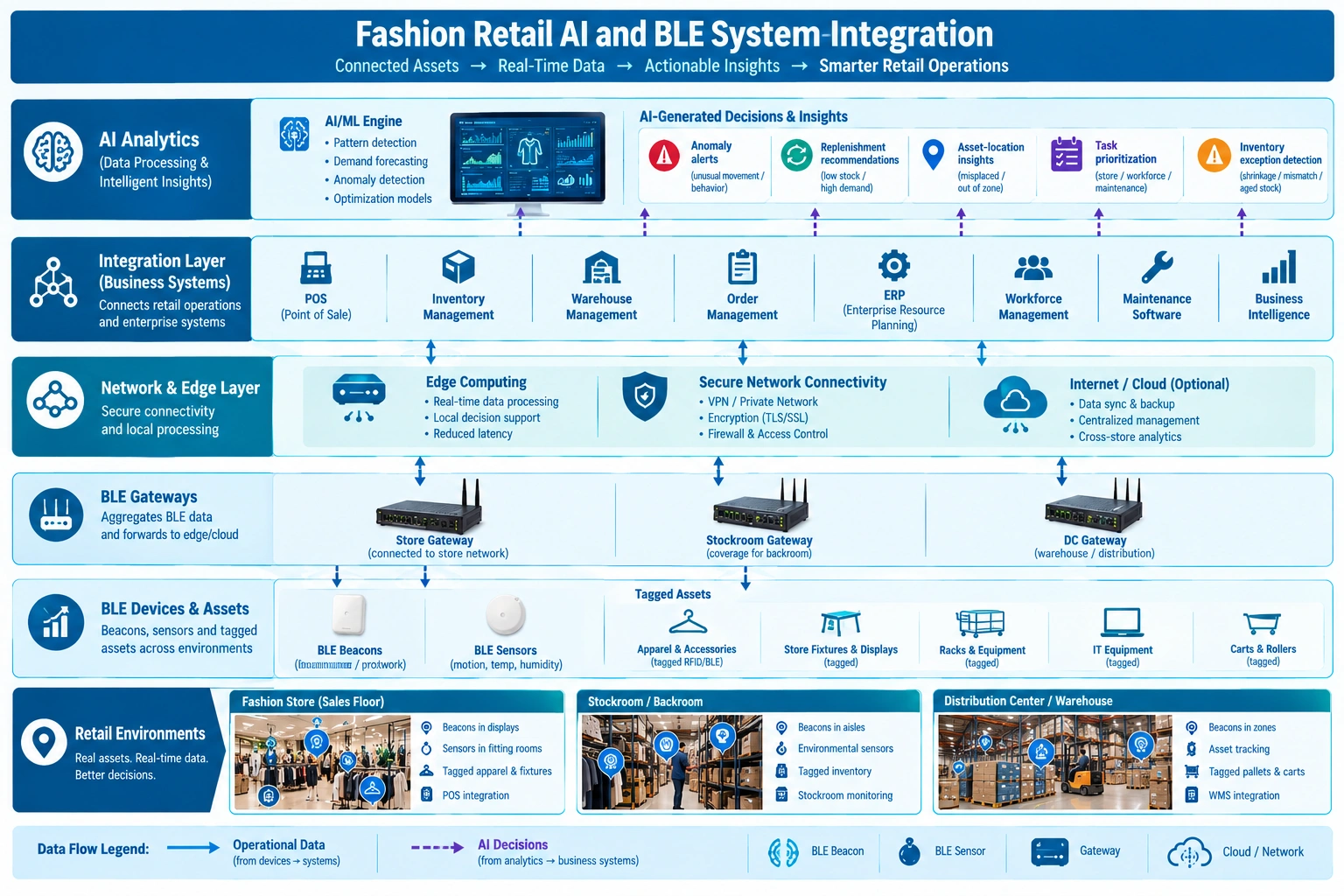
This enterprise integration diagram illustrates how BLE beacons, sensors, tagged assets, and gateways across stores, stockrooms, and distribution centers connect through edge computing and secure networks to core retail business systems. AI analytics transforms operational data into actionable outputs such as anomaly alerts, replenishment recommendations, asset-location insights, task prioritization, and inventory exception detection.
Fashion Retail KPIs for AI and BLE Deployments
A successful deployment should be measured through retail KPIs rather than device counts. The KPI framework should connect BLE observations and AI outputs to measurable inventory, store, fulfillment, and asset-management outcomes.
Relevant metrics can include:
- Inventory accuracy
- Stockout rate
- Inventory discrepancy rate
- Inventory dwell time
- Replenishment response time
- Shelf or sales-floor availability
- Stockroom-to-floor replenishment time
- Cycle-count productivity
- Merchandise recovery time
- Fitting-room recovery workload
- Asset utilization
- Asset search time
- Asset loss or misplacement incidents
- Store task completion time
- Order fulfillment cycle time
- Pick accuracy
- Order cancellation rate
- Return processing time
- Store transfer accuracy
- On-time store replenishment
- Exception detection rate
- AI anomaly detection precision
- AI anomaly detection recall
- Alert response time
- False-alert rate
- BLE gateway availability
- BLE device battery health
- Data ingestion completeness
- System availability
- Mean time to resolve operational alerts
AI model KPIs should be evaluated separately from business KPIs. High model accuracy does not automatically produce better retail performance if alerts are poorly prioritized or if store employees cannot act on them.
AI and BLE for Fashion Retail KPI Dashboard: Inventory, Operations, Assets, and System Performance
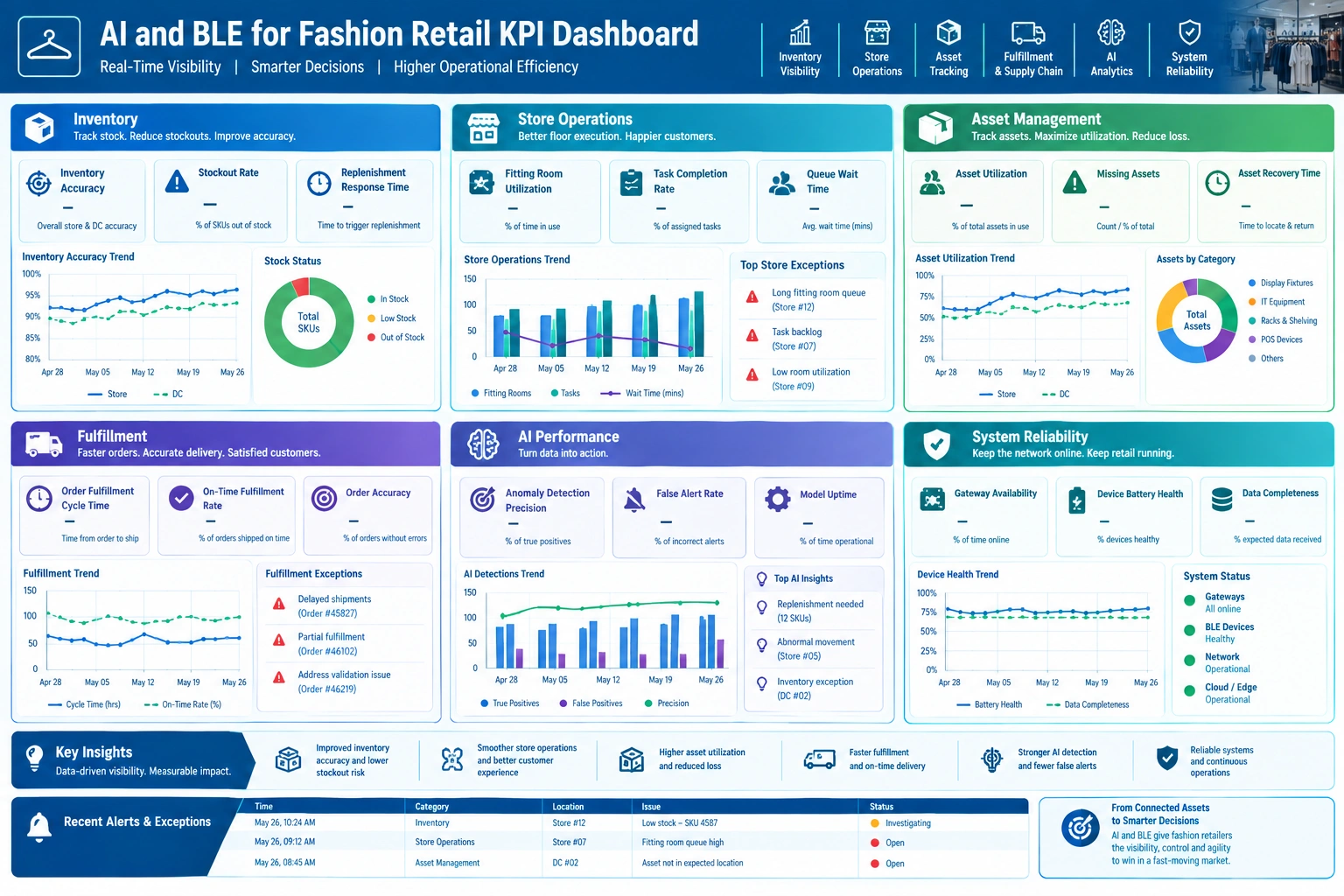
This executive KPI dashboard shows how AI and BLE performance can be monitored across inventory, store operations, asset management, fulfillment, AI analytics, and system reliability. It combines KPI cards, trends, status indicators, exception lists, and operational insights without presenting unsupported benchmark improvements.
Security and Privacy for Fashion Retail BLE Systems
Security should cover the entire data path from BLE devices through gateways, edge computing, networks, APIs, retail software, and analytics systems.
Device identities and gateway credentials should be managed through controlled provisioning processes. Communication between gateways, edge systems, servers, and cloud services should use appropriate encryption and authenticated connections. Network segmentation can separate IoT devices from sensitive POS and corporate systems.
Access controls should follow defined operational responsibilities. Store associates may require access to task alerts, while inventory managers, loss-prevention teams, IT administrators, and data scientists may require different levels of information.
Privacy requires additional attention when BLE data can be associated with individuals. Retailers should establish clear purposes for collection, minimize unnecessary personal information, define retention periods, and control access to analytics that could expose employee or customer behavior.
GAO’s long-standing investment in product and system R&D, quality assurance, and technical support provides a relevant foundation when evaluating IoT hardware for deployments where reliability and controlled operation are important.
Planning and Commissioning an AI and BLE Fashion Retail Deployment
A controlled implementation process reduces the risk of deploying hardware before the business process and data requirements are understood.
Define the Retail Problem
Start with a measurable problem such as inventory discrepancy, slow replenishment, asset misplacement, fitting-room recovery workload, or store fulfillment inefficiency. Define the required business action and KPI before selecting BLE equipment.
Survey the Store Environment
Document floor plans, stockrooms, fitting rooms, receiving areas, fixtures, shelving, network connectivity, power availability, wireless conditions, and expected movement paths.
Select the BLE Equipment
Select beacons, sensors, gateways, mounting methods, batteries, and accessories according to coverage, operating conditions, maintenance requirements, and required location resolution.
Conduct a Pilot
A pilot should represent actual merchandise density and normal store operations. Test detection consistency, gateway coverage, data latency, battery behavior, network resilience, and integration with retail software.
Validate AI Outputs
AI models should be evaluated using representative operational data. Store teams should confirm whether alerts are understandable, actionable, and appropriately prioritized.
Commission the Production System
Commissioning should include device inventory, identifier mapping, gateway configuration, cybersecurity controls, integration testing, alert testing, documentation, user training, and acceptance criteria.
Scaling AI and BLE Across Fashion Retail Locations
Multi-store deployments introduce challenges that do not appear in a single-store pilot. Store layouts differ, network environments vary, merchandise volumes change, and operational practices may not be identical.
A scalable system should standardize device naming, gateway configuration, data schemas, API interfaces, security policies, and monitoring procedures while allowing store-specific parameters where necessary.
Centralized software can compare store-level metrics and identify locations requiring investigation. Local edge processing can continue essential functions even when a store temporarily loses external connectivity.
Retail organizations should also maintain a controlled device lifecycle covering:
- Device provisioning
- Installation records
- Firmware and configuration management
- Battery replacement
- Gateway health monitoring
- Fault investigation
- Device reassignment
- Decommissioning
- Secure disposal
GAO can support organizations evaluating BLE and related IoT hardware requirements across different operational environments, with technical support available remotely or onsite as appropriate.
Practical Benefits of AI-Enabled Fashion Retail Operations
Combining AI with BLE can provide value when connected data is translated into decisions that store and supply-chain teams can act upon.
More Actionable Inventory Visibility
BLE observations can add location and movement context to conventional inventory records. AI can prioritize discrepancies and identify patterns requiring investigation.
Faster Operational Response
Real-time or near-real-time event detection can help employees respond to defined store conditions without waiting for a periodic manual audit.
Better Asset Utilization
Location and movement information can reveal how operational assets are used, where they accumulate, and where additional equipment may be required.
Improved Omnichannel Execution
Location-aware merchandise information can support store fulfillment, transfers, replenishment, and other processes associated with omnichannel retail.
More Consistent Multi-Store Analysis
Centralized analytics can compare operational patterns across stores while retaining local processing where immediate response or connectivity resilience is required.
Reduced Manual Investigation
AI can prioritize exceptions so employees spend less time searching through large quantities of raw operational data and more time addressing events requiring human judgment.
AI-Enabled Fashion Retail Operations: Manual Monitoring vs. BLE and AI-Assisted Decisions
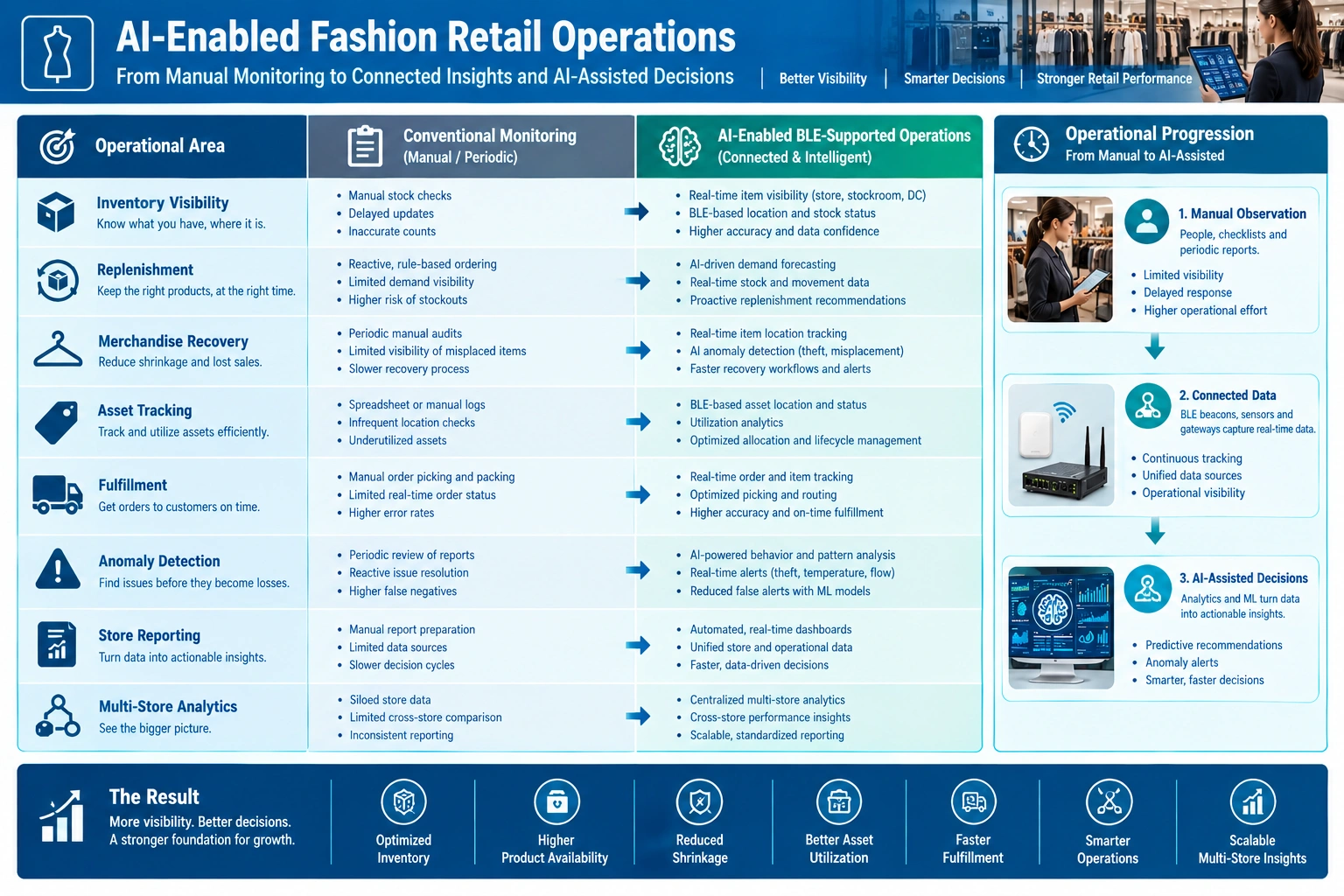
This comparison infographic shows how fashion retail operations evolve from manual, periodic monitoring to connected BLE data and AI-assisted decision-making. It compares inventory, replenishment, merchandise recovery, asset tracking, fulfillment, anomaly detection, reporting, and multi-store analytics while avoiding unsupported performance claims.
Standards, Compliance, and Operational Governance
Fashion retailers should align BLE deployments with applicable wireless, cybersecurity, privacy, data-management, and workplace requirements in each operating jurisdiction.
Relevant technical and governance areas can include:
- Bluetooth specifications and device interoperability requirements.
- Applicable radio-frequency regulations in operating countries.
- Corporate cybersecurity policies.
- Network security and access-control requirements.
- Data protection and privacy requirements.
- Retail payment-system security requirements where systems interact with POS environments.
- Internal data-retention and data-classification policies.
- Supplier cybersecurity requirements.
- Software vulnerability and patch-management procedures.
Compliance should be evaluated according to the actual deployment, geography, data collected, applications integrated, and organizational policies. A BLE inventory-monitoring deployment does not automatically have the same compliance profile as a system that processes customer-linked behavioral information.
AI and BLE Fashion Retail Implementation Recommendations
Several practical principles can improve deployment quality:
- Begin with a clearly measurable fashion retail workflow rather than a technology-first project.
- Select merchandise and assets for tracking based on business value and operational need.
- Validate BLE performance in the actual store environment before finalizing gateway density.
- Keep raw device data separate from normalized business events.
- Integrate BLE information with inventory, POS, fulfillment, and workforce records where appropriate.
- Use edge processing when local response, buffering, or connectivity resilience is required.
- Establish AI model validation procedures before allowing automated operational actions.
- Measure model performance and business outcomes independently.
- Design alert workflows around employee responsibilities.
- Build device lifecycle management into the operating model from the beginning.
- Apply privacy-by-design principles when BLE data can relate to individuals.
- Use network segmentation, authenticated communication, access control, and controlled device management.
- Revalidate deployments after major store-layout changes.
- Standardize configurations across stores while preserving necessary local parameters.
- Use GAO’s BLE and IoT hardware capabilities as potential components within a broader retail solution rather than treating hardware selection as the complete project.
GAO Support for AI and BLE Fashion Retail Solutions
GAO has supplied BLE, RFID, and other IoT hardware products and systems for organizations requiring connected identification, sensing, and monitoring capabilities. Its product scope can support use cases involving BLE gateways, beacons, sensors, and related data-collection requirements.
GAO RFID Inc., GAO Research Inc., and GAO Tek Inc. form GAO Group, with operations based in New York City and Toronto, Canada. The group has served U.S. and Canadian customers for three decades, including Fortune 500 companies, R&D organizations, universities, and government agencies. Its engineering approach emphasizes R&D, quality assurance, and technical support.
For fashion retailers, the practical role of GAO is to provide relevant hardware and technical support that can be evaluated within the retailer’s existing inventory, store-operation, asset-management, and analytics requirements.
Business Case for AI and BLE in Fashion Retail
The business case should connect investment to operational problems and measurable KPIs.
| Business Area | AI and BLE Contribution | Potential KPI |
|---|---|---|
| Inventory | Location and anomaly intelligence | Inventory accuracy |
| Replenishment | Product movement and prioritization | Replenishment response time |
| Store Operations | Event-driven task prioritization | Task completion time |
| Fitting Rooms | Merchandise recovery insights | Recovery time |
| Asset Management | Asset-location visibility | Asset utilization |
| Fulfillment | Location context for store orders | Pick accuracy |
| Loss Prevention | Detection of unusual movement patterns | Exception investigation rate |
| Analytics | Cross-store operational intelligence | Reporting cycle time |
| Infrastructure | Gateway and device monitoring | System availability |
The strongest business cases usually begin with a narrow operational problem where data can directly influence a decision. Expansion can follow after the pilot demonstrates technical reliability, employee acceptance, integration quality, and measurable KPI relevance.
Future Direction of AI and BLE for Fashion Retail
Fashion retail is moving toward increasingly connected operations in which inventory, store activity, fulfillment, assets, and operational systems can contribute data to common analytical workflows. AI will increasingly combine multiple data sources rather than treating BLE observations as an isolated signal.
Future deployments may emphasize:
- More context-aware inventory intelligence.
- AI-assisted store task prioritization.
- Predictive replenishment.
- Automated anomaly triage.
- Improved omnichannel inventory decisions.
- Greater use of edge AI for local retail events.
- Multimodal analytics combining BLE, RFID, POS, environmental sensors, and computer vision.
- More granular asset utilization analytics.
- AI-assisted workforce and store-operation planning.
These developments should remain grounded in measurable business requirements, reliable data, appropriate security controls, and responsible handling of customer and employee information.
Future-State AI and BLE for Fashion Retail: Connected Stores, Intelligent Operations, and Smarter Decisions
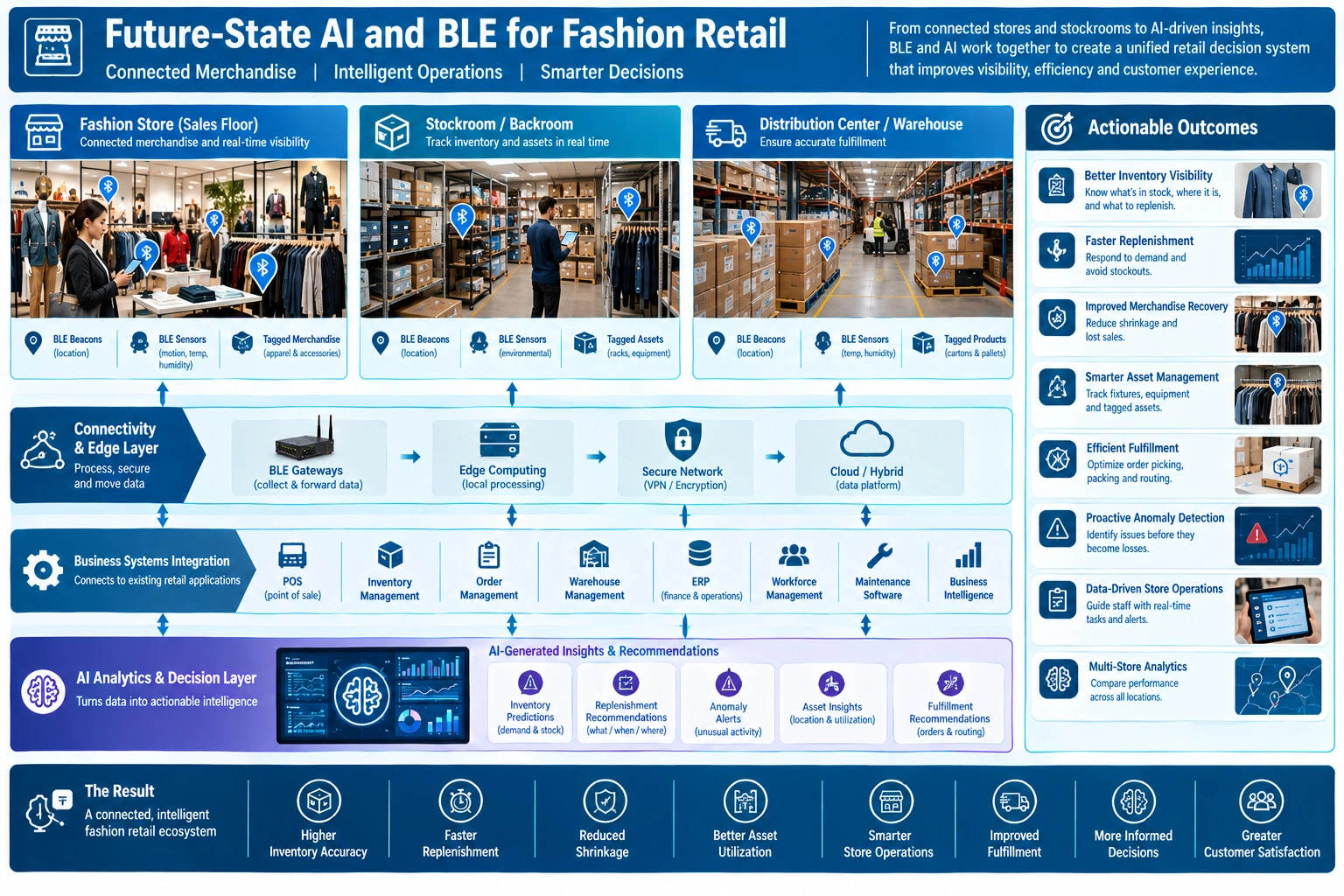
This technical illustration shows a future-state fashion retail ecosystem connecting stores, stockrooms, distribution centers, BLE infrastructure, edge computing, business systems, and AI analytics. It demonstrates how connected operational data can generate inventory predictions, replenishment recommendations, anomaly alerts, asset insights, fulfillment recommendations, and prioritized store actions.
Key Takeaways for Fashion Retail Decision-Makers
AI and BLE can provide fashion retailers with a practical mechanism for connecting merchandise, store assets, operational events, and business systems. The greatest value comes from combining BLE-derived observations with inventory, POS, fulfillment, workforce, and operational data and then applying AI to identify exceptions, predict conditions, and prioritize actions.
A successful deployment should begin with a defined retail workflow, measurable KPIs, representative pilot testing, reliable BLE coverage, secure integration, and clear employee responsibilities. Cloud, private-server, edge, and hybrid deployment models can each be appropriate depending on connectivity, data control, response-time, scalability, and IT requirements.
GAO’s BLE and IoT hardware products and systems can be evaluated as components of these fashion retail solutions, supported by the group’s long-standing R&D, quality-assurance, and technical-support capabilities.
Building the Future of Industrial AI and IoT with Aperture Venture Studio and GAO RFID Inc.
For more than three decades, GAO Group of Companies has invested heavily in R&D of industrial BLE, RFID, and IoT. As generative AI has become useful for industrial and retail applications, we have continued developing AI and IoT technologies and founded Aperture Venture Studio to build, launch, and scale advanced AI and IoT solutions relevant to areas such as fashion retail.
Aperture brings together AI and IoT technical experts, operational executives, investors, and industry leaders. We also develop Aperture Ventures Summit and TekSummit to discuss advanced AI and IoT topics. We welcome you to join us as:
- Advisors, Co-founders or Employees
- Investors
- Customers