
AI-Enabled RFID for Research Institutions
AI-Enabled RFID for Research Institutions
Research institutions manage highly specialized assets, research materials, laboratory equipment, specimens, documents, instruments, and controlled-access resources across laboratories, cleanrooms, archives, libraries, storage rooms, and shared research facilities. AI-enabled RFID helps research organizations convert identification and location events into operational intelligence for asset tracking, laboratory inventory, equipment utilization, research-material management, and exception detection. UHF RFID is useful for longer-range identification of tagged equipment and supplies, while HF RFID and LF RFID address shorter-range identification requirements where proximity, controlled read zones, or specialized asset characteristics matter. AI methods can analyze RFID event streams alongside laboratory information management systems, enterprise asset management software, access-control records, environmental sensors, and other operational data. The result is a more context-aware system for locating research assets, detecting unusual movement, improving inventory accuracy, supporting equipment scheduling, and identifying operational exceptions before they disrupt research activities.
AI-Enabled RFID Deployment for Research Institution Asset and Laboratory Equipment Management
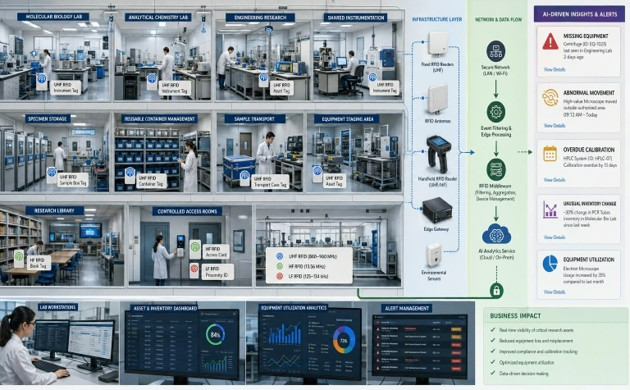
This visual illustrates how UHF, HF, and LF RFID technologies connect research laboratories, equipment, specimen storage, controlled-access areas, and staging facilities. RFID readers, edge gateways, middleware, and AI analytics work together to provide real-time asset visibility and generate alerts for missing equipment, abnormal movement, overdue calibration, inventory changes, and equipment utilization.
What AI-Enabled RFID Means for Research Institutions
AI-enabled RFID is best understood as a research-operations capability rather than simply an RFID installation. RFID provides machine-readable identification events, while AI and related IoT technologies interpret those events together with operational context.
For research institutions, the useful question is not only whether an asset was detected. The more valuable question is whether the detected movement, location, timing, and usage pattern are consistent with the research workflow.
Typical research assets include:
- Mass spectrometers, chromatographs, centrifuges, microscopes, spectrometers, incubators, freezers, and laboratory analyzers
- Calibration equipment, test fixtures, measurement instruments, engineering prototypes, and specialized tooling
- Research specimens, sample containers, reagent-associated materials, and reusable transport cases where RFID tagging is technically appropriate
- Computers, portable instruments, laboratory accessories, and shared research equipment
- Research documents, technical records, archived materials, and library resources
- Equipment awaiting calibration, maintenance, decontamination, inspection, or reassignment
AI adds value by correlating RFID events with information from laboratory information management systems (LIMS), electronic laboratory notebooks (ELN), computerized maintenance management systems (CMMS), enterprise asset management (EAM) software, inventory databases, scheduling software, access-control systems, and environmental monitoring systems.
A research institution can therefore move from periodic manual inventory toward continuous operational visibility. That distinction matters when equipment is shared among research groups, moved between laboratories, or temporarily staged in preparation for experiments.
Research Operations Where AI Delivers the Most Value
| Research Operation | RFID Role | AI-Driven Improvement | Operational Outcome |
|---|---|---|---|
| Laboratory asset tracking | Identifies tagged equipment at defined read points | Detects unusual movement and location discrepancies | Faster asset recovery and fewer misplaced instruments |
| Shared equipment management | Records equipment movement and availability | Predicts utilization and identifies scheduling conflicts | Better use of high-value instruments |
| Calibration control | Associates equipment identity with movement history | Flags assets approaching calibration or inspection deadlines | Lower risk of using unavailable equipment |
| Research material inventory | Captures tagged containers and supplies where suitable | Detects unusual consumption or inventory changes | Improved material visibility |
| Specimen logistics | Records tagged transport units and selected specimens | Identifies missing or delayed transfers | Better chain-of-custody visibility |
| Laboratory equipment maintenance | Connects equipment identity with service events | Identifies usage patterns relevant to maintenance | More informed maintenance planning |
| Research library management | Identifies tagged publications and technical resources | Detects circulation anomalies and inventory exceptions | Improved collection control |
| Controlled-area movement | Detects tagged asset transitions | Correlates movement with authorized workflows | Stronger operational control |
GAO supplies RFID, BLE, and related IoT hardware products and systems that can support these research workflows. Practical deployment still requires selecting tag types, reader locations, antenna configurations, middleware rules, and software integrations according to the physical characteristics of each laboratory and research process.
Research Asset Tracking and Laboratory Inventory
Research asset tracking presents a different engineering problem from conventional warehouse inventory. Laboratory equipment may be large, metallic, temperature-sensitive, electrically active, densely packed, or frequently moved by researchers. A single laboratory can also contain equipment from multiple research groups with different ownership, maintenance, and access requirements.
AI-enabled RFID can establish a location history for tagged assets by combining reader events with known laboratory zones and workflow states.
Useful AI functions include:
- Anomaly detection for equipment appearing in unexpected laboratories or storage zones
- Classification of normal versus unusual asset movement patterns
- Prediction of equipment demand based on historical utilization
- Identification of assets that remain unused for unusually long periods
- Detection of repeated movement between laboratories that may indicate inefficient workflows
- Correlation of equipment movement with maintenance, calibration, or reservation records
- Automated exception generation when an asset fails to appear at an expected location
The engineering objective should not be maximum RFID read coverage everywhere. Excessive reader coverage can produce redundant events, increase system complexity, and make event interpretation harder. Research institutions generally benefit from carefully defined read zones around entrances, equipment rooms, staging areas, storage locations, and other operational transition points.
From RFID Events to AI-Driven Research Decisions
A practical AI-enabled RFID workflow begins with physical identification and ends with an operational action.
Data acquisition
RFID tags identify assets, equipment, containers, or other selected research resources. Fixed readers capture events at strategically defined locations, while handheld readers support inventory surveys, laboratory audits, and exception investigation.
Communication and edge processing
Readers transmit identification events through Ethernet, Wi-Fi, serial interfaces, or other supported communications to an edge gateway or server. Edge processing can remove duplicate reads, apply filtering rules, normalize timestamps, and associate events with known zones before forwarding useful data.
RFID middleware
Middleware converts raw reader events into operational records. Typical functions include tag filtering, reader health monitoring, event deduplication, device configuration, location-zone mapping, and interfaces to higher-level software.
Enterprise software integration
Validated events can be associated with asset records in EAM or CMMS systems, laboratory records in LIMS, research documentation in ELN systems, reservation data, inventory databases, or access-control records.
AI analytics
Machine learning and statistical models evaluate historical and real-time events. Depending on the use case, the model may perform anomaly detection, classification, forecasting, clustering, utilization analysis, or risk scoring.
Operational decision
The resulting insight can trigger an inventory exception, maintenance review, equipment-location alert, laboratory workflow notification, utilization report, or investigation by facilities and research-operations personnel.
Human action and feedback
Researchers, laboratory managers, facilities teams, asset administrators, and IT personnel investigate exceptions and confirm the operational outcome. Those validated outcomes can subsequently improve rules and AI models.
AI-Enabled RFID Workflow for Research Institution Asset and Laboratory Management
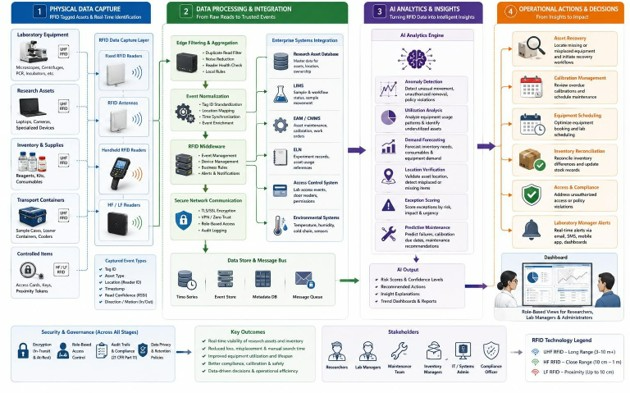
This workflow diagram illustrates how RFID events move from tagged research assets and RFID readers through edge processing, middleware, secure networks, enterprise systems, and AI analytics. It shows how AI converts identification data into insights such as anomaly detection, utilization analysis, demand forecasting, and location verification, ultimately supporting operational actions and human decision-making.
RFID Technologies for Research Institution Environments
Research institutions rarely benefit from treating every RFID requirement as identical. UHF RFID, HF RFID, and LF RFID have different operating characteristics and should be selected according to the asset, read distance, material composition, required interaction model, and environmental conditions.
UHF RFID
UHF RFID is generally useful for research asset inventories and location events where longer read distances and rapid identification of multiple tagged items are required. It can support laboratory equipment inventories, storage-area audits, equipment staging, and controlled transition zones.
Metallic instruments and dense laboratory environments require careful tag selection and antenna positioning. On-metal RFID tags may be necessary for equipment with conductive surfaces.
HF RFID
HF RFID is suitable for shorter-range identification and controlled interaction points. It can be useful where a researcher intentionally presents an item to a reader, where proximity is desirable, or where specialized high-frequency RFID applications fit the workflow.
LF RFID
LF RFID can be appropriate for specialized proximity-identification scenarios where short-range operation and particular tag-reader characteristics are more important than high-throughput inventory.
The technology decision should follow the research workflow rather than forcing one RFID frequency into every application.
Deployment Architecture for Research Data and RFID Systems
A research institution can deploy AI-enabled RFID using a combination of local processing, privately hosted servers, or cloud-hosted software. The appropriate model depends on research-data governance, cybersecurity requirements, network availability, IT policies, integration requirements, and the sensitivity of associated operational information.
Cloud Version
A cloud-hosted SaaS deployment can centralize RFID event processing, dashboards, AI analytics, device management, and reporting. This model can be useful for organizations operating multiple research facilities or institutions that want centralized visibility without maintaining all application infrastructure locally.
RFID readers and edge gateways still perform local acquisition and filtering. Only the required operational data should be forwarded to cloud services. Network segmentation, encrypted communication, identity management, role-based access, API security, and retention policies should be established before production deployment.
Cloud deployment can also simplify centralized software updates and support standardized reporting across multiple campuses or research locations.
Server Version
A Server Version places application software on customer-managed servers, private data centers, edge servers, or other privately hosted infrastructure. This approach can be appropriate when research institutions require tighter control over operational data, integration with internal systems, restricted network connectivity, or institution-specific cybersecurity controls.
Local processing can also reduce dependence on continuous external connectivity. RFID event filtering, reader management, and selected AI inference functions can remain close to the research environment while higher-level reporting is handled by internal servers.
Selecting the Deployment Model
The decision should consider more than infrastructure preference. Research institutions should evaluate:
- Whether RFID events are connected to sensitive research information
- Existing LIMS, EAM, CMMS, ELN, identity, and access-control infrastructure
- Network segmentation between laboratory systems and general IT networks
- Required response time for operational alerts
- Data retention and audit requirements
- IT staffing available for server maintenance
- Number and geographic distribution of research facilities
- Requirements for ofline or degraded-network operation
- Integration methods such as REST APIs, database interfaces, message queues, or vendor middleware
Cloud vs. Server Deployment Models for AI-Enabled RFID in Research Institutions
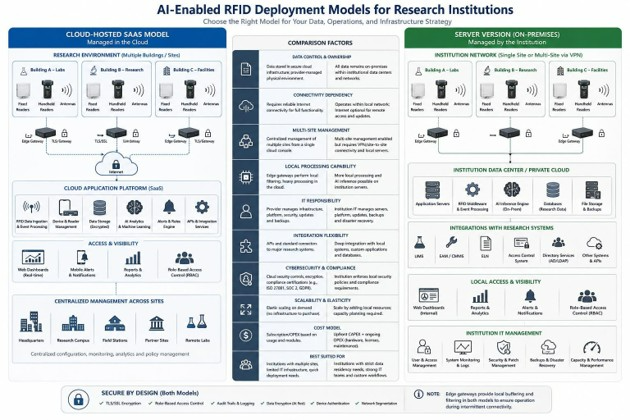
This comparison diagram presents two technically realistic deployment options for AI-enabled RFID: a cloud-hosted SaaS model and an institution-managed on-premises server model. It compares data control, connectivity, multi-site management, local processing, IT responsibility, integration flexibility, cybersecurity, scalability, and cost considerations to support informed deployment decisions.
Engineering Considerations Before RFID Commissioning
Successful research RFID deployment depends heavily on physical validation. A design that performs well in an office environment may produce inconsistent results around laboratory instruments, stainless-steel benches, liquid containers, freezers, shielded equipment, dense storage racks, and electrically noisy environments.
Site engineering should therefore evaluate:
- RFID tag performance on representative equipment and materials
- Reader and antenna placement at actual movement points
- Read-zone boundaries and unintended reads between adjacent laboratories
- Metallic surfaces, liquids, shielding, and other RF-interference conditions
- Reader power settings and regulatory constraints
- Network availability and VLAN or security-zone requirements
- Edge gateway capacity and event-processing rates
- RFID reader health monitoring and failure detection
- Integration identifiers between RFID tags and institutional asset records
- Procedures for commissioning, acceptance testing, and periodic inventory validation
Pilot testing should use representative research workflows rather than a demonstration with a small number of idealized tags. Equipment should be moved through actual laboratory doors, staging areas, storage locations, and shared-instrument workflows to validate both read performance and business rules.
GAO’s experience supplying RFID hardware products and systems to organizations in the United States and Canada supports this type of deployment-oriented approach. The broader GAO organization has served Fortune 500 companies, leading R&D firms, prestigious universities, and government agencies for decades, with substantial investment in product and system R&D, quality assurance, and remote or onsite technical support.
RFID Site-Commissioning Checklist for Research Laboratories and Institutions
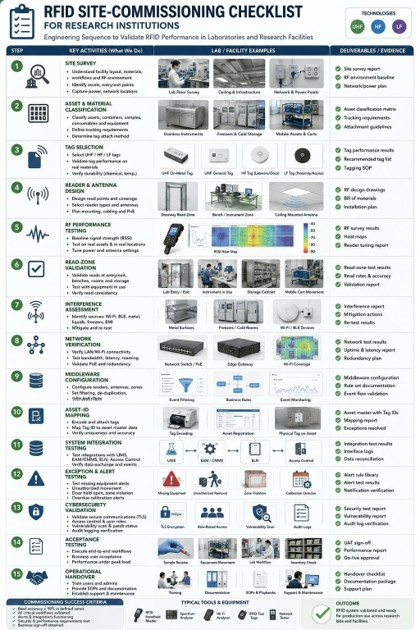
This engineering infographic presents a 15-step RFID commissioning sequence tailored to research environments, from site surveying and asset classification through RF testing, read-zone validation, network verification, system integration, cybersecurity, acceptance testing, and operational handover. It emphasizes validating RFID performance against real laboratory workflows, equipment, storage conditions, and controlled-access scenarios.
Security and Data Governance for Research RFID
RFID identification data may appear operationally simple, but research institutions should treat it as controlled operational information when it can reveal laboratory activity, equipment movements, facility usage, or research workflows.
Security controls should include network segmentation, encrypted communications, authenticated device access, least-privilege application permissions, centralized identity management, audit logging, secure API authentication, software patch management, and controlled administrative access.
AI models should also receive validated and appropriately filtered data. Poor-quality RFID events can produce false alerts, inaccurate utilization statistics, and incorrect assumptions about asset location. Data quality therefore becomes an engineering control, not simply an analytics concern.
Research institutions should define who can view asset locations, who can modify RFID mappings, who can acknowledge AI-generated exceptions, and how long event histories should be retained. These controls help separate useful operational intelligence from unnecessary exposure of research activity.
AI Capabilities for Research Institution RFID Systems
AI becomes useful when RFID event data is combined with research-operations context. A reader detecting a tagged centrifuge is only an identification event. A system that determines whether the centrifuge is expected in that laboratory, whether it has an upcoming calibration requirement, whether another research group has reserved it, and whether its recent movement pattern is unusual provides substantially more operational value. Relevant AI methods for research institutions include:
- Anomaly detection: Identifies unusual movement, unexpected laboratory locations, abnormal inventory changes, or deviations from established equipment-use patterns.
- Classification: Categorizes RFID events according to asset movement, storage, laboratory transfer, maintenance, calibration, or other workflow states.
- Time-series forecasting: Estimates equipment demand, inventory consumption, laboratory resource requirements, or expected utilization.
- Clustering: Groups research assets according to movement behavior, utilization patterns, laboratory association, or operational characteristics.
- Predictive analytics: Helps identify equipment likely to require attention based on usage history and operational records.
- Computer vision integration: Can supplement RFID identification with visual verification at selected workstations, storage areas, or controlled transition points.
- Edge AI: Supports low-latency inference close to RFID readers where rapid local decisions or reduced network dependency are important.
- Generative AI: Can summarize operational exceptions, explain trends in natural language, assist technical personnel with investigation workflows, and provide interfaces to approved operational data.
AI should not automatically replace laboratory personnel or asset administrators. For high-consequence decisions, the preferred design is often human-in-the-loop operation in which AI identifies a condition, presents supporting evidence, and allows an authorized person to confirm the action.
Research Equipment Utilization and Predictive Operations
Specialized research instruments frequently represent significant capital expenditure and may be shared across departments or research programs. Utilization can remain difficult to measure when reservations are recorded separately from actual equipment movement.
RFID can provide an independent operational signal. AI can then compare equipment location events with reservation schedules, maintenance records, laboratory access events, and historical utilization.
This can reveal patterns such as:
- Instruments reserved frequently but physically idle
- Equipment repeatedly transferred between research groups
- Instruments that remain in staging areas longer than expected
- Underutilized equipment that could support additional research programs
- Unexpected equipment movement during periods of restricted access
- Assets repeatedly moved shortly before maintenance or calibration activities
- Bottlenecks around shared instrumentation rooms
These insights can support equipment scheduling, capital planning, laboratory-space management, and resource allocation without relying exclusively on manually entered usage records.
AI-Enabled RFID Research Equipment Utilization Dashboard
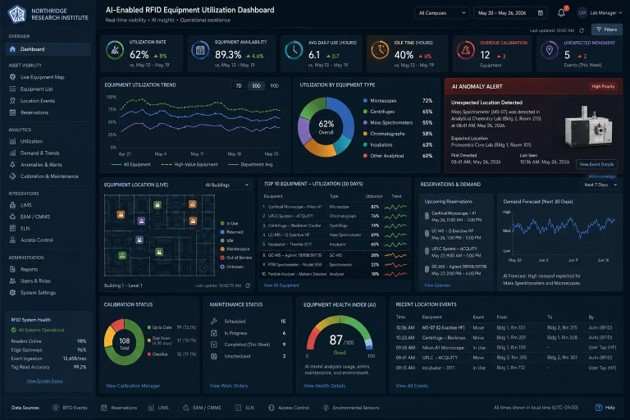
This enterprise dashboard illustrates how RFID location events, equipment reservations, maintenance records, and AI analytics can provide real-time visibility into research equipment. It highlights utilization rates, idle time, availability, calibration status, demand trends, unexpected equipment movement, and AI-generated alerts to support laboratory management decisions.
AI-Assisted Research Inventory and Exception Management
Research inventory differs from conventional commercial inventory because many items have scientific, procedural, or experimental significance beyond their financial value.
An inventory exception could mean that a research instrument is in the wrong laboratory, a reusable transport container has not returned to its expected location, a tagged research material has not arrived at a designated processing area, or a group of assets has remained unaccounted for after a laboratory transfer.
AI can prioritize these exceptions instead of presenting every RFID discrepancy equally. A useful exception-management workflow can assign severity according to:
- Asset criticality
- Research program dependency
- Expected location
- Duration outside the expected zone
- Historical movement pattern
- Equipment availability
- Maintenance or calibration status
- Research schedule
- Access-control context
- Confidence of the underlying RFID event
A high-value instrument missing from a scheduled research laboratory should receive different treatment from a low-priority accessory temporarily detected in another room.
This prioritization reduces alert fatigue and allows laboratory managers to concentrate on events that can materially affect research continuity.
RFID for Research Specimen and Material Logistics
RFID can support selected specimen and research-material workflows where the physical container, carrier, rack, tray, or transport unit is technically suitable for tagging.
Tagging every specimen is not automatically appropriate. Material composition, container size, temperature, liquids, metalized packaging, sterilization processes, and regulatory or scientific requirements can affect RFID performance and operational suitability.
A more practical approach can use RFID on transport carriers, racks, trays, reusable containers, or other durable identifiers where direct specimen tagging is unsuitable.
AI can then analyze movement sequences across receiving, preparation, laboratory processing, storage, transfer, and disposition stages.
The resulting system can help detect:
- Missing transport containers
- Unexpected movement between laboratory zones
- Delayed transfers
- Incomplete workflow sequences
- Repeated handling anomalies
- Mismatches between expected and observed movement
For sensitive research operations, RFID should supplement established identification and chain-of-custody procedures rather than become the sole source of truth.
Integration With Research Software and Institutional Systems
The operational value of RFID increases when identification events are connected to the systems already used by research personnel and IT teams.
Common integration targets include:
- LIMS: Associates equipment, materials, or selected workflow events with laboratory processes and records.
- ELN systems: Provides contextual operational information that can help explain asset or material activity.
- EAM and CMMS software: Connects RFID observations with equipment ownership, maintenance, work orders, calibration, and service history.
- Inventory management systems: Supports automated reconciliation and exception identification.
- Research equipment scheduling software: Compares planned reservations with observed equipment activity.
- Identity and access-management systems: Provides authorized-user context for selected operational events.
- Access-control systems: Helps correlate asset movement with controlled-area activity.
- Environmental monitoring systems: Adds temperature, humidity, freezer status, or other environmental information where relevant.
- Data warehouses and analytics systems: Supports historical analysis across research facilities.
- Institutional reporting systems: Converts operational data into management-level KPIs.
REST APIs, database interfaces, message queues, middleware connectors, and scheduled data exchange can all be appropriate depending on the existing software environment.
Integration should preserve the authoritative ownership of data. For example, RFID middleware may provide the observed location event, while the EAM system remains authoritative for asset ownership and maintenance status.
Practical RFID Deployment Scenario in a Research Facility
Consider a research institution operating several shared laboratories and a central instrumentation facility.
High-value analytical instruments are assigned RFID tags selected for their physical surfaces. Fixed UHF RFID readers are installed at carefully evaluated transition points between equipment storage, shared instrumentation rooms, and laboratory corridors. Handheld RFID readers support periodic inventory and investigation of missing assets.
Each reader sends events to an edge gateway. The gateway removes repeated observations and associates validated events with predefined research-facility zones.
Middleware then maps RFID identifiers to the institution’s asset records. Equipment status, maintenance history, calibration schedules, reservation data, and authorized laboratory zones are retrieved from existing systems.
An AI service analyzes the resulting event stream.
Suppose a mass spectrometer normally remains in a shared analytical laboratory but is detected repeatedly near a storage area outside its expected workflow. The system compares the movement with reservation information and recent maintenance records. If no valid operational reason exists, it generates an exception for the equipment administrator.
The administrator verifies the situation and discovers that the instrument has been temporarily relocated for service preparation. The exception is closed with an operational explanation.
This example illustrates an important engineering principle: RFID supplies evidence of physical movement, while software context and AI help determine whether the movement requires attention.
RFID Deployment in a Modern Research Institution: AI-Enabled Asset Tracking
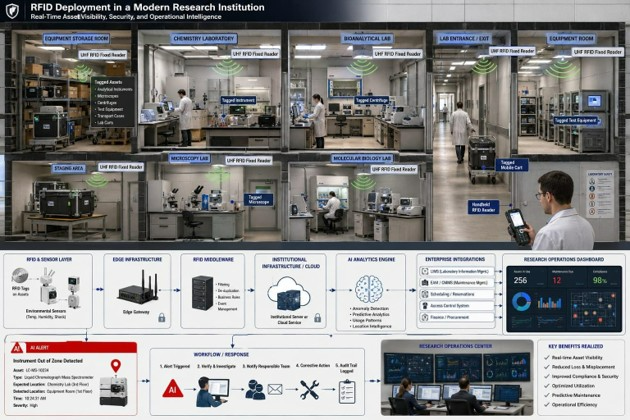
This technical illustration shows how UHF RFID is deployed across interconnected research laboratories, storage areas, equipment rooms, and staging zones. It traces RFID data from tagged laboratory assets and fixed or handheld readers through edge gateways, middleware, institutional infrastructure, and AI analytics into LIMS, EAM/CMMS, scheduling, access control, and research operations dashboards. An AI-generated out-of-zone alert demonstrates real-time asset monitoring and operational response.
Key Performance Indicators for AI-Enabled Research Asset Management
Research institutions should define measurable outcomes before deployment. RFID read counts alone are not sufficient to demonstrate operational value.
Useful KPIs include:
- Asset inventory accuracy
- Percentage of assets with verified current locations
- Mean time to locate research equipment
- Number of unresolved asset-location exceptions
- Equipment utilization rate
- Equipment idle time
- Reservation-to-actual-use variance
- Calibration compliance rate
- Maintenance scheduling accuracy
- Mean time to resolve asset exceptions
- Inventory audit duration
- Manual inventory labor hours
- Inventory reconciliation accuracy
- Unplanned equipment downtime
- Equipment transfer cycle time
- Research-material transfer exceptions
- Transport-container recovery rate
- RFID read-zone accuracy
- False-positive alert rate
- False-negative detection rate
- RFID reader availability
- Middleware event-processing latency
- AI inference latency
- Network availability
- Integration transaction success rate
- Data-quality exception rate
- Number of unauthorized movement alerts
- Time required to investigate movement anomalies
- Percentage of assets integrated with authoritative institutional records
- Cost avoided through improved equipment utilization
KPIs should be measured before and after deployment where possible. A pilot that establishes a baseline for inventory accuracy, search time, utilization, and exception volume provides stronger evidence than a deployment measured only by reader performance.
Scalability Across Research Campuses and Facilities
A research institution may begin with one laboratory and later extend RFID to shared instrumentation, engineering facilities, archives, libraries, storage rooms, or additional campuses.
Scalability should therefore be considered during the initial design. A scalable implementation separates:
- RFID device management
- Edge event processing
- Middleware
- Asset identity management
- AI analytics
- Institutional software integration
- User dashboards
- Security and identity controls
This separation allows additional readers and research facilities to be added without redesigning every downstream application.
Device naming, tag-ID conventions, laboratory-zone identifiers, asset master-data mappings, API contracts, and event schemas should be standardized early. Consistent data structures become particularly important when multiple research buildings use different reader models or operating procedures.
GAO provides RFID, BLE, and IoT hardware products and systems that can be evaluated for research-facility deployments ranging from individual laboratories to broader institutional requirements. Hardware selection should remain tied to the physical environment, required read behavior, integration requirements, and lifecycle-support expectations.
Maintenance, Monitoring, and Lifecycle Management
RFID performance can degrade operationally even when the hardware remains powered. Antennas may be repositioned, laboratory layouts may change, equipment may be moved, network configurations may be modified, and new metallic objects can alter RF behavior.
A production research RFID system should therefore include ongoing monitoring. Important maintenance activities include:
- Reader connectivity monitoring
- Antenna and cable inspection
- Firmware and software update management
- Tag replacement procedures
- Asset-ID reconciliation
- Read-zone performance testing
- Network and gateway health monitoring
- Middleware event-quality monitoring
- AI model performance evaluation
- False-alert analysis
- Integration error monitoring
- Backup and recovery testing
- Periodic cybersecurity review
AI models also require lifecycle management. Changes in laboratory workflows can cause historical patterns to become less representative. Model drift, changing asset populations, new laboratory locations, and altered equipment schedules should therefore be considered during periodic model validation.
Interoperability and Technical Design Practices
Research institutions often operate heterogeneous IT environments built over many years. RFID systems should therefore use well-defined interfaces rather than creating isolated operational databases.
Several practices improve interoperability:
- Use stable asset identifiers that map to authoritative institutional records.
- Maintain clear ownership for asset, maintenance, location, and event data.
- Normalize RFID timestamps and location identifiers.
- Separate raw reader events from validated business events.
- Maintain versioned API contracts.
- Log integration failures and provide retry mechanisms.
- Use role-based access controls for operational dashboards and administrative functions.
- Design for temporary network outages where laboratory operations require continuity.
- Preserve sufficient event history for troubleshooting without retaining unnecessary information.
- Test integrations using representative research workflows before production commissioning.
The objective is not to replace existing research software. RFID should provide reliable physical-world observations that improve the information available to existing systems.
Implementation Roadmap for Research Institutions
A controlled implementation reduces both technical and operational risk.
Define the Research Workflow
Identify the assets, laboratories, movement points, users, and operational decisions that require improved visibility. A useful first deployment usually addresses a specific measurable problem such as locating shared instruments or improving laboratory inventory accuracy.
Characterize the Physical Environment
Test representative tags on representative equipment. Evaluate metallic instruments, liquids, freezers, cabinets, doors, racks, benches, and other structures that could influence RFID performance.
Establish the Data Model
Define tag identifiers, asset identifiers, laboratory zones, reader identifiers, event types, timestamps, user roles, and integration relationships before large-scale deployment.
Conduct a Controlled Pilot
Select one or more representative laboratories. Measure read performance, location accuracy, exception rates, integration reliability, and user acceptance using actual research workflows.
Integrate Institutional Systems
Connect validated RFID events with EAM, CMMS, LIMS, ELN, scheduling, inventory, identity, or access-control systems as required.
Introduce AI Gradually
Begin with transparent analytics such as anomaly detection, utilization analysis, and rule-assisted exception management. More sophisticated predictive models should be introduced after sufficient high-quality historical data has been collected.
Validate Operational Outcomes
Compare baseline and post-deployment KPIs. Review false alerts, missed events, user feedback, equipment-location accuracy, and workflow improvements.
Expand by Research Use Case
Extend the solution to additional laboratories, shared equipment, research materials, specimen logistics, libraries, archives, or other suitable operational domains only after the initial deployment has demonstrated reliable performance.
AI-Enabled RFID Implementation Roadmap for Research Institutions
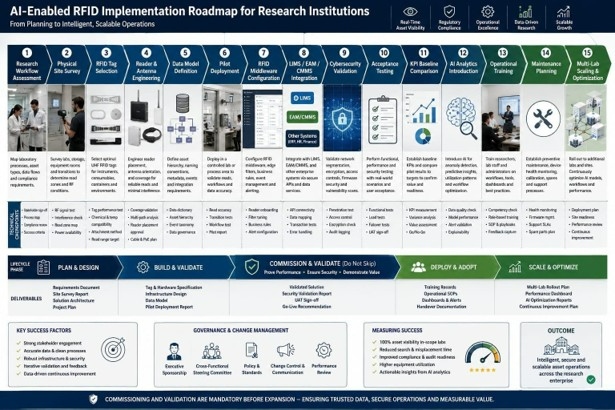
This enterprise roadmap illustrates the complete lifecycle for deploying AI-enabled RFID across research institutions, from workflow assessment and site surveying through hardware engineering, pilot deployment, system integration, cybersecurity validation, and acceptance testing. It emphasizes commissioning and validation before operational expansion, followed by AI analytics, staff training, maintenance planning, and multi-laboratory scaling. Technical checkpoints, deliverables, governance, and performance measures reinforce a controlled and scalable implementation strategy.
Technical Performance and Business Value for Research Institutions
The strongest value proposition for AI-enabled RFID is not the RFID event itself. Value comes from converting physical-world observations into reliable information that improves research operations.
Key improvements can include:
- Faster asset location: RFID reduces dependence on manual searches by providing recent location evidence for tagged equipment.
- Improved inventory accuracy: Automated identification reduces repetitive manual counting and supports more frequent inventory verification.
- Higher equipment utilization: AI can identify underused instruments and compare actual movement with reservations.
- Better maintenance coordination: Equipment movement and utilization information can provide additional context for maintenance and calibration planning.
- Reduced operational disruption: Early detection of missing or misplaced assets can prevent avoidable delays to experiments.
- Better laboratory resource planning: Historical movement patterns can support decisions about shared equipment and space.
- More consistent exception management: AI can prioritize unusual events instead of requiring staff to review every raw RFID observation.
- Improved operational security: Movement events can support investigation of unexpected asset transitions when integrated with appropriate authorization data.
- Scalable research operations: Standardized RFID and data interfaces make it easier to extend visibility to additional facilities.
- Stronger decision support: Combining RFID with LIMS, EAM, CMMS, scheduling, and environmental information provides richer operational context than any individual data source.
The financial benefit should be calculated against the institution’s actual baseline. High-value instruments, labor-intensive inventories, research delays, asset-recovery costs, and equipment utilization should be quantified before deployment.
Engineering Lessons for AI-Enabled RFID in Research Facilities
Several implementation lessons are especially important for research institutions.
RFID should be designed around physical workflows rather than abstract coverage targets. A reader that detects a tag from a long distance is not automatically useful if the resulting event does not indicate a meaningful transition.
Tag selection should be based on actual asset materials. Metallic laboratory equipment and liquid-containing containers can behave very differently from cardboard or plastic inventory.
AI should receive validated events rather than unrestricted raw reader streams. Filtering, deduplication, zone association, and timestamp normalization improve downstream model quality.
Institutional software should remain part of the design from the beginning. A technically successful RFID deployment can still provide limited value if asset identifiers cannot be reconciled with EAM, CMMS, LIMS, or other authoritative records.
Human validation remains important for exceptions. AI should support laboratory managers, asset administrators, facilities personnel, and IT teams rather than obscure the evidence behind an operational recommendation.
Cybersecurity should be incorporated during system design rather than added after commissioning. Reader credentials, network segmentation, API authentication, access permissions, logging, patching, and data-retention rules all contribute to the overall security posture.
GAO Support for Research Institution RFID Deployments
GAO has supplied RFID, BLE, and related IoT hardware products and systems to organizations requiring practical identification, tracking, sensing, and connectivity capabilities. Its broader customer experience includes Fortune 500 companies, leading R&D organizations, prestigious universities, and U.S. and Canadian government agencies.
GAO RFID capabilities can support research institutions evaluating tags, readers, antennas, handheld equipment, gateways, and associated software components for laboratory and asset-management applications. Deployment decisions should be based on the specific physical environment, research workflow, integration requirements, and operational objectives rather than on a one-size-fits-all design.
Headquartered in New York City and Toronto, Canada, GAO is recognized among leading B2B and B2G suppliers of RFID and BLE technologies. GAO and its sister companies, GAO Research and GAO Tek, form the GAO Group, with operations based in New York City and Toronto. The organizations have invested substantially in R&D, quality assurance, and technical support, including remote and onsite assistance.
GAO Research Institution RFID Solution Ecosystem: AI, Hardware, and Laboratory Systems Integration
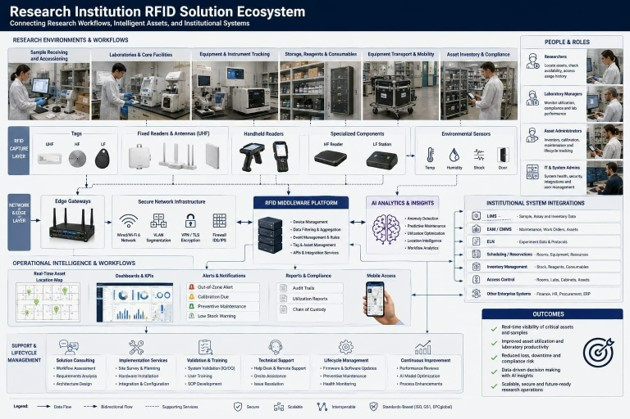
This technical illustration shows how RFID hardware, secure network infrastructure, middleware, AI analytics, and institutional systems work together across a research environment. It connects UHF, HF, and LF RFID technologies with LIMS, EAM/CMMS, ELN, scheduling, inventory, and access-control systems while showing researchers, laboratory managers, asset administrators, and IT personnel using the resulting operational intelligence. Technical support and lifecycle management are presented as enabling functions rather than promotional elements.
Key Takeaways for Research Institution Decision-Makers
AI-enabled RFID can provide research institutions with a practical method for connecting physical asset movement to digital operational intelligence. The most effective deployments begin with a clearly defined research workflow, representative RFID testing, reliable asset identification, and integration with existing institutional software.
UHF RFID, HF RFID, and LF RFID should be selected according to physical and operational requirements rather than treated as interchangeable technologies. AI should be introduced where it adds measurable value through anomaly detection, utilization analysis, forecasting, classification, or decision support.
A successful deployment also requires cybersecurity, data governance, lifecycle maintenance, integration testing, user training, and KPI measurement.
Research institutions considering these applications can evaluate GAO’s RFID, BLE, IoT hardware products, software capabilities, and technical support to determine which technologies best fit their laboratories, research facilities, asset-management processes, and operational requirements.
Building the Future of Industrial AI and IoT with Aperture Venture Studio and GAO RFID Inc.
For more than three decades, GAO Group of Companies has invested heavily in R&D for industrial RFID, BLE, and IoT. As AI became increasingly useful in industrial and research applications, we expanded our work in AI and IoT technologies and founded Aperture Venture Studio to help advance practical AI and IoT solutions relevant to areas such as research asset management, connected laboratories, and intelligent operational systems.
Aperture has attracted AI and IoT technical experts, entrepreneurial and operational executives, influential investors, and leading companies. We have also developed the Aperture Ventures Summit and TekSummit to discuss advanced AI and IoT topics.
Together, these activities contribute to technical communities focused on practical AI and IoT development.
We welcome you to join us as:
- Advisors, co-founders, or employees
- Investors
- Customers