
AI and BLE for Textile Production
How AI and BLE Transform Textile Production
AI is transforming Textile Production by turning physical asset, material, equipment, and production-flow data into actionable manufacturing intelligence. Textile mills and integrated textile plants manage fiber bales, yarn packages, cones, beams, rolls, dyes, chemicals, pallets, carts, tooling, inspection equipment, and mobile maintenance resources across spinning, weaving, knitting, dyeing, finishing, and fabric handling operations. AI can analyze these movements and operating conditions to identify production bottlenecks, predict equipment problems, optimize material staging, and improve asset utilization. BLE Gateways, BLE Beacons, and BLE Sensors provide a practical data-acquisition layer for tracking mobile resources and selected environmental or condition parameters. When connected with MES, ERP, WMS, CMMS, QMS, laboratory systems, and production equipment data, BLE-supported AI enables Textile Production teams to make faster and more evidence-based operational decisions.
AI-Driven Textile Production with BLE
AI and BLE for Textile Production combine machine learning, analytics, IoT sensing, and physical asset identification with textile manufacturing workflows. BLE should be treated as an enabling technology rather than the business objective. The operational objective is better control over fiber, yarn, fabric, equipment, tooling, work-in-process, and finished-goods movement.
Textile Production is particularly suitable for AI-driven asset tracking because materials and production resources move through many interconnected processes. A typical textile operation may include fiber preparation, opening and blending, carding, drawing, roving, spinning, winding, warping, sizing, weaving, knitting, dyeing, printing, finishing, inspection, fabric rolling, warehousing, and shipment.
AI can use location events together with production orders, machine states, quality records, maintenance history, inventory transactions, and process timestamps. This creates a more complete representation of manufacturing conditions than an isolated location record.
BLE Beacons can identify yarn carts, fabric rolls, transport bins, pallets, maintenance tools, inspection instruments, change parts, and other mobile assets. BLE Sensors can monitor appropriate conditions such as temperature or humidity where these measurements are operationally relevant. BLE Gateways collect nearby device transmissions and forward the data to local or centralized processing software.
GAO supplies BLE, RFID, and other IoT hardware products and systems that can be evaluated for these Textile Production applications. The appropriate combination depends on asset size, tracking frequency, radio environment, environmental exposure, required accuracy, battery life, and integration requirements.
AI Applications for Textile Production
AI Asset Tracking for Textile Mills
AI asset tracking provides more than a current location. It can identify how frequently textile assets move, how long they remain in particular zones, and whether their movement is consistent with the production plan.
For example, a fabric roll may remain in an inspection area longer than the expected process interval. AI can compare that dwell time with historical production patterns and determine whether the delay is unusual. Similar analysis can identify yarn carts waiting between winding and warping, beams waiting before weaving, or material-handling equipment accumulating near a production bottleneck.
This information helps supervisors distinguish normal production variation from conditions requiring intervention.
AI Material Flow Optimization
Textile Production depends on timely movement of raw materials and work-in-process. Fiber bales, sliver cans, roving packages, yarn cones, beams, fabric rolls, dyes, finishing chemicals, packaging materials, and reusable transport containers can all create staging requirements.
AI can analyze material movement and production schedules to predict where resources will be needed next. This supports better staging decisions and reduces unnecessary travel by forklifts, carts, and material-handling personnel.
For textile plants operating multiple production departments, location intelligence can also reveal recurring transfer delays between spinning, weaving, dyeing, finishing, inspection, and warehouse areas.
Predictive Maintenance for Textile Equipment
Textile machinery operates under demanding continuous-production conditions. Spinning frames, ring spindles, open-end spinning machines, winding machines, warpers, sizing machines, looms, knitting machines, dyeing machines, stenters, compactors, dryers, calenders, and finishing equipment can generate substantial maintenance requirements.
AI can combine equipment operating information with asset location, condition observations, maintenance history, work orders, and production schedules. This allows maintenance teams to identify patterns associated with increased failure risk or abnormal utilization.
BLE tracking adds another useful dimension by showing where mobile maintenance tools, spare-part containers, inspection instruments, and change parts are located. This can reduce technician search time during production interruptions.
AI Quality-Risk Detection
Textile quality depends on process consistency across yarn formation, weaving or knitting, coloration, finishing, and inspection. Defects can include broken ends, yarn irregularities, fabric contamination, shade variation, weaving defects, knitting defects, dimensional variation, skew, bow, shrinkage, and finishing inconsistencies.
AI can correlate quality events with production orders, machines, material movements, process stages, environmental conditions, and inspection timestamps. Location information from BLE devices can provide additional context when investigating where materials, rolls, tools, or process resources were positioned during a quality event.
Computer vision can also complement BLE-based data collection for fabric inspection. BLE answers where an asset or resource is located, while machine vision can evaluate visual characteristics of the textile itself.
Production and Work-In-Process Visibility
Work-in-process visibility is important when textile materials move through sequential manufacturing stages. A production planner may need to know whether yarn is ready for warping, whether a beam is available for weaving, whether greige fabric has entered dyeing, or whether finished fabric has completed inspection.
AI can analyze movement events and process timestamps to identify abnormal dwell, missed transfers, queue buildup, and production bottlenecks. This supports more accurate production planning and faster response to disruptions.
Textile Production AI and BLE Operations Workflow
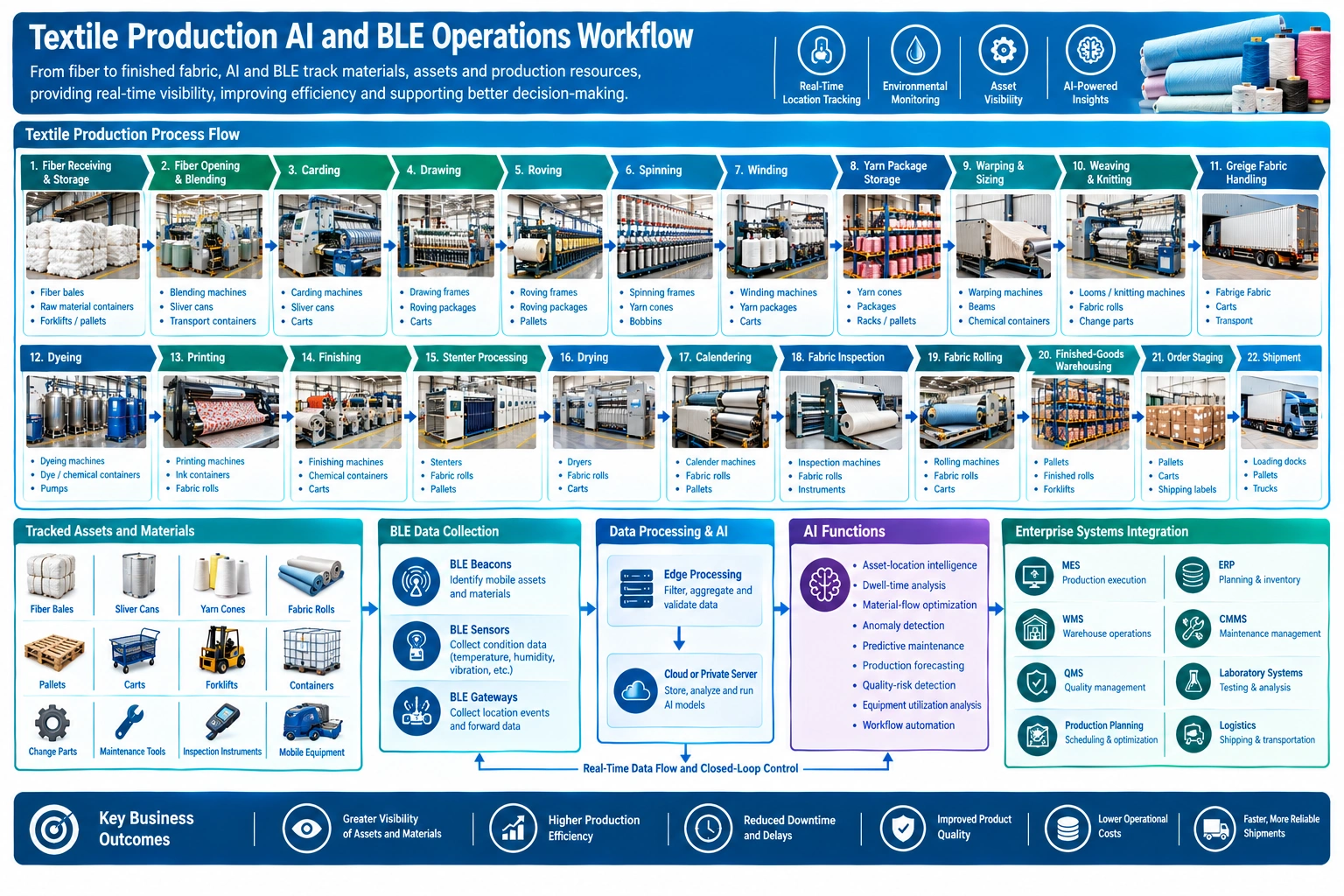
The completed infographic maps textile production from fiber receiving through shipment, showing BLE asset tracking, sensor data collection, edge and cloud or private-server processing, AI analytics, and enterprise system integration. It highlights tracked materials, production assets, AI functions, and key operational outcomes across the textile manufacturing workflow.
Textile Production Workflows Supported by AI
Fiber Receiving and Raw-Material Preparation
The workflow begins when cotton, polyester, viscose, wool, blended fibers, or other textile raw materials arrive at the plant. Receiving teams verify quantities, material identity, supplier information, and storage requirements before material enters the production flow.
AI can analyze receiving patterns, inventory levels, production requirements, and historical consumption to improve material availability. BLE tracking can identify selected mobile containers, handling equipment, and reusable material carriers as they move between receiving, storage, and preparation areas.
Spinning and Yarn Preparation
Spinning operations transform prepared fibers into yarn through processes such as carding, drawing, roving, spinning, and winding. Production resources may move between machines and departments while yarn packages accumulate in intermediate storage.
AI can analyze production rates, machine utilization, package movement, and queue duration to identify bottlenecks. BLE asset tracking can help locate yarn carts, cones, bobbins, transport containers, and maintenance resources.
Warping, Sizing, Weaving, and Knitting
Warping and sizing prepare yarn for weaving, while knitting creates fabric through loop formation. Weaving operations rely on looms, beams, warp systems, weft insertion, and associated material-handling activities.
AI can identify abnormal waiting time between yarn preparation and fabric formation. Location events can also help production personnel determine whether required beams, yarn packages, change parts, or tools are available near the correct machine.
Dyeing, Printing, and Finishing
Dyeing and finishing introduce additional process dependencies. Textile lots can move through dyeing machines, washing, drying, stentering, coating, printing, calendaring, compacting, or other finishing operations depending on the product.
AI can compare actual process progression with expected production schedules and identify excessive dwell or delayed transfers. BLE data can provide supporting location information for material containers, fabric rolls, process resources, and mobile equipment.
Inspection, Fabric Rolling, and Warehouse Movement
After finishing, fabric may undergo inspection, grading, rolling, labeling, packaging, and warehouse staging. Fabric rolls can remain in several locations before customer orders are consolidated.
AI can identify finished-roll dwell, warehouse congestion, order-staging delays, and unusual movement patterns. Location intelligence can help warehouse personnel find specific rolls and reduce time spent searching for work-in-process or finished goods.
Textile Production Asset Tracking and AI Solution Matrix
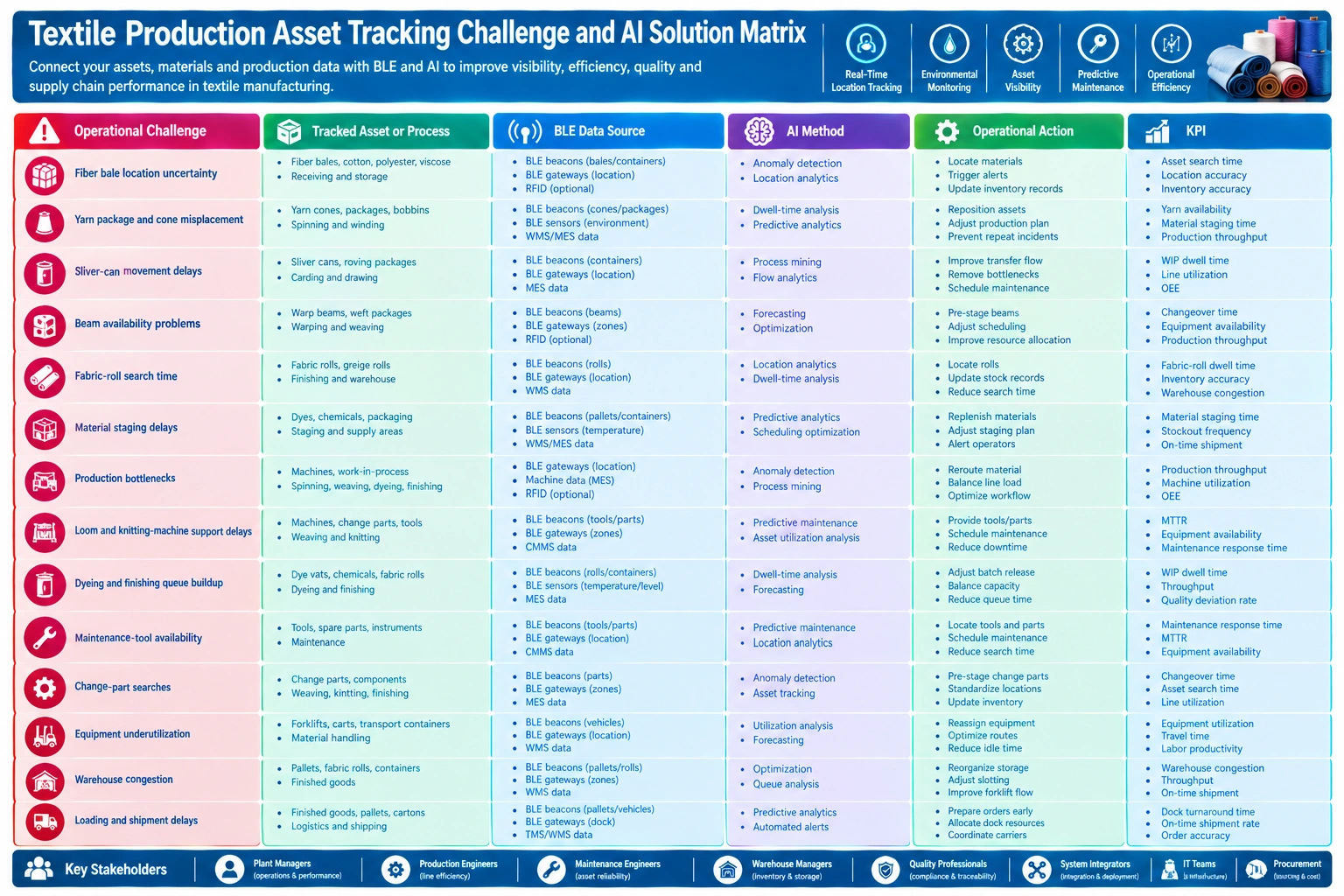
The completed matrix maps textile production challenges such as material misplacement, staging delays, equipment underutilization, maintenance-tool availability, warehouse congestion, and shipment delays to tracked assets, BLE and RFID data sources, AI methods, operational actions, and measurable KPIs. It also identifies key stakeholders involved in textile manufacturing operations and technology deployment.
Technical Capabilities for AI and BLE in Textile Production
AI and BLE solutions for textile production require coordinated hardware, data processing, industrial software, and analytics capabilities. Textile mills and finishing facilities can deploy BLE Beacons, BLE Sensors, and BLE Gateways where location, movement, condition, or process data must be collected from mobile and reusable production assets.
BLE Hardware for Textile Manufacturing
BLE Beacons can identify yarn packages, sliver cans, fabric rolls, beams, carts, pallets, maintenance tools, and other mobile assets. BLE Sensors can add information such as temperature, humidity, vibration, shock, or equipment operating conditions where these measurements are relevant to textile production.
BLE Gateways collect transmissions from tagged assets and sensors and transfer the data to edge computers, industrial servers, or cloud systems. Gateway placement should account for spinning rooms, weaving areas, knitting departments, dyeing and finishing zones, inspection areas, warehouses, loading areas, metal machinery, walls, racks, and other physical conditions that can affect wireless signal behavior.
AI Models for Textile Production
AI models can transform BLE observations and production data into operational recommendations. Relevant techniques include anomaly detection, time-series forecasting, classification, clustering, predictive maintenance models, process mining, optimization, and machine-learning-based risk scoring.
Textile-specific models can evaluate asset dwell time, yarn availability, production queues, equipment utilization, maintenance patterns, material movement, fabric-roll residence time, and deviations from expected production sequences. Historical MES, ERP, WMS, CMMS, QMS, and sensor data can improve model accuracy when sufficient labeled and time-series data are available.
Edge Processing and Industrial Data Handling
Edge processing is useful where textile operations require rapid event detection without sending every raw BLE observation to a remote system. An edge computer or industrial server can filter duplicate observations, calculate asset proximity, identify zone transitions, aggregate sensor readings, and generate local events.
Examples include detecting when a yarn package enters a production area, identifying an unexpected fabric-roll dwell period, or recognizing abnormal vibration from monitored equipment. Processed events can then be transmitted to a private server or cloud environment for historical analytics, AI model execution, reporting, and enterprise integration.
Cloud and Private Server Deployment
Textile manufacturers can select cloud, private-server, or hybrid deployment according to security, connectivity, IT policy, latency, and data-governance requirements.
A cloud deployment can support centralized analytics across multiple mills and production locations. A private-server implementation can keep operational data within the manufacturer’s controlled IT environment. Hybrid systems can retain time-sensitive processing locally while transferring selected production events and historical information to centralized analytics services.
Deployment should define data ownership, retention periods, backup procedures, user access, system availability, disaster recovery, and connectivity dependencies before commissioning.
BLE Deployment Engineering for Textile Production
BLE deployment should begin with a site survey rather than simply installing gateways at convenient locations. Textile machinery, dense production layouts, metallic structures, racks, enclosed rooms, and changing inventory positions can influence radio coverage and location accuracy.
Beacon and Sensor Placement
Asset tags should be positioned so that signals remain detectable while minimizing mechanical damage, contamination, heat exposure, moisture exposure, and interference with normal handling.
For fabric rolls, beams, carts, pallets, and reusable containers, mounting locations should be standardized. Tags attached to maintenance tools and change parts should remain readable during normal storage and use.
Sensors used around dyeing, drying, finishing, or other environmentally demanding processes require appropriate industrial specifications for temperature, humidity, moisture, vibration, or chemical exposure.
Gateway Coverage and Zone Design
Gateway locations should correspond to operational zones rather than arbitrary physical distances. Typical zones can include raw-material storage, fiber preparation, spinning, winding, warping, sizing, weaving, knitting, dyeing, printing, finishing, inspection, finished-goods storage, and shipping.
Multiple gateway observations can be combined to estimate the most likely asset zone. More demanding applications may use calibrated location methods based on received signal strength, gateway geometry, site measurements, and historical movement patterns.
Commissioning and Validation
Commissioning should verify:
- BLE tag identity and asset association
- Gateway connectivity and coverage
- Signal detection across production zones
- Asset movement events
- Sensor data quality
- Timestamp synchronization
- Duplicate-event filtering
- Zone-transition accuracy
- Edge-to-server communication
- Enterprise software transactions
- Alarm and notification behavior
- AI model outputs against known operating conditions
Pilot testing should use representative textile assets and normal production conditions. Testing only during an empty facility or maintenance shutdown can produce misleading coverage and performance results.
AI and BLE Integration with Textile Production Software
BLE data becomes more valuable when connected with existing manufacturing and business systems. GAO solutions can be designed to complement established textile production processes rather than requiring operators to replace every existing application.
MES Integration
Manufacturing Execution Systems can provide production orders, work-center information, machine status, operation sequences, and production quantities. BLE events can add physical movement information that may not be captured directly by MES.
AI can compare expected material movement with observed movement and identify delayed staging, missing production inputs, abnormal dwell periods, or process deviations.
ERP Integration
ERP systems can provide order, purchasing, inventory, customer, and production-planning information. Combining ERP records with physical asset and material-location data can improve visibility into whether required materials are actually positioned where production needs them.
AI models can use historical order patterns and material movement to support demand forecasting, production planning, and inventory decisions.
WMS and Warehouse Operations
WMS integration can connect BLE location events with raw-material, work-in-process, and finished-goods records. This can reduce time spent searching for yarn packages, fabric rolls, pallets, carts, and order-staging assets.
AI can identify warehouse congestion, repeated relocation patterns, excessive staging dwell, and potential shipment delays.
CMMS and Maintenance Systems
CMMS data can be combined with BLE equipment observations, vibration information, maintenance history, work orders, and operating conditions.
Predictive maintenance models can identify equipment behavior associated with failures or degraded performance. BLE can also locate maintenance tools, spare components, portable test equipment, and change parts so technicians spend less time searching before beginning work.
QMS and Laboratory Systems
Quality systems can provide inspection results, defect classifications, laboratory measurements, and product specifications. Production location, equipment history, material movement, and process events can provide additional context.
AI can correlate production conditions with quality deviations and help identify recurring relationships between equipment, materials, operating conditions, and inspection results. Such models should support qualified quality processes rather than automatically replacing required inspection or laboratory decisions.
Security, Interoperability, and Data Governance
Industrial AI and BLE deployments should incorporate cybersecurity and data-governance requirements from the planning stage. Textile production data may contain operational information about production schedules, equipment performance, inventory, orders, and facility activity.
Secure Data Transmission and Access
BLE communication, gateway connections, edge systems, application interfaces, and enterprise integrations should be configured according to the manufacturer’s security policies and applicable organizational controls.
Role-based access can restrict operational information according to job responsibilities. Administrative access should be controlled separately from normal operator access, with appropriate authentication, logging, and account-management procedures.
Network Segmentation
BLE gateways and edge systems should be placed within appropriately controlled network segments. Connectivity between operational technology and enterprise IT environments should follow established industrial cybersecurity practices.
Firewalls, access controls, monitored interfaces, secure remote administration, patch management, and documented system dependencies should be considered during deployment.
Interoperability
A practical textile solution should accommodate existing software and industrial equipment wherever possible. Integration methods may include APIs, database interfaces, message-based communication, industrial protocols, file exchange, and middleware.
Interoperability testing should verify not only whether systems exchange data, but whether exchanged events correctly update production, inventory, maintenance, quality, and logistics records.
Operational Improvements and Textile Production KPIs
The business value of AI and BLE should be measured against operational KPIs rather than tag counts or gateway installations. Baseline measurements should be collected before deployment so improvements can be quantified.
Relevant KPIs include:
- Asset search time
- Material staging time
- Yarn availability
- Work-in-process dwell time
- Fabric-roll dwell time
- Production throughput
- Machine utilization
- OEE
- Equipment availability
- Unplanned downtime
- Mean time to repair
- Maintenance response time
- Changeover duration
- Change-part retrieval time
- Warehouse congestion
- Inventory accuracy
- Quality deviation rate
- Rework rate
- Scrap rate
- Order-staging time
- On-time shipment performance
AI can continuously evaluate these measurements and identify trends that are difficult to recognize through manual reporting. BLE provides physical-event data that helps establish where and when operational changes occur.
Implementation Recommendations for Textile Manufacturers
A successful deployment should be implemented in controlled stages rather than attempting to instrument every textile asset simultaneously.
Define the Initial Production Problem
Select a measurable problem such as fabric-roll search, yarn staging delays, maintenance response, equipment utilization, warehouse congestion, or work-in-process visibility.
Define the baseline KPI, expected improvement, data sources, responsible teams, and operational action that should result from an AI-generated insight.
Select Assets and Data Sources
Prioritize assets whose location or condition directly affects production. Candidate assets include yarn packages, beams, fabric rolls, carts, pallets, maintenance tools, change parts, reusable containers, and mobile support equipment.
Combine BLE observations with MES, ERP, WMS, CMMS, QMS, machine, and production data where those sources are available.
Pilot One Production Area
A spinning room, weaving department, finishing area, warehouse, or maintenance workflow can provide a manageable starting point.
The pilot should measure detection reliability, location accuracy, data latency, battery performance, operator acceptance, system integration, and KPI improvement before broader deployment.
Validate AI Performance
AI models should be evaluated using actual production data and clearly defined performance measures. False alarms, missed events, model drift, incomplete data, and changes in production patterns should be monitored.
Human operators should remain involved in decisions where safety, product quality, maintenance authorization, or production changes require qualified judgment.
Scale Across the Facility
Once the pilot demonstrates measurable value, standardized tag mounting, gateway installation, naming conventions, asset IDs, network configuration, integration methods, and maintenance procedures can support expansion.
Multi-site manufacturers can establish common data definitions while allowing each textile facility to account for its own machinery, floor layout, production processes, and operational constraints.
Scaling AI and BLE Across Textile Production Operations
Large textile manufacturers may require thousands of tracked assets and sensors distributed across multiple production departments or facilities. Scalability depends on consistent asset identification, gateway management, data processing capacity, network reliability, software integration, and battery-management procedures.
AI models can become more useful as historical production data accumulates across different machines, products, shifts, and production conditions. However, data quality should remain a primary consideration. A larger volume of inaccurate location or sensor data does not automatically produce better analytics.
GAO can support organizations evaluating BLE hardware, gateways, sensing requirements, data collection, and integration approaches for textile production use cases. Engineering teams should define the required accuracy and business outcome before selecting the final hardware configuration.
Key Takeaways for AI and BLE in Textile Production
- AI can analyze textile production data to identify material-flow delays, equipment risks, quality patterns, and operational inefficiencies.
- BLE provides practical location and condition data for mobile assets, reusable production equipment, materials, tools, and selected machinery.
- Textile-specific deployment should account for spinning, weaving, knitting, dyeing, printing, finishing, inspection, warehousing, and shipping conditions.
- Edge processing can reduce unnecessary data transmission and support rapid operational event detection.
- Cloud, private-server, and hybrid deployments can accommodate different IT, security, latency, and data-governance requirements.
- MES, ERP, WMS, CMMS, QMS, and laboratory integration can connect physical production events with enterprise workflows.
- Pilot deployments should establish measurable baselines and validate location accuracy, data quality, AI performance, and operational benefits.
- Scaling should use standardized asset identities, installation practices, network configurations, software interfaces, and maintenance procedures.
- KPI measurement should focus on production throughput, utilization, downtime, material availability, quality, inventory accuracy, maintenance performance, and shipment execution.
Building the Future of Industrial AI and IoT with GAO
AI and IoT technologies can give textile manufacturers greater visibility into physical production activities while helping engineering and operations teams make decisions from continuously collected data. BLE Beacons, BLE Sensors, and BLE Gateways provide a practical data-collection layer for assets and processes that are difficult to monitor through conventional enterprise systems alone.
GAO provides BLE and RFID technologies that can be evaluated for textile manufacturing applications including asset tracking, material movement, production support, maintenance, warehouse operations, and industrial monitoring. Its engineering-oriented approach supports organizations through technology selection, deployment planning, integration, testing, and ongoing optimization.
GAO is headquartered in New York City and Toronto, Canada, and serves organizations across the United States and Canada, including Fortune 500 companies, research and development organizations, universities, and government organizations. With extensive experience in BLE and RFID technologies, GAO can help textile manufacturers develop practical connected-production solutions aligned with their operational requirements, software environment, and long-term scalability objectives