
AI and RFID for Fishing Fleets
AI-Driven Fishing Fleet Operations with RFID Asset Visibility
Fishing fleets operate across demanding environments where vessel availability, catch handling, fuel consumption, maintenance, crew safety, cold-chain integrity, and regulatory compliance directly affect profitability. AI and IoT solutions can combine operational data from vessels, ports, processing facilities, and connected equipment with RFID-based identification of tagged assets, tools, containers, supplies, and maintenance items. AI models can then correlate these data streams to identify operational exceptions, predict maintenance requirements, improve inventory decisions, and support fleet planning.
For fishing fleets, RFID is most valuable when it is treated as an identification and data-capture layer within a broader operational solution rather than as a standalone tracking technology. UHF RFID can support rapid identification of tagged items at shore facilities and controlled vessel access points, while HF RFID is useful for shorter-range identification and LF RFID can be considered for selected low-frequency identification environments. AI adds value by turning identification events and related IoT data into decisions for fleet managers, vessel operators, maintenance teams, cold-chain personnel, and procurement groups.
AIoT Fishing Fleet Operations Overview
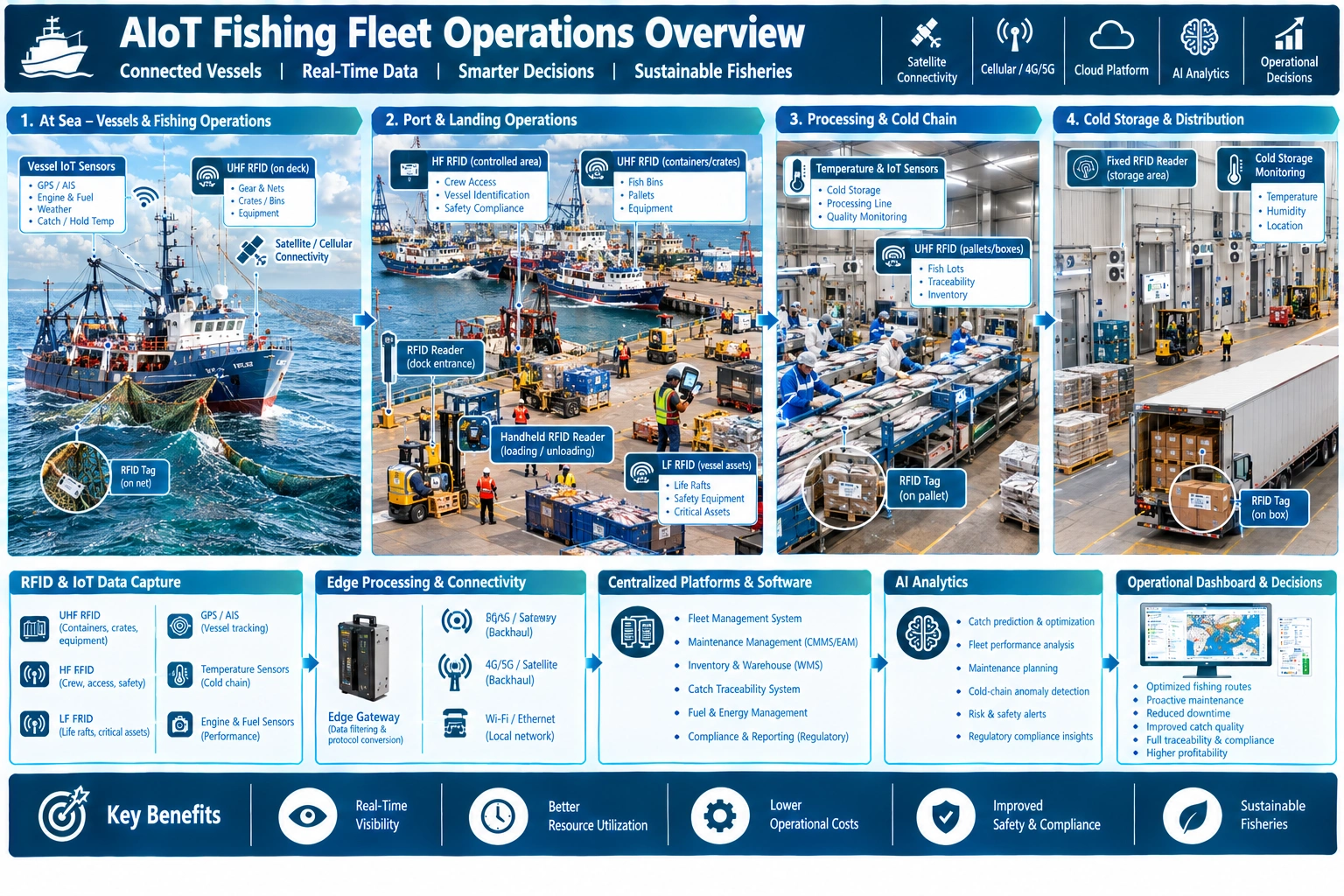
This infographic shows connected fishing vessels, port operations, processing facilities, and cold storage linked through RFID, IoT sensors, edge connectivity, centralized software, and AI analytics. The system supports fleet management, maintenance planning, catch traceability, cold-chain monitoring, compliance reporting, and operational decision-making.
Why AI Matters for Modern Fishing Fleet Management
Fishing operations generate highly variable data because vessels move between ports, fishing grounds, processing locations, fuel stations, maintenance facilities, and offshore operating areas. The operational state of a vessel can change quickly because of weather, catch conditions, equipment performance, fuel availability, crew schedules, and port turnaround requirements.
AI helps fishing fleet organizations interpret these changing conditions instead of relying only on manually maintained logs and isolated operational records. Machine learning can identify patterns in vessel maintenance history, engine operating conditions, fuel consumption, spare-parts demand, and equipment failures. Computer vision can support selected inspection and catch-handling workflows where cameras are practical. Edge AI can process time-sensitive information aboard a vessel or at a port when connectivity to centralized systems is intermittent.
RFID contributes a different capability. It establishes machine-readable identity for physical objects. A tagged hydraulic tool, fishing-net component, engine spare, life-saving item, reusable fish container, maintenance kit, or refrigerated handling asset can be associated with an asset record. The resulting identification events can become inputs to AI models and fleet-management workflows.
The practical objective is therefore not simply RFID tracking. The objective is AI-driven fishing fleet management supported by reliable physical-asset identification and operational data.
Fishing Fleet Applications for AI-Driven Operations
Fishing fleets can apply AI and RFID across vessel operations, shore facilities, maintenance, inventory, catch handling, and compliance activities.
| Fishing Fleet Application | RFID Role | AI Role | Operational Outcome |
|---|---|---|---|
| Vessel equipment tracking | Identifies tagged tools, equipment, and maintenance items | Detects unusual usage or missing-item patterns | Better vessel readiness |
| Spare-parts management | Identifies tagged parts, kits, and containers | Forecasts replenishment requirements | Fewer stockouts |
| Fishing gear management | Identifies nets, gear components, reels, and handling equipment | Analyzes usage and replacement patterns | Better gear availability |
| Maintenance management | Associates physical parts with maintenance records | Predicts failure and maintenance demand | Reduced unplanned downtime |
| Port turnaround | Captures movement of tagged assets through receiving and dispatch points | Predicts turnaround bottlenecks | Faster vessel preparation |
| Cold-chain operations | Identifies reusable containers and handling assets | Correlates movement with temperature and dwell data | Better product handling |
| Catch traceability | Links tagged containers or batches to operational events | Detects anomalies in handling records | Improved traceability |
| Safety equipment management | Identifies selected tagged equipment | Detects inspection and replacement exceptions | Better readiness |
| Fuel and provisioning | Associates supplies and service items with vessel activity | Forecasts consumption patterns | Better voyage planning |
| Compliance documentation | Links physical assets to inspection records | Flags missing or inconsistent records | More reliable audits |
Vessel Readiness and Departure Preparation
Before departure, vessel operators must verify fuel, provisions, fishing gear, navigation equipment, safety equipment, spare parts, maintenance tools, refrigeration systems, and other mission-critical resources. Manual checklists can become difficult to maintain when equipment is distributed across vessels, warehouses, workshops, and port facilities.
RFID can automate identification at controlled points such as maintenance stores, gear rooms, provisioning areas, and port staging zones. AI software can compare actual preparation events against expected voyage requirements and historical patterns.
For example, if a vessel scheduled for a particular fishing operation normally requires a defined set of hydraulic components and replacement parts, the system can identify missing items before departure. The result is a preventive readiness check rather than a manual discovery after the vessel has left port.
AI-Powered Predictive Maintenance for Fishing Vessels
Fishing vessels operate propulsion engines, generators, pumps, compressors, refrigeration equipment, hydraulic systems, winches, cranes, steering systems, and other machinery under demanding conditions. Maintenance teams need to know not only whether a replacement component is available, but also where it is, which vessel requires it, and whether its maintenance history supports continued use.
RFID can establish a physical-to-digital relationship between serialized parts and maintenance records. AI can analyze maintenance intervals, failure history, operating conditions, part replacement frequency, and equipment-specific behavior.
This approach supports condition-based and predictive maintenance without assuming that RFID itself predicts failure. RFID supplies reliable identification and movement information, while machine learning and other AI methods analyze operational variables.
Fishing Gear and Equipment Management
Fishing gear represents a substantial operational resource. Depending on fleet type, assets can include trawl nets, purse-seine equipment, longline gear, hooks, lines, floats, reels, winches, shackles, hydraulic components, sorting equipment, and specialized handling tools.
Tagged assets can be identified as they enter workshops, storage locations, vessels, or staging areas. AI can evaluate historical usage, repair frequency, replacement rates, and vessel assignments to improve gear planning.
For larger fleets, this can also support standardized gear-control procedures across multiple vessels. Maintenance supervisors can identify assets that have exceeded inspection intervals or have unusual repair histories.
RFID Deployment on Fishing Vessels and Connected Fleet Operations
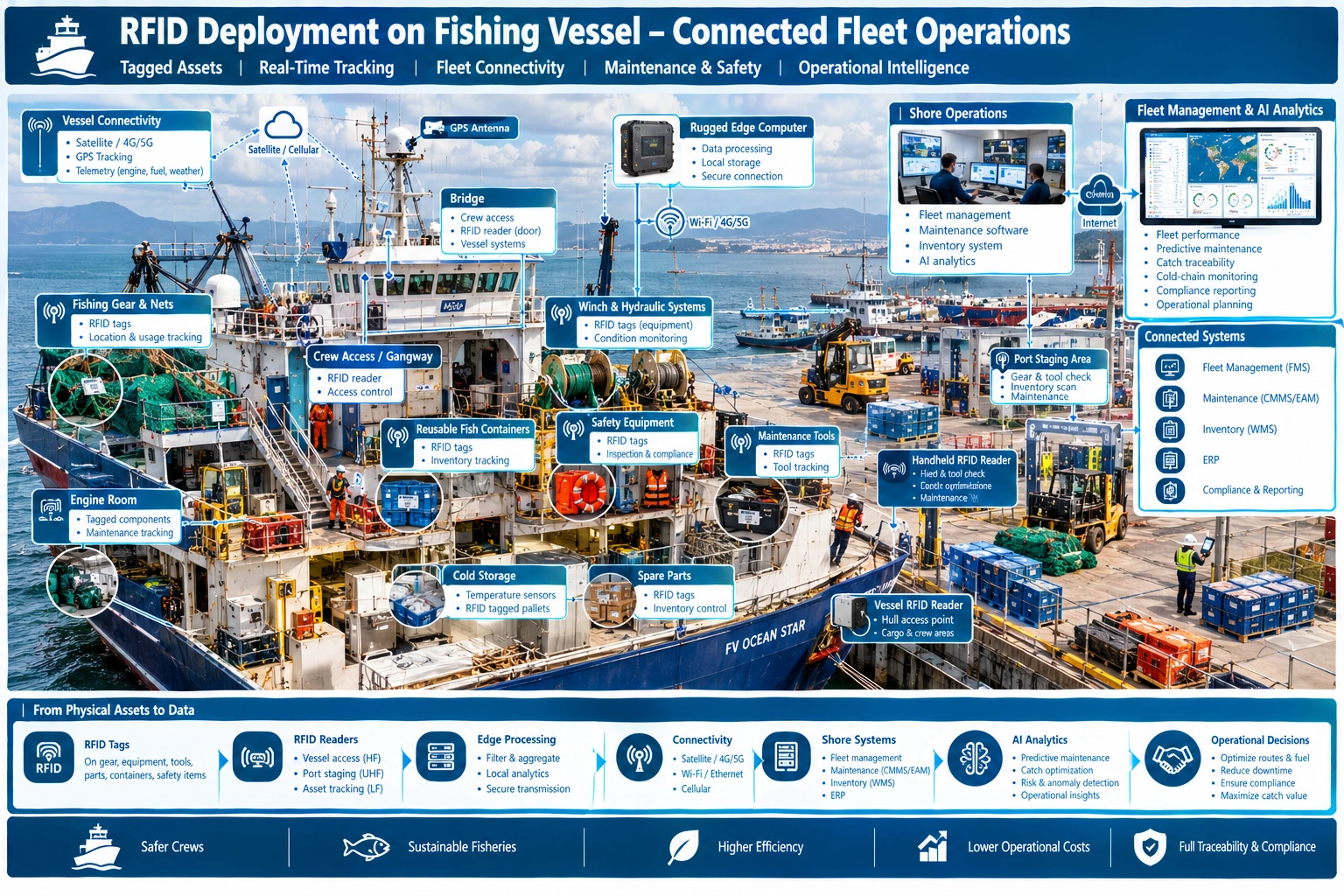
This visual shows RFID deployment aboard a commercial fishing vessel and across port operations. Tagged fishing gear, tools, reusable containers, safety equipment, machinery, and spare parts connect through RFID readers and onboard edge computing to shore-based fleet, maintenance, inventory, and AI systems.
Fishing Fleet Operational Challenges Addressed by AI
Fishing fleets face operational conditions that make conventional asset and maintenance management difficult. These challenges include:
- Distributed assets moving between vessels, ports, workshops, warehouses, and processing locations
- Limited visibility into the current location of tools, spare parts, fishing gear, and reusable handling equipment
- Manual vessel-preparation checklists that depend on crew and shore personnel
- Unplanned propulsion, refrigeration, hydraulic, generator, or auxiliary-equipment failures
- Difficult spare-parts forecasting caused by irregular voyages and variable maintenance demand
- Loss, misplacement, or delayed return of reusable equipment
- Inconsistent maintenance records across vessels and shore facilities
- Intermittent maritime connectivity that limits continuous centralized data access
- Harsh saltwater, vibration, temperature, humidity, and mechanical conditions affecting equipment
- Complex catch-handling and cold-chain workflows
- Regulatory and traceability requirements involving vessel, catch, equipment, and handling records
- Limited personnel availability for manual inventory and inspection activities
- Port congestion and uncertain vessel turnaround times
- Difficulty correlating physical asset movements with maintenance and fleet-management records
- Cybersecurity requirements for connected vessel and shore-side systems
AI does not eliminate these constraints. Its value comes from using available operational data to prioritize exceptions, forecast demand, identify patterns, and assist personnel with decisions.
From RFID Capture to AI-Driven Fishing Fleet Decisions
A practical AI and RFID deployment for fishing fleets should be designed as a complete data workflow rather than as an isolated reader installation.
Physical Data Acquisition
The process begins with physical identification and operational data capture. RFID tags can be attached to selected assets according to material compatibility, environmental exposure, read distance, and expected handling conditions.
UHF RFID is particularly useful where multiple tagged items need to be identified rapidly at controlled shore-side or vessel-access locations. HF RFID can support short-range identification workflows where proximity is intentional. LF RFID may be appropriate for specialized low-frequency identification requirements, especially where its propagation characteristics and operating environment provide an advantage.
RFID should not be applied indiscriminately. High-value, reusable, frequently moved, inspection-sensitive, or operationally critical assets generally provide stronger business value than inexpensive consumables that are difficult to justify tagging individually.
Vessel and Port Connectivity
RFID events can be combined with data from engine monitoring systems, refrigeration equipment, GPS or GNSS positioning, fuel systems, weather services, maintenance systems, and other IoT devices.
Connectivity may include Ethernet, Wi-Fi, cellular networks, satellite communications, serial interfaces, CAN-based vessel equipment interfaces, and other suitable industrial or maritime communications methods. The correct combination depends on vessel design, port infrastructure, bandwidth availability, environmental exposure, and whether data must be transmitted in real time.
A vessel should not be assumed to have continuous high-bandwidth connectivity. A resilient solution can buffer RFID events and operational data locally, synchronize records when connectivity becomes available, and maintain event timestamps so shore-side software can reconstruct the operational sequence.
Edge Processing on Fishing Vessels
Edge processing can reduce dependence on continuous connectivity. A rugged onboard computer can receive RFID reader events and selected equipment data, normalize timestamps, filter duplicate reads, associate identifiers with vessel and voyage records, and forward required information to shore systems.
Edge processing is also useful when a fishing fleet needs immediate local alerts. For example, a missing critical maintenance item or unexpected equipment condition can be surfaced locally without waiting for a remote server.
Middleware and Data Normalization
Middleware connects RFID readers and IoT devices with fleet-management, maintenance, inventory, traceability, and analytics software. It can normalize device identifiers, eliminate duplicate events, validate tag reads, map asset IDs to master records, and route data to appropriate applications.
A well-designed data model should distinguish between the RFID identifier, physical asset identifier, vessel identifier, voyage identifier, location, timestamp, event type, maintenance state, and inventory status. This distinction is important because an RFID tag identifies an object, while an operational database must determine what that object means to the fishing operation.
AI Analytics and Operational Decision Support
Once reliable data are available, AI can evaluate patterns across vessel and shore-side operations. Models may support predictive maintenance, spare-parts forecasting, anomaly detection, vessel-readiness scoring, inventory optimization, route or voyage planning, and operational exception management.
For example, an AI model can identify that a particular class of pump requires replacement more frequently on vessels operating under certain duty cycles. RFID-based part identity and replacement history can provide an additional data dimension, allowing maintenance planners to associate the prediction with the correct physical components.
The AI output should remain operationally interpretable. Maintenance personnel need to understand why a component was prioritized, fleet managers need to know which vessel is affected, and procurement teams need to understand the expected demand.
Technical System Components for AI-Driven Fishing Fleet Operations
The technology stack for fishing fleets should be selected according to the physical operating environment and the decisions the organization needs to improve. RFID hardware provides physical identification, while IoT devices, communications, edge computing, enterprise software, and AI services provide the surrounding operational context.
RFID Hardware for Marine Fleet Environments
Fishing fleets may require rugged RFID tags, fixed readers, integrated antennas, handheld readers, vehicle-mounted readers, and specialized tag mounting methods. Tag selection must account for metal surfaces, liquids, saltwater exposure, vibration, impact, temperature, cleaning procedures, and the required read distance.
GAO supplies RFID, BLE, and other IoT hardware products and systems that can be incorporated into asset identification, inventory, maintenance, and operational workflows. For fishing fleets, engineering selection should begin with the physical asset and operating environment rather than choosing RFID hardware solely from nominal read-range specifications.
Fleet Software and Enterprise Integration
RFID data become substantially more useful when associated with existing fleet-management and maintenance records. Relevant systems can include:
- Fleet management software
- Computerized maintenance management systems
- Enterprise asset management software
- Warehouse and inventory management systems
- Procurement and purchasing software
- Catch documentation and traceability systems
- Cold-chain monitoring software
- Fuel management systems
- Vessel monitoring and positioning systems
- Enterprise resource planning software
- Business intelligence and analytics software
Integration can use APIs, message brokers, database interfaces, industrial gateways, file-based exchange, or other approved enterprise integration methods.
Cloud Version and Server Version for Fishing Fleets
A Cloud Version can be appropriate for fleets operating multiple vessels and geographically distributed shore facilities. Centralized cloud-hosted software can simplify multi-vessel data aggregation, remote analytics, centralized dashboards, software maintenance, and fleet-wide reporting.
A Server Version can be more appropriate when a fishing organization requires privately hosted software, tighter control over operational data, local processing, integration with existing data centers, or operation in environments where external connectivity is constrained. A privately hosted server can reside at a port facility, corporate data center, vessel-support facility, or other customer-controlled infrastructure.
A hybrid deployment is often practical. Critical identification and event processing can operate locally, while selected operational records and analytics are synchronized with centralized software when connectivity is available.
Part 2 continues directly from the Cloud Version and Server Version discussion in Part 1.
AI Methods for Fishing Fleet Operations
AI methods should be selected according to the operational decision being improved rather than added simply because data are available. Fishing fleet deployments can combine several AI techniques:
- Predictive maintenance: Machine learning models analyze equipment condition, operating hours, maintenance history, failure records, and replacement-part data to estimate maintenance requirements for engines, generators, pumps, refrigeration equipment, hydraulic systems, and other machinery.
- Anomaly detection: Models identify unusual fuel consumption, equipment behavior, asset movement, temperature conditions, or maintenance patterns that differ from established operating baselines.
- Demand forecasting: Time-series models estimate future requirements for vessel spare parts, fishing gear, maintenance materials, provisions, and other frequently consumed resources.
- Classification: AI can categorize maintenance events, inventory exceptions, equipment conditions, or operational records according to predefined business rules and historical patterns.
- Optimization: AI-assisted optimization can help fleet planners evaluate vessel schedules, maintenance windows, provisioning requirements, port activities, and resource allocation.
- Computer vision: Where suitable cameras are installed, vision models can assist with selected inspection, catch-handling, equipment-condition, or safety workflows.
- Edge AI: Local models can support time-sensitive decisions on vessels or at ports when connectivity to centralized computing resources is limited.
The strongest implementations establish a clear relationship between the model output and an operational action. A prediction that does not influence maintenance scheduling, inventory replenishment, vessel preparation, or another measurable decision provides limited operational value.
Engineering Considerations for RFID Deployment on Fishing Vessels
Marine conditions introduce engineering constraints that do not exist in a typical indoor warehouse. Saltwater, condensation, vibration, impact, corrosion, electromagnetic interference, metal structures, engine-room temperatures, and frequent cleaning can affect RFID equipment and installation quality.
Tag Selection and Mounting
RFID tag selection should consider the material and geometry of the asset. Tags designed for general-purpose surfaces may perform poorly when mounted directly on metal machinery, near liquids, or around dense mechanical structures.
For fishing fleets, engineering teams should evaluate:
- Tag material and enclosure durability
- IP or equivalent environmental protection requirements
- Resistance to saltwater and corrosion
- Resistance to vibration and impact
- Operating temperature
- Attachment method
- Read performance near metal and liquids
- Required identification distance
- Tag memory requirements
- Asset lifecycle and expected reuse
- Whether the tag can be replaced independently from the asset
Critical serialized assets should generally use a durable identifier that remains associated with the physical asset throughout its service life.
Reader and Antenna Placement
RFID readers should be installed where asset movement naturally concentrates. Examples include vessel stores, maintenance-room entrances, gear staging points, port receiving areas, workshop doors, and controlled equipment handover locations.
Installing readers solely according to theoretical read range can create unreliable results. Metal bulkheads, pipes, machinery, liquids, and human bodies can alter RF behavior. Site testing should therefore be performed using representative tagged assets under actual operating conditions.
Handheld RFID readers can complement fixed installations for inventory reconciliation, vessel inspections, maintenance verification, and exception investigation.
Event Filtering and Data Quality
A reader can generate repeated observations of the same tag. The software layer should distinguish between a meaningful business event and repeated RF observations.
For example, ten reads of a tagged hydraulic component while it remains near a reader do not necessarily represent ten asset movements. Middleware can apply time windows, reader-zone logic, directionality, confidence thresholds, and business rules before creating a movement event.
This distinction becomes especially important when AI models consume RFID data. Poor event normalization can cause an AI system to interpret duplicated reads as excessive asset movement or abnormal activity.
Communication and Data Resilience for Offshore Fishing Fleets
Fishing vessels can operate beyond reliable terrestrial network coverage. A fleet solution therefore needs a communications strategy that separates local operational availability from centralized data availability.
A typical implementation can combine:
- Ethernet for fixed onboard equipment and local servers
- Wi-Fi for handheld readers and authorized crew devices
- Cellular connectivity near shore and in supported operating regions
- Satellite communication for offshore synchronization
- GNSS for vessel position and voyage context
- Serial or industrial interfaces for selected equipment
- Local databases for temporary event storage
- Message queues for asynchronous data transfer
A local-first design allows RFID events, equipment readings, and maintenance transactions to continue when the vessel is offline. Once connectivity returns, the edge system can synchronize records with the shore-side service.
Time synchronization is also important. Vessel clocks, RFID readers, edge computers, and centralized systems should use controlled time sources so that maintenance, asset movement, temperature, positioning, and voyage events can be correctly correlated.
Cybersecurity for Connected Fishing Fleet Systems
Connected vessels and shore facilities increase the number of systems that require cybersecurity controls. RFID itself is only one part of the security boundary. The wider environment can include edge computers, network gateways, handheld devices, vessel-management software, APIs, cloud services, private servers, maintenance systems, and corporate IT networks.
Fishing fleet deployments should consider:
- Unique credentials for readers, gateways, edge computers, and software services
- Role-based access for vessel crews, maintenance personnel, fleet managers, procurement teams, and administrators
- Encryption for data transmitted between vessels and shore systems
- Encryption for sensitive stored operational records where required
- Secure API authentication
- Network segmentation between vessel operational equipment and general-purpose IT systems
- Controlled remote administration
- Firmware and software patch management
- Device inventory and configuration management
- Audit logging for administrative and operational changes
- Backup and recovery procedures
- Detection of abnormal network or application behavior
- Secure retirement and replacement of RFID readers and edge computers
Cybersecurity controls should be proportionate to the operational consequence of compromise. Systems affecting propulsion, safety, refrigeration, navigation, or other critical vessel functions require particularly careful separation and change-control procedures.
GAO can support organizations with RFID, BLE, and IoT hardware products and systems while engineering teams determine how those devices should be integrated into the customer’s security and network-control environment.
Regulatory and Standards Considerations for Fishing Fleets
Fishing fleet technology programs frequently intersect with vessel monitoring, catch documentation, food traceability, worker safety, maritime communications, equipment inspection, data protection, and fisheries-management requirements. Applicable requirements vary according to vessel flag, fishing region, species, operating area, customer requirements, and jurisdiction.
Relevant regulatory and standards domains can include:
- Fisheries management and catch reporting requirements
- Vessel monitoring and positioning requirements
- Electronic catch documentation
- Food traceability and cold-chain requirements
- Maritime radio and communications requirements
- Vessel safety requirements
- Occupational safety requirements
- Port and terminal operating requirements
- Hazardous-area requirements where applicable
- Electrical and electromagnetic compatibility requirements
- RFID spectrum and radio-equipment regulations
- Cybersecurity requirements applicable to connected maritime systems
- Data protection and privacy requirements
- Equipment inspection and maintenance documentation
- Customer-specific chain-of-custody requirements
RFID does not automatically make an operation compliant. The system should instead provide accurate, timestamped, auditable records that can support the applicable compliance process.
Engineering teams should validate the exact requirements with the relevant maritime authority, fisheries regulator, classification organization, port authority, and legal or compliance specialists before deployment.
Fishing Fleet KPIs Improved by AI-Enabled Asset Visibility
A successful deployment should be evaluated through operational measurements rather than RFID read counts alone.
| KPI | AI and RFID Contribution |
|---|---|
| Vessel readiness rate | Verifies required equipment and supplies before departure |
| Unplanned equipment downtime | Predictive models identify potential failures earlier |
| Maintenance schedule compliance | Links physical components with maintenance records |
| Mean time to repair | Helps maintenance teams locate required tools and parts |
| Spare-parts stockout rate | Forecasts vessel-specific demand |
| Inventory accuracy | Automates identification of selected physical assets |
| Gear utilization | Tracks movement and assignment of reusable gear |
| Asset search time | Provides more reliable last-known movement information |
| Port turnaround time | Identifies staging and preparation bottlenecks |
| Cold-chain exception rate | Correlates container and handling events with temperature records |
| Catch traceability completeness | Associates physical handling assets with operational records |
| Fuel consumption variance | AI identifies unusual consumption patterns |
| Maintenance cost per vessel | Supports condition-based maintenance planning |
| Asset loss rate | Improves accountability for selected high-value items |
| Inspection completion rate | Identifies equipment requiring inspection or verification |
Additional measurements can include false-read rate, missed-read rate, synchronization latency, data completeness, AI alert precision, alert response time, and system availability.
Implementation Strategy for AI and RFID in Fishing Fleets
A phased deployment is usually more effective than attempting to tag every physical object across a fleet immediately.
Planning and Asset Prioritization
Start by mapping the fishing fleet’s highest-value operational problems. A fleet may discover that spare-parts availability, vessel readiness, maintenance tools, or reusable fishing gear produces a stronger return than general-purpose asset tagging.
Create an asset hierarchy that distinguishes:
- Vessel
- Equipment
- Subsystem
- Serialized component
- Tool
- Fishing gear
- Spare part
- Consumable
- Reusable container
- Maintenance kit
Each physical identifier should map to a controlled master record.
Site Survey and Pilot Design
A pilot should represent actual marine conditions. Testing only in an office or warehouse can produce misleading RFID performance results.
The pilot should evaluate representative assets in:
- Vessel stores
- Engine-room environments
- Gear storage
- Maintenance workshops
- Port receiving areas
- Outdoor staging locations
- Cold-storage areas where relevant
Test cases should include normal movement, blocked reads, multiple simultaneous tags, wet conditions, metal-mounted tags, handheld scanning, and offline operation.
Integration and Commissioning
Integration should begin after asset identifiers, business rules, and system interfaces have been defined. The commissioning process should verify:
- Correct tag-to-asset association
- Reader configuration
- Antenna positioning
- Event filtering
- Timestamp accuracy
- Vessel identification
- User permissions
- Offline data buffering
- Synchronization behavior
- API or database integration
- Maintenance-record association
- Inventory status updates
- AI data pipelines
- Alert generation
- Audit logging
Operational personnel should participate in acceptance testing because technically correct RFID reads do not necessarily mean that the resulting business event is correct.
Scaling AI and RFID Across a Fishing Fleet
Once a pilot has demonstrated measurable value, scaling should preserve standardization while allowing for differences between vessel classes.
A large fishing fleet may contain vessels with different layouts, machinery, operating profiles, communication capabilities, and maintenance practices. A single physical RFID installation cannot necessarily be copied without modification.
A scalable program should standardize:
- Asset identifier conventions
- RFID tag naming and association rules
- Data schemas
- Reader configuration principles
- Event definitions
- User roles
- API interfaces
- Cybersecurity controls
- Maintenance workflows
- KPI definitions
- AI model governance
The physical installation can then be adapted to each vessel while maintaining common software and data definitions.
AI models should also be monitored after deployment. Equipment behavior can change because of vessel age, operating region, maintenance practices, engine replacement, seasonal activity, or changes in fishing methods. Model performance should therefore be periodically evaluated rather than treated as permanently fixed.
Business Value of AI-Driven Fishing Fleet Management
Combining AI with reliable physical asset identification can improve fishing fleet operations in several connected ways.
- Higher vessel readiness: Identification events can verify that critical equipment, parts, tools, and supplies have reached the correct vessel before departure.
- Lower maintenance disruption: AI can prioritize maintenance based on historical and current operating conditions, while RFID helps identify the relevant physical component.
- Improved inventory control: Tagged parts and equipment can provide more accurate physical inventory records, while demand forecasting supports replenishment planning.
- Better port coordination: Asset movement data can expose delays in staging, provisioning, gear preparation, and maintenance handover.
- Improved traceability: Physical identification events can strengthen the relationship between containers, handling assets, operational events, and digital records.
- Reduced asset loss: Accountability improves when selected high-value tools, equipment, and reusable assets have identifiable movement histories.
- More effective fleet planning: AI can combine maintenance, inventory, vessel, and operational data to help managers prioritize resources across multiple vessels.
- Greater operational resilience: Edge processing and local data storage allow important workflows to continue during intermittent offshore connectivity.
- Improved decision quality: Fleet managers can act on exception-based information rather than manually reviewing large volumes of disconnected records.
The financial impact depends on fleet size, asset value, maintenance costs, port turnaround requirements, existing software, connectivity costs, and the percentage of physical assets that can be reliably identified.
Practical Recommendations for Fishing Fleet AI and RFID Projects
Fishing fleet organizations considering an AI-enabled RFID program should focus first on operational outcomes.
- Select a small number of measurable use cases with identifiable financial or operational impact.
- Prioritize high-value, reusable, mobile, inspection-sensitive, or mission-critical assets.
- Perform RFID testing with actual vessel materials and representative equipment.
- Treat metal and liquid environments as RF engineering considerations rather than installation afterthoughts.
- Design for intermittent vessel connectivity from the beginning.
- Separate RFID observations from validated business events through middleware.
- Integrate physical asset identity with fleet, maintenance, inventory, and procurement records.
- Establish data-quality controls before training AI models.
- Keep AI recommendations explainable to vessel engineers, maintenance supervisors, and fleet managers.
- Validate AI models against real fleet outcomes rather than relying solely on statistical accuracy.
- Implement cybersecurity controls across the complete connected system, not only the RFID layer.
- Establish common data definitions before expanding to multiple vessels.
- Measure operational KPIs before and after deployment to establish a credible business case.
- Train vessel crews and shore personnel on the operational purpose of the system, not only the reader hardware.
- Review tag and reader performance periodically as vessel equipment, layouts, and workflows change.
How GAO Supports Fishing Fleet RFID and AIoT Deployments
GAO provides RFID, BLE, and IoT hardware products and systems that can support physical asset identification, inventory visibility, equipment monitoring, and connected operational workflows. Our engineering approach can be applied to fishing-fleet requirements involving vessel equipment, maintenance resources, spare parts, fishing gear, reusable containers, and shore-side logistics.
GAO’s experience supplying technology to organizations in the United States and Canada includes Fortune 500 companies, research and development organizations, universities, and government agencies. GAO’s operations are headquartered in New York City and Toronto, Canada, with a long history of investment in product and system research and development, quality assurance, and remote or onsite technical support.
For a fishing fleet, the appropriate solution depends on vessel configuration, asset types, operating region, connectivity, regulatory requirements, existing software, and the operational KPIs being targeted. Technical evaluation should therefore precede hardware standardization.
Key Takeaways for AI-Enabled Fishing Fleet Operations
AI-driven fishing fleet management becomes more effective when physical assets can be identified reliably and connected to the operational records that describe their condition, location, assignment, maintenance history, and use.
RFID provides a practical identification layer for selected fishing-fleet assets, while IoT devices and vessel systems provide operational context. Edge computing supports local processing when vessels operate beyond reliable terrestrial connectivity. Enterprise software connects asset events with maintenance, inventory, fleet, procurement, and traceability workflows. AI then analyzes these combined datasets to support predictive maintenance, demand forecasting, anomaly detection, readiness assessment, and operational planning.
The strongest deployment strategy begins with a defined fishing-fleet problem, validates the physical environment, establishes data quality, integrates with existing software, and measures operational results before scaling across vessels.
Organizations evaluating these applications can learn more about GAO’s RFID, BLE, and IoT hardware products, systems, engineering capabilities, and technical support for marine and fishing-fleet requirements.
Building the Future of Industrial AI and IoT with Aperture Venture Studio and GAO RFID Inc.
For more than three decades, GAO Group of Companies has invested heavily in R&D for industrial RFID, BLE, and IoT. As generative AI became increasingly useful in industrial applications, we expanded our work across AI and IoT, including RFID and BLE, and founded Aperture Venture Studio to build and scale AI and IoT capabilities relevant to industries such as fishing fleets and marine operations.
Aperture has attracted AI and IoT technical experts, entrepreneurial and operational executives, influential investors, and leading companies. We have also developed Aperture Ventures Summit and TekSummit to discuss advanced AI and IoT topics and foster technical communities.
We welcome participation as:
- Advisors, co-founders, or employees
- Investors
- Customers