
AI and RFID for Sawmills
AI-Driven Sawmill Operations and RFID-Based Traceability
AI-driven sawmill operations use connected equipment data, machine learning, computer vision, Industrial AI, and RFID-based identification to improve how logs, lumber, work-in-process materials, mobile assets, and production activities are tracked and managed. In a sawmill, RFID acts primarily as a reliable identification and data-capture technology, while AI converts operational data into predictions, recommendations, anomaly detection, and increasingly automated decisions.
Modern sawmills must manage log-yard inventory, species segregation, log scaling, primary breakdown, edging, trimming, grading, drying, finished-lumber inventory, maintenance, and shipment coordination. These processes generate fragmented data across scanners, PLCs, mill equipment, RFID readers, moisture sensors, cameras, MES software, and ERP systems. AI helps connect these operational signals to identify bottlenecks, predict equipment failures, optimize lumber recovery, and improve material flow.
For sawmills handling high volumes and variable timber characteristics, the combination of AI and RFID supports better traceability from log receipt through finished-product dispatch. GAO supplies RFID, BLE, and IoT hardware and systems that can support these connected sawmill applications.
AI and RFID Deployment in Modern Sawmill Operations
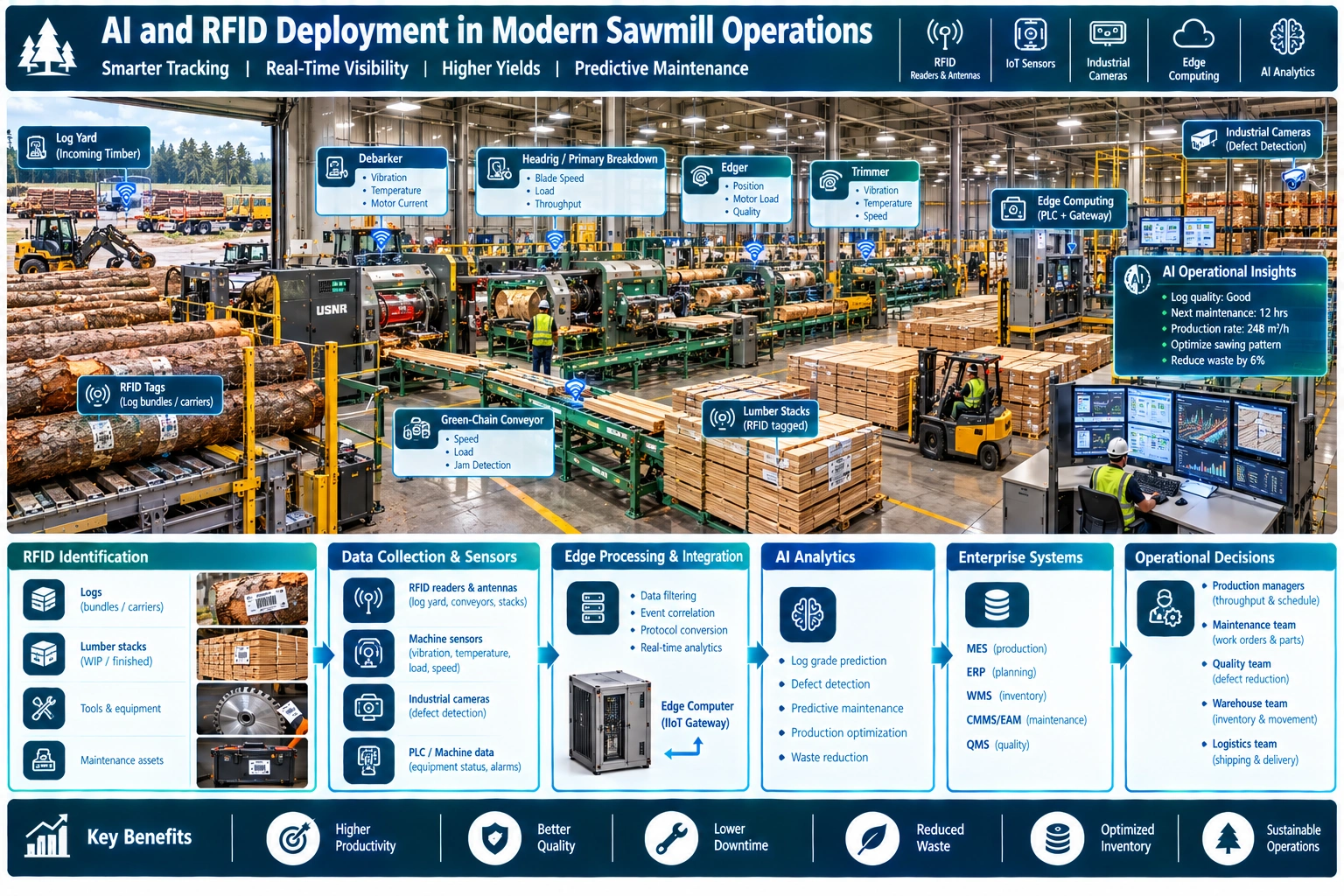
This visual depicts a realistic modern sawmill where RFID-tagged timber moves through log handling, debarking, primary breakdown, edging, trimming, and green-chain conveyors. RFID readers, industrial sensors, cameras, PLC-connected equipment, and edge computing support machine monitoring, production analytics, log tracking, and AI-driven operational recommendations.
Understanding AI-Enabled RFID Systems in Sawmills
RFID Provides Identity and Event Data for Sawmill AI
AI applications require dependable operational data. RFID can provide persistent or event-based identification for assets and materials moving through selected points in a sawmill. Depending on the application, UHF RFID, HF RFID, and LF RFID may be used for equipment identification, reusable carriers, maintenance tools, lumber bundles, kiln assets, mobile equipment, and controlled production processes.
A sawmill RFID implementation should not assume that every individual log requires the same tagging approach. Bark condition, moisture, rough handling, impact, tag attachment methods, reading distance, metal machinery, stacked timber, and conveyor speed must all be evaluated during engineering and commissioning.
Typical RFID data events can include:
- Asset identity
- Reader location
- Timestamp
- Direction of movement
- Production checkpoint
- Operator or equipment association
- Maintenance status
- Inventory status
- Process completion event
AI models can combine these RFID events with data from PLCs, vibration sensors, motor-current monitoring, moisture meters, laser scanners, machine vision systems, log scanners, and production databases.
AI Converts Sawmill Data into Operational Decisions
Artificial Intelligence of Things, or AIoT, combines AI with IoT devices, connected equipment, sensors, and industrial systems. Within sawmills, AIoT can support Industrial AI, Edge AI, machine learning, computer vision, and predictive analytics.
Rather than simply reporting that a lumber bundle passed an RFID checkpoint, an AI system can analyze whether:
- The bundle is moving according to the production schedule.
- Work-in-process inventory is accumulating before the kiln or planer mill.
- A machine stoppage is creating downstream congestion.
- Lumber drying data indicates elevated degradation risk.
- A critical asset is missing from its assigned maintenance area.
- Production throughput differs from the expected cutting plan.
- Machine vibration and production conditions indicate an emerging failure.
The value comes from connecting material identity with machine conditions and process context. A sawmill manager can therefore move beyond isolated RFID read events toward actionable operational intelligence.
Why This Combination Matters for Modern Sawmills
Sawmills operate with significant variability. Log diameter, taper, species, moisture content, defects, grade requirements, saw performance, blade condition, and downstream demand can all affect production results. Fixed process assumptions often fail when timber characteristics change.
AI can analyze this variability at scale, while RFID can strengthen visibility for selected physical assets and process events. The result is improved traceability and better data continuity between the log yard, primary breakdown, secondary processing, lumber drying, finished-goods storage, and shipping.
GAO has helped organizations deploy RFID and IoT hardware products and systems where dependable identification and operational data capture are required, including demanding industrial environments that require careful reader placement, tag selection, and integration planning.
High-Value AI Applications Across Sawmill Operations
AI Log Yard Management and Timber Inventory Visibility
The log yard is one of the most operationally challenging areas of a sawmill. Incoming timber must be received, measured, classified, stored, and retrieved while maintaining visibility into species, supplier, purchase information, log characteristics, and available inventory.
AI can analyze log inventory records, production demand, historical consumption, weather conditions, and yard movement patterns to improve inventory planning. RFID can identify reusable log-handling assets, marked loads, equipment, or other traceable units where practical.
Relevant applications include:
- AI-assisted log inventory forecasting
- Supplier and timber-source data analysis
- Log-yard congestion detection
- Mobile-equipment utilization analysis
- Production-demand forecasting
- Inventory aging analysis
- Material-location verification
- Yard movement optimization
A practical deployment may combine RFID checkpoints with GNSS or RTLS technologies for mobile equipment when broader location visibility is required. RFID should be selected where controlled identification points and reliable asset association provide greater value than continuous positioning.
AI Production Optimization for Primary Breakdown
Primary breakdown converts logs into cants, boards, slabs, and other products. The process depends on log geometry, defects, scanning accuracy, sawing patterns, equipment condition, and production requirements.
AI can analyze historical cutting results and machine data to identify patterns affecting lumber recovery and throughput. Computer vision and optimization algorithms can supplement existing scanning and optimization systems by detecting anomalies and evaluating production outcomes.
Operational improvements can include:
- Improved cutting-plan analysis
- Lumber recovery monitoring
- Saw deviation detection
- Bottleneck identification
- Throughput forecasting
- Production variance analysis
- Downtime root-cause analysis
- Work-order prioritization
RFID can provide supporting traceability for reusable production assets, carts, carriers, tooling, and selected material units rather than replacing specialized log-scanning systems.
Predictive Maintenance for Sawmill Equipment
Sawmill equipment experiences vibration, shock loading, sawdust exposure, heat, lubrication challenges, and heavy-duty operating conditions. Unplanned failure of a headrig, bandsaw, chipper, edger, planer, conveyor drive, hydraulic system, or critical motor can disrupt production and create significant downstream losses.
AI-driven predictive maintenance analyzes equipment signals such as:
- Vibration spectra
- Bearing temperature
- Motor current
- Hydraulic pressure
- Lubrication condition
- Acoustic signatures
- Runtime hours
- Production load
- Alarm history
- Maintenance records
RFID can strengthen maintenance workflows by identifying maintenance tools, replaceable components, inspection equipment, and reusable assets. Maintenance technicians can associate inspections and repair activities with specific machines or components using RFID-enabled identification processes.
GAO can supply RFID hardware that supports asset identification and maintenance data collection as part of broader industrial IoT systems.
AI Predictive Maintenance Workflow for Sawmill Equipment
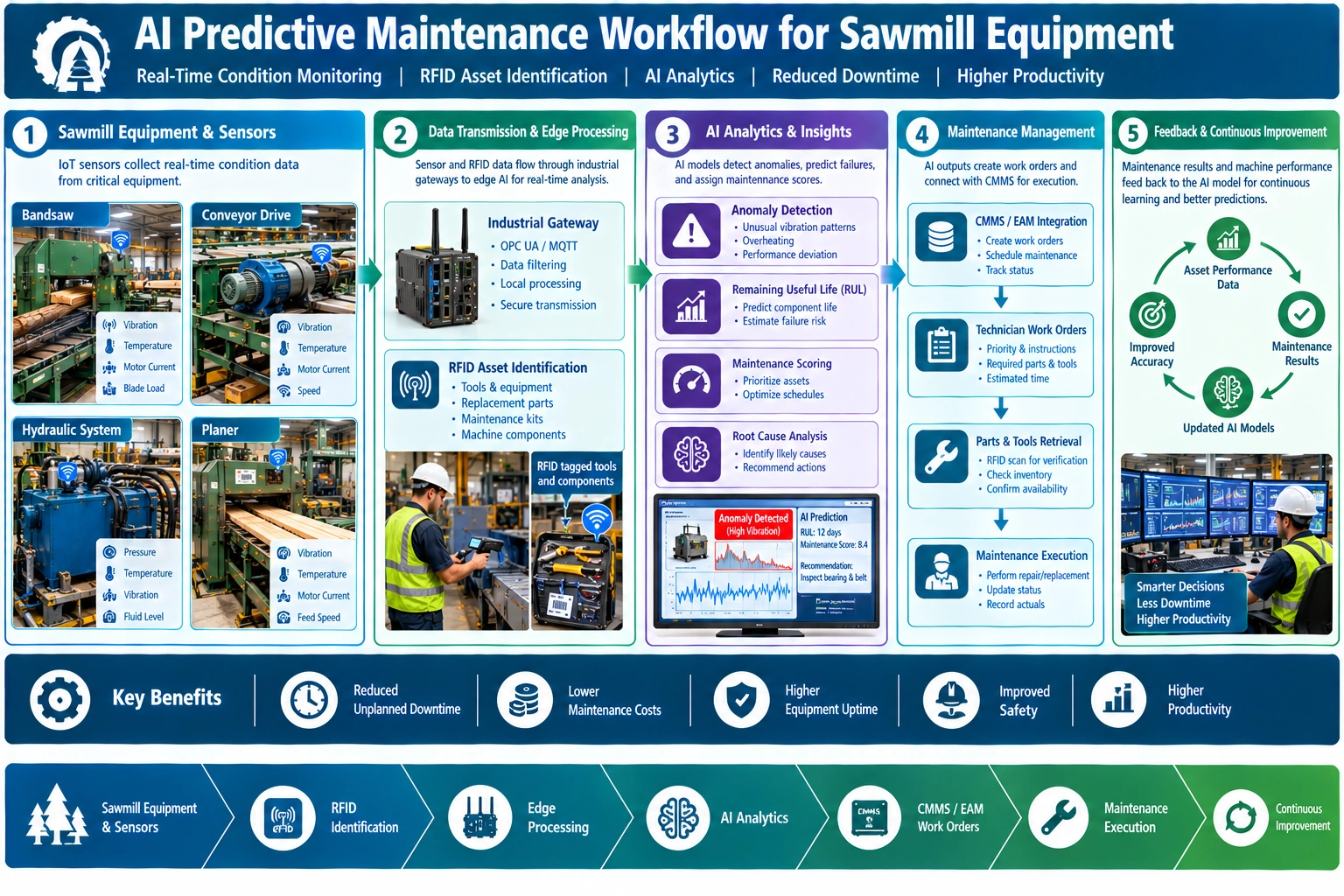
This workflow shows condition data from bandsaws, conveyor drives, hydraulic systems, and planers flowing through industrial gateways into edge AI processing. RFID-tagged tools and replacement components are scanned during maintenance, while AI anomaly detection, maintenance scoring, CMMS work orders, and technician feedback create a continuous predictive maintenance cycle.
AI Lumber Flow and Work-in-Process Management
Material flow problems can occur when green lumber accumulates before sorting, drying, planing, grading, or packaging. Sawmill production departments may operate at different speeds, causing work-in-process inventory to grow without immediate visibility into the source of the constraint.
AI can analyze RFID events, conveyor information, machine production counts, scanner data, and MES records to identify:
- Queue formation
- Production starvation
- Recurring bottlenecks
- Excessive material dwell time
- Conveyor disruptions
- Kiln scheduling conflicts
- Unexpected work-in-process accumulation
The AI system can recommend production changes based on current operating conditions instead of relying only on historical schedules.
AI Quality Control and Lumber Grading
Computer vision is particularly relevant to sawmill quality control. Cameras and AI models can analyze lumber surfaces for visible defects and process abnormalities, subject to the accuracy requirements of the grading application and applicable grading rules.
Potential AI-assisted inspection activities include:
- Knot detection
- Surface-defect detection
- Wane identification
- Crack and split detection
- Stain detection
- Dimension verification
- Edge-quality analysis
- Packaging-quality inspection
These systems should supplement qualified grading processes and be validated against the applicable product specifications and grading standards. AI outputs require confidence thresholds, quality controls, and human review procedures where production or commercial decisions carry significant consequences.
Kiln Drying Intelligence and Moisture Management
Lumber drying is a critical stage affecting product quality, value recovery, and energy consumption. AI can analyze kiln schedules, moisture measurements, temperature, relative humidity, airflow, species, lumber dimensions, and historical drying results.
AI models may help identify:
- Drying-cycle deviations
- Excessive drying time
- Moisture variability
- Elevated degrade risk
- Energy consumption anomalies
- Kiln loading patterns
- Potential schedule optimization opportunities
RFID can identify reusable kiln assets, handling equipment, or traceable lumber packages when environmental conditions and tag selection permit reliable operation.
The Sawmill Data-to-Decision Workflow
An effective AI and RFID system for sawmills follows a complete data lifecycle. The solution should be engineered around actual material movement, equipment boundaries, communication reliability, and operational decision points rather than adding disconnected sensors.
Data Acquisition at the Log Yard and Production Floor
Data acquisition begins with the physical processes that need to be monitored. Typical sources include:
- RFID readers and antennas
- UHF, HF, or LF RFID tags selected for specific assets
- PLCs and programmable automation controllers
- Vibration sensors
- Temperature sensors
- Motor-current sensors
- Hydraulic pressure sensors
- Moisture meters
- Laser measurement systems
- Industrial cameras
- Log scanners
- Conveyor encoders
- Machine alarms and event logs
Each source should have a documented purpose. Collecting large volumes of sensor data without a defined maintenance, quality, throughput, or traceability objective increases storage and integration complexity without necessarily improving decisions.
Industrial Communication and Data Transport
Sawmills commonly contain equipment from different generations and manufacturers. Communication infrastructure may therefore include Ethernet networks, industrial Wi-Fi, fiber connections, serial interfaces, and industrial communication protocols.
Relevant protocols and interfaces may include:
- OPC UA
- Modbus TCP
- EtherNet/IP
- PROFINET
- MQTT
- REST APIs
- SQL database connectors
- Vendor-specific machine interfaces
RFID middleware should filter duplicate reads and convert raw reader events into meaningful business events. For example, repeated tag reads from an antenna should not automatically create multiple inventory movements.
Network design must account for sawdust, vibration, long production buildings, electrical interference, and physical obstructions. Industrial network segmentation and managed switches may be required to separate operational technology from business IT systems.
Edge Processing for Time-Sensitive Sawmill Decisions
Edge computing is useful when sawmill processes require low-latency analysis or when internet connectivity is intermittent. An industrial edge server can process RFID events, sensor streams, camera data, and machine signals close to the production floor.
Typical edge functions include:
- RFID event filtering
- Sensor data normalization
- Local database buffering
- Machine-learning inference
- Computer vision processing
- Anomaly detection
- Alarm generation
- PLC or HMI integration
Edge AI does not eliminate the need for centralized analytics. Instead, it allows immediate processing where sending all raw production data to a remote location would create latency, bandwidth, cost, or reliability concerns.
AI Analytics and Decision Processing
Once operational data is normalized, AI models can perform several analytical functions.
Machine-learning models can forecast equipment conditions or production output. Anomaly-detection models can identify unusual vibration patterns or throughput changes. Optimization algorithms can evaluate production schedules and material flow. Computer vision models can inspect visible lumber characteristics.
AI outputs should be linked to clear business actions, such as:
- Create a maintenance inspection request.
- Notify the production supervisor.
- Recommend equipment inspection.
- Flag abnormal work-in-process accumulation.
- Escalate a potential quality issue.
- Update production forecasts.
- Recommend a revised material sequence.
The strongest implementations define who receives the AI recommendation, what evidence accompanies it, and whether a human or automated control system is authorized to act.
Integration with Sawmill Software and Business Systems
Operational intelligence becomes more useful when connected to existing software. Depending on the mill, integration may involve:
- Manufacturing execution systems
- ERP software
- Production planning software
- Log-scaling and timber-management software
- Maintenance management systems
- Quality management systems
- Warehouse management software
- SCADA systems
- Historian databases
- Business intelligence software
Integration should use documented APIs, database interfaces, or industrial middleware wherever possible. Direct modifications to machine-control systems should be carefully governed to avoid introducing production or safety risks.
RFID, AI Models, Software, and Deployment Components for Sawmills
A sawmill AIoT solution requires coordinated hardware, software, communication infrastructure, security controls, and AI processing. Component selection should follow the operational problem being solved rather than deploying technology broadly without a defined use case.
RFID Hardware for Harsh Sawmill Conditions
RFID hardware selection begins with the physical environment and identification requirement.
UHF RFID is generally suitable for longer-range identification at controlled portals, conveyor points, equipment zones, and asset-tracking locations where tag orientation and material conditions permit reliable reading. HF RFID may be appropriate for shorter-range, controlled identification workflows. LF RFID can be considered for specialized short-range applications where environmental characteristics and existing equipment requirements support its use.
A site survey should evaluate:
- Read distance requirements
- Tag orientation
- Tag mounting methods
- Moisture exposure
- Temperature conditions
- Mechanical impact
- Metal interference
- Dense timber stacking
- Reader mounting locations
- Conveyor speed
- Electrical interference
GAO can assist organizations by supplying RFID readers, antennas, tags, and supporting hardware appropriate to defined operational requirements.
AI Models for Sawmill Operations
Different sawmill problems require different AI methods.
Predictive maintenance commonly uses time-series analysis, anomaly detection, classification, and regression models. Production optimization may use optimization algorithms and forecasting models. Computer vision applications use machine-learning models trained on images captured under representative mill conditions.
Model performance should be evaluated using sawmill-specific operational data. A model trained using clean laboratory data may perform poorly when exposed to sawdust, variable lighting, timber surface variation, vibration, or changing equipment operating conditions.
Cloud Version
The Cloud Version uses cloud-hosted software managed within cloud infrastructure. RFID events and processed operational data can be transmitted securely from sawmill gateways or edge servers to centralized cloud software.
This approach is generally appropriate when:
- Multiple sawmills require centralized reporting.
- Corporate teams need cross-site analytics.
- Historical data volumes support centralized AI training.
- IT teams prefer managed infrastructure.
- Remote experts require controlled access to operational information.
Cloud deployments should use encrypted communications, identity management, access controls, audit logging, backups, and clearly defined data-retention policies. Raw high-volume camera streams may still be processed locally before selected results are transferred to cloud software.
Server Version
The Server Version deploys software on customer-managed servers, edge servers, private data centers, factory servers, or other privately hosted infrastructure. This model is useful when a sawmill requires greater control over operational data, local processing continuity, or integration with privately hosted business systems.
A Server Version may be appropriate when:
- Production must continue during internet interruptions.
- Low-latency processing is required.
- Data-residency requirements limit external hosting.
- Existing sawmill software is privately hosted.
- High-volume machine or camera data is processed locally.
Server deployments require defined responsibilities for patching, backups, cybersecurity monitoring, server capacity, and disaster recovery.
Security and Supporting Infrastructure
Cybersecurity should be designed into the sawmill solution from commissioning onward. Recommended controls include:
- Network segmentation between operational technology and business systems
- Role-based access control
- Multi-factor authentication for remote access where appropriate
- Encrypted data transmission
- Device identity management
- Secure gateway configuration
- Software patch management
- Centralized logging
- Backup and recovery procedures
- Restricted remote administration
- Continuous monitoring of critical systems
Security controls should be balanced against operational requirements. Production systems must remain available and maintain safe operation even when analytics, cloud connectivity, or AI services experience disruption.
Key Technical Capabilities and Business Value for AI-Enabled Sawmills
AI applications supported by RFID, IoT sensors, machine data, and connected sawmill systems can improve decisions across production, maintenance, inventory, and quality operations. The greatest value is achieved when each technology is connected to a measurable operational problem.
Improved Material Traceability and Inventory Accuracy
Sawmills manage logs, cants, green lumber, kiln loads, finished lumber, reusable handling assets, maintenance tools, and mobile equipment. Visibility can decline when materials move between outdoor yards, conveyors, sorting areas, kilns, warehouses, and shipping locations.
RFID-supported identification can create reliable event records at selected operational checkpoints. AI can analyze these records alongside production schedules and inventory data to identify unexpected movement patterns, inventory discrepancies, material dwell time, and process delays.
This improves operational visibility because the system can associate physical movement events with production context rather than treating each identification event as an isolated transaction.
Practical benefits include:
- Improved visibility into selected lumber and production assets
- Reduced manual inventory verification
- Faster investigation of missing or delayed assets
- Better work-in-process monitoring
- Improved reconciliation between physical operations and software records
- More accurate production and inventory forecasts
Reduced Unplanned Equipment Downtime
Predictive maintenance is one of the highest-value Industrial AI applications for sawmills because equipment failures can interrupt multiple downstream operations.
AI models can identify abnormal patterns before a failure becomes operationally significant. Combining machine-condition data with maintenance history, runtime, production loading, and repair records can improve maintenance prioritization.
The improvement occurs because maintenance teams receive earlier evidence of potential degradation rather than relying exclusively on fixed inspection intervals or reactive alarms.
Potential results include:
- Earlier detection of bearing degradation
- Identification of abnormal motor loading
- Improved planning of equipment inspections
- Reduced emergency maintenance activity
- Better spare-parts planning
- Improved maintenance labor utilization
- More consistent equipment availability
RFID can support these workflows by identifying maintenance tools, replacement parts, inspection devices, and reusable assets associated with maintenance activities.
Better Lumber Recovery and Production Performance
Lumber recovery depends on numerous variables, including log dimensions, species, taper, internal and external defects, sawing accuracy, blade condition, machine alignment, and production strategy.
AI can analyze production records to identify relationships between operating conditions and recovery outcomes. Optimization models can support production planning by comparing expected and actual yields.
Useful production intelligence may include:
- Recovery variance by log class
- Throughput variation by shift
- Saw performance trends
- Excessive trim loss
- Rework patterns
- Production bottlenecks
- Downtime effects on output
- Differences between planned and actual lumber volume
The objective is not simply to collect more production data. AI should help production teams understand why recovery or throughput changes and which corrective action is likely to have the greatest operational value.
Faster Detection of Quality Problems
Quality problems discovered late in the production process can increase rework, downgrade rates, material losses, and customer claims.
Computer vision and machine-learning models can continuously analyze images from selected production points. These systems can identify visible anomalies and send exceptions to operators or quality personnel.
AI-assisted quality systems can improve response time because inspection information is processed continuously instead of waiting for manual review or downstream detection.
Engineering teams should establish:
- Image-quality requirements
- Camera positioning standards
- Lighting controls
- Model confidence thresholds
- Human-review procedures
- Validation datasets
- Model retraining processes
- Quality escalation rules
AI should be deployed as part of a controlled quality process, particularly where automated results influence lumber grade, commercial value, or customer specifications.
More Efficient Kiln Operations
Kiln drying involves energy consumption, production scheduling, moisture control, species characteristics, lumber dimensions, airflow, and product-quality requirements.
AI can identify patterns in historical kiln data that may not be obvious through manual analysis. Forecasting and anomaly-detection models can help operators investigate unusual drying conditions earlier.
Potential benefits include:
- Reduced drying-cycle variability
- Improved moisture consistency
- Earlier identification of process deviations
- Better kiln scheduling
- Reduced unnecessary energy consumption
- Improved analysis of drying defects
Results depend heavily on accurate moisture measurement, consistent sensor calibration, representative historical data, and operator knowledge.
Scalable Multi-Sawmill Intelligence
Organizations operating multiple sawmills often face inconsistent data definitions, different machine generations, and varying software environments.
A standardized AIoT system can normalize selected data across sites while preserving local operational requirements. Central teams can compare production trends, equipment conditions, and inventory performance while each mill continues using appropriate local controls.
Scalability can be improved through:
- Standardized data models
- Reusable RFID configurations
- Common equipment-monitoring templates
- Consistent KPI definitions
- Centralized AI model governance
- Site-specific edge processing
- Repeatable cybersecurity procedures
GAO supports organizations with RFID, BLE, and IoT hardware and systems that can form part of repeatable deployments across multiple operational locations.
Operational KPIs for AI and RFID Sawmill Projects
AI and RFID projects should begin with measurable performance objectives. Sawmill teams should establish baseline values before deployment and measure changes using consistent definitions.
Relevant KPIs can include:
- Lumber recovery percentage
- Log-to-lumber conversion performance
- Production throughput
- Board feet produced per shift
- Machine availability
- Overall equipment effectiveness
- Unplanned downtime hours
- Mean time between failures
- Mean time to repair
- Maintenance backlog
- Work-in-process inventory
- Inventory-record accuracy
- Material dwell time
- Kiln cycle duration
- Moisture-content variation
- Lumber degrade rate
- Quality rejection rate
- Rework volume
- Downgrade rate
- Energy consumption per production unit
- RFID read reliability
- RFID exception rate
- Asset search time
- Production schedule adherence
- Conveyor utilization
- Mobile-equipment utilization
- Data-processing latency
- AI model precision
- AI model recall
- Operator response time to AI-generated alerts
KPI selection should reflect the specific sawmill application. A predictive-maintenance project should not be judged primarily by RFID read volume, while an inventory-traceability project should not be evaluated solely by machine-learning accuracy.
Engineering Considerations for Deploying AI and RFID in Sawmills
Successful deployments depend on detailed site engineering. Sawmills present physical and operational conditions that can affect identification performance, sensor reliability, communication systems, and AI data quality.
Start with Process Mapping
Before selecting readers, tags, sensors, or AI software, engineering teams should map the physical workflow.
The process map should identify:
- Log receiving points
- Log storage zones
- Material movement routes
- Primary breakdown equipment
- Secondary processing equipment
- Sorting and stacking areas
- Kiln loading and unloading points
- Finished-lumber storage
- Shipping operations
- Maintenance areas
The team should identify where a decision currently depends on incomplete or delayed information. Those decision points are often better starting locations than attempting to digitize every asset.
Conduct an RFID Site Survey
RFID performance should be validated in the actual sawmill environment.
Testing should consider:
- Reader-to-tag distance
- Tag orientation
- Timber moisture conditions
- Wet and dry operating conditions
- Tag mounting durability
- Metal structures
- Equipment vibration
- High-speed conveyor movement
- Dense lumber stacking
- Simultaneous tag populations
Pilot testing should use representative production conditions. Laboratory read performance alone is insufficient for a sawmill deployment.
Establish Reliable Data Quality Controls
AI model performance is limited by data quality. Missing timestamps, duplicate RFID events, inconsistent equipment names, inaccurate maintenance records, and poorly calibrated sensors can produce misleading AI results.
Recommended controls include:
- Standardized asset identifiers
- Timestamp synchronization
- Duplicate-event filtering
- Sensor calibration schedules
- Data validation rules
- Defined data ownership
- Equipment naming standards
- Exception monitoring
- Historical-data quality reviews
Integrate Without Disrupting Production Controls
Sawmill equipment often operates under strict reliability and safety requirements. AI analytics should initially operate independently from machine control unless a controlled and validated automation use case justifies deeper integration.
A phased approach can include:
- Read-only data collection
- Historical analysis
- Operator dashboards
- AI-generated recommendations
- Human-approved actions
- Limited automation with safety controls
- Expanded automation following validation
This progression allows operational teams to build confidence in AI recommendations before automated actions affect production processes.
Design for Maintainability
An AIoT system requires ongoing maintenance. RFID readers require physical inspection, antennas may require adjustment after equipment changes, sensors need calibration, and AI models require performance monitoring.
Long-term planning should define:
- Hardware inspection schedules
- Spare hardware availability
- Reader and gateway configuration management
- Sensor calibration requirements
- Software patching
- AI model monitoring
- Model retraining criteria
- Data backup procedures
- Cybersecurity monitoring
- Documentation updates
GAO’s technical support and hardware experience can assist organizations that require remote or onsite support for RFID and IoT deployments.
A Practical Implementation Roadmap for Sawmill AI Projects
A phased implementation reduces technical and operational risk.
Identify the Highest-Value Operational Problem
The first step is to select a problem with measurable business impact. Suitable starting points may include:
- Unplanned equipment downtime
- Poor inventory visibility
- Excessive work-in-process accumulation
- Quality inspection delays
- Kiln performance variability
- Maintenance asset losses
The selected problem should have a defined owner, baseline KPI, expected decision improvement, and available data sources.
Assess Existing Equipment and Data
The deployment team should document:
- Existing PLC systems
- Available industrial protocols
- Machine age and connectivity
- Existing RFID infrastructure
- Sensor availability
- Network coverage
- MES and ERP interfaces
- Maintenance software
- Historical production data
This assessment identifies integration gaps before hardware and software are purchased.
Run a Controlled Pilot
A pilot should focus on one defined production area or workflow. The goal is to validate technical performance under real sawmill conditions.
Pilot acceptance criteria should include:
- RFID read reliability
- Sensor data completeness
- Communication reliability
- AI model performance
- Operator usability
- Integration accuracy
- Cybersecurity controls
- Maintenance requirements
Validate Business Outcomes
Technical functionality does not automatically produce business value. The pilot should demonstrate whether the new information improves actual decisions.
For example, a predictive-maintenance system should demonstrate earlier identification of meaningful equipment issues. A material-tracking system should demonstrate improved inventory accuracy or reduced search time.
Scale Using Standardized Deployment Procedures
After validation, the deployment can expand to additional sawmill processes or locations.
Standardization should include:
- Hardware configuration templates
- Tag specifications
- Reader placement guidelines
- Data models
- Integration procedures
- KPI definitions
- Cybersecurity requirements
- Commissioning checklists
- Maintenance documentation
This approach reduces variation while allowing adjustments for individual mill layouts and equipment.
Practical Technology Trade-Offs for Sawmill Operations
No single technology is appropriate for every traceability or AI requirement.
RFID is highly useful for controlled identification points, but continuous real-time positioning may require RTLS, GNSS, BLE, ultra-wideband, or other location technologies depending on the operational environment.
Cloud software can simplify centralized analytics, but edge or privately hosted servers may be more suitable for low-latency processing and local operational resilience.
Computer vision can inspect visible material characteristics, but lighting, dust, camera contamination, and timber variation must be controlled. Machine-learning models can identify patterns, but they require representative historical data and regular performance evaluation.
The best system is therefore determined by the sawmill workflow, physical environment, required decision speed, available infrastructure, cybersecurity requirements, and expected return on investment.
Implementation Lessons from AIoT and RFID Sawmill Deployments
Several practical lessons consistently influence project success.
- Begin with an operational decision, not a technology specification.
- Use RFID where physical identification events provide measurable value.
- Validate tag and reader performance under actual sawmill conditions.
- Keep AI models connected to clearly defined operator actions.
- Establish data-quality standards before training production models.
- Avoid excessive integration with machine-control systems during early pilots.
- Design edge processing for operational resilience where production depends on low latency.
- Include maintenance personnel during solution design.
- Measure business outcomes against baseline KPIs.
- Plan for sensor maintenance, reader inspection, software updates, and AI model monitoring.
These practices help ensure that AI and RFID systems become useful operational tools rather than disconnected technology demonstrations.
Building Smarter, More Traceable Sawmill Operations with GAO
AI-driven sawmill management can improve how production teams understand equipment conditions, material movement, lumber flow, quality events, kiln performance, and inventory status. RFID serves as an enabling identification technology within selected workflows, while sensors, machine data, computer vision, and Industrial AI provide broader operational intelligence.
The strongest implementations begin with specific sawmill challenges and integrate technology around measurable decisions. Careful site surveys, realistic pilot testing, data-quality controls, cybersecurity planning, and phased integration are essential for dependable results.
Headquartered in New York City and Toronto, Canada, GAO is recognized among leading global B2B and B2G suppliers of RFID and BLE technologies. For more than three decades, the GAO Group has served organizations across the United States and Canada, including Fortune 500 companies, leading R&D organizations, prestigious universities, and U.S. and Canadian government agencies.
GAO provides RFID, BLE, and IoT hardware products and systems supported by ongoing investment in research and development, quality assurance, and technical expertise. Organizations evaluating AI-enabled asset tracking, maintenance intelligence, inventory visibility, or connected sawmill operations can learn more about GAO’s technology solutions and engineering support.
Building the Future of Industrial AI and IoT with Aperture Venture Studio and GAO RFID Inc.
For more than three decades, GAO Group of Companies has invested heavily in research and development involving industrial RFID, BLE, and IoT technologies. As generative AI and Industrial AI have demonstrated practical value for applications such as sawmill operations, maintenance intelligence, asset tracking, and production analytics, we have expanded our work in AI and IoT technologies and founded Aperture Venture Studio to help advance AI and IoT innovation across diverse applications.
Aperture brings together technical experts, entrepreneurial and operational executives, influential investors, and leading organizations. Through Aperture Ventures Summit and TekSummit, we also support discussion of advanced AI and IoT topics and the development of active technical communities.
We welcome participation as:
- Advisors, co-founders, or employees
- Investors
- Customers