
AI and RFID for University Libraries
AI-Driven University Library Operations with RFID
Artificial intelligence is changing how university libraries manage collections, circulation, access, and physical assets by turning library data into actionable operational intelligence. AI-driven library systems can analyze circulation histories, item locations, usage patterns, collection activity, and operational events to improve inventory management, shelf availability, loss prevention, and staff workflows. RFID provides the item-level identification needed to capture reliable physical collection data, while AI methods such as machine learning, predictive analytics, anomaly detection, and computer vision can interpret that data and support better decisions. For university libraries managing textbooks, monographs, journals, media collections, special collections, and high-demand academic resources, this combination can reduce manual searching and improve collection visibility. GAO supplies RFID hardware products and systems that can support university library workflows, including identification and tracking requirements where appropriately engineered and integrated with library software.
University Library AI and RFID Operational Overview
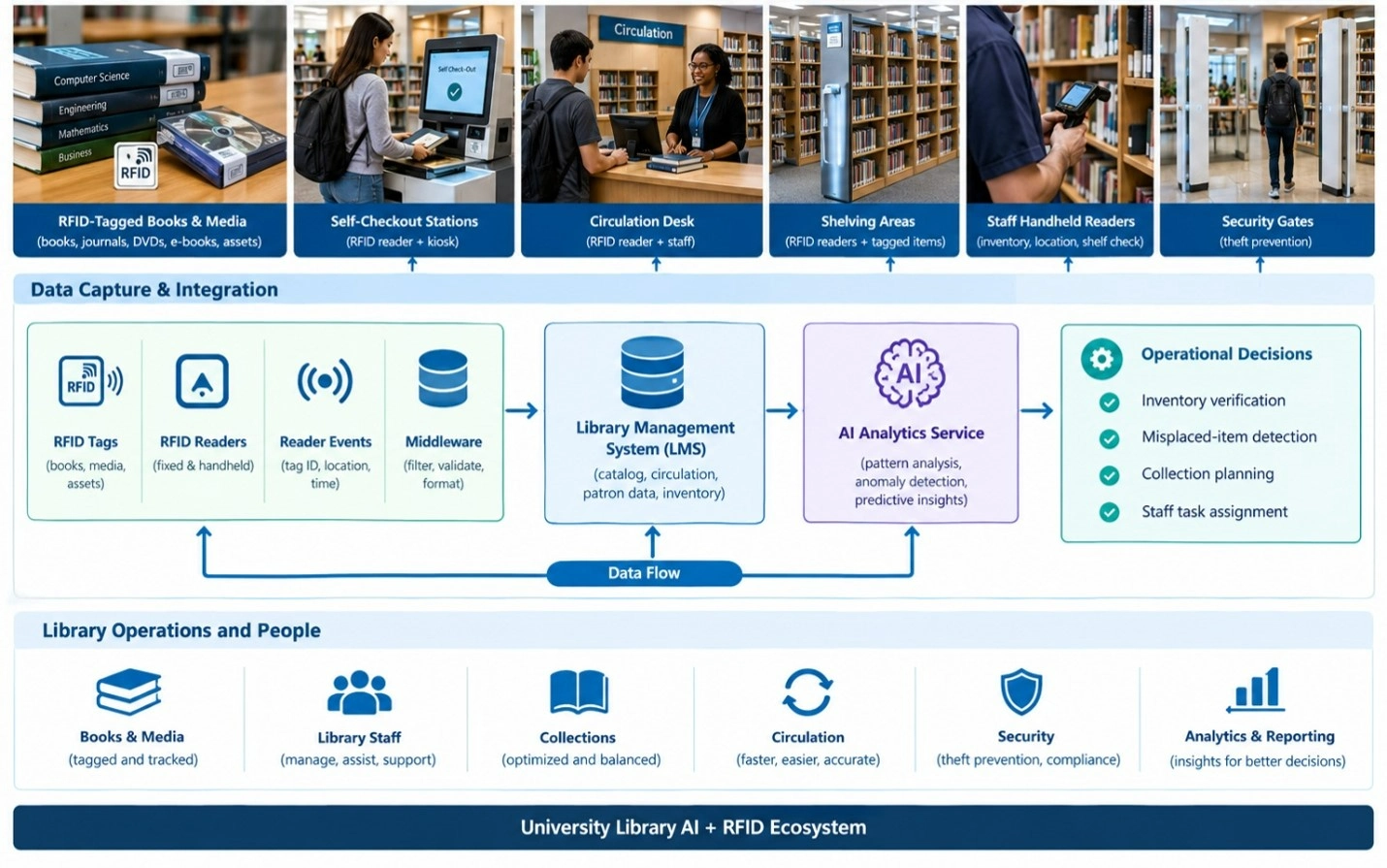
This enterprise diagram illustrates how RFID-tagged books and media move through readers, middleware, and the library management system into AI analytics. It highlights how these connected technologies support inventory verification, misplaced-item detection, collection planning, staff task assignment, circulation, and library security.
What AI-Powered RFID Means for University Libraries
University libraries operate around a deceptively complex physical information environment. Thousands or millions of physical items may move between stacks, circulation desks, reserve collections, study areas, sorting locations, storage rooms, and temporary processing areas. A conventional barcode workflow identifies an item only when a scanner is deliberately aligned with its barcode. RFID changes the physical data-capture model by allowing compatible readers to identify tagged items without requiring optical line-of-sight.
AI adds a decision-making layer to this identification capability. Rather than treating every RFID event as an isolated transaction, AI-enabled library software can correlate item identities, timestamps, locations, circulation records, collection metadata, and historical activity. This creates opportunities to identify unusual movement patterns, predict demand, prioritize inventory work, and improve the accuracy of collection-related decisions.
For university libraries, the most valuable applications are generally not the RFID tag itself but the operational intelligence produced from reliable item-level data. Examples include:
- AI-assisted inventory management for large academic collections
- Automated identification of potentially misplaced books
- Predictive analysis of circulation demand
- Intelligent prioritization of shelf-reading activities
- Detection of unusual item movement or repeated security events
- Collection utilization analysis
- Forecasting demand for reserve and high-use materials
- Automated exception reporting for missing or incorrectly shelved items
- Staff task prioritization based on collection conditions
- Analysis of circulation and location data to support collection planning
GAO’s role can extend beyond individual RFID components by supplying hardware products and systems that organizations can incorporate into broader library identification, inventory, and tracking workflows.
University Library Use Cases for AI-Enabled RFID
AI-Assisted Collection Inventory
Collection inventory is one of the strongest applications for RFID-enabled AI in university libraries. Periodic inventory traditionally requires staff to move through shelves, identify items, compare physical observations against library records, and investigate discrepancies. Large academic libraries can have extensive stacks distributed across multiple floors, buildings, annexes, and specialized collections.
RFID handheld readers can capture multiple tagged items as library staff move along shelving rows. The resulting item-location data can then be compared with expected locations maintained by the integrated library system. AI-based anomaly detection can help distinguish normal movement from potentially misplaced or missing materials.
A useful implementation should not automatically classify every unexpected location as an error. Reserve materials, recently returned items, reshelving carts, temporary exhibits, processing areas, and authorized collection moves can produce legitimate exceptions. AI models therefore work best when they incorporate circulation status, collection rules, time windows, and known staff workflows.
Mis-Shelved Book Detection
Mis-shelving directly affects discoverability because a catalog may report that an item is available even though the physical item is not where expected. RFID can capture the item’s identity and observed location, while AI software can compare that observation against call-number sequences, shelf zones, collection rules, and previous observations.
A university library can use this information to produce exception lists for staff rather than requiring personnel to manually inspect every shelf. The system can prioritize discrepancies according to factors such as demand, reservation status, course relevance, or the duration of the location mismatch.
AI-Based Circulation Demand Analysis
Circulation data can reveal how academic resources are used across semesters, departments, courses, and user groups. AI models can analyze historical borrowing patterns alongside academic calendars, examination periods, course reading lists, and collection-level activity where those data sources are available and appropriately governed.
The resulting forecasts can support decisions about:
- Reserve collection preparation
- High-demand textbook availability
- Staffing requirements around peak periods
- Interlibrary loan demand
- Collection purchasing priorities
- Retention and withdrawal reviews
- Location changes for heavily used resources
RFID contributes the physical item identity and movement data needed to connect these analytical insights with actual collection behavior.
Intelligent Loss Prevention
University libraries need to distinguish legitimate circulation from unauthorized movement. RFID security systems can help identify tagged items passing through monitored exit areas, while AI can analyze event patterns to prioritize unusual activity for investigation.
A practical design should avoid treating every security event as evidence of theft. Items may be authorized for temporary relocation, scanning, exhibitions, interlibrary loan processing, repair, or other controlled workflows. AI can therefore support staff by correlating security events with circulation and operational records rather than replacing human judgment.
Reserve and Course Material Management
Course reserves experience significant fluctuations in demand. AI can analyze previous semester usage and current circulation activity to identify resources likely to experience shortages. RFID provides rapid item identification during preparation, shelving, returns, and inventory checks.
This can help library staff locate reserve materials more quickly, verify that expected copies are physically present, and identify items that have remained outside their assigned collection area.
AI-Driven University Library RFID Inventory Workflow
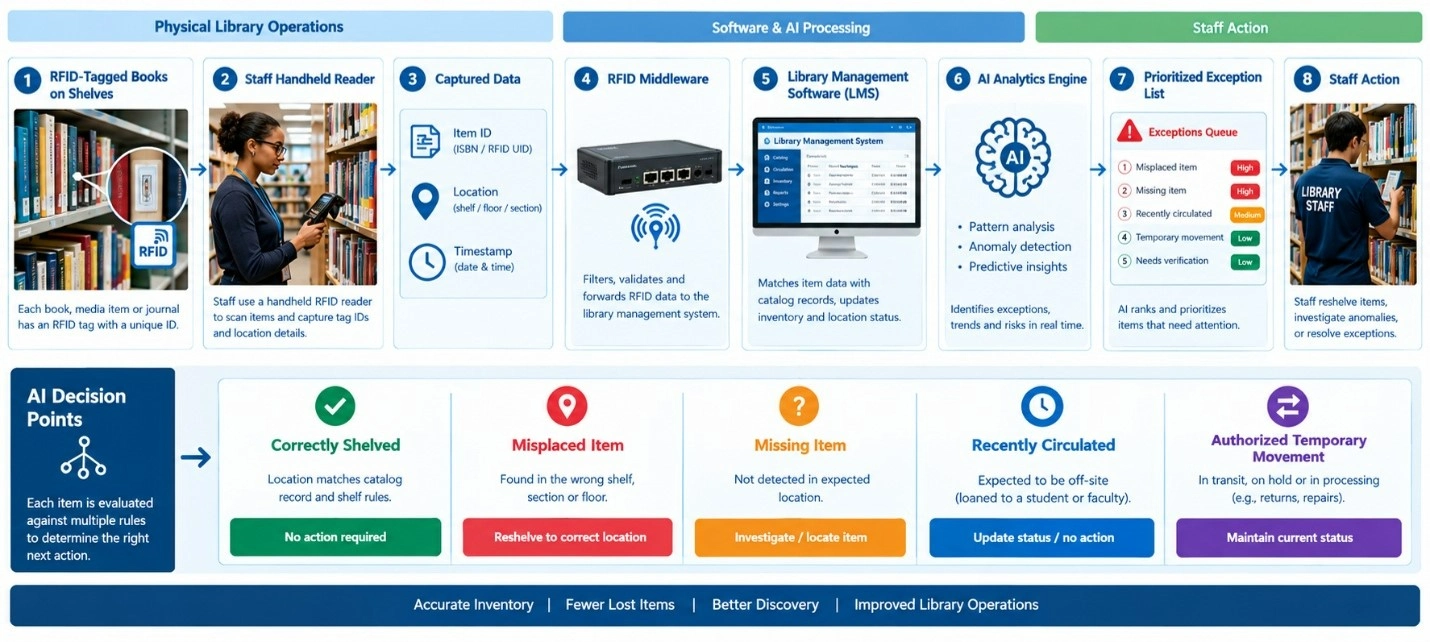
This workflow diagram shows how RFID-tagged library items are scanned, processed through middleware and library management software, and analyzed by AI. It highlights decision points for correctly shelved, misplaced, missing, recently circulated, and temporarily moved items, guiding staff toward prioritized reshelving and investigation actions.
AI and RFID Deployment Components for University Libraries
A practical university library solution normally consists of several interconnected components rather than a single RFID device. The exact configuration depends on collection size, building layout, circulation processes, existing library software, privacy requirements, and the desired level of automation.
RFID Tags and Readers
UHF RFID can provide longer read ranges and support rapid identification of multiple tagged items, making it useful for inventory and selected movement-monitoring applications. HF RFID, including technologies commonly used in library circulation systems, is suitable for short-range item identification and controlled interactions such as reader stations. LF RFID generally has more limited applicability to modern university library item management because of its lower data capacity and shorter practical operating characteristics, although specific legacy or specialized applications may exist.
RFID tag selection should account for book construction, tag placement, reader orientation, read sensitivity, interference, security requirements, and the physical characteristics of special collections. Tag encoding should also follow a consistent identifier strategy that allows the RFID item identity to correspond reliably with the library’s bibliographic and item records.
RFID Handheld Readers and Inventory Equipment
Handheld RFID readers are particularly useful for shelf inventory because staff can scan along rows of books without removing every item. The system should capture enough contextual information to determine which shelf or collection zone was inspected.
Reader ergonomics are important. Library staff may use handheld equipment for extended periods, so weight, trigger placement, battery life, read feedback, and software usability can directly influence inventory productivity.
RFID Security Gates and Self-Service Equipment
RFID-enabled security gates can monitor tagged items at controlled exit points. Self-checkout and self-return equipment can use RFID identification to associate physical items with circulation transactions. These systems should integrate with the university library’s existing circulation and patron-management workflows rather than operating as isolated equipment.
RFID Middleware and Integration Software
Middleware normalizes reader events before they reach downstream applications. It can filter duplicate reads, associate events with reader zones, validate identifiers, and pass relevant information to library software.
Integration commonly involves APIs, database interfaces, SIP2 or other library interoperability mechanisms, depending on the library management system and equipment vendor. Careful integration prevents raw RFID reads from overwhelming the circulation or catalog systems with redundant events.
AI Analytics and Machine Learning
AI models can operate on normalized item events, circulation history, expected locations, collection metadata, and other approved data sources. Suitable techniques include classification, anomaly detection, clustering, forecasting, and time-series analysis.
AI should generally generate recommendations, alerts, priorities, or forecasts rather than directly changing authoritative bibliographic records without validation. This separation helps preserve data integrity in university library systems.
Cloud Version and Server Version
A Cloud Version can host RFID integration, analytics, dashboards, and AI services in managed cloud infrastructure. This model can suit university libraries that want centralized access across multiple branches and prefer to reduce local server administration. Network reliability, data governance, identity management, and integration security should be evaluated before deployment.
A Server Version can run software on library-controlled edge servers, university data-center infrastructure, private servers, or other privately hosted environments. This approach may be preferable when institutional policies require tighter control over operational data, when integration with existing campus systems is easier through local infrastructure, or when connectivity constraints make local processing advantageous.
Hybrid deployment can also be appropriate. RFID event processing and essential library workflows can remain close to the equipment while selected analytics or reporting workloads operate in managed cloud infrastructure.
University Library RFID and AI Deployment Architecture
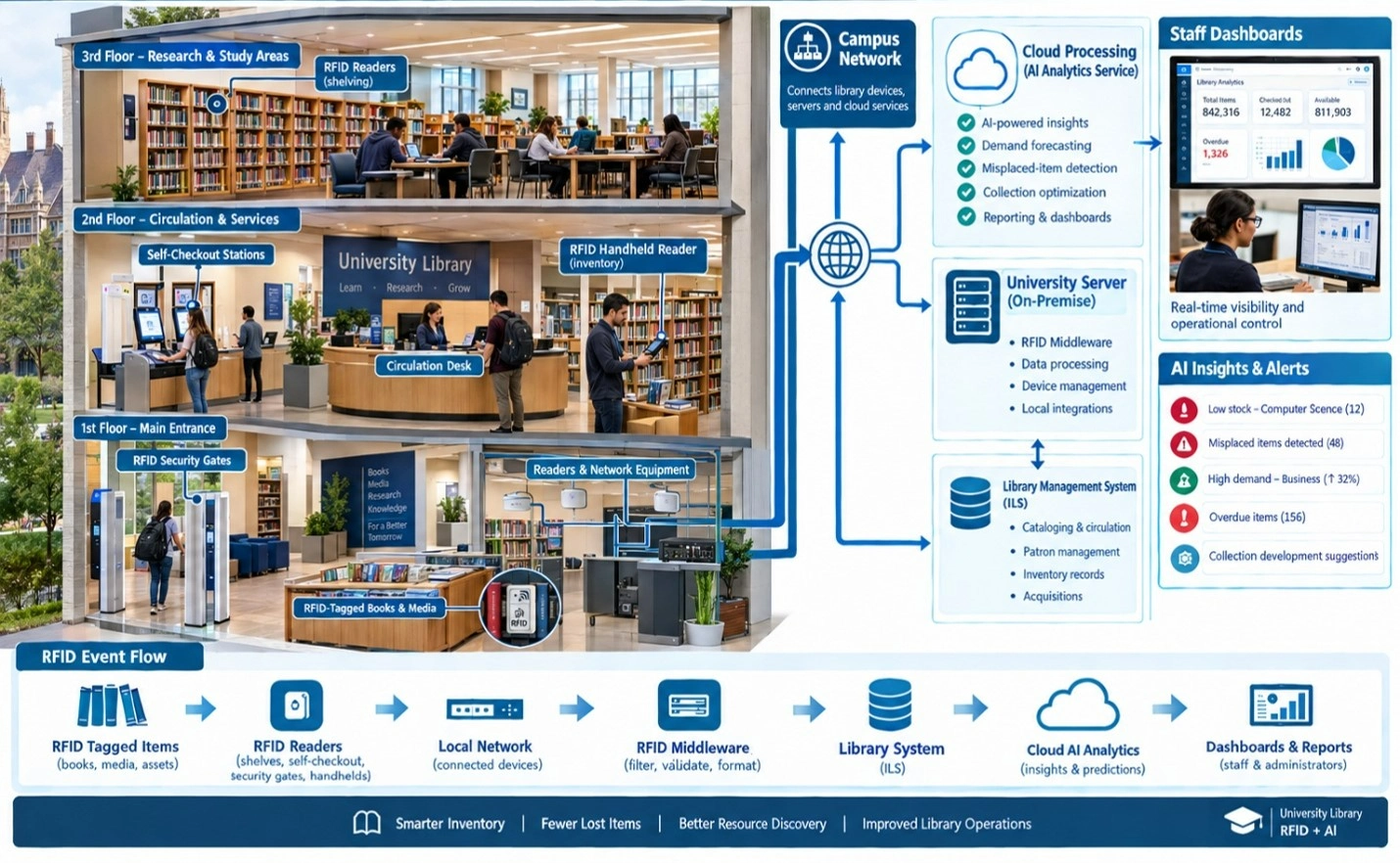
This technical illustration shows how RFID-enabled library operations connect across multiple floors, campus networking, on-premise servers, the integrated library system, and cloud AI analytics. It highlights the flow from RFID events to dashboards, inventory alerts, demand forecasts, and misplaced-item reports.
Security and Data Governance
University libraries manage sensitive operational and patron-related information. RFID implementations should therefore separate item identification from unnecessary personally identifiable information wherever practical.
Security controls can include encrypted network communication, role-based access control, authenticated APIs, network segmentation, audit logging, secure device management, credential rotation, and controlled administrative privileges. AI services should follow institutional data governance requirements and should avoid ingesting patron information unless the use case genuinely requires it and appropriate controls are established.
University Library Implementation and Operational Design
Deploying AI-enabled RFID in a university library requires more than installing readers and tagging books. The implementation should begin with the library’s physical workflows, collection structure, existing library management system, network environment, and measurable operational objectives. A phased deployment reduces disruption and makes it easier to validate read performance before expanding across branches or collections.
Planning and Site Assessment
The initial assessment should document circulation points, stack configurations, entrances and exits, service desks, reserve areas, processing rooms, archives, and other locations where library materials routinely move.
Key engineering questions include:
- Which collections require item-level RFID identification?
- Which workflows currently consume the most staff time?
- Where do misplaced-item and inventory discrepancies occur?
- Which existing circulation and library management systems must be integrated?
- Where should RFID readers, antennas, security gates, and network connections be installed?
- Which areas require handheld inventory capability?
- Which university cybersecurity and data-governance requirements apply?
- Which AI decisions should remain recommendations requiring librarian validation?
A site survey should also evaluate shelving materials, reader placement, electromagnetic conditions, network coverage, power availability, and physical traffic patterns.
RFID Tagging and Data Preparation
Tagging should be treated as a controlled data-migration activity rather than simply attaching labels to books. Each RFID tag needs a reliable association with the corresponding library item record.
A typical preparation workflow includes:
- Verify bibliographic and item records.
- Assign or encode the appropriate RFID identifier.
- Attach the tag according to the selected placement standard.
- Validate read performance.
- Associate the tag with the correct item record.
- Test circulation and inventory operations.
- Record exceptions requiring manual review.
Special collections require additional care because conservation requirements may restrict tag placement or handling. Materials with metallic components, unusual bindings, embedded media, or preservation constraints may also require alternative identification approaches.
Commissioning and RFID Performance Testing
RFID commissioning should test the system under realistic operating conditions rather than relying only on laboratory read tests. Books should be tested in representative shelf configurations, circulation stacks, carts, bags, and service areas.
Important tests include:
- Read accuracy for densely packed shelves
- Identification of multiple items during inventory
- Reader performance at circulation stations
- Security gate detection behavior
- False-read and missed-read rates
- Duplicate event filtering
- Tag-to-item record matching
- Network connectivity
- API and library software integration
- Recovery after network or device interruption
AI models should also be tested against historical or representative library data before being used to generate operational recommendations. Accuracy should be measured separately for different collections because circulation patterns and physical arrangements can vary substantially.
University Library RFID Commissioning and Testing Process
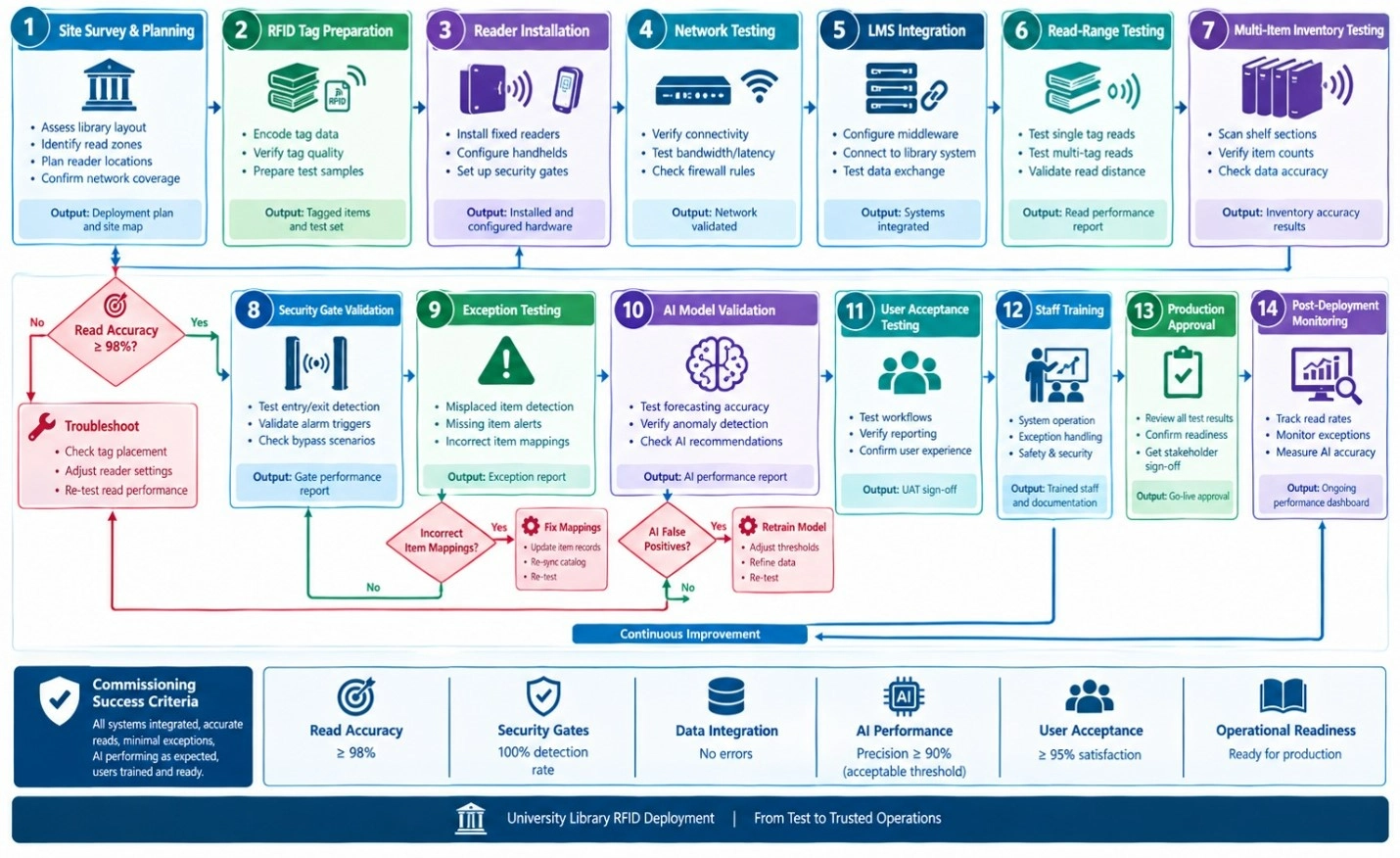
This technical flowchart illustrates the complete commissioning lifecycle for a university library RFID deployment, from site survey and hardware installation through system integration, performance testing, AI validation, staff training, and production approval. Decision points highlight troubleshooting for read accuracy, item-mapping errors, and AI false positives before continuous post-deployment monitoring.
Integrating RFID Data with University Library Software
The value of RFID depends heavily on interoperability. University libraries commonly rely on integrated library systems for acquisitions, cataloging, circulation, serials, patron services, and item-status management. RFID systems should complement these applications rather than create a parallel source of truth.
Middleware can normalize RFID events and determine whether an observed item represents a checkout, return, inventory observation, movement event, or security-related exception. APIs and established library interoperability protocols can then exchange relevant transaction information with the library management system.
Integration should define authoritative ownership of each data element. For example, the library management system may remain authoritative for item status and circulation, while the RFID inventory system records physical observations and the AI service produces analytical recommendations.
This separation becomes particularly important when deploying AI. A machine-learning model might identify that an item appears to be misplaced, but the final location correction should generally be validated through an approved library workflow.
GAO can support organizations with RFID hardware products and systems that are incorporated into broader identification, tracking, and automation solutions.
AI Models for University Library Management
AI applications should be selected according to specific library decisions rather than implemented simply because data is available.
Demand Forecasting
Time-series forecasting can estimate future circulation demand for books, course reserves, journals, media, and other frequently used resources. Models can incorporate historical circulation, seasonality, semester schedules, and other approved operational variables.
Forecasts can help collection managers anticipate periods of increased demand and identify resources that may require additional copies, relocation, or reserve placement.
Anomaly Detection
Anomaly detection is useful for identifying unusual item movement or location patterns. The model can compare observed RFID events with expected item locations and normal circulation behavior.
A robust implementation should account for legitimate exceptions. A book moving from a stack to a repair room should not automatically be treated as a misplaced item.
Collection Utilization Analytics
AI can combine circulation records, physical inventory observations, collection categories, and time-based usage patterns to identify underused and heavily utilized portions of a collection.
Such analysis can support evidence-based decisions concerning shelf allocation, collection development, retention, relocation, and service planning.
Intelligent Staff Task Prioritization
Rather than presenting library employees with thousands of raw discrepancies, AI can rank exceptions according to operational importance. A missing high-demand reserve title, for example, may receive a higher priority than a low-use item whose location has not been confirmed recently.
Human review remains important because collection policies and contextual knowledge are difficult to represent completely in an algorithm.
Operational Benefits of AI-Enabled RFID in University Libraries
| Capability | Operational Improvement | Why It Matters |
|---|---|---|
| Automated inventory | Faster physical collection verification | Staff can identify multiple tagged items without scanning individual barcodes |
| Mis-shelving detection | Faster exception identification | Physical observations can be compared with expected locations |
| Demand forecasting | Better preparation for peak borrowing | Historical circulation can inform future resource requirements |
| Security analytics | More focused investigation | Unusual movement patterns can be prioritized |
| Collection analytics | Better evidence for collection decisions | Usage information can be correlated with physical item activity |
| Staff task prioritization | Better allocation of library labor | AI can rank exceptions according to operational relevance |
| Multi-branch visibility | Centralized operational reporting | Common data structures can support multiple library locations |
The measurable value should be assessed using baseline and post-deployment metrics rather than broad claims about automation.
University Library KPIs for AI and RFID Projects
A successful implementation should establish measurable performance indicators before deployment.
Relevant KPIs include:
- Inventory accuracy rate
- Inventory completion time per collection zone
- Items processed per staff hour
- Mis-shelved item detection rate
- Missing-item resolution time
- RFID read success rate
- False-positive security events
- Checkout transaction time
- Return processing time
- Self-service transaction adoption
- Reserve-item availability
- Collection utilization rate
- Exception resolution time
- Reader and gate uptime
- RFID tag failure rate
- AI forecast accuracy
- AI anomaly detection precision
- Staff intervention rate
- Integration error rate
- Mean time to resolve system faults
These measurements should be segmented by library branch, collection type, and workflow where practical. A single overall accuracy figure can conceal problems affecting particular shelving configurations or specialized collections.
Cybersecurity, Privacy, and Reliability
University library RFID deployments should be designed around the principle that physical item identification does not automatically require extensive patron-data exposure. RFID event processing can often be separated from personally identifiable circulation information.
Security controls should include:
- Role-based access to administrative and analytical functions
- Authenticated device and API communication
- Encryption for data transmitted between components
- Network segmentation where appropriate
- Audit logging for administrative actions
- Secure credential and key management
- Controlled access to AI datasets
- Regular software and firmware maintenance
- Backup and recovery procedures
- Monitoring for abnormal device behavior
Reliability also requires operational fallback procedures. A library should determine how circulation, inventory, and security workflows continue if a reader, local server, network connection, or cloud service becomes temporarily unavailable.
AI systems require an additional layer of governance. Model outputs should be monitored for false positives, changing collection behavior, data-quality problems, and model drift. Librarians and library IT personnel should retain appropriate authority over consequential collection and patron-service decisions.
Scaling AI and RFID Across University Library Networks
A deployment that works in one library branch may require modification before being extended to an entire university library network. Differences in shelving, building construction, collection type, reader placement, network infrastructure, and operating procedures can affect RFID performance.
Scaling should therefore proceed through controlled stages:
- Validate one representative collection.
- Measure RFID and workflow performance.
- Correct integration and data-quality issues.
- Tune AI rules and models.
- Establish operational support procedures.
- Expand to additional collections or branches.
- Compare performance against the original baseline.
- Continue monitoring after expansion.
Standardized tag encoding, device configuration, software interfaces, security controls, and reporting definitions can make multi-branch administration easier.
GAO’s experience supplying RFID products and systems to organizations can be relevant when universities need hardware configurations that can be adapted to specific physical workflows and deployment requirements. GAO Group companies have served customers in the United States and Canada for three decades, including Fortune 500 companies, leading R&D organizations, prestigious universities, and government agencies. The group has also invested substantially in product and system R&D, supported by quality-assurance processes and remote or onsite technical assistance.
Practical Recommendations for University Library AI and RFID Deployment
The strongest implementations begin with a clearly defined operational problem. A university library does not necessarily need every possible RFID capability or AI model.
Recommended engineering practices include:
- Start with inventory accuracy, circulation efficiency, mis-shelving, or another measurable library problem.
- Select UHF, HF, or LF RFID according to the actual operating distance, item characteristics, and workflow requirements.
- Validate tag placement using representative books and media before large-scale tagging.
- Keep authoritative circulation and bibliographic records under controlled library-system governance.
- Use middleware to normalize and filter RFID events before downstream processing.
- Test RFID performance with real shelving density and real library workflows.
- Introduce AI first as decision support where false positives could disrupt library operations.
- Establish measurable KPIs before deployment.
- Protect patron-related information through data minimization and access controls.
- Design fallback procedures for network, server, reader, and cloud-service interruptions.
- Treat each new library branch or collection as a commissioning exercise rather than assuming identical performance.
- Continuously evaluate AI recommendations against librarian-validated outcomes.
Key Takeaways for AI-Enabled University Libraries
AI-driven university library management becomes substantially more useful when reliable physical collection data is available. RFID can provide that item-level visibility, while AI can turn observations and historical library data into forecasts, anomaly alerts, utilization analysis, and prioritized operational tasks.
The most effective approach is therefore a coordinated system involving RFID hardware, library management software, middleware, campus networking, AI analytics, cybersecurity controls, and trained library personnel. Successful deployment depends on accurate tag-to-item associations, tested reader performance, carefully defined integration boundaries, and measurable operational outcomes.
GAO provides RFID and IoT hardware products and systems that can support university organizations developing identification, inventory, tracking, and automation solutions. Universities evaluating these technologies can use a phased engineering approach to determine where RFID and AI deliver measurable improvements while preserving library data integrity and established staff workflows.
Building the Future of Industrial AI and IoT with Aperture Venture Studio and GAO RFID Inc.
For more than three decades, GAO Group of Companies has invested heavily in R&D for industrial RFID, BLE, and IoT. As AI became increasingly useful for practical applications, we expanded our work across AI and IoT technologies and established Aperture Venture Studio to support the development and scaling of AI and IoT solutions relevant to areas such as intelligent university library operations, RFID-enabled asset visibility, and automation.
Aperture has attracted AI and IoT technical experts, entrepreneurial and operational executives, investors, and leading companies. We have also developed the Aperture Ventures Summit and TekSummit to discuss advanced AI and IoT topics.
Our communities bring together technical expertise and practical industry experience.
We welcome you to join us as:
- Advisors, co-founders, or employees
- Investors
- Customers