
AI and RFID for Medical Device Manufacturing
AI-Driven Medical Device Manufacturing with RFID Traceability
AI and RFID help medical device manufacturers connect physical production activity with quality, traceability, inventory, and operational decision-making. RFID provides machine-readable identification and event data for components, work-in-process units, finished devices, reusable tooling, sterilization loads, containers, and production materials, while AI analyzes those events to identify anomalies, predict process deviations, optimize material movement, and support quality decisions. UHF RFID is particularly useful for non-line-of-sight identification of tagged items at receiving, production, staging, and shipping points, while HF and LF RFID can be selected for shorter-range or specialized identification requirements. FDA’s Unique Device Identification system is designed to identify medical devices from manufacturing through distribution and patient use, making reliable identification and traceability especially important. For U.S. manufacturers, the Quality Management System Regulation became effective February 2, 2026 and incorporates ISO 13485:2016 by reference into 21 CFR Part 820.
Medical Device Manufacturing AI and RFID System for Smart Production
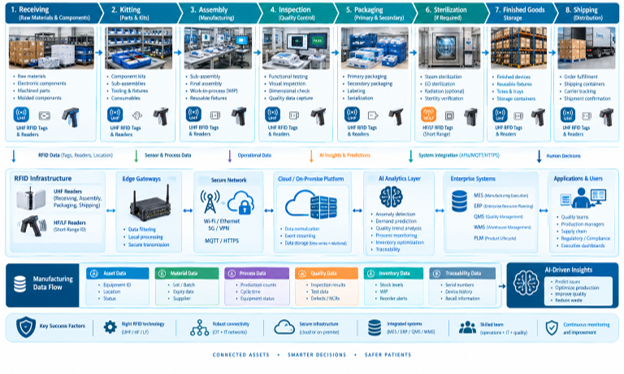
This technical illustration shows how RFID-enabled medical device manufacturing connects materials, components, work-in-process assets, and finished devices across receiving, assembly, inspection, sterilization, storage, and shipping. It maps RFID infrastructure and enterprise systems to AI capabilities including anomaly detection, demand prediction, quality analysis, inventory optimization, and end-to-end traceability.
What AI and RFID Mean for Medical Device Manufacturing
Medical device manufacturing depends on controlled processes, documented evidence, product identification, validated production activities, supplier controls, inspection, nonconformance management, and traceability across the product lifecycle. RFID becomes valuable when manufacturers need automatic identification of physical objects without requiring operators to scan every item individually.
AI adds analytical capability to that identification layer. Instead of treating an RFID read as only an inventory transaction, a manufacturing system can combine RFID events with production orders, inspection results, machine parameters, environmental measurements, maintenance records, operator actions, supplier information, and quality records.
The resulting data can support decisions such as:
- Detecting unusual movement or dwell time for work-in-process devices.
- Identifying material shortages before an assembly order reaches a constrained workstation.
- Predicting inventory requirements for device components and production consumables.
- Detecting abnormal routing of components between controlled production areas.
- Correlating RFID movement events with inspection failures or nonconformance records.
- Identifying repeated delays at assembly, inspection, packaging, or sterilization stages.
- Improving genealogy and traceability for serialized devices and critical components.
- Supporting recall investigations by rapidly locating affected lots, batches, serial numbers, or production containers.
- Monitoring reusable fixtures, molds, test equipment, and production tooling.
- Detecting unexpected movement of quarantined, rejected, or released material.
RFID should not be treated as a replacement for the UDI system. FDA’s UDI framework requires applicable medical devices to carry a UDI in human- and machine-readable form and requires device information to be submitted to GUDID. RFID can serve as an additional machine-readable identification and event-capture mechanism when appropriately designed around labeling, packaging, validation, and regulatory requirements.
Medical Device Manufacturing Applications for AI-Enabled RFID
AI-Assisted Component and Raw Material Traceability
Manufacturers can tag incoming components, raw-material containers, subassemblies, sterile packaging materials, and production kits. RFID readers at receiving and material staging areas automatically capture movement events and associate them with purchase orders, supplier records, lot numbers, and production requirements.
AI can analyze these events against production schedules and material consumption patterns. This helps identify likely shortages, unusual consumption, misplaced materials, and delayed replenishment before they interrupt production.
GAO provides RFID hardware and IoT systems that can support automatic identification and monitoring of physical assets and materials across controlled manufacturing environments.
Work-in-Process Tracking for Medical Devices
Medical devices may pass through numerous operations such as machining, molding, cleaning, assembly, inspection, testing, labeling, packaging, and sterilization. Manual tracking can create gaps when operators move units between workstations without recording every transition.
RFID can create event records when tagged units, carriers, trays, or work orders pass defined reader zones. AI can use timestamps and process history to identify excessive dwell times, unexpected routing, bottlenecks, or deviations from expected manufacturing sequences.
This approach is particularly useful where serialized or lot-controlled products require strong genealogy without adding excessive manual scanning activity.
AI-Based Quality and Process Monitoring
Quality engineers can combine RFID movement history with inspection measurements, equipment parameters, environmental data, and nonconformance records. Machine learning models can then identify relationships that may not be obvious from individual production records.
Examples include:
- Detecting a relationship between extended workstation dwell time and higher inspection failure rates.
- Identifying production routes associated with increased rework.
- Detecting unusual movement patterns preceding a quality event.
- Prioritizing investigations based on the combination of RFID history and quality records.
- Identifying process stages where material handling creates recurring delays.
AI predictions should remain subject to appropriate validation, human review, quality procedures, and risk controls. AI-generated recommendations should not automatically become regulated quality decisions without a suitable validation and governance process.
Finished Device Inventory and Shipment Verification
RFID can automate identification of finished medical devices, shipping cases, pallets, reusable containers, and staging locations. UHF RFID is particularly suitable where many tagged objects must be read quickly without direct line-of-sight interaction. GS1 identifies UHF Gen2 as a major standard for passive UHF RFID, while its RFID standards also cover tag data, software interfaces, and related interoperability mechanisms.
AI can use shipment history and order information to detect unusual inventory conditions, predict fulfillment requirements, and flag discrepancies between expected and physically observed items.
Sterilization, Packaging, and Controlled Material Movement
Medical device production frequently includes packaging, sterilization, quarantine, release, and controlled storage processes. RFID can identify carriers, trays, batches, or product units as they move through these stages.
AI can analyze dwell time and process-event sequences to identify unusual delays or deviations. The system can also correlate RFID events with sterilization records and production orders, provided the integration has been validated for the intended use.
RFID tags must be selected carefully around sterilization processes because heat, radiation, moisture, pressure, chemicals, shielding, and packaging materials can affect tag performance. Tag survivability and read performance should therefore be tested under actual process conditions rather than assumed from laboratory specifications.
From RFID Data Capture to AI-Driven Manufacturing Decisions
A practical AI and RFID solution for medical device manufacturing should be designed as a controlled chain of identification, communication, data processing, analytics, and operational action rather than as an isolated RFID installation.
Physical Data Capture
RFID tags are attached or associated with the objects that require identification. Depending on the application, these may include serialized devices, components, work-in-process carriers, material totes, reusable fixtures, packaging units, pallets, or production tools.
UHF RFID is generally appropriate when manufacturers need longer-range identification and rapid reading of multiple passive tags. HF RFID can be more appropriate for controlled short-range interactions, while LF RFID is suited to specialized applications requiring low-frequency characteristics and close-range identification.
Tag placement is an engineering decision. Metal surfaces, liquids, dense packaging, carbon-loaded materials, device geometry, and nearby radio-frequency sources can reduce read performance. Medical device manufacturers should therefore conduct site surveys and representative tag-read testing before finalizing hardware.
RFID Readers and Edge Processing
Fixed RFID readers can be installed at receiving docks, material issue points, production cells, inspection areas, packaging stations, warehouse aisles, or shipping gates. Handheld RFID readers can support exception handling, cycle counts, investigations, and mobile inventory activities.
Reader data should normally pass through middleware or edge software that filters duplicate reads, applies location or event rules, timestamps events, and converts raw reader observations into meaningful manufacturing events.
For example, ten repeated reads of the same tag at one workstation should not automatically create ten separate business transactions. Event filtering should distinguish between raw radio observations and validated business events such as “device entered inspection,” “carrier entered sterilization staging,” or “finished case entered shipping.”
Manufacturing and Enterprise System Integration
Processed RFID events can be associated with manufacturing orders, device identifiers, component lots, production operations, locations, and personnel or equipment records.
Depending on the manufacturer’s existing software environment, integration may involve:
- Manufacturing Execution Systems (MES)
- Enterprise Resource Planning (ERP)
- Quality Management Systems (QMS)
- Warehouse Management Systems (WMS)
- Laboratory or inspection systems
- Product Lifecycle Management (PLM)
- Computerized Maintenance Management Systems (CMMS)
- Serialization and UDI-related systems
- Supplier management systems
- Data historians
- Manufacturing databases
- Cloud analytics services
- Privately hosted analytics servers
The integration layer should preserve source-event provenance. A quality engineer investigating a deviation should be able to determine which RFID reader generated an event, when it occurred, what tag was observed, what location was associated with the reader, and how that event was transformed before reaching the AI analysis layer.
AI Analytics and Operational Decisions
AI models can operate on the historical event stream after data has been normalized and associated with manufacturing context. Depending on the problem, appropriate methods may include supervised classification, anomaly detection, time-series forecasting, clustering, process mining, predictive maintenance models, and optimization algorithms.
A useful implementation does not stop at a prediction. The output should connect to a defined operational action.
For example:
RFID event history → process-time analysis → anomaly detected → quality engineer receives alert → affected work-in-process identified → investigation initiated → disposition recorded
End-to-End AI and RFID Manufacturing Workflow for Medical Devices
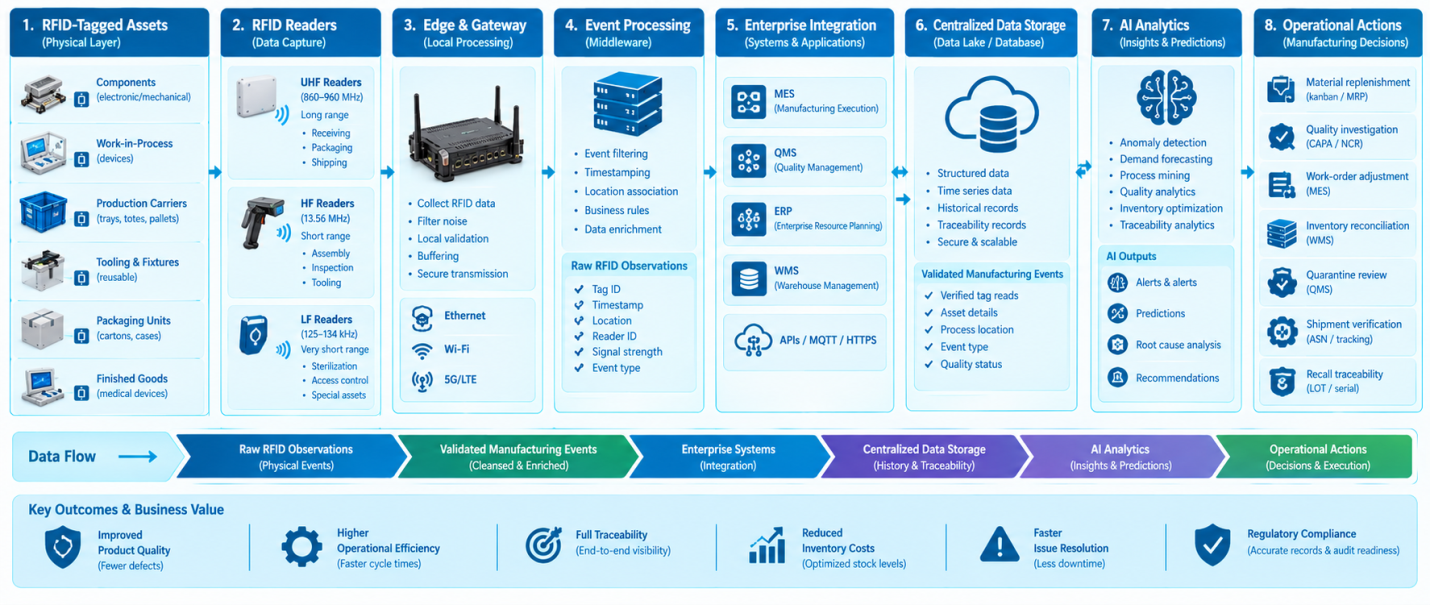
This workflow diagram illustrates how RFID-tagged medical device assets generate raw observations that are validated, integrated with MES, QMS, ERP, and WMS platforms, and analyzed using AI. It connects RFID data with anomaly detection, forecasting, process mining, and quality analytics to support replenishment, quality investigation, inventory reconciliation, shipment verification, and recall traceability.
Regulatory and Quality Considerations for RFID-Enabled Medical Device Manufacturing
Medical device manufacturers should design RFID and AI implementations within their established quality management and risk-management processes. FDA’s QMSR took effect on February 2, 2026 and incorporates ISO 13485:2016 into the U.S. device quality framework. ISO 13485 addresses quality management systems specific to medical devices and supports controlled design, production, delivery, and risk-related processes.
RFID implementation should therefore consider:
- Validation of software functions that affect regulated production or quality records.
- Electronic record integrity and appropriate audit trails.
- Controlled configuration of RFID readers, antennas, middleware, and event rules.
- Verification of tag readability under actual manufacturing conditions.
- Change control for reader firmware, middleware logic, AI models, and integration interfaces.
- Access control for production, quality, inventory, and administrative users.
- Data retention requirements for manufacturing and quality records.
- Traceability of automated decisions and human approvals.
- Cybersecurity controls for network-connected readers, gateways, servers, and cloud services.
- Risk assessment for incorrect reads, missed reads, duplicate reads, tag damage, reader failure, network interruption, and integration errors.
RFID does not inherently make a process compliant. Compliance depends on how identification data, software, procedures, validation, records, and human controls are designed and governed.
Engineering Priorities Before Deployment
A successful medical device manufacturing deployment should begin with the operational problem rather than with the RFID reader or AI model. The engineering team should first determine which traceability gap, inventory problem, quality bottleneck, or manufacturing decision requires improvement.
Key planning questions include:
- Which medical devices, components, carriers, tools, or production materials require automatic identification?
- Is item-level, case-level, pallet-level, or container-level identification required?
- Which manufacturing stages require location or transition events?
- Does the application require UHF, HF, or LF RFID?
- Will tags encounter metal, liquids, sterilization, high temperatures, chemicals, or high-pressure processes?
- Which events must become controlled records within MES, QMS, ERP, or WMS?
- Which AI decisions require human approval?
- What happens when RFID connectivity or network communication fails?
- How will incorrect or missing reads be detected and reconciled?
- How will the implementation be validated and controlled under the manufacturer’s quality system?
- Which KPIs will demonstrate measurable improvement?
GAO can support this engineering process with RFID, BLE, and IoT hardware products and systems that can be incorporated into application-specific identification and monitoring solutions. GAO’s experience serving organizations across the U.S. and Canada includes work with Fortune 500 companies, research organizations, universities, and government agencies, supported by product R&D, quality assurance processes, and technical support.
Selecting UHF, HF, and LF RFID for Medical Device Production
RFID frequency selection should follow the physical characteristics of the medical device, required read distance, tag form factor, process environment, and identification workflow. Treating all RFID technologies as interchangeable can create unnecessary read failures or poor process control.
| RFID technology | Typical medical device manufacturing use | Engineering considerations |
|---|---|---|
| UHF RFID | Receiving, WIP tracking, finished goods, containers, pallets, tool tracking, shipping verification | Longer read range, rapid multi-tag reading, antenna placement, metal and liquid sensitivity |
| HF RFID | Short-range workstation identification, controlled operator interactions, specific device or fixture identification | Near-field operation, predictable short-range interaction, suitable for controlled read zones |
| LF RFID | Specialized short-range identification and environments where LF characteristics are advantageous | Shorter read distance, lower data throughput, application-specific tag and reader selection |
UHF is often the first technology evaluated for warehouse and production-flow applications because it can identify multiple tagged objects over relatively long distances. HF can be useful where the manufacturer wants a deliberate tap or close-range interaction at a workstation. LF may be appropriate for specialized identification requirements where short-range operation and lower-frequency behavior are more important than high-throughput inventory capture.
Medical device manufacturers should test RFID performance using the actual device materials and packaging. Stainless steel instruments, fluid-containing products, foil-based packaging, conductive materials, sterilization equipment, and densely packed totes can produce RF behavior that differs substantially from open-air laboratory testing.
UHF vs HF vs LF RFID Comparison for Medical Device Manufacturing
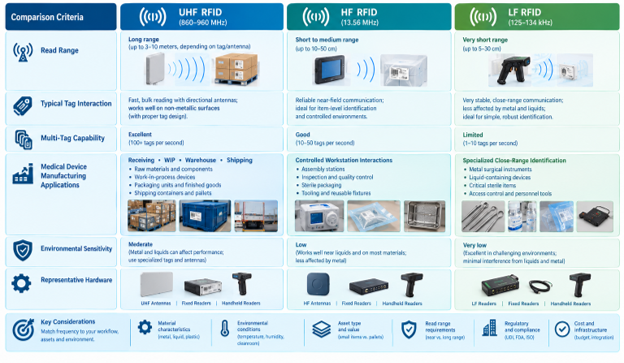
This technical comparison diagram evaluates UHF, HF, and LF RFID technologies across read range, tag interaction, multi-tag capability, environmental sensitivity, hardware, and medical device manufacturing applications. It shows how each frequency can support different workflows, from receiving and WIP tracking to controlled workstation identification and specialized close-range applications.
AI Models for Medical Device Traceability and Quality Operations
AI selection should be driven by the manufacturing decision rather than by model complexity. Medical device manufacturers frequently have structured event data, production timestamps, inspection results, equipment measurements, quality records, and inventory transactions that can support several analytical approaches.
Anomaly Detection
Unsupervised or semi-supervised anomaly detection can identify unusual RFID movement patterns without requiring a large labeled dataset for every possible failure mode.
Potential signals include:
- Unexpected movement between controlled production zones.
- Abnormally long dwell time at an assembly or inspection operation.
- Repeated movement between two locations.
- A device or carrier appearing at an impossible production stage.
- A quarantined material container appearing in released inventory.
- A tooling asset being used at an unexpected production cell.
Time-Series Forecasting
Forecasting models can analyze historical material consumption, production schedules, order patterns, and RFID-derived inventory events.
Potential outputs include predicted component consumption, expected material shortages, anticipated staging requirements, and production congestion.
Forecasting should account for scheduled maintenance, engineering changes, product variants, supplier lead times, safety stock policies, and production campaign changes. RFID alone cannot provide these business variables.
Classification and Risk Prioritization
Classification models can rank production events according to their likelihood of requiring review. For example, a model could combine process dwell time, equipment condition, material lot, production route, and historical quality outcomes to prioritize work-in-process units for investigation.
The model should provide an interpretable reason code where practical. Quality personnel generally need to understand why an event was prioritized rather than receiving an unexplained numerical score.
Process Mining
RFID event histories can form a useful event log for process mining. Each tagged object can become associated with timestamps and manufacturing activities such as receiving, kitting, assembly, inspection, packaging, quarantine, release, and shipping.
Process-mining analysis can reveal:
- Actual process paths compared with designed workflows.
- Recurring bottlenecks.
- Rework loops.
- Unexpected process variations.
- Long waiting periods.
- Workstation utilization problems.
- Differences between production lines or shifts.
This can be especially valuable when standard operating procedures describe one workflow while actual material movement follows another.
Cloud and Server Deployment for Medical Device Manufacturing AI
Medical device manufacturers should select deployment models according to data governance, connectivity, latency, validation requirements, cybersecurity policies, and operational ownership.
Cloud Version
A cloud-hosted software deployment can centralize RFID event processing, historical data, AI analytics, dashboards, and multi-site reporting.
Cloud deployment can be appropriate when:
- Multiple manufacturing facilities need consolidated reporting.
- Corporate teams require cross-site production analytics.
- Large historical datasets are used for model development.
- Centralized software administration is preferred.
- Manufacturing sites have reliable outbound connectivity.
- The organization’s cybersecurity and quality processes permit the selected cloud configuration.
A cloud deployment should not assume uninterrupted network availability. RFID readers and edge systems should be able to buffer events locally when connectivity to the cloud is interrupted.
Server Version
A privately hosted server deployment can place RFID middleware, databases, analytics software, and AI services on customer-managed infrastructure. The server may reside in a factory data center, private data center, edge computing environment, or other customer-controlled hosting location.
Server deployment can be appropriate when:
- Production data must remain within controlled infrastructure.
- Low-latency processing is important.
- Manufacturing networks are isolated.
- Connectivity to external cloud services is restricted.
- The organization has established server administration and cybersecurity processes.
- Software validation and change-control procedures favor controlled infrastructure.
A hybrid arrangement can also be used. RFID event filtering and immediate operational rules can execute near the manufacturing equipment, while approved historical data can be transferred to centralized infrastructure for deeper AI analysis.
The critical engineering principle is to separate real-time operational control from long-term analytical processing where necessary. A production line should not become dependent on a remote analytics service merely to determine whether an RFID read occurred.
Cybersecurity and Data Integrity for RFID-Enabled Manufacturing
Connecting RFID readers to MES, QMS, ERP, warehouse software, and AI services expands the manufacturing network’s attack surface. Security should therefore be designed across the reader, gateway, network, server, application, database, and user layers.
Important controls include:
- Unique credentials for RFID readers and gateways.
- Role-based access for production, quality, warehouse, engineering, and IT users.
- Network segmentation between RFID infrastructure and general corporate networks.
- Encrypted communications where supported and appropriate.
- Secure configuration and controlled firmware updates.
- Audit logging for configuration and administrative changes.
- Monitoring for unauthorized devices or unexpected network behavior.
- Backup and recovery procedures for event databases.
- Time synchronization across readers, gateways, servers, and manufacturing systems.
- Controlled interfaces between RFID middleware and QMS or MES.
- Data validation rules that prevent malformed events from becoming production records.
- Defined fallback procedures during reader, server, or network failures.
Data integrity is particularly important when RFID events become evidence used in quality investigations. The system should distinguish between a raw reader observation, a processed event, and a business transaction. This distinction makes troubleshooting and audit reconstruction substantially easier.
Implementation, Validation, and Commissioning Best Practices
Define the Manufacturing Use Case
Start with a measurable problem such as WIP visibility, component traceability, inventory accuracy, tooling utilization, shipment verification, or quality investigation time.
Define the current process, manual touchpoints, error sources, required data, and desired KPI before selecting RFID hardware.
Perform an RFID Site Survey
Evaluate:
- Metal surfaces.
- Liquids and fluid-filled products.
- RF shielding.
- Packaging materials.
- Reader placement.
- Antenna orientation.
- Read-zone boundaries.
- Conveyor speed.
- Tag orientation.
- Interference sources.
- Human movement.
- Sterilization and environmental conditions.
A controlled test should measure read accuracy under realistic operating conditions rather than relying solely on vendor specifications.
Establish Event and Data Rules
Define precisely what constitutes a manufacturing event.
For example:
RFID observation: Tag detected by reader 04.
Processed event: Tagged carrier entered Assembly Cell 3 at 10:42:17.
Business transaction: Work order 84721 moved to Assembly Cell 3.
This layered approach reduces duplicate transactions and provides a clear troubleshooting path.
Validate the Complete System
Testing should cover the complete chain from RFID tag to business action.
Relevant tests can include:
- Tag read reliability.
- Missed-read detection.
- Duplicate-read suppression.
- Reader failure.
- Network interruption.
- Server interruption.
- Database recovery.
- Incorrect tag association.
- Unauthorized configuration change.
- MES/QMS integration failure.
- AI alert generation.
- Human review and disposition.
- Audit-log integrity.
The validation strategy should be appropriate to the intended use and the manufacturer’s quality procedures. A system used only for non-regulated inventory visibility may require a different validation approach from software that directly creates or modifies regulated production or quality records.
Practical Benefits of AI-Enabled RFID in Medical Device Manufacturing
Combining automatic identification with AI creates value because each technology addresses a different part of the manufacturing problem.
Better traceability results when RFID automatically records physical movement while AI connects those events with production, quality, and inventory context.
Faster investigations become possible when engineers can search historical movement and process events rather than reconstructing device history from disconnected spreadsheets and manual records.
Improved inventory visibility results when RFID provides physical observations and AI identifies discrepancies between expected and observed inventory.
Earlier bottleneck detection becomes possible when AI analyzes RFID timestamps across production stages and identifies unusual dwell times.
More effective quality analysis results when movement history is correlated with inspection, process, equipment, and nonconformance data.
Improved scalability becomes possible because automated event capture reduces dependence on manually recorded location transactions as production volume increases.
Better operational resilience can result from local edge processing and event buffering, allowing manufacturing operations to continue collecting data during temporary network interruptions.
GAO’s RFID and IoT hardware can be used as part of these identification and monitoring workflows, with the specific reader, antenna, tag, gateway, and integration design selected according to the medical device manufacturing environment.
Connecting RFID Traceability with UDI and Device Genealogy
RFID and UDI should be treated as complementary identification mechanisms rather than interchangeable technologies.
FDA requires applicable medical device labels and packages to carry UDI in human-readable and machine-readable forms, with specified device information submitted to GUDID. The UDI contains a device identifier and, when applicable, production identifiers such as lot, batch, serial number, manufacturing date, or expiration date.
A manufacturing system can therefore maintain relationships among:
UDI / device identity → component lots → production order → manufacturing operations → inspection records → packaging → sterilization records → shipment
RFID can provide additional physical-event evidence along that chain when the implementation is appropriately designed.
For example, a serialized device can be associated with an RFID tag or RFID-enabled carrier. RFID events can then indicate where that device or carrier was observed during manufacturing. The UDI remains the regulated device identification mechanism, while RFID supplies additional automated event information.
This distinction is important for system design, validation, labeling, and regulatory documentation.
Explore AI and RFID Solutions for Medical Device Manufacturing
Medical device manufacturers evaluating RFID should begin by identifying the production, traceability, quality, inventory, or logistics problem they need to solve. The appropriate RFID frequency, tag, reader, edge software, integration method, AI model, and deployment model should then be selected around that requirement.
GAO can help organizations evaluate RFID hardware and IoT technologies for applications such as component tracking, WIP visibility, tooling management, inventory monitoring, shipment verification, and manufacturing traceability.
GAO Engineering Support for Medical Device Manufacturing RFID
GAO has supplied RFID, BLE, and IoT hardware products and systems to organizations across the U.S. and Canada for applications requiring automated identification, asset monitoring, and connected operational data. GAO’s sister companies, GAO Research and GAO Tek, together form GAO Group, with operations based in New York City and Toronto, Canada.
For medical device manufacturers, practical value comes from selecting hardware around the actual production environment rather than treating RFID as a generic inventory technology. Reader configuration, tag selection, antenna placement, middleware rules, networking, integration, cybersecurity, and operational procedures all affect the final result.
GAO has invested substantially in R&D and maintains quality assurance processes while providing technical support remotely and onsite. Its customer base has included Fortune 500 companies, leading research and development organizations, universities, and government agencies in the United States and Canada.
Key Recommendations for Medical Device Manufacturers
A technically sound AI and RFID program should:
- Start with a clearly defined medical device manufacturing problem and measurable KPI.
- Map the complete material and device workflow before installing readers.
- Select UHF, HF, or LF RFID according to the physical environment and required interaction model.
- Test tags against actual device materials, packaging, sterilization conditions, and handling procedures.
- Separate raw RFID observations from validated manufacturing events.
- Integrate RFID data with MES, QMS, ERP, WMS, and relevant quality systems only where the business process requires it.
- Use AI to prioritize decisions and detect patterns rather than replacing established quality responsibilities without validation.
- Design edge buffering and failure recovery before production commissioning.
- Apply cybersecurity controls to readers, gateways, servers, databases, APIs, and user accounts.
- Establish data ownership, retention, auditability, and change-control procedures.
- Validate software functions according to their intended use and quality-system requirements.
- Monitor both RFID performance and AI model performance after deployment.
- Expand from a controlled pilot to additional production cells only after the initial workflow demonstrates reliable operational value.
The strongest implementations treat RFID as a source of trusted physical-world events and AI as a method for converting those events into actionable manufacturing intelligence.
Building the Future of Industrial AI and IoT with Aperture Venture Studio and GAO RFID Inc.
For more than three decades, GAO Group of Companies has invested heavily in R&D for industrial RFID, BLE, and IoT. As generative AI has become increasingly useful for industrial applications, we have continued developing AI and IoT technologies that connect physical identification data with operational intelligence. We have also founded Aperture Venture Studio to support advanced AI and IoT initiatives that can address practical manufacturing and healthcare technology challenges.
Aperture brings together AI and IoT technical experts, entrepreneurial and operational executives, investors, and leading companies. Through initiatives such as Aperture Ventures Summit and TekSummit, we also support discussion of advanced AI and IoT applications.
We welcome participation as:
- Advisors, co-founders, or employees
- Investors
- Customers