
AI and RFID for Smart Cities
AI-Driven Smart City Operations with RFID-Based Asset Intelligence
AI and RFID for Smart Cities combines artificial intelligence with connected identification and sensing technologies to improve how municipalities monitor, maintain, and operate public infrastructure. RFID can provide machine-readable identity and location-event data for infrastructure assets, equipment, tools, vehicles, utility components, public-facility inventory, and maintenance resources. AI then converts these operational events into predictions, anomaly detection, prioritization, and decision support. UHF RFID is particularly useful for non-line-of-sight identification of tagged assets across depots, maintenance yards, service facilities, and controlled access points, while HF and LF RFID address shorter-range identification requirements. For Smart Cities, the value comes less from RFID alone than from combining reliable asset data with AI, IoT sensors, edge computing, analytics, geographic information systems, and municipal software. This approach can support predictive maintenance, resource utilization, infrastructure inspections, work-order management, and more accountable public-service operations.
Smart City AI and RFID Operational Architecture for Connected Municipal Infrastructure
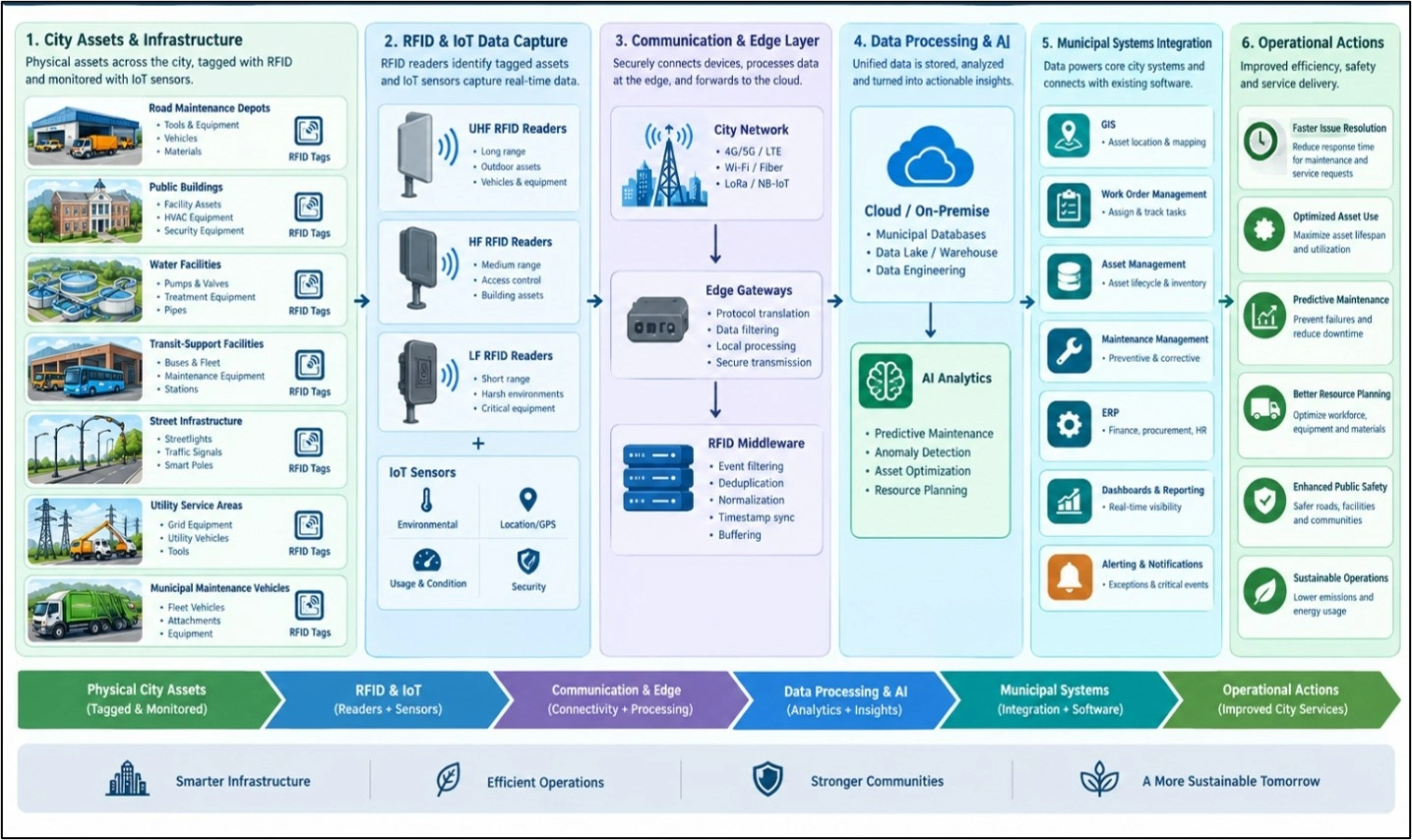
This diagram illustrates how RFID-tagged municipal assets and IoT sensors feed data through RFID readers, edge gateways, and middleware. AI analytics then integrates with GIS, asset management, maintenance, ERP, dashboards, and alerting systems to support predictive maintenance, optimized resource planning, public safety, and sustainable city operations.
What AI and RFID Mean for Smart City Infrastructure
Smart City operations depend on accurate information about physical infrastructure that is distributed across large geographic areas. Municipal departments may manage street-maintenance equipment, traffic-control assets, public-facility equipment, waste-management resources, utility components, emergency-response equipment, construction barriers, inspection tools, and mobile maintenance inventories. Traditional spreadsheets, manual inspections, barcode scans, and disconnected maintenance records can make it difficult to establish where an asset is, whether it was inspected, which crew handled it, and when it should receive service.
RFID provides an automated identification layer for selected physical assets. AI provides the analytical layer that interprets the resulting operational history.
A practical Smart City solution can therefore connect:
- RFID-tagged infrastructure assets and maintenance equipment
- Fixed, portal, handheld, and vehicle-mounted RFID readers
- IoT sensors measuring condition, temperature, vibration, occupancy, or environmental parameters
- Edge gateways located at municipal facilities or field locations
- RFID middleware for filtering, deduplication, normalization, and event processing
- Cellular, Wi-Fi, Ethernet, private wireless, or other municipal communication networks
- Asset management and computerized maintenance management systems
- GIS and spatial asset databases
- Work-order and field-service systems
- AI models for anomaly detection, forecasting, classification, prioritization, and optimization
- Operational dashboards and alerts for public works supervisors and maintenance teams
The resulting system can establish a more continuous relationship between asset identity, location, condition, maintenance history, work activity, and operational status.
This distinction is important. RFID does not determine whether a water-pump assembly is likely to fail, whether a maintenance vehicle is being underutilized, or whether a particular infrastructure component should receive priority. RFID supplies reliable identification events. AI analyzes those events alongside historical maintenance records, sensor readings, inspection results, GIS information, weather conditions, work orders, and other relevant data.
For Smart Cities, that combination supports a transition from manually reconstructed asset histories toward data-driven operational decisions.
NIST’s Smart City work emphasizes interoperability, replicability, scalability, security, privacy, reliability, resilience, and measurement as important considerations for real-world cyber-physical city systems.
Where AI-Enabled RFID Delivers Value Across Smart City Operations
Public Works Asset Management
Public works departments frequently operate large inventories of maintenance equipment and mobile resources distributed across depots and field locations. RFID can associate physical equipment with unique digital records, while AI can identify utilization patterns and maintenance priorities.
Relevant applications include:
- Tracking road-maintenance tools, portable equipment, pumps, generators, barriers, signs, and inspection equipment
- Monitoring equipment movement between municipal depots and work zones
- Associating equipment with work orders and maintenance crews
- Identifying missing or misplaced maintenance resources
- Forecasting demand for frequently deployed equipment
- Detecting unusual movement or utilization patterns
- Supporting automated inventory reconciliation at maintenance facilities
The operational improvement comes from connecting the physical movement of equipment with the work-management record.
Municipal Fleet and Field-Service Operations
RFID can identify equipment, tools, containers, and service resources entering or leaving maintenance yards. AI can correlate these events with vehicle assignments, work orders, service schedules, and historical utilization.
This can help municipal fleet and field-service managers determine:
- Which equipment is frequently deployed
- Which resources remain unused for extended periods
- Whether required tools are available before dispatch
- Whether equipment was returned after a field assignment
- Which maintenance activities consume particular resources
- Where inventory shortages repeatedly occur
RFID should complement rather than replace fleet telematics, GPS, CAN-bus data, or vehicle-management software when those technologies already provide more appropriate vehicle information.
Public Facility Equipment Management
Libraries, civic centers, recreation facilities, government buildings, transportation facilities, and other public properties contain equipment that requires periodic inspection and maintenance.
RFID can associate physical equipment with maintenance records, inspection routes, and facility locations. AI can then identify missed inspections, unusual maintenance frequency, recurring faults, or assets approaching replacement thresholds.
For example, a municipal facilities department could tag air-handling equipment, pumps, portable generators, electrical maintenance equipment, safety equipment, and specialized tools. AI models could combine RFID movement history with maintenance records and sensor data to prioritize inspection activities.
Water and Utility Infrastructure Support
Water and utility operations contain geographically distributed equipment where asset identity and maintenance history are important. RFID can be particularly useful for controlled environments such as treatment plants, pump stations, maintenance depots, stores, and service workshops.
Potential applications include:
- Identifying pumps and replacement components
- Tracking valves and specialized maintenance equipment
- Managing spare parts
- Recording equipment movement between facilities
- Supporting inspection and maintenance workflows
- Linking physical components with GIS records
- Improving traceability of maintenance activities
AI can use asset history, sensor readings, failure records, inspection results, and environmental conditions to identify maintenance patterns.
RFID should not be treated as a substitute for industrial process instrumentation. Pressure, flow, vibration, electrical measurements, water-quality sensors, and other operational measurements remain necessary when the objective is equipment-condition monitoring.
Smart City Operational Workflow from RFID Events to AI Decisions
A practical AI-enabled Smart City implementation normally begins with the physical asset rather than the AI model.
Asset Identification and Data Capture
Each selected asset receives an RFID identifier appropriate for its physical characteristics and operating environment.
UHF RFID can support longer-range identification and rapid bulk reading in maintenance depots, inventory areas, vehicle yards, and controlled passage points. HF RFID is suitable for shorter-range interactions where proximity and deliberate reads are desirable. LF RFID can be useful for specific short-range identification requirements and environments where its propagation characteristics are advantageous.
Tag selection requires consideration of:
- Metal surfaces
- Liquids and moisture
- Outdoor exposure
- Temperature
- Mechanical impact
- Required read distance
- Mounting method
- Asset material
- Tag orientation
- Reader antenna placement
- Required identification speed
A technically correct deployment therefore starts with an RF site survey and representative tag testing rather than selecting a tag solely from its nominal read range.
Reader and Edge Processing
Fixed readers can monitor defined locations such as municipal depots, equipment rooms, controlled entrances, stores, and service areas. Handheld readers can support inspections and field verification. Vehicle-mounted readers may support specific mobile inventory scenarios.
Reader events are typically passed to an edge gateway or local computing device.
The edge layer can perform:
- Event filtering
- Duplicate suppression
- Reader health monitoring
- Timestamp normalization
- Asset-event correlation
- Temporary data buffering
- Local business rules
- Connectivity-loss handling
- Secure transmission to centralized software
This is important because raw RFID reads can contain repeated observations of the same tag. Sending every raw read directly to business applications can produce noisy datasets and unnecessary network and database load.
RFID Middleware and Data Normalization
RFID middleware converts reader-specific observations into standardized operational events.
A normalized event could include:
- Asset identifier
- Reader identifier
- Facility or geographic location
- Timestamp
- Direction or movement state where available
- Read confidence or supporting signal information
- Associated work order
- Equipment or asset class
- Event type
The middleware layer should separate RFID device behavior from municipal applications. This allows readers from different locations or vendors to feed a consistent event structure into asset-management and analytics software.
AI Analytics and Decision Support
Once RFID events are combined with municipal operational data, AI can identify patterns that are difficult to detect manually.
Potential methods include:
- Time-series forecasting for equipment demand
- Classification models for maintenance priority
- Anomaly detection for unusual asset movement
- Clustering for utilization analysis
- Predictive models for maintenance planning
- Optimization algorithms for resource allocation
- Computer vision when visual inspections are also available
- Natural-language processing for maintenance notes and inspection reports
- Generative AI for controlled querying and summarization of operational records
AI output should normally become a decision-support signal rather than an unexplained automated instruction. A public works supervisor may need to see why an asset was prioritized, what evidence supports the recommendation, and which work order or inspection record generated the underlying data.
Smart City RFID-to-AI Workflow for Intelligent Municipal Asset Management
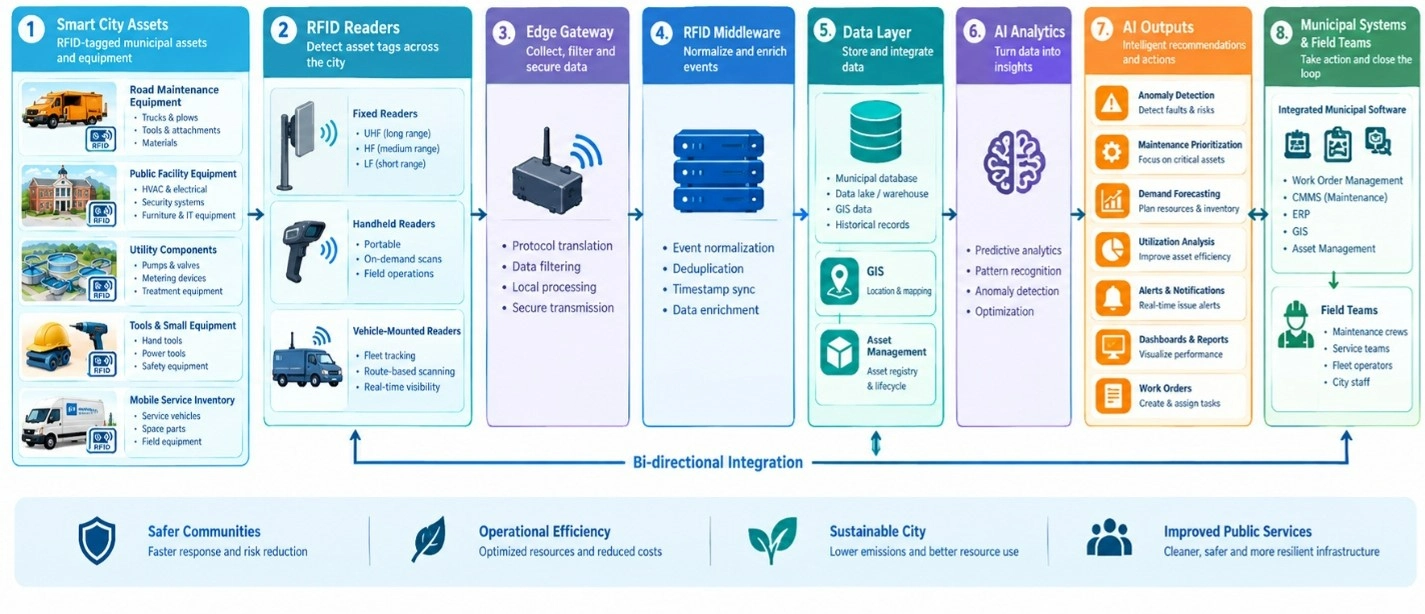
This workflow shows how RFID-tagged municipal assets move from identification through fixed, handheld, and vehicle-mounted readers to edge processing, RFID middleware, integrated data systems, and AI analytics. AI-generated insights drive anomaly detection, maintenance prioritization, forecasting, utilization analysis, alerts, dashboards, and work orders for municipal field teams.
AI and RFID Smart City Deployment Scenarios
Municipal Maintenance Depot
A municipal maintenance depot is one of the most practical starting points because it provides a controlled environment for validating RFID performance and operational workflows.
RFID-tagged tools, barriers, pumps, generators, spare components, inspection equipment, and other resources can be monitored at defined entry and exit points.
AI can analyze historical movement and work-order data to identify:
- High-demand equipment
- Underutilized resources
- Repeated shortages
- Unusual movement patterns
- Maintenance demand
- Resource requirements for upcoming work
The depot also provides an appropriate location for testing antenna positioning, tag orientation, reader power settings, network connectivity, event filtering, and integration before extending the system to geographically distributed city operations.
Public Infrastructure Inspection
Field inspectors can use handheld RFID readers to verify that the correct infrastructure asset is being inspected and associate the inspection with the appropriate digital record.
A field workflow may combine RFID identification, mobile applications, GPS, photographs, inspection forms, sensor measurements, and previous maintenance records.
AI can then identify recurring inspection findings and prioritize assets based on factors such as:
- Previous failures
- Inspection severity
- Age
- Maintenance history
- Environmental exposure
- Service frequency
- Location
- Reported defects
The result is a more traceable relationship between physical infrastructure and its digital maintenance history.
Public Facility Maintenance
A city operating multiple public facilities can use RFID to establish reliable identification of equipment and maintenance resources across buildings.
For example, an HVAC service team could identify a specific tagged component before performing maintenance. The mobile system can retrieve the corresponding equipment record, previous service history, required inspection procedure, and open work orders.
AI can then identify facilities or equipment classes with unusually high maintenance frequency and help maintenance managers investigate root causes.
Emergency and Resilience Operations
Emergency-response inventories require rapid verification when equipment is deployed from municipal storage locations.
RFID can support identification of generators, lighting equipment, pumps, barriers, communication equipment, emergency supplies, and specialized tools.
AI can analyze historical deployment patterns to support preparedness planning and resource staging. However, life-safety decisions should retain appropriate human oversight and operational procedures rather than relying solely on an AI recommendation.
Engineering Considerations for Smart City RFID Deployments
Smart City environments introduce several conditions that can materially affect RFID performance.
RF Environment and Physical Installation
Municipal facilities can contain metal racks, vehicles, electrical equipment, concrete structures, liquids, pipes, and other materials that influence RF behavior.
A deployment should therefore evaluate:
- Antenna polarization
- Reader placement
- Tag orientation
- Read-zone geometry
- Metal and liquid interference
- Inter-reader interference
- Environmental exposure
- Expected asset density
- Reader power configuration
- Regulatory frequency requirements
- Required read accuracy
Testing should use the actual tag model, mounting method, reader, antenna, and representative asset materials.
Data Quality and Event Semantics
A technically successful RFID installation can still fail operationally if the resulting data does not correspond to useful municipal business events.
For example, a reader detecting a tag does not automatically prove that an asset has permanently moved from one facility to another. Business rules may need to consider repeated reads, direction, dwell time, reader location, authorized movement, and related work orders.
This makes event modeling a critical engineering activity.
Interoperability with Municipal Software
RFID data should be integrated with systems already used by municipal departments rather than creating another isolated database.
Relevant integration targets can include:
- Enterprise asset management systems
- CMMS software
- GIS
- ERP
- Procurement systems
- Inventory management
- Fleet management
- Work-order management
- Field-service applications
- Data warehouses
- Business intelligence systems
- Municipal dashboards
- Identity and access management systems
APIs, message queues, webhooks, database integration, and standards-based data exchange can be selected according to the existing IT environment.
NIST’s Smart City work specifically highlights interoperability and standards-based foundations as important for scalable and trustworthy city deployments.
Realistic Municipal Maintenance Depot RFID Deployment for Smart City Asset Management
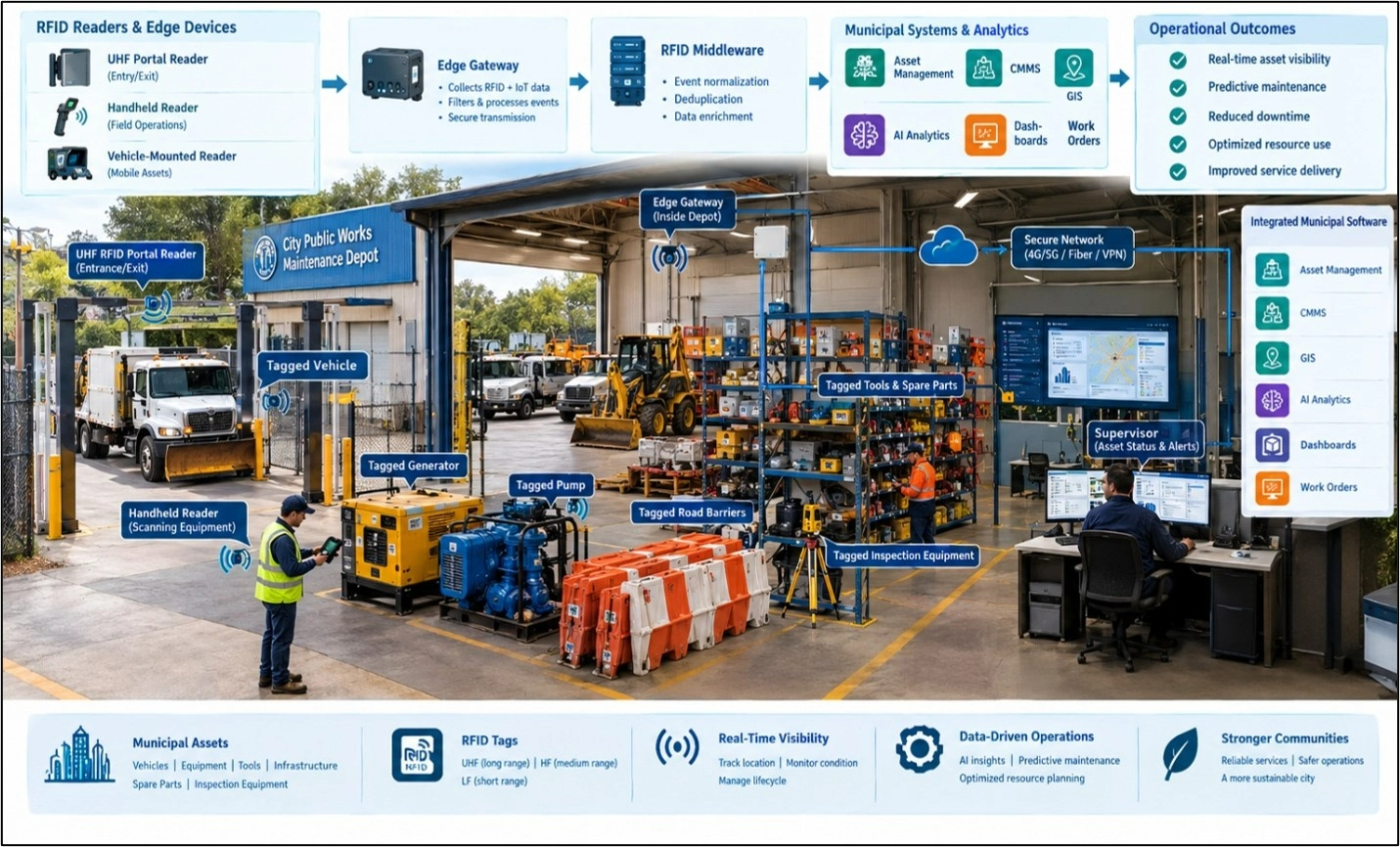
This visual depicts a real-world municipal maintenance depot where RFID-tagged vehicles, generators, pumps, tools, road barriers, spare parts, and inspection equipment are tracked using portal, handheld, and vehicle-mounted readers. RFID events flow through an edge gateway and middleware into asset management, CMMS, GIS, AI analytics, dashboards, and work-order systems to support real-time visibility and predictive maintenance.
RFID, AI, Communication, and Software Components for Smart Cities
A Smart City deployment requires several technology layers working together. RFID is only one component of the overall solution.
RFID Hardware
RFID hardware can include:
- UHF RFID fixed readers for depot entrances and controlled zones
- UHF RFID antennas configured for the required read area
- Handheld RFID readers for inspections and inventory verification
- Vehicle-mounted RFID readers for selected mobile operations
- HF RFID readers for controlled short-range interactions
- LF RFID readers for specialized short-range identification
- Passive RFID tags for lower-cost asset identification
- Ruggedized tags for outdoor infrastructure and harsh environments
- On-metal tags for metallic municipal equipment
- Reader mounting hardware and protective enclosures
UHF RFID systems commonly operate within the 860 to 960 MHz range under relevant air-interface specifications. ISO/IEC 18000-63 defines parameters for 860 to 960 MHz Type C RFID communications, while GS1’s EPC Gen2 family provides a widely used framework for UHF passive RFID systems. (ISO)
Edge Computing and Connectivity
Municipal locations may use Ethernet, Wi-Fi, cellular networks, private wireless networks, or other communication methods depending on coverage, latency, availability, and security requirements.
Edge processing is particularly useful when a municipal facility requires continued operation during temporary network interruptions. Local buffering can prevent RFID events from being lost when connectivity to centralized software is unavailable.
AI and Data Processing
AI processing can occur centrally or closer to the operational site.
A Smart City solution may use:
- Machine learning
- Time-series forecasting
- Anomaly detection
- Predictive maintenance models
- Classification
- Optimization algorithms
- Computer vision
- Natural-language processing
- Generative AI for controlled operational queries
The model should be selected according to the decision being supported rather than choosing AI simply because it is available.
Cloud and Server Deployment for Smart City AI and RFID Systems
Smart City departments can deploy AI-enabled RFID systems through cloud-hosted software, privately hosted servers, or a hybrid arrangement. The appropriate model depends on municipal IT policies, connectivity, data governance, latency requirements, integration constraints, and the operating environment.
Cloud Version
A cloud-hosted deployment centralizes RFID events, asset records, analytics, dashboards, and AI services within managed cloud infrastructure. Municipal facilities can send normalized events through secure network connections while authorized personnel access applications from different departments and locations.
Cloud deployment is particularly useful when Smart City operations involve:
- Multiple maintenance depots or public facilities
- Geographically distributed infrastructure
- Centralized analytics
- Cross-department reporting
- Rapid expansion to additional locations
- Remote operational monitoring
- AI model management across multiple sites
Cloud processing can also simplify centralized software updates and provide scalable computational resources for analytics workloads. Connectivity should nevertheless be engineered carefully because loss of network service can interrupt real-time visibility unless local buffering and edge processing are implemented.
Server Version
A privately hosted server deployment places application software and databases on customer-managed infrastructure. This can include municipal data centers, private cloud infrastructure, departmental servers, or other controlled computing environments.
This model can be appropriate where municipalities require:
- Greater control over infrastructure
- Existing private data-center investments
- Integration with internal databases
- Specific data-governance requirements
- Local processing for selected operational workloads
- Operation within restricted networks
A server deployment does not eliminate the need for cybersecurity, redundancy, backups, patch management, monitoring, identity management, and disaster recovery.
Hybrid Smart City Deployment
A hybrid design can place time-sensitive event filtering and buffering at municipal facilities while sending normalized operational data to centralized servers or cloud services.
This approach can be valuable for large Smart City programs because RFID events can continue to be captured locally while AI analytics, historical reporting, and cross-department analysis are performed centrally.
Security and Data Governance for Smart City RFID Systems
Smart City systems connect physical infrastructure with municipal information systems, making cybersecurity a core engineering requirement rather than an optional feature.
A secure implementation should consider the complete path from RFID reader to business application.
Device and Network Security
Security controls can include:
- Unique device identities
- Strong authentication
- Role-based access control
- Encrypted communications
- Network segmentation
- Secure device configuration
- Certificate-based authentication where appropriate
- Firewall controls
- Reader and gateway patch management
- Centralized security logging
- Device health monitoring
RFID tags themselves generally should not be treated as secure databases. Sensitive information should normally remain in protected municipal systems while the tag carries an identifier that references the appropriate record.
Application and Data Security
Municipal asset information should be protected through appropriate authorization, encryption, audit logging, backup, retention, and access-control policies.
AI systems introduce additional considerations. Model inputs should be validated, data quality should be monitored, and automated recommendations should be traceable to the operational data used to produce them.
A useful Smart City AI workflow should allow an authorized operator to determine:
- Which asset generated the event
- Where and when it was detected
- Which maintenance or inspection record was associated with it
- Which AI model generated the recommendation
- What factors contributed to the recommendation
- Which employee or system approved the resulting action
This traceability becomes especially important when AI influences public-infrastructure maintenance priorities.
Integrating AI-Enabled RFID with Municipal Systems
The greatest operational value usually appears when RFID events become part of existing Smart City workflows rather than remaining within a separate RFID application.
Asset Management and GIS
Asset management systems maintain information about infrastructure components, equipment ownership, lifecycle status, maintenance history, and replacement requirements.
GIS adds geographic context.
Combining RFID, asset management, and GIS can allow municipal teams to associate physical asset events with:
- Geographic location
- Facility
- Maintenance zone
- Infrastructure type
- Asset owner
- Inspection route
- Work order
- Maintenance history
This creates a more useful operational record than RFID identification alone.
CMMS and Work-Order Management
CMMS integration can connect asset identification with maintenance execution.
A technician can identify an asset using a handheld RFID reader, retrieve the corresponding maintenance record, complete an inspection, and update the work order.
AI can analyze completed work orders to identify recurring maintenance patterns and suggest where inspection resources should be concentrated.
ERP, Procurement, and Inventory
Municipal procurement and inventory departments can use RFID events to improve visibility into spare components and maintenance resources.
AI can use consumption history to support demand forecasting and purchasing decisions.
For example, repeated replacement of a particular component across several facilities may indicate a broader maintenance issue rather than an isolated inventory requirement.
Dashboards and Business Intelligence
Operational dashboards can present:
- Asset location
- Equipment availability
- Maintenance status
- Open work orders
- Inspection completion
- Inventory levels
- Utilization trends
- RFID reader health
- AI-generated alerts
- Predicted maintenance priorities
Dashboards should distinguish measured events from AI-generated predictions so that supervisors can understand what is known and what is inferred.
AI Use Cases for Smart City Asset and Infrastructure Management
AI becomes most useful when it addresses a defined operational decision.
Predictive Maintenance
Historical maintenance records, RFID asset identity, inspection results, and IoT sensor measurements can be combined to estimate maintenance risk.
A model may identify assets that exhibit patterns associated with increased maintenance requirements.
For example, repeated maintenance events combined with operating duration and sensor anomalies could increase the predicted priority of an equipment inspection.
RFID supplies asset identity and movement context, while condition sensors and maintenance records provide much of the information required for the prediction.
Asset Utilization Analysis
AI can analyze RFID movement events to determine how frequently municipal equipment is deployed.
This can reveal:
- Frequently requested equipment
- Underutilized assets
- Seasonal demand
- Depot-to-depot movement
- Repeated equipment shortages
- Excess inventory
- Unusual utilization
Such analysis can support more evidence-based equipment allocation.
Anomaly Detection
Anomaly detection can identify asset movements that differ from established operating patterns.
Examples include:
- Equipment leaving an authorized facility unexpectedly
- A normally stationary asset being repeatedly moved
- An asset appearing at an unexpected municipal location
- Equipment being checked out without a corresponding work order
- Unusual after-hours movement
These signals should normally initiate investigation rather than automatically imply unauthorized activity.
Maintenance Demand Forecasting
AI can forecast demand for equipment, spare parts, and maintenance resources by analyzing historical work orders, seasonal patterns, asset populations, and operational events.
This can help public works departments plan staffing and inventory before demand peaks.
Intelligent Inspection Prioritization
Inspection schedules can be optimized by combining asset age, previous defects, maintenance frequency, location, environmental exposure, operational criticality, and inspection history.
AI can help rank inspection candidates, while municipal engineering personnel retain responsibility for determining the final inspection program.
Measuring Smart City AI and RFID Performance
A deployment should be evaluated using operational KPIs rather than reader counts alone.
Useful measures include:
- Asset identification accuracy
- RFID read reliability
- Asset-location accuracy
- Inventory reconciliation time
- Equipment search time
- Maintenance response time
- Inspection completion rate
- Preventive-maintenance compliance
- Unplanned equipment downtime
- Equipment utilization
- Spare-parts availability
- Work-order completion time
- Repeat maintenance rate
- False-positive alert rate
- AI prediction accuracy
- AI recommendation acceptance rate
- Reader uptime
- Edge gateway availability
- Data synchronization success rate
- Mean time to detect infrastructure exceptions
Baseline measurements should be captured before implementation wherever practical. Comparing pre-deployment and post-deployment performance provides a stronger assessment than reporting technology installation statistics.
Smart City Implementation Lifecycle
A successful implementation should progress from an operational problem to a tested production workflow.
Planning and Requirements
Start by defining the municipal process that requires improvement.
Suitable questions include:
- Which assets require automated identification?
- Which locations generate the greatest operational friction?
- Which departments own the relevant records?
- What decisions should AI support?
- Which existing software must receive RFID events?
- What connectivity is available?
- Which assets are difficult to tag?
- What cybersecurity requirements apply?
A focused pilot is usually easier to validate than attempting to instrument an entire city simultaneously.
RFID Site Survey and Hardware Selection
Representative assets should be tested before procurement at scale.
The evaluation should cover:
- Tag attachment
- Read range
- Orientation
- Metal and liquid effects
- Environmental conditions
- Reader placement
- Antenna coverage
- Expected asset density
- Read-zone boundaries
- Network availability
GAO supplies RFID, BLE, and IoT hardware products and systems that can support asset identification and connected operational applications. Our experience supplying technology to organizations in the U.S. and Canada, including government agencies, R&D organizations, universities, and major companies, reinforces the importance of matching hardware selection to the actual operating environment rather than relying solely on laboratory specifications.
Commissioning and Integration Testing
Commissioning should verify the entire workflow rather than only checking whether an RFID reader detects a tag.
Testing should confirm:
- Correct tag-to-asset association
- Correct location mapping
- Event deduplication
- Timestamp accuracy
- Network recovery
- Edge buffering
- API integration
- Work-order association
- Dashboard accuracy
- Alert behavior
- User permissions
- AI data pipelines
Failure scenarios should also be tested intentionally, including network outages, reader failures, duplicate reads, damaged tags, missing assets, and invalid data.
Optimization and Expansion
After the pilot demonstrates measurable operational value, the deployment can expand to additional depots, facilities, infrastructure classes, and departments.
RF performance should be reviewed whenever the physical environment changes. AI models should also be monitored because asset populations, maintenance policies, equipment usage, and operating conditions can change over time.
Practical Engineering Recommendations for Smart City Deployments
Several implementation principles can reduce technical and operational risk.
- Begin with a clearly defined municipal workflow such as depot inventory, equipment checkout, inspection verification, or maintenance tracking.
- Select RFID tags based on actual asset materials and environmental conditions rather than nominal read distance.
- Use edge buffering where network outages could otherwise cause operational data loss.
- Normalize RFID events before sending them into asset management or maintenance software.
- Keep asset identifiers separate from sensitive personal or operational information stored in municipal databases.
- Treat AI predictions as decision-support outputs and provide appropriate human review for consequential maintenance decisions.
- Integrate with existing GIS, CMMS, asset management, inventory, and work-order systems rather than creating disconnected records.
- Establish measurable baselines before deployment.
- Test failure conditions during commissioning rather than assuming normal connectivity and reader operation.
- Monitor RFID read quality, data quality, model performance, and cybersecurity continuously after deployment.
- Expand based on measured operational value instead of deploying tags and readers indiscriminately across every municipal asset.
- Document tag replacement, reader maintenance, software updates, model monitoring, and operational ownership before production rollout.
GAO’s three decades of R&D investment in RFID, BLE, and IoT technologies support this type of engineering-led approach. GAO, together with GAO Research and GAO Tek, has served U.S. and Canadian organizations including Fortune 500 companies, leading R&D organizations, universities, and government agencies. Quality assurance processes and remote or onsite technical support are important considerations when Smart City deployments move from pilot installations into long-term operational use.
The Business Value of AI-Enabled Smart City Asset Management
The business case for AI-enabled RFID in Smart Cities is strongest when technology improvements translate into measurable operational outcomes.
Automated asset identification can reduce the time personnel spend locating and reconciling equipment. Better asset histories can improve maintenance planning. AI-based prioritization can help supervisors focus scarce maintenance resources on higher-risk assets. More accurate inventory information can reduce unnecessary purchases while improving availability of critical equipment.
The benefits are therefore interconnected:
- Better identification improves data quality.
- Better data quality improves analytics.
- Better analytics improve maintenance and resource decisions.
- Better decisions improve operational efficiency.
- Measurable operational improvements provide a basis for controlled expansion.
This approach is particularly relevant to municipalities managing large distributed asset populations where manual records and periodic inspections cannot provide continuous operational visibility.
Why GAO Supports AI and RFID for Smart Cities
GAO’s role can extend beyond supplying individual RFID readers or tags to supporting the hardware and connected systems required for practical asset-management applications.
Our RFID, BLE, and IoT product capabilities can be applied to municipal equipment identification, facility operations, inventory monitoring, field-service workflows, and connected infrastructure use cases. Technical support can address hardware selection, deployment considerations, system integration, and operational requirements.
Headquartered in New York City and Toronto, Canada, GAO is ranked among the top 10 leading B2B and B2G BLE and RFID suppliers worldwide. Our broader organization combines product development, research, and technical capabilities across RFID, BLE, IoT, and related technologies.
For Smart City organizations, the most useful next step is to define a specific operational problem, identify the assets and workflows involved, establish measurable KPIs, and evaluate the RFID, IoT, AI, connectivity, and software components required to solve it.
Building the Future of Industrial AI and IoT with Aperture Venture Studio and GAO RFID Inc.
For more than three decades, GAO Group of Companies has invested heavily in R&D covering industrial RFID, BLE, and IoT. As generative AI became increasingly useful for industrial and infrastructure applications, we expanded our work across AI and IoT, including RFID and BLE, and founded Aperture Venture Studio to build, launch, and scale next-generation AI and IoT companies relevant to areas such as Smart Cities and public infrastructure.
Aperture has attracted AI and IoT technical experts, entrepreneurial and operational executives, influential investors, and leading companies. We have also developed Aperture Ventures Summit and TekSummit to discuss advanced AI and IoT topics and foster technical communities.
We welcome you to join us as:
- Advisors, co-founders, or employees
- Investors
- Customers