
AI and RFID for Tool Rental
AI-Driven Tool Rental Management with RFID
AI is transforming tool rental operations by turning equipment identification, rental transactions, inspection records, maintenance history, and utilization data into actionable operational intelligence. RFID provides an automated method for identifying tagged tools and rental assets as they move through receiving, storage, checkout, return, inspection, maintenance, and redeployment workflows. AI can then analyze these event streams to identify utilization patterns, predict maintenance requirements, detect unusual asset movement, improve inventory accuracy, and support more informed rental decisions.
For tool rental companies, the combination is particularly valuable because revenue depends on keeping rentable equipment available while controlling loss, damage, downtime, and unnecessary inventory. UHF RFID can support bulk and long-range identification across rental yards and warehouses, while HF and LF RFID can address specialized identification requirements where shorter read ranges or different operating conditions are appropriate. GAO supplies RFID hardware and systems that can be incorporated into these operational workflows, helping organizations automate physical asset identification and connect equipment data with business software.
AI-Driven RFID Tool Rental Management
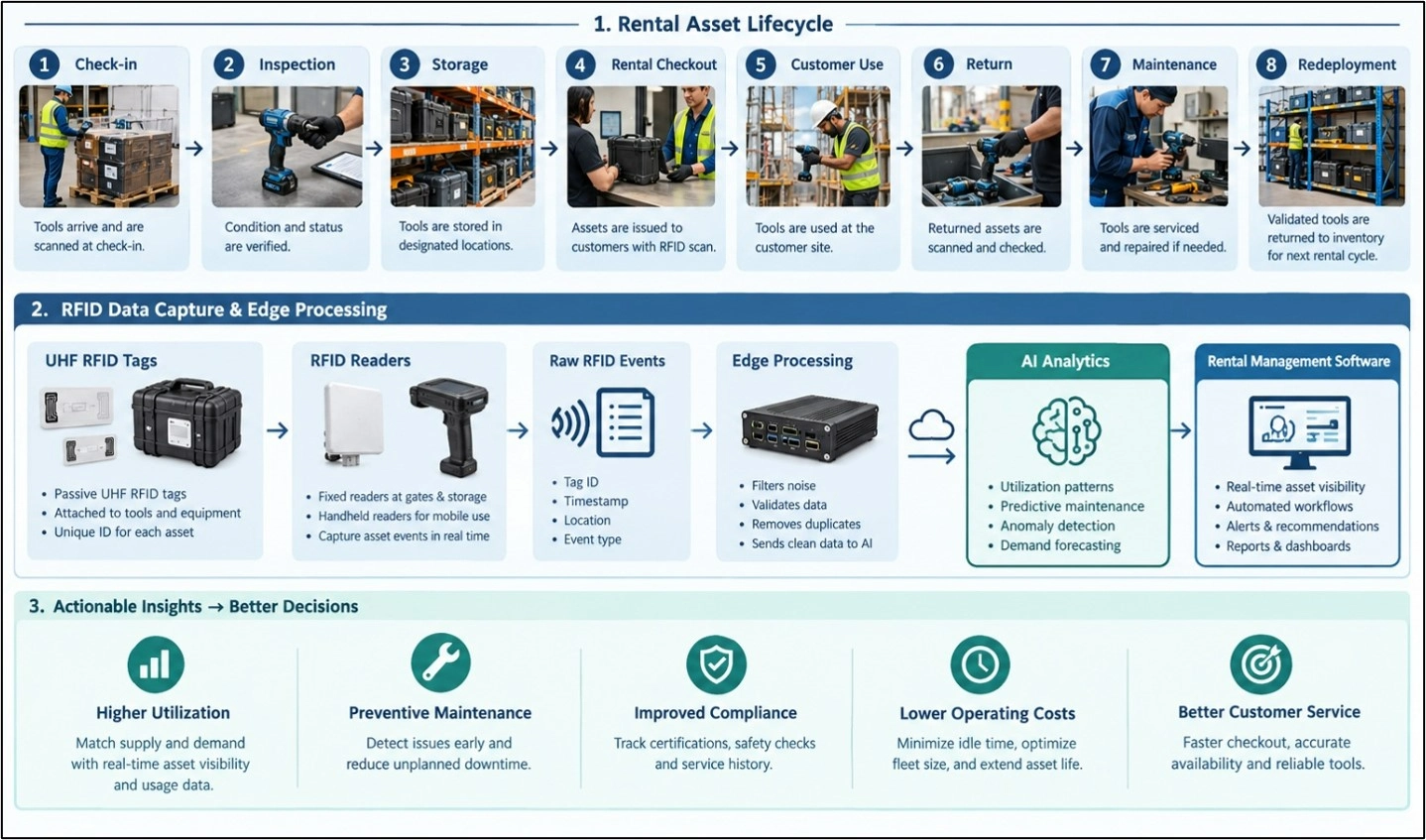
This infographic illustrates the complete rental asset lifecycle from check-in to redeployment.
RFID captures real-time tool and equipment events throughout rental operations. Edge processing validates and filters RFID data before AI analyzes utilization, maintenance, and anomalies. Actionable insights are delivered to rental management software for better operational decisions.
What AI Means for Modern Tool Rental Operations
AI-enabled tool rental management combines machine learning, predictive analytics, anomaly detection, optimization, and, where appropriate, computer vision with connected equipment and operational data. The objective is not simply to automate RFID reading. The objective is to create better decisions from reliable information about each rental asset.
A rental tool can generate a sequence of operational events throughout its lifecycle. A tagged concrete saw may be received at a branch, assigned to a storage location, checked out to a contractor, returned after a rental period, inspected for damage, sent for maintenance, cleared for service, and placed back into rentable inventory. Each event can contribute to an asset history.
AI can analyze this history alongside rental orders, maintenance records, inspection results, customer demand, location data, and equipment availability. This creates opportunities for more accurate demand forecasting, maintenance prioritization, asset utilization analysis, and exception management.
The most important engineering principle is that AI quality depends on data quality. RFID events must therefore be associated with the correct asset identifier, timestamp, location, transaction, and operational state. Duplicate reads, missed reads, incorrectly positioned tags, reader interference, and inconsistent asset records can produce misleading analytics if they are not handled before AI models consume the data.
RFID as the Asset Identification Layer
RFID acts as an automated identification mechanism within the broader tool rental solution. A durable RFID tag can be associated with a specific tool, machine, accessory, container, or other rental asset. Readers and antennas capture tag observations at designated points such as receiving areas, warehouse doors, rental counters, inspection stations, maintenance areas, and dispatch zones.
UHF RFID is generally suited to applications requiring longer read ranges and faster identification of multiple tagged assets. This makes it relevant to rental yards, warehouse portals, tool cages, staging areas, and bulk asset verification.
HF RFID can be appropriate for shorter-range controlled interactions, such as specific workstation or transaction-point identification. LF RFID can be considered for specialized applications where its operating characteristics provide an advantage.
The correct frequency is determined by the physical environment, required read distance, tag form factor, material composition, reader placement, throughput, and workflow. Metal tools, batteries, liquids, dense equipment storage, and closely packed assets can influence RFID performance and should be evaluated during site testing rather than assumed from laboratory specifications.
AI as the Decision Layer
AI adds interpretation to the identification data. Instead of treating every RFID read as an isolated event, software can associate sequential observations with rental transactions and operational states.
Potential AI functions include:
- Predicting which rental assets are likely to require maintenance based on utilization, operating history, inspection findings, and previous service intervals.
- Detecting unusual movement patterns that may indicate misplaced equipment, unauthorized movement, or inventory discrepancies.
- Forecasting demand for high-turnover equipment by branch, geographic area, season, customer segment, and rental category.
- Identifying assets with consistently low utilization that may represent excess fleet capacity.
- Prioritizing returned equipment for inspection based on usage history, asset type, rental duration, and known failure patterns.
- Detecting inconsistencies between physical RFID events and rental management records.
- Recommending asset transfers between branches when predicted demand and available inventory indicate an imbalance.
- Identifying recurring delays in check-in, inspection, maintenance, or dispatch workflows.
This division of responsibility is important. RFID provides physical-world observations, while AI interprets those observations in relation to rental operations. The resulting system can support employees rather than requiring every decision to be made manually.
Core Tool Rental Applications for AI and RFID
Tool rental operations contain several high-value workflows where automated asset identification and AI analytics can work together.
Automated Rental Asset Tracking
Rental companies often manage large fleets containing power tools, generators, compressors, lifts, concrete equipment, landscaping equipment, construction tools, accessories, and specialized machinery. Manual inventory counts can become difficult when assets are distributed across storage areas, branches, service locations, trucks, and customer-return zones.
RFID can create automated observations as tagged equipment passes through defined read points. AI can analyze these events to establish expected asset locations and identify exceptions.
For example, if a generator is recorded as being available at a branch but RFID observations place it in a dispatch staging area, the system can reconcile the physical event with the rental order. If the same asset later appears outside its expected movement sequence, the system can generate an exception for investigation.
The operational objective is not simply knowing that a tag was read. The objective is establishing a reliable asset state such as available, reserved, dispatched, rented, returned, under inspection, under maintenance, or ready for rental.
AI-Powered Inventory Accuracy
Tool rental branches frequently maintain large numbers of similar-looking assets. Manual identification can create errors when equipment is moved between storage locations or when accessories become separated from primary rental equipment.
AI can compare RFID observations against rental inventory records and identify discrepancies. A recurring difference between recorded and observed inventory may indicate a process problem, incorrect transaction completion, misplaced equipment, or an asset that requires investigation.
Automated inventory verification can also support periodic cycle counts. Rather than requiring employees to manually inspect every asset, RFID-enabled workflows can identify assets observed within a defined area and flag assets that were expected but not detected.
Rental Check-In and Check-Out Automation
Check-out and check-in are critical control points because they connect the physical equipment to a customer rental transaction.
A tagged asset can be associated with the relevant rental order when it passes through an RFID-enabled transaction area. Software can verify whether the expected equipment is present and identify missing or unexpected items.
During return processing, RFID observations can help determine which assets entered the branch. AI can then prioritize subsequent activities based on the asset’s rental history, usage pattern, maintenance status, and inspection requirements.
This can reduce dependence on manual identification while preserving employee approval for exceptions and high-value decisions.
Predictive Maintenance for Rental Equipment
Maintenance is one of the strongest AI applications in tool rental because equipment availability directly affects rental revenue and customer service.
A predictive maintenance solution can combine RFID-based asset identity with:
- Maintenance history
- Service intervals
- Inspection results
- Rental duration
- Rental frequency
- Equipment category
- Operating hours where available
- Failure records
- Parts replacement history
- Technician observations
- Customer-return conditions
Machine learning models can identify patterns associated with elevated maintenance risk. The output can be a maintenance priority score rather than an automatic service decision.
For example, two identical concrete mixers may have similar total rental counts but very different maintenance histories. One may have repeated inspection failures after long-duration rentals, while the other remains within normal service patterns. AI can help maintenance teams prioritize the higher-risk asset.
RFID provides the identity and movement context needed to associate maintenance events with the correct physical asset.
Asset Utilization and Fleet Optimization
Asset utilization is a major financial consideration in rental operations. Equipment that remains idle for extended periods ties up capital, while equipment with high demand may generate missed rental opportunities when unavailable.
AI can analyze rental frequency, duration, branch-level demand, seasonal patterns, asset category, and availability history to identify utilization trends.
The resulting analysis can support decisions such as:
- Which assets should remain at a branch?
- Which equipment should be transferred to another location?
- Which asset categories require additional fleet capacity?
- Which assets have persistently low utilization?
- Which equipment should receive higher maintenance priority?
- Which rental categories experience recurring availability shortages?
RFID strengthens this analysis by providing physical asset observations that can validate whether recorded inventory states correspond with actual asset movement.
Tool Rental Workflow from RFID Capture to AI Decision
A practical AI-enabled tool rental solution begins with physical data capture and progresses through several processing stages.
Asset Tagging and Data Acquisition
Each selected rental asset receives an RFID tag appropriate to its physical characteristics and expected service conditions. Tag attachment requires consideration of metal surfaces, vibration, impact, weather exposure, cleaning processes, temperature, and tag durability.
Readers are positioned at operational control points rather than simply distributed uniformly throughout a facility. Typical locations include receiving doors, dispatch portals, rental counters, tool cages, inspection areas, and maintenance entrances.
The objective is to capture meaningful workflow events with sufficient confidence to establish asset state.
Communication and Edge Processing
RFID readers transfer observations to local software through supported wired or wireless network connections. Edge processing can filter duplicate reads, apply signal and timing rules, associate observations with zones, and forward normalized events to central software.
Edge processing is especially useful when a rental branch requires rapid local decisions or has intermittent connectivity. It can also reduce unnecessary transmission of raw repeated reads.
A normalized event may contain information such as asset identifier, reader identifier, timestamp, zone, event type, and confidence information. This structured event can then be consumed by rental management software and analytics services.
Data Integration
RFID events become more valuable when connected with existing rental software. Relevant systems may include rental management software, inventory databases, maintenance management systems, order management software, customer relationship systems, accounting applications, warehouse systems, and business intelligence tools.
An integration layer can map RFID asset identifiers to existing equipment IDs and rental records. APIs, message queues, database interfaces, or other enterprise integration mechanisms can be used depending on the existing software environment.
Data normalization is essential because an RFID tag identifier alone does not provide sufficient business context. The system needs to understand what the physical asset represents, where it should be, which rental order it belongs to, and what operational state applies.
AI-Enabled Tool Rental Workflow
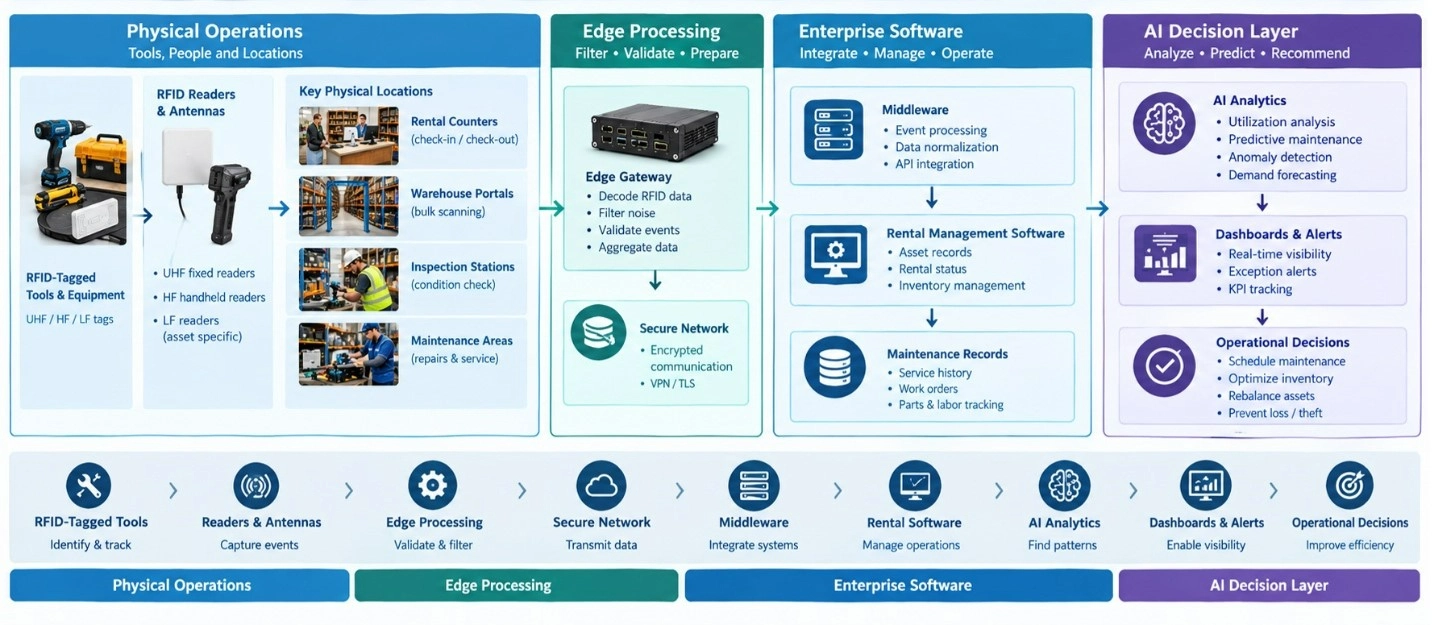
This workflow shows the end-to-end movement of RFID data across tool rental operations.
RFID-tagged tools are identified through readers, antennas, rental counters, and warehouse portals.Edge processing validates events before secure communication sends data to enterprise software and maintenance records.AI analytics then generates dashboards, alerts, and operational decisions for efficient asset management.
Deployment Considerations for Tool Rental Locations
Tool rental environments are physically demanding and operationally variable. Equipment may include metal surfaces, engines, batteries, hydraulic components, dense storage racks, outdoor yards, trailers, and customer-return areas. These conditions can affect RFID read performance and must be considered during deployment planning.
A successful implementation should begin with workflow mapping rather than hardware installation. The deployment team should identify where assets enter and leave the branch, where rental transactions occur, where inspection is performed, where maintenance takes place, and where equipment is staged for dispatch.
RFID reader placement should then be designed around these control points. Read zones should be tested using representative tagged equipment under realistic conditions, including stacked tools, moving assets, metal equipment, different orientations, and normal employee activity.
AI deployment also requires sufficient historical data. A predictive model should not be treated as reliable simply because it produces a score. Rental companies should establish baseline data quality, validate model outputs, monitor false positives and false negatives, and periodically retrain models as equipment fleets and rental behavior change.
GAO’s experience supplying RFID hardware and systems for organizations in the United States and Canada supports the importance of combining product selection with practical deployment and technical support requirements. GAO operates from locations in New York City and Toronto, Canada, and its broader organization has served Fortune 500 companies, research organizations, universities, and government agencies.
RFID Tool Rental Branch Deployment
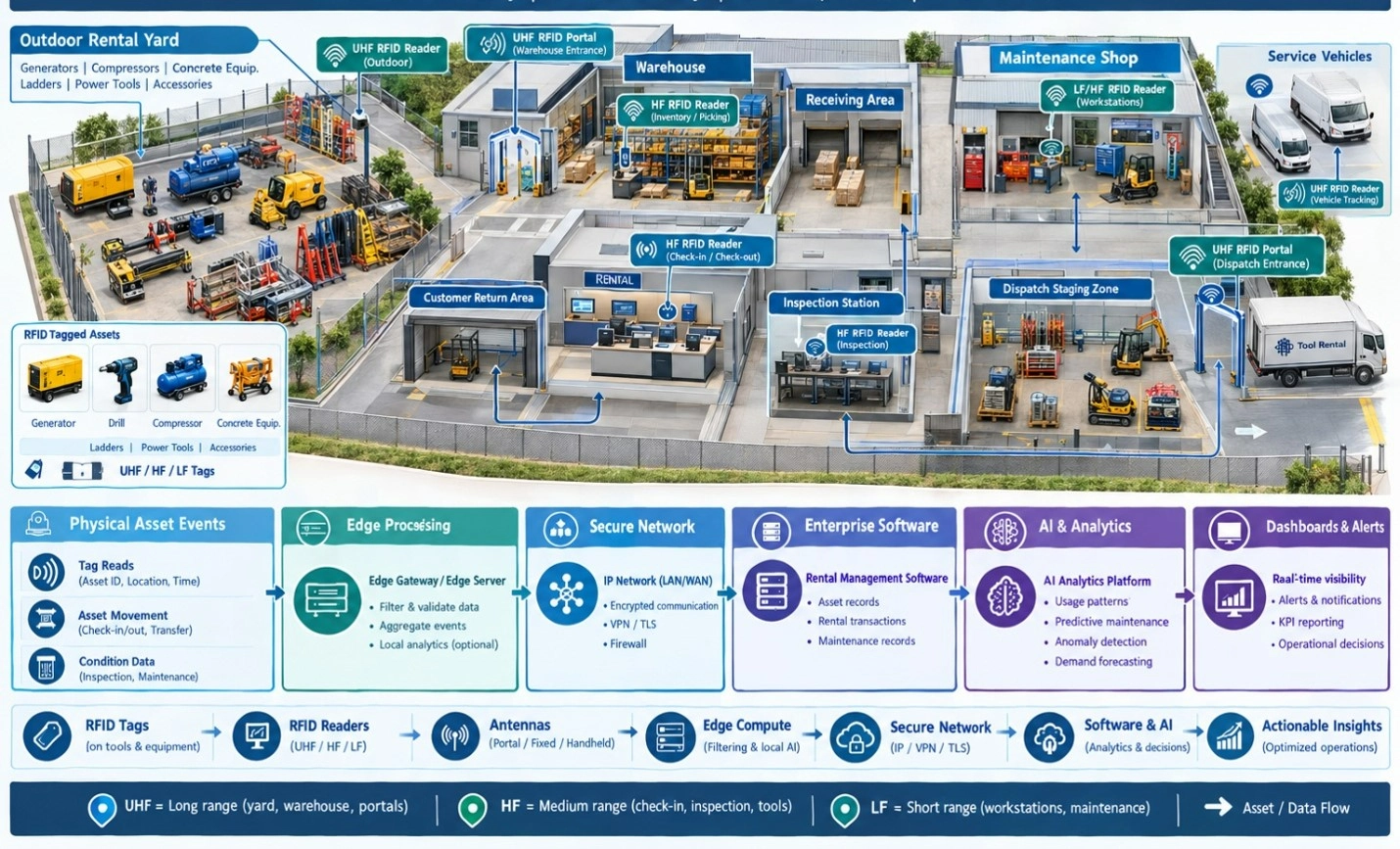
This diagram illustrates a realistic RFID deployment across a tool rental branch and outdoor yard.RFID readers capture asset movements at warehouses, rental counters, inspection stations, and dispatch areas.Edge computing filters and validates events before securely transmitting data to enterprise systems.AI analytics converts asset data into alerts, dashboards, maintenance insights, and operational decisions.
Data Quality as the Foundation for AI Tool Rental Analytics
AI-driven rental decisions depend on trustworthy asset data. RFID deployments should therefore include explicit data-quality controls.
Important controls include:
- Validating that every RFID tag maps to the correct rental asset record.
- Detecting duplicate or repeated reads generated by a stationary asset.
- Separating genuine movement events from reads caused by neighboring zones.
- Establishing read-zone boundaries at doors, portals, and workstations.
- Recording timestamps consistently across readers and enterprise systems.
- Reconciling RFID observations against rental transactions.
- Flagging assets with missing or contradictory lifecycle states.
- Monitoring reader health and communication failures.
- Tracking tag replacement and reassignment events.
- Maintaining audit records for important asset-state changes.
These controls create the foundation for AI models that analyze equipment utilization, maintenance risk, demand, and operational exceptions. Without them, a model may learn process errors rather than genuine rental behavior.
The next stage is to connect these data-quality practices with the broader technical stack, including RFID hardware selection, AI models, cloud and server deployment, cybersecurity, enterprise integration, KPIs, implementation strategy, and long-term optimization.
RFID Hardware and AI Technology for Tool Rental
A practical tool rental deployment requires RFID hardware, local processing, enterprise software integration, and AI capabilities selected around actual rental workflows. Technology selection should follow the physical operating environment rather than forcing a standard configuration onto every branch.
RFID Hardware Selection
A typical RFID installation can include:
- UHF RFID tags for tools and equipment requiring longer-range identification and rapid multi-asset reading.
- HF RFID tags and readers for controlled short-range identification points.
- LF RFID equipment for specialized applications where LF characteristics are appropriate.
- Fixed RFID readers at warehouse, receiving, dispatch, and controlled movement points.
- Integrated or external antennas selected according to the required read zone.
- Handheld RFID readers for cycle counting, exception investigation, and mobile inventory verification.
- RFID printers or encoders for producing and commissioning tagged asset labels where required.
- Industrial network equipment connecting readers and edge processing devices.
- Edge computers or gateways for local event filtering and workflow processing.
Tag selection deserves particular attention in tool rental because equipment may be exposed to impact, moisture, dust, temperature changes, vibration, outdoor storage, cleaning chemicals, and metal surfaces. The tag must remain readable throughout the expected rental lifecycle.
AI Models for Rental Operations
Different tool rental problems require different AI approaches.
| Rental Problem | Suitable AI Method | Example Output |
|---|---|---|
| Equipment demand forecasting | Time-series forecasting | Predicted demand by branch and asset category |
| Maintenance risk | Classification or survival analysis | Maintenance risk score |
| Unusual asset movement | Anomaly detection | Exception alert |
| Fleet utilization | Clustering and predictive analytics | Utilization segment |
| Return inspection priority | Classification | Inspection priority |
| Branch inventory imbalance | Optimization and forecasting | Recommended transfer |
| Rental duration analysis | Regression | Expected rental duration |
| RFID event irregularities | Anomaly detection | Suspected data-quality issue |
Machine learning should be selected according to the available data and business objective. A complex model is not automatically better than a simpler model. For many operational workflows, explainable models with clear thresholds can be easier for rental managers and maintenance teams to validate.
Computer vision can complement RFID in selected workflows, particularly where visual inspection is required. For example, cameras may assist with identifying visible damage to returned equipment, while RFID establishes the identity of the asset being inspected. Human review should remain available for ambiguous inspection results.
Cloud Version and Server Version for Tool Rental Systems
Tool rental companies can select a deployment model according to their IT policies, branch connectivity, data requirements, and integration strategy.
Cloud Version
A Cloud Version can centralize RFID event processing, rental data, AI analytics, dashboards, and reporting across multiple branches. This approach can simplify centralized management when a company operates geographically distributed rental locations.
Cloud processing can support:
- Centralized asset histories across branches.
- Cross-location utilization analysis.
- Fleet demand forecasting.
- Enterprise-level AI model management.
- Centralized dashboards and reporting.
- Remote system administration.
- Integration with cloud-based enterprise applications.
The design still requires appropriate edge processing at the branch when immediate local filtering or operational continuity is necessary.
Server Version
A Server Version can be deployed using customer-managed infrastructure according to organizational requirements. This may include edge servers, customer-managed servers, private data centers, factory servers, privately hosted enterprise infrastructure, or other controlled server environments.
Server-based deployment can be useful when a rental organization requires greater control over data processing, network access, integration boundaries, or operational policies. It can also support branches where certain RFID processing functions must remain locally available.
The choice between Cloud Version and Server Version should consider connectivity, latency, cybersecurity requirements, data governance, existing IT infrastructure, disaster recovery, scalability, software maintenance, and integration requirements.
Edge Processing for AI-Enabled Tool Rental
Edge processing places selected computation close to RFID readers and operational equipment. This is useful when the rental branch needs rapid response or when sending every raw RFID observation to a central system would create unnecessary network traffic.
An edge system can:
- Remove duplicate RFID reads.
- Apply time and signal thresholds.
- Associate readers with defined rental zones.
- Detect entry and exit events.
- Normalize RFID event formats.
- Temporarily store events during network interruptions.
- Forward validated events to central software.
- Trigger local alerts for selected exceptions.
Edge processing can also improve operational resilience. If a branch temporarily loses its external connection, local processing can continue collecting and validating RFID events before synchronization occurs.
RFID and AI Software Integration
RFID should not operate as an isolated identification system. The greatest operational value comes from connecting physical asset events with the software already used by the rental business.
Potential integration targets include:
- Rental management systems
- Inventory management systems
- Maintenance management software
- Warehouse management systems
- Order management software
- Customer relationship management systems
- Accounting and billing software
- Enterprise resource planning systems
- Business intelligence and reporting tools
- Mobile workforce applications
- API gateways and integration middleware
A common integration pattern is to maintain a master equipment record containing the rental asset ID, RFID tag ID, equipment category, branch, status, maintenance information, and lifecycle history.
When an RFID event occurs, middleware can translate the reader event into a business event. For example, a sequence of reads at a dispatch portal may become a “dispatch confirmation” event when matched against an authorized rental order.
This distinction between RFID read and business event is important. Not every tag read represents a transaction. Software should apply workflow rules before changing an asset’s official rental status.
Cybersecurity and Data Protection for RFID Tool Rental Systems
Security should be considered throughout deployment rather than added after installation.
Important controls include:
- Network segmentation for RFID readers and edge devices.
- Strong authentication for administrative access.
- Role-based access to asset and customer information.
- Encryption for sensitive data in transit and at rest where appropriate.
- Secure API authentication between RFID middleware and enterprise software.
- Regular firmware and software maintenance.
- Device inventory and configuration management.
- Logging of administrative and important operational events.
- Backup and recovery procedures.
- Monitoring for unauthorized device or network activity.
- Controlled access to maintenance interfaces.
- Secure credential management.
RFID tag identifiers should also be handled according to the organization’s data governance policies. A tag ID may not contain sensitive information by itself, but when linked to customer, rental, location, or transaction records, it becomes part of a larger operational information set.
AI systems require additional controls. Model access, training data, prediction logs, model versions, thresholds, and automated actions should be governed so that organizations can understand why important operational recommendations were produced.
Engineering Lifecycle for AI and RFID Tool Rental Deployment
A phased implementation reduces technical and operational risk.
Planning
Planning begins by identifying the highest-value workflows. A rental company may start with inventory accuracy, automated check-in, asset tracking, or predictive maintenance rather than attempting to automate every process simultaneously.
The planning phase should define:
- Asset categories to be tagged.
- RFID frequency requirements.
- Target workflows.
- Required read locations.
- Existing software interfaces.
- Data ownership.
- AI objectives.
- Security requirements.
- Success metrics.
- Branch and fleet scalability requirements.
Hardware Selection and Site Testing
Hardware should be evaluated using representative rental equipment. Metal tools, machinery, accessories, containers, and other difficult assets should be included in testing.
Site testing should evaluate read range, orientation sensitivity, interference, tag durability, portal performance, handheld performance, reader density, and false-read conditions.
Commissioning
Commissioning verifies that installed hardware performs according to the defined workflow.
Tests can include:
- Tag registration.
- Reader communication.
- Antenna coverage.
- Zone detection.
- Portal directionality.
- Duplicate-read filtering.
- Asset-to-tag mapping.
- Middleware event processing.
- Enterprise software synchronization.
- Exception handling.
- Local data buffering.
- Security controls.
Integration and User Acceptance
Rental employees should validate the system using actual operating procedures. A technically successful RFID deployment can still fail operationally if employees cannot understand alerts, exception workflows, or asset-state changes.
User acceptance testing should therefore involve rental counter staff, warehouse personnel, inspectors, maintenance technicians, dispatch employees, branch managers, and IT administrators as appropriate.
Optimization
Optimization should use measured performance rather than assumptions. Read accuracy, exception rates, processing latency, inventory discrepancies, transaction completion time, and AI prediction performance should be monitored.
Reader placement may require adjustment after real operating conditions are observed. AI thresholds may also require tuning as additional historical data becomes available.
Scalability
A successful pilot should be designed with future expansion in mind. A company may begin with one branch and later extend the solution to multiple locations.
Scalability considerations include:
- Consistent asset identification.
- Standard RFID tag commissioning procedures.
- Reusable integration interfaces.
- Centralized or federated AI models.
- Cross-branch asset histories.
- Reader configuration management.
- Common security policies.
- Standard KPI definitions.
- Centralized monitoring.
Tool Rental KPIs Enabled by AI and RFID
The combined system can support operational measurement across several areas.
| KPI | Measurement Focus |
|---|---|
| Inventory accuracy | Difference between recorded and physically observed assets |
| Asset utilization rate | Percentage of available time assets are rented or actively utilized |
| Rental turnaround time | Time from return to rentable status |
| Check-in processing time | Time required to register returned assets |
| Check-out processing time | Time required to prepare assets for rental |
| Maintenance downtime | Time assets remain unavailable for service |
| Mean time between failures | Reliability of rental equipment |
| Maintenance prediction accuracy | Performance of maintenance-risk models |
| Asset loss rate | Assets not reconciled to expected locations |
| RFID read accuracy | Percentage of required asset events captured correctly |
| Exception rate | Frequency of unresolved RFID or workflow discrepancies |
| Branch transfer efficiency | Effectiveness of moving assets between locations |
| Demand forecast accuracy | Accuracy of predicted rental demand |
| Rental availability | Ability to provide requested equipment |
| Asset recovery time | Time required to locate missing or misplaced equipment |
These KPIs should be established before deployment so that the organization can compare baseline performance with post-deployment results.
Business and Operational Benefits of AI-Enabled Tool Rental
The value of AI and RFID comes from improving specific operating conditions.
Higher Inventory Accuracy
Automated identification reduces dependence on manual counting and visual identification. More reliable asset records can improve inventory reconciliation and reduce time spent searching for equipment.
Better Equipment Availability
Predictive maintenance and faster return processing can help identify equipment that needs attention before it becomes unexpectedly unavailable. Faster inspection and maintenance workflows can also shorten the time between customer return and next rental.
Reduced Asset Loss and Misplacement
Automated movement observations provide a stronger audit trail for rental equipment. AI anomaly detection can identify movement patterns that differ from expected workflows, allowing employees to investigate exceptions earlier.
Improved Fleet Utilization
Rental companies can use asset-level utilization information to identify underused equipment and demand shortages. This supports more informed fleet allocation and branch transfer decisions.
More Efficient Branch Operations
Automating repetitive identification tasks allows employees to spend more time on inspection, customer service, maintenance decisions, and exception handling rather than manual asset searches and counts.
Better Data for Management Decisions
Combining RFID events, rental transactions, maintenance records, and AI analytics creates a more complete view of the equipment lifecycle. Managers can use this information to evaluate fleet performance, maintenance patterns, branch demand, and process bottlenecks.
Practical Recommendations for Tool Rental Companies
Organizations evaluating AI and RFID should begin with a measurable operational problem rather than technology selection alone.
Recommended practices include:
- Select one or two high-value rental workflows for the initial deployment.
- Perform an RFID site survey before final hardware selection.
- Test tags on representative metal, plastic, powered, and outdoor equipment.
- Maintain a unique relationship between the RFID tag ID and rental asset ID.
- Establish data-quality rules before implementing AI analytics.
- Use edge processing where local filtering and resilience are important.
- Integrate RFID events with existing rental software rather than maintaining a separate asset database without business context.
- Define KPIs before the pilot begins.
- Validate AI predictions against real maintenance and rental outcomes.
- Keep human approval for important operational decisions.
- Establish cybersecurity and device-management procedures during commissioning.
- Design the system so additional branches and equipment categories can be added later.
- Monitor performance continuously and adjust reader configuration, workflow rules, and AI models based on measured results.
GAO can support organizations evaluating RFID hardware and system requirements for tool rental applications, including the selection of RFID components, deployment considerations, and technical support. Its long-standing work with organizations across the United States and Canada provides a practical foundation for addressing enterprise identification and connected-device requirements.
Summary: Building Intelligent Tool Rental Operations
AI-enabled tool rental management becomes most effective when RFID identification, reliable data processing, enterprise software, and AI analytics are designed as one operational system. RFID establishes visibility into the movement and identity of physical rental assets, while AI converts that information into forecasts, anomaly detection, maintenance priorities, utilization insights, and workflow recommendations.
Tool rental companies should prioritize measurable problems such as inventory accuracy, asset loss, equipment downtime, rental turnaround, and fleet utilization. Deployment should then proceed through site testing, hardware commissioning, software integration, data-quality validation, AI model development, cybersecurity controls, KPI measurement, and continuous optimization.
GAO provides RFID hardware, IoT products, and technical systems that can support these requirements, with engineering and technical support available for organizations developing practical RFID-enabled rental workflows.
Conclusion and Recommendations for AI and RFID in Tool Rental
AI and RFID can provide a practical foundation for improving tool rental operations when deployment is aligned with physical workflows and measurable business requirements. UHF RFID is particularly relevant to automated identification across yards, warehouses, and movement points, while HF and LF RFID can address more controlled or specialized identification scenarios. AI adds value through predictive maintenance, demand forecasting, anomaly detection, utilization analysis, and operational optimization.
A phased implementation is recommended. Start with a defined rental workflow, establish data quality, validate RFID performance under real conditions, integrate with existing software, and then introduce AI models using trustworthy historical data. This approach supports scalable improvement without requiring unnecessary technology complexity.
Building the Future of Industrial AI and IoT with Aperture Venture Studio and GAO
Industrial AI and IoT are increasingly connecting physical assets, operational data, intelligent analytics, and enterprise decision-making. Aperture Venture Studio and GAO can contribute to this direction by supporting practical development around connected equipment, RFID, AI analytics, edge processing, and enterprise IoT systems. The focus is on translating emerging technologies into technically grounded solutions that can operate within real industrial workflows. For organizations evaluating intelligent asset management, automated identification, predictive analytics, or connected operations, this combination of engineering knowledge and applied technology development provides a path toward measurable digital transformation.