
AI and RFID for Bakery Manufacturing
AI-Driven Bakery Manufacturing with RFID-Enabled Traceability
AI and IoT are changing bakery manufacturing by connecting production data, ingredients, packaging materials, work-in-process items, finished products, and logistics activities into actionable operational intelligence. In bakery plants, AI can analyze production, quality, inventory, environmental, and equipment data to identify deviations and support faster decisions. RFID provides an important data-capture layer by identifying and tracking tagged ingredients, containers, reusable assets, packaging materials, work-in-process batches, and finished-goods handling units.
The combination is particularly useful where bakery manufacturers must manage short product shelf lives, frequent production runs, recipe changes, allergen controls, high-speed packaging, sanitation cycles, and strict traceability requirements. UHF RFID can support automated identification across production and warehouse areas, while HF or LF RFID can be appropriate for more localized identification requirements. GAO provides RFID, BLE, and IoT hardware products and systems that can support these connected bakery manufacturing processes.
Why AI Matters in Bakery Manufacturing
Bakery manufacturing produces large amounts of operational data. Mixing, proofing, baking, cooling, slicing, packaging, palletizing, warehousing, and shipping each generate information that can influence product quality and production efficiency.
Traditional production systems often record events after they occur. AI can instead analyze patterns across multiple data sources and identify conditions that may require attention.
For example, an AI-enabled bakery manufacturing solution can correlate:
- Ingredient lot and batch information with production orders
- Recipe parameters with mixer and production-line data
- Proofing conditions with product-quality observations
- Oven temperature profiles with product characteristics
- Packaging-line events with finished-product counts
- RFID movements with work-in-process location
- Equipment sensor readings with maintenance history
- Warehouse movements with production schedules and shipment requirements
- Quality inspection results with specific production batches
This creates a more complete operational picture than relying on isolated spreadsheets, manual scans, or disconnected machine records.
AI does not replace bakery production controls. Its value comes from using operational data to improve forecasting, anomaly detection, quality analysis, scheduling, maintenance decisions, and resource utilization while keeping established food-safety procedures and human oversight in place.
Core Bakery Manufacturing Applications
AI Ingredient Inventory and Lot Traceability
Ingredient management is one of the most important applications because bakery production depends on the availability, identity, condition, and lot history of flour, sugar, yeast, oils, fats, dairy ingredients, eggs, flavorings, inclusions, and other materials.
RFID tags can associate physical materials with digital records. Readers positioned at receiving points, storage locations, staging areas, or production entrances can capture movement events automatically.
AI can then use these records with ERP, warehouse management, manufacturing execution, and quality data to identify inventory discrepancies, predict material requirements, and support production planning.
A useful implementation does not treat RFID reads as the final business result. The important output is a trusted material event such as:
ingredient received → lot identified → storage location recorded → production order assigned → material issued → batch consumed → finished product associated with ingredient lots
This relationship can substantially simplify investigations when a bakery manufacturer needs to determine which products were manufactured using a particular ingredient lot.
RFID-Enabled Bakery Manufacturing Workflow from Ingredients to Shipment
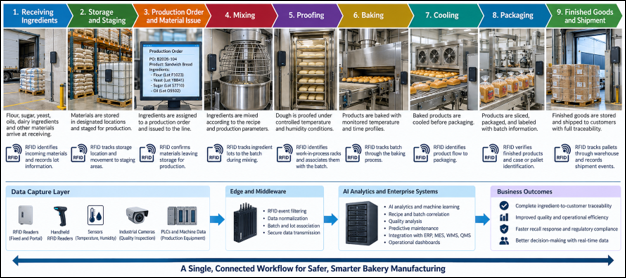
This infographic illustrates an end-to-end bakery manufacturing workflow from ingredient receiving and storage through mixing, proofing, baking, cooling, packaging, and shipment. It shows how RFID identification, edge processing, AI analytics, and enterprise systems connect production events to ingredient traceability, quality, inventory, and operational decisions.
AI Production Scheduling for Bakery Lines
Bakery production scheduling is affected by product demand, recipe requirements, equipment capacity, changeovers, sanitation, labor availability, ingredient availability, proofing requirements, oven capacity, packaging-line constraints, and shipping schedules.
AI-based scheduling can analyze these variables to identify production sequences that reduce avoidable downtime and changeover disruption.
RFID can provide physical confirmation of production materials and work-in-process movement. For example, when tagged ingredient containers or production carts enter a staging area, the system can compare the actual material status with the planned production schedule.
This distinction between planned and actual production is important. A scheduling system may show that a batch is ready, while the physical materials required for that batch are still in another area. Automated identification can provide a more accurate operational state.
AI can use this information to support decisions such as:
- Which production order should run next
- Whether required ingredients are available
- Whether a production batch has reached the correct stage
- Whether a packaging line is likely to become a bottleneck
- Whether a changeover sequence should be adjusted
- Whether an order is at risk of missing its shipping window
The final scheduling decision can remain under production management control, particularly where food-safety, allergen, sanitation, or quality requirements constrain the available production sequence.
AI Quality Control for Baked Products
Quality variation can result from ingredient characteristics, mixing conditions, dough temperature, proofing time, oven performance, cooling conditions, packaging, and environmental conditions.
AI can support quality control by identifying relationships between process parameters and observed product characteristics.
Computer vision can inspect attributes such as:
- Product shape
- Surface appearance
- Color
- Crust characteristics
- Size and dimensional consistency
- Packaging position
- Label presence
- Visible defects
Process sensors can provide additional information about oven temperature, humidity, dough conditions, equipment states, and production timing.
RFID adds product or batch identity to these observations. Instead of simply detecting that a product has a quality deviation, the system can associate the observation with a production batch, recipe, ingredient lot, line, equipment state, and production time.
This enables a more useful question: What production conditions are associated with recurring quality deviations?
AI models can then assist quality teams in detecting patterns that may not be obvious through manual review.
Bakery Manufacturing Operational Challenges AI Can Address
Bakery plants face several conditions that make connected data particularly valuable.
Short Shelf Life and High Production Frequency
Many bakery products have limited shelf life. Production, inventory, picking, and shipment decisions therefore need to be closely coordinated.
AI can analyze demand patterns, production history, inventory levels, and shipment requirements to improve planning. RFID can provide timely physical inventory and movement information to reduce dependence on manual inventory counts.
Recipe and Allergen Management
Different bakery products can require different ingredients, formulations, equipment settings, and sanitation procedures. Allergen management adds another layer of operational control.
A connected solution can associate production orders with ingredient lots and production events, providing stronger digital traceability. However, RFID and AI should complement, not replace, validated allergen-control procedures, cleaning protocols, material segregation, and food-safety controls.
High-Speed Packaging
Packaging lines can operate at significantly higher speeds than manual material-handling processes. Errors involving labels, cases, pallets, or production quantities can therefore propagate quickly.
RFID can help identify cases, pallets, reusable containers, or other tagged assets as they move through designated points. AI analytics can compare expected production quantities with observed movements and identify unusual patterns.
Equipment Downtime
Mixers, conveyors, proofers, ovens, cooling systems, slicers, packaging machines, and palletizing equipment are critical production assets.
AI-based predictive or condition-based maintenance can combine equipment sensor data, operating hours, fault codes, maintenance history, and production conditions to identify potential failure patterns.
RFID can complement this by identifying maintenance assets, tooling, mobile equipment, spare parts, or service items where appropriate.
Manual Data Entry
Manual recording introduces delays and creates opportunities for transcription errors. Automated identification can capture material and asset movements at defined process points.
The engineering objective should not be to RFID-tag everything. Tags and readers should be deployed where automatic identification produces a measurable operational benefit.
From Physical Bakery Operations to AI Decisions
A practical AIoT solution for bakery manufacturing typically connects the physical production environment to operational software through several stages.
Data Acquisition
The first stage collects information from physical bakery operations.
Potential sources include:
- UHF RFID readers and antennas
- HF RFID readers for localized identification
- LF RFID systems where their characteristics fit the application
- Temperature and humidity sensors
- Equipment sensors and machine interfaces
- Barcode systems
- Industrial cameras
- PLC and automation data
- Weighing systems
- Production-line counters
- ERP and production-order records
- Quality inspection records
- Warehouse transactions
The selection of each data source should be based on the process requirement rather than technology preference.
Communication and Edge Processing
Collected data can be transferred through industrial Ethernet, Wi-Fi, cellular connectivity, or other appropriate communication infrastructure.
An edge computer or industrial gateway can perform initial processing before data reaches centralized software. Edge processing is particularly useful when the bakery needs low-latency responses, local operation during network interruptions, or preprocessing of high-volume sensor and machine data.
For example, an edge system can filter duplicate RFID reads, normalize equipment events, associate reads with production zones, and forward meaningful events to the central application.
Middleware and Event Processing
Middleware connects physical identification and machine data with business applications.
A well-designed middleware layer can transform raw events such as:
Tag ID detected → Reader ID → Timestamp
into a business event such as:
Ingredient container entered production staging for Batch B2026-104
This transformation is essential because raw RFID reads alone do not provide sufficient business context.
AI Analytics
AI models can analyze the normalized operational data.
Depending on the bakery application, suitable methods may include:
- Machine learning for demand and production forecasting
- Anomaly detection for equipment and process behavior
- Computer vision for product and packaging inspection
- Classification models for quality-related patterns
- Time-series models for equipment and process data
- Optimization algorithms for scheduling
- Predictive models for maintenance requirements
- Generative AI for operational knowledge retrieval and natural-language analysis
AI outputs should be connected to defined operational actions rather than treated as standalone predictions.
Business Action
The final stage converts analysis into an operational decision.
Examples include:
- Adjusting production priorities
- Investigating a quality deviation
- Holding a material for verification
- Replenishing an ingredient
- Scheduling maintenance
- Investigating an inventory discrepancy
- Reviewing a packaging-line anomaly
- Escalating a traceability event
- Updating production or warehouse records
The objective is a closed operational loop in which physical events create trustworthy data, AI produces useful analysis, and authorized personnel or systems take appropriate action.
AIoT Deployment Architecture for Connected Bakery Manufacturing
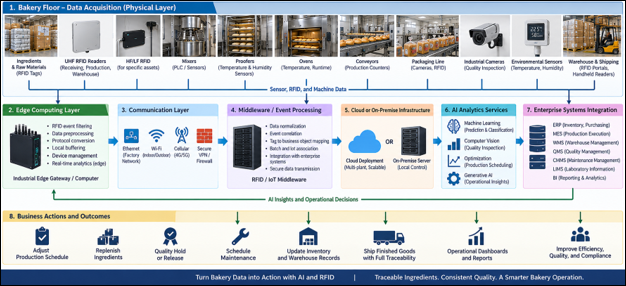
This diagram shows how bakery-floor data from RFID readers, sensors, cameras, PLCs, production equipment, and warehouse operations flows through edge computing, secure communications, middleware, and cloud or server infrastructure. AI analytics then connects with ERP, MES, WMS, QMS, maintenance, and reporting systems to support production, quality, traceability, inventory, and maintenance decisions.
RFID Selection for Bakery Manufacturing
RFID selection should follow the physical characteristics of each bakery process.
UHF RFID
UHF RFID is generally suitable for longer-range automated identification where tags may be read without close physical contact. Bakery applications can include tagged cases, pallets, reusable containers, ingredient containers, work-in-process carriers, and warehouse movements.
Reader placement requires attention to conveyor speed, antenna orientation, tag placement, read zones, reflections, nearby metal, liquids, and the physical composition of packaging.
HF RFID
HF RFID can be useful for shorter-range, controlled identification points. It may be appropriate where a bakery process requires intentional close-range identification rather than longer-range portal-style reads.
LF RFID
LF RFID operates at lower frequencies and can be appropriate for specific short-range identification applications where its physical characteristics fit the environment.
The correct choice depends on required read distance, tag form factor, environmental conditions, asset composition, throughput, reader placement, and the required level of automation.
Realistic RFID Deployment in a Connected Bakery Manufacturing Facility
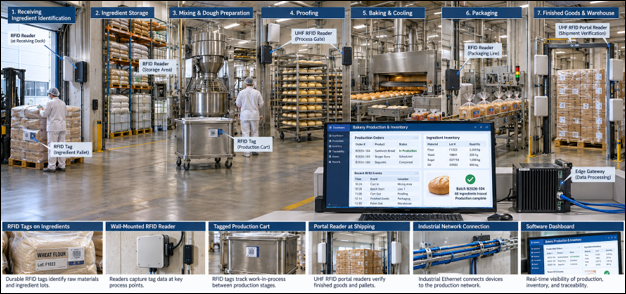
This visual depicts a practical bakery manufacturing facility using RFID across ingredient receiving, storage, production, packaging, and finished-goods handling. It shows tagged materials and production carts, UHF RFID readers, an edge gateway, industrial network connectivity, and software providing production, inventory, and traceability visibility.
Hardware, Software, and Deployment for Bakery AI Solutions
A production-ready bakery manufacturing solution requires more than RFID readers and AI models. The system must connect physical production processes with reliable identification, industrial communications, operational software, and controlled decision-making. Hardware selection should account for flour dust, humidity, washdown practices, temperature variation, conveyor speeds, metal structures, food-contact restrictions, and cleaning procedures.
RFID and Identification Hardware
RFID hardware can include fixed readers, antennas, handheld readers, RFID tags, gateways, and related mounting equipment.
For bakery manufacturing, tag selection should consider the material being identified and its operating environment. Tags attached to plastic ingredient containers, corrugated cases, reusable totes, pallets, or metal assets may require different form factors and mounting approaches.
Fixed readers can be installed at receiving docks, production entrances, staging areas, conveyor points, packaging areas, and warehouse transitions. Handheld RFID readers can supplement fixed infrastructure for exception handling, cycle counts, investigations, and asset-location tasks.
GAO supplies RFID hardware and systems that can be incorporated into these identification workflows, with deployment decisions based on the physical characteristics and operational requirements of the bakery facility.
Sensors, Cameras, and Industrial Equipment Data
RFID provides identity, but bakery AI applications often require additional process data.
Temperature sensors can provide information about ovens, cooling environments, storage areas, and other controlled conditions. Humidity measurements can help analyze proofing and environmental conditions. Machine interfaces and PLC data can expose equipment states, alarms, cycle times, operating parameters, and production counts.
Industrial cameras can support computer-vision applications for baked-product appearance, dimensions, packaging inspection, label verification, and other visual quality checks.
Combining these sources is more valuable than relying on any single data stream. For example, an AI quality model may become more useful when a visual defect can be correlated with the production batch, ingredient lots, oven conditions, production time, and equipment state.
Edge Computing and Industrial Gateways
An edge gateway can sit between bakery-floor devices and centralized software. Its responsibilities may include protocol conversion, RFID event filtering, local buffering, device management, data normalization, and temporary operation during network interruptions.
This is particularly useful in facilities where production cannot stop simply because connectivity to a remote application is temporarily unavailable.
Edge processing can also reduce unnecessary network traffic. A reader may generate multiple observations of the same RFID tag while a pallet passes through a read zone. Middleware can consolidate those observations into a meaningful movement event before forwarding it to the central system.
Enterprise Software Integration
AI-driven bakery manufacturing solutions commonly exchange information with systems such as:
- Enterprise resource planning systems for purchasing, inventory, recipes, production orders, and financial records
- Manufacturing execution systems for production execution, work-in-process, and production genealogy
- Warehouse management systems for receiving, storage, picking, staging, and shipping
- Quality management systems for inspections, deviations, holds, corrective actions, and quality records
- Maintenance management systems for equipment history, work orders, preventive maintenance, and spare parts
- Laboratory information systems where laboratory testing contributes to quality decisions
- Human-machine interfaces and supervisory control systems for machine and process information
- Business intelligence software for operational reporting and KPI analysis
Common integration methods may include REST APIs, database interfaces, message brokers, industrial protocols, web services, and structured event interfaces. The appropriate method depends on the existing software environment and the required latency.
Cloud Version vs. Server Version
A Cloud Version can host application software, analytics, dashboards, AI services, databases, and related components within cloud infrastructure. This model can be appropriate for bakery manufacturers operating multiple plants that need centralized visibility, shared analytics, remote software administration, or consolidated reporting.
Cloud deployment can simplify centralized scaling and make it easier to aggregate data across facilities. However, connectivity, data governance, cybersecurity, latency requirements, and integration with plant-floor systems must be evaluated before moving operational workloads to the cloud.
A Server Version can run software on customer-managed factory servers, edge servers, private data centers, or other privately hosted infrastructure. This approach can be useful when a bakery requires local processing, greater control over data location, operation during limited connectivity, or integration with existing plant systems.
A hybrid implementation can combine both models. Time-sensitive RFID and machine processing can remain local while selected operational data, reports, historical records, and AI workloads are synchronized with centralized infrastructure.
The most appropriate deployment model depends on the bakery’s plant connectivity, IT policies, cybersecurity requirements, number of facilities, operational latency requirements, data governance, and existing software infrastructure.
AI Capabilities That Improve Bakery Manufacturing
AI delivers the greatest value when it is connected to measurable production and quality objectives.
Demand and Production Forecasting
Forecasting models can analyze historical orders, production volumes, seasonal demand, product mix, and inventory information to support production planning.
For bakeries with many SKUs and frequent production cycles, better forecasting can help reduce situations where production capacity is allocated inefficiently or finished products remain in inventory longer than necessary.
RFID-generated inventory events can provide additional information about the physical movement of ingredients, work-in-process, cases, and pallets. This can help distinguish recorded inventory from observed inventory activity.
Predictive Maintenance
Predictive maintenance models can examine equipment operating conditions and historical failures to identify patterns associated with potential faults.
For bakery equipment, relevant data may include:
- Mixer operating cycles
- Conveyor motor behavior
- Oven temperature stability
- Proofer operating conditions
- Slicer operating cycles
- Packaging-machine alarms
- Motor current or vibration measurements
- Equipment runtime
- Previous maintenance events
The objective is not to predict every failure with certainty. A practical system should prioritize equipment conditions that justify inspection or maintenance action.
Computer Vision for Product and Packaging Quality
Computer vision can inspect high-speed production where manual inspection of every item is impractical.
AI models can identify visual patterns associated with underbaked or overbaked products, inconsistent appearance, dimensional deviations, damaged packaging, missing labels, incorrect positioning, or other defined inspection criteria.
Camera placement, lighting, image resolution, conveyor speed, product orientation, model training data, and false-positive tolerance all influence system performance.
A bakery should validate AI inspection against its existing quality specifications rather than treating model confidence as an independent quality standard.
AI-Based Anomaly Detection
Anomaly detection can identify unusual combinations of production variables.
For example, a model may identify that a particular production run has an unusual combination of equipment temperature, cycle time, ingredient lot, and quality observations.
This can support earlier investigation than waiting for a finished-product complaint or a large quantity of rejected product.
AI-Assisted Traceability
Traceability becomes more useful when the system can connect identity with production context.
A bakery manufacturer could query a production record and identify relationships among:
Ingredient lot → production batch → equipment and process events → quality inspection → packaging unit → pallet → shipment
RFID can automate portions of the physical identification process, while enterprise software provides the transactional context.
The result is a more complete digital production genealogy.
Operational and Business Benefits for Bakery Manufacturers
Combining AI with RFID-enabled data capture can improve several bakery-specific performance areas.
- Faster traceability investigations: Automated identification can reduce the effort required to reconstruct ingredient, batch, and finished-product movement histories.
- Better inventory accuracy: RFID events can provide additional physical evidence for ingredient, container, case, and pallet movements.
- Reduced manual recording: Automated identification decreases dependence on repetitive manual scans and entries at suitable process points.
- Improved production visibility: Managers can compare planned production with observed movement and equipment events.
- Earlier quality intervention: AI can detect process or visual patterns before deviations become larger production problems.
- Reduced unplanned downtime: Predictive analytics can help maintenance teams prioritize inspections and interventions.
- Improved warehouse coordination: Physical movement events can help connect production completion with staging, storage, picking, and shipping.
- Better utilization of production assets: Data-driven scheduling and analysis can expose bottlenecks involving mixers, proofers, ovens, packaging machines, conveyors, and other constrained equipment.
- Improved batch genealogy: Connecting ingredient identity, production events, quality records, and finished goods creates stronger production traceability.
- Scalable multi-plant analysis: Centralized software can compare operational patterns across bakery facilities when data standards are consistent.
GAO’s experience supplying RFID, BLE, and IoT hardware products and systems can support organizations that need to connect physical identification with broader manufacturing and operational processes.
Cybersecurity and Data Governance
AI and RFID systems should be designed as part of the bakery’s overall industrial cybersecurity program.
RFID itself is only one component of the security model. Risks can arise from network-connected readers, gateways, edge servers, application interfaces, cloud services, databases, user accounts, and integrations with production systems.
Important controls include:
- Network segmentation between production equipment and business networks
- Role-based access control
- Strong authentication
- Encryption for appropriate data transmissions
- Secure API authentication
- Device identity and credential management
- Software and firmware update procedures
- Audit logging
- Backup and recovery procedures
- Monitoring of abnormal system activity
- Controlled access to production and quality records
Data governance is equally important. A bakery should define which information is retained, how long it is retained, who can access it, and how AI-generated recommendations are recorded.
AI decisions that affect product release, quality holds, allergen controls, or other regulated processes should have clearly defined human authorization and validation procedures.
Implementation Roadmap for Bakery AI and RFID
Successful implementation normally starts with the operational problem rather than with a specific RFID reader or AI model.
Define the Business and Production Problem
Start by identifying a measurable issue such as inventory discrepancies, traceability effort, packaging errors, production downtime, quality variation, or inefficient production scheduling.
Define the baseline KPI before deployment.
Map the Bakery Workflow
Document the physical flow of ingredients, work-in-process, packaging materials, finished products, reusable containers, and pallets.
Identify where manual identification occurs and where an automated event would provide useful information.
Select RFID and Sensor Locations
Reader locations should be selected according to actual process movement.
Conduct site surveys for:
- Read-zone dimensions
- Tag orientation
- Conveyor speed
- Metal interference
- Liquid-rich environments
- Reader antenna positioning
- Forklift traffic
- Washdown requirements
- Network availability
A controlled pilot should validate read performance before broad deployment.
Establish Data and Integration Rules
Define the relationship between tag IDs, material IDs, lot numbers, production orders, batch numbers, asset IDs, and shipment records.
Without these mappings, an RFID system may generate large volumes of identification data without creating useful manufacturing information.
Validate AI Models
AI models should be trained and evaluated using bakery-specific data.
Quality models should account for normal product variation. Maintenance models should use equipment-specific operating history. Forecasting models should reflect product seasonality and SKU-level demand.
Model performance should be measured using operational metrics rather than generic AI accuracy alone.
Pilot Before Scaling
A practical pilot might cover one production line, one ingredient workflow, one packaging area, or one warehouse transition.
The pilot should measure both technical performance and operational value.
Once the process is validated, the solution can be extended to additional lines, products, warehouses, or facilities.
KPIs for AI-Enabled Bakery Manufacturing
A bakery manufacturer should establish KPIs that connect the technology to measurable operational outcomes.
Relevant metrics include:
- Ingredient inventory accuracy
- RFID read accuracy
- Batch traceability completion time
- Production schedule adherence
- Overall equipment effectiveness
- Unplanned downtime
- Mean time between failures
- Mean time to repair
- Changeover duration
- Production throughput
- First-pass quality rate
- Scrap and rework rate
- Packaging defect rate
- Finished-goods inventory accuracy
- Order fulfillment accuracy
- On-time shipment rate
- Production yield
- Product hold duration
- Traceability investigation time
- Manual data-entry workload
The correct KPI set depends on the bakery’s production model and primary business problem.
Practical Recommendations from GAO
Bakery manufacturers considering AI and RFID should prioritize measurable operational improvements rather than attempting to digitize every physical object.
Start with high-value process points where identification is difficult, manual, error-prone, or operationally expensive. Use RFID where automated identity capture is genuinely useful, and combine it with sensors, machine data, computer vision, and enterprise software where those sources provide additional context.
The solution should also accommodate exceptions. Bakery operations contain damaged labels, misplaced containers, production changes, equipment downtime, sanitation events, and unexpected schedule changes. A robust system must allow operators to correct or verify events rather than assuming that every automated observation is perfect.
GAO can provide RFID, BLE, and IoT hardware products and systems for organizations evaluating these requirements, along with technical support for selecting and implementing appropriate technologies.
Building a Connected, AI-Enabled Bakery Manufacturing Operation
AI can make bakery manufacturing data more actionable, but its effectiveness depends on the quality of the underlying operational information. RFID provides automated physical identification, while sensors, machine interfaces, computer vision, manufacturing software, and business systems provide additional context.
The strongest implementations connect these technologies around a specific bakery workflow: ingredient traceability, production scheduling, quality inspection, maintenance, packaging, warehouse management, or finished-goods tracking.
For bakery manufacturers, the practical objective is not simply to deploy AI or RFID. It is to create reliable information that helps production, quality, maintenance, warehouse, and management teams make better decisions.
GAO’s three decades of R&D and customer service experience include supplying technology products and systems to organizations in the United States and Canada, including Fortune 500 companies, leading R&D organizations, universities, and government agencies. GAO maintains stringent quality assurance processes and provides expert technical support remotely or onsite.
Building the Future of Industrial AI and IoT with Aperture Venture Studio and GAO RFID Inc.
For more than three decades, GAO Group of Companies has invested heavily in R&D for industrial RFID, BLE, and IoT technologies. As generative AI became increasingly useful for industrial applications, we expanded our work across AI and IoT, including RFID and BLE, and founded Aperture Venture Studio to support the development and scaling of AI and IoT solutions relevant to industries such as bakery manufacturing.
Aperture has attracted AI and IoT technical experts, entrepreneurial and operational executives, investors, and leading companies. We have also developed Aperture Ventures Summit and TekSummit to discuss advanced AI and IoT topics.
These activities contribute to broader technical communities focused on practical AI and IoT applications. We welcome professionals and organizations interested in contributing as advisors, co-founders or employees, investors, or customers.