
AI-Driven Cold Storage Logistics with RFID
How AI Improves Cold Storage Logistics and Inventory Control
AI-driven cold storage logistics combines artificial intelligence with connected identification, warehouse data, and operational systems to improve how temperature-sensitive products are received, stored, located, picked, shipped, and reconciled. RFID provides machine-readable identification for pallets, cases, reusable containers, racks, and other logistics assets, while AI analyzes movement, inventory, order, and operational data to support better decisions. Together, these technologies can strengthen inventory accuracy, automate location and movement records, improve order fulfillment, reduce search time, and identify operational anomalies in refrigerated and frozen facilities. AI can also support demand forecasting, labor planning, replenishment, slotting, exception detection, and predictive maintenance when sufficient historical and real-time data are available. For cold storage operators, the practical value comes from connecting physical inventory movements with digital warehouse records so that logistics teams can act on current information rather than relying primarily on manual scans, spreadsheets, or delayed reconciliation.
Cold Storage Logistics AI and RFID Operational Overview
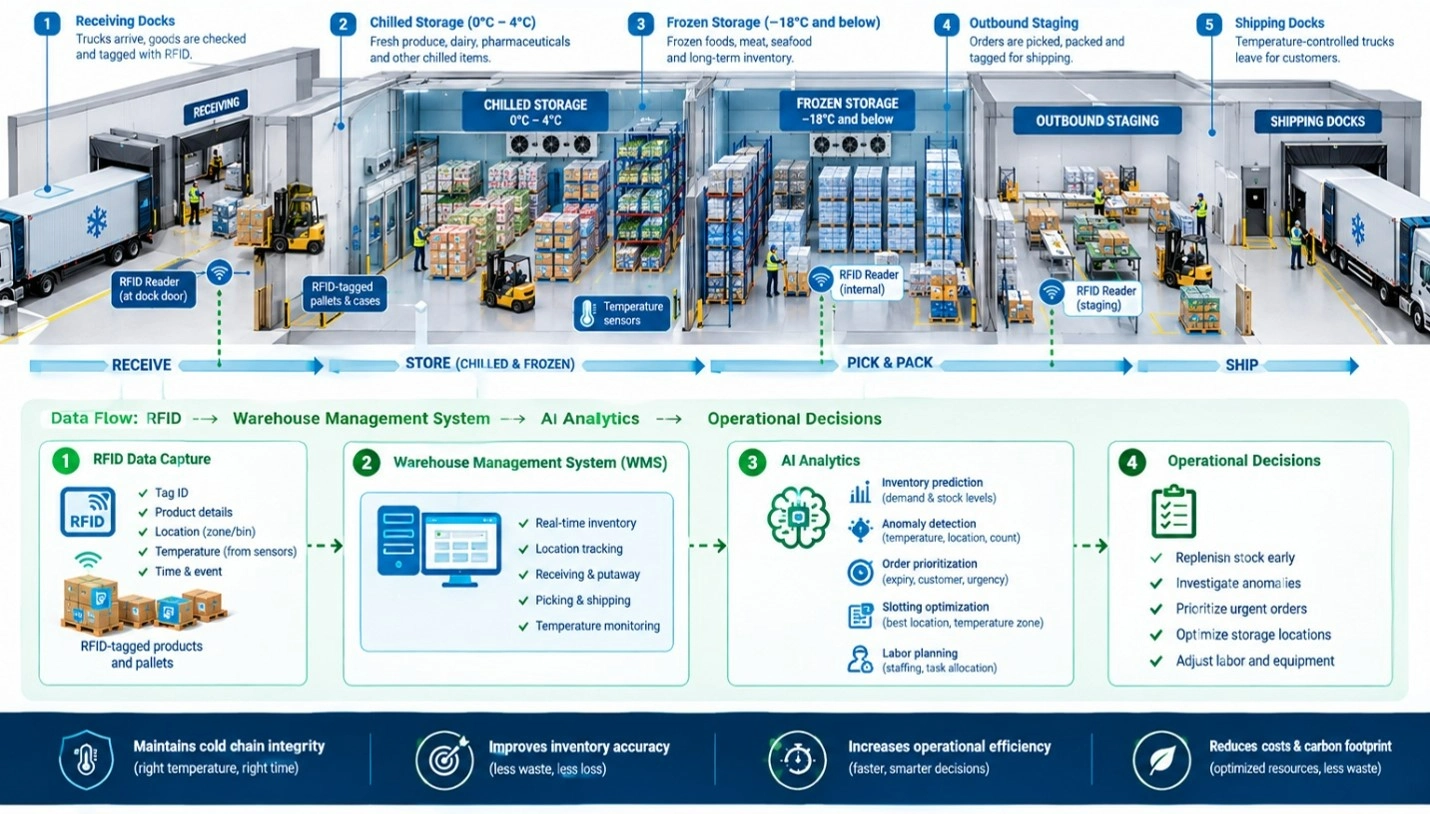
This infographic illustrates how RFID-enabled cold storage operations connect physical inventory movement with warehouse management systems and AI analytics. It highlights AI-driven inventory prediction, anomaly detection, order prioritization, storage optimization, and labor planning to improve cold-chain integrity, accuracy, and operational efficiency.
The Role of AI in Cold Storage Inventory Management
Cold storage facilities operate under tighter operational constraints than conventional warehouses. Product may have defined temperature requirements, limited shelf life, lot or batch controls, customer-specific handling requirements, and strict shipping windows. A warehouse management decision therefore depends on more than knowing whether an item exists. The system needs to understand what the item is, where it is, how much is available, which lot it belongs to, when it should move, and whether the inventory record is consistent with the physical operation.
AI can use historical warehouse transactions and real-time identification data to improve these decisions.
- AI inventory management can identify discrepancies between expected and observed inventory movements.
- AI demand forecasting can estimate future storage and order requirements from historical demand, seasonality, customer orders, and other available data.
- AI slotting can recommend storage locations based on product velocity, handling requirements, order patterns, and available capacity.
- AI order prioritization can help warehouse teams sequence work according to shipment requirements and operational constraints.
- AI anomaly detection can flag unusual pallet movements, unexpected inventory changes, duplicate events, or transactions that do not fit established patterns.
- AI labor planning can estimate workload around receiving, put-away, replenishment, picking, staging, and shipping activities.
- Predictive maintenance can analyze equipment information to identify patterns associated with potential failures in refrigeration or material-handling equipment, where appropriate sensor data are available.
- AI-assisted traceability can correlate product identification, movement events, lot information, and warehouse transactions to create a more complete operational history.
RFID contributes the physical identification layer. UHF RFID is particularly relevant where pallets, cartons, cases, reusable containers, or other logistics units need to be identified automatically as they pass through warehouse areas. HF RFID can be useful for shorter-range identification requirements, while LF RFID may be selected for specialized identification environments where its characteristics are better suited to the application.
GAO provides RFID hardware products and systems that can support organizations implementing automated identification and asset-tracking processes. The appropriate RFID configuration depends on the facility layout, read distance, tagged material, reader placement, operating temperature, workflow, and required identification granularity.
Cold Storage Workflows Supported by AI and RFID
A useful implementation begins with the physical workflow rather than with the RFID reader or AI model. Cold storage logistics typically involves multiple transitions where inventory information can become incomplete or delayed.
Receiving and Inbound Verification
Inbound logistics begins when refrigerated or frozen products arrive at the receiving dock. Product identity, quantity, lot information, purchase-order data, and handling requirements must be reconciled with the expected shipment.
RFID can automatically identify tagged pallets or cases as they enter designated read zones. The resulting events can be associated with receiving records in the WMS or inventory system. AI can then help identify discrepancies such as unexpected quantities, unusual receiving patterns, or repeated exceptions.
A practical design should account for dock-door geometry, metal structures, forklifts, pallet orientation, reader antenna positioning, and the potential effect of RF propagation conditions around refrigerated infrastructure.
Put-Away and Cold Room Location Tracking
After receiving, inventory is moved to chilled, frozen, or other temperature-controlled storage areas. Accurate location records are particularly important when workers must retrieve products from large cold rooms.
RFID events can establish when tagged inventory passes designated points. The WMS can associate the event with a storage location, while AI can use movement history and order patterns to support better slotting decisions.
The objective is not simply to detect a tag. The system should establish a reliable relationship between:
- Product identity
- Pallet or case identity
- Storage location
- Lot or batch
- Quantity
- Movement event
- Timestamp
- Relevant warehouse transaction
Inventory Reconciliation and Cycle Counting
Manual inventory counts can become resource-intensive when products are distributed across multiple refrigerated zones. RFID-assisted counting can provide faster identification of tagged inventory, while AI can prioritize locations or products that are more likely to contain discrepancies.
AI anomaly detection becomes particularly useful when the system has sufficient historical data. A single unusual event should not automatically be treated as an inventory error. The system should consider transaction history, expected workflow, reader confidence, duplicate reads, and other available operational evidence.
Picking, Staging, and Shipping
Outbound operations require the warehouse to identify the correct products and move them through staging toward the correct shipping destination.
RFID can capture movement through designated picking or dock areas. AI can use order data and historical activity to help prioritize picking sequences, identify potential exceptions, and improve workload planning.
This creates a closed operational loop:
Order → Pick → Verify → Stage → Ship → Record → Analyze
The value increases when RFID events are correlated with WMS transactions instead of being stored as an isolated stream of tag reads.
Cold Storage Receiving-to-Shipping Workflow: AI and RFID Logistics
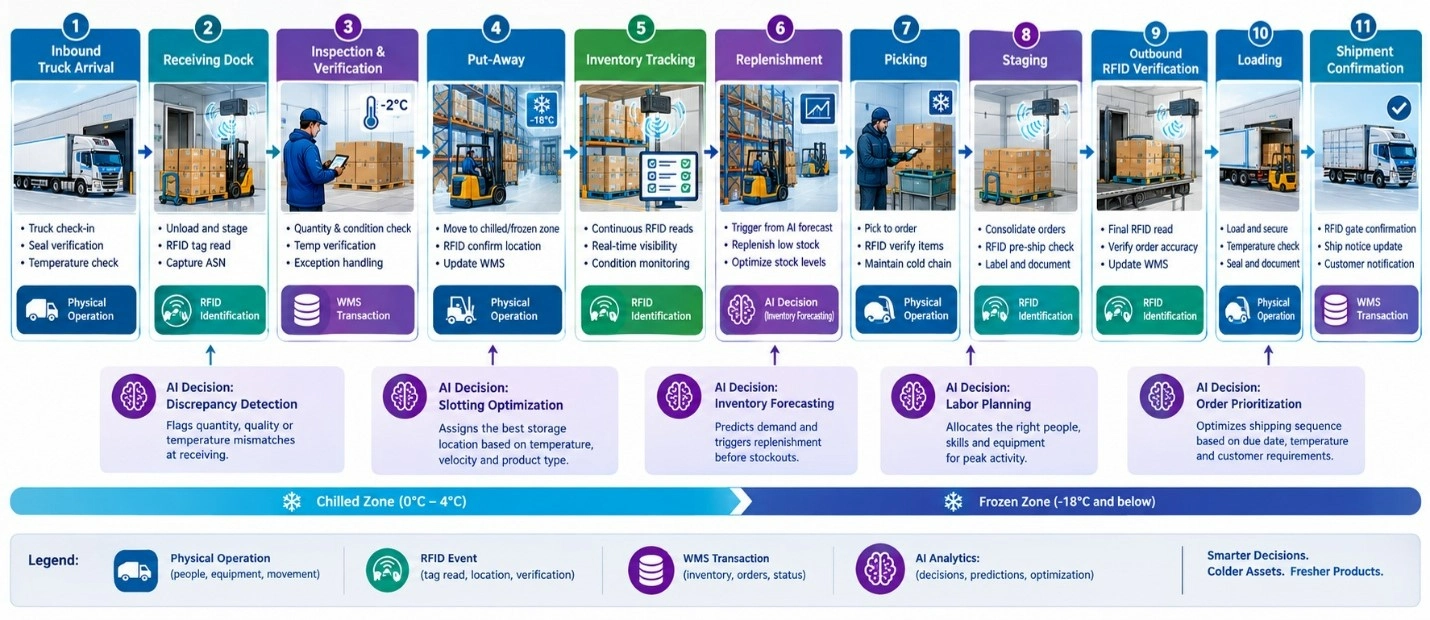
This technical workflow illustrates temperature-controlled warehouse operations from inbound truck arrival and RFID receiving through chilled/frozen storage, inventory tracking, picking, staging, outbound verification, loading, and shipment confirmation. It highlights how AI supports discrepancy detection, storage slotting, inventory forecasting, labor planning, and order prioritization alongside RFID and WMS transactions.
RFID Identification for Temperature-Controlled Logistics
| RFID Type | Cold Storage Relevance | Typical Role |
|---|---|---|
| UHF RFID | Strong fit for longer-range automated identification | Pallets, cases, dock-door movement, inventory visibility |
| HF RFID | Suitable for controlled short-range identification | Item or container identification at defined interaction points |
| LF RFID | Useful for specialized short-range identification environments | Selected industrial identification applications |
UHF RFID is often attractive for cold storage logistics because warehouse operators can design read zones around receiving docks, shipping doors, conveyor transitions, or other controlled movement points. However, reliable performance requires engineering attention to tag selection, antenna orientation, reader power, reader sensitivity, RF interference, metal, liquids, packaging composition, and physical tag placement.
Cold and frozen environments also introduce practical considerations. RFID tags and associated materials should be evaluated against the expected temperature range, condensation, handling conditions, cleaning processes, packaging characteristics, and required service life. A tag that performs well on a dry cardboard carton may behave differently when applied to moisture-rich products, liquid containers, metalized packaging, or densely packed pallets.
RFID Readers and Antennas
Readers collect RFID responses and forward identification events to the software layer. Antenna positioning determines much of the practical read-zone behavior.
Cold storage deployments may use fixed readers around:
- Receiving doors
- Shipping doors
- Conveyor transitions
- Controlled access points
- Storage-zone entrances
- Staging areas
- Inventory counting locations
Handheld RFID readers can complement fixed infrastructure when personnel need to perform directed inventory searches or cycle counts.
RFID Tags and Logistics Units
Tag selection should correspond to the object being identified.
Potential tagging levels include:
- Pallets
- Cartons
- Cases
- Reusable plastic containers
- Totes
- Roll cages
- Carts
- Material-handling assets
Tag placement should be standardized. Poor placement can create inconsistent reads and make system behavior difficult to troubleshoot.
Cold Storage AI and RFID System Architecture
A cold storage solution normally contains several functional layers, even when those layers are delivered through different software products.
Physical identification layer
RFID tags identify logistics units while fixed or handheld RFID readers capture tag observations.
Edge connectivity layer
Reader gateways or edge computers collect RFID events, perform preliminary filtering, and forward relevant information to higher-level software. Edge processing can reduce unnecessary data transmission and provide faster local responses where required.
Middleware and event-processing layer
RFID middleware can remove duplicate reads, normalize reader events, apply business rules, and transform raw observations into meaningful warehouse events such as “pallet entered receiving zone” or “case detected at shipping verification.”
Warehouse software layer
The WMS remains responsible for core warehouse transactions such as receiving, put-away, inventory status, picking, replenishment, and shipping. RFID should complement these transactions rather than create a disconnected inventory database.
AI analytics layer
Machine learning and statistical models can process historical and real-time operational data for forecasting, anomaly detection, workload prediction, slotting recommendations, and other defined use cases.
Enterprise integration layer
APIs, databases, message brokers, or other integration mechanisms can connect the RFID and AI solution with WMS, ERP, transportation management systems, order-management software, maintenance systems, and business intelligence tools.
AI and RFID Cold Storage Deployment Architecture for Smart Warehouse Logistics
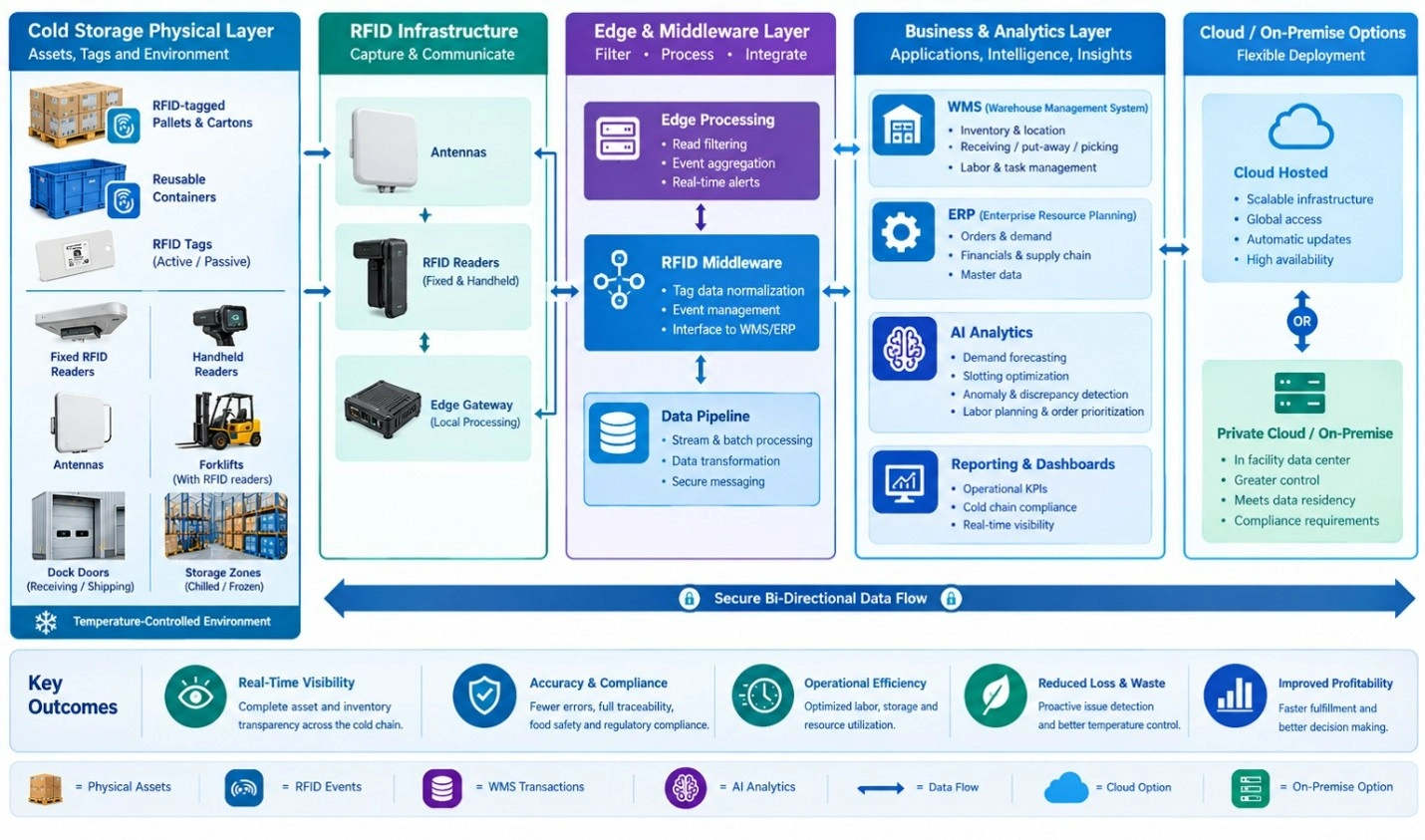
This enterprise architecture diagram shows how RFID-tagged cold-chain assets connect through readers, antennas, edge gateways, RFID middleware, WMS, ERP, and AI analytics. It highlights bidirectional data flows and flexible cloud or private on-premise deployment, enabling real-time visibility, predictive decisions, operational efficiency, and reduced cold-chain loss.
Cloud Version for Cold Storage Operations
A cloud-hosted version can be appropriate for organizations operating multiple cold storage facilities that need centralized reporting, consolidated analytics, or remote access to operational data.
Cloud deployment can support centralized AI model management, cross-site analytics, and consolidated inventory information when the required integrations and network connectivity are available.
However, critical local processes should not automatically depend on continuous wide-area connectivity. Reader-event buffering, local validation, and appropriate edge processing can improve resilience when network connectivity is interrupted.
Server Version for Controlled Warehouse Environments
A server version can be deployed on customer-managed edge servers, private data centers, warehouse servers, or other privately hosted infrastructure. This approach can suit operations with strict internal IT policies, existing private infrastructure, or requirements for greater local control over data processing.
A hybrid implementation is also possible, with time-sensitive RFID event processing performed locally while selected historical data and AI analytics are processed centrally.
Technical Capabilities and Operational Improvements
Combining AI with RFID-based identification gives cold storage logistics teams a way to move from transaction-based inventory control toward continuously informed operational decision-making. RFID supplies frequent identification events, while AI converts accumulated warehouse data into forecasts, recommendations, and exception alerts.
More Accurate Cold Storage Inventory
AI-assisted inventory management can compare expected stock positions with RFID-observed movements and WMS transactions. This helps identify discrepancies before they become larger reconciliation problems.
Useful measurements include:
- Inventory record accuracy
- RFID read accuracy
- Cycle-count variance
- Unlocated inventory
- Inventory adjustment frequency
- Time required to locate a pallet or case
The quality of the AI output depends heavily on the quality of the underlying event data. Reader placement, tag performance, transaction timestamps, and consistent location identifiers therefore remain important engineering considerations.
Better FEFO and Shelf-Life Management
First-expired, first-out (FEFO) practices are particularly important for temperature-sensitive products with defined shelf-life requirements. AI can analyze expiration dates, lot information, order requirements, inventory positions, and historical movement patterns to recommend which inventory should be picked first.
RFID can provide the identification link between the physical logistics unit and the digital record used by the AI or WMS.
The resulting process can help warehouse personnel answer questions such as:
- Which pallet should be picked next?
- Which lot has the earliest expiration?
- Which inventory has remained in storage longer than expected?
- Which orders could consume inventory approaching its expiration date?
- Where are products associated with a particular lot located?
Improved Dock and Staging Operations
Dock congestion can create delays when inbound and outbound movements are not synchronized with warehouse capacity. AI can analyze historical arrival patterns, order workload, staging activity, and available storage capacity to support scheduling decisions.
RFID identification at receiving and shipping points can provide event timestamps that improve visibility into actual movement rather than relying exclusively on planned transaction times.
Exception Detection
An AI model can identify operational patterns that differ from normal behavior.
Potential examples include:
- A pallet appearing in an unexpected storage zone
- Repeated movement events without a corresponding WMS transaction
- Unusual dwell time in staging
- Unexpected inventory accumulation
- Repeated discrepancies involving a particular process
- Abnormal picking or replenishment activity
Human review should remain part of high-impact exception handling. AI should prioritize and explain potential issues rather than automatically treating every anomaly as an operational failure.
Business Value for Cold Chain Operations
| Operational Area | AI-Supported Improvement | Potential Business Outcome |
|---|---|---|
| Inventory control | Predict discrepancies and prioritize counts | Higher inventory accuracy |
| Receiving | Identify unusual inbound transactions | Faster exception resolution |
| Put-away | Recommend storage locations | Better space utilization |
| Picking | Prioritize work using order and inventory data | Improved fulfillment performance |
| FEFO | Identify inventory approaching expiration | Lower avoidable product loss |
| Staging | Detect excessive dwell time | Faster outbound movement |
| Labor | Forecast workload | Better workforce allocation |
| Equipment | Identify maintenance patterns | Reduced unplanned disruption |
| Reporting | Consolidate operational events | Faster management decisions |
GAO’s experience supplying RFID hardware products and systems to organizations supports practical deployments where automated identification must connect physical operations with software-based business processes. The appropriate solution should be selected according to measurable operational requirements rather than technology adoption alone.
Engineering Considerations for Cold Storage RFID Deployment
A successful deployment requires more than installing readers at warehouse doors. Cold storage facilities contain physical and environmental conditions that can affect RFID performance and data quality.
RF Environment and Tag Selection
Metal racks, forklifts, refrigeration equipment, liquids, insulated containers, and dense product arrangements can affect radio-frequency behavior. Testing should therefore be performed using the actual packaging, pallet configuration, and operating conditions expected after commissioning.
UHF RFID tag selection should consider:
- Product material
- Packaging composition
- Presence of liquids
- Metal surfaces
- Tag mounting position
- Required read distance
- Reader antenna orientation
- Operating temperature
- Condensation and moisture exposure
- Mechanical handling conditions
A controlled site survey should establish where fixed readers provide reliable read zones and where handheld devices are more appropriate.
Read-Zone Design
A reader should not simply detect every tag within its maximum theoretical range. A well-designed read zone should detect the intended movement while minimizing unintended reads from nearby storage locations or adjacent dock lanes.
For example, a shipping-door read zone should distinguish products being loaded through that door from inventory remaining in a nearby staging area.
This requires careful positioning of antennas, physical lane design, shielding where appropriate, reader power configuration, and software-level event filtering.
Data Quality and Event Processing
Raw RFID reads are not equivalent to business transactions. A tag can be detected multiple times while remaining within a reader’s field.
Middleware should therefore apply appropriate event-processing rules, such as:
- Duplicate-read filtering
- Timestamp normalization
- Reader and antenna identification
- Location association
- Event aggregation
- Movement-state determination
- Transaction correlation
- Exception generation
AI models should consume meaningful operational events rather than unprocessed reader noise whenever possible.
AI Models and Data for Cold Storage Logistics
Different cold storage applications require different analytical methods. A single AI model should not be treated as suitable for every warehouse decision.
Forecasting Models
Time-series forecasting can support demand planning, workload prediction, storage-capacity planning, and replenishment decisions.
Relevant input data may include:
- Historical orders
- Product movement
- Seasonal demand
- Customer requirements
- Inventory levels
- Storage capacity
- Receiving schedules
- Shipment schedules
Forecast quality should be monitored continuously because demand patterns can change.
Classification and Anomaly Detection
Classification models can categorize operational events, while anomaly-detection methods can identify behavior that differs from established patterns.
For cold storage operations, these methods can support exception management involving inventory movements, unusual dwell times, transaction mismatches, and unexpected process sequences.
Optimization
Optimization methods can help determine better combinations of storage locations, picking sequences, labor allocation, or shipment priorities.
These models should respect operational constraints rather than optimizing a single metric. For example, the mathematically shortest picking route may not be appropriate if it conflicts with product handling requirements, FEFO priorities, or warehouse safety rules.
Edge AI and Local Processing
Edge AI can be useful when rapid local analysis is required or when operational data should be processed close to RFID readers and warehouse equipment.
A practical deployment can use local computing for:
- RFID event filtering
- Immediate rule-based alerts
- Local buffering
- Reader health monitoring
- Selected AI inference tasks
Cloud or centralized servers can then handle larger-scale historical analysis, model training, cross-facility reporting, and centralized management where appropriate.
Integration with WMS, ERP, and Cold Chain Systems
AI and RFID should fit into existing cold storage processes rather than requiring warehouse personnel to maintain parallel records.
A typical integration flow is:
RFID Reader → Edge Gateway → RFID Middleware → Event Processing → WMS → AI Analytics → Operational Recommendation → Warehouse Action
The WMS remains the authoritative source for relevant inventory transactions when that is the organization’s established operating model. RFID provides additional physical-event evidence, while AI uses both operational history and current information to produce recommendations or alerts.
ERP integration can provide purchasing, product, supplier, financial, and order information. Transportation management software can contribute shipment schedules and transportation requirements. Business intelligence systems can consume processed operational data for management reporting.
API-based integration, message queues, database interfaces, or other enterprise integration mechanisms can be selected according to the existing IT environment.
RFID Deployment in a Refrigerated Warehouse: End-to-End Cold Chain Visibility
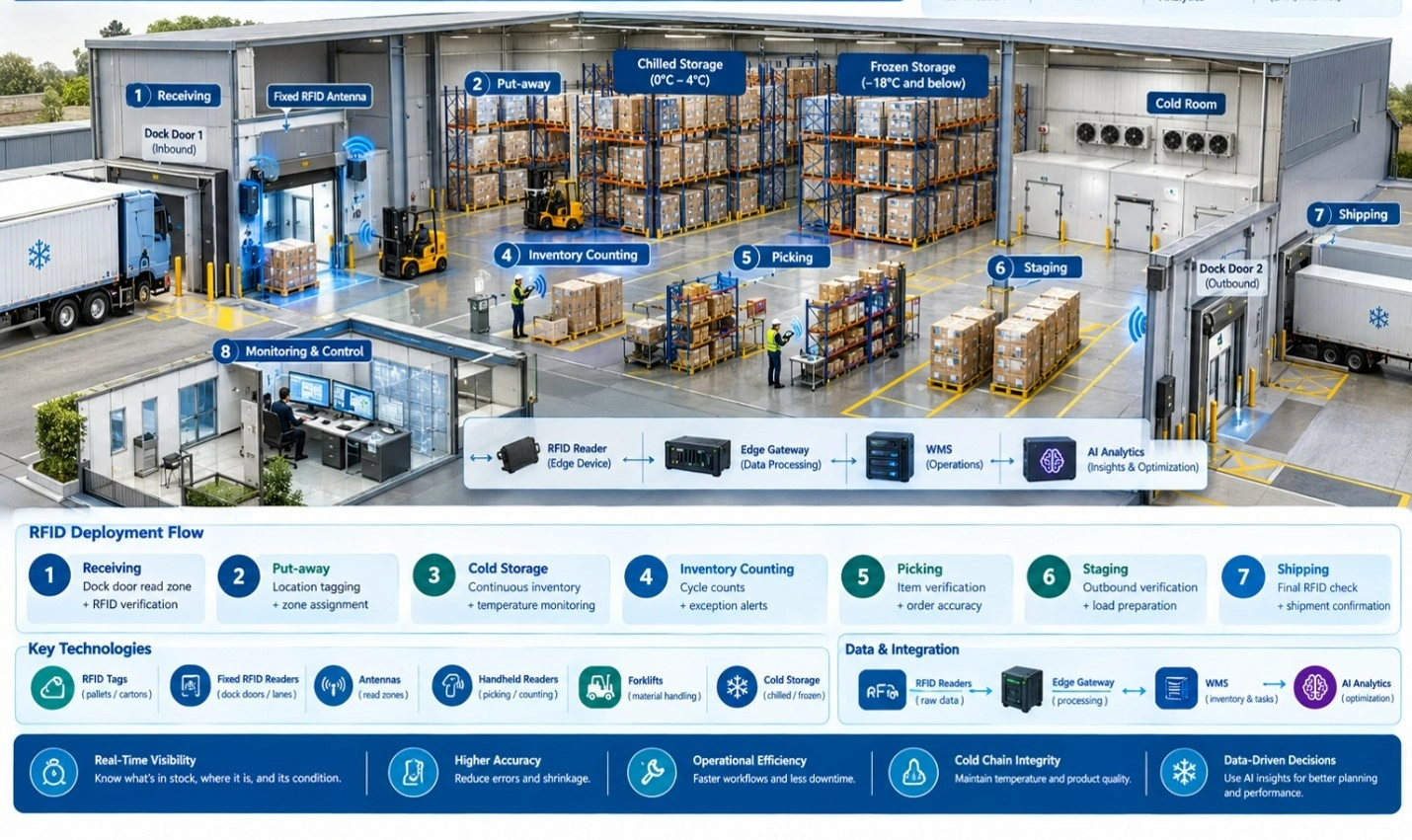
This technical illustration shows how RFID is physically deployed across receiving, chilled and frozen storage, inventory counting, picking, staging, and shipping. It also maps RFID readers and handheld devices to edge processing, WMS, and AI analytics, demonstrating how real-time identification supports accurate, efficient, and temperature-controlled warehouse operations.
Cybersecurity, Reliability, and Operational Resilience
Cold storage logistics systems increasingly connect RFID readers, edge computers, warehouse software, AI services, and enterprise applications. Security must therefore cover both operational technology and information technology components.
Recommended controls include:
- Role-based access control for RFID and warehouse applications
- Strong authentication for administrative accounts
- Encryption for data transmitted between system components
- Network segmentation for connected warehouse equipment
- Secure API authentication
- Software and firmware patch management
- Logging and audit trails
- Backup and recovery procedures
- Monitoring for unauthorized device activity
- Controlled access to edge servers and RFID infrastructure
Reliability is equally important. A temporary network failure should not necessarily stop physical warehouse operations. Local event buffering and store-and-forward mechanisms can preserve RFID observations until connectivity is restored.
AI systems also require governance. Model outputs should be monitored for accuracy, data drift, false positives, and changes in warehouse operating conditions. Human approval remains appropriate for decisions that could materially affect product disposition, customer orders, or safety.
KPIs for AI-Enabled Cold Storage Logistics
Measurement should begin before deployment so that the organization can compare operational performance against a baseline.
Relevant KPIs include:
- Inventory record accuracy
- RFID read accuracy
- Inventory discrepancy rate
- Cycle-count completion time
- Pallet search time
- Receiving processing time
- Put-away cycle time
- Picking accuracy
- Order fulfillment time
- Dock-to-stock time
- Staging dwell time
- FEFO compliance
- Product expiration loss
- Warehouse space utilization
- Labor hours per order
- Replenishment response time
- Shipment verification accuracy
- RFID reader availability
- System uptime
- AI alert precision
- AI alert response time
- Exception resolution time
- Unplanned equipment downtime
- Inventory adjustment frequency
The strongest KPI program connects technology measurements with operational outcomes. Reader uptime alone does not demonstrate business value if inventory accuracy remains poor. Similarly, an accurate AI forecast has limited practical value if warehouse processes cannot act on the resulting recommendation.
Implementation Roadmap for Cold Storage Logistics
A phased deployment generally reduces technical and operational risk.
Planning and Site Assessment
Document the warehouse’s physical flows, inventory hierarchy, WMS processes, storage zones, dock configuration, temperature ranges, existing network infrastructure, and major operational pain points.
Define whether the first objective is inventory accuracy, receiving verification, shipment verification, FEFO support, asset tracking, or another measurable use case.
RFID Proof of Concept
Test representative products, pallets, packaging materials, and operating conditions. Validate read performance using the actual cold storage environment rather than relying exclusively on laboratory specifications.
Integration and Commissioning
Connect readers and middleware with the relevant warehouse software. Establish identifiers for products, locations, readers, antennas, pallets, and other tracked assets.
Test normal workflows and failure conditions, including duplicate reads, missing reads, network interruptions, unexpected movements, and incorrect transaction sequences.
AI Model Development
Begin with a clearly defined operational problem and an adequate historical dataset. Establish data-quality requirements, model evaluation criteria, alert thresholds, and human-review procedures.
AI should initially assist warehouse personnel with recommendations and prioritization. Automation can expand as the model demonstrates reliable performance under actual operating conditions.
Optimization and Scaling
After the initial deployment is stable, analyze KPI results and expand to additional dock doors, storage zones, product categories, or facilities.
Multi-site deployments should standardize core data definitions while allowing site-specific differences in warehouse layouts, operating procedures, and equipment.
Key Takeaways for AI-Driven Cold Storage Logistics
AI can improve cold storage logistics by turning inventory and operational data into forecasts, recommendations, and exception alerts. RFID strengthens that process by providing automated identification events for pallets, cases, containers, and other logistics assets.
The most effective implementations treat RFID as part of an integrated warehouse information process rather than as a standalone tracking technology. Careful tag selection, RF engineering, event filtering, WMS integration, cybersecurity, reliable connectivity, and measurable KPIs are essential.
GAO supports organizations with RFID, BLE, and IoT hardware products and systems designed for practical identification and tracking requirements. Headquartered in New York City and Toronto, Canada, GAO is ranked among the top 10 leading B2B and B2G RFID and BLE suppliers globally. Its related GAO companies have served U.S. and Canadian organizations, including Fortune 500 companies, leading R&D organizations, universities, and government agencies.
Organizations evaluating AI-driven cold storage inventory management can use these principles to define a measurable pilot, select appropriate RFID hardware, validate the operating environment, and establish a scalable path toward broader cold-chain automation.
Building the Future of Industrial AI and IoT with Aperture Venture Studio and GAO RFID Inc.
For more than three decades, GAO Group of Companies has invested heavily in R&D for industrial RFID, BLE, and IoT. As AI has become increasingly useful in industrial applications, we have developed AI and IoT technologies that can support applications such as cold storage inventory management, asset tracking, and cold-chain logistics. We have also founded Aperture Venture Studio to advance AI and IoT solutions relevant to these and other industrial applications.
Aperture has attracted AI and IoT technical experts, entrepreneurial and operational executives, influential investors, and leading companies. We have also developed Aperture Ventures Summit and TekSummit to discuss advanced AI and IoT topics.
These activities have helped build technical communities around industrial AI and IoT.
We welcome you to join us as:
- Advisors, Co-founders, or Employees
- Investors
- Customers