
AI and BLE for Smart Battery Manufacturing
AI-Driven Quality and Safety Visibility for Smart Battery Manufacturing
Smart battery manufacturing plants rely on tightly controlled environments, precise process conditions, and complete traceability across lithium-ion cell and battery pack production. From raw material handling through electrode manufacturing, cell assembly, formation, aging, grading, module assembly, and final pack testing, manufacturers need reliable visibility into equipment, materials, products, and personnel.
AI-powered analytics combined with Bluetooth Low Energy (BLE) tracking can provide continuous operational visibility across these manufacturing stages. BLE beacons, gateways, sensors, and tags can capture location, environmental, and equipment-related data, while AI analyzes this information to identify anomalies, improve process control, and support predictive decision-making.
Smart battery manufacturing also operates under demanding safety and regulatory requirements. Standards and regulations such as UN 38.3, IEC 62133, and the EU Battery Regulation place strong emphasis on battery safety, testing, traceability, and data integrity. GAO BLE hardware and AI-enabled systems can help manufacturers build connected production environments that improve traceability and operational awareness.
Gigafactory Digital Twin: Dry Room, Formation & Pack Assembly Overview
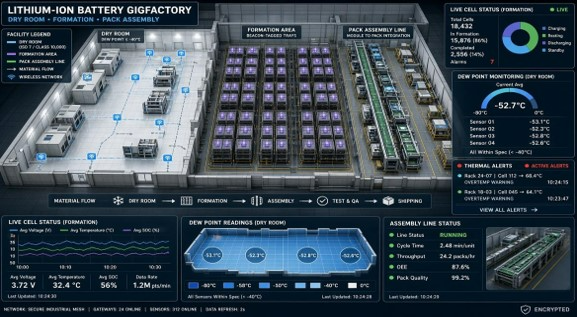
A gigafactory digital twin can provide a virtual representation of battery manufacturing operations, connecting physical production assets, environmental conditions, material movement, and process data. BLE tracking can provide location and status information from dry rooms, formation areas, aging zones, module assembly stations, and pack assembly areas, while AI can analyze the combined data to identify operational patterns and potential issues.
Understanding AI and BLE in Smart Battery Manufacturing Operations
AI enables battery manufacturers to analyze large volumes of production, environmental, equipment, and location data. Machine learning models can identify patterns that may be difficult to detect through conventional monitoring methods.
BLE provides a flexible wireless connectivity layer for tracking assets, containers, trays, equipment, and personnel. BLE beacons, tags, gateways, and sensors can communicate location and sensor information throughout manufacturing facilities.
When AI and BLE are combined, manufacturers can connect real-world production activity with software-based analytics. This can provide a more complete understanding of where materials are located, how long they remain at specific stations, and whether environmental or operational conditions deviate from expected ranges.
Key Applications of AI-Powered BLE in Smart Battery Manufacturing
Dry Room Environmental Monitoring
Battery cell manufacturing requires carefully controlled environmental conditions, particularly in dry rooms where moisture levels must remain within defined limits. BLE-enabled environmental sensors can monitor temperature and humidity and transmit measurements to gateways for centralized analysis. AI can analyze environmental trends and identify unusual changes that may require attention.
Cell and Tray Work-in-Process Tracking
BLE tags can be attached to trays, containers, carts, and other work-in-process assets. Gateways installed throughout the facility can detect BLE transmissions and provide location information. This allows production teams to understand where cells and trays are located and how long they remain within different production areas.
Formation and Aging Cycle Tracking
Formation and aging are important stages in battery manufacturing. BLE tracking can associate trays and cell batches with specific formation and aging areas. AI analytics can evaluate cycle information, dwell times, and process data to identify unusual patterns and support production planning.
Cell Grading, Binning, and Traceability
After formation and testing, cells may be graded and grouped according to performance characteristics. BLE-enabled tracking can help maintain visibility of trays and batches as they move through grading and binning operations. This can support traceability and reduce the risk of misplaced or incorrectly routed material.
Off-Gas and Venting Detection
Battery manufacturing environments may require monitoring for gases and other indicators associated with abnormal battery conditions. BLE-enabled gas and environmental sensors can transmit readings to centralized systems. AI can analyze sensor patterns and provide alerts when measurements move outside expected ranges.
Module and Pack Assembly
BLE tracking can provide visibility as battery cells move into module and pack assembly. Tags and gateways can associate materials and assets with assembly stations, helping manufacturers maintain process visibility and traceability throughout downstream production.
Personnel and PPE Compliance in Controlled Zones
BLE technology can also support personnel location awareness in controlled manufacturing zones. BLE badges or tags can help identify personnel presence within designated areas, while AI analytics can evaluate movement patterns and support operational and safety monitoring.
GAO RFID Inc. provides BLE and IoT hardware, software, and systems that can be used to support connected industrial operations. Its solutions can help manufacturers collect and manage location, sensor, and asset data across complex production environments.
Standards and Regulatory Context for Smart Battery Manufacturing
Battery manufacturers must address a range of safety, quality, transportation, environmental, and traceability requirements. UN 38.3 is relevant to the transportation testing of lithium batteries, while IEC 62133 addresses safety requirements for portable sealed secondary cells and batteries. The EU Battery Regulation introduces additional requirements related to battery information, sustainability, performance, and traceability.
AI and BLE systems can support these requirements by providing additional visibility into manufacturing processes, asset movement, environmental conditions, and production records. However, manufacturers should determine compliance requirements according to their specific products, markets, and applicable regulations.
Case Scenario: Tracing a Cell Through Formation to Pack Assembly
Consider a battery cell tray entering a formation area. A BLE tag associated with the tray communicates with nearby gateways, allowing the system to determine its approximate location. As the tray moves through formation and aging, location events can be associated with production records.
When the cells move to grading, the system can continue tracking the tray and associate the location history with the corresponding production data. After grading, the cells can be routed toward module assembly while the same traceability information remains available to authorized systems.
AI analytics can use the collected information to identify unusual dwell times, unexpected movements, or deviations from normal production patterns. This provides manufacturers with greater visibility from formation through downstream assembly.
Integrated Battery Manufacturing Line with BLE Tracking & AI Analytics
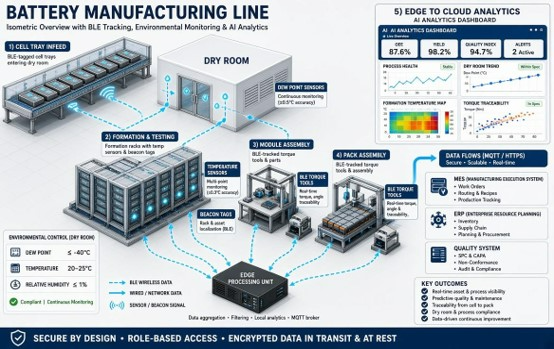
An integrated battery manufacturing line can connect BLE tracking infrastructure with production equipment, environmental sensors, manufacturing software, and AI analytics. BLE gateways can collect data from tags and sensors installed across production areas, while centralized systems can combine location and process information for analysis.
From Station to Software: The AI and BLE Data Workflow in Smart Battery Manufacturing
The workflow begins with physical assets, equipment, sensors, and personnel generating operational data. BLE tags and sensors transmit information to nearby gateways. Gateways forward the collected information to local or cloud-based software systems.
AI analytics can then process this information alongside production and equipment data. Machine learning models can identify patterns, detect anomalies, forecast potential issues, and provide actionable information to production and engineering teams.
This architecture creates a connection between physical manufacturing operations and digital analytics, allowing manufacturers to move from basic tracking toward more intelligent operational monitoring.
BLE Hardware, AI Software, and Deployment Options for Smart Battery Manufacturing
A typical deployment may include BLE beacons, BLE tags, gateways, environmental sensors, location-aware devices, edge computing equipment, and software platforms. Hardware selection depends on the manufacturing environment, required sensing capabilities, coverage area, battery requirements, and integration architecture.
AI analytics can operate through cloud-based systems or on-premises infrastructure depending on operational, security, latency, and data governance requirements. GAO provides hardware and system options that can support different industrial deployment models.
Engineering Considerations Before Deployment
Important planning considerations include:
- BLE gateway placement and coverage requirements
- Dry room environmental conditions
- BLE tag and beacon battery life
- Required location accuracy
- Sensor measurement requirements
- Interference from industrial equipment and structures
- Integration with existing manufacturing systems
- Data storage and processing requirements
- Cybersecurity and access control
- Maintenance and device replacement procedures
- Scalability across production lines and facilities
- Regulatory and data governance requirements
AI Capabilities for Smart Battery Manufacturing
Thermal and Moisture Anomaly Detection
AI can analyze temperature and moisture measurements collected from BLE-enabled sensors to identify unusual conditions. Early identification of environmental deviations can help engineering teams investigate potential process or equipment issues.
Computer Vision for Weld and Seal Inspection
Computer vision can analyze images captured during battery manufacturing and assembly processes. AI models can identify visual characteristics associated with weld quality, sealing, alignment, and other inspection criteria.
Predictive Forecasting for Formation Capacity and Maintenance
AI can analyze historical formation, production, equipment, and sensor data to identify trends and support forecasting. Similar approaches can be applied to equipment maintenance by identifying patterns associated with potential failures or declining performance.
Sensor Fusion Across BLE and Process Equipment
Sensor fusion combines information from multiple sources. BLE location data can be analyzed together with environmental sensors, production equipment, quality systems, and other operational data to provide a more comprehensive view of manufacturing activity.
Benefits of AI-Powered BLE for Smart Battery Manufacturing Plants
- Improved visibility into work-in-process materials
- More consistent asset and tray tracking
- Better environmental monitoring
- Earlier detection of abnormal operating conditions
- Improved production traceability
- Greater visibility across formation, aging, and assembly operations
- Data-driven operational decision-making
Key Benefits of Smart Battery Manufacturing
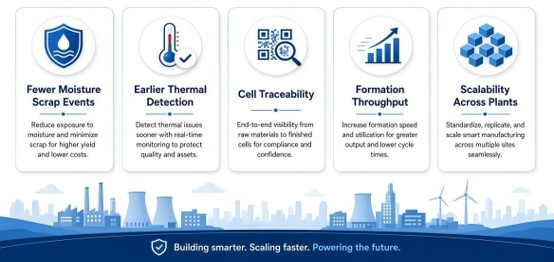
Smart battery manufacturing connects production processes, equipment, materials, environmental conditions, and software systems. By combining BLE tracking with AI analytics, manufacturers can create a more connected production environment with greater operational visibility and traceability.
Measuring Performance: KPIs for AI and BLE in Smart Battery Manufacturing
Manufacturers can use key performance indicators to evaluate the effectiveness of AI and BLE deployments. Useful metrics may include asset location accuracy, tracking coverage, production cycle time, dwell time, environmental excursions, equipment downtime, traceability completeness, and alert response time.
Monitoring these metrics over time can help production and engineering teams identify opportunities for optimization and measure the operational impact of connected manufacturing systems.
Integrating AI and BLE Data With Plant Systems
Manufacturing Execution System Integration
BLE location and sensor information can be integrated with manufacturing execution systems to associate asset movement and process activity with production records.
Quality Management and Traceability System Integration
Traceability data can be connected with quality management systems to support investigation, inspection, and production history requirements.
Enterprise Resource Planning and Production Scheduling Integration
Operational information from BLE and AI systems can support enterprise resource planning and production scheduling by providing additional visibility into material locations, production progress, and asset availability.
Business Intelligence and Reporting Dashboards
AI and BLE data can be presented through business intelligence dashboards that provide production, engineering, quality, and management teams with operational insights.
Cybersecurity, Data Governance, and Privacy for Smart Battery Manufacturing
Connected manufacturing systems should be designed with appropriate cybersecurity and data governance controls. BLE devices, gateways, networks, software platforms, and integrations should be protected through suitable authentication, access control, encryption, monitoring, and update procedures.
Manufacturers should also define appropriate policies for storing, accessing, sharing, and retaining location, sensor, production, and personnel-related information.
Implementing AI and BLE in Your Smart Battery Manufacturing Operations
Implementation should begin with a clear assessment of the manufacturing process and the operational problems that need to be addressed. Manufacturers can identify critical production zones, assets, sensors, and data sources before selecting BLE hardware and AI capabilities.
A pilot deployment can then be implemented within a defined production area. Results from the pilot can be evaluated before expanding the solution across additional production lines or manufacturing facilities.
Scaling AI and BLE from Pilot Zone to Gigafactory Deployment
Scaling requires consideration of gateway coverage, device management, network architecture, data processing, integration, cybersecurity, and maintenance. A modular deployment approach can allow manufacturers to expand from individual production zones to complete manufacturing facilities.
Standardized hardware configurations, installation procedures, data structures, and monitoring processes can help simplify deployment across multiple production lines and facilities.
Frequently Asked Questions About AI and BLE for Smart Battery Manufacturing
What is the difference between BLE and RFID for smart battery manufacturing?
BLE can provide wireless connectivity, location information, and sensor data over suitable ranges, while RFID is commonly used for identification and tracking through radio-frequency communication. The appropriate technology depends on the required range, accuracy, environment, asset type, and application.
Does BLE tracking affect dry room conditions or cell safety?
BLE tracking devices should be selected and installed according to the environmental and safety requirements of the manufacturing area. Device placement, enclosure, battery characteristics, and operating conditions should be evaluated during engineering and deployment planning.
Can AI and BLE integrate with an existing manufacturing execution system?
Yes. BLE and AI data can be integrated with existing manufacturing execution systems through suitable interfaces and data integration architectures. The specific implementation depends on the existing software environment and integration requirements.
What BLE hardware does a smart battery manufacturing line typically need?
A deployment may use BLE tags, beacons, gateways, environmental sensors, and other BLE-enabled devices. The exact hardware configuration depends on the production process, facility layout, tracking requirements, and environmental conditions.
How long do BLE beacon batteries last on trays and racks in continuous use?
Battery life depends on the beacon configuration, transmission interval, sensor functions, environmental conditions, and battery capacity. Manufacturers should select devices according to the required operating life and maintenance strategy.
Can AI predict a thermal event before it becomes a safety incident?
AI can analyze temperature, environmental, equipment, and other sensor data to identify patterns associated with abnormal conditions. Predictive capabilities depend on the quality and quantity of available data and should complement established battery safety systems and procedures.
How should plants protect BLE location and traceability data?
Plants should apply appropriate cybersecurity controls, including authentication, access management, encryption, network protection, monitoring, software updates, and data governance policies.
Can BLE tracking support EU Battery Regulation traceability requirements?
BLE tracking can provide additional data and visibility that may support traceability processes. However, manufacturers should evaluate the specific requirements applicable to their batteries, markets, and regulatory obligations.
AI and BLE Deployment Lifecycle for Smart Battery Manufacturing Plants
Planning and Site Assessment
The first stage involves evaluating facility layouts, production processes, environmental conditions, tracking requirements, and integration needs.
Hardware Selection and Installation
BLE tags, beacons, gateways, sensors, and related infrastructure are selected and installed according to the requirements identified during planning.
Commissioning and Calibration
Installed devices are commissioned and calibrated to verify connectivity, coverage, sensor measurements, and tracking performance.
Integration Testing
BLE data flows are tested with AI analytics platforms, manufacturing systems, quality systems, dashboards, and other required integrations.
Optimization
System performance is evaluated using operational data. Gateway placement, device configuration, alert thresholds, and analytics models can be adjusted where necessary.
Maintenance and Scaling
Ongoing maintenance includes device monitoring, battery replacement, software updates, system reviews, and expansion to additional production areas.
Practical Engineering Recommendations for Smart Battery Manufacturing Plants
- Begin with a clearly defined production or safety use case.
- Perform a detailed RF and facility assessment before installing gateways.
- Select BLE devices that can operate reliably in the intended manufacturing environment.
- Design data integration before expanding the physical deployment.
- Use pilot deployments to validate tracking accuracy and operational value.
- Plan for long-term maintenance, cybersecurity, and system scalability.
Applying AI and BLE to Safer, More Traceable Battery Manufacturing
AI and BLE can help battery manufacturers connect physical production activities with digital intelligence. From dry room monitoring and work-in-process tracking to formation, aging, grading, module assembly, and pack production, connected systems can provide greater visibility across the manufacturing lifecycle.
When appropriately engineered and integrated with existing plant systems, AI-powered BLE can support improved traceability, environmental awareness, operational monitoring, and data-driven decision-making across smart battery manufacturing facilities.
Why GAO for BLE Smart Battery Manufacturing Solutions
GAO provides BLE, RFID, IoT, and wireless technology solutions for industrial applications. Its hardware and systems can support asset tracking, environmental monitoring, location awareness, sensor connectivity, and integration with enterprise and industrial software platforms.
GAO RFID Inc. and GAO Tek work with industrial organizations to develop connected technology solutions for demanding operational environments. Depending on deployment requirements, solutions can be implemented using cloud-based or server-based architectures.
Building the Future of Industrial AI and IoT with Aperture Venture Studio and GAO RFID Inc.
Aperture Venture Studio brings together technology development, innovation, and industrial expertise to build solutions for emerging technology markets. GAO RFID Inc. and GAO Tek contribute RFID, BLE, IoT, and wireless technology expertise to help organizations connect physical operations with digital intelligence.