
AI-Driven Beauty Product Manufacturing with BLE
Beauty Product Manufacturing with AI-Enabled BLE
Beauty Product Manufacturing increasingly depends on precise control of ingredients, batch processes, filling and packaging lines, environmental conditions, work-in-process materials, finished products, and production equipment. AI-enabled manufacturing systems can analyze operational data continuously to identify deviations, predict equipment and process problems, improve material flow, and support faster production decisions. BLE sensors, BLE beacons, and BLE gateways provide practical data capture for temperature-sensitive materials, mobile assets, containers, production carts, equipment, and personnel-associated workflows.
AI and BLE solutions are particularly useful where beauty products move through many controlled stages, including raw material receiving, formulation, compounding, filling, labeling, secondary packaging, quality inspection, finished-goods storage, and shipment preparation. The resulting AIoT solution combines connected devices, industrial systems, analytics, and enterprise software to convert real-time operating data into actionable information for production, quality, maintenance, warehouse, and supply-chain teams. This approach helps beauty product manufacturers improve traceability, reduce production interruptions, strengthen inventory accuracy, and make operational decisions using current plant data.
AI-Driven Beauty Product Manufacturing with BLE
AI-driven Beauty Product Manufacturing uses artificial intelligence and connected industrial data to improve formulation, batch processing, equipment utilization, material handling, packaging, quality control, and warehouse operations. BLE serves primarily as a data acquisition and identification technology rather than the decision-making layer.
BLE temperature and environmental sensors can monitor storage conditions for selected ingredients, finished products, and controlled production areas. BLE beacons can identify mobile equipment, ingredient containers, totes, carts, pallets, tools, and other assets as they move through manufacturing and warehouse zones. BLE gateways collect device data and forward it to edge processing systems, cloud software, or privately hosted servers.
AI models can then analyze this information alongside data from MES, ERP, WMS, QMS, CMMS, laboratory systems, production equipment, and other manufacturing sources. For example, an AI system can correlate production delays with material-location data, equipment conditions, batch status, operator workflow, and packaging-line activity. This provides a more complete operational view than treating each data source independently.
GAO provides BLE, RFID, and IoT hardware products and systems that can support these types of industrial data collection requirements. For beauty product manufacturers, the practical value comes from selecting sensing, identification, gateway, and software components according to the actual production workflow, environmental conditions, asset types, and integration requirements.
Beauty Product Manufacturing AI and BLE Operations Overview
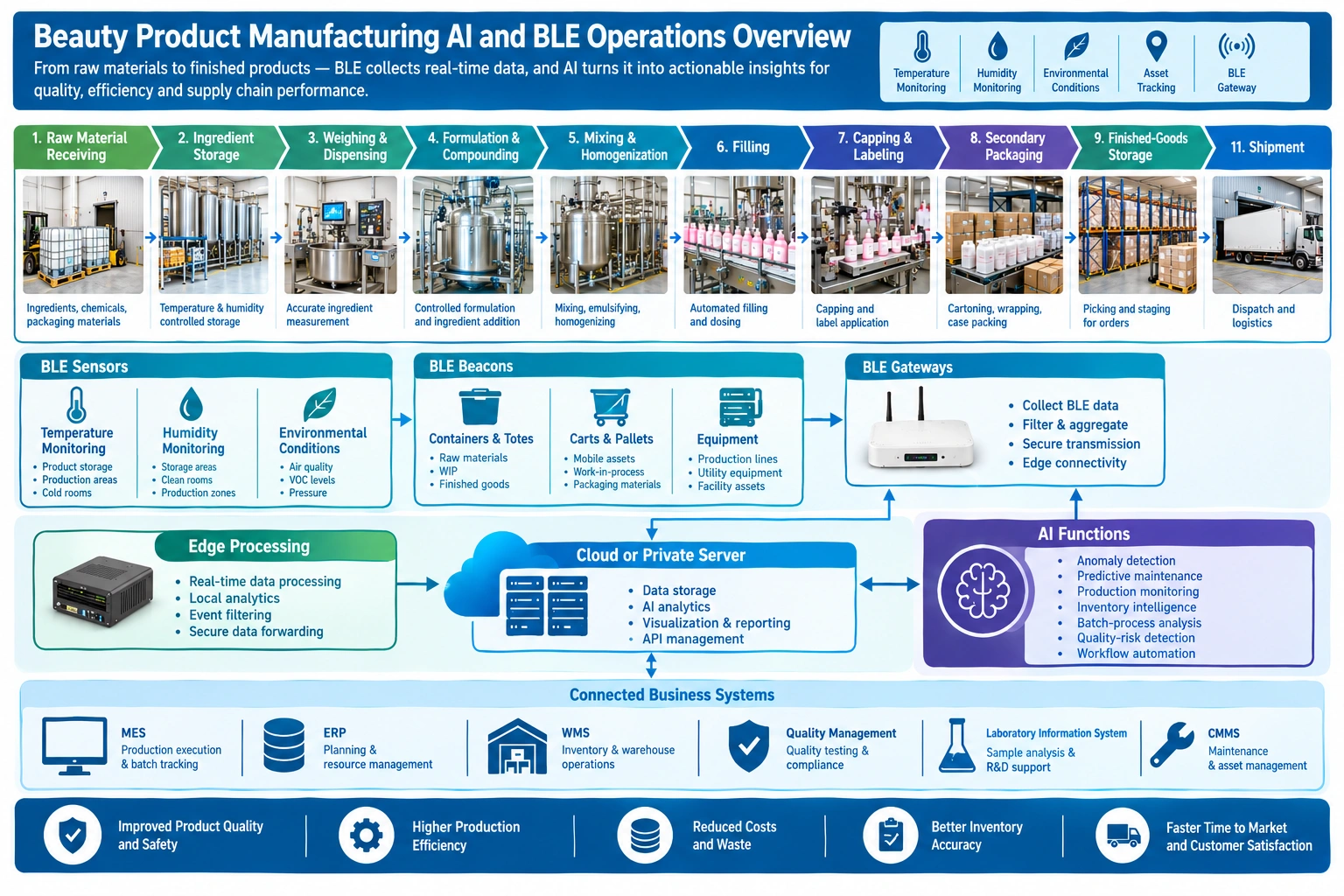
The completed diagram maps beauty product manufacturing from raw material receiving through shipment. It shows BLE sensors, beacons, and gateways feeding edge and cloud or private server systems, where AI supports production monitoring, predictive maintenance, inventory intelligence, quality-risk detection, and workflow automation.
AI Applications Across Beauty Product Manufacturing Operations
AI can improve beauty product manufacturing by analyzing information from formulation processes, production equipment, material movements, quality activities, warehouse operations, and environmental monitoring. The most valuable applications are those connected directly to measurable production and quality objectives.
Production and Batch Process Visibility
Beauty products often pass through multiple controlled production stages before filling and packaging. Batch status can depend on ingredient availability, weighing accuracy, mixing time, temperature, viscosity, equipment availability, quality release, and production scheduling.
AI can combine these signals to identify abnormal production patterns and highlight batches that may require attention. BLE-enabled identification of mobile containers, ingredient totes, carts, and work-in-process materials can add location context to production records.
Useful applications include:
- Monitoring batch movement between dispensing, formulation, compounding, filling, and packaging areas
- Detecting unusual batch dwell times between manufacturing stages
- Identifying recurring delays associated with specific production areas or equipment
- Correlating material availability with production schedule interruptions
- Supporting production supervisors with real-time operational status
Ingredient and Material Tracking
Beauty product manufacturing uses a wide range of raw materials, including fragrances, oils, surfactants, preservatives, pigments, active ingredients, emulsifiers, solvents, packaging components, and other formulation materials. Locating the correct material at the correct production stage can affect production schedules and batch execution.
BLE beacons attached to suitable containers, totes, carts, or mobile assets can provide location information through BLE gateways. AI software can analyze movement patterns and identify material-location anomalies.
Applications include:
- Locating ingredient totes and mobile containers
- Identifying materials waiting too long in staging areas
- Detecting unexpected movement between production zones
- Improving material search and retrieval time
- Supporting inventory reconciliation with production activity
- Identifying recurring material-handling bottlenecks
Filling and Packaging Line Optimization
Filling, capping, labeling, cartoning, and secondary packaging are highly time-sensitive operations. A delay in packaging-material availability or equipment performance can create downstream production congestion.
AI can analyze line status, production rates, equipment events, material availability, and historical cycle data to identify bottlenecks. BLE identification can provide additional visibility into packaging components, mobile equipment, carts, and material movement.
AI-supported actions can include:
- Detecting abnormal filling or packaging cycle times
- Identifying recurring packaging-line delays
- Predicting equipment conditions associated with downtime
- Monitoring movement of packaging materials and mobile equipment
- Supporting production schedule adjustments
- Prioritizing maintenance interventions
Environmental and Storage Condition Monitoring
Certain cosmetic and personal-care ingredients and finished products may require controlled storage or production environments. Temperature, humidity, and other environmental conditions can affect material condition, product stability, or manufacturing requirements depending on the formulation.
BLE environmental sensors can continuously collect condition data in storage rooms, ingredient areas, production zones, or other monitored locations. AI can analyze trends and distinguish normal fluctuations from conditions requiring intervention.
Potential AI functions include:
- Environmental anomaly detection
- Condition trend analysis
- Early warning for storage-area deviations
- Correlation between environmental conditions and operational events
- Automated escalation of persistent deviations
- Historical analysis supporting quality investigations
Predictive Maintenance for Beauty Manufacturing Equipment
Beauty product manufacturing facilities may operate mixers, agitators, homogenizers, pumps, filling machines, capping machines, labeling machines, conveyors, compressors, HVAC equipment, chillers, and other production-support systems.
Predictive analytics can combine equipment condition data, maintenance history, operating schedules, production loads, and failure records to identify patterns associated with equipment degradation. BLE sensors can provide additional condition data for selected mobile or fixed equipment where appropriate.
This can help maintenance teams:
- Detect abnormal operating patterns before a failure
- Prioritize maintenance work based on operational risk
- Reduce unplanned production interruptions
- Improve equipment availability
- Correlate equipment problems with production losses
- Support maintenance planning around batch and production schedules
Beauty Product Manufacturing Workflows Supported by AI
AI becomes most useful when connected to complete manufacturing workflows rather than isolated sensor readings. A typical AIoT workflow begins with data acquisition, continues through BLE communication and processing, and ends with an operational decision or automated action. The uploaded requirements call for this complete path from data capture through communication, edge or server processing, middleware, enterprise integration, analytics, and business action.
Raw Material Receiving and Identification
Receiving teams can associate incoming materials with their intended storage or production locations. BLE identification can provide visibility for selected mobile containers and handling assets, while ERP and WMS records provide material identity, lot, quantity, and inventory context.
AI can identify unusual receiving-to-storage dwell times, material movement patterns, or staging conditions that could affect production readiness.
Ingredient Weighing and Staging
Accurate ingredient staging is essential for batch execution. Materials may move from warehouses to dispensing rooms and then to formulation areas. AI can analyze staging patterns against production schedules and identify materials that are misplaced, delayed, or repeatedly difficult to locate.
Formulation and Compounding
Formulation and compounding operations can involve controlled sequences of ingredient addition, mixing, heating, cooling, homogenization, and sampling. AI can analyze batch-process information and identify deviations from expected operating patterns.
BLE-based asset identification can add location information for mobile vessels, containers, carts, and other movable equipment when that information is operationally useful.
Filling, Labeling, and Packaging
AI can analyze production rates, downtime events, packaging-material availability, equipment status, and work-in-process movement to identify bottlenecks. BLE tracking can provide location information for mobile resources and materials supporting the packaging line.
Finished-Goods Storage and Shipment Preparation
After quality release, finished beauty products may move into warehouse storage, order staging, and shipping areas. AI can identify excessive finished-goods dwell time, staging congestion, and order-preparation delays by correlating WMS records with physical location information.
This creates a foundation for more accurate production-to-warehouse visibility and better coordination between manufacturing, quality, inventory, and logistics teams.
AI Capabilities for Beauty Product Manufacturing
AI provides the analytical layer that converts manufacturing data into operational decisions. For beauty product manufacturers, useful AI applications focus on production reliability, formulation workflow visibility, material availability, equipment performance, quality risk, and warehouse efficiency.
Anomaly Detection for Manufacturing and Quality Conditions
AI-based anomaly detection establishes expected operating patterns for formulation, compounding, filling, packaging, storage, and material movement. Deviations can be detected by comparing current data with historical production behavior, configured operating limits, or expected process sequences.
Examples include:
- Detecting abnormal temperature or humidity patterns in monitored storage areas
- Identifying unusually long batch or material dwell times
- Detecting unexpected movement of ingredient containers or production assets
- Identifying abnormal equipment operating patterns
- Flagging unusual packaging-line cycle times
- Detecting deviations from expected sanitation or production workflows
The objective is not simply to generate alerts. AI should help distinguish actionable deviations from normal operational variation so that supervisors and engineers can focus on conditions with meaningful production or quality implications.
Predictive Analytics for Equipment and Operations
Predictive analytics can combine equipment condition information with maintenance records, production schedules, operating cycles, and historical failure patterns. This is particularly useful for mixers, homogenizers, pumps, filling equipment, conveyors, compressors, HVAC equipment, and other assets where unexpected downtime can interrupt batch schedules.
AI models can support:
- Failure-risk prediction
- Remaining-useful-life estimation where sufficient historical data exists
- Maintenance prioritization
- Production-impact assessment
- Abnormal operating-condition detection
- Maintenance scheduling around planned production windows
BLE sensors can contribute condition or environmental data where their measurement capabilities and installation environment are appropriate. BLE should be selected according to the measurement requirement rather than used as a substitute for dedicated industrial control instrumentation.
AI-Based Production Optimization
Production optimization can analyze batch schedules, equipment availability, material readiness, line capacity, changeover requirements, and historical production performance. AI can identify scheduling combinations that reduce idle time and improve utilization.
For beauty product manufacturing, optimization can consider:
- Formulation and compounding equipment availability
- Filling and packaging-line capacity
- Ingredient staging status
- Packaging-component availability
- Cleaning and changeover requirements
- Quality-release dependencies
- Finished-goods storage capacity
The resulting recommendations can help production planners sequence work more effectively without removing required quality or safety controls.
Intelligent Inventory and Material Visibility
Inventory accuracy depends on both digital records and physical material movement. AI can compare ERP and WMS transactions with location and movement information from connected devices.
For example, repeated discrepancies between recorded and observed material locations may indicate process problems such as delayed transactions, incorrect staging, misplaced containers, or incomplete material movements.
AI-supported inventory intelligence can improve:
- Ingredient location visibility
- Packaging-component availability
- Container utilization
- Material search time
- Production-readiness assessment
- Finished-goods staging
- Inventory reconciliation
Automated Operational Alerts
AI systems can prioritize alerts based on severity, persistence, production impact, and historical patterns. Instead of sending identical notifications for every event, an intelligent alerting system can direct the appropriate issue to production, quality, maintenance, warehouse, or facilities personnel.
GAO’s connected hardware products and systems can support the underlying data-collection requirements for these workflows, while the AI and enterprise software determine how the collected information is analyzed and acted upon.
BLE Deployment Considerations for Beauty Product Manufacturing
Successful BLE deployment depends on the physical characteristics of the manufacturing facility, the required measurement accuracy, asset density, gateway coverage, radio environment, battery requirements, and integration design. The technology should be engineered around the beauty manufacturing workflow rather than deployed simply because BLE devices are available.
Sensor Selection and Environmental Protection
BLE sensors should be selected according to the variable being measured and the location where measurement occurs. Temperature and humidity sensors may be suitable for selected storage and environmental-monitoring applications, while specialized industrial instrumentation may remain preferable for critical process measurements.
Device selection should consider:
- Required measurement range and accuracy
- Sensor placement
- Cleaning procedures
- Exposure to moisture and chemicals
- Washdown requirements
- Enclosure and ingress protection
- Battery operating life
- Calibration requirements
- Radio performance around metal equipment
Beauty manufacturing facilities can contain stainless-steel vessels, piping, filling equipment, storage racks, conveyors, and other structures that can affect radio propagation. A site survey should therefore precede large-scale deployment.
Gateway Placement and Coverage
BLE gateways should be positioned to provide reliable coverage for the intended zones while minimizing unnecessary device density. Manufacturing areas, formulation rooms, warehouses, packaging lines, cold or controlled storage areas, and loading zones may have different radio characteristics.
Gateway planning should account for:
- Building construction
- Stainless-steel equipment
- Production-room partitions
- Storage racks
- Equipment density
- Expected asset movement
- Required location accuracy
- Gateway backhaul availability
- Network redundancy
Gateway data can be processed locally at an edge server when immediate response is important, or forwarded to cloud or privately hosted server software for centralized analytics.
Asset Identity and Data Quality
AI results are only as reliable as the data supplied to the analytics system. Each tracked asset, container, tote, cart, pallet, or equipment item should have a consistent identity and association with the relevant manufacturing record.
Data-quality controls should address:
- Unique device identifiers
- Asset-to-device association
- Sensor calibration
- Gateway time synchronization
- Duplicate records
- Missing data
- Battery-related gaps
- Incorrect zone assignments
- Historical data retention
A clean asset identity model is especially important when BLE data is correlated with batch numbers, material lots, work orders, equipment IDs, and warehouse records.
Battery and Device Maintenance
Battery-powered BLE sensors and beacons require a maintenance strategy. Battery status should be monitored where supported, and replacement intervals should be based on actual operating conditions rather than nominal battery specifications alone.
High-transmission frequencies, temperature extremes, environmental exposure, and beacon configuration can affect battery life. Maintenance teams should maintain device inventories and replacement procedures so that depleted devices do not create unexplained gaps in operational data.
Security and System Integration for AI and BLE
Security should cover the complete path from BLE devices to gateways, processing systems, enterprise applications, and user interfaces. Appropriate controls can include device authentication, secure gateway configuration, network segmentation, encrypted communications where supported, access control, logging, software patching, and controlled administrative privileges.
Beauty product manufacturers should also distinguish between monitoring systems and safety-critical control systems. AI recommendations or BLE-derived information should not bypass established process controls, quality procedures, validation requirements, or authorized operator decisions.
A practical security design should define:
- Which devices are authorized to join the system
- Which gateways can communicate with each device group
- Which users can access manufacturing data
- Which systems can receive or transmit information
- How operational events are logged
- How device and software updates are managed
- How disconnected or compromised devices are handled
GAO supports organizations with BLE, RFID, and IoT hardware products and systems, with engineering support that can be applied to device selection, deployment, integration, and troubleshooting requirements.
Integrating AI and BLE with Beauty Manufacturing Software
AI-driven manufacturing solutions become more valuable when operational data is connected with the systems already used by production, quality, warehouse, maintenance, and business teams. The uploaded requirements specifically call for consideration of middleware, enterprise software integration, analytics, and business actions as part of the complete workflow.
MES Integration
MES provides production execution information such as work orders, batch status, production operations, equipment status, and production quantities. BLE location or condition information can add physical context to MES records.
AI can correlate MES events with asset movement, equipment conditions, material availability, and process timing to identify production bottlenecks and unusual batch behavior.
ERP and WMS Integration
ERP systems provide business and resource information, while WMS manages warehouse inventory and movement. Integration allows AI to compare planned material requirements and inventory records with observed physical movement.
This can support:
- Material availability checks
- Ingredient staging
- Packaging-component planning
- Inventory reconciliation
- Finished-goods location visibility
- Order staging
- Shipment preparation
CMMS and Maintenance Integration
CMMS software manages maintenance work orders, preventive maintenance, spare parts, and equipment histories. AI can use this information together with equipment-condition and operational data to identify maintenance priorities.
A closed workflow can move from anomaly detection to maintenance recommendation, work-order creation, technician assignment, verification, and performance measurement.
QMS and Laboratory System Integration
Quality systems and laboratory information can provide batch-release status, inspection results, sampling information, deviations, and other quality-related records. Connecting these records with production and material data can help identify relationships between operational conditions and quality events.
The AI system should preserve appropriate data lineage so that quality personnel can determine which source records contributed to an analytical result.
Cloud and Private Server Deployment for Beauty Manufacturing
The appropriate deployment model depends on connectivity, data-governance requirements, plant operating conditions, integration needs, latency requirements, and the organization’s IT capabilities. The source requirements distinguish a Cloud Version from a Server Version, with the latter including customer-managed servers, private data centers, factory servers, and other privately hosted enterprise infrastructure.
Cloud Version
A cloud-hosted deployment can centralize data from multiple beauty manufacturing facilities. This can simplify centralized analytics, reporting, software maintenance, and cross-site performance analysis.
Cloud deployment can be appropriate when:
- Reliable network connectivity is available
- Centralized analytics are important
- Multiple facilities need shared reporting
- Corporate IT manages cloud infrastructure
- Integration with cloud business applications is required
Edge processing can still be used for immediate local analytics or buffering when connectivity to the cloud is interrupted.
Server Version
A privately hosted deployment can keep operational data within factory servers, customer-managed infrastructure, private data centers, or other controlled enterprise environments. This may be preferred when manufacturing organizations have strict data-governance requirements or established industrial IT infrastructure.
Server deployment can support:
- Local processing
- Reduced dependence on external connectivity
- Integration with private manufacturing networks
- Customer-controlled data storage
- Local operational dashboards
- Site-specific security policies
A hybrid design can also combine local processing with centralized server or cloud analytics when the operational requirements justify it.
KPIs for AI-Enabled Beauty Product Manufacturing
AI initiatives should be measured against manufacturing outcomes rather than sensor counts. Useful KPIs can include:
- Overall equipment effectiveness (OEE)
- Unplanned equipment downtime
- Mean time between failures
- Mean time to repair
- Batch cycle time
- Batch dwell time
- Production schedule adherence
- Changeover time
- Filling-line utilization
- Packaging-line throughput
- Ingredient staging time
- Material search time
- Inventory accuracy
- Container utilization
- Finished-goods dwell time
- Order fulfillment cycle time
- On-time shipment rate
- Environmental excursion frequency
- Environmental excursion duration
- Quality deviation frequency
- Rework rate
- Scrap and material loss
- Maintenance response time
- Preventive-maintenance compliance
- Asset location accuracy
The most meaningful KPI program establishes a baseline before deployment and then measures changes after the system has operated long enough to produce representative data.
Implementation Recommendations for Beauty Product Manufacturers
A phased implementation reduces technical and operational risk. Manufacturers should begin with a clearly defined business problem rather than attempting to track every asset and process simultaneously.
Recommended implementation practices include:
- Select one high-value workflow such as material staging, packaging-line visibility, equipment monitoring, or finished-goods tracking
- Define measurable baseline KPIs before installing devices
- Survey the manufacturing facility for BLE coverage and radio interference
- Select sensors and beacons according to environmental and measurement requirements
- Establish consistent asset and device identities
- Validate gateway coverage before expanding the deployment
- Connect BLE data with the appropriate MES, ERP, WMS, CMMS, or QMS records
- Test data quality before training or deploying AI models
- Use edge processing where immediate local response is required
- Establish cybersecurity and device-management procedures
- Validate alerts with production, maintenance, quality, and warehouse personnel
- Expand only after the initial workflow demonstrates measurable operational value
GAO can support this process through BLE, RFID, and IoT hardware products and systems, along with technical assistance for organizations evaluating deployment requirements.
Scaling AI and BLE Across Beauty Product Manufacturing Facilities
Once an initial deployment is validated, manufacturers can extend the same data-management principles to additional production rooms, packaging lines, warehouses, and facilities. Scaling should preserve consistent device identities, naming conventions, data models, security controls, and KPI definitions.
Multi-site deployment can enable comparison of production performance, equipment reliability, material-flow efficiency, and maintenance patterns across facilities. However, each facility should still be evaluated individually because building construction, equipment layout, production processes, network infrastructure, and operating procedures can affect BLE performance and AI data quality.
AI models should also be monitored after deployment. Changes in product formulations, production equipment, operating schedules, packaging formats, or facility layouts can change the statistical patterns on which models depend. Periodic model evaluation and data-quality monitoring are therefore important parts of long-term operation.
Key Takeaways for AI-Driven Beauty Product Manufacturing
AI-driven Beauty Product Manufacturing combines operational data, connected equipment, sensors, asset identification, analytics, and enterprise software to improve production and business decisions. BLE provides a practical enabling technology for selected location, identification, temperature, environmental, and asset-monitoring requirements.
The strongest implementations focus on measurable manufacturing problems such as production bottlenecks, material-location uncertainty, equipment downtime, packaging delays, inventory inaccuracies, environmental deviations, and finished-goods dwell time.
Successful deployment requires more than installing BLE devices. Manufacturers should engineer the complete workflow from data acquisition through gateway communication, processing, AI analytics, enterprise integration, security, operational action, and KPI measurement. The uploaded requirements emphasize this complete deployment lifecycle, including planning, hardware selection, commissioning, integration, testing, optimization, maintenance, scalability, cybersecurity, and interoperability.
GAO provides BLE, RFID, and IoT hardware products and systems for organizations that need practical connected-data solutions. Readers evaluating AI-enabled manufacturing can learn more about GAO’s technologies, engineering expertise, products, and technical support to determine which approach fits their beauty product manufacturing requirements.
Building the Future of Industrial AI and IoT with GAO
For more than three decades, GAO and its related companies have invested heavily in R&D for industrial BLE, RFID, IoT, and AI technologies. This experience supports practical solutions for beauty product manufacturing, including connected sensing, asset identification, production visibility, and data-driven operational improvement.
GAO serves organizations across the United States and Canada, including Fortune 500 companies, R&D organizations, universities, and government agencies. Its engineering resources, quality assurance practices, and remote and onsite technical support help organizations evaluate, deploy, integrate, and maintain connected manufacturing systems for demanding operational environments.