
AI and RFID for Hazardous Waste Management in Environmental Services
AI and RFID for Hazardous Waste Operations
AI and RFID can give hazardous-waste organizations more reliable visibility across waste generation, containerization, accumulation, inspection, staging, transportation, treatment, storage, and disposal. RFID identifies drums, totes, IBCs, pallets, roll-off containers, tanks, and other tracked assets, while AI analyzes the resulting operational data with information from EHS software, ERP, WMS, TMS, LIMS, CMMS, manifests, inspections, and connected equipment. This combination helps organizations identify container-location discrepancies, predict pickup demand, prioritize inspections, detect manifest anomalies, improve inventory reconciliation, and recognize operational risks earlier. For hazardous-waste generators, transporters, treatment, storage and disposal facilities, and environmental service providers, the objective is not simply automated identification. The objective is a more traceable and data-driven hazardous-waste operation that supports compliance, worker safety, efficient material handling, and timely decision-making. GAO provides RFID hardware, software, and connected solutions that can be configured for these industrial tracking requirements.
AI and RFID Hazardous Waste Operations Overview
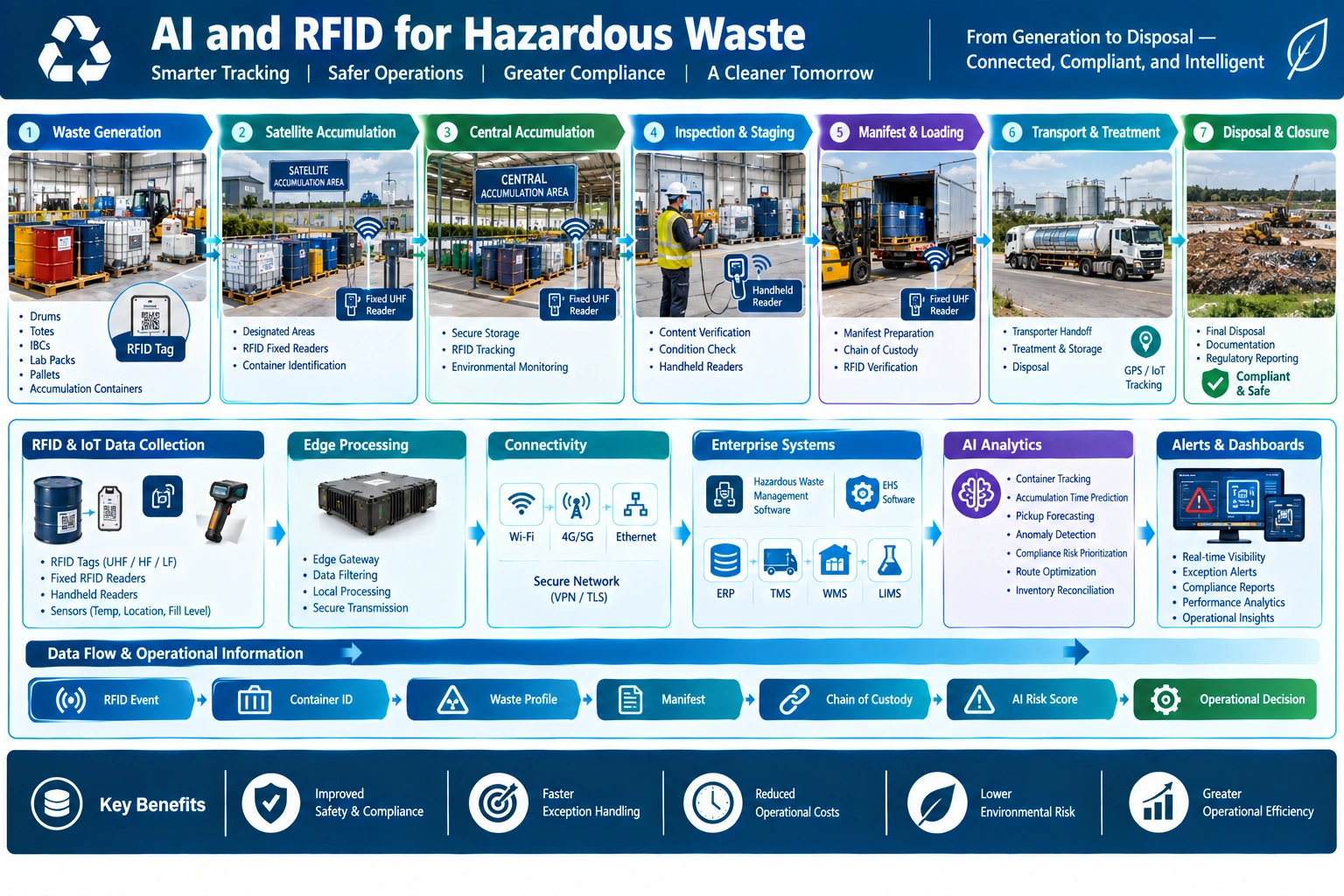
This enterprise infographic illustrates the movement of hazardous-waste containers through accumulation, inspection, staging, transport, treatment, storage, and disposal. It connects RFID and IoT data with edge processing, enterprise systems, AI analytics, compliance alerts, and operational decisions.
Alt Text: AI and RFID track hazardous waste through accumulation, transport, treatment, compliance, and disposal workflows.
Why AI Is Transforming Hazardous Waste Management
Hazardous-waste operations generate large quantities of structured and unstructured information. Waste profiles, waste determinations, container IDs, waste codes, inspection records, manifests, shipment records, treatment batches, analytical results, equipment conditions, and location events can reside in different software systems. Manual reconciliation makes it difficult to determine which container is where, how long it has been accumulating, whether the associated records are complete, and which exceptions require immediate attention.
AI can analyze these data sources to identify patterns and prioritize operational work. RFID strengthens the underlying identification layer by associating physical containers and assets with digital records. The resulting data can support both routine workflows and exception management.
AI for Hazardous Waste Classification and Waste Profiles
Hazardous-waste classification requires accurate characterization of the material, applicable waste codes, chemical information, process knowledge, analytical results, and regulatory criteria. AI can assist qualified personnel by extracting information from waste-profile documents, laboratory reports, safety documentation, historical records, and enterprise databases.
Machine-learning models can identify inconsistencies between a proposed waste profile and historical records. AI can also flag unusual changes in waste composition, missing documentation, duplicate profiles, or data combinations that warrant review.
AI should support, rather than independently replace, qualified waste determinations and regulatory decision-making. High-consequence classification decisions require documented rules, validated models, appropriate approvals, and human oversight.
AI for Container Tracking and Accumulation-Time Control
Container tracking is one of the most practical areas for combining AI and RFID. Each tracked drum, tote, IBC, roll-off, or other container can have an RFID identity associated with its waste profile, container status, location, generation date, inspection history, and shipment record.
AI can analyze container movement and historical accumulation patterns to predict which areas are likely to approach storage or accumulation limits. This allows environmental managers and operations teams to prioritize pickups before a situation becomes a compliance exception.
RFID event histories also help identify containers that appear in an unexpected zone, remain stationary longer than expected, or have a digital record that does not match their physical location.
AI for Pickup Planning and Transportation
Hazardous-waste pickup requirements can vary significantly by waste stream, generation rate, container capacity, treatment availability, transporter schedules, regulatory requirements, and site conditions.
AI can forecast waste-generation volumes and estimate future container demand. Route-optimization models can consider pickup locations, vehicle capacity, compatible waste streams, service windows, travel time, and operational constraints.
RFID can verify the physical containers selected for shipment. A reader at a loading area or a handheld device can compare container identities against the planned shipment, helping personnel detect an incorrect container, missing container, or unexpected asset before the transporter departs.
AI for Treatment, Storage, and Disposal Operations
Treatment, storage and disposal facilities manage complex flows of incoming waste. Containers may move through receiving, inspection, sampling, quarantine, storage, treatment preparation, processing, final storage, reclamation, recycling, or disposal.
AI can identify bottlenecks by analyzing container dwell times, treatment capacity, storage utilization, batch histories, equipment conditions, and incoming shipment patterns. Predictive models can also help estimate treatment demand and identify equipment conditions associated with processing delays.
RFID provides physical identity and movement events that can associate a container with a receiving transaction, treatment batch, storage location, or final disposition record.
AI for Hazardous Waste Compliance and Inspection
Compliance work often involves repetitive inspections, documentation reviews, reconciliation, and exception investigation. AI can prioritize inspections based on container age, previous nonconformances, location, waste characteristics, inspection history, and operational risk.
Computer vision can support selected inspection tasks such as identifying visible labeling deficiencies, PPE compliance issues, container-condition anomalies, or spill indicators where appropriate. Such systems should supplement formal inspections and established safety procedures rather than replace trained personnel.
Hazardous Waste Applications Where AI and RFID Add Operational Value
Waste Generation and Containerization
The process begins when a hazardous waste stream is identified and placed into an approved container. A digital record can associate the container with the waste profile, generator location, waste code, generation date, container type, and required handling information.
RFID can provide the physical identity needed to maintain this association as the container moves. AI can compare generation patterns across production areas and identify unusual changes in container volume, frequency, or composition.
Satellite and Central Accumulation Areas
Satellite accumulation areas and central accumulation areas require controlled container management, inspections, labeling, segregation, and time-sensitive handling. Container-location uncertainty becomes particularly problematic when facilities have multiple accumulation zones.
RFID readers can capture container movements through designated transition points, while handheld devices can update locations during manual moves. AI can analyze movement histories and dwell time to identify containers requiring attention.
Manifest Preparation and Shipment Handoff
Manifest accuracy is essential to hazardous-waste transportation. Incorrect container counts, mismatched waste descriptions, missing information, or discrepancies between physical shipments and digital records can create delays and compliance exposure.
AI can compare manifest information against historical and current operational records. RFID can provide a physical container count and identity check before loading. Together, these technologies can reduce manual reconciliation and provide stronger evidence for shipment verification.
Transporter and TSDF Receiving
The handoff between a generator, transporter, transfer operation, and receiving facility is a critical chain-of-custody point.
RFID identification at loading and receiving locations can establish time-stamped events for individual containers. AI can compare expected shipments with received containers and flag missing, duplicated, unexpected, or incorrectly associated records.
This approach can be particularly useful when environmental service providers manage multiple generators, transport vehicles, treatment facilities, and temporary staging locations.
Treatment and Processing
Treatment facilities can associate container IDs with sampling, treatment batches, processing equipment, storage locations, and final disposition. AI can analyze historical treatment performance and identify process conditions associated with delays, rework, or nonconformance.
RFID does not determine whether a waste stream is chemically compatible with a treatment process. Instead, it supplies reliable identification and movement information that can be combined with approved treatment rules, laboratory data, process records, and qualified operational decisions.
RFID Hazardous Waste Facility Deployment
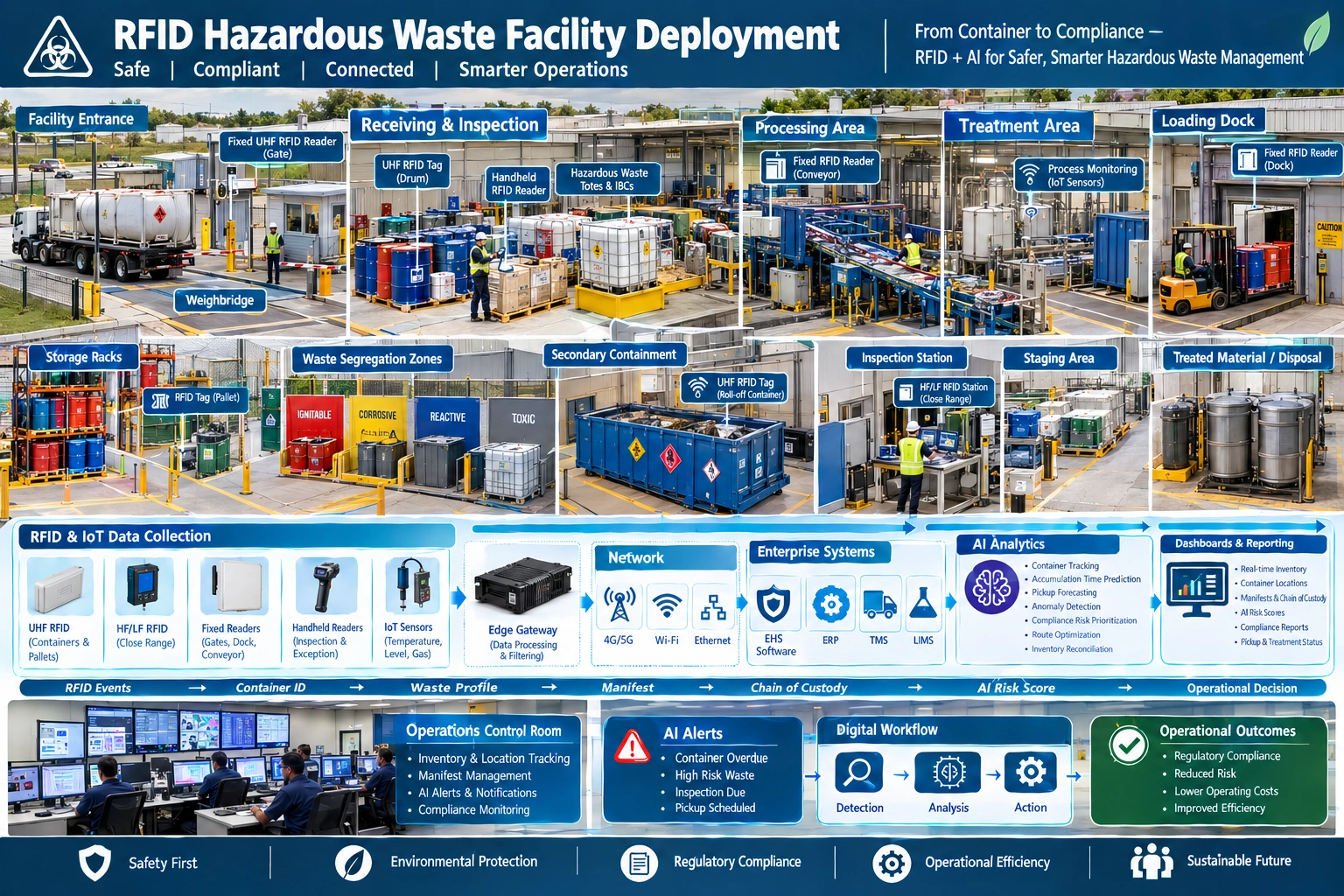
This realistic facility view shows RFID deployment across receiving, inspection, segregation, storage, processing, treatment, staging, and loading areas. It connects fixed and handheld RFID readers, IoT sensors, edge processing, enterprise systems, AI analytics, alerts, and compliance reporting.
Alt Text: Realistic hazardous-waste facility showing RFID readers, tagged containers, AI analytics, safety zones, and compliance workflows
Hazardous Waste Challenges Addressed by AI-Enabled Tracking
Container Location Uncertainty
Large industrial facilities can contain hundreds or thousands of containers distributed across generation points, accumulation areas, warehouses, yards, loading zones, and treatment operations. Manual location records become outdated when containers are moved without timely system updates.
RFID provides event-based identification, while AI can analyze movement histories and identify unusual location changes or prolonged inactivity. Operations personnel can then investigate exceptions rather than searching every container manually.
Accumulation-Time and Inspection Risk
Container age and inspection requirements are operationally important. A container that is physically present but missing a reliable digital timestamp can create uncertainty during compliance reviews.
AI can rank containers according to age, inspection status, location, waste stream, historical risk, and upcoming operational deadlines. RFID helps associate the physical container with the digital record used by these models.
Manifest and Chain-of-Custody Errors
Manual data entry creates opportunities for container IDs, quantities, shipment counts, and other information to become inconsistent across systems.
An RFID-enabled verification point can compare the physical shipment with the expected digital record. AI can then analyze discrepancies across manifests, receiving records, container histories, and transporter transactions.
Incompatible or Incorrectly Staged Waste
Hazardous-waste segregation depends on waste characteristics, facility procedures, compatibility requirements, secondary containment, and applicable regulations. A digital tracking system can help personnel identify where containers are located and which waste profiles are associated with them.
AI can flag combinations of location, waste category, container status, and movement patterns that require review. Final compatibility decisions should remain governed by approved procedures and qualified personnel.
Fragmented Data Across Sites
Environmental service organizations may manage waste across numerous generator facilities, transfer locations, transportation operations, and treatment or disposal facilities. Data can become fragmented among EHS software, ERP, WMS, TMS, LIMS, CMMS, spreadsheets, documents, and local databases.
GAO can help organizations connect RFID identification and tracking hardware with the software systems used for hazardous-waste operations, allowing physical events to become usable enterprise data.
Emergency Response and Incident Visibility
Spills, damaged containers, transportation incidents, fires, equipment failures, and other emergencies require rapid access to accurate information.
RFID can help personnel identify the affected container or asset, while connected software can retrieve associated waste profiles, location history, shipment information, and handling records. AI can prioritize related records and surface potentially relevant information to authorized responders.
Hazardous Waste Data Flow from Container Events to AI Decisions
Data Acquisition
Data begins with physical events and operational records. RFID tags identify containers and assets, while other connected devices and enterprise systems contribute information about location, weight, equipment status, environmental conditions, inspections, shipments, and treatment operations.
A reliable implementation defines the required data fields before selecting hardware. Container identity, timestamp, location, event type, reader identity, operator identity, waste profile, and transaction reference are common data elements.
RFID Event Capture
UHF RFID is generally useful for longer-range identification and movement tracking at controlled facility transition points. Because hazardous-waste containers can contain liquids and may have metallic surfaces, tag selection and mounting require engineering validation.
On-metal UHF tags can be appropriate for metal drums and other conductive surfaces. Antenna orientation, container geometry, liquid content, reader power, interference, and read-zone design can materially affect performance.
HF and LF RFID can be useful where controlled, close-range identification is preferable. Handheld RFID readers provide flexibility for inventory counts, inspections, exception handling, and locations where fixed readers are impractical.
RFID should supplement required hazardous-waste labels, manifests, inspections, physical controls, and documented handling procedures. A hazardous-waste area is not automatically a hazardous location simply because hazardous waste is present. Where a facility has a formally classified hazardous location, RFID and network equipment must be selected and installed according to the applicable site classification and certification requirements.
Communications and Edge Processing
RFID readers can communicate through Ethernet, Wi-Fi, private wireless networks, or cellular connectivity depending on site requirements. An edge gateway can buffer events during network interruptions and perform local processing such as duplicate-event suppression, timestamp normalization, reader-health monitoring, and basic identity validation.
Edge processing is particularly valuable at remote yards, transfer facilities, treatment sites, and industrial areas where connectivity can be intermittent.
Enterprise Software Integration
The RFID event layer should integrate with the software systems already used by the organization. Common integrations include:
- EHS and hazardous-waste management software for container status, compliance, inspections, and waste profiles.
- ERP software for purchasing, accounting, vendors, and enterprise transactions.
- WMS software for storage locations and inventory movement.
- TMS software for pickup scheduling, transportation, and shipment coordination.
- LIMS software for sampling, laboratory results, and waste characterization.
- CMMS software for maintenance of treatment equipment and material-handling assets.
- Document management software for manifests, certificates, inspection records, and supporting documentation.
- GIS software for geographic visualization of generators, routes, facilities, and waste movements.
- Identity and access-management systems for controlling authorized access to sensitive operational information.
APIs or middleware can normalize RFID events before they enter enterprise systems. This prevents each individual reader from becoming directly coupled to every business application.
AI Analytics and Operational Actions
AI becomes useful after reliable operational data has been collected and contextualized. Models can analyze container movement, dwell time, shipment history, waste-generation patterns, equipment conditions, treatment records, and compliance information.
Typical outputs include risk scores, forecasts, anomaly alerts, prioritized work queues, predicted pickup requirements, inventory discrepancies, and maintenance recommendations.
Human review remains important for high-consequence decisions involving waste classification, compatibility, treatment authorization, transportation compliance, emergency response, and regulatory interpretation.
RFID, AI Software, and Hazardous Waste Infrastructure
Cloud Version for Multi-Site Hazardous Waste Operations
A cloud-hosted version is suitable when hazardous-waste organizations need centralized visibility across multiple generators, treatment facilities, warehouses, yards, or transportation operations. RFID events can be transmitted to cloud-hosted software where authorized users access container histories, dashboards, analytics, alerts, shipment records, and compliance information.
Cloud deployment can simplify centralized software administration and make it easier to aggregate data from geographically distributed sites. It can also support enterprise-level AI models using larger historical datasets.
Connectivity remains an important design consideration. Local buffering at the edge allows RFID events to be retained during temporary network outages and forwarded when connectivity is restored.
Security controls should include strong identity management, encryption in transit and at rest, role-based authorization, audit logging, API security, network segmentation where appropriate, and defined data-retention policies.
Server Version for Privately Hosted Hazardous Waste Systems
A server version places the software on customer-managed or privately hosted infrastructure, which may include an industrial edge server, facility server room, private data center, or other controlled enterprise computing environment.
This approach can suit organizations requiring greater control over data location, network connectivity, update schedules, integration boundaries, or IT/OT separation. It can also be useful at facilities with restricted external connectivity.
Customer responsibilities generally include server lifecycle management, backups, disaster recovery, patching, cybersecurity controls, user administration, and software maintenance unless these functions are provided under a managed support arrangement.
AI Methods for Hazardous Waste Operations
Different hazardous-waste workflows require different AI methods. Time-series models can forecast waste-generation and pickup demand. Classification models can support document and waste-profile analysis. Anomaly-detection models can identify unusual container movements or manifest discrepancies. Optimization models can improve pickup scheduling and route planning.
Computer vision can support selected inspection tasks, while predictive-maintenance models can analyze treatment equipment and material-handling assets.
Model governance is important because hazardous-waste operations can involve safety and regulatory consequences. Organizations should define model ownership, validation requirements, confidence thresholds, escalation procedures, audit trails, and human approval points.
RFID Hardware Selection for Hazardous Waste Containers
RFID hardware selection should begin with the physical characteristics of the waste containers and the operating environment rather than with reader specifications alone.
Metal drums, liquid-filled containers, IBCs, roll-offs, pallets, and reusable containers can produce different RF conditions. Appropriate tag construction, mounting location, read distance, antenna polarization, reader configuration, and environmental protection should be validated through field testing.
Industrial deployments may require ruggedized readers, protected cabling, suitable enclosures, handheld devices, edge gateways, and backup connectivity. Equipment located in classified hazardous locations requires appropriate certification and installation practices based on the site’s actual classification.
Reader Placement and RF Site Survey
Reader placement determines whether RFID data is useful for operational control. Doorways, loading lanes, container-transfer points, receiving stations, treatment-entry points, and controlled staging zones are often more valuable than indiscriminate facility-wide coverage.
A site survey should evaluate metal structures, liquids, RF interference, forklift traffic, antenna orientation, reader zones, container stacking, worker movement, and expected read rates.
GAO can help organizations evaluate RFID hardware and deployment configurations for hazardous-waste tracking requirements, including fixed readers, antennas, tags, handheld equipment, gateways, and associated software integration.
Part 2 continues directly from Part 1, covering security, integrations, technical capabilities, KPIs, compliance considerations, implementation, business value, and the required closing section.
Security, Data Governance, and System Integration for Hazardous Waste
AI and RFID deployments in hazardous-waste operations must protect operational records while maintaining reliable access for authorized personnel. Container identities, waste profiles, manifests, laboratory results, shipment histories, treatment records, and incident information can contain sensitive operational and compliance data.
Security therefore needs to be incorporated into the complete system rather than treated as an isolated software feature.
RFID and Network Security
RFID readers, handheld devices, gateways, servers, and connected software should use controlled identities and authenticated communication. Network segmentation can separate RFID infrastructure from business applications and operational technology where required.
Important controls include:
- Role-based access for environmental, warehouse, transportation, maintenance, and IT personnel.
- Encryption for data transmitted between readers, gateways, servers, and cloud services.
- Secure device credentials and controlled reader configuration.
- Audit trails for container-status changes, shipment verification, and administrative actions.
- Network segmentation between enterprise IT, RFID infrastructure, and industrial control systems where appropriate.
- Secure APIs between RFID middleware and EHS, ERP, WMS, TMS, LIMS, and other applications.
- Backup and disaster-recovery procedures for critical container and shipment records.
- Monitoring of unauthorized access, abnormal device behavior, and unexpected network activity.
Data Governance and AI Model Controls
AI models depend on reliable historical data. Duplicate container records, incorrect timestamps, missing movement events, inconsistent waste-profile information, and incomplete manifest data can reduce model quality.
Organizations should establish data ownership, validation rules, retention requirements, model review procedures, and escalation criteria.
AI recommendations should also remain explainable enough for operational personnel to understand why an alert was generated. A container marked as high risk, for example, should have traceable supporting information such as extended dwell time, overdue inspection status, unusual movement, or a discrepancy between physical and digital records.
Integration with Existing Enterprise Systems
A hazardous-waste RFID solution should complement existing software instead of creating another isolated information source.
Typical integration paths include:
- RFID middleware to EHS or hazardous-waste management software.
- EHS records to ERP for financial and vendor transactions.
- RFID container events to WMS for storage and staging visibility.
- Shipment events to TMS for transportation execution.
- Container and sample IDs to LIMS for laboratory workflows.
- Equipment events to CMMS for maintenance management.
- Manifest and certificate documents to document-management systems.
- Location and route information to GIS and transportation applications.
- User identities to enterprise identity and access-management systems.
- Security events to SIEM systems where centralized monitoring is required.
API-based integration can normalize information before it reaches downstream applications. This is particularly valuable when different facilities use different software versions or when a hazardous-waste provider operates multiple sites.
Technical Capabilities for Hazardous Waste Operations
The combination of AI, RFID, connected equipment, and enterprise software can support a broad range of operational capabilities.
Container Traceability
RFID gives individual containers a machine-readable identity that can remain associated with a waste record as the container moves through defined operational zones.
Traceability can cover:
- Generation point.
- Satellite accumulation area.
- Central accumulation area.
- Inspection station.
- Staging area.
- Loading dock.
- Transporter handoff.
- Receiving facility.
- Quarantine or exception area.
- Treatment location.
- Storage location.
- Final disposition.
AI can analyze these movement records to identify missing events, unexpected movements, prolonged dwell times, or discrepancies between planned and actual container paths.
Automated Inventory Reconciliation
Manual hazardous-waste inventory counts can consume substantial labor, especially across large accumulation areas and treatment facilities.
RFID-assisted counts can compare physical container identities with the expected inventory record. AI can prioritize discrepancies according to operational importance.
Examples include:
- Container physically present but absent from the digital inventory.
- Container recorded in the wrong location.
- Duplicate container identity.
- Shipment record without a corresponding physical container.
- Physical container without a current shipment record.
- Unexpected container movement.
- Container remaining in a staging zone longer than expected.
Predictive Operational Planning
Historical RFID events provide a time series of container generation and movement. AI can use these records with production schedules, waste profiles, seasonal patterns, treatment capacity, and transportation information.
Predictive outputs can include:
- Expected container generation.
- Pickup demand.
- Storage-space requirements.
- Treatment workload.
- Transportation requirements.
- Expected container dwell time.
- Equipment maintenance demand.
- Potential operational bottlenecks.
These forecasts can help environmental managers coordinate with production, warehouse, transportation, and treatment teams before capacity constraints become urgent.
Exception Management
Exception management is often more valuable than simply displaying a dashboard.
AI can prioritize exceptions based on factors such as waste type, container age, location, shipment status, inspection history, historical incidents, and operational deadlines.
A work queue might identify:
- Containers requiring inspection.
- Containers approaching an accumulation threshold.
- Manifest discrepancies.
- Unexpected container locations.
- Shipment-count mismatches.
- Treatment batches with abnormal process conditions.
- Equipment showing predictive-maintenance indicators.
- Containers requiring reconciliation before shipment.
This allows personnel to focus on the highest-priority issues rather than manually reviewing every transaction.
Hazardous Waste Performance Metrics and KPIs
A successful AI and RFID deployment should be measured using operational and compliance KPIs rather than reader counts alone.
Traceability and Inventory KPIs
Useful metrics include:
- Container traceability rate.
- Container inventory accuracy.
- RFID read success rate.
- RFID reader uptime.
- Container search time.
- Location-data accuracy.
- Inventory reconciliation rate.
- Container movement-event completeness.
- Staging dwell time.
- Container utilization.
- Storage-capacity utilization.
Compliance and Shipment KPIs
Organizations can monitor:
- Accumulation-time compliance.
- Inspection completion rate.
- Manifest data accuracy.
- Manifest exception rate.
- Chain-of-custody completeness.
- Profile approval cycle time.
- Waste-characterization turnaround time.
- Compliance audit findings.
- Corrective-action closure time.
- Pickup schedule adherence.
Transportation and Treatment KPIs
Transportation and treatment operations can use:
- Shipment cycle time.
- Truck dwell time.
- Route utilization.
- Pickup forecast accuracy.
- Treatment throughput.
- Treatment batch yield.
- Disposal lead time.
- Nonconformance rate.
- Treatment-process exception rate.
- Emergency response time.
AI Performance KPIs
AI models should also be evaluated independently from general operational performance.
Relevant measures include:
- Prediction error.
- AI alert precision.
- False-alert rate.
- Exception detection rate.
- Forecast accuracy.
- Model drift.
- Human-review acceptance rate.
- Time from AI alert to operational action.
AI performance should be reviewed against actual operational outcomes. A model producing many alerts is not necessarily effective if most alerts are irrelevant.
Hazardous Waste Regulations and Standards Considerations
AI and RFID do not replace regulatory obligations. They provide additional identification, data-management, and decision-support capabilities that can help organizations execute established procedures more consistently.
U.S. hazardous-waste programs commonly involve requirements under the Resource Conservation and Recovery Act and its implementing regulations, including requirements addressing hazardous-waste identification, generators, accumulation, manifests, treatment, storage, and disposal. Transportation activities can also involve U.S. Department of Transportation hazardous-material requirements. OSHA requirements may apply to hazard communication, worker protection, and hazardous-waste operations depending on the work being performed.
Organizations operating in Canada may need to consider federal requirements such as the Canadian Environmental Protection Act and Transportation of Dangerous Goods requirements, together with applicable provincial requirements.
The exact requirements depend on the waste stream, generator status, facility activity, jurisdiction, permits, transportation mode, and other site-specific conditions.
RFID Compliance and Hazardous Locations
RFID radio equipment must also comply with applicable radio-frequency requirements. Equipment used in the United States may fall under FCC requirements, while Canadian deployments may involve ISED requirements and other jurisdictions may use different regulatory frameworks.
Hazardous waste and hazardous locations should not be treated as identical concepts. A facility containing hazardous waste is not automatically classified as a hazardous location. If a particular area is classified because of flammable gases, vapors, combustible dust, or other site-specific conditions, electrical and electronic equipment must be selected and installed according to the applicable classification and certification requirements.
RFID can support compliance workflows, but it does not replace required labels, manifests, inspections, waste determinations, worker training, secondary containment, segregation procedures, or physical safety controls.
Management System Standards
Organizations may also align their environmental, occupational-safety, quality, and cybersecurity practices with standards such as ISO 14001, ISO 45001, ISO 9001, and IEC 62443 where appropriate.
The value of these standards in an AI and RFID deployment is not simply certification. They can provide structured processes for managing environmental performance, worker safety, quality, cybersecurity, access controls, documented procedures, corrective actions, and continuous improvement.
Implementing AI and RFID for Hazardous Waste
Successful implementation should begin with an operational problem rather than with RFID hardware or an AI model.
Phase 1: Hazardous Waste Workflow Assessment
The first step is to map the physical movement of waste and associated information.
The assessment should identify:
- Waste-generation points.
- Waste profiles and classification processes.
- Container types and materials.
- Satellite and central accumulation areas.
- Inspection procedures.
- Staging and loading zones.
- Transporter handoff points.
- Treatment and disposal workflows.
- Existing EHS, ERP, WMS, TMS, LIMS, and CMMS systems.
- Current manual data-entry points.
- Existing compliance and reconciliation problems.
GAO can help organizations translate these requirements into appropriate RFID hardware, software, and deployment configurations.
Phase 2: RFID Site Survey and Pilot
A pilot should test the physical RF environment before full deployment.
Testing should include representative containers such as metal drums, plastic drums, totes, IBCs, pallets, and other tracked assets. The evaluation should measure read reliability, tag placement, antenna orientation, reader positioning, forklift traffic, liquid contents, metal interference, and expected movement speeds.
A pilot should also test the complete transaction rather than only the RFID read. A successful event should move from physical container identification through edge processing, enterprise integration, AI analysis, and operational action.
Phase 3: AI Data Preparation
AI deployment should follow sufficient data collection and validation.
Organizations can establish historical datasets containing:
- Container movement events.
- Waste-generation volumes.
- Pickup history.
- Inspection records.
- Manifest information.
- Waste-profile data.
- Laboratory results.
- Treatment records.
- Equipment conditions.
- Incident and nonconformance records.
Data quality controls should remove duplicates, reconcile conflicting identifiers, standardize timestamps, and establish reliable relationships between physical assets and enterprise records.
Phase 4: Operational Deployment
Deployment can then expand from a controlled pilot to additional accumulation areas, loading zones, treatment operations, warehouses, yards, and facilities.
Role-specific interfaces can provide different information to different teams. Environmental managers may need compliance-risk and inspection information, while warehouse operators may need container location and movement information. Transportation teams may require shipment verification, and maintenance teams may need equipment-condition information.
Phase 5: Continuous Optimization
The system should be evaluated using defined KPIs. Reader performance, tag reliability, integration errors, AI alert quality, prediction accuracy, and operational outcomes should be reviewed periodically.
New workflows can be added after the core tracking process is stable. Examples include returnable-container tracking, spill-kit management, PPE and equipment tracking, treatment-batch association, and automated exception prioritization.
Business Benefits of AI and RFID for Hazardous Waste
AI and RFID can produce measurable value when they are applied to specific operational problems.
Improved Container Visibility
Reliable container identification reduces uncertainty about where waste is located and which digital record belongs to the physical container.
Better Compliance Readiness
More complete container histories, inspection records, movement events, and shipment reconciliation can make compliance reviews and internal audits more manageable.
Lower Manual Search and Reconciliation Work
Automated identification reduces repetitive scanning, searching, counting, and manual record comparison.
More Predictable Transportation
AI-based forecasting can help align waste-generation rates with pickup schedules, vehicle capacity, treatment availability, and storage constraints.
Faster Exception Response
Prioritized alerts allow personnel to investigate high-risk discrepancies before they become larger operational or compliance problems.
Improved Treatment and Storage Visibility
Connecting container identities with treatment batches, storage locations, equipment, and laboratory information provides a more complete view of the waste lifecycle.
Scalable Multi-Site Operations
A standardized RFID and AI approach can be extended across multiple generators, warehouses, yards, transfer facilities, treatment operations, and disposal locations while allowing site-specific workflows.
How GAO Supports AI and RFID for Hazardous Waste
GAO provides RFID hardware, software, and technical support for organizations that need to connect physical assets with enterprise information systems. Our capabilities can support fixed RFID readers, antennas, tags, handheld readers, gateways, RFID software, integration components, and deployment assistance.
For hazardous-waste operations, the practical objective is to match the technology with the physical container, RF environment, workflow, software requirements, and site safety conditions. That can include evaluating UHF RFID for container and yard tracking, HF or LF RFID for controlled close-range identification, and handheld RFID for inventory and exception workflows.
GAO has supported organizations that require customized hardware and software combinations rather than a single standardized deployment. Our approach can accommodate different facility layouts, container types, connectivity conditions, enterprise applications, and operational requirements.
Moving from Hazardous Waste Tracking to AI-Driven Operations
AI and RFID provide complementary capabilities for hazardous-waste management. RFID connects digital records to physical containers and assets, while AI converts accumulated operational data into forecasts, anomaly detection, prioritization, and decision support.
The strongest implementations begin with well-defined hazardous-waste workflows, reliable container identification, accurate enterprise records, controlled integration, and measurable KPIs. AI can then be applied where it provides clear operational value, including pickup forecasting, accumulation-time risk, manifest reconciliation, inspection prioritization, treatment analysis, inventory reconciliation, and predictive maintenance.
Organizations should treat AI recommendations as decision support for high-consequence hazardous-waste activities and maintain appropriate human review, regulatory controls, and documented operating procedures.
Learn More About GAO Hazardous Waste RFID and AI Solutions
Organizations evaluating AI and RFID for hazardous-waste operations can work with GAO to assess container-tracking requirements, RFID technology selection, software integration, AI use cases, site conditions, and deployment models. Our team can help identify suitable hardware and software combinations for generators, environmental service providers, transport operations, treatment facilities, storage areas, and disposal workflows.
GAO can also support organizations that need to connect RFID data with existing EHS, ERP, WMS, TMS, LIMS, CMMS, and other enterprise systems. The resulting solution can provide a practical foundation for better container traceability, operational visibility, compliance support, and data-driven hazardous-waste management.
Building the Future of Industrial AI and IoT with Aperture Venture Studio and GAO RFID Inc.
Aperture Venture Studio and GAO RFID Inc. contribute to practical industrial AI and IoT innovation by combining technical development, applied engineering, RFID expertise, and enterprise deployment knowledge. For hazardous-waste operations, this focus supports solutions that connect physical containers, connected equipment, RFID identification, AI analytics, and enterprise software to improve traceability, safety, compliance support, and operational decision-making. Organizations can apply these capabilities to demanding environmental-service workflows while maintaining appropriate human oversight, regulatory controls, cybersecurity practices, and site-specific engineering requirements.