
AI and RFID for Government Facilities
AI-Driven Asset Tracking and Operations in Government Facilities
Government facilities manage large inventories of equipment, documents, vehicles, supplies, maintenance assets, access-controlled items, and other physical resources across offices, courthouses, military-support facilities, public works sites, laboratories, and administrative buildings. AI can turn data collected from RFID-tagged assets into actionable information for asset tracking, inventory management, space utilization, maintenance planning, and operational monitoring. UHF RFID is particularly useful for automatically identifying tagged assets across defined read zones, while HF and LF RFID can support applications where shorter read ranges or specialized identification characteristics are appropriate.
The combination of AI with RFID data allows government facility managers to move beyond periodic manual inventories. RFID readers generate identification events, middleware normalizes those events, and AI models can identify unusual movement patterns, predict inventory requirements, detect discrepancies, and prioritize operational actions. The resulting system can connect physical assets with facility-management software, inventory databases, work-order systems, security controls, and reporting tools.
GAO supplies RFID hardware and systems that can support these government facility workflows, including RFID readers, tags, antennas, and related identification technologies. Its experience serving government agencies alongside commercial and research organizations provides a practical foundation for designing RFID-enabled operational systems.
What AI and RFID Mean for Government Facility Management
RFID provides the identification layer while AI provides analysis and decision support. The distinction is important because an RFID reader does not determine whether an asset movement is operationally appropriate. It records an identification event. AI software can subsequently evaluate that event against asset records, expected locations, work orders, schedules, authorization rules, or historical behavior.
A government facility RFID system may capture:
- Asset identification and tag ID
- Reader location and read-zone information
- Timestamped movement events
- Equipment location changes
- Inventory presence or absence
- Storage-area activity
- Check-in and check-out events
- Movement between controlled areas
- Maintenance-related asset transfers
- Supplies entering or leaving designated areas
AI models can correlate these events with information from computerized maintenance management systems, facility-management software, inventory databases, procurement systems, building-management systems, and access-control records.
The resulting workflow supports applications such as AI asset tracking, AI inventory management, maintenance prioritization, discrepancy detection, facility supply forecasting, and operational anomaly detection.
Government Facility Use Cases for AI-Enabled RFID
Government facilities have highly varied physical environments and operational requirements. A courthouse may require controlled tracking of equipment and records, while a public laboratory may need detailed movement histories for instruments and supplies. A public works facility may need to monitor tools, maintenance equipment, spare parts, and mobile assets.
AI Asset Tracking for Government Equipment
Government organizations often maintain equipment across multiple rooms, buildings, departments, and storage locations. Manual inventories can become outdated when equipment is relocated without timely database updates.
RFID identification events provide a continuous source of location information within instrumented areas. AI can analyze these events to identify assets that remain outside their expected locations, frequently move between departments, or appear in unexpected read zones.
Useful outputs include:
- Current or most recently detected asset location
- Assets missing from expected areas
- Unusual movement patterns
- Frequently relocated equipment
- Long-dwell assets
- Equipment requiring physical verification
The system should distinguish between a detection event and a verified physical location. RF propagation, tag orientation, antenna placement, metal surfaces, and adjacent read zones can affect detection performance. Government facilities should therefore validate RFID read zones during commissioning rather than assuming that every detected event represents precise room-level positioning.
AI Inventory Management for Government Supplies
Administrative and operational facilities can maintain significant quantities of consumables, replacement parts, office equipment, safety supplies, maintenance materials, and specialized inventory.
RFID can automate identification when tagged items pass through receiving, storage, issue, return, or dispatch areas. AI can use historical consumption and inventory movement data to estimate demand and identify unusual consumption.
Potential functions include:
- Inventory discrepancy detection
- Stock-level monitoring
- Consumption forecasting
- Slow-moving inventory identification
- Replenishment prioritization
- Receiving verification
- Issue and return reconciliation
The most effective implementation usually begins with inventory categories where stockouts, misplaced items, or manual counting create measurable operational costs.
Maintenance Asset Monitoring
Maintenance teams may manage pumps, HVAC equipment, electrical equipment, tools, test instruments, generators, replacement components, and specialized service equipment.
RFID can associate physical assets with maintenance records, while AI can analyze movement and work-order information. For example, repeated movement of a particular maintenance tool to specific facilities could indicate recurring service demand. Similarly, an equipment component repeatedly appearing in maintenance-storage areas may provide useful operational context when combined with work-order history.
RFID should not replace equipment condition sensors when actual condition measurements are required. Instead, RFID can provide identification and movement context that complements vibration, temperature, current, pressure, or other sensor data.
Government Facility Receiving and Dispatch
Receiving areas represent a practical RFID deployment point because shipments, equipment, supplies, and replacement components enter the facility through controlled physical locations.
A receiving workflow can associate RFID-tagged items with purchase orders, shipment records, asset records, and destination departments. AI can identify discrepancies such as unexpected quantities, repeated receiving exceptions, or unusual delays between receipt and internal delivery.
Dispatch workflows can apply similar controls when equipment or supplies leave a facility.
Government Facility RFID Workflow From Identification to AI Decision Support
A technically sound deployment begins with physical identification and progresses through data processing before AI analysis.
The first layer consists of RFID tags attached to assets, containers, equipment, supplies, or other trackable objects. Tag selection depends on the asset material, required read distance, mounting method, operating environment, and required data capacity.
RFID readers and antennas create defined read zones at locations such as:
- Receiving doors
- Equipment rooms
- Storage areas
- Maintenance stores
- Department entrances
- Loading areas
- Controlled transfer points
- Inventory checkpoints
Reader events are transmitted to middleware or edge software. The middleware filters duplicate reads, associates events with reader and antenna locations, applies business rules, and forwards normalized records to government facility software.
The resulting data can be represented as:
RFID Tag → Reader and Antenna → Read Event → Edge/Middleware Processing → Database → AI Analytics → Operational Decision → Facility Action
AI analytics can then compare observed activity against expected operational patterns. An anomaly model might flag an unexpected asset movement. A forecasting model might estimate future consumption of a category of supplies. A classification model could categorize inventory exceptions based on historical operational data.
The final action remains connected to the responsible government facility workflow. Depending on the use case, that action could involve a physical inventory check, maintenance task, inventory replenishment, record correction, supervisor review, or security investigation.
Government Facility AI-RFID Operational Workflow
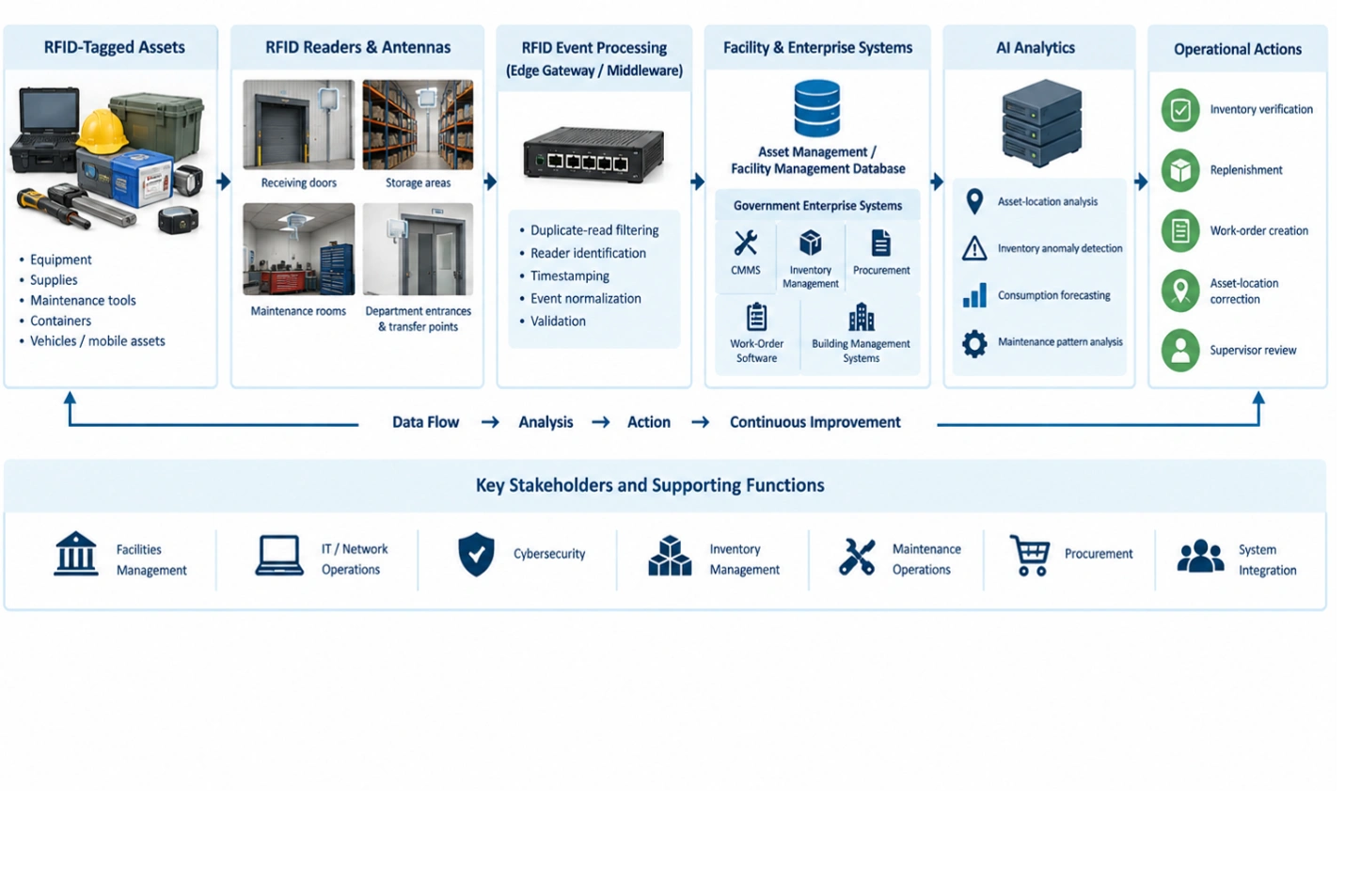
The completed workflow illustrates how RFID-tagged government assets generate identification events that are filtered and normalized at the edge before entering facility and enterprise systems. AI analytics then supports asset-location analysis, inventory anomaly detection, consumption forecasting, and maintenance pattern analysis, with results routed to operational actions and continuous improvement.
RFID Hardware and AI Software for Government Facilities
Government facility deployments generally combine RFID hardware, edge computing, networking, data storage, enterprise software, and AI analytics. Hardware selection should follow the physical workflow rather than starting with a particular reader model.
UHF RFID
UHF RFID is generally appropriate for longer-range identification of tagged equipment, containers, supplies, and assets moving through defined facility read zones. It can support portal-style receiving and dispatch applications as well as fixed-point inventory monitoring.
Read performance depends heavily on antenna geometry, tag design, mounting surface, reader configuration, and environmental interference. Metal cabinets, electrical equipment, dense storage racks, and liquids can affect RF performance and should be considered during site surveys.
HF and LF RFID
HF RFID can be appropriate for shorter-range identification and applications where controlled proximity reading is preferred. LF RFID can support specialized identification requirements where its operating characteristics fit the application.
Government facilities should select the RFID frequency based on read distance, asset material, tag placement, environmental conditions, reader density, and workflow requirements rather than treating one RFID frequency as universally suitable.
Edge Processing and Middleware
Edge processing is useful where RFID events need immediate filtering and normalization before reaching central systems. It can reduce unnecessary event traffic and provide local continuity when connectivity to a central server is temporarily unavailable.
Middleware commonly handles:
- Duplicate-read filtering
- Event normalization
- Reader and antenna identification
- Timestamp synchronization
- Asset-to-tag association
- Read-zone rules
- Data validation
- Integration with enterprise applications
AI Analytics
AI software can operate on historical and near-real-time RFID event data. Machine learning models can identify patterns that would be difficult to detect through manual review alone.
Relevant methods include:
- Anomaly detection for unexpected asset movements
- Time-series forecasting for supply consumption
- Classification for inventory exceptions
- Pattern analysis for asset utilization
- Predictive models supporting maintenance planning
- Rules combined with machine learning for operational alerts
AI model outputs should remain explainable enough for facility personnel to understand why an event was flagged, particularly where the output influences an administrative, maintenance, inventory, or security-related workflow.
Cloud and Server Deployment for Government Facilities
Government facilities can use either cloud-hosted software or privately hosted server deployments depending on data governance, connectivity, procurement requirements, cybersecurity controls, and organizational IT policy.
Cloud Version uses cloud-hosted software and centralized computing resources. It can be useful for organizations managing RFID-enabled facilities across multiple locations because data can be consolidated for cross-site analytics, reporting, and centralized model management.
Server Version places the software on edge servers, customer-managed servers, private data centers, facility servers, or other privately hosted infrastructure. This approach can be preferable where government IT policies require greater control over data location, network connectivity, system administration, or integration boundaries.
A hybrid arrangement can also be appropriate. RFID events can be processed locally while selected historical or analytical data is transferred to a central environment.
GAO can supply RFID hardware and related systems that form the physical identification layer of these deployments. Integration design should then be coordinated with the government facility’s existing network, security controls, databases, and operational software.
Government Facility RFID Deployment Architecture for Secure Asset Tracking
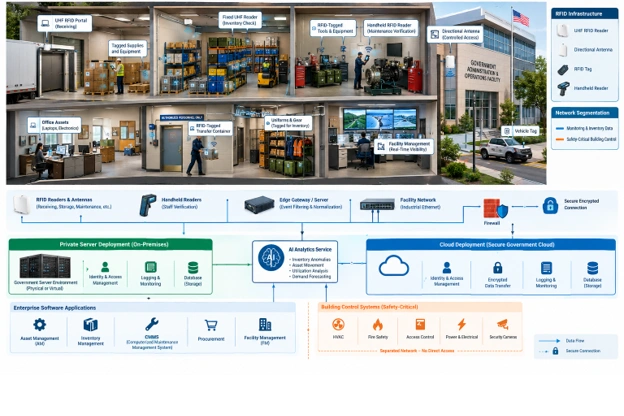
This visual illustrates a realistic government facility using UHF RFID portals, fixed readers, handheld readers, and RFID-tagged assets across receiving, storage, maintenance, office, and controlled transfer areas. RFID events flow through a segmented facility network and edge gateway to enterprise applications and AI analytics, with separate private-server and secure cloud deployment paths. Safety-critical building control systems are shown on a separated network.
Engineering Considerations for Government RFID Deployment
Successful deployment depends on physical and digital engineering decisions made before large-scale installation.
Site surveys should document wall construction, doors, metal surfaces, storage density, electrical equipment, network availability, reader mounting locations, antenna orientation, and expected asset movement paths.
Tag selection should also be tested against the actual asset materials. A tag that performs well on cardboard may behave differently when attached to metal equipment or placed near liquids. Government facilities should therefore conduct representative tag-read testing using actual asset types.
Read-zone design requires particular attention. Adjacent readers can create overlapping coverage, while poorly positioned antennas can produce unwanted reads. The objective is not simply to maximize RF coverage. The objective is to create reliable identification zones that correspond to actual operational events.
Commissioning should include:
- Reader and antenna validation
- Tag-placement verification
- Read-rate testing
- False-read testing
- Network connectivity validation
- Middleware event testing
- Asset database reconciliation
- AI baseline establishment
- User acceptance testing
- Operational workflow validation
AI should generally be introduced after sufficient operational data has been collected. Establishing a baseline from normal facility activity makes anomaly detection more useful than deploying a model without understanding normal movement patterns.
Security and Data Governance for Government RFID Systems
RFID-enabled government facility systems should be designed as part of the organization’s broader cybersecurity and information-governance controls.
Important considerations include authenticated device access, network segmentation, encrypted communications, role-based access control, secure server configuration, event logging, firmware management, backup procedures, and controlled administrative privileges.
RFID data can also reveal operational information such as asset locations, movement schedules, inventory levels, and maintenance activity. Access to this information should therefore follow the organization’s data classification and authorization requirements.
AI introduces additional considerations. Model inputs should be validated, data quality should be monitored, and anomalous outputs should be reviewed according to the operational risk of the application. Systems supporting inventory or maintenance decisions can use human review before significant actions are taken.
GAO’s role can include supplying the RFID hardware and related identification components needed for these systems, while the final cybersecurity design should align with the government organization’s IT, OT, privacy, procurement, and security requirements.
AI Capabilities That Improve Government Facility Operations
AI becomes most valuable when RFID data is connected to an established government facility workflow rather than treated as a standalone identification system. RFID provides timestamped observations of tagged assets, while AI can identify patterns across those observations and other operational records.
- AI asset-location analysis: Identifies assets that have moved from expected locations or have not appeared in designated areas within expected intervals.
- Inventory anomaly detection: Compares RFID inventory events with expected stock records to identify quantity discrepancies, unusual consumption, or missing items.
- Demand forecasting: Uses historical issue and replenishment records to estimate future requirements for supplies, spare parts, and frequently consumed materials.
- Asset utilization analysis: Examines movement frequency and dwell time to identify underused, heavily shared, or frequently relocated equipment.
- Maintenance workflow support: Correlates asset movement with maintenance records to provide additional context for work-order planning.
- Receiving verification: Compares RFID-tagged items with expected shipment and purchase-order information to highlight receiving exceptions.
- Operational anomaly detection: Identifies movement patterns that differ from established facility activity and routes them for human review.
- Cross-facility analysis: When multiple government facilities use compatible data structures, centralized analytics can compare inventory, asset utilization, and operational patterns across locations.
These capabilities can reduce dependence on manual reconciliation while preserving human oversight. AI should prioritize exceptions and provide evidence for its recommendations rather than silently changing authoritative government records.
Business and Operational Benefits for Government Facilities
The practical value of AI-enabled RFID depends on the workflow being improved. A government organization can measure benefits through operational KPIs rather than relying on technology adoption alone.
More Accurate Government Asset Records
Frequent RFID observations can reduce the time between a physical asset relocation and the corresponding digital record update. This is particularly useful for equipment shared among departments or buildings.
The objective is not necessarily continuous tracking of every asset. A more practical design may instrument high-value transfer points and inventory locations where reliable identification events provide the greatest operational value.
Faster Physical Inventory
RFID can reduce the manual effort required to identify tagged assets and supplies. Handheld readers can support targeted verification, while fixed readers can automatically capture movement through designated areas.
AI can further reduce administrative effort by identifying which records require investigation rather than requiring staff to examine every transaction.
Better Supply Planning
Historical inventory movement provides a useful dataset for forecasting. AI can analyze consumption patterns by department, facility, season, project, or supply category.
Forecasting should account for procurement lead times, planned projects, emergency stock requirements, and abnormal historical events. A model trained only on average consumption can produce poor recommendations when government operations experience irregular demand.
Improved Maintenance Coordination
RFID does not measure equipment condition by itself, but it can identify which physical asset is being moved, serviced, stored, or issued.
When combined with maintenance records and condition sensors, RFID events provide additional context for AI-assisted maintenance planning. This can help maintenance personnel locate equipment, associate tools or components with work activities, and identify recurring operational patterns.
Stronger Operational Accountability
Timestamped RFID events can establish a consistent record of when tagged assets were detected at defined facility locations. These records can support inventory reconciliation and operational audits when combined with appropriate access controls and data-retention policies.
RFID records should not automatically be interpreted as proof of individual responsibility. A read event establishes that a tag was detected, not necessarily which person handled the asset.
Government Facility AI and RFID KPIs
A successful implementation should define measurable performance indicators before deployment. Relevant KPIs include:
- Asset inventory accuracy
- RFID read success rate
- False-read rate
- Inventory reconciliation time
- Asset search time
- Percentage of assets with current location records
- Receiving verification accuracy
- Inventory discrepancy rate
- Stockout frequency
- Inventory dwell time
- Supply forecast accuracy
- Maintenance response time
- Work-order completion time
- Asset utilization rate
- RFID system availability
- Gateway connectivity
- Reader uptime
- Data-processing latency
- AI alert precision
- AI alert review rate
- Exception resolution time
- Number of unresolved inventory discrepancies
- Average time between physical movement and record update
KPIs should be tied to a defined baseline. For example, if manual inventory currently requires several days, the organization can measure how RFID changes inventory duration and reconciliation effort after deployment.
AI-specific metrics should also be evaluated. An anomaly model generating a large number of false alerts can increase workload rather than reduce it. Precision, recall, alert volume, review time, and resolution outcomes should therefore be monitored during the pilot.
Implementation Roadmap for Government RFID and AI
A phased deployment is generally more practical than attempting to RFID-enable an entire government facility network simultaneously.
Select a High-Value Workflow
Begin with one measurable problem such as equipment inventory, receiving verification, maintenance-tool management, or supply reconciliation.
The initial use case should have:
- A defined asset population
- Known operational owners
- A measurable baseline
- Clearly defined read zones
- Available source data
- A practical human response to AI-generated exceptions
Assess Assets and Physical Conditions
Document asset materials, dimensions, mounting surfaces, movement patterns, environmental conditions, and expected read distances.
Metal equipment may require RFID tags specifically designed for metal mounting. Portable equipment may need ruggedized tags that tolerate handling, cleaning, and repeated movement.
Conduct an RFID Site Survey
The survey should identify:
- Receiving and dispatch points
- Storage areas
- Equipment rooms
- Department boundaries
- Doorways and transfer points
- Reader mounting locations
- Antenna orientation
- Network connections
- Potential RF interference
- Metal structures and reflective surfaces
The objective is to design useful read zones rather than simply maximize RF coverage.
Commission Hardware and Middleware
Readers, antennas, gateways, tags, and middleware should be tested together using representative government assets.
Testing should verify that:
- Required tags are detected consistently
- Unwanted adjacent reads are controlled
- Duplicate events are filtered
- Reader locations are correctly identified
- Timestamps are reliable
- Asset records correctly map to tag IDs
- Network failures are handled appropriately
- Data reaches the intended application
Establish the AI Baseline
AI should be trained or configured using validated operational data. Normal movement patterns should be understood before anomaly detection thresholds are established.
A useful baseline can include normal inventory turnover, expected asset locations, common movement routes, typical dwell times, and ordinary receiving patterns.
Integrate With Existing Government Software
RFID data becomes more useful when it connects with existing systems instead of creating another isolated database.
Potential integrations include:
- Asset management systems
- CMMS
- Facility-management software
- Inventory management
- Procurement systems
- ERP systems
- Work-order management
- Building-management systems
- Reporting and analytics systems
Integration should define which system remains authoritative for each type of record. RFID should generally provide identification events rather than become the authoritative source for every government asset attribute.
Pilot, Measure, and Expand
The pilot should measure technical performance and operational outcomes simultaneously.
After validating the first workflow, additional locations or asset categories can be introduced using the lessons learned from tag placement, reader configuration, network design, data quality, user workflows, and AI alert thresholds.
Interoperability and Long-Term Scalability
Government facilities frequently operate heterogeneous IT environments. A new RFID system therefore needs clearly defined interfaces and data models.
A normalized RFID event can contain fields such as:
- Tag identifier
- Asset identifier
- Reader identifier
- Antenna identifier
- Location identifier
- Timestamp
- Event type
- Read confidence or signal-related information where supported
- Associated work order or transaction
- Processing status
Using consistent event structures simplifies integration across facilities and makes historical analytics more useful.
Scaling should also account for reader density, network bandwidth, event volume, database capacity, AI processing requirements, cybersecurity monitoring, device management, and support procedures.
A multi-building government deployment should avoid creating different tag naming conventions or incompatible event formats at every location. Standardization at the data and integration layers can substantially reduce future expansion effort.
Practical Design Lessons for Government Facilities
Several engineering principles consistently matter when designing RFID-enabled government operations.
- Design around physical workflows: RFID placement should correspond to real movement and handling processes.
- Test real assets: Laboratory demonstrations cannot fully reproduce the behavior of metal equipment, dense storage, liquids, and mixed materials found in government facilities.
- Separate identification from condition monitoring: RFID identifies tagged objects, while sensors measure physical conditions such as temperature, vibration, pressure, or humidity.
- Treat read events as observations: A tag detection should not automatically be interpreted as proof of possession, authorization, or human activity.
- Keep humans in the decision loop: AI-generated exceptions should be routed to appropriate personnel when operational consequences are significant.
- Establish data ownership: Determine which government system is authoritative for assets, inventory, work orders, procurement, and facility records.
- Monitor AI performance continuously: Alert precision and false-positive rates can change as facility workflows change.
- Secure the complete data path: Protect RFID readers, gateways, servers, databases, interfaces, credentials, and administrative access.
- Plan for maintenance: Reader firmware, tags, antennas, gateways, network components, and software require lifecycle management.
- Measure operational outcomes: The strongest deployment cases demonstrate reduced reconciliation effort, faster asset searches, improved inventory accuracy, or better supply -planning.
GAO Support for Government RFID and IoT Deployments
GAO supplies RFID products and systems that can serve as the identification layer for government facility applications. Its product and engineering experience spans UHF, HF, and LF RFID technologies along with related BLE and IoT hardware.
Headquartered in New York City and Toronto, Canada, GAO serves organizations across the United States and Canada. Its customer base has included Fortune 500 companies, research and development organizations, universities, and U.S. and Canadian government agencies.
GAO’s hardware-focused approach can support deployments involving RFID tags, fixed readers, handheld readers, antennas, gateways, and related IoT components. Organizations planning a government facility deployment can evaluate the required RFID technology, asset characteristics, read-zone requirements, integration points, and operating environment before selecting the final hardware configuration.
Key Takeaways for AI and RFID in Government Facilities
AI-enabled RFID can help government facilities improve asset visibility, inventory reconciliation, receiving verification, supply forecasting, and maintenance coordination. RFID provides reliable identification events at defined physical locations, while AI analyzes those events alongside facility and enterprise data to identify patterns and prioritize exceptions.
The strongest implementations begin with a specific operational problem, validate RFID performance using actual government assets, establish data and cybersecurity controls, integrate with existing software, and measure outcomes against a baseline.
GAO can provide RFID hardware and related IoT technologies for organizations evaluating these applications. Government facility managers, system integrators, and IT teams can use a phased deployment approach to determine where RFID and AI provide measurable operational value before expanding to additional buildings or workflows.
Building the Future of Industrial AI and IoT with Aperture Venture Studio and GAO RFID Inc.
For more than three decades, GAO Group of Companies has invested heavily in R&D for industrial RFID, BLE, and IoT technologies. As generative AI became increasingly useful for industrial applications, the organization expanded its work in AI-enabled IoT, including RFID and BLE, and established Aperture Venture Studio to support the development and scaling of AI and IoT solutions relevant to areas such as government facility operations.
Aperture brings together AI and IoT technical experts, operational executives, investors, and technology organizations. GAO also supports technical communities through initiatives such as Aperture Ventures Summit and TekSummit, where advanced AI and IoT topics are discussed.
Organizations interested in contributing as advisors, co-founders or employees, investors, or customers are welcome to engage with these initiatives.