
AI and RFID for Office Buildings
How AI-Powered RFID Systems Are Transforming Modern Office Buildings
Office buildings are becoming increasingly data-driven environments where facility managers, workplace experience teams, security personnel, property operators, and corporate real estate professionals require accurate, real-time visibility into people, assets, spaces, and operational activities. AI-powered RFID solutions help address these requirements by combining intelligent analytics with automated identification and tracking technologies.
Within modern office buildings, RFID readers, smart badges, tagged assets, visitor credentials, equipment labels, and connected building systems generate operational data that artificial intelligence can analyze to improve workplace efficiency, security, space utilization, maintenance planning, and occupant experiences. AI algorithms transform raw RFID data into actionable insights that support faster decision-making across facility operations.
Organizations managing corporate campuses, high-rise office towers, mixed-use commercial properties, and smart workplaces increasingly deploy AI-enabled RFID solutions to reduce operational costs, improve security compliance, optimize occupancy management, and automate routine building processes. By integrating RFID-generated data with workplace management software, access control systems, building automation systems, and facility management applications, office buildings gain a more intelligent and responsive operating environment.
GAO has supported organizations across North America by supplying RFID hardware, readers, tags, antennas, and IoT-based tracking solutions that help improve visibility and operational efficiency in commercial real estate environments.
AI-Powered RFID Intelligence for Smart Office Buildings
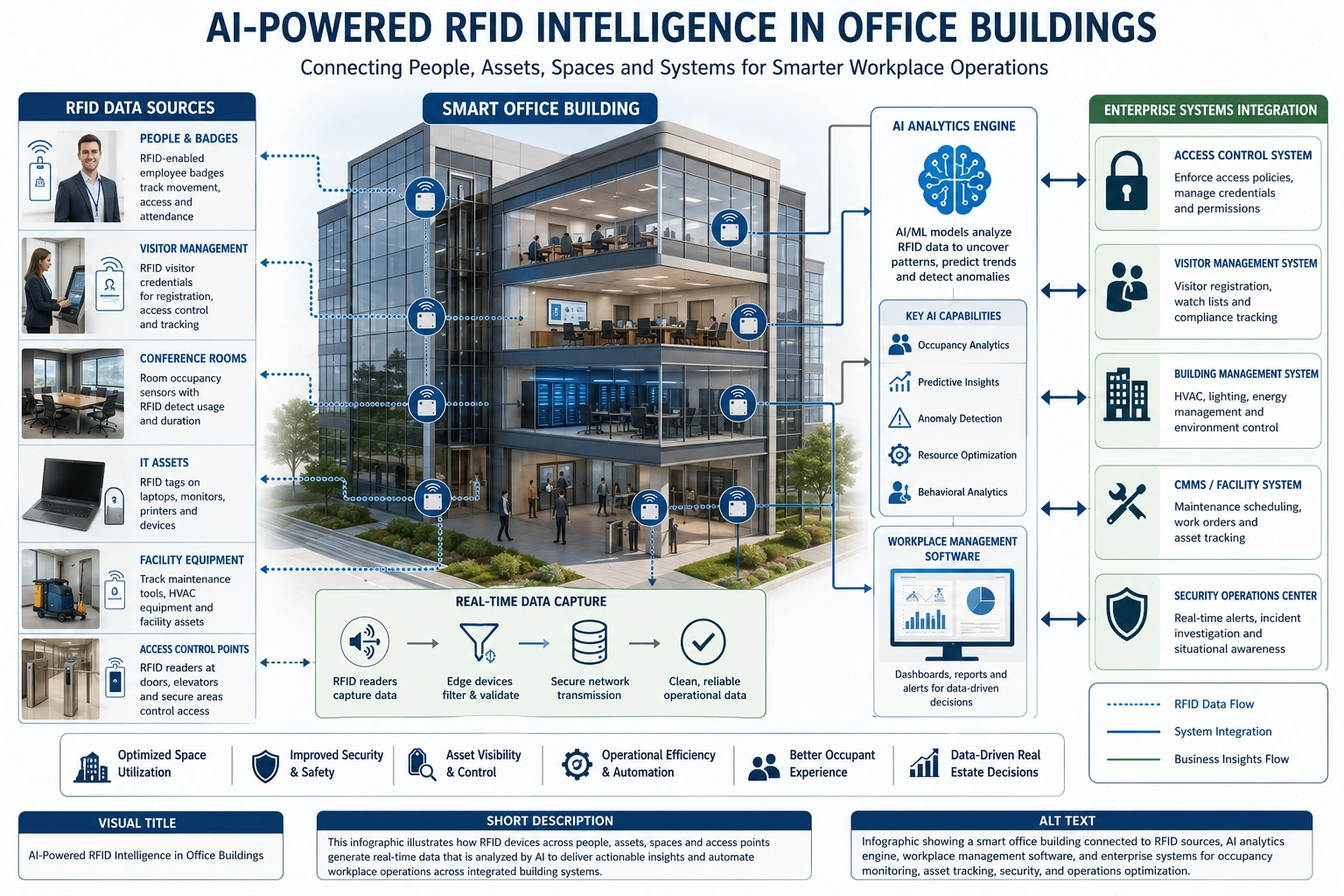
This infographic illustrates how RFID-enabled employee badges, visitor credentials, office assets, facility equipment, and access control points generate real-time data within a smart office building. AI analytics transform this data into actionable insights that improve occupancy management, workplace utilization, security monitoring, asset tracking, and facility operations through integration with enterprise systems.
Understanding AI-Driven RFID Solutions for Commercial Office Buildings
Artificial intelligence and RFID technologies serve complementary functions within office environments.
RFID technology enables automatic identification and tracking of employees, visitors, laptops, monitors, printers, mobile devices, meeting room assets, maintenance equipment, furniture, and operational resources. RFID systems capture location, movement, status, and utilization information without requiring direct line-of-sight scanning.
Artificial intelligence analyzes this continuously generated operational data to identify patterns, detect anomalies, forecast utilization trends, support security decisions, automate workflows, and improve workplace operations.
Key office building functions supported by AI-enabled RFID systems include:
- Employee access management
- Visitor registration and movement tracking
- Conference room utilization analysis
- Workplace occupancy monitoring
- IT asset lifecycle management
- Facility maintenance coordination
- Emergency evacuation support
- Space utilization optimization
- Equipment inventory automation
- Security incident investigation
- Smart workplace analytics
- Building operations reporting
Commercial real estate operators increasingly view RFID-generated operational intelligence as a valuable data source for workplace optimization initiatives. AI enhances the value of that data by enabling predictive and automated decision-making capabilities.
GAO frequently assists organizations implementing RFID-based workplace tracking systems by providing hardware products and technical guidance tailored to building operations requirements.
Office Building Challenges Driving AI-Based RFID Adoption
Office buildings face numerous operational challenges that affect efficiency, security, and occupant satisfaction.
Workplace Occupancy Visibility
Hybrid work schedules have created uncertainty regarding actual building utilization. Facility managers often lack accurate information regarding desk occupancy, collaboration space usage, meeting room demand, and departmental workspace utilization.
AI-driven RFID analytics provide detailed occupancy intelligence that supports workplace planning decisions.
Asset Tracking Complexity
Large office environments contain thousands of valuable assets, including:
- Laptops
- Desktop computers
- Network equipment
- Presentation systems
- Video conferencing devices
- Mobile devices
- Specialized workplace equipment
Manual inventory processes are labor-intensive and frequently inaccurate.
RFID-enabled asset visibility combined with AI analytics helps identify utilization patterns, misplaced equipment, and inventory discrepancies.
Security and Access Control Risks
Unauthorized access, credential misuse, visitor compliance issues, and insider security risks remain significant concerns for commercial office properties.
AI models can analyze RFID access activity to detect unusual movement patterns, suspicious access attempts, and abnormal occupancy behavior.
Maintenance and Facility Operations Challenges
Facility teams manage HVAC equipment, electrical systems, elevators, emergency systems, security equipment, and workplace infrastructure.
AI-powered analysis of RFID-tagged maintenance assets helps improve preventive maintenance scheduling and resource allocation.
Space Utilization Inefficiencies
Organizations often lease more office space than necessary because utilization data is incomplete or outdated.
RFID-generated occupancy information allows AI systems to identify underutilized areas, optimize workspace assignments, and improve real estate planning.
AI and RFID Solution Matrix for Office Buildings
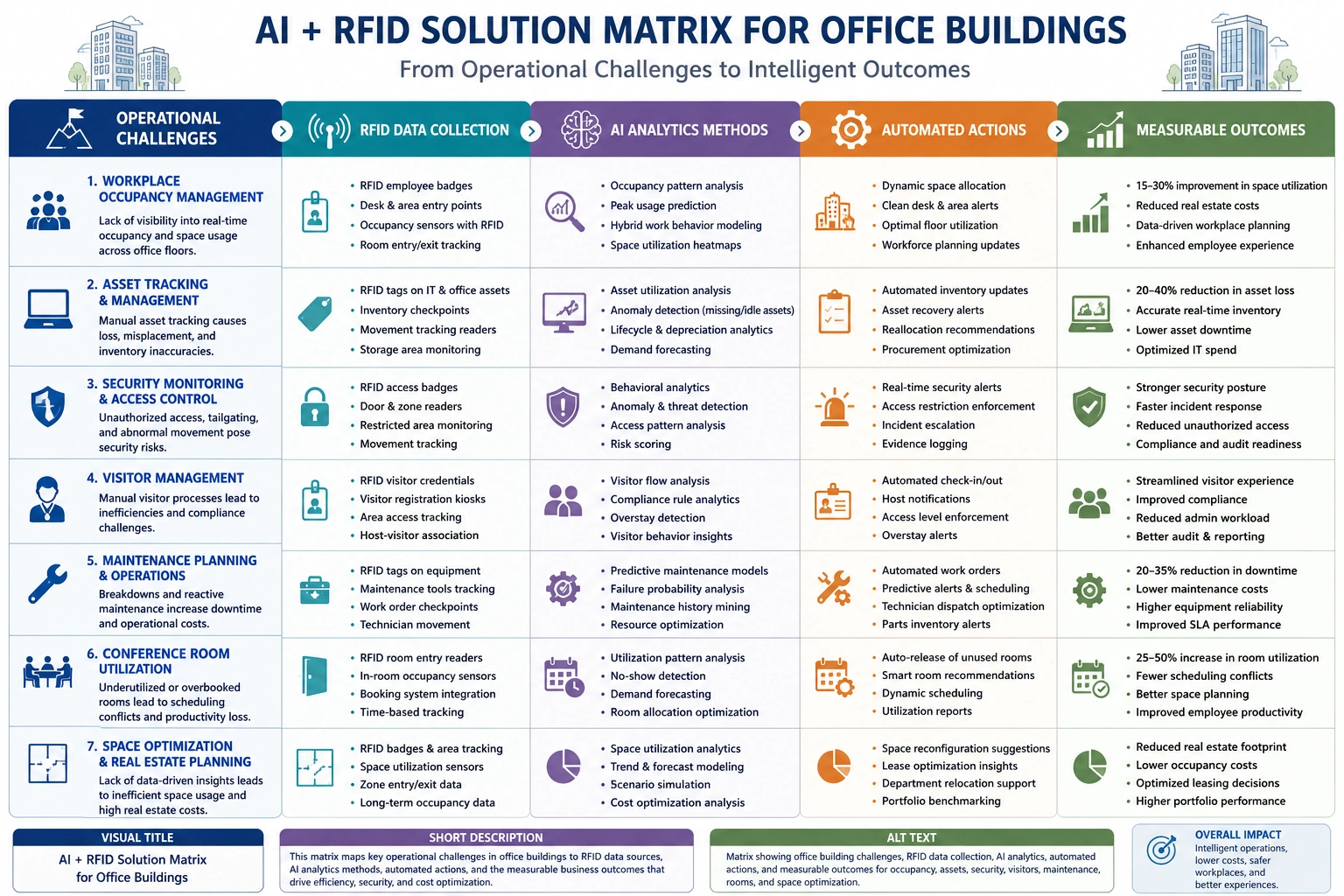
This matrix illustrates how common office building operational challenges such as occupancy management, asset tracking, security monitoring, visitor management, maintenance planning, conference room utilization, and space optimization can be addressed using RFID data collection and AI analytics. It demonstrates the connection between operational problems, intelligent automation, and measurable business outcomes including improved space utilization, reduced costs, enhanced security, and increased workplace efficiency.
High-Value AI and RFID Applications in Office Buildings
Smart Workplace Occupancy Analytics
RFID-enabled employee badges and workplace sensors provide real-time occupancy information throughout office floors, collaboration zones, meeting rooms, cafeterias, and shared workspaces.
AI systems analyze:
- Occupancy density
- Peak usage periods
- Workspace demand
- Department utilization patterns
- Hybrid work behavior
The resulting insights support workplace planning and commercial real estate optimization.
Intelligent Asset Management
RFID tags attached to IT assets, office equipment, and operational resources create continuous visibility throughout the building.
AI algorithms help:
- Predict asset demand
- Detect asset loss
- Identify underutilized equipment
- Improve procurement planning
- Optimize inventory levels
Visitor Management and Security Monitoring
RFID visitor credentials provide visibility into visitor movement and authorized access zones.
AI-powered analysis supports:
- Security event detection
- Visitor compliance monitoring
- Restricted-area access validation
- Emergency accountability reporting
Conference Room Optimization
Many organizations experience meeting room shortages despite low actual utilization.
RFID occupancy monitoring combined with AI analytics helps:
- Identify ghost meetings
- Improve room scheduling
- Increase utilization rates
- Optimize collaboration spaces
Emergency Response and Evacuation Support
RFID systems help identify personnel locations during emergency situations.
AI-driven analysis supports:
- Occupant accountability
- Evacuation planning
- Muster point verification
- Incident response coordination
Facility Operations Intelligence
Facility teams use RFID-enabled tracking to monitor maintenance equipment, contractor activities, and operational workflows.
AI models generate insights that improve:
- Maintenance efficiency
- Workforce productivity
- Resource allocation
- Service response times
Operational Workflow of AI-Enabled RFID Systems in Office Buildings
A typical office building deployment follows a structured data flow process.
Data Acquisition
RFID readers positioned at:
- Building entrances
- Elevator lobbies
- Office floors
- Conference rooms
- Asset storage areas
- Security checkpoints
collect identification and movement data from RFID tags and credentials.
Communication Infrastructure
Captured data travels through:
- Ethernet networks
- Wi-Fi infrastructure
- Secure IP networks
- Edge gateways
- Building communication systems
to centralized processing systems.
Edge Processing
Local edge servers perform:
- Data filtering
- Event validation
- Initial analytics
- Device management
- Operational rule enforcement
before forwarding relevant information to enterprise applications.
Enterprise Software Integration
RFID-generated data integrates with:
- Integrated Workplace Management Systems (IWMS)
- Computerized Maintenance Management Systems (CMMS)
- Building Management Systems (BMS)
- Access Control Systems
- Visitor Management Systems
- Security Information Systems
- Enterprise Resource Planning (ERP) software
AI Analytics and Decision Support
Machine learning models analyze workplace activity, occupancy trends, asset utilization patterns, and security events.
Outputs may include:
- Occupancy forecasts
- Utilization recommendations
- Security alerts
- Maintenance priorities
- Resource optimization suggestions
Automated Business Actions
Insights generated by AI trigger operational actions such as:
- Space reallocation
- Maintenance scheduling
- Security investigations
- Inventory adjustments
- Occupancy reporting
- Workforce planning
Technology Components Supporting AI-Based RFID Solutions in Office Buildings
RFID Hardware Infrastructure
Office building deployments commonly utilize:
- UHF RFID readers for asset tracking
- HF RFID systems for access credentials
- RFID smart badges
- Asset identification tags
- Fixed reader installations
- Handheld inventory readers
- RFID antennas
- Security checkpoint readers
AI and Analytics Components
The intelligence layer may incorporate:
- Machine learning models
- Predictive analytics
- Occupancy forecasting algorithms
- Anomaly detection models
- Behavioral analytics
- Resource optimization engines
- Natural language reporting tools
Software and Data Management Components
Supporting software typically includes:
- Workplace management software
- Facility management software
- Access control software
- Asset management applications
- Data integration middleware
- Analytics dashboards
- Reporting systems
Cloud and Server Deployment Models for Office Building RFID Intelligence
Organizations deploy AI-enabled RFID solutions using cloud-hosted, privately hosted server, or hybrid deployment approaches depending on operational, regulatory, and cybersecurity requirements.
Cloud Deployment
Cloud-hosted deployments are commonly selected for:
- Multi-site office portfolios
- Commercial real estate operators
- Managed workplace environments
- Rapid scalability requirements
- Centralized reporting initiatives
Benefits include:
- Reduced infrastructure management
- Simplified software updates
- Centralized analytics
- Cross-site benchmarking
- Faster deployment cycles
Cloud-hosted systems can aggregate occupancy, asset utilization, visitor management, and security data across multiple office properties to provide portfolio-wide visibility.
Server Deployment
Privately hosted server deployments are often preferred when organizations require:
- Enhanced control over sensitive data
- Internal cybersecurity governance
- Regulatory compliance requirements
- Private network operations
- Integration with existing corporate systems
Server-based deployments may operate within:
- Customer-managed data centers
- Private cloud environments
- Dedicated enterprise hosting facilities
- Edge computing installations
Large financial institutions, government facilities, legal firms, and research organizations frequently prefer privately hosted deployments because of strict security requirements.
Hybrid Deployment
Hybrid deployments combine local processing with centralized analytics.
Typical examples include:
- Real-time access control decisions processed locally
- Occupancy analytics stored in the cloud
- Asset tracking managed on-site
- Portfolio reporting generated centrally
This approach often provides an effective balance between responsiveness, scalability, and security.
Cybersecurity and Data Protection Considerations
Office buildings contain sensitive operational and personnel information that requires strong protection.
Successful implementations incorporate multiple security layers.
RFID Security Controls
Common protections include:
- Credential authentication
- Tag encryption
- Reader authentication
- Access authorization policies
- Secure communication channels
AI Security Monitoring
Artificial intelligence can strengthen security by identifying:
- Unusual badge activity
- Unauthorized movement patterns
- Suspicious visitor behavior
- Credential sharing attempts
- Access anomalies
Network Security Measures
Organizations typically implement:
- Network segmentation
- Secure VPN connectivity
- Encrypted communications
- Identity management controls
- Security monitoring systems
Data Governance
Commercial real estate operators must establish policies governing:
- Occupancy data retention
- Visitor information handling
- Employee privacy considerations
- Access audit trails
- Regulatory compliance reporting
Practical experience shows that cybersecurity planning should begin during solution design rather than after deployment. This approach reduces implementation risk and improves long-term operational reliability.
GAO has supplied RFID hardware and tracking systems for organizations requiring secure identification and asset visibility across controlled environments.
Operational Benefits of AI-Enabled RFID Systems in Office Buildings
Combining AI analytics with RFID-generated operational data delivers measurable improvements across workplace management, security operations, facility services, and commercial real estate performance.
Improved Workplace Utilization
Organizations gain better visibility into:
- Desk occupancy
- Collaboration space demand
- Meeting room utilization
- Departmental space consumption
This supports data-driven real estate decisions.
Enhanced Asset Visibility
RFID-enabled tracking reduces:
- Asset loss
- Inventory discrepancies
- Equipment search time
- Manual audit effort
AI further improves outcomes by identifying utilization trends and forecasting future demand.
Better Security Awareness
Security teams benefit from:
- Faster anomaly detection
- Improved incident investigations
- Enhanced visitor monitoring
- Increased accountability
Increased Facility Management Efficiency
Maintenance teams can improve:
- Resource allocation
- Service response times
- Preventive maintenance planning
- Contractor coordination
Occupant Experience Improvements
Employees and visitors experience:
- Faster access processing
- Improved workspace availability
- Better meeting room scheduling
- Reduced operational disruptions
Real Estate Cost Optimization
Property operators gain actionable insights supporting:
- Portfolio planning
- Space consolidation
- Lease optimization
- Workplace redesign initiatives
Implementation Best Practices for Office Building Deployments
Successful office building deployments typically follow a structured implementation process.
Define Business Objectives
Organizations should identify priorities such as:
- Occupancy intelligence
- Asset management
- Visitor management
- Security monitoring
- Workplace optimization
Evaluate Existing Infrastructure
Assessment should include:
- Access control systems
- Building management systems
- Network infrastructure
- Workplace management software
- Security monitoring systems
Select Appropriate RFID Technologies
Technology selection depends on:
- Tracking distance requirements
- Asset characteristics
- Environmental conditions
- Security requirements
- Operational workflows
Establish Data Governance Policies
Organizations should define:
- Data ownership
- Retention policies
- Privacy controls
- Access permissions
- Reporting requirements
Pilot Before Large-Scale Deployment
Pilot programs help validate:
- Reader placement
- Data quality
- Integration performance
- AI model accuracy
- Operational workflows
Continuously Optimize AI Models
Performance improves when organizations periodically review:
- Occupancy trends
- Asset utilization patterns
- Security events
- User behavior changes
- Building operational data
Key Takeaways for AI-Powered RFID in Office Buildings
AI-enabled RFID systems provide office buildings with improved visibility, automation, and operational intelligence. By combining occupancy monitoring, asset tracking, access control, visitor management, and facility operations data, organizations can make better decisions regarding workplace utilization, security, maintenance, and commercial real estate planning.
Successful implementations require careful consideration of RFID technology selection, software integration, cybersecurity controls, deployment models, and business objectives. Organizations that establish clear operational goals and maintain strong governance practices are more likely to achieve measurable improvements in efficiency, security, and workplace experiences.
With decades of experience supporting organizations throughout the United States and Canada, GAO supplies RFID hardware products, tracking systems, and technical expertise that help commercial real estate operators improve visibility, automation, and operational performance.
Building the Future of Industrial AI and IoT with Aperture Venture Studio and GAO
For more than three decades, GAO and its affiliated organizations have invested extensively in RFID, BLE, IoT, and industrial automation research and development. As artificial intelligence increasingly enhances office building operations, workplace management, asset visibility, and security intelligence, GAO continues supporting organizations with proven identification and tracking technologies.
To accelerate innovation across AI and IoT applications, we established Aperture Venture Studio to help advance practical AI and connected technology solutions for commercial real estate and other industries. Through collaboration with leading technical experts, industry professionals, investors, and technology organizations, we continue fostering knowledge sharing and technical advancement.
GAO serves Fortune 500 companies, leading research institutions, universities, and government organizations throughout North America. Our commitment to quality assurance, engineering excellence, and expert support helps organizations successfully deploy RFID and IoT technologies that address real-world operational challenges.
We welcome opportunities to collaborate with:
- Advisors, technical experts, and industry professionals
- Investors interested in AI and IoT innovation
- Organizations seeking RFID, IoT, and workplace intelligence solutions
This completes the webpage content.