
AI and BLE for Industrial Electronics Production
AI-Driven Industrial Electronics Production for Smarter Manufacturing
AI is transforming industrial electronics production by turning production data, equipment signals, material movements, quality records, and connected assets into actionable operational intelligence. For electronics manufacturers, AI can support component traceability, work-in-process monitoring, production quality analysis, predictive maintenance, inventory control, and factory-floor decision-making. BLE gateways, beacons, and sensors provide practical wireless data capture for equipment, materials, tools, test fixtures, and production areas, while AI models analyze the resulting data to identify patterns, anomalies, delays, and process risks. The combination is particularly useful where electronics production involves high-value components, tightly controlled assembly processes, frequent changeovers, electronics testing, calibration, and strict traceability requirements. GAO provides BLE, RFID, and IoT hardware products and systems that can support these connected manufacturing applications, helping organizations collect operational data that can subsequently be integrated with AI software, manufacturing systems, and analytics workflows.
AI-Driven Industrial Electronics Production Workflow
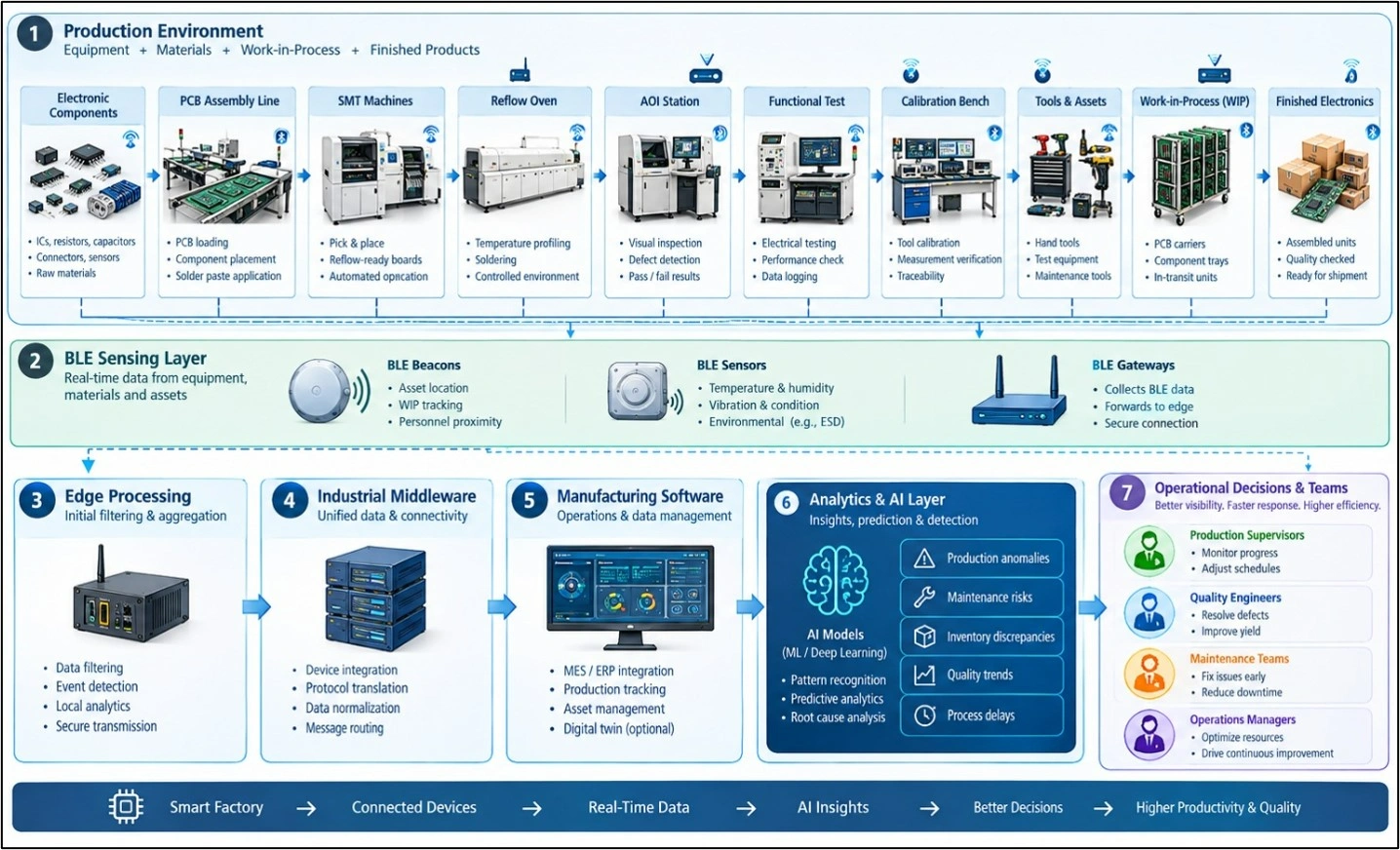
A technical workflow showing how industrial electronics production data flows from components, PCB assembly, SMT, testing, calibration, tools, WIP, and finished electronics through BLE sensing, edge processing, industrial middleware, manufacturing software, and AI analytics. The diagram highlights AI-driven anomaly detection, maintenance risk analysis, inventory monitoring, quality trends, and process-delay detection for production, quality, maintenance, and operations teams.
How AI Improves Industrial Electronics Production
Industrial electronics production generates data across component receiving, kitting, surface-mount technology (SMT), printed circuit board assembly (PCBA), inspection, programming, functional testing, environmental testing, calibration, rework, final assembly, packaging, and shipping. Much of this information already exists in manufacturing execution systems, quality databases, machine controllers, test systems, warehouse software, and enterprise resource planning systems. The challenge is connecting these records with physical conditions and movements on the production floor.
AIoT, or Artificial Intelligence of Things, combines artificial intelligence with IoT devices, sensors, connected equipment, and industrial systems. Industrial AI and Edge AI can process this information close to the production environment or within centralized computing infrastructure. Computer vision can analyze visual inspection data, machine learning can identify production patterns, and predictive models can estimate equipment or process risks.
BLE provides one practical method for obtaining additional physical-world information. A BLE beacon attached to a production carrier, test fixture, tool, or mobile asset can provide location or proximity information. BLE sensors can capture applicable environmental or equipment conditions, while BLE gateways collect wireless data and forward it to software for processing. The value does not come from wireless connectivity alone. The important engineering objective is to connect physical production events with useful manufacturing decisions.
For example, an electronics manufacturer may associate a work-in-process carrier with a particular production order. A BLE-enabled location record can indicate that the carrier has reached an assembly or testing area. AI software can compare that movement against the expected manufacturing sequence and identify unusual dwell times. If similar delays repeatedly occur before functional testing, production engineers can investigate test capacity, fixture availability, operator workload, programming failures, or upstream quality problems.
GAO supports organizations with BLE and RFID hardware products and systems that can be incorporated into these data-capture workflows. The appropriate technology depends on required read behavior, location accuracy, environmental conditions, asset characteristics, network availability, and integration requirements.
Industrial Electronics Production Applications for AI
AI-Based Work-in-Process Tracking
Work-in-process visibility is important when electronic assemblies move between SMT placement, soldering, inspection, programming, testing, rework, and final assembly. AI can correlate physical movement with production orders, routing information, station timestamps, and quality records.
BLE-enabled carriers or workstations can provide additional location context. AI software can then detect:
- Unexpected dwell time at PCB assembly or inspection stations
- Work-in-process accumulation between SMT and downstream testing
- Repeated routing deviations
- Missing or misplaced production carriers
- Bottlenecks caused by limited test fixtures or production equipment
- Abnormally long rework cycles
- Production orders that are approaching schedule risk
This approach is especially useful when production areas contain mobile work-in-process containers that are difficult to track using fixed identifiers alone.
AI for Electronics Quality and Process Analysis
Electronics manufacturing requires consistent control of soldering, component placement, programming, inspection, testing, and calibration. AI can analyze historical quality records to identify relationships between process conditions and defects.
Relevant data may include:
- SMT placement records
- Reflow temperature profiles
- Automated optical inspection results
- Automated X-ray inspection results
- In-circuit test measurements
- Functional test results
- Firmware programming records
- Calibration measurements
- Component lot information
- Rework records
- Operator and workstation information
AI models can detect statistical patterns that are difficult to identify through manual review. Anomaly detection can flag unusual test results, while classification models can help identify defect categories. Predictive analytics can also estimate which production conditions are associated with increased failure rates.
BLE sensors can complement this information where environmental or physical conditions affect the production process. For example, temperature or humidity data can provide contextual information for sensitive manufacturing areas, storage locations, calibration spaces, or electronics handling environments.
Predictive Maintenance for Electronics Manufacturing Equipment
Production equipment downtime can disrupt tightly scheduled electronics manufacturing operations. SMT placement machines, reflow systems, inspection equipment, test systems, compressors, environmental chambers, and other supporting equipment require planned maintenance and reliable operating conditions.
AI-based predictive maintenance can combine equipment telemetry, maintenance history, production schedules, alarms, utilization, and environmental measurements. Models can identify abnormal operating patterns before a failure becomes a major production interruption.
BLE sensors may contribute supplementary measurements for equipment or surrounding conditions when direct machine connectivity is unavailable or when additional sensing is required. BLE gateways can collect these measurements and forward them to the appropriate software system.
A practical maintenance workflow can therefore connect:
- Equipment operating conditions
- Historical maintenance events
- Machine utilization
- Production workload
- Environmental measurements
- Alarm and fault records
- Replacement-part history
- AI-generated maintenance risk indicators
The resulting analysis can help maintenance engineers prioritize inspections based on observed conditions rather than relying exclusively on fixed maintenance intervals.
Production Workflow from Data Capture to AI Decision-Making
AI-enabled industrial electronics production requires more than installing wireless devices. A reliable implementation begins by defining the production event or business decision that the system needs to support.
Data Acquisition on the Factory Floor
The first layer consists of physical data sources. Depending on the production process, these may include PCB assemblies, component containers, material carts, test fixtures, calibration equipment, production tools, machinery, environmental sensors, and operator workstations.
BLE beacons can identify or associate mobile assets with specific production objects. BLE sensors can provide selected physical measurements. BLE gateways collect wireless transmissions within defined coverage areas.
Device placement requires attention to production-line layout, metal obstructions, machinery, RF interference, gateway coverage, battery life, mounting methods, and maintenance accessibility. Electronics factories can contain significant amounts of metal equipment and enclosures, so wireless coverage should be validated through an actual site survey rather than assumed from theoretical range specifications.
Communication and Edge Processing
Gateway devices forward collected information through an available network to edge software, middleware, or centralized servers. Ethernet and Wi-Fi may be used for gateway backhaul depending on factory network policies.
Edge processing can filter duplicate observations, normalize device identifiers, validate timestamps, and reduce unnecessary data transmission. This is useful when production environments generate frequent location or sensor observations.
A well-designed data pipeline should preserve sufficient historical information for traceability while avoiding unnecessary storage of redundant events.
Middleware and Manufacturing Software Integration
Processed data can be connected with manufacturing execution systems (MES), enterprise resource planning (ERP) software, warehouse management systems (WMS), computerized maintenance management systems (CMMS), quality management systems (QMS), and production databases.
Integration methods may include REST APIs, MQTT, database interfaces, message brokers, webhooks, or industrial middleware, depending on the existing software environment.
The key requirement is maintaining consistent identifiers. A BLE device identifier should be associated with the correct production carrier, fixture, equipment item, work order, or sensor record. Poor identifier management can create inaccurate production histories even when wireless communication itself works correctly.
AI Analytics and Operational Decisions
Once production data is normalized, AI models can analyze it against historical and real-time information. Depending on the application, suitable methods may include anomaly detection, classification, regression, time-series forecasting, clustering, predictive maintenance models, and computer vision.
AI outputs should be translated into operationally meaningful actions. Examples include:
- Alerting maintenance personnel about abnormal equipment behavior
- Identifying production stations with increasing cycle times
- Flagging unusual work-in-process dwell times
- Prioritizing quality investigations
- Forecasting component or consumable requirements
- Detecting inventory-location discrepancies
- Supporting production scheduling decisions
Human review remains important for high-impact manufacturing decisions. AI-generated recommendations should be validated against production context, engineering rules, quality procedures, and applicable operating requirements.
AI and BLE System Components for Electronics Manufacturing
An AI-enabled industrial electronics production solution typically combines physical identification and sensing hardware, wireless gateways, networking, data-processing software, manufacturing applications, and AI analytics. Component selection should follow the production requirement rather than beginning with a particular wireless technology.
BLE Beacons, Sensors, and Gateways
BLE beacons can be attached to mobile production assets, work-in-process carriers, tools, test fixtures, or other identifiable objects. BLE sensors can provide measurements such as temperature or other supported physical parameters where those measurements are relevant to electronics production.
BLE gateways receive BLE transmissions and provide connectivity to upstream software. Gateway placement should account for line-of-sight conditions, machinery, metal structures, RF interference, required coverage, network connectivity, and service access.
GAO supplies BLE hardware products and systems that can be evaluated for applications such as asset identification, location monitoring, environmental sensing, and production-area data collection.
AI and Machine Learning Software
AI software provides the analytical layer. Industrial electronics manufacturers can use supervised learning where labeled production or quality data is available, anomaly detection where abnormal behavior must be identified, and time-series models for forecasting equipment conditions or production demand.
Computer vision can operate alongside sensor-based AI for applications such as PCB inspection, component verification, solder-joint analysis, and assembly verification. Combining visual inspection with production-history data can provide a broader view of quality than either data source alone.
Cloud Version and Server Version
A Cloud Version is appropriate when distributed production facilities need centralized software access, scalable storage, remote analytics, and integration across multiple locations. Cloud infrastructure can simplify centralized data management and support machine-learning workloads that require substantial computing resources.
A Server Version can be deployed on factory servers, customer-managed servers, private data centers, edge servers, or other privately hosted infrastructure. This model can be preferable where production data must remain within controlled infrastructure, where network connectivity is restricted, or where low-latency processing is important.
A hybrid arrangement can also be practical. Edge software can process time-sensitive production events locally, while selected historical data is transferred to centralized infrastructure for broader analytics and model development.
The appropriate deployment model depends on cybersecurity policies, latency requirements, data governance, network reliability, AI processing requirements, existing IT infrastructure, and the number of production locations.
Engineering Considerations for AI-Enabled Electronics Production
Successful deployment depends on how well the sensing, wireless communication, AI software, and manufacturing processes fit together. Industrial electronics facilities present several engineering conditions that can affect data quality and system reliability.
RF Coverage and Factory-Floor Conditions
Production machinery, metal cabinets, racks, conveyors, enclosures, and PCB manufacturing equipment can affect BLE signal propagation. Gateway placement should therefore be validated through a site survey that considers production-line geometry and expected asset movement.
Important deployment factors include:
- Gateway density and physical placement
- Metal structures and RF-obstructing equipment
- BLE advertising intervals and transmission power
- Expected asset movement patterns
- Battery life requirements
- Wireless interference from other equipment
- Network availability at gateway locations
- Maintenance access for batteries and devices
- Environmental conditions around production equipment
Location accuracy should also match the business requirement. A production workflow that only needs to determine whether a carrier is within a defined manufacturing area does not necessarily require the same infrastructure as a system requiring room-level or more precise positioning.
Data Quality and AI Model Reliability
AI recommendations are only as reliable as the production data supplied to the models. Missing gateway observations, incorrectly associated asset identifiers, inconsistent timestamps, duplicate records, and incomplete quality histories can produce misleading analytical results.
Industrial electronics manufacturers should establish data-quality controls for:
- Device identity and asset association
- Production-order identifiers
- Timestamp synchronization
- Gateway connectivity
- Sensor calibration
- Missing-event detection
- Duplicate-event filtering
- Historical data retention
- Model input validation
Production engineers should also distinguish between a genuine manufacturing anomaly and an anomaly caused by a disconnected gateway, depleted sensor battery, incorrectly configured device, or software integration failure.
Interoperability with Manufacturing Systems
AI and BLE solutions should complement existing manufacturing software rather than create an isolated data store. Integration with MES, ERP, WMS, QMS, CMMS, laboratory information systems, test databases, and equipment-control software can provide the context required for meaningful analytics.
For example, a BLE observation showing that a test fixture has entered a production area becomes more useful when software can associate that event with a specific production order, test station, fixture ID, and scheduled operation.
Standard APIs, message-based communication, database integration, and carefully controlled data mappings can help maintain interoperability. Where industrial equipment exposes standardized interfaces, those interfaces should generally be preferred over unnecessary parallel sensing.
AI Use Cases Across Industrial Electronics Production
AI can support multiple stages of electronics manufacturing when production data is sufficiently available and properly contextualized.
Intelligent Production Scheduling
AI can analyze historical cycle times, equipment availability, test capacity, work-in-process levels, rework rates, and production priorities to identify scheduling risks.
BLE-derived location information can provide additional evidence about where work-in-process carriers and mobile production assets are physically located. This can help distinguish between a scheduled operation that has not started and material that is physically waiting in another production area.
AI Inventory and Component Movement Analysis
Electronics manufacturing often involves large numbers of components with different package types, part numbers, lot identifiers, moisture sensitivity requirements, and storage conditions.
AI-based inventory analysis can identify unusual consumption patterns, potential shortages, slow-moving materials, and discrepancies between recorded and observed material movements.
BLE-enabled identification can supplement inventory records for mobile bins, carts, containers, and other reusable material-handling assets. RFID can also be considered where item-level or bulk identification requirements make it more appropriate.
GAO provides both BLE and RFID technologies, allowing the identification method to be selected according to the physical characteristics and operational requirements of the electronics manufacturing process.
Predictive Quality Analysis
Quality teams can use machine learning to examine relationships among component lots, production conditions, equipment settings, inspection results, test measurements, and rework events.
For example, an AI model could identify that a particular combination of equipment condition, component lot, process timing, and environmental measurements is associated with an elevated probability of test failure.
Such analysis does not replace engineering validation. Instead, it helps quality engineers prioritize investigations and identify patterns that deserve closer examination.
AI-Assisted Tool and Fixture Management
Test fixtures, programming adapters, calibration tools, torque tools, inspection equipment, and specialized production tooling can become bottlenecks when they are misplaced, unavailable, or overdue for maintenance.
BLE beacons can associate mobile tools or fixtures with locations, while software can combine this information with maintenance and production records.
AI can then analyze utilization and movement patterns to identify:
- Frequently requested fixtures
- Underutilized tooling
- Repeated fixture-search events
- Maintenance-related availability problems
- Production delays associated with missing tools
- Unusual movement patterns that require investigation
Environmental Monitoring for Sensitive Electronics Processes
Temperature and humidity can be relevant to component storage, electronics assembly, calibration areas, laboratories, and other controlled environments. AI can analyze environmental histories to detect trends and identify conditions associated with process or material risks.
BLE sensors can provide wireless environmental measurements where appropriate. Alerts can be generated when readings exceed configured thresholds, while machine learning can identify gradual changes that may not immediately cross an alarm threshold.
Security and Governance for Connected Electronics Manufacturing
Connecting production equipment, wireless devices, gateways, manufacturing software, and AI systems increases the importance of cybersecurity and data governance.
BLE devices should be managed as part of the organization’s broader connected-device security program. Appropriate controls can include device authentication, secure configuration, controlled gateway access, network segmentation, software updates, credential management, and monitoring for unusual communication behavior.
Production networks should also be separated appropriately from general corporate networks where required by the organization’s cybersecurity policies. Gateway connectivity should expose only the interfaces necessary for the intended data flow.
AI systems require additional controls. Manufacturing data may contain sensitive production information, proprietary process information, product test results, or customer-related information. Access to datasets and AI outputs should therefore follow established authorization policies.
Important controls can include:
- Role-based access control
- Encrypted communication
- Secure API authentication
- Network segmentation
- Device inventory management
- Gateway hardening
- Audit logging
- Backup and recovery procedures
- Model access controls
- Data-retention policies
- Software patch management
- Change control for production AI models
GAO’s hardware and system offerings can form part of a broader connected-device implementation, while the customer’s IT and cybersecurity teams should establish the policies governing network access, credentials, data retention, and software integration.
KPIs for Measuring AI-Enabled Electronics Production
AI projects should be evaluated against measurable manufacturing outcomes rather than the number of connected devices deployed. Relevant KPIs depend on the production process and the specific business problem.
Useful measurements may include:
KPI Manufacturing Relevance
First-pass yield Measures the percentage of units passing production without rework
Overall equipment effectiveness Evaluates availability, performance, and quality
Mean time between failures Indicates equipment reliability
Mean time to repair Measures maintenance response and restoration efficiency
Work-in-process dwell time Identifies delays between production operations
Production cycle time Measures elapsed manufacturing time
Rework rate Indicates process and quality performance
Test failure rate Tracks failures detected during electronics testing
Inventory accuracy Compares recorded inventory with verified physical status
Tool availability Measures accessibility of production tooling and fixtures
Schedule adherence Measures production completion against planned timing
Scrap rate Tracks material and product losses
Maintenance-related downtime Quantifies production loss associated with equipment maintenance
Environmental excursion rate Tracks temperature or humidity events where applicable
The most meaningful evaluation compares the KPI baseline before deployment with performance after commissioning. AI recommendations should also be evaluated for false positives, false negatives, alert response time, and practical usefulness to engineering teams.
Implementation Approach for Industrial Electronics Production
A practical implementation should begin with a clearly defined manufacturing problem. Deploying BLE devices without establishing the required operational decision can generate data without producing measurable value.
Define the Production Requirement
Start by identifying the process that requires better visibility or prediction. Examples include missing production carriers, excessive WIP dwell time, test-fixture availability, environmental monitoring, equipment maintenance, or quality investigation.
The requirement should define:
- What must be observed
- Which physical assets are involved
- What information already exists in manufacturing software
- What additional data is required
- Who will use the resulting information
- What operational action should follow an AI recommendation
- Which KPI will demonstrate improvement
Select Hardware and Data Sources
BLE beacons, sensors, and gateways should be selected according to the physical environment and required data. RFID may be more appropriate for certain component or material identification requirements, while direct machine interfaces may provide better equipment telemetry than adding independent sensors.
GAO can support this selection process with BLE, RFID, and IoT hardware products and systems for different industrial tracking and sensing requirements.
Conduct a Factory Pilot
A limited pilot should cover a representative production process rather than the entire factory. The pilot can validate wireless coverage, battery life, gateway placement, data accuracy, software integration, and user workflows.
Testing should include normal production conditions as well as expected exceptions such as gateway outages, device failures, asset movement outside designated areas, and temporary network interruptions.
Integrate with Existing Software
Once physical data capture has been validated, integration with MES, ERP, QMS, WMS, CMMS, or other relevant systems can be implemented.
Data mappings should be documented so that device identifiers, asset identifiers, work orders, production stations, and timestamps remain consistent across systems.
Validate AI Models
AI models should be tested using representative historical or live production data. Engineering teams should verify whether detected patterns correspond to real production conditions.
Model validation should consider:
- Accuracy
- False-positive rate
- False-negative rate
- Data completeness
- Model drift
- Explainability requirements
- Response time
- Human review requirements
Production AI should be monitored after deployment because changes in equipment, products, production volumes, software, or process parameters can change the data distribution on which a model depends.
Scaling AI and BLE Across Electronics Manufacturing Operations
After a successful pilot, organizations can expand the system to additional production lines, facilities, equipment groups, or asset categories.
Scaling should not simply mean installing more BLE devices. The underlying data model, device-management process, gateway configuration, software integration, cybersecurity controls, and AI monitoring should also scale.
Multi-site manufacturers may centralize selected analytics while retaining local processing for time-sensitive production functions. A standardized device and asset naming scheme can simplify cross-site analysis.
Production changes should also be incorporated into system governance. New product variants, revised PCB designs, additional test stations, production-line relocations, and new equipment can affect both physical tracking and AI models.
Practical Benefits of AI for Industrial Electronics Production
Combining AI with connected production data can improve manufacturing operations when the technology is matched to a specific process requirement.
Better Production Visibility
AI can correlate physical asset movement with production records, helping teams identify where work-in-process, tools, fixtures, and materials are located and how long they remain in particular areas.
Faster Identification of Production Problems
Anomaly detection can surface unusual cycle times, equipment behavior, test results, or environmental conditions earlier than manual analysis.
Improved Quality Investigation
Combining inspection, testing, process, material, and environmental records can give quality engineers a broader evidence base for root-cause analysis.
More Effective Maintenance Planning
Predictive models can help maintenance teams prioritize equipment based on observed risk and operational impact rather than relying solely on calendar-based maintenance.
Greater Operational Scalability
A standardized data and device-management approach can support additional production lines and facilities without requiring every process to be redesigned independently.
Stronger Traceability
Connecting production events with equipment, materials, fixtures, work orders, and locations can strengthen the historical record available for manufacturing and quality investigations.
AI-Enabled Electronics Factory Control Loop
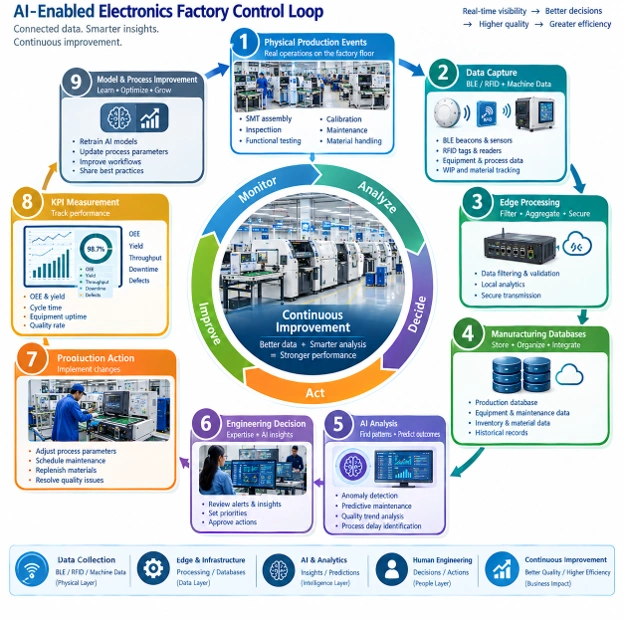
A circular control-loop diagram illustrating how electronics manufacturing data flows from production events and BLE/RFID capture through edge processing, databases, AI analysis, engineering decisions, and production actions. The loop emphasizes KPI measurement and continuous model and process improvement while keeping human engineering decisions central to operational changes.
GAO Experience Supporting Industrial IoT Deployments
GAO is headquartered in New York City and Toronto, Canada, and is recognized among the leading B2B and B2G BLE and RFID suppliers. GAO, GAO Research, and GAO Tek operate as sister companies serving customers across North America.
For three decades, GAO has supplied technology products and systems to organizations including Fortune 500 companies, R&D organizations, universities, and government agencies in the United States and Canada. Its work in BLE, RFID, and IoT has included hardware and system requirements where reliable data capture, wireless connectivity, asset visibility, and industrial integration are important.
GAO has invested substantially in product and system R&D and maintains quality-assurance processes for its technology offerings. Technical support can be provided remotely or onsite, depending on project requirements.
For industrial electronics manufacturers, this experience is relevant when evaluating BLE gateways, beacons, sensors, RFID technologies, and connected systems as components of broader AI-enabled manufacturing initiatives.
Key Takeaways for AI-Enabled Industrial Electronics Production
AI can provide substantial value in electronics manufacturing when it is connected to reliable production data and specific operational decisions. The strongest implementations combine manufacturing records with physical-world information from equipment, materials, work-in-process, tools, fixtures, and production environments.
BLE can serve as an enabling data-capture technology for location, proximity, identification, and selected sensing requirements. It should be selected according to the production problem, RF environment, required accuracy, battery constraints, integration requirements, and cybersecurity policies.
Successful implementation should prioritize:
- A clearly defined manufacturing problem and measurable KPI
- Accurate asset, production, and equipment identifiers
- Validated BLE gateway coverage
- Reliable data ingestion and timestamp management
- Integration with MES, ERP, QMS, WMS, CMMS, and relevant databases
- Appropriate AI model selection and validation
- Human engineering review of important AI recommendations
- Cybersecurity and data-governance controls
- Pilot testing before large-scale deployment
- Continuous monitoring of system and model performance
Organizations evaluating AI-enabled industrial electronics production can explore GAO’s BLE, RFID, IoT, and related technical solutions to determine which hardware and system configurations align with their production environment, data requirements, and integration objectives.
Building the Future of Industrial AI and IoT with Aperture Venture Studio and GAO RFID Inc.
For more than three decades, GAO Group of Companies has invested heavily in R&D for industrial BLE, RFID, and IoT. As generative AI has become increasingly useful for industrial applications, we have expanded our work across AIoT, Industrial AI, BLE, and RFID technologies. We have also established Aperture Venture Studio to support the development and scaling of AI and IoT solutions relevant to areas such as industrial electronics production, connected manufacturing, and intelligent asset and process management.
Aperture brings together AI and IoT technical specialists, experienced operational professionals, investors, and technology organizations. We have also developed Aperture Ventures Summit and TekSummit to facilitate discussion of advanced AI and IoT technologies.
These activities contribute to broader technical communities focused on practical applications of AI and IoT.
We welcome you to engage with us as:
- Advisors, co-founders, or employees
- Investors
- Customers