
AI and RFID for Public Libraries
AI-Enabled Public Library RFID Operations and Analytics
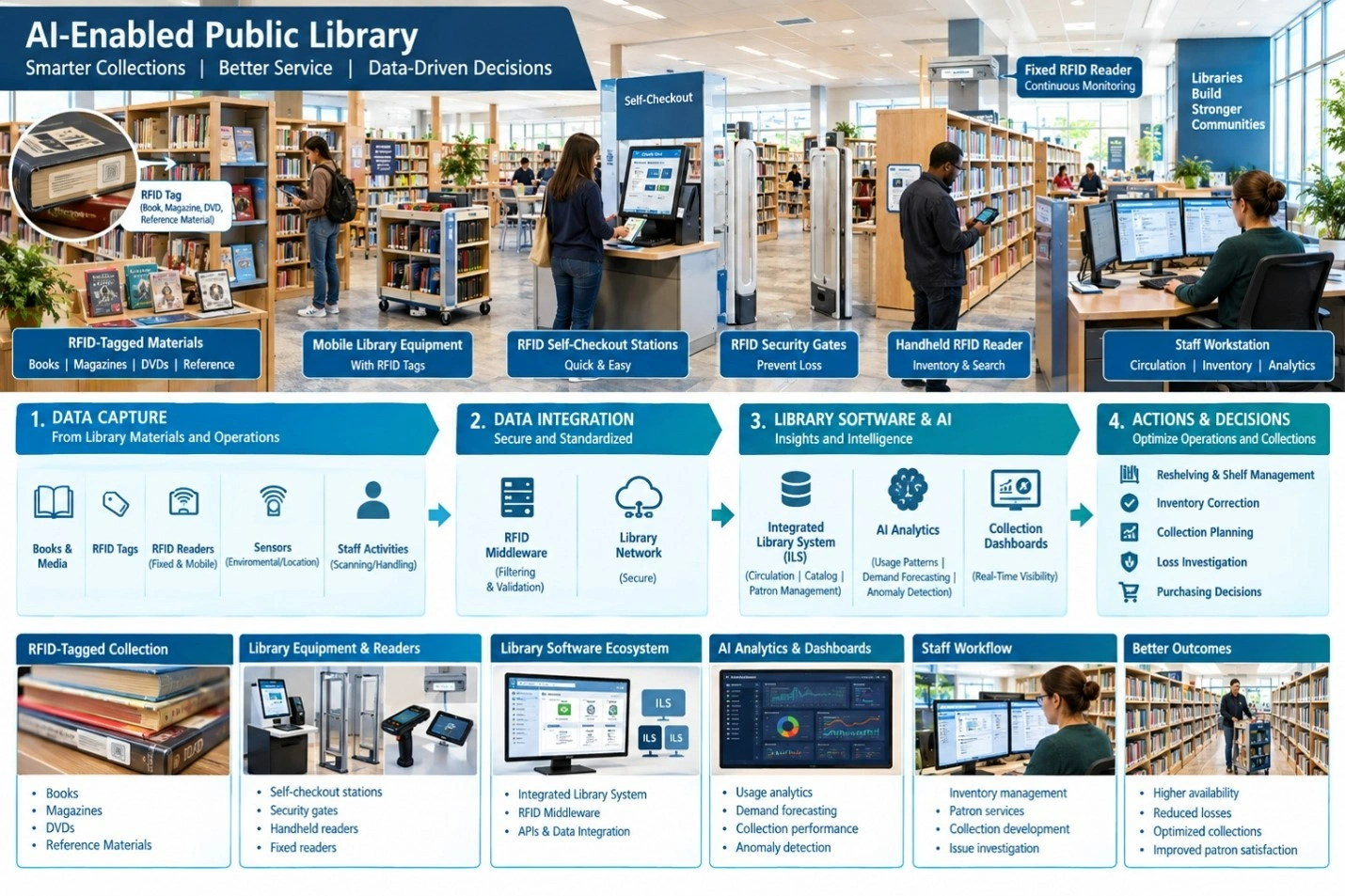
This enterprise illustration shows how RFID-tagged library materials move through readers, RFID middleware, the integrated library system, and AI analytics. It connects physical library operations with dashboards and staff decisions for inventory correction, reshelving, collection planning, loss investigation, and purchasing.
How AI and RFID Improve Public Library Operations
AIoT in public libraries combines artificial intelligence with connected identification devices, sensors, readers, and software systems. For libraries, the objective is not simply to automate RFID scanning. The greater value comes from converting item-level collection events into operational intelligence.
RFID tags provide an electronic identity for individual library items. A circulation transaction, inventory scan, reshelving activity, security event, or collection transfer can therefore become a structured data event. AI can then compare these events with circulation records, acquisition information, due dates, branch-level demand, collection categories, seasonal patterns, and historical inventory results.
Public libraries can apply this capability to several operational problems:
- Collection inventory: AI can identify unusual gaps between expected and observed item locations and prioritize shelves or collection areas for staff verification.
- Circulation management: Machine-learning models can analyze borrowing patterns to identify demand changes by title category, branch, age group, season, or collection type.
- Shelf management: RFID inventory data can support identification of misplaced, misshelved, recently returned, or incorrectly recorded materials.
- Loss prevention: RFID security events can be correlated with circulation status and collection records to help staff investigate potentially abnormal movement.
- Collection development: Demand forecasting can help collection managers evaluate purchasing, replacement, relocation, and weeding requirements.
- Inter-branch transfers: RFID identification can improve visibility when materials move between branches, sorting areas, bookmobiles, processing rooms, and circulation desks.
- Staff workload management: AI can prioritize inventory activities, exception handling, and collection checks according to operational urgency rather than relying entirely on fixed schedules.
The distinction between RFID data capture and AI decision support is important. RFID determines which physical item was detected. AI determines what the resulting data may mean operationally and which action deserves attention.
Public Library Collection Intelligence
Public libraries maintain collections with very different circulation characteristics. A children’s picture book, popular fiction title, local-history publication, DVD, large-print book, and reference item may require different inventory and demand-management policies.
AI models can use RFID-derived movement history together with the integrated library system to calculate patterns such as circulation frequency, average time between transactions, branch demand, overdue behavior, and repeated shelf-search events. These insights can help library managers distinguish between genuinely low-use materials and items that are unavailable because of inaccurate location records.
GAO RFID hardware can serve as the physical data-capture layer for these workflows, while the library’s existing software remains responsible for catalog records, patron transactions, and collection-management processes.
AI-Assisted Public Library RFID Collection Decision Tree
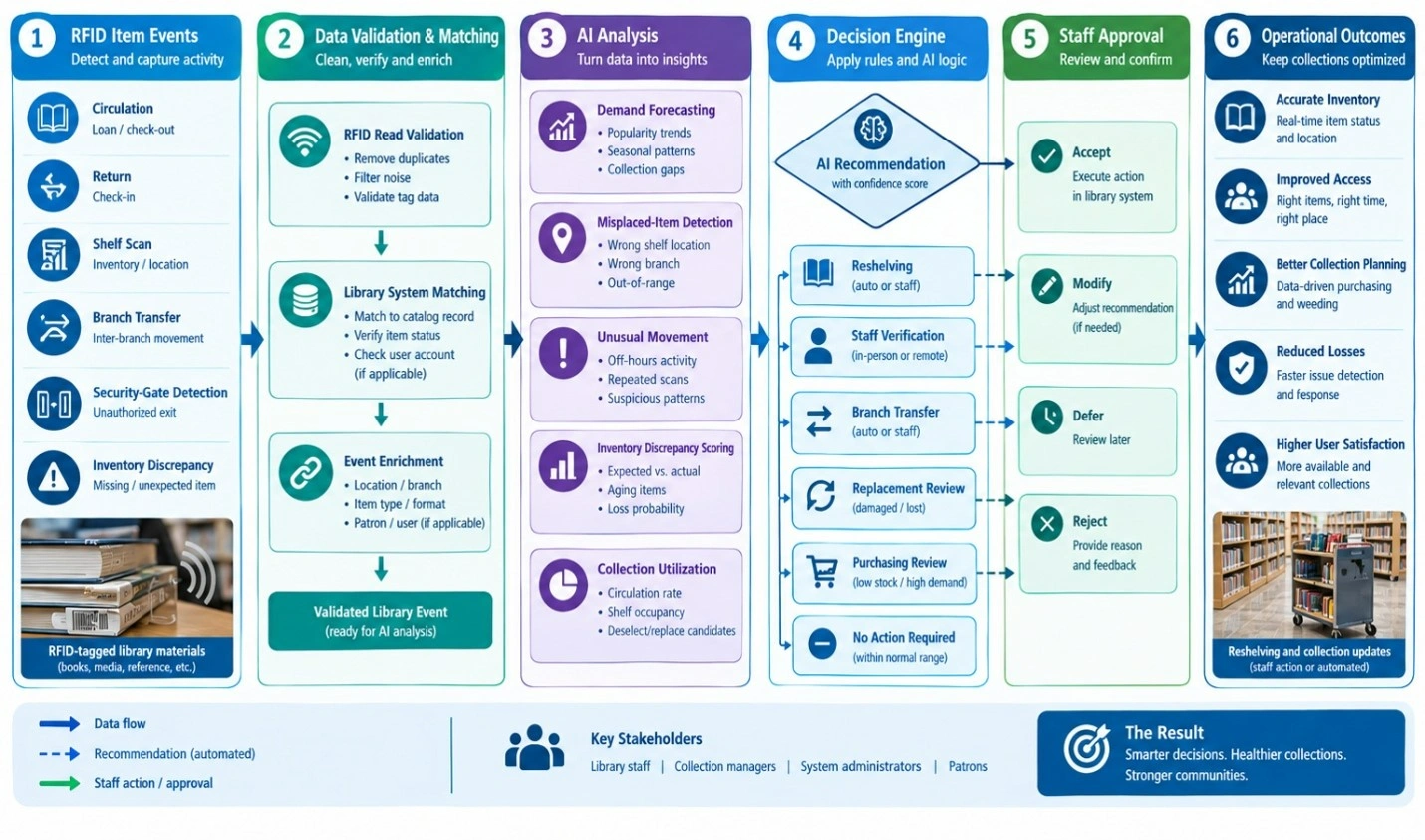
This decision tree illustrates how RFID events are validated, matched with library-system records, analyzed by AI, and converted into prioritized collection-management recommendations. It clearly separates automated recommendations from staff approval and shows outcomes including reshelving, branch transfers, replacement review, purchasing review, and inventory correction.
Public Library RFID Applications Supported by AI
Public library RFID programs typically cover more than self-checkout. AI can make the resulting item-level information useful across collection management, circulation, security, and planning.
AI-Assisted Inventory and Shelf Verification
Traditional library inventory requires staff to locate materials, compare physical collections with catalog records, and investigate discrepancies. RFID handheld readers can capture multiple tagged items without requiring staff to individually scan every barcode.
AI adds a prioritization layer. Instead of presenting thousands of raw RFID observations, software can identify records requiring attention. A model could flag a title that repeatedly appears in an unexpected collection area, a material that has not been detected despite being recorded as available, or a cluster of discrepancies associated with a particular shelf section.
Such recommendations should remain explainable. Library staff should be able to see the RFID observation, catalog record, last circulation event, expected location, and reason the system assigned a high discrepancy score.
AI-Enabled Circulation and Self-Service
RFID-enabled self-checkout can identify multiple materials during a transaction, reducing manual item-by-item barcode scanning. The integrated library system can then update circulation records according to established library policies.
AI can analyze transaction volumes and queue patterns to help library managers determine when additional self-service capacity or staff support may be needed. It can also identify unusual transaction patterns for investigation without automatically making punitive decisions about patrons.
Privacy is especially important. Public libraries routinely operate under strong expectations concerning patron confidentiality. AI analytics should therefore favor aggregated, minimized, or appropriately anonymized data wherever individual-level information is not required for the operational purpose.
RFID Security and Unusual Movement Detection
RFID-enabled security gates can detect tagged materials moving through designated exit points. A library system can compare an observed item identifier against its circulation status and other transaction records.
AI can assist with exception analysis by identifying recurring patterns rather than treating every security event as a confirmed loss. For example, repeated detection of items whose circulation records were not synchronized correctly may indicate a process or integration problem rather than intentional removal.
This distinction reduces false positives and helps library personnel focus on events that warrant investigation.
Branch Transfers and Mobile Library Operations
Public library systems frequently move collections among branches, processing areas, outreach locations, and mobile library services. RFID identification can establish item-level movement records at transfer points.
AI can analyze transfer history and circulation demand to recommend where selected materials should be positioned. A high-demand title may be more useful at a branch with sustained demand than at a location where the same item has remained unused.
For mobile libraries and outreach programs, RFID can also help reconcile materials before departure and after return, reducing manual collection checks.
Real-World Public Library RFID Deployment and AI Analytics
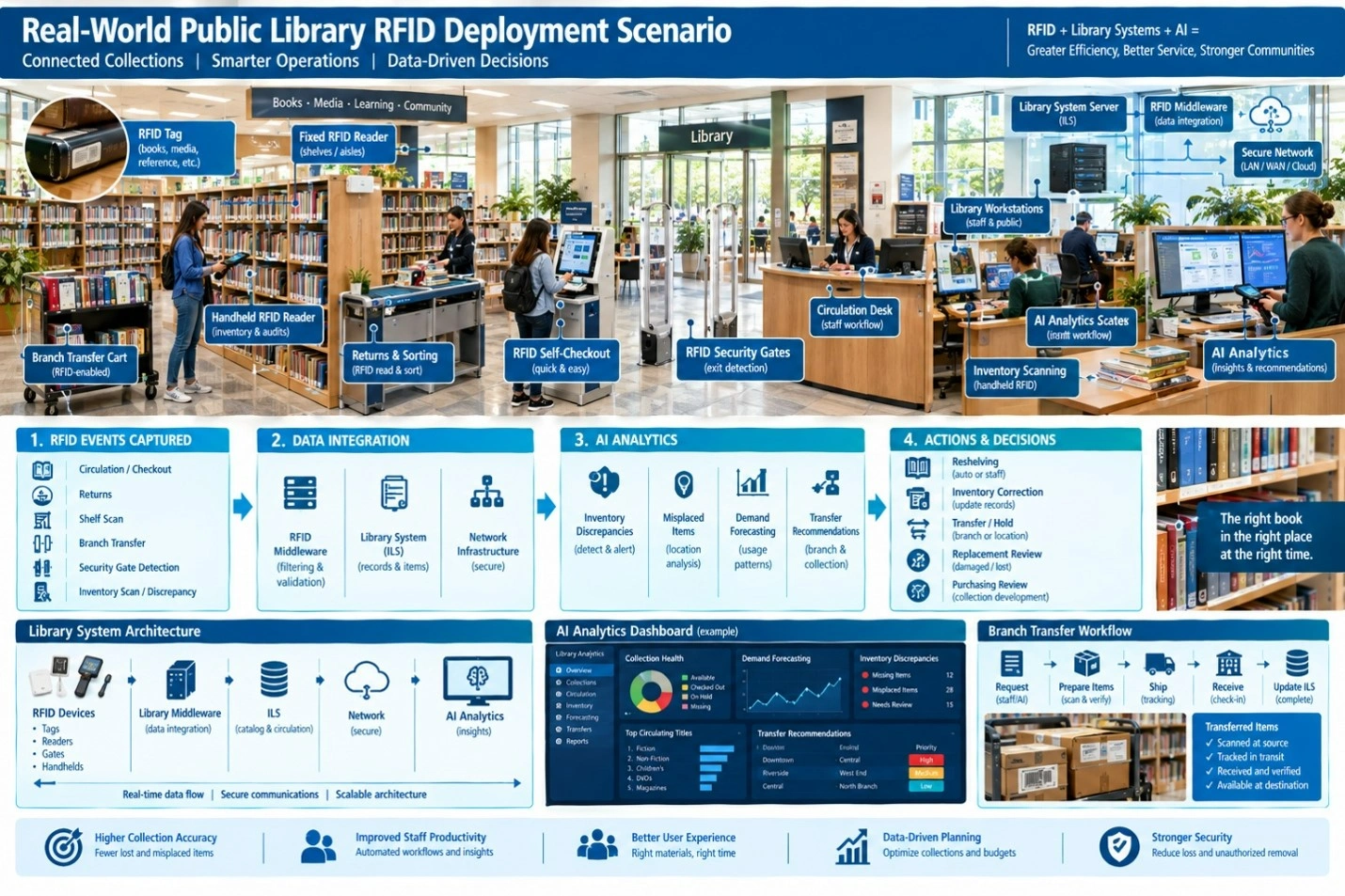
This deployment illustration shows RFID integrated across a public library, from tagged books and fixed and handheld readers to self-checkout, returns, security gates, circulation, and branch transfers. It maps RFID events through middleware, the integrated library system, secure networking, and AI analytics to support inventory correction, misplaced-item detection, demand forecasting, transfer recommendations, and collection decisions.
Public Library AI-RFID Operational Workflow
A reliable implementation begins with physical collection events and ends with a controlled library-management action. The workflow can be divided into connected technical stages.
RFID Data Acquisition
RFID tags are attached to books, media cases, equipment, or other suitable library assets. Reader selection depends on the required reading distance, item construction, tag placement, interference conditions, and whether the application requires individual item interrogation or near-field interaction.
HF RFID is commonly suitable for shorter-range item interactions such as controlled checkout or identification environments where close coupling is acceptable. UHF RFID can provide longer read ranges and is useful where libraries need rapid detection of multiple items during inventory activities. LF RFID has a more limited role in modern library collection workflows because of its shorter read range and lower suitability for high-density item identification.
The selected RFID technology should therefore follow the workflow rather than being chosen solely on nominal read distance.
Reader, Gateway, and Network Layer
RFID readers capture tag identifiers and may also provide information about reader location, antenna, timestamp, and transaction context. Fixed readers can support checkout stations, security points, or controlled collection areas, while handheld readers are valuable for shelf inventory and exception investigation.
Reader data can move through Ethernet, Wi-Fi, USB, serial interfaces, or other appropriate communication methods depending on the device and deployment. Network segmentation should be considered where RFID equipment communicates with library servers or cloud-hosted services.
Middleware and Data Validation
RFID middleware performs important processing before information reaches AI analytics or library software. It can filter duplicate reads, normalize identifiers, associate events with reader locations, and apply business rules.
This stage is particularly important in libraries because a single book can be detected repeatedly while a staff member walks along a shelf. Sending every raw read directly to downstream analytics can create unnecessary data volume and misleading event counts.
A properly configured middleware layer converts repeated observations into meaningful events such as “item detected during shelf inventory” or “item passed through security gate.”
AI Analysis and Library-System Integration
Validated RFID events can be matched against the integrated library system, catalog records, circulation database, acquisition records, and branch-location information.
Machine-learning models can then evaluate historical and current data for tasks such as:
- Inventory discrepancy detection
- Demand forecasting
- Misshelved-item identification
- Collection utilization analysis
- Transfer recommendations
- Exception prioritization
- Maintenance and equipment monitoring
- Abnormal movement analysis
AI recommendations should flow back into established staff processes. A library employee can verify a suggested discrepancy, correct a location record, reshelve a material, initiate a transfer, or request further investigation.
End-to-End AI-RFID Workflow for Public Library Management
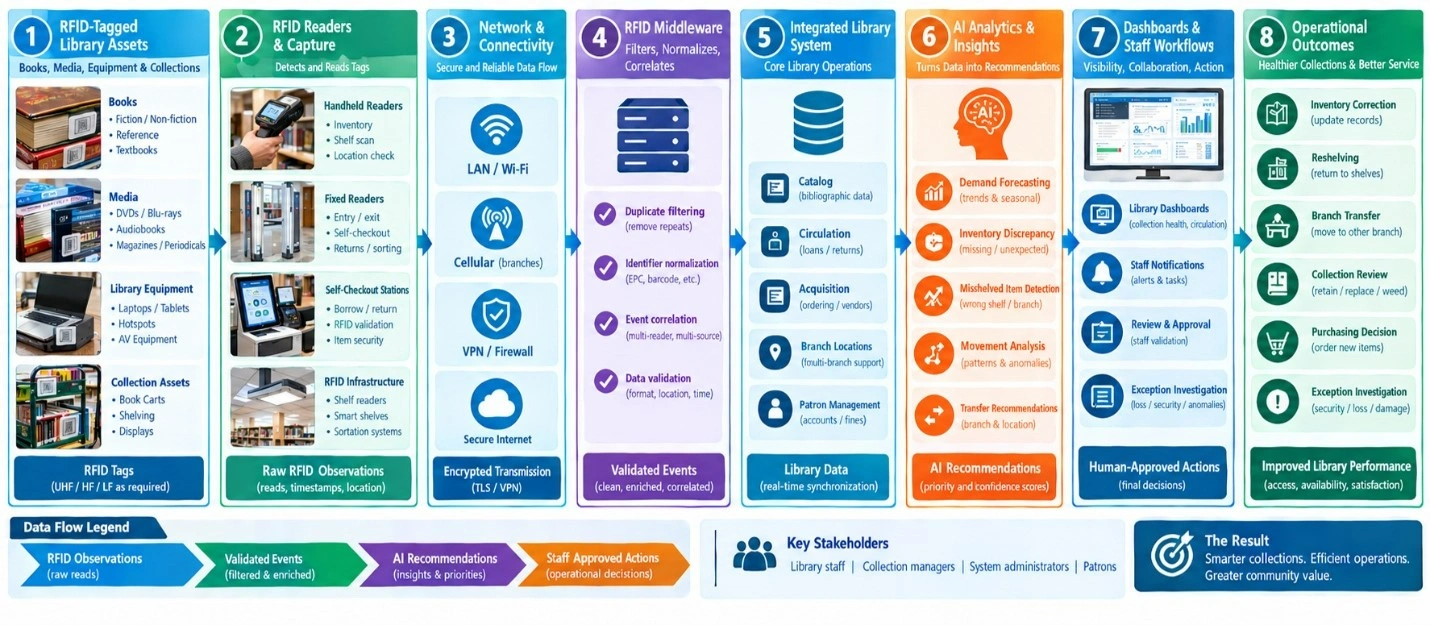
This workflow diagram traces library assets from RFID tagging and reader capture through secure connectivity, middleware validation, the integrated library system, and AI analytics. It distinguishes raw observations, validated events, AI recommendations, and human-approved actions such as inventory correction, reshelving, branch transfer, collection review, and exception investigation.
Technical Components for Public Library AI-RFID Systems
A public library deployment normally combines item-level RFID identification with existing library software rather than replacing the library’s core management system.
RFID Tags and Readers
RFID tags provide unique identifiers for physical materials. Tag selection should consider adhesive performance, book-cover materials, media cases, expected service life, and compatibility with the selected reader frequency.
Handheld readers are particularly valuable for shelf inventories because librarians can move through collection aisles and capture multiple item identifiers efficiently. Fixed readers support repeatable transactions at locations such as self-service stations and security points.
AI and Analytics Software
AI software may use supervised learning, anomaly detection, forecasting models, clustering, or rules combined with machine learning. The appropriate method depends on the library use case and available historical data.
Demand forecasting can use time-series techniques, while anomaly detection may identify unusual movement or inventory patterns. Computer vision can also complement RFID where visual confirmation of shelf conditions or signage is useful, although RFID remains the primary item-identification mechanism in an RFID-focused deployment.
Cloud Version and Server Version
A Cloud Version can host RFID middleware, analytics, dashboards, and selected AI services within managed cloud infrastructure. This model can be appropriate for multi-branch library systems that need centralized monitoring, remote software administration, and shared analytics across locations.
A Server Version can run on customer-managed servers, private data centers, branch infrastructure, or other privately hosted enterprise computing environments. This approach may be preferred where a library system requires greater control over data location, network boundaries, integration interfaces, or operational dependencies.
Both models require careful identity management, encryption, access control, backup procedures, monitoring, and integration testing. Public libraries should determine the appropriate deployment model according to privacy requirements, IT capabilities, network reliability, integration constraints, and the sensitivity of the data being processed.
GAO can support organizations evaluating RFID hardware and systems according to the required reading environment, deployment model, and operational workflow.
Engineering Design Considerations for Public Library RFID
A successful public library RFID deployment depends on more than selecting readers and tags. Collection density, shelving materials, electromagnetic conditions, reader placement, network connectivity, software interfaces, privacy requirements, and staff procedures all affect system performance.
RFID Read Accuracy and Tag Placement
Books and media items differ in size, material composition, cover construction, and tag placement. A tag that performs well on a standard paperback may behave differently when attached to a DVD case, laminated publication, metal-containing equipment case, or other library asset.
Commissioning should therefore include representative materials from the actual collection. Testing should measure missed reads, unintended reads from adjacent shelves, duplicate observations, and read performance at circulation stations.
Reader power and antenna configuration should be adjusted according to the physical environment rather than simply maximizing transmission power. Excessive read range can create unwanted detections across neighboring shelves or work areas.
Integrated Library System Interoperability
The RFID solution should exchange information with the integrated library system through documented interfaces and established library data workflows.
Important integration points may include:
- Bibliographic and item identifiers
- Item status
- Patron circulation transactions
- Due dates and returns
- Branch and shelving locations
- Acquisition and receiving records
- Inter-branch transfer records
- Inventory status
- Security events
- Staff exception workflows
The integration layer should also handle temporary network interruptions. A circulation station or handheld inventory device may need controlled local buffering so that a short connectivity failure does not result in duplicate transactions or lost inventory observations.
Cybersecurity and Privacy
Public library technology systems require security controls appropriate to the information being processed. RFID identifiers by themselves generally do not provide a complete picture of patron activity, but linking RFID events with circulation or patron records can create sensitive information.
Recommended controls include:
- Encryption for data in transit and, where appropriate, at rest
- Role-based access control
- Strong administrator authentication
- Network segmentation for RFID and library equipment
- Secure API authentication
- Audit logging
- Regular software and firmware updates
- Backup and recovery procedures
- Vulnerability management
- Data minimization
- Defined retention periods
- Separation of patron identity from analytics datasets where operationally feasible
AI models should also be governed carefully. A recommendation engine should not become an uncontrolled mechanism for making decisions about patrons. Human review, documented business rules, model monitoring, and explainable outputs are especially important where analytics could affect access, security investigations, or service decisions.
AI-RFID Performance Metrics for Public Libraries
Public libraries should measure the operational result of an RFID and AI deployment rather than evaluating the technology only by reader specifications.
Useful KPIs include:
| KPI | Library Application | Why It Matters |
|---|---|---|
| Inventory accuracy | Collection verification | Measures agreement between physical and catalog records |
| Inventory cycle time | Shelf inventory | Shows staff time required to verify collections |
| Misshelved-item detection rate | Shelf management | Measures identification of items in incorrect locations |
| Self-checkout utilization | Circulation | Indicates adoption of automated borrowing |
| Average checkout transaction time | Circulation | Measures transaction efficiency |
| Return processing time | Returns | Shows how quickly materials become available again |
| RFID read success rate | RFID operations | Measures identification reliability |
| False-read rate | Reader deployment | Identifies unintended tag detections |
| Item reconciliation rate | Transfers | Measures successful branch-to-branch tracking |
| Collection availability | Collection management | Indicates whether catalog-available items are physically locatable |
| Transfer turnaround time | Inter-branch logistics | Measures movement efficiency |
| Exception resolution time | Staff operations | Measures how quickly discrepancies are investigated |
| Collection utilization | Collection planning | Supports purchasing, relocation, and weeding decisions |
| AI recommendation precision | Analytics | Measures usefulness of automated recommendations |
| Forecast accuracy | Demand planning | Evaluates AI predictions against actual circulation |
These KPIs should be evaluated against a baseline established before deployment. A faster inventory process is valuable only if the resulting records remain accurate and staff can resolve exceptions efficiently.
Implementation and Commissioning for Public Libraries
A phased implementation reduces operational risk and provides measurable evidence before the technology is expanded across branches.
Planning and Site Assessment
The first stage should document the library’s existing workflows and physical environment. Assessment should cover circulation desks, self-checkout areas, security gates, shelving layouts, processing rooms, staff work areas, returns points, branch-transfer routes, network infrastructure, and collection characteristics.
The library should also identify which operational problems are most important. A system designed primarily for rapid inventory requires different reader placement and handheld workflows from one designed around self-service circulation.
GAO can help organizations evaluate RFID hardware and system configurations according to the physical deployment environment and intended library workflow.
Pilot Deployment
A pilot should represent real operating conditions rather than an isolated laboratory test. Suitable pilot collections can include different book formats, media types, shelving configurations, and transaction volumes.
Testing should measure:
- RFID read accuracy
- Reader coverage
- Tag durability
- Unintended reads
- Transaction reliability
- Network behavior
- Library-system integration
- Inventory processing time
- Staff usability
- Exception handling
- AI recommendation quality
Staff feedback is particularly important because library personnel understand collection behavior and exceptions that may not be visible in system logs.
Integration and Acceptance Testing
Integration testing should verify the complete transaction path from physical RFID detection to the final library-system record.
For example, a returned book should be recognized at the appropriate station, matched with the correct item record, assigned the correct status, and become available to the next operational workflow according to library policy.
Acceptance testing should include failure scenarios such as:
- Duplicate RFID reads
- Missing tags
- Damaged tags
- Network interruption
- Reader failure
- Incorrect item location
- Unsynchronized circulation records
- Duplicate transaction messages
- Unauthorized software access
- Incorrect AI recommendations
Testing failure conditions is essential because library staff must know how to recover when automated workflows do not behave as expected.
Scaling AI-RFID Across Public Library Branches
Multi-branch library systems introduce additional engineering requirements. Different buildings may have different shelving layouts, network conditions, reader placements, collection sizes, and operating procedures.
A scalable deployment should standardize what can be standardized while allowing site-specific configuration.
Common elements suitable for standardization include:
- RFID identifier formats
- Middleware event structures
- Security policies
- Integration interfaces
- Device-management procedures
- User roles
- Logging standards
- KPI definitions
- AI model governance
- Backup and recovery procedures
Site-specific configuration may still be required for reader placement, antenna orientation, network connectivity, physical security, shelving construction, and collection workflows.
AI models should also be monitored after expansion. A model trained using one branch’s circulation patterns may perform differently at another branch serving a different population or collection profile. Continuous validation can identify model drift and changes in demand patterns.
Practical Benefits of AI-Enabled RFID for Public Libraries
The combination of RFID identification and AI analysis can improve public library operations because each technology addresses a different part of the problem.
Faster Collection Inventory
RFID enables staff to identify multiple items while moving along shelves. AI can reduce the subsequent workload by prioritizing discrepancies and identifying records that deserve manual investigation.
The result is not simply faster scanning. It is a more targeted inventory process in which staff spend less time reviewing routine matches and more time resolving meaningful exceptions.
Better Collection Availability
A catalog can show an item as available even when the physical item is difficult to locate. RFID observations provide additional evidence about where the material was last detected.
AI can combine this information with circulation and inventory history to distinguish between likely misshelving, delayed processing, transfer activity, and potential collection loss.
More Responsive Collection Development
Circulation history can reveal changes in demand across branches and collection categories. AI forecasting can help collection managers estimate future demand and evaluate whether materials should be purchased, replaced, relocated, retained, or reviewed for weeding.
These recommendations should support professional judgment rather than automatically determining collection policy.
Improved Staff Productivity
Automation can reduce repetitive identification and reconciliation tasks. Library personnel can then devote more time to patron assistance, programming, reference services, collection development, community engagement, and exception handling.
Stronger Operational Visibility
A combination of RFID event data and library-system records creates a more detailed view of physical collection movement. Management can identify bottlenecks in returns processing, transfer workflows, inventory activities, and collection maintenance.
AI and RFID Technology Selection for Public Libraries
Technology selection should begin with operational requirements rather than a particular RFID frequency or AI model.
Libraries should evaluate:
- Collection composition
- Required reading distance
- Number of items processed simultaneously
- Shelf density
- Circulation volume
- Branch count
- Self-service requirements
- Inventory frequency
- Security-gate requirements
- Existing integrated library system
- API and middleware capabilities
- Network availability
- Cloud and server preferences
- Data-protection requirements
- Staff technical capabilities
- Maintenance requirements
- Total cost of ownership
UHF RFID can be attractive for rapid shelf inventory because of its longer potential read range and suitability for bulk item detection. HF RFID can be appropriate for shorter-range controlled interactions and established library transaction environments. LF RFID generally has less applicability to high-throughput library collection inventory because of its shorter operating range.
The correct choice depends on the complete workflow, tag construction, reader environment, interference conditions, and integration requirements.
Operational Governance and Long-Term Maintenance
RFID and AI systems require continuing operational governance after installation. Tags can become damaged, readers may require maintenance, software integrations can change, and library collections continually evolve.
A maintenance program should include:
- Periodic reader performance checks
- RFID tag replacement procedures
- Firmware and software updates
- Integration monitoring
- Network health monitoring
- Security patch management
- AI model performance reviews
- Backup verification
- Access-control reviews
- KPI trend analysis
- Staff retraining
- Configuration documentation
AI models should be reviewed when collection policies, circulation behavior, branch structures, or data sources change. A model that performed well during initial commissioning may require recalibration after significant operational changes.
Public libraries should also document which actions are automated and which require staff approval. This improves accountability and prevents automation from obscuring the operational responsibility of library personnel.
Public Library Use Cases for AI-RFID Integration
Several practical use cases demonstrate how the technologies can work together across a public library system.
| Use Case | RFID Contribution | AI Contribution | Operational Result |
|---|---|---|---|
| Shelf inventory | Captures nearby item identifiers | Prioritizes discrepancies | Faster inventory resolution |
| Misshelved materials | Records physical detections | Detects location anomalies | More accurate shelving |
| Self-checkout | Identifies multiple items | Analyzes transaction patterns | Faster service and capacity planning |
| Returns processing | Identifies returned materials | Prioritizes exceptions | Faster collection availability |
| Branch transfers | Records item movement | Forecasts branch demand | Better collection allocation |
| Collection development | Provides movement history | Forecasts demand | Better purchasing decisions |
| Loss investigation | Records security events | Correlates unusual patterns | More focused investigation |
| Equipment tracking | Identifies tagged devices | Detects unusual movement | Better asset visibility |
| Inventory reconciliation | Captures physical observations | Compares expected and observed status | Fewer unresolved records |
These applications can be introduced independently. A library does not necessarily need to deploy every capability at the same time. A focused inventory or circulation project can establish reliable RFID data and integration practices before more advanced AI functions are introduced.
Key Recommendations for Public Library AI-RFID Projects
Successful deployment depends on aligning technology with library operations.
- Begin with measurable collection-management or circulation problems rather than starting with an RFID specification.
- Establish baseline KPIs before deployment.
- Test RFID tags using actual books, media, equipment, shelving, and environmental conditions.
- Validate reader placement and power levels to prevent unintended detections.
- Treat middleware as an important data-quality layer rather than a simple connection between devices and software.
- Integrate RFID events with the existing integrated library system and established staff workflows.
- Separate patron identity from analytics wherever individual-level information is not operationally necessary.
- Use explainable AI recommendations for collection and inventory decisions.
- Keep human approval in workflows that affect collection policy, patron services, or security investigations.
- Pilot the system at a representative branch before expanding across a multi-branch public library network.
- Monitor AI model performance after deployment and investigate changes in data quality or circulation behavior.
- Standardize interfaces, security policies, KPIs, and device-management practices across branches.
- Select Cloud Version or Server Version according to privacy, IT capabilities, integration requirements, network conditions, and operational governance.
- Establish a lifecycle plan for RFID tags, readers, middleware, software, security updates, and AI models.
GAO Experience Supporting RFID and AI-Enabled Library Systems
GAO’s experience with RFID and connected identification technologies can support public libraries evaluating hardware, data-capture systems, and integrated deployment approaches. GAO has supplied technology products and systems to organizations across the United States and Canada, including Fortune 500 companies, research organizations, universities, and government agencies.
Headquartered in New York City and Toronto, Canada, GAO is recognized among leading B2B and B2G suppliers of RFID and BLE technologies. Its engineering focus includes RFID readers, tags, sensors, gateways, software, and related systems that can be adapted to different operational requirements.
GAO Group includes GAO, GAO Research Inc., and GAO Tek Inc. The companies have invested substantially in research and development and maintain quality-assurance processes intended to support reliable technology deployment. Technical assistance can be provided remotely or onsite according to project requirements.
For public libraries, the practical value of this experience is the ability to evaluate RFID hardware and system requirements in relation to actual collection workflows, physical environments, software integration, and long-term operational needs.
Building More Intelligent Public Library Operations
AI-enabled RFID gives public libraries a way to connect physical collection activity with actionable operational intelligence. RFID identifies books, media, equipment, and other tagged assets, while AI can analyze movement, circulation, inventory, and demand information to identify exceptions and support planning.
The strongest implementations focus on measurable library problems such as inventory accuracy, collection availability, self-service efficiency, branch transfers, and demand forecasting. They also protect patron privacy, maintain human oversight, and integrate with existing library software.
Libraries planning an RFID modernization project can evaluate the required readers, tags, middleware, software, AI capabilities, network design, cybersecurity controls, and deployment model as one coordinated system. GAO can provide further information on RFID hardware products, connected systems, engineering considerations, and technical support for organizations developing these capabilities.
AI-Enhanced RFID Future State for Public Libraries
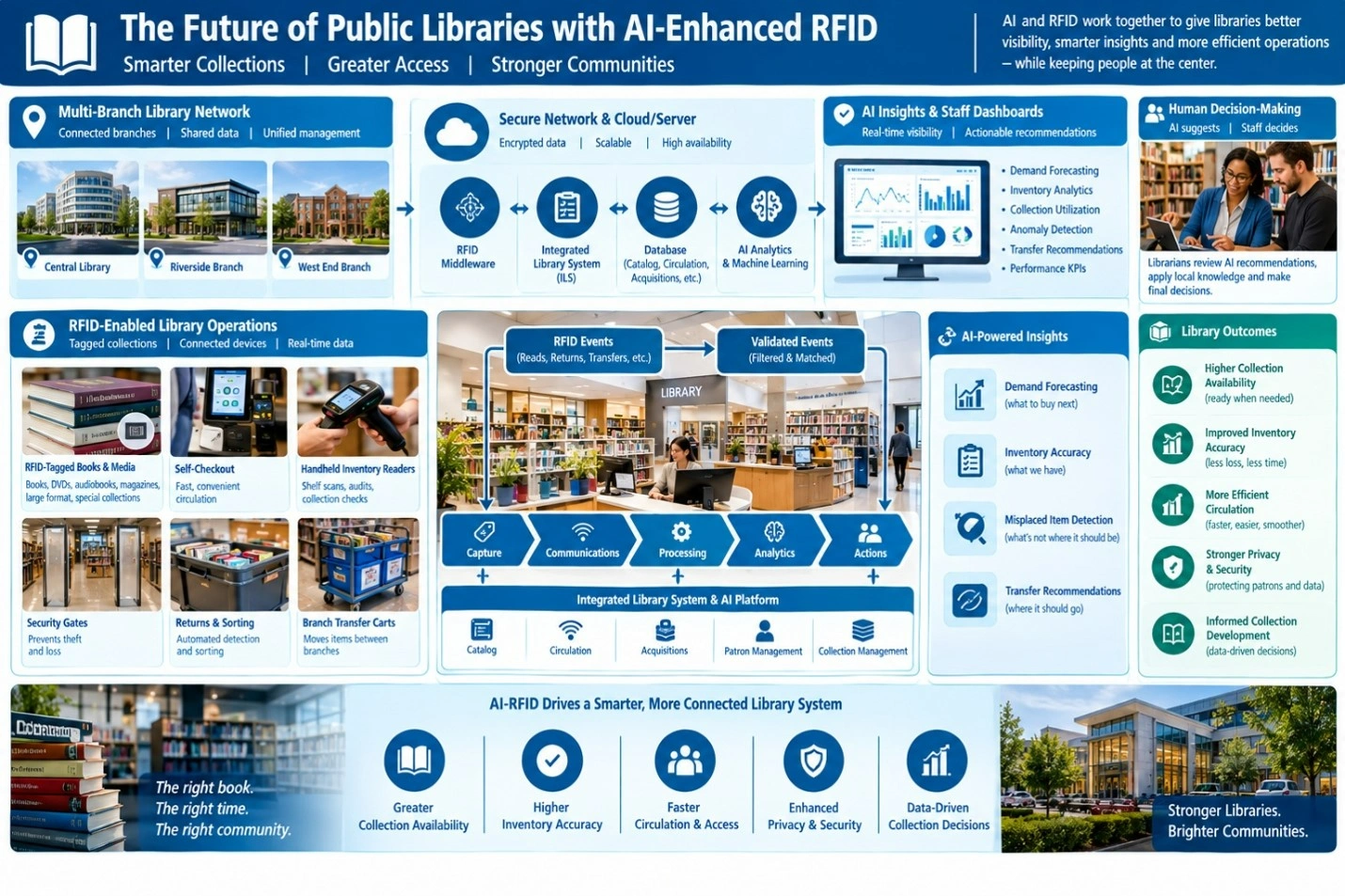
This future-state illustration shows how RFID-enabled collections, self-checkout, inventory readers, security gates, returns, and branch transfers connect with library software and AI analytics across a multi-branch network. It emphasizes AI-assisted recommendations with librarians retaining decision authority while supporting collection availability, inventory accuracy, efficient circulation, privacy, and informed collection development.
Building the Future of Industrial AI and IoT with Aperture Venture Studio and GAO
For more than three decades, GAO Group of Companies has invested heavily in R&D covering industrial RFID, BLE, and IoT. As AI has become increasingly useful for operational applications, we have developed AI and IoT technologies that combine connected identification with intelligent analysis. We have also founded Aperture Venture Studio to advance AI and IoT solutions relevant to areas such as public library collection management, inventory intelligence, and connected asset operations.
Aperture brings together technical experts, operational leaders, investors, and companies working on AI and IoT applications. Through Aperture Ventures Summit and TekSummit, we also support discussion of advanced AI and IoT technologies.
We welcome participation as:
- Advisors, co-founders, or employees
- Investors
- Customers