
AI and RFID for Apartment Buildings
AI-Powered RFID Apartment Building Management System for Smart Access, Security, and Operations
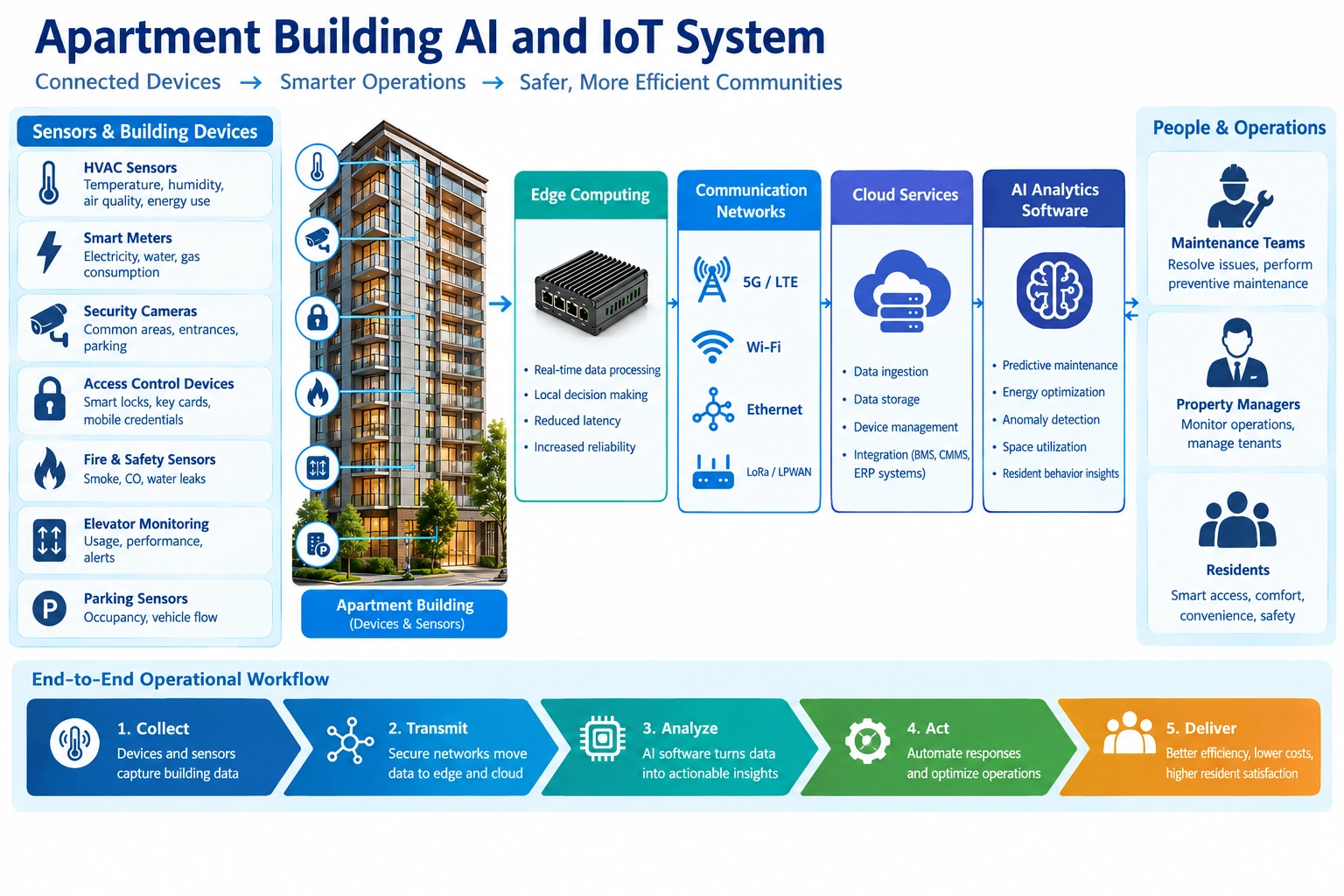
This visual illustrates how AI-powered RFID technology enhances apartment building operations through secure resident access control, smart parcel lockers, vehicle access management, maintenance asset tracking, IoT security monitoring, and centralized analytics. RFID readers, smart credentials, and connected sensors continuously collect operational data that is processed by AI analytics to improve security, automate workflows, optimize maintenance activities, and support intelligent decision-making. The key takeaway is that combining RFID with AI enables apartment buildings to operate more efficiently while improving resident experiences and property management visibility.
How AI-Powered RFID Solutions Transform Apartment Building Management
AI-powered RFID solutions enable apartment building operators to improve access management, resident services, maintenance operations, package handling, and asset visibility through automated identification and intelligent data analysis. By combining artificial intelligence with UHF RFID, HF RFID, and LF RFID technologies, property managers can move from manual tracking processes toward data-driven building operations.
For apartment buildings, AI analyzes RFID-generated information from access points, equipment rooms, maintenance activities, shared facilities, and inventory areas to identify operational patterns, predict service requirements, detect anomalies, and optimize resource utilization. RFID provides accurate identification and location-related data, while AI converts this information into actionable operational insights.
Modern apartment communities require secure resident access, efficient facility maintenance, controlled equipment management, and improved tenant experiences. AI-powered RFID systems support these requirements by connecting RFID readers, smart cards, RFID tags, software systems, and analytics tools into a unified operational solution.
GAO supplies RFID, BLE, and IoT hardware products and systems that support organizations implementing intelligent building management solutions. Headquartered in New York City and Toronto, Canada, GAO serves customers across the United States and Canada, including Fortune 500 companies, research organizations, universities, and government agencies through its RFID and IoT technology solutions.
Understanding AI-Based RFID Applications in Apartment Buildings
AI-based RFID applications in apartment buildings combine automatic identification technology with machine learning, computer vision integration, predictive analytics, and intelligent automation. The objective is not only to identify tagged objects or authorized users but also to analyze operational data and improve building performance.
RFID technology uses radio frequency communication to identify and exchange information with tagged objects. Depending on operational requirements, apartment buildings may use:
- UHF RFID systems for longer-range identification of assets, equipment, inventory, and service operations
- HF RFID systems for secure resident credentials, smart cards, access badges, and controlled-area identification
- LF RFID systems for specialized low-frequency identification applications requiring short-range communication and reliability near certain materials
AI enhances RFID systems by applying analytical models to collected data. Examples include:
- Machine learning models that predict maintenance requirements based on equipment usage history
- Anomaly detection algorithms that identify unusual access patterns or unauthorized activity
- Predictive analytics that optimize facility management schedules
- Natural language processing systems that analyze maintenance reports and resident service requests
- Intelligent workflow automation that assigns tasks based on RFID-generated operational information
For apartment building operators, RFID acts as the data collection layer while AI provides intelligence for operational decisions.
Key AI and RFID Applications for Apartment Buildings
AI-Powered RFID Access Control and Resident Security Management
Apartment buildings require reliable identity verification systems for residents, employees, contractors, and visitors. RFID-based access control systems provide automated authentication using RFID cards, key fobs, mobile credentials, and smart identification devices.
AI improves these systems by analyzing access events and identifying unusual patterns.
Applications include:
- Resident entrance management for apartment doors, parking garages, elevators, and amenity areas
- Employee access monitoring for maintenance rooms, electrical rooms, and restricted areas
- Visitor management using RFID credentials combined with AI-based authorization workflows
- Detection of abnormal access behavior through machine learning analysis
- Automated access reporting for property managers and security teams
Engineering considerations include encryption, credential management, reader placement, network connectivity, and integration with building management software.
AI-Driven RFID Asset Tracking for Apartment Maintenance Operations
Apartment buildings contain thousands of operational assets, including:
- HVAC equipment
- Pumps
- Electrical panels
- Fire safety equipment
- Maintenance tools
- Cleaning equipment
- Landscaping equipment
- Spare parts inventory
- Appliances in managed rental units
Manual asset tracking often creates challenges such as misplaced tools, incomplete maintenance records, and inefficient inspections.
AI-powered RFID asset tracking improves maintenance operations by automatically recording asset movement and usage history.
Operational improvements include:
- Automated asset inventory verification
- Maintenance scheduling based on equipment usage patterns
- Identification of missing or misplaced maintenance equipment
- Historical analysis of repair frequency
- Improved accountability among maintenance teams
RFID handheld readers, fixed RFID readers, and RFID tags allow property management teams to maintain accurate asset records while AI models identify trends that support preventive maintenance strategies.
AI-Based RFID Package Room and Smart Locker Management
Package management has become a critical operational challenge for apartment buildings due to increased residential deliveries.
RFID and AI solutions improve package handling through automated identification and tracking.
Applications include:
- RFID-tagged package identification
- Smart locker access management
- Automated package arrival notifications
- Package storage monitoring
- Delivery workflow optimization
- Theft reduction through access event analysis
AI can analyze delivery volume, resident pickup patterns, storage duration, and peak delivery periods to optimize package room operations.
Property managers can use these insights to determine locker capacity requirements, staffing needs, and operational improvements.
AI-Enhanced RFID Inventory Management for Building Supplies
Apartment communities maintain inventory for maintenance departments, cleaning operations, and facility management teams.
Common inventory items include:
- Replacement filters
- Plumbing components
- Electrical supplies
- Lighting equipment
- Safety equipment
- Cleaning materials
- Replacement hardware
RFID inventory management provides automatic identification, while AI improves demand forecasting.
AI capabilities include:
- Predicting supply consumption trends
- Reducing inventory shortages
- Identifying excessive stock levels
- Automating reorder recommendations
- Improving procurement planning
This approach helps apartment operators reduce operational delays caused by unavailable maintenance materials.
Apartment Building Operational Workflow for AI-Powered RFID Systems
H2: AI-Powered RFID Data Flow and Operational Intelligence Workflow for Apartment Buildings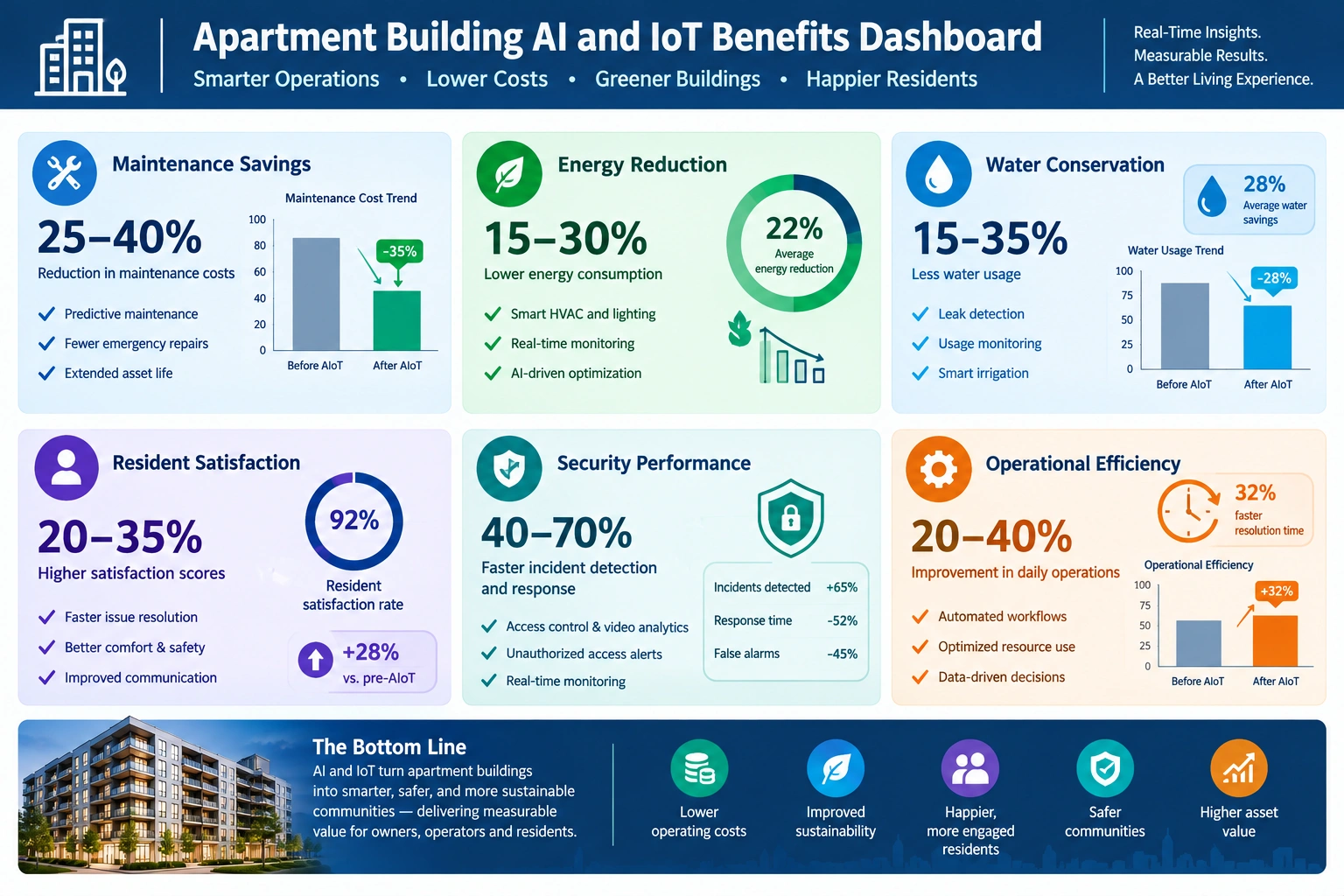
This workflow diagram illustrates how RFID data from residents, visitors, vehicles, package rooms, maintenance assets, and building equipment moves through readers, edge gateways, middleware, databases, and AI analytics systems. The visual demonstrates how raw RFID events are transformed into operational insights, dashboards, alerts, maintenance work orders, access decisions, and security responses. The key takeaway is that AI-enabled RFID systems create a continuous intelligence cycle that improves apartment building security, maintenance efficiency, resident services, and operational decision-making.
An AI-powered RFID solution for apartment buildings typically follows a complete operational lifecycle:
- RFID tag assignment: Assets, resident credentials, equipment, or packages receive RFID identification tags.
- Data capture: RFID readers collect identification information from tagged objects or authorized users.
- Communication transmission: Reader data is transferred through Ethernet, Wi-Fi, cellular networks, or IoT gateways.
- Edge processing: Local processing systems filter duplicate reads, validate data, and reduce unnecessary network traffic.
- Middleware processing: RFID middleware manages device communication, data normalization, and integration with software systems.
- Data storage: Information is stored in cloud databases, private servers, or facility management systems.
- AI analytics processing: Machine learning models analyze RFID events to identify trends, risks, and optimization opportunities.
- Operational decision-making: Property managers receive recommendations, alerts, reports, or automated workflows.
A typical deployment may connect RFID readers with:
- Property management software
- Building management systems
- Access control software
- Maintenance management systems
- Enterprise resource planning software
- Security monitoring systems
- Resident service applications
AI and RFID Deployment Considerations for Apartment Buildings
Successful RFID deployment requires careful planning around building layout, operational requirements, security policies, and integration needs.
Important engineering considerations include:
- RFID frequency selection based on application requirements
- Reader placement around entrances, elevators, equipment rooms, and storage areas
- RFID tag selection based on environmental conditions
- Network availability and communication reliability
- Software integration requirements
- Data privacy and cybersecurity controls
- Scalability for future building expansion
Apartment buildings have unique RF environments due to concrete structures, metal doors, elevators, mechanical rooms, and dense residential layouts. Proper RFID system design requires testing read ranges, interference conditions, and installation locations before full deployment.
GAO provides RFID hardware products and technical support for organizations developing RFID-based identification, tracking, and IoT solutions. GAO’s quality assurance processes and engineering support help customers evaluate hardware selection, system integration requirements, and deployment considerations.
RFID Hardware, AI Software, and Technical Infrastructure for Apartment Buildings
AI-powered RFID solutions for apartment buildings require coordinated hardware, software, communication technologies, and security mechanisms. The system design depends on whether building operators prefer cloud-hosted services or privately managed server environments.
RFID Hardware Components
Core hardware components include:
- RFID tags attached to assets, equipment, credentials, and packages
- Fixed RFID readers installed at entrances, storage areas, and operational zones
- RFID handheld readers used by maintenance and facility teams
- RFID antennas optimized for specific reading environments
- IoT gateways connecting RFID equipment with software systems
UHF RFID is commonly selected for asset tracking and inventory applications because of its longer read range. HF RFID is widely used for secure identification applications such as access cards and resident credentials. LF RFID remains useful for specialized identification scenarios requiring short-range communication.
AI Software and Data Processing Components
AI software components include:
- Machine learning models for pattern recognition
- Predictive maintenance algorithms
- Anomaly detection systems
- Data analytics dashboards
- Automated workflow engines
- Reporting and visualization tools
AI models require structured RFID event data, including timestamps, reader locations, asset identifiers, access records, and operational history.
Communication Protocols and Integration Technologies
Apartment building RFID systems may use:
- Ethernet for fixed RFID reader connectivity
- Wi-Fi for mobile and flexible deployments
- Bluetooth Low Energy for complementary IoT sensing
- Cellular networks for remote building connectivity
- MQTT for IoT messaging
- REST APIs for software integration
- TCP/IP networking for enterprise communication
Security mechanisms may include:
- Encrypted communication channels
- User authentication
- Role-based access control
- Credential lifecycle management
- Network segmentation
- Secure device configuration
Cloud Version and Server Version Deployments for Apartment Buildings
Apartment building operators can deploy AI-powered RFID solutions using either cloud-hosted software or privately managed server environments. The selection depends on data governance requirements, cybersecurity policies, portfolio size, integration complexity, and operational preferences.
Cloud Version Deployment
Cloud-hosted deployments store RFID events, analytics data, reports, and AI models within managed cloud infrastructure.
Common use cases include:
- Multi-property apartment portfolios
- Distributed property management operations
- Centralized reporting across multiple buildings
- Rapid deployment projects
- Buildings with limited local IT resources
Advantages include:
- Simplified software updates
- Centralized management
- Faster scalability
- Reduced local infrastructure requirements
- Easier AI model deployment and retraining
Cloud-hosted environments commonly integrate with property management software, resident applications, maintenance systems, and security monitoring software through APIs and secure communication channels.
Server Version Deployment
Server-based deployments place software on privately managed servers located within a building, a regional data center, a managed hosting environment, or a customer-controlled computing facility.
Common use cases include:
- Buildings with strict data governance requirements
- Luxury residential communities requiring enhanced privacy controls
- Government housing facilities
- Military housing environments
- Organizations requiring complete control of operational data
Advantages include:
- Greater control over resident information
- Custom integration capabilities
- Independent data retention policies
- Reduced dependency on external connectivity
- Enhanced control over cybersecurity configurations
Many apartment operators adopt hybrid deployments where RFID readers and local software process operational events locally while selected data is synchronized with cloud-based analytics systems.
Key Technical Capabilities of AI-Powered RFID Solutions for Apartment Buildings
H2\:AI-Powered RFID System Architecture for Smart Apartment Building Operations
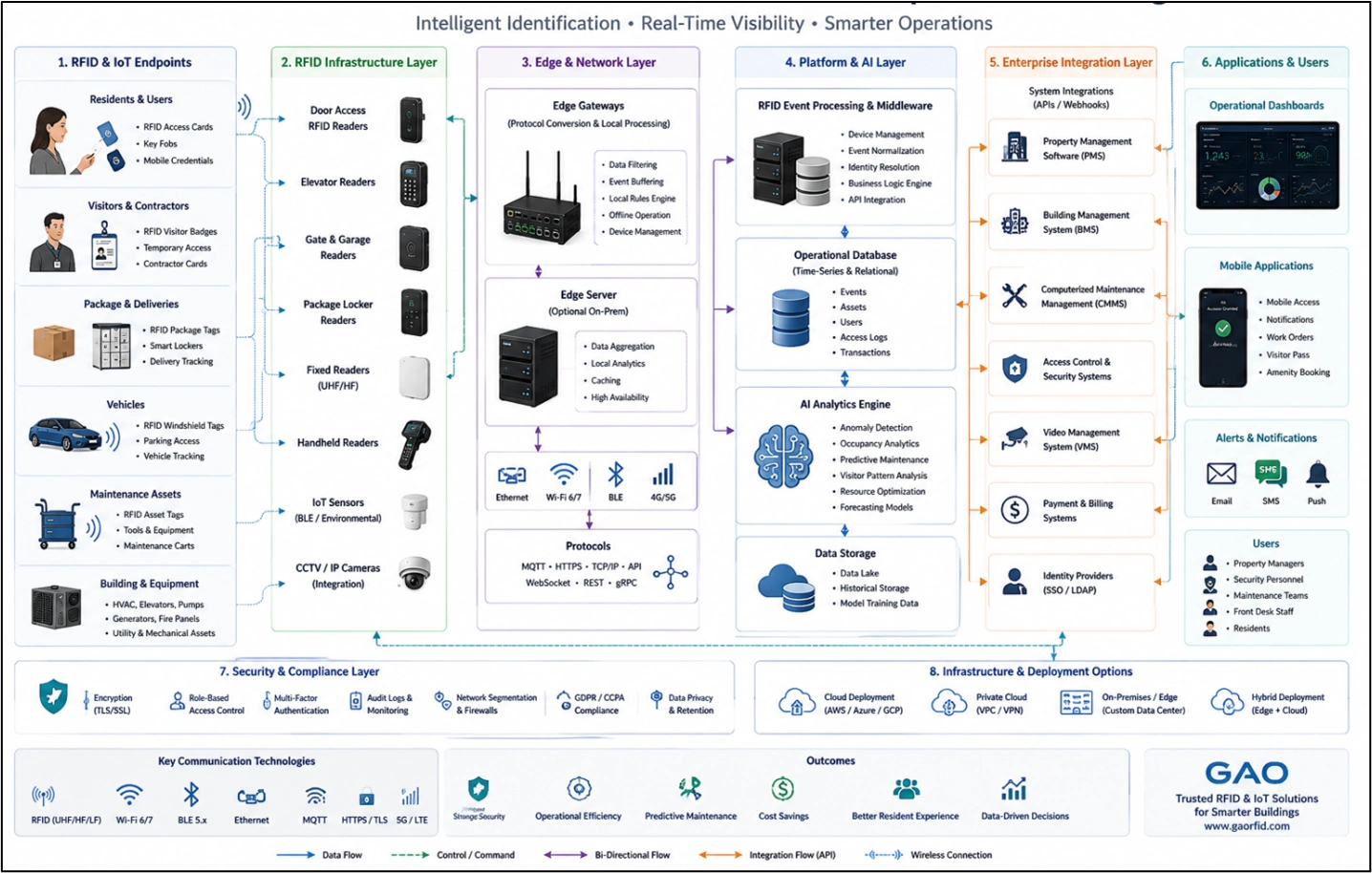
The diagram shows how RFID devices, edge systems, AI analytics, property management software, and resident-facing applications connect across a smart apartment building environment.
This architecture diagram illustrates the complete technical relationship between RFID endpoints, readers, edge gateways, AI analytics engines, operational databases, property management software, building management systems, security systems, and resident applications. It demonstrates how RFID-generated data flows through communication networks and AI processing layers to support access control, maintenance management, occupancy intelligence, security monitoring, and resident services. The key takeaway is that RFID serves as the operational data foundation while AI transforms building events into actionable insights and automated decisions.
AI transforms RFID-generated operational data into actionable intelligence that supports apartment building management, resident services, maintenance operations, and security functions.
Predictive Maintenance Intelligence
Apartment buildings rely on critical infrastructure such as:
- HVAC systems
- Chillers
- Boilers
- Water pumps
- Fire suppression systems
- Backup power equipment
- Elevator systems
RFID tracking records maintenance activity, technician interactions, inspection history, and equipment utilization.
AI analyzes this information to:
- Predict maintenance requirements
- Identify recurring equipment failures
- Prioritize work orders
- Reduce emergency repair incidents
- Improve asset lifecycle planning
Property managers can shift from reactive maintenance to preventive and predictive maintenance strategies.
Intelligent Access and Security Monitoring
RFID access control systems generate large volumes of operational data.
AI can analyze:
- Access frequency
- Resident movement trends
- Contractor access activity
- Visitor authorization records
- Building occupancy patterns
Benefits include:
- Faster identification of unusual access behavior
- Automated security alerts
- Improved compliance reporting
- Better visibility into restricted-area activity
- Enhanced incident investigation capabilities
Machine learning models continuously improve detection accuracy by learning normal operational behavior for each building.
Smart Package and Delivery Optimization
Modern apartment communities often experience significant package traffic from courier services, food delivery providers, and e-commerce shipments.
RFID-enabled package rooms generate operational data related to:
- Delivery volumes
- Pickup times
- Storage utilization
- Resident interactions
- Locker occupancy
AI uses this information to:
- Forecast storage demand
- Optimize locker allocation
- Reduce package congestion
- Improve resident notifications
- Support staffing decisions during peak delivery periods
Automated Inventory Visibility
Apartment maintenance teams frequently manage thousands of inventory items across multiple storage rooms and maintenance facilities.
RFID automatically records inventory movements while AI analyzes:
- Consumption rates
- Reorder patterns
- Seasonal demand fluctuations
- Supplier performance trends
- Stockout risks
This reduces inventory carrying costs while maintaining operational readiness.
Workforce Productivity Optimization
Apartment building operations involve multiple job functions, including:
- Property managers
- Building engineers
- Maintenance technicians
- Security personnel
- Housekeeping teams
- Groundskeeping staff
- Package room operators
RFID event data combined with AI analytics helps optimize:
- Technician dispatching
- Preventive maintenance scheduling
- Inspection routing
- Work order prioritization
- Resource allocation
These improvements help reduce operational inefficiencies while improving resident service quality.
Business Benefits of AI-Enabled RFID Systems in Apartment Buildings
Organizations implementing AI-powered RFID solutions often pursue measurable operational improvements rather than technology adoption alone.
Key benefits include:
Improved Resident Experience
- Faster access authentication
- Reduced package handling delays
- Improved maintenance response times
- Better facility availability
- Enhanced security monitoring
Reduced Operational Costs
- Lower asset loss rates
- Reduced manual inventory audits
- Improved maintenance efficiency
- Better resource utilization
- Fewer emergency repair events
Enhanced Compliance and Reporting
Apartment operators frequently maintain records related to:
- Fire safety inspections
- Equipment maintenance
- Contractor access
- Resident security events
- Asset inventories
RFID and AI solutions improve record accuracy while simplifying audit preparation.
Better Asset Utilization
Visibility into asset location and utilization supports:
- Improved capital planning
- Extended equipment lifespan
- Reduced duplicate purchases
- Faster asset retrieval
Scalability Across Property Portfolios
Apartment management companies operating multiple properties can standardize operational processes using RFID-based data collection and AI-driven analytics.
GAO has helped organizations evaluate RFID hardware, readers, tags, sensors, and IoT systems used in asset tracking, identification, monitoring, and operational visibility applications across diverse industries.
Communication Protocols, Standards, and Security Considerations
Apartment building RFID deployments rely on a combination of industry standards and secure communication technologies.
Common Communication Technologies
- Ethernet
- Wi-Fi
- Bluetooth Low Energy (BLE)
- MQTT
- HTTPS
- REST APIs
- TCP/IP
- VPN connectivity
- Cellular LTE and 5G networks
RFID Standards
- EPC Gen2 (ISO 18000-63)
- ISO/IEC 14443
- ISO/IEC 15693
- ISO 18000 series
- NFC standards for credential applications
Cybersecurity Controls
Security remains a critical design consideration because apartment building systems manage resident identities, access permissions, and operational records.
Recommended controls include:
- Encryption of RFID communications where applicable
- Multi-factor administrator authentication
- Role-based access controls
- Secure credential issuance processes
- Network segmentation
- Security event logging
- Vulnerability assessments
- Firmware management procedures
Organizations should establish cybersecurity policies before deployment and validate integrations between RFID systems and property management software.
H2: Engineering Best Practices and Implementation Recommendations
H2: Apartment Building RFID Technology Selection Decision Tree for Access Control, Asset Tracking, and Smart Building Operations
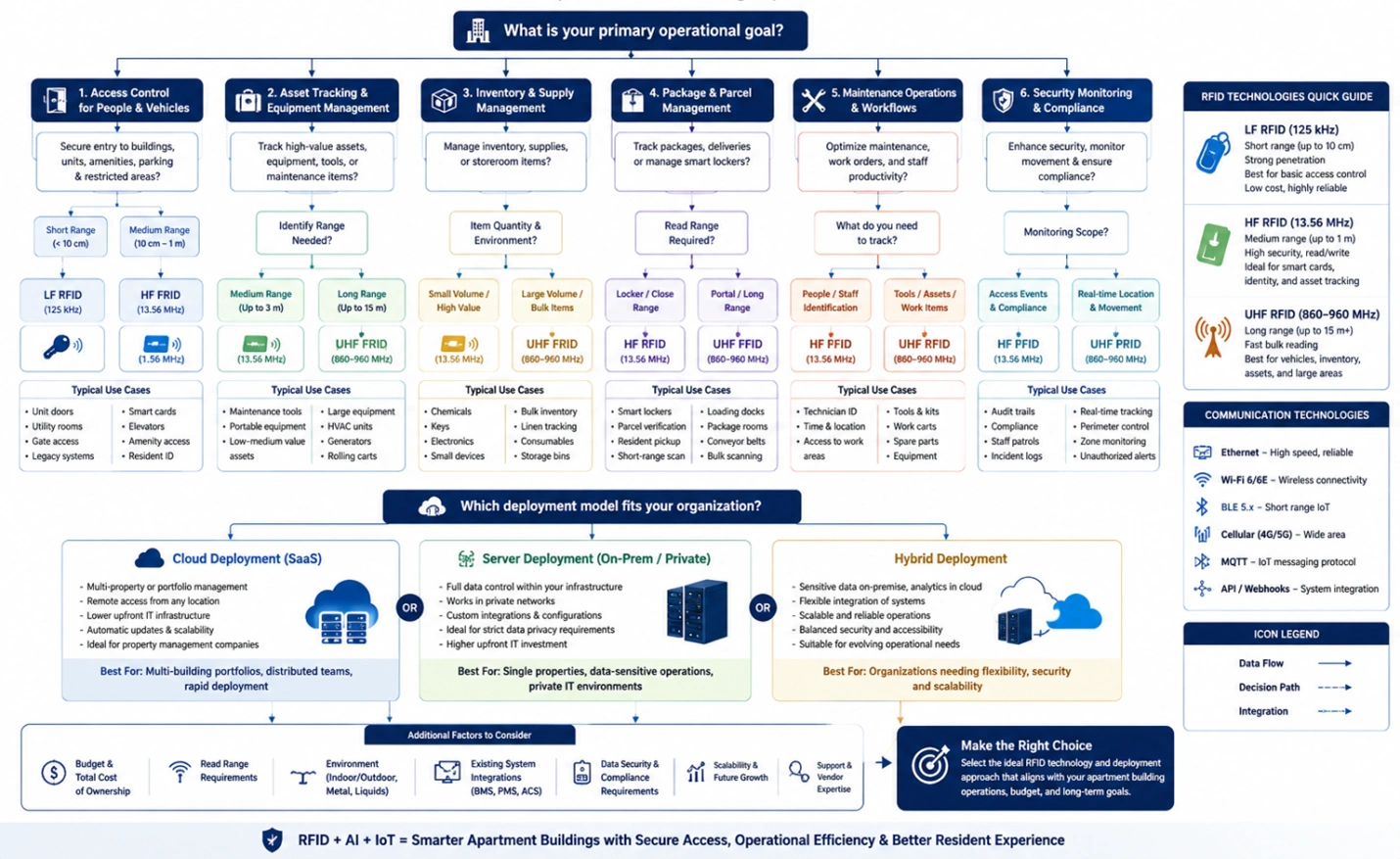
The visual presents a structured decision tree that guides apartment building teams from operational requirements to the most appropriate RFID technology and deployment model.
This decision tree helps apartment building owners, property managers, facility directors, and technology procurement teams select the most appropriate RFID technology and deployment approach based on operational objectives. It maps common apartment building use cases such as access control, package management, maintenance operations, inventory tracking, and security monitoring to LF RFID, HF RFID, or UHF RFID solutions. The diagram also compares cloud, server, and hybrid deployment models to support informed implementation planning and technology investment decisions.
Successful AI-enabled RFID projects typically follow a structured deployment lifecycle.
Planning Phase
- Define operational objectives
- Identify measurable KPIs
- Assess building infrastructure
- Evaluate security requirements
- Establish integration requirements
Hardware Selection Phase
- Select RFID frequency technology
- Determine reader placement strategy
- Evaluate tag durability requirements
- Assess communication infrastructure
Pilot Testing Phase
- Validate read accuracy
- Test building-specific RF conditions
- Verify software integrations
- Confirm cybersecurity controls
Production Deployment Phase
- Deploy readers and tags
- Configure software systems
- Train operations personnel
- Establish maintenance procedures
Continuous Optimization
- Monitor KPI performance
- Improve AI models
- Adjust workflows
- Expand deployment coverage
Practical experience shows that apartment building deployments benefit from starting with a focused use case such as access control, package management, or maintenance asset tracking before expanding into broader operational automation.
Operational KPIs for AI and RFID in Apartment Buildings
H2: AI-Powered RFID Apartment Building Operations Dashboard and KPI Analytics
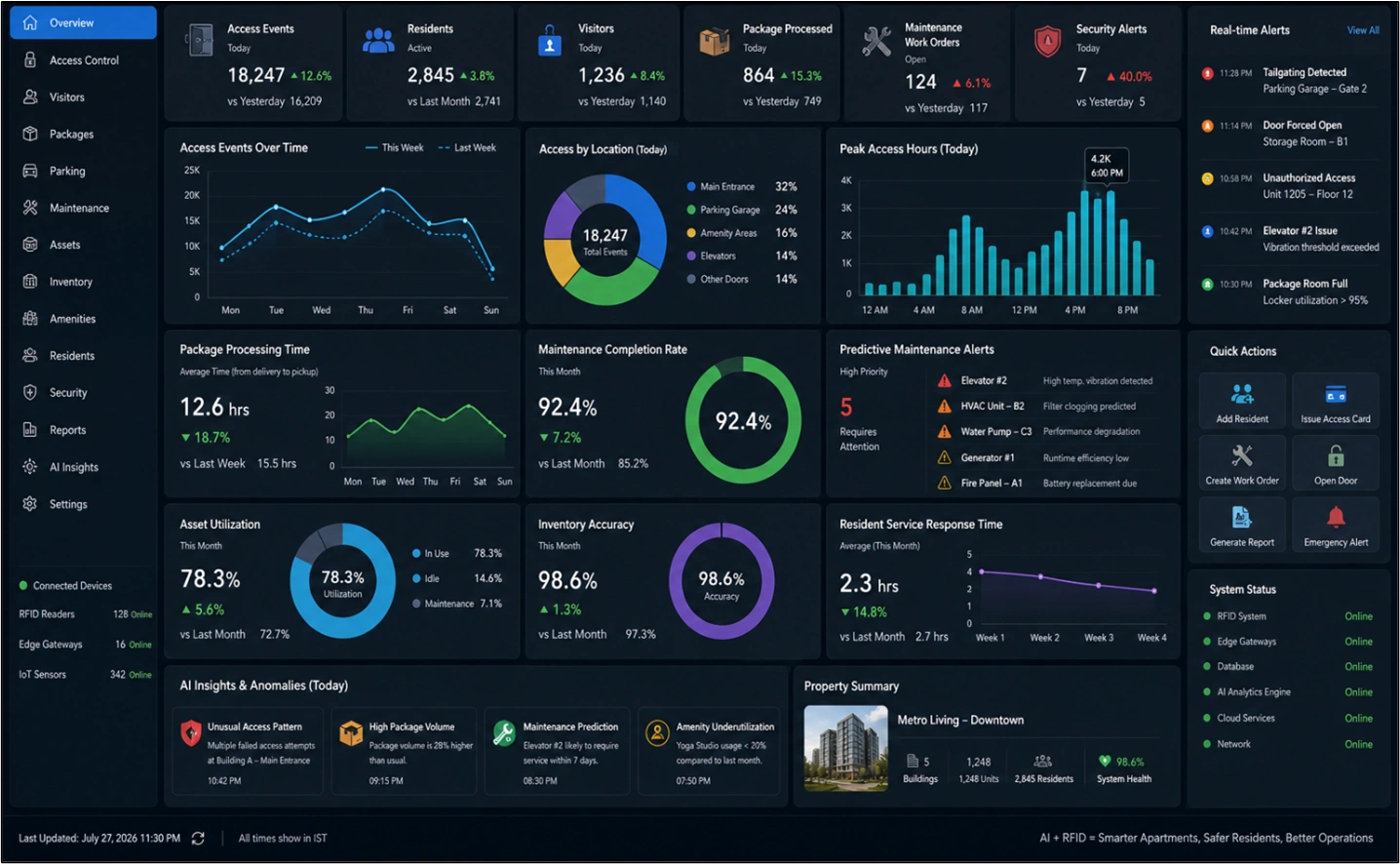
This executive dashboard visual demonstrates how apartment building operators can monitor RFID-driven operational performance through real-time analytics and AI-generated insights. The dashboard consolidates key metrics including access events, package processing efficiency, maintenance completion rates, asset utilization, inventory accuracy, resident service responsiveness, predictive maintenance alerts, and security incidents. The visual highlights how RFID-generated data combined with AI analytics supports data-driven decision-making, operational optimization, improved resident experiences, and proactive facility management.
Common KPIs include:
- Resident access success rate
- Unauthorized access incident rate
- Package pickup turnaround time
- Maintenance response time
- Preventive maintenance completion rate
- Asset utilization rate
- Asset recovery rate
- Inventory accuracy percentage
- Inventory stockout frequency
- Work order completion time
- Equipment downtime
- Elevator availability
- HVAC uptime
- Resident satisfaction scores
- Security event response time
Tracking these metrics enables apartment operators to quantify the value generated by RFID-based data collection and AI-powered operational intelligence.
Advancing Apartment Building Operations with AI-Powered RFID Solutions
AI-powered RFID solutions enable apartment building operators to improve access control, maintenance management, package handling, inventory visibility, asset tracking, and security monitoring through automated identification and intelligent analytics. RFID technology provides accurate operational data from residents, assets, facilities, and service activities, while AI converts this information into predictive insights, automated workflows, and data-driven decision support.
Successful implementations require careful planning, appropriate RFID technology selection, robust cybersecurity controls, software integration, and continuous performance optimization. Organizations evaluating intelligent apartment building solutions should focus on measurable operational outcomes, scalability requirements, and long-term maintainability.
GAO, headquartered in New York City and Toronto, Canada, is recognized among the leading global B2B suppliers of RFID and BLE technologies. Through decades of investment in research and development, rigorous quality assurance processes, and expert technical support delivered remotely and onsite, GAO has supplied RFID hardware products and IoT systems that help organizations improve visibility, automation, security, and operational efficiency.
To learn more about RFID technologies, AI-enabled operational solutions, technical deployment guidance, and engineering support for apartment building applications, contact GAO and explore our RFID, BLE, and IoT technology offerings.
Building the Future of Industrial AI and IoT with
AI-Powered RFID Apartment Building Management System for Smart Access, Security, and Operations
This visual illustrates how AI-powered RFID technology enhances apartment building operations through secure resident access control, smart parcel lockers, vehicle access management, maintenance asset tracking, IoT security monitoring, and centralized analytics. RFID readers, smart credentials, and connected sensors continuously collect operational data that is processed by AI analytics to improve security, automate workflows, optimize maintenance activities, and support intelligent decision-making. The key takeaway is that combining RFID with AI enables apartment buildings to operate more efficiently while improving resident experiences and property management visibility.
How AI-Powered RFID Solutions Transform Apartment Building Management
AI-powered RFID solutions enable apartment building operators to improve access management, resident services, maintenance operations, package handling, and asset visibility through automated identification and intelligent data analysis. By combining artificial intelligence with UHF RFID, HF RFID, and LF RFID technologies, property managers can move from manual tracking processes toward data-driven building operations.
For apartment buildings, AI analyzes RFID-generated information from access points, equipment rooms, maintenance activities, shared facilities, and inventory areas to identify operational patterns, predict service requirements, detect anomalies, and optimize resource utilization. RFID provides accurate identification and location-related data, while AI converts this information into actionable operational insights.
Modern apartment communities require secure resident access, efficient facility maintenance, controlled equipment management, and improved tenant experiences. AI-powered RFID systems support these requirements by connecting RFID readers, smart cards, RFID tags, software systems, and analytics tools into a unified operational solution.
GAO supplies RFID, BLE, and IoT hardware products and systems that support organizations implementing intelligent building management solutions. Headquartered in New York City and Toronto, Canada, GAO serves customers across the United States and Canada, including Fortune 500 companies, research organizations, universities, and government agencies through its RFID and IoT technology solutions.
Understanding AI-Based RFID Applications in Apartment Buildings
AI-based RFID applications in apartment buildings combine automatic identification technology with machine learning, computer vision integration, predictive analytics, and intelligent automation. The objective is not only to identify tagged objects or authorized users but also to analyze operational data and improve building performance.
RFID technology uses radio frequency communication to identify and exchange information with tagged objects. Depending on operational requirements, apartment buildings may use:
- UHF RFID systems for longer-range identification of assets, equipment, inventory, and service operations
- HF RFID systems for secure resident credentials, smart cards, access badges, and controlled-area identification
- LF RFID systems for specialized low-frequency identification applications requiring short-range communication and reliability near certain materials
AI enhances RFID systems by applying analytical models to collected data. Examples include:
- Machine learning models that predict maintenance requirements based on equipment usage history
- Anomaly detection algorithms that identify unusual access patterns or unauthorized activity
- Predictive analytics that optimize facility management schedules
- Natural language processing systems that analyze maintenance reports and resident service requests
- Intelligent workflow automation that assigns tasks based on RFID-generated operational information
For apartment building operators, RFID acts as the data collection layer while AI provides intelligence for operational decisions.
Key AI and RFID Applications for Apartment Buildings
AI-Powered RFID Access Control and Resident Security Management
Apartment buildings require reliable identity verification systems for residents, employees, contractors, and visitors. RFID-based access control systems provide automated authentication using RFID cards, key fobs, mobile credentials, and smart identification devices.
AI improves these systems by analyzing access events and identifying unusual patterns.
Applications include:
- Resident entrance management for apartment doors, parking garages, elevators, and amenity areas
- Employee access monitoring for maintenance rooms, electrical rooms, and restricted areas
- Visitor management using RFID credentials combined with AI-based authorization workflows
- Detection of abnormal access behavior through machine learning analysis
- Automated access reporting for property managers and security teams
Engineering considerations include encryption, credential management, reader placement, network connectivity, and integration with building management software.
AI-Driven RFID Asset Tracking for Apartment Maintenance Operations
Apartment buildings contain thousands of operational assets, including:
- HVAC equipment
- Pumps
- Electrical panels
- Fire safety equipment
- Maintenance tools
- Cleaning equipment
- Landscaping equipment
- Spare parts inventory
- Appliances in managed rental units
Manual asset tracking often creates challenges such as misplaced tools, incomplete maintenance records, and inefficient inspections.
AI-powered RFID asset tracking improves maintenance operations by automatically recording asset movement and usage history.
Operational improvements include:
- Automated asset inventory verification
- Maintenance scheduling based on equipment usage patterns
- Identification of missing or misplaced maintenance equipment
- Historical analysis of repair frequency
- Improved accountability among maintenance teams
RFID handheld readers, fixed RFID readers, and RFID tags allow property management teams to maintain accurate asset records while AI models identify trends that support preventive maintenance strategies.
AI-Based RFID Package Room and Smart Locker Management
Package management has become a critical operational challenge for apartment buildings due to increased residential deliveries.
RFID and AI solutions improve package handling through automated identification and tracking.
Applications include:
- RFID-tagged package identification
- Smart locker access management
- Automated package arrival notifications
- Package storage monitoring
- Delivery workflow optimization
- Theft reduction through access event analysis
AI can analyze delivery volume, resident pickup patterns, storage duration, and peak delivery periods to optimize package room operations.
Property managers can use these insights to determine locker capacity requirements, staffing needs, and operational improvements.
AI-Enhanced RFID Inventory Management for Building Supplies
Apartment communities maintain inventory for maintenance departments, cleaning operations, and facility management teams.
Common inventory items include:
- Replacement filters
- Plumbing components
- Electrical supplies
- Lighting equipment
- Safety equipment
- Cleaning materials
- Replacement hardware
RFID inventory management provides automatic identification, while AI improves demand forecasting.
AI capabilities include:
- Predicting supply consumption trends
- Reducing inventory shortages
- Identifying excessive stock levels
- Automating reorder recommendations
- Improving procurement planning
This approach helps apartment operators reduce operational delays caused by unavailable maintenance materials.
Apartment Building Operational Workflow for AI-Powered RFID Systems
H2: AI-Powered RFID Data Flow and Operational Intelligence Workflow for Apartment Buildings
This workflow diagram illustrates how RFID data from residents, visitors, vehicles, package rooms, maintenance assets, and building equipment moves through readers, edge gateways, middleware, databases, and AI analytics systems. The visual demonstrates how raw RFID events are transformed into operational insights, dashboards, alerts, maintenance work orders, access decisions, and security responses. The key takeaway is that AI-enabled RFID systems create a continuous intelligence cycle that improves apartment building security, maintenance efficiency, resident services, and operational decision-making.
An AI-powered RFID solution for apartment buildings typically follows a complete operational lifecycle:
- RFID tag assignment: Assets, resident credentials, equipment, or packages receive RFID identification tags.
- Data capture: RFID readers collect identification information from tagged objects or authorized users.
- Communication transmission: Reader data is transferred through Ethernet, Wi-Fi, cellular networks, or IoT gateways.
- Edge processing: Local processing systems filter duplicate reads, validate data, and reduce unnecessary network traffic.
- Middleware processing: RFID middleware manages device communication, data normalization, and integration with software systems.
- Data storage: Information is stored in cloud databases, private servers, or facility management systems.
- AI analytics processing: Machine learning models analyze RFID events to identify trends, risks, and optimization opportunities.
- Operational decision-making: Property managers receive recommendations, alerts, reports, or automated workflows.
A typical deployment may connect RFID readers with:
- Property management software
- Building management systems
- Access control software
- Maintenance management systems
- Enterprise resource planning software
- Security monitoring systems
- Resident service applications
AI and RFID Deployment Considerations for Apartment Buildings
Successful RFID deployment requires careful planning around building layout, operational requirements, security policies, and integration needs.
Important engineering considerations include:
- RFID frequency selection based on application requirements
- Reader placement around entrances, elevators, equipment rooms, and storage areas
- RFID tag selection based on environmental conditions
- Network availability and communication reliability
- Software integration requirements
- Data privacy and cybersecurity controls
- Scalability for future building expansion
Apartment buildings have unique RF environments due to concrete structures, metal doors, elevators, mechanical rooms, and dense residential layouts. Proper RFID system design requires testing read ranges, interference conditions, and installation locations before full deployment.
GAO provides RFID hardware products and technical support for organizations developing RFID-based identification, tracking, and IoT solutions. GAO’s quality assurance processes and engineering support help customers evaluate hardware selection, system integration requirements, and deployment considerations.
RFID Hardware, AI Software, and Technical Infrastructure for Apartment Buildings
AI-powered RFID solutions for apartment buildings require coordinated hardware, software, communication technologies, and security mechanisms. The system design depends on whether building operators prefer cloud-hosted services or privately managed server environments.
RFID Hardware Components
Core hardware components include:
- RFID tags attached to assets, equipment, credentials, and packages
- Fixed RFID readers installed at entrances, storage areas, and operational zones
- RFID handheld readers used by maintenance and facility teams
- RFID antennas optimized for specific reading environments
- IoT gateways connecting RFID equipment with software systems
UHF RFID is commonly selected for asset tracking and inventory applications because of its longer read range. HF RFID is widely used for secure identification applications such as access cards and resident credentials. LF RFID remains useful for specialized identification scenarios requiring short-range communication.
AI Software and Data Processing Components
AI software components include:
- Machine learning models for pattern recognition
- Predictive maintenance algorithms
- Anomaly detection systems
- Data analytics dashboards
- Automated workflow engines
- Reporting and visualization tools
AI models require structured RFID event data, including timestamps, reader locations, asset identifiers, access records, and operational history.
Communication Protocols and Integration Technologies
Apartment building RFID systems may use:
- Ethernet for fixed RFID reader connectivity
- Wi-Fi for mobile and flexible deployments
- Bluetooth Low Energy for complementary IoT sensing
- Cellular networks for remote building connectivity
- MQTT for IoT messaging
- REST APIs for software integration
- TCP/IP networking for enterprise communication
Security mechanisms may include:
- Encrypted communication channels
- User authentication
- Role-based access control
- Credential lifecycle management
- Network segmentation
- Secure device configuration
Cloud Version and Server Version Deployments for Apartment Buildings
Apartment building operators can deploy AI-powered RFID solutions using either cloud-hosted software or privately managed server environments. The selection depends on data governance requirements, cybersecurity policies, portfolio size, integration complexity, and operational preferences.
Cloud Version Deployment
Cloud-hosted deployments store RFID events, analytics data, reports, and AI models within managed cloud infrastructure.
Common use cases include:
- Multi-property apartment portfolios
- Distributed property management operations
- Centralized reporting across multiple buildings
- Rapid deployment projects
- Buildings with limited local IT resources
Advantages include:
- Simplified software updates
- Centralized management
- Faster scalability
- Reduced local infrastructure requirements
- Easier AI model deployment and retraining
Cloud-hosted environments commonly integrate with property management software, resident applications, maintenance systems, and security monitoring software through APIs and secure communication channels.
Server Version Deployment
Server-based deployments place software on privately managed servers located within a building, a regional data center, a managed hosting environment, or a customer-controlled computing facility.
Common use cases include:
- Buildings with strict data governance requirements
- Luxury residential communities requiring enhanced privacy controls
- Government housing facilities
- Military housing environments
- Organizations requiring complete control of operational data
Advantages include:
- Greater control over resident information
- Custom integration capabilities
- Independent data retention policies
- Reduced dependency on external connectivity
- Enhanced control over cybersecurity configurations
Many apartment operators adopt hybrid deployments where RFID readers and local software process operational events locally while selected data is synchronized with cloud-based analytics systems.
Key Technical Capabilities of AI-Powered RFID Solutions for Apartment Buildings
H2\:AI-Powered RFID System Architecture for Smart Apartment Building Operations
The diagram shows how RFID devices, edge systems, AI analytics, property management software, and resident-facing applications connect across a smart apartment building environment.
This architecture diagram illustrates the complete technical relationship between RFID endpoints, readers, edge gateways, AI analytics engines, operational databases, property management software, building management systems, security systems, and resident applications. It demonstrates how RFID-generated data flows through communication networks and AI processing layers to support access control, maintenance management, occupancy intelligence, security monitoring, and resident services. The key takeaway is that RFID serves as the operational data foundation while AI transforms building events into actionable insights and automated decisions.
AI transforms RFID-generated operational data into actionable intelligence that supports apartment building management, resident services, maintenance operations, and security functions.
Predictive Maintenance Intelligence
Apartment buildings rely on critical infrastructure such as:
- HVAC systems
- Chillers
- Boilers
- Water pumps
- Fire suppression systems
- Backup power equipment
- Elevator systems
RFID tracking records maintenance activity, technician interactions, inspection history, and equipment utilization.
AI analyzes this information to:
- Predict maintenance requirements
- Identify recurring equipment failures
- Prioritize work orders
- Reduce emergency repair incidents
- Improve asset lifecycle planning
Property managers can shift from reactive maintenance to preventive and predictive maintenance strategies.
Intelligent Access and Security Monitoring
RFID access control systems generate large volumes of operational data.
AI can analyze:
- Access frequency
- Resident movement trends
- Contractor access activity
- Visitor authorization records
- Building occupancy patterns
Benefits include:
- Faster identification of unusual access behavior
- Automated security alerts
- Improved compliance reporting
- Better visibility into restricted-area activity
- Enhanced incident investigation capabilities
Machine learning models continuously improve detection accuracy by learning normal operational behavior for each building.
Smart Package and Delivery Optimization
Modern apartment communities often experience significant package traffic from courier services, food delivery providers, and e-commerce shipments.
RFID-enabled package rooms generate operational data related to:
- Delivery volumes
- Pickup times
- Storage utilization
- Resident interactions
- Locker occupancy
AI uses this information to:
- Forecast storage demand
- Optimize locker allocation
- Reduce package congestion
- Improve resident notifications
- Support staffing decisions during peak delivery periods
Automated Inventory Visibility
Apartment maintenance teams frequently manage thousands of inventory items across multiple storage rooms and maintenance facilities.
RFID automatically records inventory movements while AI analyzes:
- Consumption rates
- Reorder patterns
- Seasonal demand fluctuations
- Supplier performance trends
- Stockout risks
This reduces inventory carrying costs while maintaining operational readiness.
Workforce Productivity Optimization
Apartment building operations involve multiple job functions, including:
- Property managers
- Building engineers
- Maintenance technicians
- Security personnel
- Housekeeping teams
- Groundskeeping staff
- Package room operators
RFID event data combined with AI analytics helps optimize:
- Technician dispatching
- Preventive maintenance scheduling
- Inspection routing
- Work order prioritization
- Resource allocation
These improvements help reduce operational inefficiencies while improving resident service quality.
Business Benefits of AI-Enabled RFID Systems in Apartment Buildings
Organizations implementing AI-powered RFID solutions often pursue measurable operational improvements rather than technology adoption alone.
Key benefits include:
Improved Resident Experience
- Faster access authentication
- Reduced package handling delays
- Improved maintenance response times
- Better facility availability
- Enhanced security monitoring
Reduced Operational Costs
- Lower asset loss rates
- Reduced manual inventory audits
- Improved maintenance efficiency
- Better resource utilization
- Fewer emergency repair events
Enhanced Compliance and Reporting
Apartment operators frequently maintain records related to:
- Fire safety inspections
- Equipment maintenance
- Contractor access
- Resident security events
- Asset inventories
RFID and AI solutions improve record accuracy while simplifying audit preparation.
Better Asset Utilization
Visibility into asset location and utilization supports:
- Improved capital planning
- Extended equipment lifespan
- Reduced duplicate purchases
- Faster asset retrieval
Scalability Across Property Portfolios
Apartment management companies operating multiple properties can standardize operational processes using RFID-based data collection and AI-driven analytics.
GAO has helped organizations evaluate RFID hardware, readers, tags, sensors, and IoT systems used in asset tracking, identification, monitoring, and operational visibility applications across diverse industries.
Communication Protocols, Standards, and Security Considerations
Apartment building RFID deployments rely on a combination of industry standards and secure communication technologies.
Common Communication Technologies
- Ethernet
- Wi-Fi
- Bluetooth Low Energy (BLE)
- MQTT
- HTTPS
- REST APIs
- TCP/IP
- VPN connectivity
- Cellular LTE and 5G networks
RFID Standards
- EPC Gen2 (ISO 18000-63)
- ISO/IEC 14443
- ISO/IEC 15693
- ISO 18000 series
- NFC standards for credential applications
Cybersecurity Controls
Security remains a critical design consideration because apartment building systems manage resident identities, access permissions, and operational records.
Recommended controls include:
- Encryption of RFID communications where applicable
- Multi-factor administrator authentication
- Role-based access controls
- Secure credential issuance processes
- Network segmentation
- Security event logging
- Vulnerability assessments
- Firmware management procedures
Organizations should establish cybersecurity policies before deployment and validate integrations between RFID systems and property management software.
H2: Engineering Best Practices and Implementation Recommendations
H2: Apartment Building RFID Technology Selection Decision Tree for Access Control, Asset Tracking, and Smart Building Operations
The visual presents a structured decision tree that guides apartment building teams from operational requirements to the most appropriate RFID technology and deployment model.
This decision tree helps apartment building owners, property managers, facility directors, and technology procurement teams select the most appropriate RFID technology and deployment approach based on operational objectives. It maps common apartment building use cases such as access control, package management, maintenance operations, inventory tracking, and security monitoring to LF RFID, HF RFID, or UHF RFID solutions. The diagram also compares cloud, server, and hybrid deployment models to support informed implementation planning and technology investment decisions.
Successful AI-enabled RFID projects typically follow a structured deployment lifecycle.
Planning Phase
- Define operational objectives
- Identify measurable KPIs
- Assess building infrastructure
- Evaluate security requirements
- Establish integration requirements
Hardware Selection Phase
- Select RFID frequency technology
- Determine reader placement strategy
- Evaluate tag durability requirements
- Assess communication infrastructure
Pilot Testing Phase
- Validate read accuracy
- Test building-specific RF conditions
- Verify software integrations
- Confirm cybersecurity controls
Production Deployment Phase
- Deploy readers and tags
- Configure software systems
- Train operations personnel
- Establish maintenance procedures
Continuous Optimization
- Monitor KPI performance
- Improve AI models
- Adjust workflows
- Expand deployment coverage
Practical experience shows that apartment building deployments benefit from starting with a focused use case such as access control, package management, or maintenance asset tracking before expanding into broader operational automation.
Operational KPIs for AI and RFID in Apartment Buildings
H2: AI-Powered RFID Apartment Building Operations Dashboard and KPI Analytics
This executive dashboard visual demonstrates how apartment building operators can monitor RFID-driven operational performance through real-time analytics and AI-generated insights. The dashboard consolidates key metrics including access events, package processing efficiency, maintenance completion rates, asset utilization, inventory accuracy, resident service responsiveness, predictive maintenance alerts, and security incidents. The visual highlights how RFID-generated data combined with AI analytics supports data-driven decision-making, operational optimization, improved resident experiences, and proactive facility management.
Common KPIs include:
- Resident access success rate
- Unauthorized access incident rate
- Package pickup turnaround time
- Maintenance response time
- Preventive maintenance completion rate
- Asset utilization rate
- Asset recovery rate
- Inventory accuracy percentage
- Inventory stockout frequency
- Work order completion time
- Equipment downtime
- Elevator availability
- HVAC uptime
- Resident satisfaction scores
- Security event response time
Tracking these metrics enables apartment operators to quantify the value generated by RFID-based data collection and AI-powered operational intelligence.
Advancing Apartment Building Operations with AI-Powered RFID Solutions
AI-powered RFID solutions enable apartment building operators to improve access control, maintenance management, package handling, inventory visibility, asset tracking, and security monitoring through automated identification and intelligent analytics. RFID technology provides accurate operational data from residents, assets, facilities, and service activities, while AI converts this information into predictive insights, automated workflows, and data-driven decision support.
Successful implementations require careful planning, appropriate RFID technology selection, robust cybersecurity controls, software integration, and continuous performance optimization. Organizations evaluating intelligent apartment building solutions should focus on measurable operational outcomes, scalability requirements, and long-term maintainability.
GAO, headquartered in New York City and Toronto, Canada, is recognized among the leading global B2B suppliers of RFID and BLE technologies. Through decades of investment in research and development, rigorous quality assurance processes, and expert technical support delivered remotely and onsite, GAO has supplied RFID hardware products and IoT systems that help organizations improve visibility, automation, security, and operational efficiency.
To learn more about RFID technologies, AI-enabled operational solutions, technical deployment guidance, and engineering support for apartment building applications, contact GAO and explore our RFID, BLE, and IoT technology offerings.
Building the Future of Industrial AI and IoT with Aperture Venture Studio and GAO
For more than three decades, GAO Group of Companies has invested heavily in the research and development of RFID, BLE, IoT, and intelligent automation technologies. As AI has demonstrated increasing value in apartment building operations, property technology, asset visibility, predictive maintenance, and smart access management, we have expanded our focus on AI-driven IoT innovation and founded Aperture Venture Studio to help accelerate the development and adoption of advanced AI and IoT solutions for smart buildings and other sectors.
Aperture has attracted highly experienced AI researchers, IoT specialists, operational leaders, investors, and industry participants who contribute technical expertise and practical implementation knowledge.
We have also developed highly successful Aperture Ventures Summit and TekSummit programs that facilitate discussion of advanced AI, RFID, BLE, and IoT technologies.
These efforts have helped build diverse technical communities focused on solving real-world operational challenges through intelligent connected systems.
We welcome you to join us as:
- Advisors, co-creators, or employees
- Investors
- Customers
Together, we can help advance the future of AI-enabled RFID, IoT, and intelligent building operations. and GAO
For more than three decades, GAO Group of Companies has invested heavily in the research and development of RFID, BLE, IoT, and intelligent automation technologies. As AI has demonstrated increasing value in apartment building operations, property technology, asset visibility, predictive maintenance, and smart access management, we have expanded our focus on AI-driven IoT innovation and founded Aperture Venture Studio to help accelerate the development and adoption of advanced AI and IoT solutions for smart buildings and other sectors.
Aperture has attracted highly experienced AI researchers, IoT specialists, operational leaders, investors, and industry participants who contribute technical expertise and practical implementation knowledge.
We have also developed highly successful Aperture Ventures Summit and TekSummit programs that facilitate discussion of advanced AI, RFID, BLE, and IoT technologies.
These efforts have helped build diverse technical communities focused on solving real-world operational challenges through intelligent connected systems.
We welcome you to join us as:
- Advisors, co-creators, or employees
- Investors
- Customers
Together, we can help advance the future of AI-enabled RFID, IoT, and intelligent building operations.