
How AI Is Transforming BLE for Environmental Monitoring
AI-Driven Environmental Monitoring with BLE Sensors and Gateways
Artificial intelligence is transforming environmental monitoring by turning continuous sensor measurements into actionable operational intelligence. For environmental operations, AI can analyze temperature, humidity, air quality, particulate matter, water conditions, pressure, vibration, gas concentration, and other measurements collected through connected sensing equipment. BLE sensors provide a low-power local communication layer, while BLE gateways transfer sensor data to edge servers, private servers, or cloud software for analysis. AI models can identify abnormal environmental conditions, compensate for missing data, detect sensor drift, forecast threshold violations, and prioritize field responses. This approach is particularly useful for facilities, laboratories, wastewater operations, industrial environmental programs, storage areas, remediation sites, and distributed monitoring locations. GAO supplies BLE sensors, BLE beacons, gateways, RFID products, and related IoT hardware that can support environmental monitoring systems where low-power wireless sensing and automated data collection are appropriate.
Environmental Monitoring Architecture: AI and BLE Data Flow Diagram
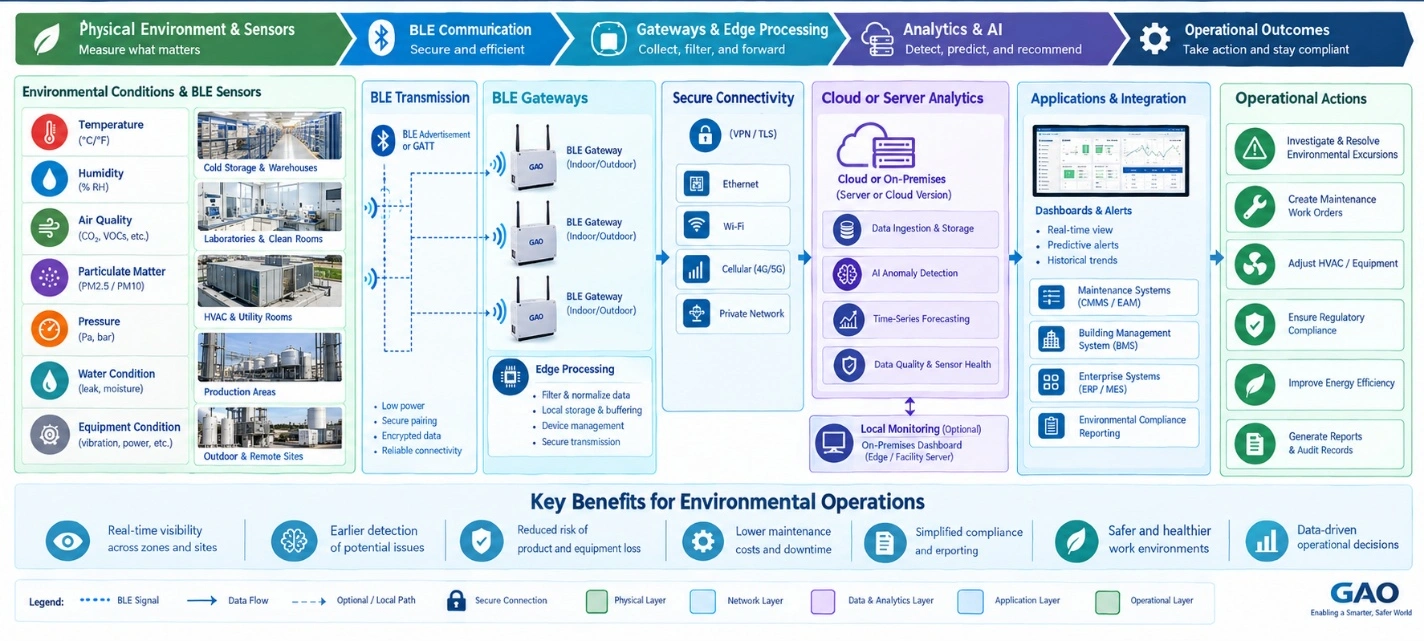
An end-to-end system architecture diagram showing environmental monitoring using Bluetooth Low Energy (BLE) sensors and AI analytics. The workflow maps real-world parameters—such as temperature, humidity, air quality, and vibration across warehouses, clean rooms, and production facilities—through BLE gateways, secure network connections, and cloud AI servers. It illustrates data ingestion, anomaly detection, and automated integration with BMS, CMMS, and ERP systems to enable real-time alerts, compliance reporting, and optimized energy efficiency.
What AI-Enabled BLE Environmental Monitoring Means
AI-enabled environmental monitoring combines sensing, wireless data acquisition, IoT connectivity, analytics, and operational decision-making. The objective is not simply to collect more environmental measurements. The objective is to determine whether those measurements represent normal operating conditions, emerging environmental risks, equipment problems, sensor faults, or events requiring human intervention.
BLE is particularly useful where sensors must operate for long periods from small batteries and where the monitored area can be covered through appropriately positioned gateways. A BLE sensor may periodically broadcast environmental measurements or maintain a BLE connection with a gateway. The gateway then performs protocol conversion and forwards the data through Ethernet, Wi-Fi, cellular connectivity, or another IP-based communication path.
AI adds an analytical layer above this data collection process. Depending on the application, the system may use:
- Time-series anomaly detection to identify unusual environmental measurements
- Machine learning models to distinguish genuine environmental events from sensor noise
- Forecasting models to predict temperature, humidity, air-quality, or other threshold conditions
- Sensor-drift detection to identify measurements that gradually diverge from expected behavior
- Data-quality models to identify missing, duplicated, stale, or inconsistent readings
- Classification models to categorize environmental events according to their operational characteristics
- Predictive maintenance models to identify deteriorating monitoring equipment
- Edge AI for rapid local analysis when connectivity to a remote server is intermittent
- Statistical process monitoring for environmental parameters with established operating ranges
For environmental operations, this distinction is important. A temperature reading of 28°C, for example, has little operational meaning without context. The AI system may need to consider historical trends, outdoor weather, location, time of day, equipment status, ventilation conditions, and measurements from neighboring sensors before determining whether the reading represents a meaningful environmental event.
Where AI Improves Environmental Monitoring Operations
Environmental monitoring programs often contain many distributed measurement points. These may include indoor environmental stations, outdoor monitoring locations, wastewater treatment areas, chemical storage zones, laboratories, industrial facilities, remediation sites, environmental sampling locations, and equipment rooms.
AI becomes particularly valuable when environmental teams must interpret high-frequency measurements rather than review individual readings manually.
Air Quality and Particulate Monitoring
BLE-connected air-quality sensors can collect measurements such as particulate concentrations, temperature, humidity, volatile organic compound indicators, and other parameters supported by the sensing equipment.
AI can establish location-specific baselines and identify deviations that deserve investigation. Instead of generating an alert every time a measurement briefly crosses a fixed threshold, an AI model can consider duration, rate of change, historical behavior, nearby sensors, and environmental conditions.
This can help environmental teams investigate:
- Unexpected particulate increases
- Persistent air-quality deterioration
- Abnormal sensor behavior
- Ventilation-related changes
- Environmental events affecting specific monitoring zones
- Potential sensor contamination or drift
GAO BLE sensing and gateway hardware can provide the data acquisition layer for these applications, while customer software and analytics systems can perform the environmental analysis.
Water and Wastewater Monitoring
Environmental operations involving water treatment, wastewater collection, process discharge, and water-quality observation can generate measurements continuously or at scheduled intervals.
BLE sensors can be appropriate for localized monitoring where the wireless range and gateway placement are suitable. AI can analyze trends and relationships among available measurements, helping operators identify abnormal conditions before they become larger operational problems.
Potential AI applications include:
- Detecting abnormal changes in water-condition measurements
- Identifying sensor drift or fouling
- Predicting maintenance requirements for monitoring equipment
- Detecting unusual relationships between multiple measurements
- Identifying recurring environmental patterns
- Prioritizing locations for physical inspection or sampling
AI should not automatically replace regulatory sampling, laboratory analysis, calibration procedures, or established environmental controls. Rather, it can provide an additional analytical layer that helps teams determine where closer investigation may be warranted.
Industrial Environmental Conditions
Industrial environmental programs may monitor areas containing pumps, motors, ventilation equipment, tanks, chemical storage, process equipment, environmental control systems, and monitoring instruments.
Environmental monitoring data can be correlated with operational information to identify relationships that are difficult to see through isolated sensor readings. For example, an environmental change may occur repeatedly when a ventilation system changes state or when specific equipment enters a particular operating condition.
AI can correlate time-series environmental measurements with equipment states and operational events to identify these patterns.
Environmental Storage and Controlled Areas
Environmental conditions can be important for chemical storage, laboratories, sample storage, environmental testing areas, and other controlled locations.
BLE sensors can provide continuous local measurements while gateways aggregate data from multiple locations. AI can detect slow temperature or humidity changes that may not immediately trigger conventional alarms.
The resulting system can support:
- Environmental condition monitoring
- Threshold-risk prediction
- Sensor health monitoring
- Historical trend analysis
- Alert prioritization
- Investigation workflows
- Maintenance planning
- Environmental reporting
The Environmental Monitoring Data-to-Decision Workflow
A practical AI-enabled BLE environmental monitoring solution should be designed as an end-to-end operational process rather than as a collection of independent sensors.
Data Acquisition at the Monitoring Point
The workflow begins with physical environmental measurements. Sensors may measure temperature, relative humidity, pressure, particulate concentration, gas-related parameters, water conditions, vibration, or other variables supported by the selected instrumentation.
Sensor selection should account for measurement range, accuracy, resolution, response time, environmental rating, calibration requirements, battery life, installation location, and maintenance requirements.
BLE sensor selection also requires consideration of advertising interval, transmit power, battery chemistry, antenna characteristics, enclosure design, and expected gateway distance.
BLE Communication and Gateway Collection
BLE sensors communicate locally with gateways using Bluetooth Low Energy. Depending on the device and application, environmental readings may be transmitted through periodic advertisements or connection-oriented communication.
Gateway placement is an engineering consideration rather than simply a coverage exercise. Concrete walls, metal equipment, tanks, process structures, electrical cabinets, water, and other obstructions can significantly affect radio performance.
Environmental monitoring sites should therefore be surveyed before large-scale deployment.
A gateway can collect measurements from multiple nearby BLE devices and forward normalized data to upstream software through Ethernet, Wi-Fi, cellular networks, or another suitable communication path.
Edge Processing and Data Validation
Processing can occur at the gateway or a nearby edge computer before information is sent to a central system.
Edge processing can perform:
- Sensor identification and device authentication
- Timestamp validation
- Duplicate detection
- Data normalization
- Range checking
- Missing-value detection
- Local buffering during network outages
- Initial anomaly screening
- Communication health monitoring
Local buffering is especially important for environmental monitoring because network interruptions should not automatically result in permanent gaps in the historical record.
Server or Cloud Analytics
Validated data can then be transmitted to server software or cloud-hosted software for centralized storage and analysis.
A centralized system can maintain environmental time-series data, device inventories, sensor locations, gateway status, alert history, calibration records, user permissions, and maintenance information.
AI models can operate against both real-time streams and historical datasets. Historical data is particularly important for establishing environmental baselines and distinguishing normal seasonal or operational variation from genuine anomalies.
AI Interpretation and Operational Response
The AI layer converts measurements into analytical outputs.
For example, an AI model may determine that:
- A temperature increase is consistent with normal daytime conditions
- A humidity increase is unusual for a particular monitoring zone
- A particulate event is occurring across several nearby sensors
- One sensor is reporting values inconsistent with neighboring sensors
- A monitoring device may be drifting from its historical behavior
- A threshold violation is becoming increasingly likely
The system can then route the result to the appropriate environmental professional, facility operator, maintenance team, compliance function, or other responsible personnel.
The important engineering principle is that AI output should remain traceable to the underlying measurements. Environmental teams should be able to inspect the sensor readings, timestamps, model output, confidence information where available, and relevant operating context before taking consequential action.
BLE Environmental Monitoring Workflow
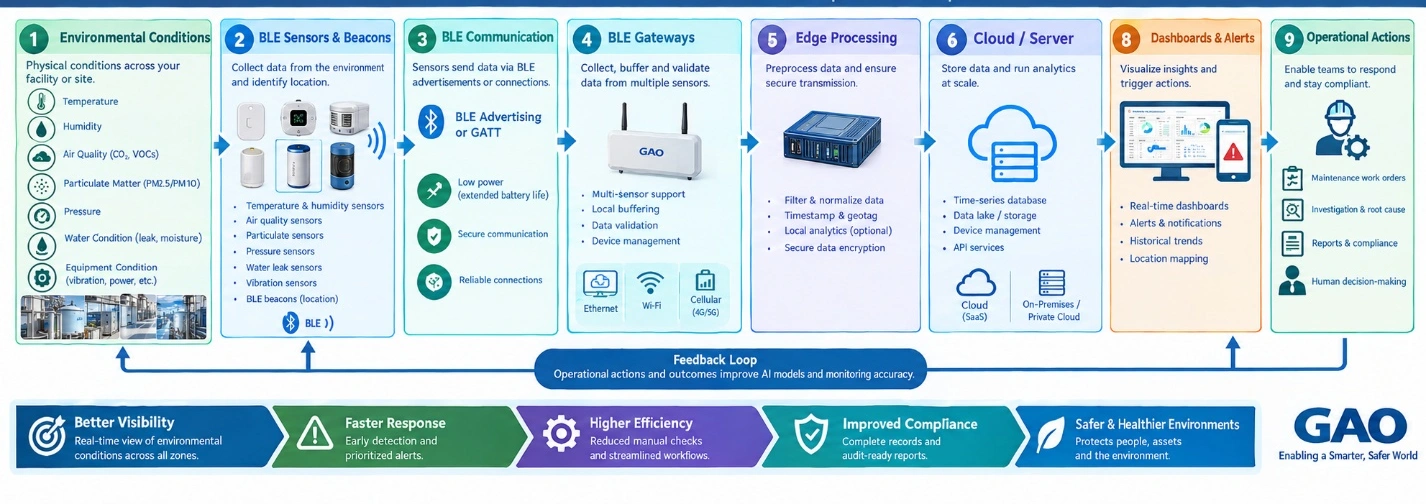
This workflow illustrates how environmental conditions are captured by BLE sensors, collected through gateways, processed at the edge, and analyzed using cloud or server-based AI. It follows the data through anomaly detection, forecasting, alerts, dashboards, and human-led operational actions, with feedback improving future monitoring.
Technical Components Behind AI-Driven BLE Environmental Monitoring
AI-enabled environmental monitoring typically combines several technical layers. The correct combination depends on monitoring density, radio conditions, environmental exposure, connectivity, data volume, response time, security requirements, and the importance of maintaining historical records.
BLE Sensors and Environmental Measurement Devices
BLE sensors form the local measurement layer. Environmental deployments may use temperature and humidity sensors, pressure sensors, air-quality sensors, particulate sensors, equipment-condition sensors, or specialized sensing devices connected to BLE-capable hardware.
Sensor specifications should be evaluated against the actual environmental conditions. A sensor designed for an office environment may not be suitable for high humidity, chemical exposure, outdoor weather, condensation, dust, or industrial temperature ranges.
BLE Gateways
BLE gateways collect measurements from local sensors and provide an upstream connection to software systems.
Gateway selection should consider:
- BLE radio sensitivity and supported Bluetooth versions
- Number of simultaneously monitored sensors
- Ethernet, Wi-Fi, or cellular connectivity
- Local storage and buffering
- Operating temperature
- Enclosure and ingress protection requirements
- Remote configuration capabilities
- Device authentication
- Secure software updates
- Integration interfaces and APIs
GAO provides BLE gateway and sensor products that can be incorporated into environmental IoT deployments where the physical site and wireless requirements are compatible with BLE.
AI and Machine Learning Software
AI software sits above the sensing and communication layers. Its effectiveness depends heavily on data quality.
Environmental AI systems may combine statistical models with machine learning rather than relying on a single model. A simple threshold may be more appropriate for a clearly defined safety limit, while anomaly detection may be better suited to identifying gradual deviations from a location-specific baseline.
Time-series forecasting can estimate future environmental conditions, while classification models can categorize recurring event patterns.
Edge, Server, and Cloud Processing
The processing model should reflect environmental monitoring requirements.
Cloud Version: A cloud-hosted deployment is appropriate when organizations need centralized monitoring across many facilities, remote access, elastic computing resources, centralized model management, and integration with cloud-based enterprise software. Environmental data can be aggregated across geographically distributed monitoring locations while access controls determine which users can view or manage individual sites.
Server Version: A privately hosted deployment can run on an edge server, customer-managed server, private data center, facility server, or other controlled enterprise infrastructure. This model can be appropriate where organizations require tighter control over data location, local processing, network isolation, integration with existing environmental software, or continued operation under restricted external connectivity.
A hybrid design can also place immediate data validation and selected AI inference near the monitoring location while forwarding historical data and broader analytics to centralized infrastructure.
Security and Data Integrity
Environmental monitoring systems should protect both the sensor network and the resulting environmental records.
Security controls may include:
- Device authentication
- Encrypted communications
- Role-based access control
- Secure gateway configuration
- Network segmentation
- Protected APIs
- Audit logging
- Credential rotation
- Signed or controlled software updates
- Backup and recovery procedures
- Data integrity checks
- Monitoring for unauthorized devices
Environmental data can also become important during audits, investigations, maintenance activities, or regulatory reviews. Maintaining accurate timestamps, device identity, measurement provenance, calibration information, and system audit records therefore has operational value beyond ordinary dashboard reporting.
Technical Capabilities That Improve Environmental Operations
Combining AI with BLE-based sensing provides value beyond simply collecting more environmental measurements. The primary improvement comes from converting high-frequency telemetry into operational context that environmental teams can use to prioritize interventions.
Continuous Zone-Level Visibility
BLE sensors can provide frequent measurements across rooms, storage areas, equipment zones, loading areas, utility spaces, and other locations that may otherwise have limited instrumentation.
AI can compare measurements spatially and temporally to identify conditions such as:
- Temperature gradients between monitored zones
- Persistent humidity differences
- Repeated air-quality deterioration in particular areas
- Environmental hotspots around equipment
- Abnormal conditions occurring only during specific operating periods
- Environmental changes following maintenance or equipment changes
This helps environmental engineers investigate the physical cause rather than responding to isolated sensor alarms.
Intelligent Alert Prioritization
A threshold-only system can generate large numbers of alerts when environmental conditions fluctuate around configured limits. AI can add context such as magnitude, duration, rate of change, historical behavior, location, and related equipment status.
An alert can therefore be classified according to operational significance rather than simply whether a numerical limit was crossed.
Examples include:
- Immediate intervention for rapidly increasing temperature in a refrigerated area
- Investigation of gradual humidity deterioration
- Maintenance notification for an HVAC zone showing repeated instability
- Communications troubleshooting when multiple sensors simultaneously stop reporting
- Low-priority notification for a predictable short-duration fluctuation
This approach can reduce alarm fatigue while preserving visibility into genuinely important environmental events.
Predictive Maintenance for Environmental Equipment
Environmental monitoring data can also support maintenance decisions for HVAC systems, refrigeration equipment, air handlers, pumps, compressors, fans, and other facility equipment.
AI can correlate environmental behavior with equipment telemetry and maintenance records to identify early indications of degradation.
For example, a refrigeration system may continue operating while requiring increasingly long recovery periods after a door opening. The environmental signal can become an early indicator for maintenance before a major temperature excursion occurs.
The AI output should support maintenance personnel rather than automatically replacing engineering judgment. Critical interventions should retain appropriate human approval and established safety procedures.
Environmental Monitoring System Design and Integration
A successful deployment begins with the environmental requirement, not the wireless technology.
Define Measurement and Risk Requirements
Environmental teams should first identify what must be measured, where it must be measured, how frequently measurements are required, and what constitutes an actionable deviation.
Important design questions include:
- Which environmental variables affect the operation?
- What accuracy and resolution are required?
- Which areas require continuous monitoring?
- What are normal operating ranges?
- Which excursions require immediate escalation?
- How long must historical records be retained?
- Which measurements require calibration?
- What happens if network connectivity is interrupted?
- Which environmental records must be retained for audits?
- Which personnel are responsible for response?
These requirements determine the appropriate sensor, gateway, data-storage, and analytics configuration.
Commissioning and Sensor Placement
Sensor placement is one of the most important practical considerations in environmental monitoring.
A technically reliable BLE connection does not guarantee a representative environmental measurement. Sensors should be positioned according to airflow, heat sources, refrigeration patterns, sunlight exposure, equipment placement, occupancy, and other physical factors.
Commissioning should include:
- Sensor identity verification
- Location association
- Calibration verification
- Gateway coverage testing
- Sampling-interval validation
- Battery-status verification
- Timestamp synchronization
- Data-loss testing
- Alarm testing
- AI baseline validation
- Integration testing
A site acceptance test should verify both the physical measurement and the complete data path into the operational software.
Integration With Facility and Operational Software
Environmental monitoring becomes substantially more useful when readings are associated with the systems that control or manage the affected operation.
Common integration targets include:
- Building management systems for HVAC status and control context
- Computerized maintenance management systems for work orders
- Facility management software for location and equipment records
- Manufacturing execution systems for production context
- Warehouse management systems for storage and material movement
- Enterprise resource planning software for operational records
- Data historians for long-term industrial telemetry
- Business intelligence software for management reporting
- Security information and event management systems for cybersecurity monitoring
APIs, MQTT, HTTPS, REST interfaces, OPC UA, database integration, or other appropriate interfaces can connect environmental data with existing software.
The integration should preserve source timestamps, device identity, location, measurement units, calibration status, and data-quality indicators. Losing this metadata during integration can make later investigation difficult.
Cybersecurity and Data Integrity for AI Environmental Monitoring
Environmental monitoring systems increasingly connect sensors and gateways to corporate networks, cloud services, facility systems, and maintenance applications. Security therefore needs to cover the complete data path.
Device and Network Security
Recommended controls include:
- Unique device identities
- Controlled gateway enrollment
- Secure credential management
- Encrypted network communication where supported
- Network segmentation for IoT devices
- Least-privilege access
- Secure administrative interfaces
- Firmware and software update procedures
- Gateway hardening
- Firewall controls
- Centralized logging
- Monitoring for unexpected device behavior
Environmental sensors should not automatically receive broad access to operational networks simply because they need to transmit telemetry.
AI Data Governance
AI models depend on the quality and provenance of environmental data.
A production system should maintain:
- Sensor identity
- Measurement timestamp
- Location
- Measurement unit
- Calibration information
- Gateway identity
- Data-quality status
- Missing-data indicators
- Model version
- Alert-generation history
- Human disposition of significant events
These records allow environmental engineers to determine whether an AI-generated alert was based on reliable measurements.
AI predictions should also be monitored for model drift. Changes to HVAC equipment, room configuration, seasonal conditions, sensor placement, operating schedules, or facility usage can change the underlying data distribution.
Standards, Regulations, and Environmental Monitoring Governance
Regulatory requirements depend heavily on the application, jurisdiction, monitored material, facility type, and consequences of an environmental excursion. A BLE system should therefore be evaluated against the applicable operational and regulatory framework rather than treated as automatically compliant.
Relevant standards and regulatory references can include:
- ISO 14001 for environmental management systems
- ISO 50001 for energy management
- ISO 9001 where environmental monitoring forms part of quality-management processes
- ISO/IEC 27001 for information-security management
- ISO/IEC 27701 where applicable privacy-management requirements exist
- OSHA requirements relevant to workplace environmental and safety conditions
- EPA requirements applicable to emissions, environmental conditions, or regulated operations
- ASHRAE guidance relevant to HVAC and indoor environmental conditions
- FDA requirements where environmental monitoring supports regulated pharmaceutical, medical-device, food, or laboratory operations
- 21 CFR Part 11 where electronic records and electronic signatures fall within its scope
- Good Manufacturing Practice requirements where environmental monitoring forms part of regulated manufacturing
- Calibration and measurement-control procedures applicable to the organization’s quality system
Compliance should be validated with the organization’s quality, regulatory, environmental health and safety, and legal teams. Technology alone does not establish regulatory compliance.
Practical Implementation Challenges and Engineering Trade-Offs
Battery Life Versus Data Frequency
More frequent BLE transmissions and measurements can increase battery consumption. Environmental operations teams should determine whether minute-level, five-minute, fifteen-minute, or event-driven measurements are actually necessary.
A higher sampling frequency is justified when rapid excursions have operational consequences. Less demanding areas may use longer intervals to reduce maintenance requirements.
Radio Coverage Versus Gateway Density
Increasing gateway density can improve collection reliability but also increases installation, network, power, and maintenance requirements.
A proper site survey should account for:
- Concrete and masonry walls
- Metal racks
- Refrigeration equipment
- Electrical equipment
- Floor-to-floor propagation
- Sensor density
- Gateway mounting height
- Radio interference
- Required redundancy
Environmental monitoring should be designed around measured radio performance rather than theoretical BLE range.
AI Complexity Versus Explainability
A sophisticated AI model may identify complex patterns, but environmental engineers still need to understand why an alert was generated.
For many environmental applications, explainable anomaly detection and time-series analysis can be preferable to opaque models. The system should ideally expose supporting evidence such as the affected zone, rate of change, historical deviation, related sensors, and predicted trajectory.
Cloud Scalability Versus Local Continuity
Cloud software can simplify centralized multi-site analytics, while local processing can provide resilience when connectivity is interrupted.
A practical solution can combine both. Gateways or edge servers can buffer measurements locally and maintain essential alarm functions, while centralized software performs long-term analysis and cross-site reporting.
AIoT for the Next Generation of Environmental Operations
Artificial Intelligence of Things, commonly called AIoT or AI and IoT, combines artificial intelligence with IoT devices, sensors, connected equipment, and industrial systems.
For environmental operations, AIoT connects physical measurements with analytical decision-making. BLE sensors provide distributed sensing, gateways collect telemetry, software manages device and data flows, and AI converts historical and real-time measurements into predictions, anomaly detection, and operational recommendations.
The most mature deployments do not treat AI as a replacement for environmental engineers. Instead, AI handles high-volume data analysis while personnel remain responsible for interpreting significant events, approving interventions, investigating root causes, and maintaining compliance procedures.
This human-in-the-loop model is particularly important for environments where an incorrect automated decision could affect safety, product integrity, equipment reliability, or regulatory records.
Implementation Roadmap for AI-Enabled BLE Environmental Monitoring
Organizations planning a deployment can reduce implementation risk by progressing from a clearly defined environmental problem toward connected sensing and analytics.
- Assess the environmental process: Identify critical zones, monitored variables, operational risks, regulatory requirements, existing instrumentation, and response procedures.
- Define measurement requirements: Establish accuracy, sampling interval, environmental range, calibration, enclosure, battery, and data-retention requirements.
- Survey the facility: Evaluate BLE propagation, gateway locations, network connectivity, physical mounting conditions, interference, and power availability.
- Select sensing hardware: Match BLE sensors and beacons to the actual environmental conditions rather than selecting solely on communication specifications.
- Commission a pilot: Test representative rooms, storage areas, equipment zones, and operating conditions before expanding the deployment.
- Validate data quality: Confirm timestamps, measurement accuracy, sensor identity, gateway coverage, missing-data handling, and calibration records.
- Integrate operational systems: Connect environmental telemetry with facility management, maintenance, building management, warehouse, manufacturing, or compliance software as appropriate.
- Establish AI baselines: Allow sufficient representative historical data to establish normal environmental behavior before relying heavily on anomaly detection.
- Validate alerts with personnel: Compare AI findings against environmental engineers’ observations and documented operating events.
- Deploy cybersecurity controls: Apply device identity, network segmentation, access management, encryption, logging, patching, and monitoring procedures.
- Measure operational performance: Track excursions, detection time, response time, false alarms, sensor availability, and maintenance indicators.
- Scale by risk: Expand first into environmental zones where improved visibility provides measurable operational value.
- Maintain the system: Recalibrate sensors, replace batteries, review gateway health, monitor AI performance, update software, and retrain models when operating conditions change.
GAO has provided BLE, RFID, and IoT hardware products and systems to organizations requiring connected sensing and identification capabilities. Our engineering support can help customers evaluate device selection, deployment requirements, system integration, and practical operating considerations
Why AI-Enabled BLE Monitoring Matters for Environmental Operations
AI does not make environmental monitoring valuable simply by adding another analytical layer. Its value comes from connecting continuous measurements with operational context and converting that information into earlier, more targeted decisions.
For environmental operations teams, the strongest use cases generally involve conditions where deterioration develops over time, multiple variables interact, or large sensor populations make manual analysis impractical.
A well-designed solution can provide:
- Earlier detection of environmental deterioration
- Better prioritization of operational alerts
- Reduced dependence on manual environmental checks
- Improved visibility across distributed facilities
- More efficient investigation of recurring excursions
- Better maintenance planning for environmental equipment
- Greater confidence in historical environmental records
- Scalable monitoring across additional zones and facilities
- Improved integration between sensing and facility operations
The underlying engineering principle remains straightforward: collect reliable measurements, preserve their context, analyze them appropriately, and connect the result to a defined operational response.
GAO’s experience supplying BLE, RFID, and IoT products and systems can support organizations evaluating connected environmental monitoring requirements. For technical teams planning a deployment, the next step is to define the monitored environment, required measurements, operational risks, and integration requirements before selecting the appropriate hardware and software.
Building the Future of Industrial AI and IoT with Aperture Venture Studio and GAO RFID Inc.
For more than three decades, GAO Group of Companies has invested heavily in R&D covering industrial BLE, RFID, and IoT. As AI became increasingly useful for industrial applications, our work expanded toward AIoT solutions for connected sensing, environmental monitoring, asset visibility, and operational analytics. We founded Aperture Venture Studio to advance AI and IoT solutions relevant to areas such as environmental operations.
Aperture brings together technical experts, executives, investors, and industry participants, while our summits foster discussion around AI and IoT. We welcome advisors, employees, investors, and customers.