
AI and RFID for Security Operations Center
AI-Driven Asset Visibility for Security Operations Centers
Security Operations Centers (SOCs) depend on accurate information about security equipment, evidence-handling assets, access credentials, mobile response equipment, communications devices, monitoring infrastructure, and personnel workflows. AI-enabled asset tracking can combine operational data with RFID identification to give SOC teams a more complete view of where critical resources are, how they are being used, and when an exception requires attention. RFID provides machine-readable identification at points where equipment enters, leaves, or moves through controlled areas, while AI analyzes the resulting operational data for anomalies, forecasting, prioritization, and decision support.
For Security Operations Centers, the value extends beyond knowing whether an item is present. AI can correlate RFID events with access-control records, incident tickets, dispatch activity, equipment maintenance, inventory transactions, and security schedules. This can help security managers identify missing equipment, unusual movement patterns, overdue returns, abnormal inventory changes, and resource requirements before they disrupt operations. GAO supplies RFID hardware and related IoT systems that can support these asset visibility and identification workflows.
How AI and RFID Support Modern Security Operations Centers
AI and RFID for Security Operations Centers should be treated as an operational intelligence solution rather than simply an RFID deployment. The objective is to turn physical security assets and their movements into structured information that security personnel can use during routine operations and incident response.
RFID can identify tagged assets without requiring an operator to scan every item individually. UHF RFID is particularly useful for reading multiple tagged objects across controlled equipment rooms, security stores, staging areas, and designated movement points. HF RFID can be appropriate for shorter-range identification tasks, badges, cards, or controlled interactions where close-range reading is preferred. LF RFID can support specialized identification requirements where its operating characteristics are advantageous.
AI adds analytical capabilities to the identification data. Depending on the SOC workflow, machine learning, anomaly detection, classification models, predictive analytics, computer vision, and rule-based decision logic can be combined. Edge AI can process selected events close to the security environment when low latency or local data processing is important, while centralized servers can perform broader historical analysis.
A practical SOC implementation may connect RFID readers with:
- Security information and event management systems
- Physical access-control systems
- Video management systems
- Computer-aided dispatch software
- Incident and case management systems
- Security guard management software
- Asset management and maintenance systems
- Inventory and warehouse management software
- Identity and credential management systems
- Building management systems
- Emergency communication systems
- Service management and work-order systems
- Databases and enterprise reporting software
The resulting system can establish relationships between physical assets, personnel, locations, incidents, and operational events.
AI-Enabled Security Operations Center RFID System Diagram
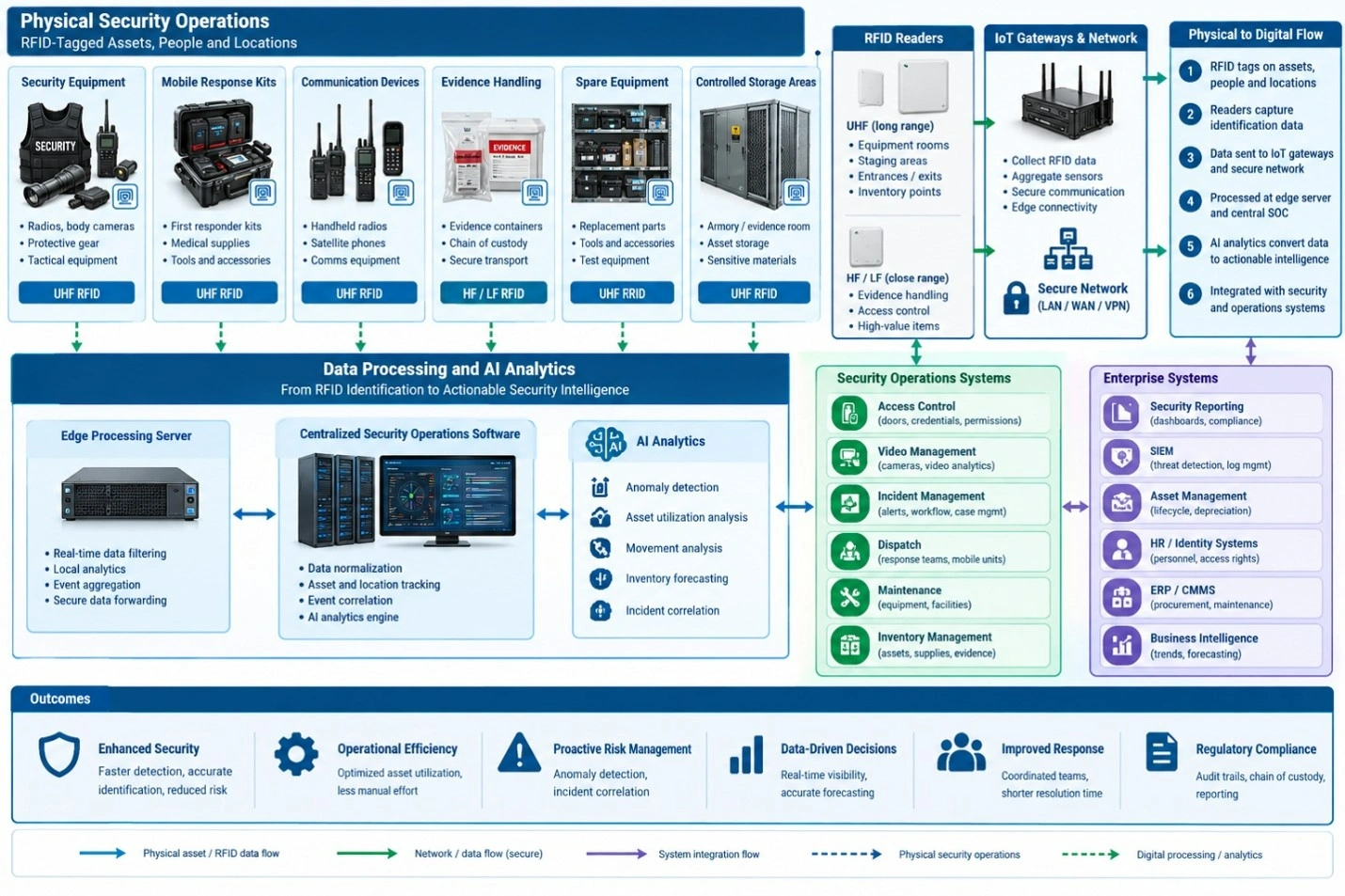
This enterprise system diagram illustrates how RFID-tagged security assets, response kits, communications equipment, evidence containers, and controlled storage areas connect through RFID readers, IoT gateways, secure networks, edge processing, and centralized security operations software. AI analytics transform identification and movement data into anomaly detection, asset utilization insights, inventory forecasting, and incident correlation, with integrations across access control, video management, dispatch, maintenance, inventory, and security reporting.
Security Operations Center Applications for AI-Based Asset Tracking
Security Equipment and Response Kit Tracking
Security teams often maintain radios, body-worn equipment, surveillance devices, portable sensors, protective equipment, access-control equipment, emergency kits, specialized tools, and mobile response cases. Manual sign-out procedures can become unreliable during shift changes, emergency deployments, or high-volume equipment movements.
RFID can create automated identification events when tagged equipment passes through designated reading zones. AI can then analyze movement histories and identify deviations from expected workflows.
A SOC can use this capability to determine:
- Which response kits are available for immediate deployment
- Whether equipment assigned to a response team has been returned
- Which assets remain in a staging area after an incident
- Whether equipment is repeatedly moved between unexpected locations
- Which equipment experiences unusually high utilization
- Whether spare equipment levels are adequate for planned operations
- Which assets require inspection or maintenance after repeated use
These functions can reduce dependence on manual reconciliation and provide security supervisors with a more current operational picture.
Access Credential and Controlled Asset Management
Security Operations Centers may oversee physical access cards, visitor credentials, temporary badges, keys, specialized credentials, and equipment associated with restricted areas. RFID can provide identification at controlled handoff points, while AI can analyze issuance, return, location, and exception records.
A useful implementation does not rely on RFID alone for authorization. Access decisions should remain governed by the organization’s identity and access-control policies. RFID events can instead provide additional operational evidence that supports reconciliation, investigations, and exception handling.
AI can flag conditions such as a credential that remains outstanding beyond its expected return period, unusual movement associated with a controlled asset, or repeated discrepancies between access records and asset transactions.
Incident Response and Emergency Equipment
Emergency response places different demands on a Security Operations Center than routine inventory management. During a major incident, security personnel may rapidly deploy medical kits, radios, cameras, access-control equipment, barriers, sensors, portable lighting, power equipment, and communications resources.
AI-enabled RFID tracking can establish a near-real-time inventory of equipment associated with an incident response. This helps the SOC determine which resources have been deployed, which remain available, and which need replenishment.
Historical incident records can also be analyzed to forecast equipment demand. For example, repeated events may reveal that certain response kits, radios, batteries, or portable monitoring devices are consistently required for particular incident categories or operating conditions.
Evidence and Investigative Asset Traceability
Security investigations can involve physical devices, storage containers, removable media, cameras, tools, access credentials, and other controlled objects. RFID can provide identification events at designated custody points, while case-management software maintains the authoritative investigative record.
AI can assist by detecting inconsistencies between expected and observed movement histories. It can also help investigators retrieve relevant records by correlating asset identifiers with incident numbers, locations, timestamps, access events, and responsible personnel.
Such systems should preserve auditability. AI-generated findings should support human investigators rather than silently replacing established evidence-handling procedures.
Security Inventory and Restricted Storage
Security stores may contain high-value or access-controlled equipment that requires frequent reconciliation. Conventional periodic inventory checks can leave a significant period during which discrepancies remain undetected.
RFID-enabled inventory processes can automate identification at storage locations and movement points. AI can analyze historical consumption and movement data to identify unusual depletion, frequently requested equipment, inactive stock, or expected shortages.
GAO can support these workflows with RFID readers, tags, antennas, gateways, and related identification hardware selected according to reading distance, asset composition, operating environment, and required workflow.
Realistic RFID Deployment in a Security Operations Center
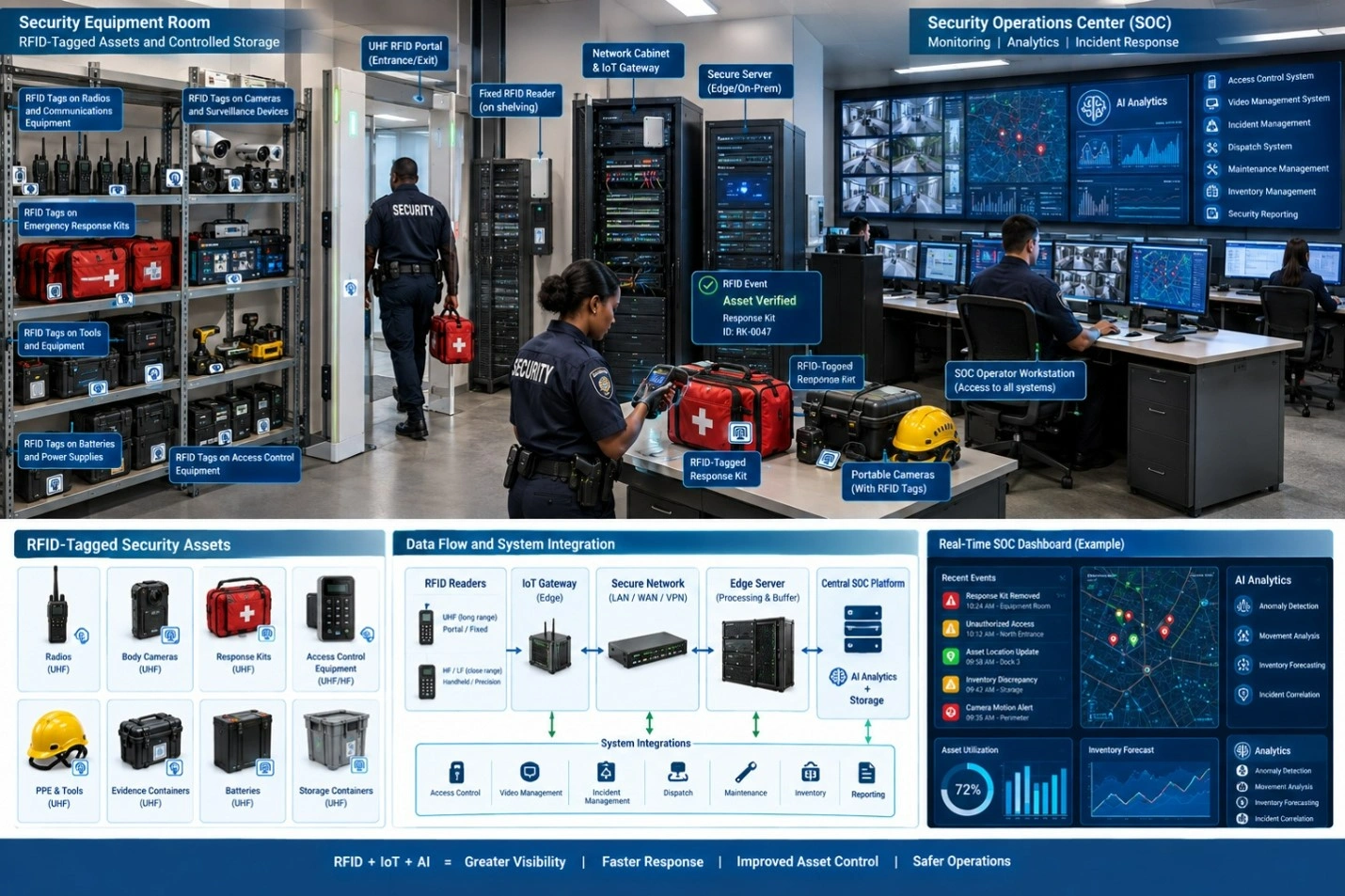
This realistic enterprise illustration shows RFID-enabled security equipment rooms and a central Security Operations Center working together. It depicts tagged radios, cameras, emergency response kits, batteries, tools, and storage containers, with UHF RFID portals, fixed readers, handheld readers, IoT gateways, edge servers, and SOC software connecting physical asset activity to AI analytics and operational systems.
Security Operations Center Data Workflow from RFID Capture to AI Decisions
A successful implementation should define the complete information path rather than focusing only on the RFID reader. The operational workflow begins with a physical event and ends with an action by a security operator, supervisor, investigator, inventory manager, or automated software process.
Physical Data Acquisition
Tagged security assets generate identification events when they enter the field of an RFID reader. Fixed readers can monitor defined movement points, while handheld readers can support verification, investigation, and cycle-count activities.
Reader placement requires careful assessment of the physical environment. Metal cabinets, electronic equipment, liquids, dense storage, walls, doors, and human movement can influence radio-frequency performance. Tag selection must therefore account for the material and geometry of the asset.
A security equipment room containing metal cases, batteries, radios, and electronic devices may require different RFID tags and antenna arrangements than an administrative storage area containing paper files or plastic identification cards.
Edge Processing and Event Validation
Raw reader events should not automatically become business transactions. The system should validate the event, remove duplicates where appropriate, associate the RFID identifier with an asset record, and determine whether the event corresponds to an expected workflow.
Edge gateways or local servers can perform initial processing before information reaches centralized systems. This can reduce unnecessary traffic and allow selected functions to continue during temporary connectivity problems.
Event validation may consider:
- RFID tag identifier
- Reader identifier
- Antenna zone
- Timestamp
- Signal characteristics
- Asset identity
- Authorized location
- Expected movement
- Personnel or team assignment
- Incident or work-order reference
- Access-control status
The objective is to convert radio-frequency observations into meaningful security operations events.
AI Analysis and Correlation
Validated events can then be analyzed alongside information from other SOC systems. AI models may identify patterns that are difficult to detect through simple threshold rules.
An anomaly model, for example, can learn normal movement patterns for a response kit and flag an unusual transfer. A forecasting model can estimate future demand for emergency equipment. A classification model can categorize equipment movement events according to normal operational workflows, maintenance activity, incident deployment, or potential exceptions.
AI should operate with appropriate confidence thresholds and human review. Security operations often involve consequences that make false positives and false negatives operationally significant. Model outputs should therefore be explainable enough for supervisors to understand why an event was flagged.
Decision Support and Security Actions
The final stage is the operational response. A detected exception may create a notification, incident ticket, inventory review, maintenance request, or supervisor task.
Examples include:
- Alerting a supervisor when a controlled asset remains outside its approved area
- Creating an inventory reconciliation task after an unexpected movement
- Triggering a maintenance inspection after repeated equipment deployment
- Recommending replenishment based on historical incident consumption
- Linking an asset movement to an existing security incident
- Displaying equipment availability to an emergency response coordinator
- Escalating repeated exceptions for management review
The system should distinguish between informational events, operational warnings, and security incidents so that SOC personnel are not overwhelmed by low-value alerts.
AI-to-Action Security Operations Center RFID Workflow
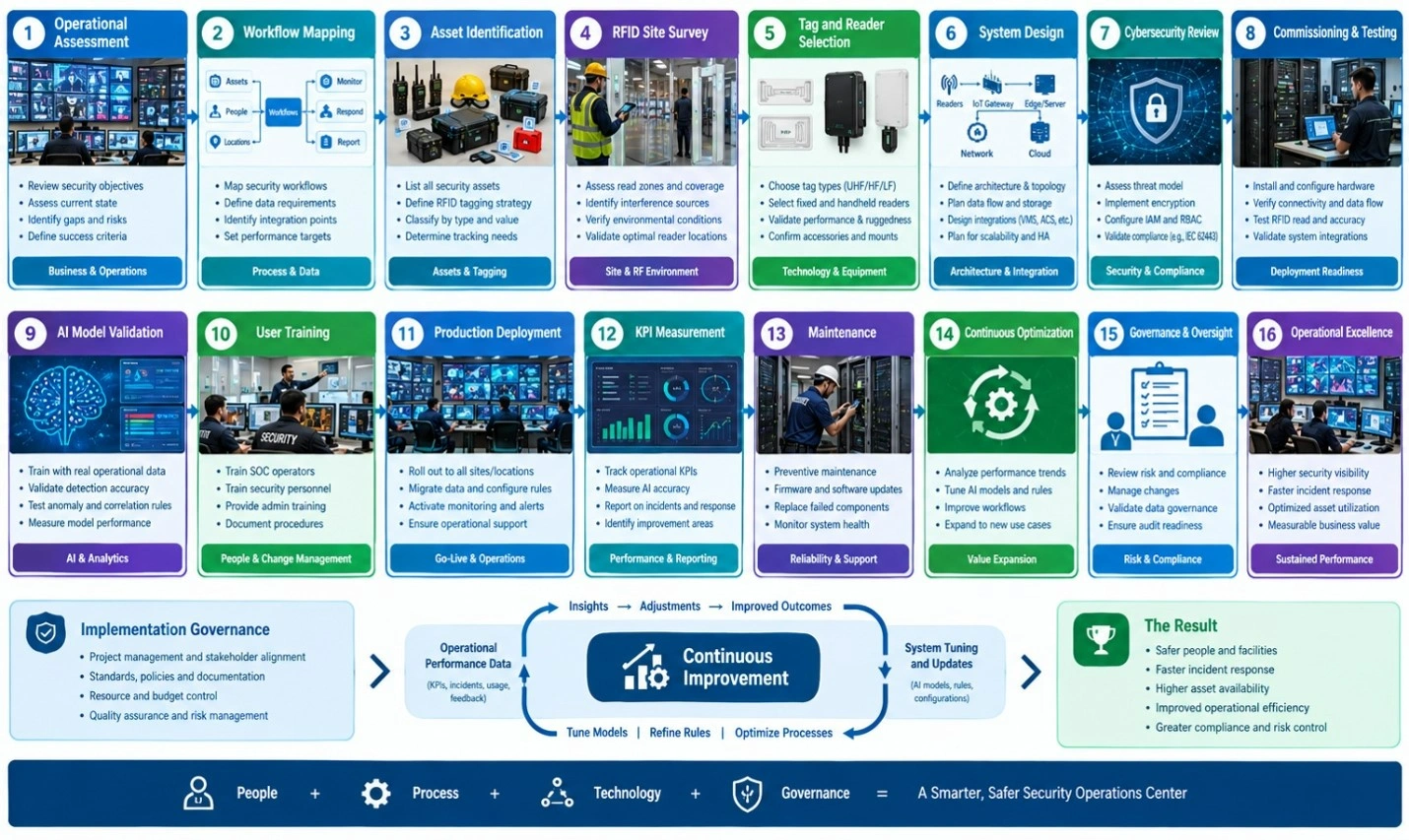
This enterprise workflow diagram shows how RFID events from tagged security assets move through reader capture, data filtering, validation, secure transmission, edge processing, centralized analytics, and AI-driven intelligence. It connects AI insights to SOC dashboards, alerts, incident management, inventory reconciliation, maintenance requests, and human-approved security actions.
RFID Hardware and AI Infrastructure for Security Operations Centers
Security Operations Center deployments require hardware selected around the physical workflow rather than around RFID specifications alone. Reader configuration, tag type, antenna placement, network connectivity, processing location, and software integration should all be considered together.
RFID Readers, Tags, and Antennas
UHF RFID is generally suited to longer-range identification and multi-tag reading around equipment rooms, storage areas, staging locations, and controlled movement points. HF RFID is useful where close-range interaction is preferred, while LF RFID can support specialized identification scenarios.
Reader selection should consider read range, expected tag density, antenna configuration, environmental interference, mounting location, network interfaces, and required event throughput.
Tag selection is equally important. Security assets may include metal radios, plastic cases, electronic equipment, fabric equipment bags, batteries, tools, and mixed-material kits. Tags designed for general-purpose objects may perform poorly when mounted directly to conductive surfaces. On-metal RFID tags can therefore be relevant for selected equipment.
Secure Communication and Integration
RFID readers can connect through Ethernet, Wi-Fi, cellular networks, or other supported communications infrastructure depending on the deployment environment. Security-sensitive systems should use authenticated communications, encryption where appropriate, network segmentation, controlled device credentials, and centralized logging.
Middleware can normalize RFID reader events and expose them to security applications through APIs, databases, message brokers, or other integration methods. This prevents individual applications from having to communicate directly with every reader.
GAO’s RFID hardware and IoT solutions can be incorporated into such systems based on the physical identification requirements and the existing software environment.
AI Processing and Security Data Management
AI processing can be distributed between edge computing resources and centralized servers. Edge processing is useful when rapid event classification, local operation, or reduced network traffic is important. Centralized processing is useful for historical analysis across multiple SOC facilities, long-term model training, enterprise reporting, and cross-site correlation.
Security organizations should also establish data retention policies, role-based access control, audit trails, model governance, and procedures for reviewing AI-generated alerts.
Cloud Version and Server Version for Security Operations Centers
A cloud-hosted deployment can be appropriate for organizations that operate multiple Security Operations Centers and need centralized visibility across locations. Cloud infrastructure can provide centralized analytics, reporting, software updates, and cross-site data aggregation without requiring every location to operate a large local computing environment.
A Server Version can be deployed on customer-managed servers, private data centers, edge servers, or other privately hosted enterprise infrastructure. This approach can be preferable where security policies, network isolation, data residency requirements, existing SOC infrastructure, or operational continuity requirements favor local control.
Hybrid deployment is also practical. RFID event processing and selected AI functions can run locally while aggregated operational data and approved analytics are synchronized with centralized infrastructure.
The appropriate model depends on the organization’s security policies, network design, latency requirements, data governance, existing IT capabilities, and the operational consequences of connectivity loss.
Deployment and Integration Considerations for Security Operations Centers
Deploying AI-enabled RFID in a Security Operations Center requires more than installing readers and attaching tags. The implementation should begin with a workflow assessment that identifies where security personnel currently receive, issue, transport, store, inspect, and return critical assets. Those physical events determine where RFID identification points provide measurable operational value.
A phased deployment is usually preferable. A controlled equipment room or response-kit store can serve as the initial deployment area before extending RFID coverage to multiple facilities, restricted zones, vehicle staging areas, or regional SOC locations.
RFID Site Survey and Hardware Selection
A site survey should document doors, walls, shelving, metal structures, electronic equipment, storage density, reader mounting positions, network availability, and expected movement patterns. Testing should be performed with representative assets rather than relying solely on theoretical RFID read-range specifications.
Important selection criteria include:
- RFID frequency and required read distance
- Asset material and tag mounting surface
- Number of tagged assets expected in each zone
- Required identification speed
- Reader and antenna placement
- Network availability and redundancy
- Environmental conditions
- Required handheld versus fixed RFID coverage
- Integration interfaces
- Local processing requirements
- Maintenance and replacement requirements
Security Operations Centers should also define what constitutes a reliable identification event. A tag detected once at a doorway may not provide enough evidence to conclude that an asset has permanently changed location. Event logic should account for repeated reads, reader zones, direction of travel, timestamps, and known operational workflows.
Integration with SOC Software
RFID data becomes substantially more useful when connected with systems already used by security personnel. An asset identifier can be associated with an equipment record, employee or team assignment, incident number, work order, storage location, or access event.
API-based integration can connect RFID middleware with incident-management software, access-control databases, inventory systems, maintenance applications, dispatch systems, and reporting databases. Message-based integration can also be used where high-frequency events need to be distributed to multiple applications.
The integration layer should preserve the original RFID event as well as the interpreted business event. This distinction helps technical teams investigate discrepancies and improves auditability.
Commissioning and Testing
Commissioning should test both technical performance and actual security workflows. Engineers should verify read coverage, missed reads, duplicate events, tag orientation, reader-zone boundaries, network behavior, database updates, alert generation, and integration with downstream systems.
Test cases should include normal asset movement, authorized transfers, unauthorized movement, equipment returns, simultaneous movement of multiple tagged assets, damaged or unreadable tags, network interruption, reader failure, and recovery after system restoration.
AI models should be validated separately from RFID performance. A reliable RFID event does not automatically produce a reliable AI conclusion. Historical data quality, representative training data, alert thresholds, model drift, and human review procedures should all be evaluated.
Cybersecurity and Data Governance for AI-Enabled SOC Asset Tracking
RFID should be treated as part of the SOC’s broader information security environment. A tagged asset can reveal operational information about equipment location, response activity, personnel assignments, or restricted-area movements. Protecting this information is therefore important even though RFID itself is primarily an identification technology.
Network segmentation can separate RFID readers and IoT gateways from general-purpose user networks. Device authentication, encrypted communications where supported, controlled administrative access, firmware management, logging, and vulnerability management should form part of the deployment lifecycle.
AI introduces additional governance requirements. Security teams should establish:
- Role-based access to asset and incident information
- Audit logging for administrative and investigative actions
- Data retention and deletion policies
- Model access controls
- Human review procedures for consequential alerts
- Procedures for correcting inaccurate asset records
- Monitoring for abnormal AI behavior or model degradation
- Backup and recovery procedures
- Segmentation between operational technology and general IT networks
- Change-control procedures for readers, middleware, and AI software
AI should generally be used as decision support when an automated decision could affect personnel access, investigations, or security response. Clear escalation rules can help ensure that high-impact actions receive appropriate human authorization.
AI Capabilities That Improve Security Operations Center Performance
Combining RFID event data with AI can improve several operational functions because the system gains both physical identification information and historical context.
Anomaly Detection
AI can establish expected movement patterns for equipment, teams, storage locations, and operational periods. A response kit normally transferred from a secure store to a designated staging area may generate an exception if it repeatedly appears in another location without a corresponding incident or work order.
This approach can reduce the burden of manually reviewing large volumes of asset transactions.
Predictive Equipment Demand
Historical RFID transactions can reveal consumption and utilization patterns. AI can use these records together with incident categories, schedules, seasonal demand, maintenance activity, and inventory levels to forecast future requirements.
The result can be a more proactive replenishment process for batteries, communication equipment, emergency kits, surveillance devices, and other frequently deployed resources.
Asset Utilization Analysis
Security managers can use AI to identify equipment that is frequently deployed, rarely used, repeatedly misplaced, or disproportionately associated with maintenance activity. Such analysis can support procurement planning and equipment lifecycle decisions.
Incident Correlation
RFID movement events can provide physical context around security incidents. AI can correlate asset movements with incident timestamps, access records, video events, dispatch activity, and work orders to help operators identify relevant records faster.
The system should preserve source records so that AI-derived relationships can be reviewed against the underlying evidence.
Measuring Business and Operational Outcomes
A Security Operations Center should define measurable outcomes before deploying AI and RFID. The number of RFID events generated is a technical metric, but it does not demonstrate operational value by itself.
Relevant KPIs can include:
- Asset inventory accuracy
- Percentage of critical assets with known current status
- Response-kit readiness
- Average time required to locate equipment
- Average equipment checkout and return time
- Overdue asset return rate
- Unresolved asset discrepancy rate
- Unauthorized movement alerts
- Mean time to review an asset exception
- RFID read success rate
- Duplicate-event rate
- Equipment utilization rate
- Emergency equipment availability
- Inventory reconciliation time
- Maintenance compliance
- Stockout frequency
- Incident-related equipment retrieval time
- Percentage of AI alerts requiring human escalation
Baseline measurements should be captured before deployment where practical. Comparing pre-deployment and post-deployment performance provides stronger evidence than relying on subjective impressions.
Operational Benefits of AI-Enabled RFID for Security Operations Centers
The combined solution can produce value across security operations because physical asset events become available for continuous analysis.
- Faster asset identification: RFID can reduce manual searching and scanning when security equipment moves through designated identification zones.
- Improved inventory accuracy: Automated identification reduces dependence on manually maintained equipment lists.
- Better response readiness: SOC personnel can obtain a more current picture of available emergency and response equipment.
- Earlier exception detection: AI can identify unusual movement or inventory patterns before they become larger operational problems.
- Improved investigations: Correlated asset, access, incident, and movement records can reduce the time required to locate relevant information.
- More effective maintenance planning: Equipment utilization data can help identify assets that require inspection or servicing.
- Better procurement decisions: Historical usage and demand forecasts can support evidence-based replacement and replenishment decisions.
- Scalable multi-site visibility: Centralized analytics can compare approved operational metrics across multiple Security Operations Centers while retaining local processing where required.
- Reduced administrative workload: Automated identification and reconciliation can reduce repetitive manual inventory activities.
These benefits depend on appropriate RFID placement, accurate asset master data, reliable system integration, and disciplined operational procedures. AI cannot compensate for poorly defined workflows or incomplete source data.
Implementation Recommendations for Security Operations Centers
Organizations planning AI-enabled RFID deployment should start with a clearly defined operational problem. A system intended to improve emergency equipment readiness will have different reader locations, tags, data models, and KPIs from one designed primarily for controlled asset custody.
Recommended implementation practices include:
- Identify high-value security workflows before selecting hardware.
- Establish an authoritative asset registry with unique identifiers.
- Test RFID tags on the actual materials used by the SOC.
- Conduct an RF site survey before final reader placement.
- Separate raw RFID observations from validated business events.
- Integrate RFID events with existing security and incident systems.
- Use edge processing where local response or connectivity resilience is important.
- Use centralized analytics for historical and multi-site analysis.
- Establish human review procedures for high-impact AI alerts.
- Protect RFID readers, gateways, servers, APIs, and databases as part of the security environment.
- Define measurable KPIs before deployment.
- Begin with a controlled operational area and expand after validation.
- Periodically review tag condition, reader performance, data quality, and AI model accuracy.
- Maintain documented recovery procedures for reader, network, server, and database failures.
GAO can provide RFID hardware and related IoT systems that support identification, asset monitoring, and connected security workflows. Organizations can evaluate the required RFID technology, readers, tags, antennas, gateways, and supporting systems according to their specific Security Operations Center environment.
AI-Enabled RFID Security Operations Center Implementation Lifecycle
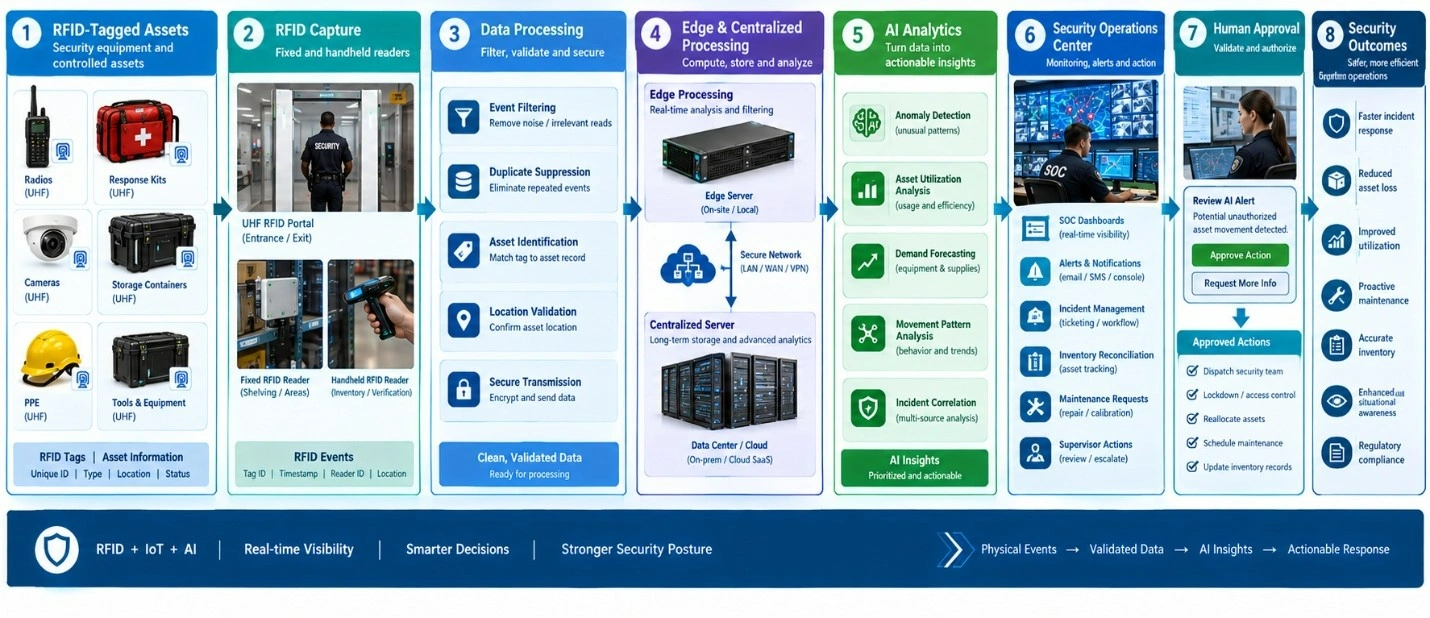
This lifecycle diagram presents the engineering progression for deploying AI-enabled RFID in a Security Operations Center, from operational assessment and workflow mapping through site surveying, system design, cybersecurity, commissioning, AI validation, and production deployment. It also highlights KPI measurement, maintenance, governance, and continuous optimization through feedback loops that connect operational performance to system tuning.
Key Takeaways for AI and RFID in Security Operations Centers
AI-enabled RFID can give Security Operations Centers a stronger connection between physical security assets and digital operational intelligence. RFID provides reliable identification events at selected locations, while AI can transform those events into anomaly detection, demand forecasting, asset utilization analysis, incident correlation, and decision support.
The strongest implementations begin with operational workflows rather than technology specifications. Reader placement, tag selection, integration, cybersecurity, data governance, AI validation, and human oversight all influence the final result.
GAO has supplied RFID and IoT hardware and systems to organizations that require practical identification and connected monitoring capabilities. GAO Group, which includes GAO and its sister companies, has served customers in the United States and Canada for three decades, including Fortune 500 companies, leading R&D organizations, universities, and government agencies. Its operations are based in New York City and Toronto, Canada, with substantial investment in product and system R&D, quality assurance, and technical support.
Security organizations evaluating AI-based asset visibility can use these principles to define an implementation that matches their physical environment, operational requirements, security policies, and existing SOC software. Learn more about GAO’s RFID technologies, IoT systems, engineering expertise, and technical support to determine how connected asset identification can fit into your Security Operations Center workflows.
Building the Future of Industrial AI and IoT with Aperture Venture Studio and GAO RFID Inc.
For more than three decades, GAO Group of Companies has invested heavily in R&D for industrial RFID, BLE, and IoT. As AI has become increasingly useful for operational applications, we have continued developing AI and IoT technologies and founded Aperture Venture Studio to support the development and scaling of AI and IoT solutions relevant to areas such as security operations, asset intelligence, and connected infrastructure.
Aperture has attracted AI and IoT technical experts, entrepreneurial and operational executives, investors, and leading companies. We also developed the Aperture Ventures Summit and TekSummit to discuss advanced AI and IoT topics and build strong technical communities.
We welcome you to join us as:
- Advisors, Co-founders, or Employees
- Investors
- Customers