
AI and RFID for Transportation Infrastructure
AI-Driven Asset Tracking and Infrastructure Management for Transportation Networks
AI is transforming transportation infrastructure management by turning continuously collected asset, equipment, inspection, and operational data into actionable decisions. For highways, bridges, tunnels, rail infrastructure, transit facilities, ports, and roadside systems, AI can identify asset-location anomalies, predict maintenance requirements, prioritize inspections, and improve the movement of critical equipment. RFID provides a practical identification and data-capture layer, with UHF RFID supporting longer-range tracking, HF RFID supporting controlled near-field identification, and LF RFID supporting specialized short-range identification environments. Combined with edge computing, sensors, computer vision, machine learning, GIS, computerized maintenance management systems (CMMS), enterprise asset management (EAM), and transportation management software, these technologies can create a continuous information flow from physical infrastructure to operational teams. GAO provides RFID and IoT hardware products and systems that can support these transportation infrastructure workflows, including deployments requiring rugged identification, automated data capture, and integration with customer software.
AIoT and RFID System for Transportation Infrastructure Management
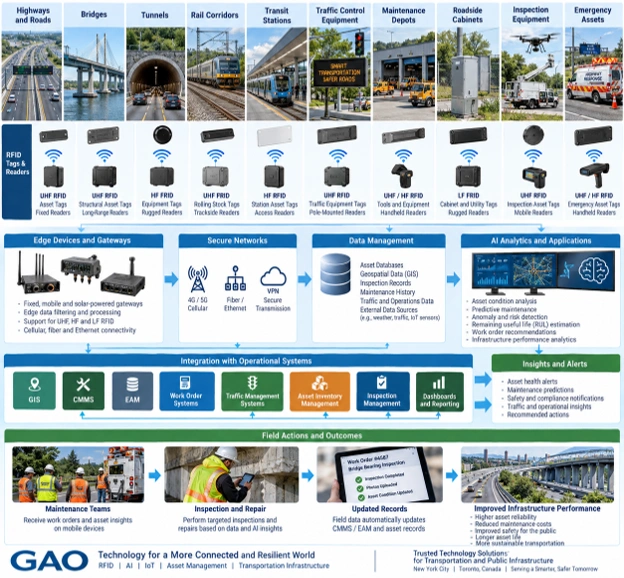
This enterprise infographic illustrates how RFID-tagged transportation assets connect with edge gateways, secure networks, data management, AI analytics, GIS, CMMS, EAM, and operational systems. It shows the progression from asset identification and monitoring through AI-driven insights, maintenance actions, and improved infrastructure performance.
What AI-Enabled RFID Asset Management Means for Transportation Infrastructure
Transportation infrastructure contains thousands of distributed assets whose condition, location, ownership, maintenance history, and operational status can change continuously. Examples include bridge inspection equipment, traffic signal controllers, variable message signs, roadway sensors, guardrail components, lighting systems, electrical cabinets, tolling equipment, rail maintenance tools, signaling equipment, emergency-response assets, and mobile maintenance machinery.
Traditional asset registers often depend on manual inspections, spreadsheets, barcode scans, handwritten field records, or periodic updates to CMMS and EAM systems. These approaches can create gaps between the physical transportation network and its digital records. An asset may have been relocated, replaced, repaired, retired, or temporarily removed while its software record remains unchanged.
AI-enabled asset management addresses this problem by combining identification data with contextual information. RFID establishes reliable asset identity, while AI can correlate RFID events with maintenance history, inspection records, sensor measurements, GIS coordinates, work orders, traffic conditions, weather information, and operational schedules.
The resulting system can answer practical questions such as:
- Where is a specific transportation maintenance asset?
- Was the correct equipment deployed to a bridge or roadway work zone?
- Which assets have not appeared at their expected inspection location?
- Which equipment is repeatedly associated with maintenance delays?
- Which infrastructure components require inspection based on historical patterns?
- Which maintenance resources should be dispatched first?
- Has an asset moved outside its authorized transportation facility or storage area?
- Which equipment is available for an upcoming roadway, rail, or bridge maintenance project?
GAO’s RFID and IoT products can support the physical identification and data-capture requirements behind these workflows, while customer software and AI applications can provide higher-level analytics and decision support.
Where AI Creates Operational Value Across Transportation Infrastructure
Highway and Roadway Asset Management
Highway agencies and road operators manage geographically dispersed equipment that may be distributed across maintenance yards, roadsides, interchanges, tunnels, and service facilities. AI-assisted RFID tracking can maintain more accurate records for maintenance tools, portable traffic-control equipment, roadwork assets, electrical components, and specialized field equipment.
Operational workflows can connect RFID events with GIS locations and CMMS work orders. A missing asset can trigger an exception rather than waiting for the next scheduled inventory cycle. Historical movement data can also help agencies identify equipment utilization patterns and improve allocation between maintenance districts.
Bridge Inspection and Maintenance
Bridge maintenance requires recurring inspections, specialized equipment, temporary access systems, lifting equipment, testing instruments, and replacement components. RFID identification can associate physical equipment with inspection jobs and bridge locations.
AI can analyze inspection histories, maintenance records, equipment utilization, and other available data to identify recurring problems and help prioritize maintenance activities. The system can also verify that inspection equipment assigned to a particular bridge project is available and accounted for.
Tunnel Infrastructure and Safety Equipment
Tunnels contain electrical systems, ventilation equipment, emergency-response equipment, fire and life-safety systems, communication equipment, lighting components, sensors, and maintenance tools. Many assets operate in environments where visibility and access can be difficult.
RFID-based identification can simplify equipment verification during maintenance activities. AI can correlate asset records with alarms, maintenance events, inspection intervals, and equipment history to support more informed maintenance prioritization.
Rail Infrastructure and Transit Facilities
Rail infrastructure introduces additional requirements involving trackside equipment, signaling components, maintenance tools, station equipment, rolling-stock support assets, and depot inventories. RFID can provide automated identification at maintenance depots, controlled storage locations, and selected trackside environments.
AI can analyze movement patterns and maintenance records to identify abnormal asset usage, recurring maintenance requirements, inventory shortages, or equipment associated with repeated service events.
Ports, Intermodal Facilities, and Transportation Terminals
Transportation terminals depend on high asset utilization and rapid movement of equipment. RFID identification can support tracking of maintenance equipment, containers, tools, spare parts, access-controlled assets, and specialized handling equipment.
AI can combine identification events with scheduling, equipment utilization, maintenance records, and facility operations to identify bottlenecks and improve resource allocation.
Realistic RFID Deployment for Transportation Maintenance Operations
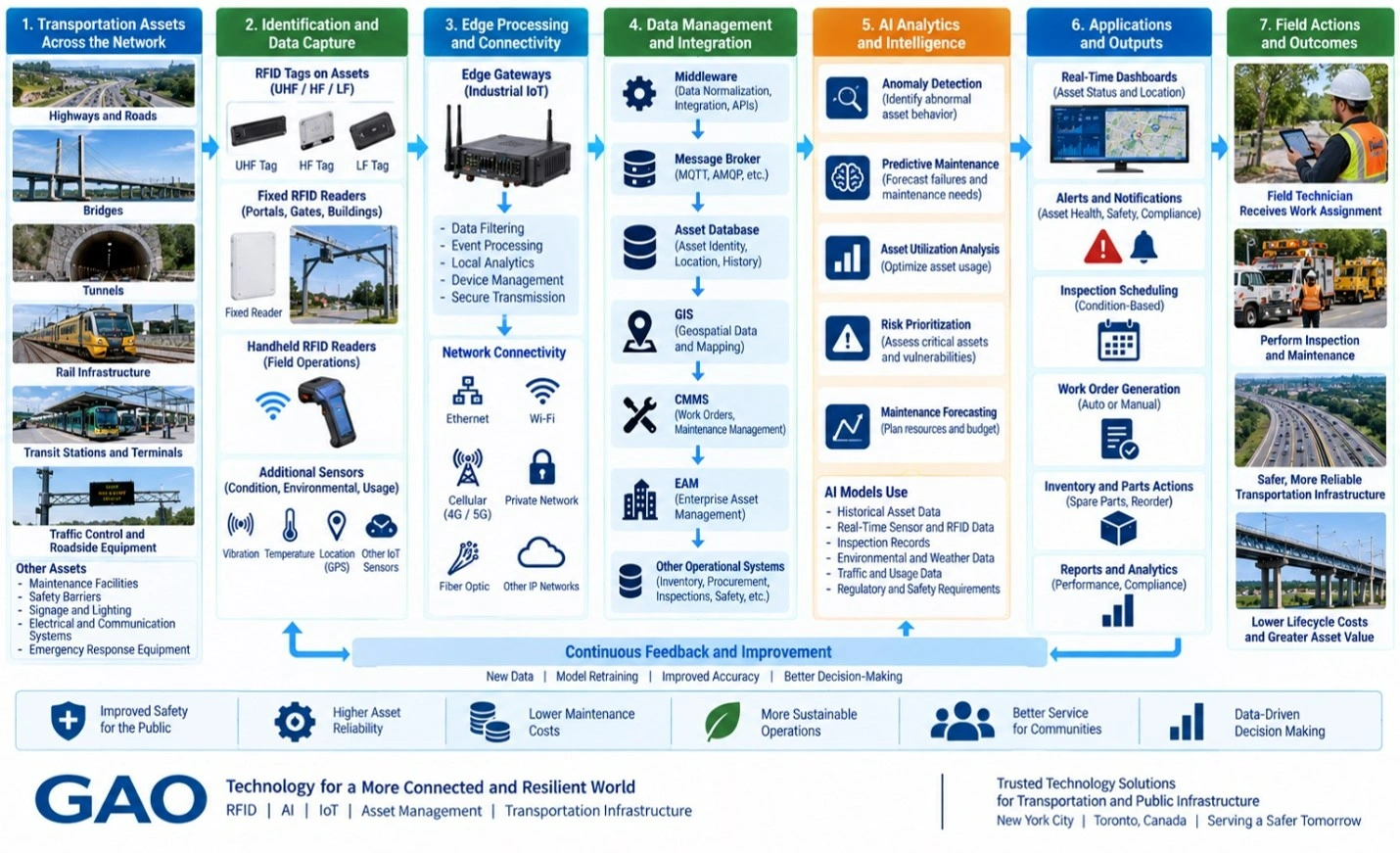
This realistic deployment illustration shows RFID-tagged maintenance trucks, traffic equipment, road barriers, inspection tools, electrical cabinets, and bridge maintenance equipment inside a transportation depot. It demonstrates how fixed and handheld RFID readers connect asset data through an IoT gateway to CMMS, EAM, GIS, work-order systems, and AI analytics for location alerts and maintenance actions.
Transportation Infrastructure Workflows Enabled by AI
AI-enabled transportation infrastructure management works best when identification, operational events, and business processes are connected rather than treated as isolated data streams.
A typical workflow begins when a physical transportation asset receives a unique identification record. Depending on the operating environment, that identity may be captured through UHF RFID for longer-range automated identification, HF RFID for controlled close-range interactions, or LF RFID for specialized environments requiring lower-frequency identification.
The RFID event is transmitted through a reader, gateway, or connected field device. Edge processing can filter duplicate reads, validate reader events, associate the identifier with a known transportation asset, and reduce unnecessary network traffic.
The processed event can then enter transportation software through APIs, middleware, message brokers, databases, or integration services. The software can associate the event with an asset record, work order, inspection activity, depot, route, bridge, tunnel, station, or maintenance district.
AI models operate on this contextual data rather than relying only on raw RFID reads. Depending on the application, machine learning can detect abnormal movement, predict maintenance requirements, identify utilization patterns, classify operational anomalies, or prioritize field activities.
The final step is a business action. An anomaly may create a CMMS work order, notify a transportation supervisor, update an asset record, trigger an inspection task, generate an inventory exception, or recommend moving equipment to another maintenance district.
End-to-End AI Workflow for Transportation Infrastructure Asset Management
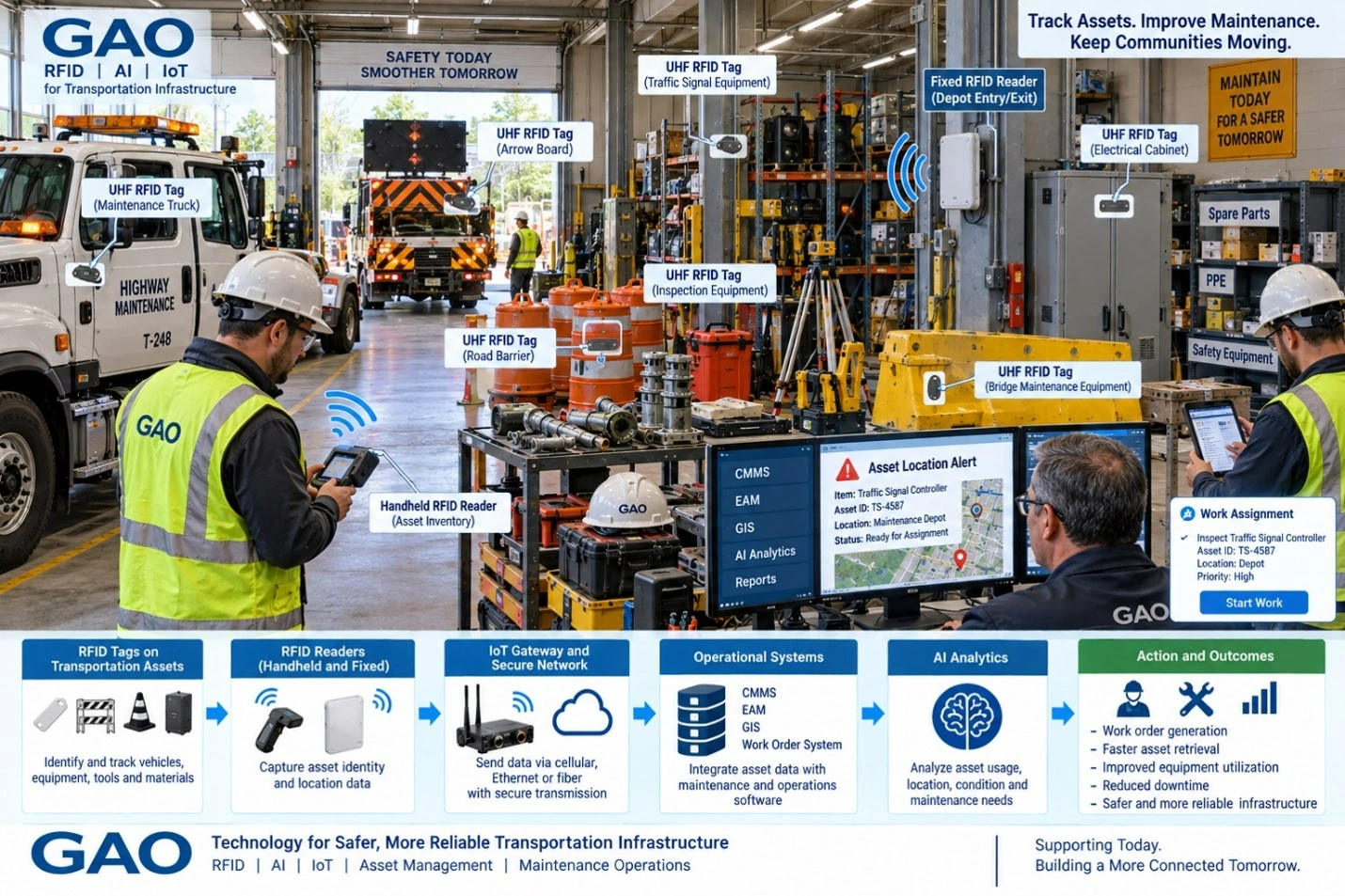
This workflow diagram traces transportation asset data from highways, bridges, tunnels, rail, and transit facilities through RFID identification, sensors, edge gateways, secure networks, middleware, GIS, CMMS, and EAM systems. AI analytics then supports anomaly detection, predictive maintenance, risk prioritization, asset utilization analysis, alerts, scheduling, work orders, and field maintenance decisions.
Core Technologies for AI-Enabled Transportation Asset Management
A transportation infrastructure solution normally combines several technical layers. RFID is an important identification mechanism, but the practical value comes from integrating it with field computing, communications, enterprise software, and AI.
UHF, HF, and LF RFID
UHF RFID is particularly useful when transportation agencies need automated identification across storage areas, maintenance depots, vehicle access points, or other locations where longer read ranges are advantageous. Reader antenna placement, tag orientation, metallic surfaces, interference, and read-zone design require field testing.
HF RFID is appropriate for controlled proximity identification such as technician workflows, equipment verification, access-related interactions, and selected maintenance processes.
LF RFID can be considered for specialized short-range identification environments where its propagation characteristics and read behavior are appropriate.
RFID selection should therefore follow the physical transportation workflow rather than being based solely on nominal read distance.
Edge Computing and Field Gateways
Edge gateways can collect RFID events and sensor data close to transportation assets. They can perform filtering, buffering, local validation, protocol conversion, and temporary data storage when network connectivity is intermittent.
This is particularly important for geographically distributed roads, bridges, rail corridors, tunnels, and remote maintenance facilities where continuous cloud connectivity cannot always be assumed.
AI and Machine Learning
AI methods can include anomaly detection, classification, forecasting, predictive maintenance models, time-series analysis, optimization, and computer vision. The appropriate model depends on the operational question and the quality of available historical data.
For example, an anomaly-detection model may identify unusual equipment movement, while a predictive model may estimate the probability of maintenance requirements from historical work orders and sensor measurements.
Transportation Software Integration
CMMS and EAM systems provide maintenance records and work-order context. GIS provides spatial relationships between assets and transportation infrastructure. ERP software can contribute procurement and financial information, while fleet-management software can provide vehicle and equipment information.
Integration should preserve a consistent asset identifier across RFID records, GIS records, maintenance systems, and AI datasets. This common identifier is essential for preventing duplicate asset records and unreliable analytics.
Cloud Version and Server Version
A Cloud Version can be appropriate when transportation organizations need centrally managed software accessible across multiple maintenance districts, facilities, or geographic regions. Cloud deployment can simplify centralized analytics, software updates, multi-site data aggregation, and remote operational visibility.
A Server Version can be deployed on customer-managed edge servers, private data centers, transportation control facilities, regional servers, or other privately hosted infrastructure. This approach can be appropriate when data residency, connectivity, integration constraints, cybersecurity policies, or operational control require privately hosted software.
Neither model is universally superior. Transportation organizations should evaluate network availability, cybersecurity requirements, data governance, latency, integration complexity, maintenance responsibilities, and the operational consequences of network outages before selecting the deployment model.
Engineering Considerations Before Deployment
Successful deployment requires more than installing RFID readers. Transportation infrastructure presents challenging physical conditions, distributed locations, mobile assets, metal surfaces, weather exposure, electromagnetic interference, inconsistent connectivity, and varying operational procedures.
The asset identification model should be defined before hardware deployment. Each asset needs a unique identifier and an agreed relationship between the physical identifier and the organization’s CMMS, EAM, GIS, or asset registry.
Reader placement should then be engineered around actual movement and work processes. A depot gate, maintenance bay, storage rack, bridge inspection staging area, or controlled equipment room may each require a different read-zone design.
Tag selection should consider mounting material, environmental exposure, attachment method, required read performance, temperature, moisture, vibration, and proximity to metal or other RF-sensitive materials.
Network design should account for remote locations and temporary loss of connectivity. Edge gateways can buffer events and synchronize them when communications are restored.
AI deployment also requires data quality controls. Poor asset records, inconsistent identifiers, missing maintenance history, duplicate events, and unvalidated inspection data can reduce model reliability regardless of the sophistication of the AI method.
GAO’s experience supplying RFID, BLE, and IoT hardware products and systems to organizations in the United States and Canada supports the practical hardware and deployment side of these requirements. GAO Group has served Fortune 500 companies, R&D organizations, universities, and government agencies for three decades, with product R&D, quality assurance, and remote or onsite technical support forming part of its engineering approach.
RFID Site Engineering and Read-Zone Design for Transportation Facilities
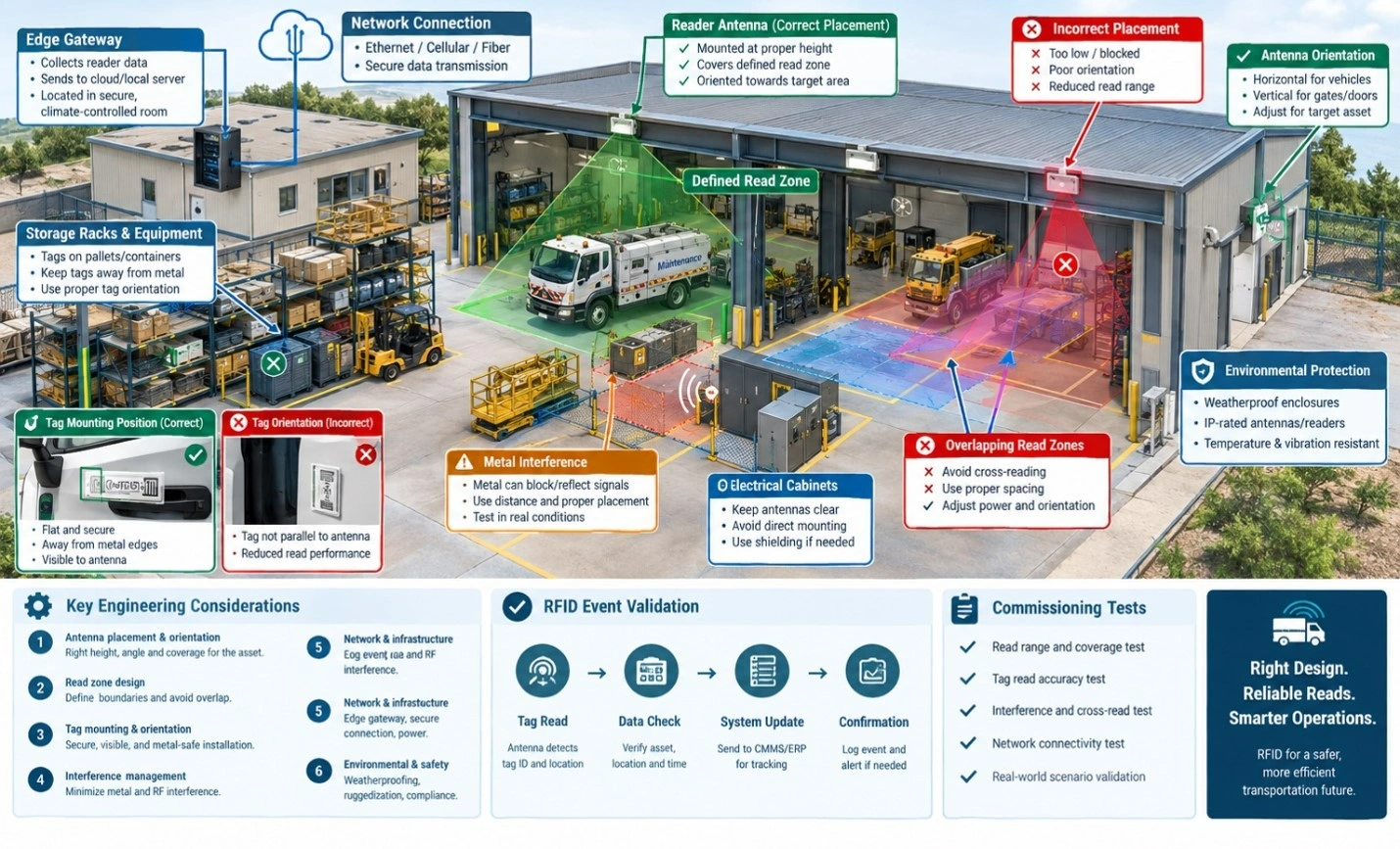
This engineering infographic illustrates RFID reader placement, antenna orientation, tag mounting, read-zone boundaries, and interference control in a transportation maintenance facility. It also highlights edge gateway connectivity, event validation, environmental protection, and commissioning tests for reliable asset identification.
AI Capabilities That Improve Transportation Infrastructure Operations
AI becomes operationally valuable when transportation infrastructure data can be connected to specific assets, locations, work orders, inspections, and maintenance events. RFID provides a reliable identification layer, while AI can interpret the resulting operational history alongside sensor readings, inspection records, GIS data, weather information, traffic conditions, and maintenance records.
Predictive Maintenance and Condition Prioritization
Transportation agencies manage large inventories of guardrail components, bridge inspection equipment, signaling equipment, tunnel safety devices, maintenance vehicles, tools, spare parts, and facility equipment. AI models can evaluate historical work orders, asset age, inspection findings, utilization, environmental exposure, and failure history to identify assets requiring earlier inspection or maintenance.
An RFID event does not by itself indicate that an asset will fail. Its value increases when the asset identity and movement history are correlated with condition data. For example, repeated movement of a bridge inspection tool between maintenance depots and multiple bridge sites can be combined with inspection schedules and equipment-service records to identify maintenance requirements or resource conflicts.
GAO can support these workflows with RFID identification and data-capture hardware that provides the asset-level information required by transportation maintenance systems.
Asset Anomaly Detection and Loss Prevention
AI can establish normal movement patterns for transportation assets and identify unusual events. Examples include a maintenance vehicle appearing at an unexpected facility, a high-value diagnostic instrument leaving an authorized area, or a spare component being recorded at a location inconsistent with its assigned work order.
Rules can handle simple exceptions, while machine-learning models can identify more complex patterns across locations and time. Combining RFID events with access-control records, GPS, BLE beacons, and work-order information can reduce false alerts and provide maintenance managers with stronger operational context.
AI-Assisted Inspection Planning
Inspection programs for bridges, tunnels, rail facilities, roadway structures, and transit assets often involve large volumes of historical information. AI can help prioritize inspection activities according to asset condition, previous defects, inspection frequency, environmental exposure, service criticality, and reported incidents.
RFID can confirm that the correct inspection equipment, tools, calibration devices, and replacement materials reached the intended work location. This creates a stronger connection between inspection planning and field execution.
Maintenance Resource Optimization
Transportation maintenance teams frequently operate under constraints involving technicians, vehicles, tools, spare parts, equipment availability, and work-site access. AI can analyze these constraints to recommend better resource assignments.
For example, a scheduling model could consider the location of available equipment, planned bridge or tunnel work, technician skills, work-order priority, travel distance, and required tools. RFID events provide a physical confirmation of equipment availability rather than relying exclusively on manually updated inventory records.
Computer Vision and RFID Correlation
Computer vision can identify visible conditions such as pavement deterioration, damaged barriers, corrosion, cracks, missing components, or unsafe conditions. RFID can identify the physical asset associated with the inspection record.
A transportation agency could therefore associate an AI-generated visual finding with a specific bridge component, maintenance cabinet, roadside asset, or rail facility. This combination improves traceability because the visual observation and the asset identity are connected within the same maintenance workflow.
AI Knowledge Assistance for Maintenance Teams
Generative AI can help maintenance personnel search technical manuals, inspection procedures, equipment records, safety instructions, and historical work orders. A controlled AI assistant could retrieve information according to the identified transportation asset and work-order context.
For example, scanning an RFID-tagged maintenance device could allow a technician to retrieve its service history, calibration requirements, operating documentation, previous faults, and applicable procedures. Such systems should use controlled source data and appropriate access controls rather than allowing unrestricted AI-generated maintenance instructions.
Transportation Infrastructure Security and Data Governance
Transportation infrastructure can involve critical public assets, operational technology, maintenance records, facility access information, and sensitive location data. RFID and AI deployments should therefore be designed with security controls from the device layer through applications and user access.
Important controls include:
- Unique device identities for RFID readers, gateways, sensors, and edge computers.
- Role-based access for maintenance personnel, supervisors, contractors, and administrators.
- Encryption for data transmitted between field equipment, gateways, servers, and cloud services.
- Network segmentation between RFID/IoT devices, operational systems, corporate IT, and external services.
- Secure API connections between RFID middleware, CMMS, EAM, GIS, ERP, and transportation management systems.
- Centralized event logging for reader activity, configuration changes, user access, and system alerts.
- Least-privilege permissions for applications and service accounts.
- Controlled firmware and software updates for connected field equipment.
- Monitoring for unauthorized readers, unexpected device behavior, and abnormal data traffic.
- Data retention policies appropriate to operational, regulatory, and contractual requirements.
AI systems also require data governance. Asset identifiers, locations, inspection information, maintenance records, and sensor data should have defined ownership and retention rules. Human review remains important when AI recommendations could influence safety-critical maintenance decisions.
KPIs for AI-Enabled RFID Transportation Asset Management
Transportation organizations should establish measurable baselines before deploying RFID and AI. The most useful KPIs connect physical asset visibility with maintenance performance, inspection execution, system reliability, and operational efficiency.
| KPI | Transportation Infrastructure Application |
|---|---|
| Asset location accuracy | Measures whether equipment is recorded at the correct depot, facility, work site, or corridor location |
| Asset inventory accuracy | Compares system records with physically available assets |
| Asset search time | Measures time required to locate tools, equipment, components, or spare parts |
| Inventory cycle time | Measures time required to complete asset verification |
| Missing asset rate | Tracks assets that cannot be located when required |
| Asset utilization | Measures how effectively shared maintenance equipment is being used |
| Equipment idle time | Identifies underused vehicles, tools, and field equipment |
| Maintenance response time | Measures time from maintenance request to operational response |
| Mean time to repair | Tracks repair duration for transportation equipment |
| Planned maintenance ratio | Measures preventive work compared with reactive maintenance |
| Unplanned failure rate | Tracks unexpected equipment failures |
| Inspection completion rate | Measures whether scheduled inspections are completed |
| Work-order accuracy | Measures the relationship between field activity and recorded work orders |
| RFID read success rate | Measures successful RFID event capture in defined read zones |
| False RFID event rate | Tracks invalid or unexpected reads |
| Asset movement compliance | Measures whether equipment moves according to authorized workflows |
| Reader availability | Measures RFID reader operational uptime |
| Gateway availability | Tracks edge gateway service availability |
| Network availability | Measures communications reliability at field locations |
| AI alert precision | Measures how many AI alerts represent meaningful conditions |
| AI alert recall | Measures how effectively AI detects known relevant conditions |
| Maintenance backlog | Tracks outstanding transportation maintenance work |
| Spare-parts availability | Measures availability of required components |
| Technician travel time | Measures travel associated with maintenance assignments |
| Equipment dispatch accuracy | Measures whether correct equipment reaches the intended work site |
| Calibration compliance | Tracks calibration status for inspection and diagnostic equipment |
| Asset lifecycle visibility | Measures completeness of asset history from acquisition through retirement |
| Cost per maintenance event | Tracks maintenance expenditure against completed work |
| Safety-related maintenance response | Measures response time for high-priority safety issues |
| Data synchronization latency | Measures delay between RFID capture and availability in business systems |
The KPI framework should be adapted to the transportation organization’s operating model. A highway agency may emphasize roadway maintenance equipment and inspection completion, while a rail operator may place greater emphasis on signaling equipment, depot inventory, trackside assets, and maintenance response.
Deployment Lifecycle for Transportation RFID and AI Systems
A successful deployment should progress from a narrowly defined operational problem toward broader transportation infrastructure coverage. Starting with the technology alone can produce large volumes of RFID events without a clear operational purpose.
Define the Transportation Use Case
Select a measurable workflow such as maintenance equipment tracking, bridge inspection equipment management, tunnel safety inventory, rail maintenance materials, or transit-facility asset control.
Establish the Asset Identification Model
Each asset should have a consistent identifier that can connect RFID records with CMMS, EAM, GIS, ERP, inventory, and work-order records. Asset classes, locations, ownership, maintenance status, and lifecycle states should be defined before large-scale tagging.
Conduct the Site Survey
Engineers should evaluate mounting surfaces, metal structures, electrical equipment, vehicle movement, environmental exposure, reader locations, network availability, and expected read zones.
Select RFID Hardware
UHF RFID is generally useful for longer-range identification and bulk asset tracking. HF can be useful where shorter-range controlled reads are appropriate. LF may be considered for specialized applications requiring close-range identification and specific operating characteristics.
Reader selection should account for fixed readers, handheld readers, antennas, read range, environmental enclosure requirements, power availability, communications, and expected tag density.
Integrate Transportation Systems
RFID middleware should transform raw reads into useful business events. Relevant events may include:
- Asset entered maintenance depot.
- Tool assigned to bridge inspection work order.
- Spare component transferred between facilities.
- Vehicle equipment checked out.
- Inspection device returned for calibration.
- Tunnel maintenance equipment moved into a restricted area.
- Rail maintenance material received at a depot.
- Asset moved outside its authorized location.
These events can then be connected to CMMS, EAM, GIS, ERP, inventory, transportation management, or facility-management software.
Validate AI Models
AI should be evaluated against real transportation data. Organizations should measure false positives, false negatives, data completeness, model drift, and the operational usefulness of recommendations.
Train Users and Establish Operating Procedures
Maintenance supervisors, field technicians, inventory personnel, inspectors, IT teams, and system administrators need role-specific procedures. The deployment should explain what RFID events mean, how exceptions are handled, and when personnel should override or confirm AI recommendations.
Scale According to Measured Results
After the pilot demonstrates measurable improvement, the same identification and integration standards can be extended to additional depots, corridors, bridges, tunnels, rail facilities, or transit locations.
Implementation Recommendations for Transportation Infrastructure
Transportation organizations can reduce deployment risk by treating RFID and AI as part of an operational information system rather than as isolated tracking technologies.
- Begin with a workflow where asset visibility directly affects maintenance, inspection, safety, inventory, or resource utilization.
- Establish a standardized asset identifier that can be shared across RFID middleware, CMMS, EAM, GIS, ERP, and inventory systems.
- Perform an RF site survey before finalizing tag and reader placement.
- Select UHF, HF, or LF according to the physical environment and required read behavior rather than applying one RFID type everywhere.
- Use fixed readers for controlled locations and handheld readers where field technicians require flexible asset verification.
- Place edge processing close to field operations when connectivity is intermittent or local response is important.
- Select cloud or customer-managed server deployment according to security, connectivity, governance, latency, and operational requirements.
- Validate RFID event quality before feeding large datasets into AI models.
- Combine RFID with BLE, GPS, sensors, computer vision, and GIS where those technologies provide useful additional context.
- Keep humans involved in safety-critical maintenance decisions.
- Establish cybersecurity controls before connecting field devices to operational or corporate networks.
- Define baseline KPIs and compare performance before and after deployment.
- Design for communication outages so field operations can continue and events can synchronize later.
- Plan hardware replacement, tag durability, reader maintenance, software updates, and technical support as part of the system lifecycle.
Explore AI, RFID, and Transportation Infrastructure Solutions with GAO
Transportation infrastructure organizations can use AI and RFID together to move beyond manually maintained asset registers toward continuously informed maintenance and operational workflows. RFID provides dependable asset identity and location events, while AI adds analysis, prioritization, prediction, and decision support using those events alongside inspection, sensor, GIS, and maintenance data.
GAO provides RFID, BLE, IoT, and supporting hardware products and systems for organizations developing these capabilities. Explore GAO’s transportation-focused RFID solutions, discuss deployment requirements with our technical team, and evaluate how asset tracking, AI analytics, edge computing, and enterprise integration can support your transportation infrastructure operations.
Why GAO for Transportation RFID and AIoT Deployments
GAO supplies RFID, BLE, IoT, and related hardware products and systems that can support transportation infrastructure applications ranging from asset identification to connected field operations. Our experience covers UHF, HF, and LF RFID technologies, readers, tags, antennas, gateways, sensors, and supporting connectivity equipment.
GAO is headquartered in New York City and Toronto, Canada, and is ranked among the top 10 leading B2B and B2G BLE/RFID suppliers globally. For three decades, GAO has served organizations across the United States and Canada, including Fortune 500 companies, leading research and development organizations, prestigious universities, and government agencies.
Our approach combines substantial R&D investment, stringent quality assurance, and expert technical support delivered remotely or onsite. For transportation infrastructure organizations, this can translate into practical assistance with technology selection, RFID deployment, system integration, testing, and long-term operational requirements.
Building the Future of Industrial AI and IoT with Aperture Venture Studio and GAO
GAO has established Aperture Venture Studio to advance practical applications of AI, IoT, RFID, BLE, edge computing, and industrial data technologies. The initiative brings together technical expertise, advisors, employees, investors, and customers to accelerate solutions for industries such as transportation infrastructure, manufacturing, logistics, energy, and public infrastructure. By connecting engineering capabilities with real operational requirements, Aperture Venture Studio supports the development, deployment, and scaling of useful AIoT solutions. GAO continues to focus on technologies that help organizations improve asset visibility, maintenance, safety, automation, and data-driven decision-making.