
AI and BLE for Aviation Precision Engineering
AI-Driven Precision Engineering for Unmanned Aircraft Systems
Artificial Intelligence of Things (AIoT) combines artificial intelligence with connected sensors, equipment, and industrial systems to turn operational data into actionable decisions. For unmanned aircraft systems (UAS), AIoT can support precision engineering across aircraft assembly, ground operations, maintenance, payload handling, battery management, component traceability, and fleet support. BLE sensors, beacons, and gateways provide a practical short-range data layer for identifying equipment, monitoring selected conditions, and locating assets around UAS production and maintenance environments. AI methods can then correlate sensor observations with maintenance records, inspection results, environmental conditions, and operational events to identify anomalies, prioritize work, and improve resource utilization. The combination is particularly useful where engineering teams need timely visibility into aircraft components, ground support equipment, tooling, batteries, and maintenance activities without adding unnecessary wiring to mobile assets.
AI, BLE and UAS Engineering Operations Lifecycle Infographic
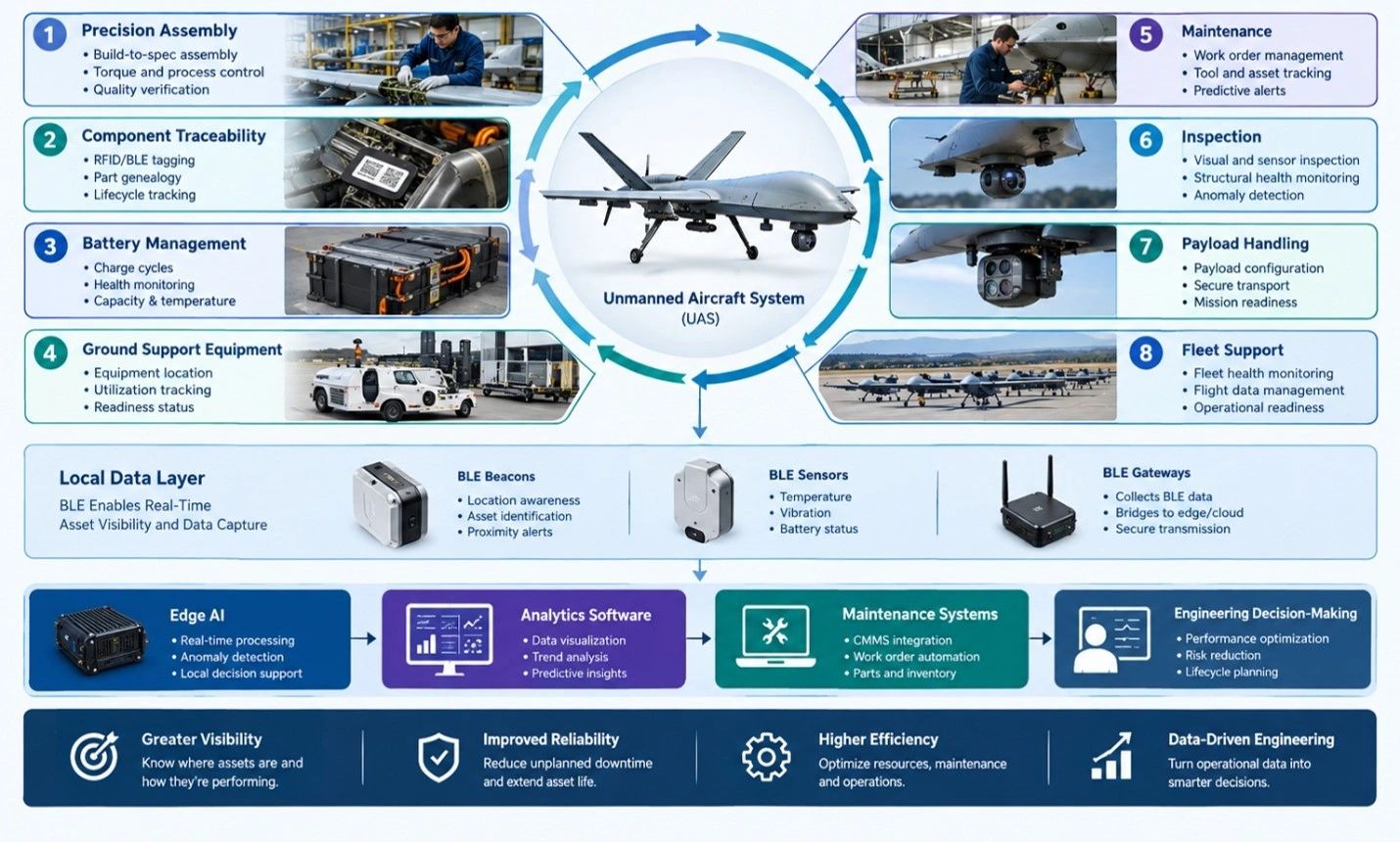
This infographic illustrates how AI, BLE-enabled data capture, edge computing, analytics, and maintenance systems connect across the UAS engineering lifecycle. It highlights applications spanning precision assembly, component traceability, battery management, ground support equipment, maintenance, inspection, payload handling, and fleet support.
What AIoT Means for UAS Precision Engineering
UAS precision engineering involves much more than aircraft design. Engineering teams must control the identity, condition, configuration, movement, and maintenance status of airframes, propulsion components, flight-control equipment, batteries, payloads, ground support equipment, tooling, and test assets. AIoT provides a way to connect these physical engineering activities with operational software.
The AI component can include machine learning, computer vision, Edge AI, Industrial AI, and, where autonomous physical actions are appropriate, Physical AI. These methods can process information from multiple sources rather than treating each sensor reading as an isolated event.
BLE serves as one enabling connectivity technology within this broader solution. BLE beacons can identify mobile equipment or tagged engineering assets, BLE sensors can capture selected environmental or equipment-condition measurements, and BLE gateways can collect nearby data and forward it to edge or server-based software.
The engineering value comes from combining these observations with other UAS data. A battery maintenance record, for example, becomes more useful when associated with battery identity, storage location, environmental conditions, inspection history, charging activity, and maintenance status. Similarly, an AI model can provide stronger maintenance recommendations when sensor observations are correlated with work orders, component configuration records, and previous failures.
GAO supplies BLE, RFID, and IoT hardware products and systems that can support organizations implementing connected asset identification, monitoring, and data-collection requirements. The appropriate technology should be selected according to the aircraft environment, operating range, data requirements, interference conditions, safety constraints, and existing UAS engineering processes.
UAS Engineering Applications for AI and BLE
AI-Assisted Component and Tool Traceability
Precision engineering teams frequently manage interchangeable components, electronic assemblies, propulsion parts, batteries, calibration equipment, specialized tools, and inspection instruments. Losing track of an asset’s location or configuration can create delays and introduce maintenance-control risks.
BLE-enabled identification can provide location or proximity information for selected mobile assets. AI software can correlate those observations with engineering records to identify unusual movements, missing equipment, delayed returns, or discrepancies between planned and actual workflows.
Typical applications include:
- Tracking UAS maintenance tooling between work areas
- Locating battery packs and charging equipment
- Monitoring movement of test instruments
- Associating engineering assets with maintenance activities
- Supporting component kitting and staging
- Detecting unexpected movement of controlled equipment
- Improving visibility of assets awaiting inspection or calibration
The engineering objective is not simply to know where an object is. The more useful objective is to understand whether its location, status, and associated activity are consistent with the UAS maintenance or production process.
Predictive Maintenance for UAS Components
AI-driven maintenance can use historical maintenance records, sensor observations, inspection findings, operating hours, environmental information, and component histories to identify patterns associated with degradation.
BLE sensors may contribute selected telemetry from equipment surrounding the aircraft or from suitable components and support equipment. Gateway devices can collect measurements and forward them to an edge computer or server.
Potential AI applications include:
- Detecting abnormal temperature patterns in battery-storage environments
- Identifying unusual vibration trends in suitable ground equipment
- Predicting maintenance requirements from accumulated operating data
- Prioritizing inspections based on anomaly severity
- Correlating recurring faults with specific components or operating conditions
- Identifying maintenance activities that require engineering review
A predictive-maintenance system should not automatically replace engineering inspection or approved maintenance procedures. AI output should be treated as decision support unless the system has been formally validated for a specific automated function.
Battery Storage and Charging Operations
Battery management is particularly important for electric and hybrid UAS because battery condition directly affects flight preparation and operational availability. Engineering teams may need visibility into battery identity, storage location, temperature, charging status, inspection status, and service history.
BLE sensors can provide localized environmental or equipment data where technically appropriate. AI can analyze this information alongside battery records to identify abnormal conditions or prioritize engineering checks.
A practical implementation can connect:
- Battery identification
- Storage cabinets or designated storage areas
- Temperature and environmental sensing
- Charging stations
- Inspection records
- Maintenance work orders
- Battery lifecycle information
- Aircraft assignment records
This creates a more complete operational record than relying on manual spreadsheets or disconnected charging logs.
Ground Support Equipment Monitoring
UAS operations depend on ground support equipment such as battery chargers, transport cases, maintenance stands, portable test equipment, communication equipment, ground control equipment, and specialized tooling.
BLE beacons can help identify mobile equipment, while BLE gateways positioned around maintenance or staging areas can collect proximity information. AI software can then analyze utilization patterns and identify equipment that is frequently misplaced, underused, overallocated, or unavailable when needed.
For UAS engineering teams, this can reduce unnecessary searching and provide better information for equipment planning without requiring every item to have a wired network connection.
UAS Engineering Use-Case Matrix: AI, BLE, Data and Operational KPIs
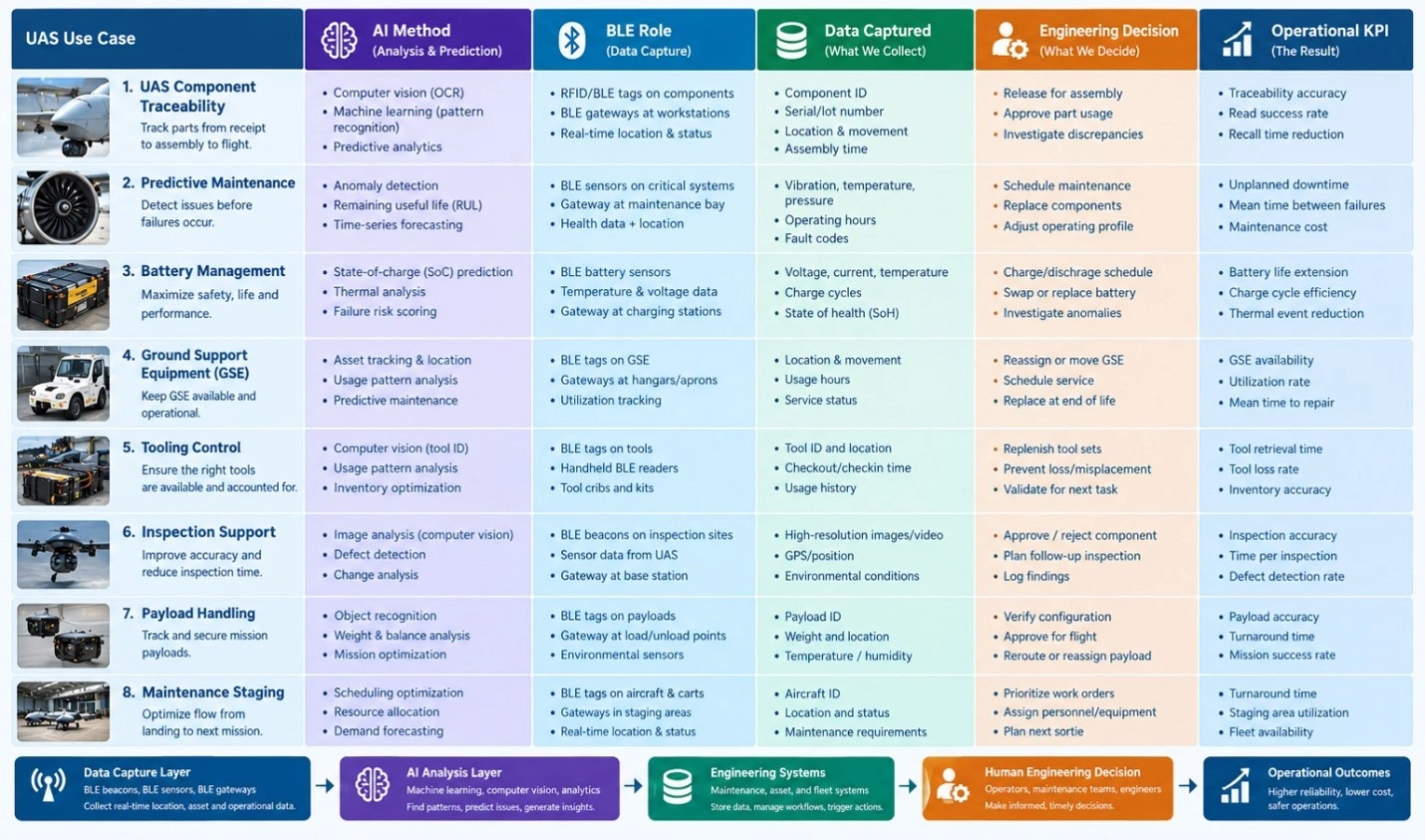
This enterprise matrix compares eight UAS engineering use cases across AI methods, BLE-enabled data capture, collected data, engineering decisions, and operational KPIs. It shows how connected asset data moves through AI analysis and engineering systems to support informed decisions, improved reliability, efficiency, and operational performance.
UAS Operational Workflow from Data Capture to Engineering Decision
A practical AIoT deployment for UAS precision engineering should connect physical operations with progressively higher levels of data processing. The objective is to create traceable data flows while keeping latency, connectivity, cybersecurity, and system reliability appropriate for the operational environment.
Physical Data Acquisition
The workflow begins with aircraft-related assets and engineering activities. BLE sensors can capture selected measurements, while BLE beacons can provide identification or proximity information for tools, batteries, containers, test equipment, or other mobile assets.
Other data sources can include:
- UAS maintenance records
- Component serial numbers
- Battery management information
- Inspection results
- Calibration records
- Ground control system data
- Environmental measurements
- Flight and mission records
- Work-order information
- Computer-vision inspection outputs
BLE should therefore be considered one input to a larger UAS engineering data process rather than the complete sensing solution.
BLE Gateway and Edge Collection
BLE gateways receive nearby BLE advertisements or sensor data and transfer relevant information to an edge computer, local server, or cloud-connected service. Gateway placement requires practical evaluation of hangar dimensions, maintenance-bay layout, equipment density, RF obstructions, metal structures, aircraft materials, and expected coverage.
Edge processing can filter duplicate observations, normalize sensor messages, perform preliminary validation, and reduce unnecessary upstream traffic. This is valuable when maintenance operations require rapid local visibility or when connectivity to a central server is intermittent.
Middleware and Data Normalization
Middleware converts heterogeneous device data into formats that application software can use consistently. A well-designed data pipeline should associate observations with persistent identifiers such as equipment IDs, battery IDs, component records, work orders, and maintenance locations.
Common integration patterns can involve APIs, message brokers, databases, industrial gateways, and enterprise application interfaces. The exact implementation should follow the existing UAS organization’s IT and engineering systems rather than introducing unnecessary software layers.
AI Processing and Engineering Analytics
AI software can process normalized data using appropriate models. Time-series models can evaluate changing sensor measurements, anomaly-detection methods can identify deviations from expected behavior, and machine-learning classification can support inspection or maintenance prioritization.
Computer vision can also contribute to UAS precision engineering by analyzing images from inspection stations or maintenance activities. AI outputs can be combined with BLE-derived asset context so that an anomaly is associated with the correct aircraft, component, workstation, or maintenance event.
Decision and Operational Action
The final stage converts analytics into an engineering action. Depending on the application, this could mean generating a maintenance alert, assigning an inspection task, locating a missing tool, restricting a battery from operational use pending inspection, or updating an asset-status record.
Human engineering oversight remains important for safety-critical decisions. AI recommendations should be auditable, traceable to source data, and evaluated against defined acceptance criteria before being incorporated into controlled UAS procedures.
UAS AIoT Workflow: From BLE Data Capture to Engineering Action
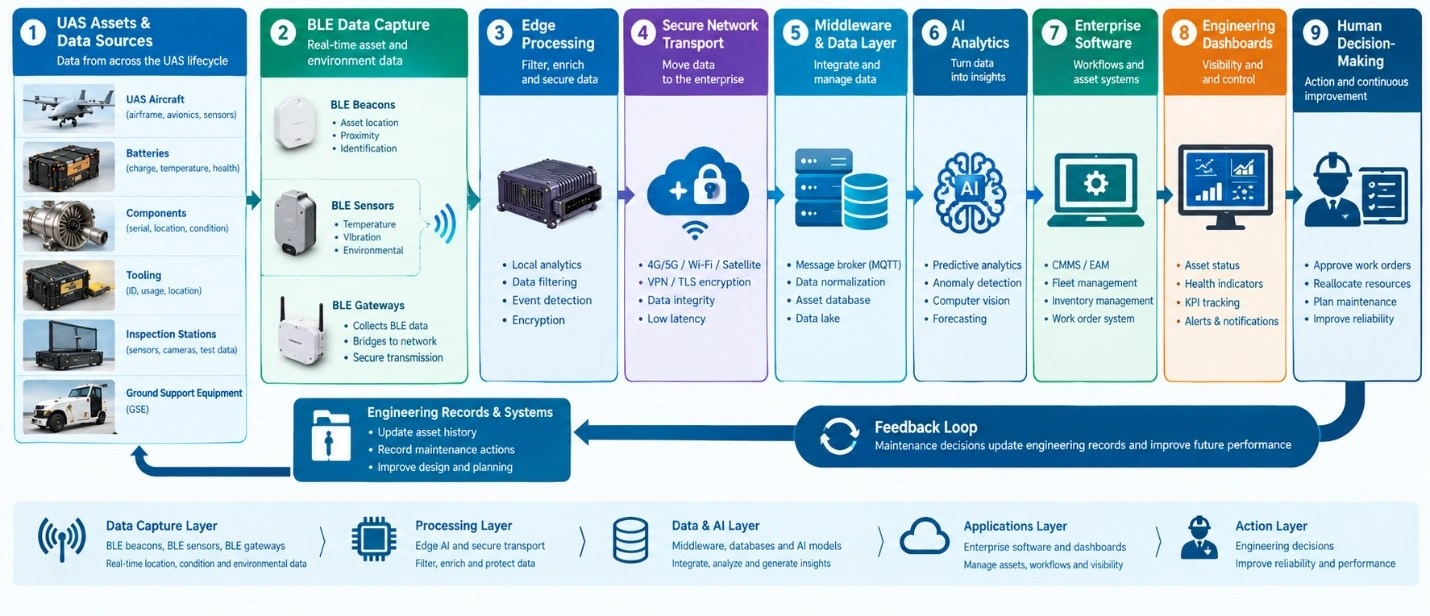
This workflow diagram illustrates the end-to-end UAS AIoT data path, from aircraft, batteries, components, tooling, inspection stations, and ground support equipment through BLE capture, edge processing, secure transport, middleware, AI analytics, and enterprise software. It highlights how engineering dashboards and human decisions feed maintenance actions back into engineering records for continuous improvement.
Engineering Considerations for UAS AIoT Deployment
Deployment quality depends heavily on engineering conditions around the aircraft and maintenance environment. BLE radio performance can be affected by metallic structures, aircraft components, equipment racks, human activity, enclosure materials, and physical layout. Consequently, coverage assumptions should be validated through site surveys and commissioning tests rather than inferred from theoretical radio range alone.
Data quality is equally important. AI models cannot compensate indefinitely for inconsistent asset identifiers, incomplete maintenance records, duplicated sensor observations, missing timestamps, or poorly controlled device configurations.
Security must also be considered across the complete data path. Device authentication, encrypted communications, access control, credential management, network segmentation, secure software updates, logging, and monitoring should be incorporated according to the UAS organization’s cybersecurity requirements.
For aviation precision engineering, the most useful AIoT implementations are therefore those that connect reliable physical data with controlled engineering processes. The goal is not to maximize the number of connected devices, but to collect the right information at the right operational points and turn it into decisions that engineers can validate and act upon.
Hardware Selection and Commissioning
BLE hardware selection should consider operating temperature, enclosure requirements, battery life, sensing accuracy, mounting method, radio behavior, maintenance accessibility, and compatibility with the target environment.
Gateway commissioning should verify actual coverage and message reliability in representative conditions. Engineers should test aircraft parked in expected configurations, equipment positioned in normal maintenance locations, and areas where metallic structures or enclosed spaces may affect radio performance.
A useful commissioning process includes:
- Defining required asset identities and data points
- Mapping maintenance bays and storage areas
- Selecting sensor and beacon mounting positions
- Installing and configuring BLE gateways
- Measuring coverage and received signal behavior
- Validating timestamp and device identity consistency
- Testing network connectivity
- Confirming data reaches the intended software
- Verifying alerts against controlled test scenarios
- Documenting device configuration and maintenance procedures
UAS AIoT Deployment Models, Software, and Supporting Technologies
A UAS precision-engineering solution can use cloud-hosted software, privately hosted servers, or a hybrid arrangement. The appropriate model depends on connectivity, data sensitivity, latency requirements, fleet size, maintenance workflows, and the organization’s IT policies.
Cloud Version for Multi-Site UAS Operations
A cloud-hosted deployment is appropriate when engineering teams need centralized visibility across multiple maintenance facilities, production locations, storage sites, or geographically distributed UAS fleets. BLE gateway data can be transmitted through secured networks to cloud services where asset records, analytics, dashboards, alerts, and AI models are managed.
Cloud deployment can simplify centralized software administration and make it easier to aggregate historical information from multiple locations. It is particularly useful for organizations comparing maintenance trends across UAS fleets or operating several engineering facilities.
Cloud connectivity should not be assumed to be continuously available. Critical local functions can remain at the edge so that temporary network interruptions do not prevent essential asset identification, local monitoring, or data buffering.
Server Version for Controlled UAS Engineering Environments
A server deployment can place software on customer-managed servers, private data centers, engineering servers, maintenance facilities, or other privately hosted infrastructure. This model can be preferable where UAS data must remain within controlled computing environments or where existing IT policies favor privately managed applications.
Server-based processing can also reduce dependency on wide-area connectivity for local engineering operations. BLE gateways can communicate with local servers through the organization’s network, while AI processing and databases remain under the customer’s administrative controls.
GAO supports organizations by providing BLE, RFID, and IoT hardware products and systems that can be incorporated into cloud-connected or privately hosted deployments according to project requirements.
AI Models and Data Processing
AI model selection should follow the engineering problem rather than the availability of a particular algorithm. Time-series analysis is suitable for continuously changing measurements, anomaly detection can identify deviations from established operating patterns, and classification models can support inspection or maintenance categorization.
Computer vision can analyze UAS components, wiring, surfaces, connectors, fasteners, and other inspection targets when suitable imagery and validated training data are available. Edge AI can perform selected processing near the point of data acquisition when response time, bandwidth, or connectivity requirements justify local inference.
A mature implementation should also maintain model versioning, training-data controls, performance monitoring, false-positive analysis, and human review procedures.
Communication and Integration Technologies
BLE provides short-range wireless communication between compatible sensors, beacons, and gateways. Other communication technologies may be required elsewhere in the UAS engineering solution, including Ethernet, Wi-Fi, cellular connectivity, GNSS, industrial networking, and application-layer APIs.
The integration layer can connect asset information and AI results with maintenance management software, inventory systems, engineering databases, quality-management software, computerized maintenance management systems (CMMS), enterprise resource planning (ERP) software, and other operational applications.
The engineering priority is interoperability. Device identifiers, timestamps, aircraft identifiers, component records, and maintenance events should remain consistent across connected systems.
Cybersecurity and Data Protection
Security should cover both wireless devices and the software that processes their information. Controls can include:
- Device authentication and authorization
- Encrypted network communications
- Segmented wireless and enterprise networks
- Role-based application access
- Secure credential management
- Controlled firmware and software updates
- Audit logging
- Gateway hardening
- Server access controls
- Backup and recovery procedures
- Monitoring for unauthorized device behavior
UAS environments can contain sensitive engineering, operational, maintenance, and mission-related information. Security requirements should therefore be established during system design rather than added after deployment.
Technical Capabilities and Operational Improvements
Better Asset Visibility
AI-supported BLE identification can provide engineering teams with more timely information about the location and movement of selected tools, batteries, components, test equipment, and ground support assets. AI analytics can distinguish routine movement from unusual activity when sufficient historical data is available.
This supports maintenance staging, equipment allocation, and investigation of missing or misplaced engineering assets.
Improved Maintenance Prioritization
AI can combine maintenance history, sensor observations, inspection findings, usage information, and component identity to rank potential maintenance actions. Instead of treating every alert equally, engineering teams can establish rules or models that distinguish normal operating variation from patterns requiring investigation.
This can improve maintenance planning while reducing unnecessary manual review.
Faster Engineering Response
Real-time or near-real-time data can reduce the time between an operational event and engineering awareness. A temperature anomaly in a controlled battery-storage area, an unexpected movement of maintenance equipment, or a recurring equipment condition can trigger an alert for investigation.
Response speed depends on sensor intervals, gateway connectivity, processing location, network performance, and alert configuration. These parameters should therefore be defined according to the actual UAS workflow.
Higher Data Quality and Traceability
Digital identification helps associate physical assets with engineering records. When identifiers are consistently maintained, organizations can build more reliable histories for batteries, components, tools, inspection equipment, and maintenance activities.
This is especially valuable when multiple aircraft share interchangeable components or when equipment moves between maintenance areas.
Scalable Fleet Support
A properly designed data model can support additional aircraft, maintenance locations, gateways, sensors, and engineering applications without redesigning the entire system. Standardized identifiers and interfaces are particularly important as UAS fleets grow.
Scalability should be measured operationally rather than simply by device count. The solution should continue to provide manageable alert volumes, acceptable database performance, reliable data ingestion, and useful AI outputs as the number of connected assets increases.
UAS Engineering KPIs for AIoT Programs
Measurement should focus on operational outcomes rather than the number of installed sensors. Useful KPIs include:
- Asset location accuracy
- Asset identification success rate
- BLE data capture reliability
- Gateway message reception rate
- Battery-storage condition excursions
- Mean time to detect an engineering anomaly
- Mean time to respond to maintenance alerts
- Mean time to repair
- Preventive maintenance compliance
- Predictive-maintenance alert precision
- False-positive alert rate
- Aircraft maintenance turnaround time
- UAS availability
- Ground support equipment utilization
- Tool search time
- Component traceability completeness
- Maintenance record completeness
- Inspection backlog
- Battery inspection compliance
- Calibration compliance
- Unscheduled maintenance frequency
- Data latency
- System availability
- AI model inference latency
- Maintenance planning accuracy
- Asset utilization rate
- Gateway coverage reliability
- Cybersecurity event detection rate
- Data synchronization success rate
- Cost per maintained aircraft
These KPIs should be established before deployment so that engineering teams can determine whether the AIoT solution is producing measurable improvement.
Implementation Recommendations for UAS Precision Engineering
A successful deployment should begin with the operational problem rather than with the wireless technology. Engineering teams should identify the UAS processes where improved information can produce a measurable outcome.
Define the Engineering Use Case
Start with a controlled use case such as battery-storage monitoring, maintenance-tool visibility, component traceability, or ground-support equipment utilization. Establish the current process, failure points, data requirements, and target KPI.
Map the Physical Environment
Document aircraft parking positions, maintenance bays, storage rooms, battery areas, inspection stations, equipment racks, and movement routes. Identify metallic obstructions, enclosed spaces, RF interference sources, and gateway mounting constraints.
Establish Asset Identity
Define consistent identifiers for aircraft, components, batteries, tools, gateways, sensors, workstations, and maintenance locations. Poor identity management can undermine otherwise accurate sensor data.
Validate Before Scaling
A pilot should test the intended workflow under normal operating conditions. Engineers should measure wireless reliability, data latency, asset identification, alert behavior, software integration, and user response.
Testing should include normal operations as well as representative failure conditions such as temporary network loss, gateway interruption, sensor battery depletion, duplicate messages, invalid data, and unavailable software services.
Integrate with Existing Engineering Software
Avoid creating a disconnected data store that engineers must manually reconcile with maintenance records. Where feasible, connect AIoT information with existing CMMS, ERP, inventory, quality, inspection, and engineering systems.
Establish Human Oversight
AI recommendations should have clear ownership. Engineering personnel should understand why an alert was generated, which data contributed to it, what confidence or severity information is available, and what procedure should follow.
Safety-critical decisions require appropriately validated processes and qualified personnel. AI should not be treated as an authority simply because a model produces a numerical result.
Standards, Compliance, and UAS Safety Considerations
UAS precision-engineering deployments operate within a broader aviation safety and regulatory environment. Applicable requirements vary according to aircraft category, operating jurisdiction, mission type, organization, and whether the activity involves design, manufacturing, maintenance, testing, or flight operations.
Relevant standards and regulatory frameworks can include:
- FAA requirements applicable to the organization’s UAS operations
- Transport Canada requirements for applicable Canadian operations
- ASTM standards relevant to unmanned aircraft systems
- RTCA standards where applicable to aviation equipment and systems
- SAE aerospace engineering standards where relevant
- ISO quality-management practices
- ISO/IEC cybersecurity standards where applicable
- NIST cybersecurity guidance where appropriate
- Organizational configuration-management procedures
- Aircraft maintenance and airworthiness procedures
- Supplier quality and component-control requirements
BLE-enabled monitoring equipment should not be introduced into a safety-critical aircraft function without appropriate engineering assessment. Wireless sensors attached to aircraft components may require evaluation for electromagnetic compatibility, mechanical attachment, environmental suitability, weight impact, and interference with existing systems.
The safest approach is to distinguish between non-flight-critical asset monitoring and equipment that could directly influence aircraft control, navigation, propulsion, or other safety-related functions.
How GAO Supports UAS Engineering Technology Programs
GAO provides BLE, RFID, and IoT hardware products and systems that organizations can use for asset identification, sensing, tracking, and connected engineering applications. For UAS maintenance and precision-engineering environments, this can include BLE beacons, BLE sensors, BLE gateways, RFID technologies, and supporting IoT equipment selected according to the operational requirement.
Headquartered in New York City and Toronto, Canada, GAO is ranked among the top 10 leading B2B and B2G BLE and RFID suppliers globally. GAO and its sister companies, GAO Research Inc. and GAO Tek Inc., form GAO Group, with operations based in New York City and Toronto.
GAO Group has served customers across the United States and Canada for three decades, including Fortune 500 companies, leading research and development organizations, prestigious universities, and U.S. and Canadian government agencies. Its engineering approach includes substantial R&D investment, stringent quality-assurance processes, and technical support delivered remotely or onsite.
For UAS organizations, the practical value of working with an experienced hardware supplier is the ability to select connected devices according to the actual engineering environment rather than treating BLE, RFID, or sensing equipment as interchangeable commodities.
UAS Precision Engineering Lifecycle: From Planning to Fleet-Scale Optimization
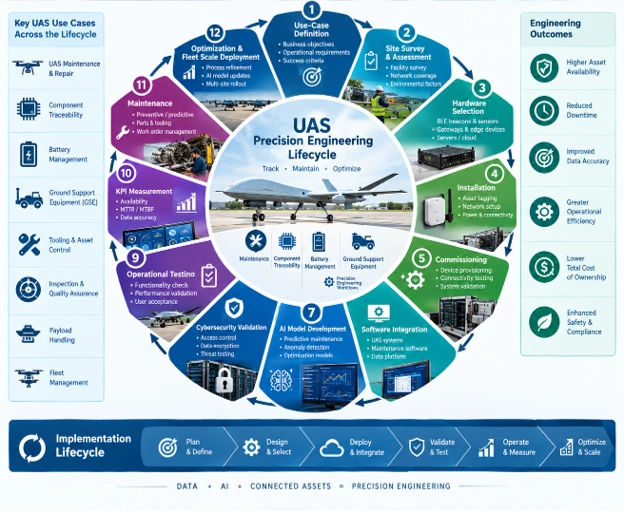
This circular lifecycle diagram presents the 12-stage implementation journey for UAS precision engineering, from use-case definition and site assessment through hardware selection, installation, AI development, cybersecurity validation, operational testing, KPI measurement, maintenance, and fleet-scale optimization. It connects the implementation stages with key UAS use cases and engineering outcomes such as higher availability, reduced downtime, improved data accuracy, and greater operational efficiency.
Key Takeaways for AI-Enabled UAS Precision Engineering
AI can make UAS precision engineering more responsive by transforming physical observations and engineering records into actionable information. BLE sensors, beacons, and gateways can provide useful identification, proximity, and condition data, while AI methods can correlate those observations with maintenance, inspection, battery, component, and equipment records.
The strongest implementations begin with a defined engineering problem, measurable KPI, reliable asset identity, validated data collection, and appropriate human oversight. Edge processing can support local responsiveness, while cloud or privately hosted server deployments can provide centralized analytics according to organizational requirements.
For UAS operators, manufacturers, maintenance organizations, and engineering teams, the objective is practical: improve asset visibility, strengthen traceability, identify abnormal conditions earlier, and support better maintenance decisions without compromising established aviation safety processes.
GAO can help organizations evaluate and deploy BLE, RFID, and IoT hardware products and systems for these connected UAS engineering requirements. Readers can explore GAO’s technology solutions, engineering resources, products, and technical support to determine which sensing and identification approach fits their specific UAS application.
Building the Future of Industrial AI and IoT with Aperture Venture Studio and GAO RFID Inc.
For more than three decades, GAO Group of Companies has invested heavily in R&D for industrial BLE, RFID, and IoT. As generative AI became increasingly useful for industrial applications, we expanded our work across AI and IoT, including BLE and RFID, and founded Aperture Venture Studio to build, launch, and scale next-generation AI and IoT companies supporting applications such as UAS precision engineering and other industrial technology domains.
Aperture has attracted AI and IoT technical experts, entrepreneurial and operational executives, influential investors, and leading companies. We have also developed Aperture Ventures Summit and TekSummit to discuss advanced AI and IoT topics and foster technical communities.
We welcome you to join us as:
- Advisors, Co-founders, or Employees
- Investors
- Customers