
AI and RFID for Wastewater Utilities
AI-Driven Asset and Operations Management for Wastewater Utilities
Wastewater utilities operate treatment plants, lift stations, collection networks, laboratories, pump stations, chemical storage areas, and maintenance facilities where equipment availability, traceability, safety, and regulatory compliance directly affect service continuity. AI-enabled operational systems can combine data from connected equipment, sensors, maintenance records, environmental measurements, and RFID-tagged assets to improve how wastewater utilities monitor and manage physical resources. RFID provides machine-readable identification for pumps, valves, motors, instruments, chemical containers, tools, spare parts, sampling equipment, and other assets, while AI converts operational data into predictions, anomaly detection, prioritization, and decision support. For wastewater utilities, this combination can support asset tracking, maintenance planning, inventory control, field-service verification, inspection workflows, and treatment-plant operations. Properly engineered deployments connect RFID readers and tags with edge computing, utility networks, computerized maintenance management systems, laboratory information systems, enterprise resource planning software, and operational databases.
What AI-Enabled RFID Means for Wastewater Utilities
AI for wastewater utilities refers to the use of artificial intelligence, machine learning, Edge AI, computer vision, and related analytical methods to interpret operational data and assist decisions across wastewater collection, treatment, maintenance, laboratory, and field-service processes.
RFID serves as one of the physical identification mechanisms that supplies reliable asset and item-level events to these AI-enabled workflows. UHF RFID is particularly useful where wastewater utilities need longer-range identification of tagged assets, tools, spare parts, containers, and equipment moving through defined areas. HF RFID can support shorter-range identification where controlled read distances are preferable, including identification at workstations, inspection points, cabinets, or laboratory processes. LF RFID can be considered for specialized identification requirements where its propagation characteristics and application environment provide an advantage.
The value comes from connecting physical assets to operational records rather than simply installing RFID readers. A pump bearing, valve actuator, flow meter, portable gas detector, chemical container, sampling kit, or replacement motor can receive a unique digital identity that links its physical location and service history with maintenance, inventory, inspection, and operational data.
AI can then analyze these events alongside other wastewater utility data. A machine-learning model may identify abnormal maintenance patterns, predict spare-parts demand, detect unusual asset movements, prioritize overdue inspections, or identify relationships between equipment condition and operational events. Rules-based analytics can also be valuable where deterministic operating procedures or regulatory controls are required.
Why Wastewater Utilities Need AI-Driven Physical Asset Visibility
Wastewater treatment depends on interconnected mechanical, electrical, instrumentation, chemical, and control assets. A failure involving a lift-station pump, blower, motor control center, ultraviolet disinfection system, aeration component, sludge-handling system, or critical process instrument can create operational consequences extending beyond a single maintenance activity.
AI-enabled asset identification helps wastewater utilities establish a more complete operational record by connecting:
- Physical asset identity with maintenance history and work orders
- Equipment location with responsible facility or maintenance zone
- Spare-parts inventory with equipment bills of material
- Inspection events with specific pumps, valves, instruments, and electrical equipment
- Field-service activity with technician work assignments
- Laboratory samples with collection points and processing steps
- Chemical containers with receiving, storage, consumption, and replenishment records
- Portable instruments with calibration and inspection records
- RFID read events with time, location, and operational context
- Asset condition information with maintenance priorities
GAO provides RFID, BLE, and other IoT hardware products and systems that can be incorporated into these wastewater utility workflows, with deployment decisions based on read range, environmental conditions, asset materials, network availability, and required identification accuracy.
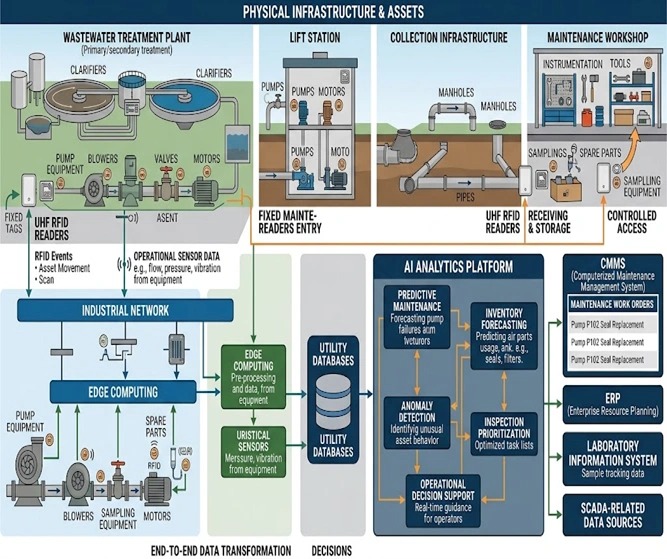
This enterprise infographic illustrates how municipal and industrial wastewater utilities connect physical assets to advanced digital systems. It shows RFID tags on critical equipment and readers capturing data flow from treatment plants, lift stations, and collection infrastructure through edge computing to an AI analytics platform. This processed data drives predictive maintenance, inventory forecasting, and operational decision support by integrating with CMMS, ERP, and SCADA-related data sources.
Wastewater Utility Applications for AI-Enabled RFID
AI Asset Tracking for Treatment Plants and Lift Stations
Treatment plants contain large numbers of distributed mechanical and electrical assets whose status and location can change during maintenance, refurbishment, storage, or replacement. RFID identification can associate individual assets with equipment records, while AI analyzes location events, service history, inspection results, and operating information.
Relevant applications include:
- Tracking pumps, motors, blowers, actuators, valves, gearboxes, and portable equipment
- Verifying that replacement components reach the correct treatment area
- Monitoring movement of maintenance tools between workshops and process areas
- Associating equipment with maintenance work orders
- Identifying assets that have remained outside their expected operating area
- Supporting asset reconciliation after major maintenance projects
- Locating mobile instruments and specialized maintenance equipment
The engineering challenge is not simply achieving a high RFID read rate. Metal equipment, electrical enclosures, concrete structures, pipes, tanks, wet surfaces, and dense mechanical installations can affect radio-frequency behavior. Tag selection and mounting therefore require field testing rather than relying solely on nominal tag specifications.
AI Predictive Maintenance and Work-Order Prioritization
Predictive maintenance for wastewater utilities can combine equipment telemetry, maintenance history, operating conditions, inspection results, and RFID-based asset identity. AI models can identify patterns associated with recurring failures or increased maintenance requirements.
For example, an AI system could correlate repeated service events involving a particular pump model with operating hours, vibration measurements, motor current, flow conditions, and historical work orders. RFID establishes the identity of the physical pump or replacement component, helping ensure that analytical results are associated with the correct equipment record.
Potential outputs include:
- Failure-risk scoring for critical pumps and rotating equipment
- Recommended maintenance priorities
- Identification of recurring equipment failures
- Spare-parts requirements derived from predicted maintenance activity
- Detection of maintenance intervals that differ from actual operating conditions
- Identification of assets with incomplete inspection or service records
AI recommendations should remain explainable enough for maintenance planners and reliability engineers to understand why an asset has been prioritized.
AI Inventory Management for Wastewater Spare Parts
Wastewater utilities often maintain inventories of pump components, bearings, seals, valves, electrical components, instrumentation parts, PPE-related consumables, treatment-process components, and emergency replacement equipment.
RFID can provide automated identification at receiving, storage, issue, return, and selected maintenance locations. AI can analyze historical consumption, seasonal demand, equipment populations, scheduled maintenance, failure rates, and lead times to improve inventory planning.
This can help address operational problems such as:
- Stockouts of critical pump and motor components
- Excessive quantities of slow-moving spare parts
- Difficulty identifying obsolete components
- Manual inventory reconciliation
- Uncertain spare-parts consumption
- Emergency purchasing caused by poor visibility
- Mismatches between CMMS records and physical stock
A practical deployment should distinguish between critical spares and ordinary consumables. High-value or operationally critical components generally justify more rigorous item-level identification than inexpensive bulk materials.
AI-Assisted Inspection and Field-Service Verification
Wastewater utility technicians frequently inspect distributed infrastructure such as lift stations, pumping stations, chemical systems, electrical rooms, collection-system equipment, and treatment-process machinery. RFID checkpoints can verify that a technician has reached the correct asset or inspection location.
A field workflow can associate the RFID identity of an asset with:
- Inspection checklist
- Previous inspection findings
- Open maintenance work orders
- Calibration requirements
- Safety procedures
- Replacement-part requirements
- Photographic or sensor evidence
- Technician observations
- Date and time of service
AI can analyze accumulated inspection information to identify recurring defects, prioritize locations for follow-up, or detect unusual deviations from expected inspection patterns.
AI and RFID for Laboratory Sample Traceability
Wastewater laboratories process samples associated with influent, primary treatment, secondary treatment, disinfection, effluent, sludge, receiving waters, and other monitoring points. RFID can be used selectively to identify sample containers, transport carriers, laboratory assets, or controlled workflow locations where its physical characteristics are appropriate.
AI can support laboratory operations through anomaly detection, workload forecasting, sample-priority recommendations, and analysis of historical results. RFID should not replace established sample identification and chain-of-custody controls. Instead, it can provide an additional machine-readable event layer where validated by the laboratory workflow.
Chemical and Consumable Inventory Visibility
Wastewater treatment facilities use chemicals and consumable materials associated with processes such as disinfection, pH adjustment, coagulation, phosphorus removal, and sludge treatment. RFID can help identify containers and material-handling units where tag durability, chemical compatibility, and regulatory requirements have been validated.
AI can use inventory events and consumption history to estimate replenishment requirements. Chemical management systems should also retain appropriate safety documentation, batch information, storage requirements, and process-specific controls rather than relying on RFID identity alone.
Wastewater Utility Operational Workflow from RFID Events to AI Decisions
An effective AI-enabled RFID solution follows a defined data path from the physical wastewater utility environment to an operational action. The workflow normally includes several layers rather than sending raw RFID events directly into an AI model.
Physical Data Acquisition
RFID tags are assigned to assets, tools, spare parts, containers, instruments, or other selected objects. Fixed readers can monitor defined locations while handheld RFID readers can support maintenance and inspection activities.
Reader placement depends on the intended business event. A receiving area may require portal-style reads, while a maintenance workshop may benefit from handheld identification. A lift station may require a controlled checkpoint rather than continuous reading.
Edge Processing and Event Filtering
Raw RFID observations can contain duplicate reads, transient reads, and events that do not represent meaningful business activity. Edge software or middleware can filter observations and convert them into events such as:
- Asset entered maintenance workshop
- Spare part received
- Tool issued to technician
- Equipment moved from storage
- Inspection checkpoint completed
- Component returned to inventory
Edge processing can reduce unnecessary network traffic and improve response times for local operational workflows.
Communication and Data Integration
RFID readers can connect through Ethernet, Wi-Fi, cellular connectivity, or other supported communication methods depending on the facility. Industrial networking should account for electromagnetic conditions, network segmentation, availability requirements, and the separation of operational technology from business systems.
Middleware can normalize RFID data and connect it with asset identifiers, facility identifiers, timestamps, work orders, inventory records, and equipment hierarchies.
AI Analytics and Decision Support
AI services can consume normalized events together with CMMS records, SCADA-related operational data, sensor measurements, ERP inventory data, laboratory information, and maintenance history.
Appropriate analytical techniques can include:
- Time-series forecasting for spare-parts demand
- Classification models for maintenance-risk categories
- Anomaly detection for unusual asset behavior
- Natural-language processing for maintenance notes
- Predictive models for equipment failure risk
- Computer vision for selected inspection tasks
- Optimization models for maintenance scheduling
The AI layer should produce actionable outputs rather than simply generating dashboards. Examples include creating a maintenance recommendation, flagging an inventory risk, requesting inspection, or alerting an operator to an unusual equipment condition.
Business and Operational Action
The final step is an operational response. A high-risk pump may generate a CMMS review, a predicted spare-parts shortage may trigger procurement planning, or an abnormal inspection pattern may create a follow-up task. Human approval remains important for maintenance decisions affecting treatment continuity, worker safety, environmental compliance, or critical infrastructure.
RFID-to-AI Wastewater Asset Management Workflow for Predictive Operations
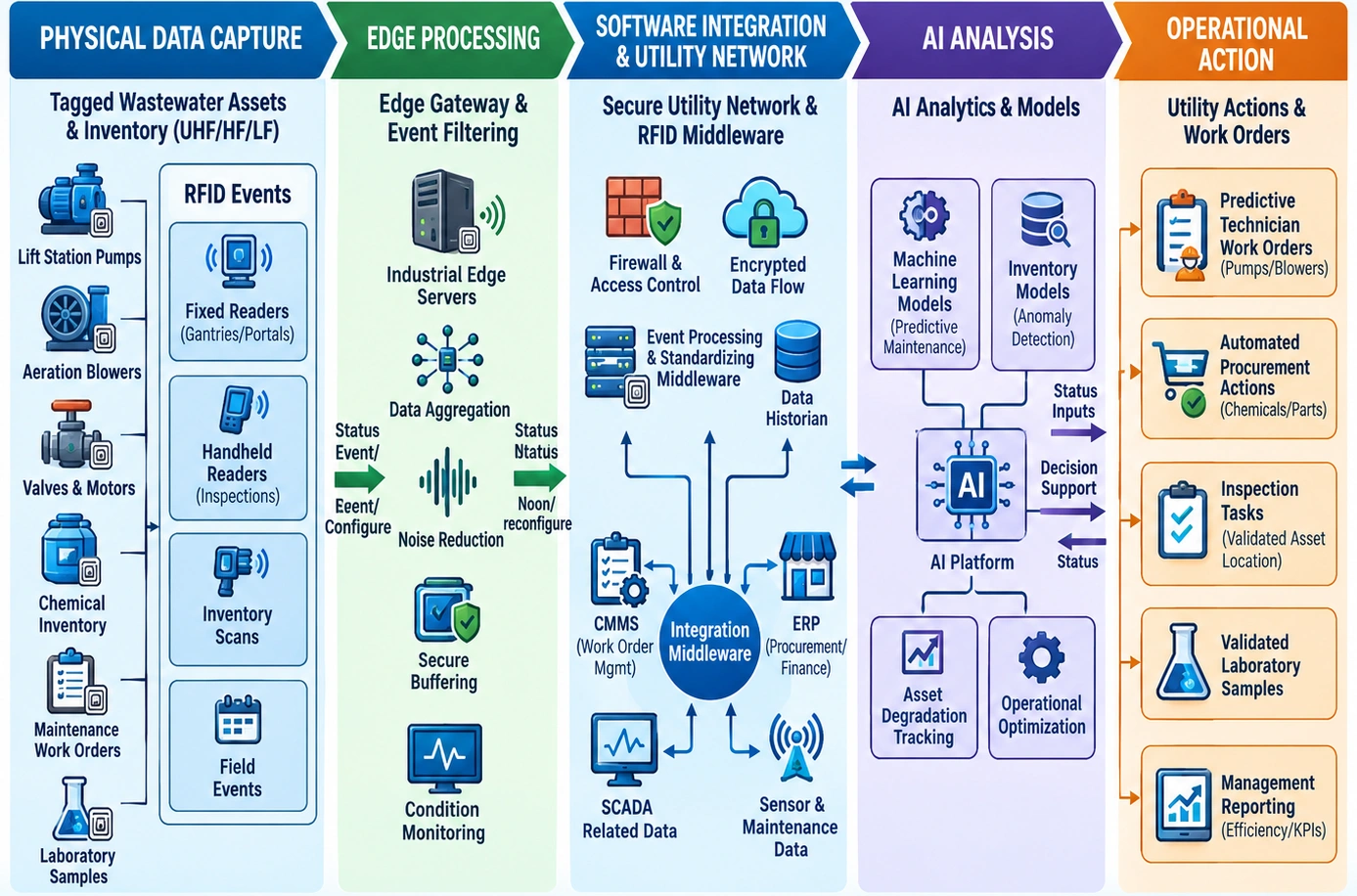
This workflow diagram illustrates the end-to-end operational path, starting from physical RFID data capture of wastewater assets and inventory. Data is processed via edge gateways and middleware before integrating with CMMS, ERP, and SCADA-related systems. AI analytics then process this aggregated data to support predictive maintenance, procurement actions, and optimized management reporting, transforming raw identification events into targeted operational actions.
AI, RFID Hardware, Software, and Deployment Choices for Wastewater Utilities
Wastewater utility deployments require coordinated selection of identification hardware, reader infrastructure, communications, software, AI services, and integration components. Equipment should be selected according to the physical environment and operational process rather than according to read range alone.
RFID Hardware Selection
UHF RFID is generally suited to wastewater utility applications requiring longer-range identification of tagged assets, tools, spare parts, and materials. It can support controlled portal reads and handheld workflows when tag orientation, mounting surface, and reader placement are engineered appropriately.
HF RFID is useful for shorter-range, intentional interactions where a technician or operator presents an item at a defined read point. It can be appropriate for controlled workstations, cabinets, laboratory-related identification processes, or equipment verification where longer-range reading would create unnecessary reads.
LF RFID can serve specialized applications requiring short-range identification and specific coupling characteristics. Its suitability should be evaluated against the asset material, operating environment, required distance, tag availability, and reader performance.
Wastewater environments require particular attention to:
- Water and moisture exposure
- Corrosion and chemical exposure
- Metal surfaces
- Outdoor temperature variation
- UV exposure
- Mechanical impact
- Cleaning procedures
- Submersible or washdown conditions
- Electrical interference
- Mounting limitations
- Tag enclosure durability
GAO can supply RFID readers, tags, antennas, handheld equipment, and related IoT hardware for evaluated use cases, while deployment engineering determines the appropriate combination for each wastewater facility.
Edge Computing and Industrial Data Processing
Edge computing places selected processing functions close to wastewater utility operations. An edge server or gateway can collect RFID observations, filter events, execute local rules, buffer data during network interruptions, and forward normalized information to centralized software.
This approach is valuable at remote lift stations or facilities where connectivity is intermittent. Local event processing can also reduce dependence on continuous cloud connectivity for basic identification and workflow functions.
Cloud Version and Server Version
A Cloud Version uses cloud-hosted software and infrastructure to centralize RFID events, AI analytics, dashboards, integrations, and multi-facility data. This model can be appropriate for wastewater utilities managing geographically distributed treatment plants, pump stations, warehouses, and maintenance operations where centralized administration and cross-site analytics are important.
A Server Version places the relevant software on customer-managed edge servers, private data centers, facility servers, or other privately hosted infrastructure. This approach can be preferable when wastewater utility policies require tighter control of operational data, when network connectivity is constrained, or when integration with existing private systems is a priority.
Both models can coexist with local edge processing. A wastewater utility may keep time-sensitive RFID event processing at a facility while forwarding validated events to a centrally managed software environment.
Security and System Integration
Security should be designed across RFID readers, edge gateways, network connections, middleware, application interfaces, databases, and AI services. Practical controls include identity management, role-based access, encrypted communications, network segmentation, logging, software patching, backup procedures, and controlled API access.
Integration should be tested against existing wastewater utility systems such as CMMS, ERP, SCADA-related data repositories, computerized laboratory systems, GIS, inventory databases, and maintenance applications. The goal is to preserve existing operational records while adding reliable physical identification and AI-assisted analysis.
Technical Capabilities and Operational Value for Wastewater Utilities
Combining AI with RFID-based identification gives wastewater utilities a way to connect physical assets and materials with operational decisions. The strongest results occur when identification events are combined with equipment condition data, maintenance records, inventory information, facility locations, and established operating procedures.
Improved Asset Accountability Across Treatment Facilities
RFID can provide a persistent identity for equipment and maintenance resources. AI adds analytical context by examining where assets move, how frequently they are serviced, and whether their actual usage differs from expected patterns.
For wastewater utilities, this can improve accountability for:
- Critical pumps and motors
- Aeration blowers
- Valve assemblies and actuators
- Portable monitoring instruments
- Electrical and instrumentation equipment
- Maintenance tools
- Replacement components
- Emergency-response equipment
- Laboratory equipment
- Mobile service equipment
An asset record can therefore become more useful than a static equipment register. Its identity can be connected to location history, service events, inspection results, and replacement-part consumption.
More Effective Predictive Maintenance
Traditional preventive maintenance commonly relies on fixed calendar intervals or operating-hour thresholds. AI can supplement these methods by identifying patterns across historical maintenance events and equipment-condition data.
A wastewater utility could use AI to identify a pump whose vibration, operating hours, maintenance frequency, and failure history indicate increasing risk. RFID helps ensure that the analytical record is associated with the correct physical asset when equipment is moved, repaired, replaced, or temporarily stored.
Predictive maintenance does not eliminate preventive maintenance requirements. Instead, it can help reliability engineers prioritize resources and investigate equipment that exhibits unusual behavior.
Faster Maintenance and Inspection Workflows
Technicians can use handheld RFID readers to identify equipment without manually entering long asset numbers. Once the physical asset is identified, the maintenance application can retrieve the associated work order, service history, inspection requirements, documentation, and relevant replacement parts.
A technician servicing a lift-station pump, for example, can identify the pump through RFID, confirm the asset record, review the outstanding maintenance task, record inspection findings, and identify required components. AI can subsequently analyze the accumulated records to detect recurring problems across pumps or facilities.
This reduces administrative effort while improving the connection between field activity and digital maintenance records.
Better Spare-Parts Availability
AI-based inventory forecasting can combine RFID inventory events with CMMS work orders, historical consumption, equipment populations, planned maintenance, and supplier lead times.
The resulting demand forecast can help maintenance planners distinguish between:
- Critical emergency spares
- Frequently consumed maintenance parts
- Long-lead components
- Obsolete or superseded components
- Low-value consumables
- Facility-specific inventory
- Shared regional inventory
RFID provides the physical identification layer, while AI provides demand analysis. Neither should be treated as a substitute for inventory governance, approved stocking policies, or engineering review.
Reduced Manual Data Entry
Manual transcription creates opportunities for incorrect asset numbers, duplicate records, missing inspection events, and delayed inventory updates. RFID can automate selected identification steps, while AI can help identify inconsistent or incomplete records.
For example, an AI data-quality process could flag an asset that appears in a maintenance record but has no corresponding identification event, or identify a component whose recorded location conflicts with recent RFID observations.
The result is not simply less data entry. More importantly, wastewater utilities can develop a more consistent relationship between physical assets and their digital records.
Improved Multi-Facility Visibility
Utilities operating multiple treatment plants, pump stations, laboratories, warehouses, and maintenance depots can use centralized software to compare asset movements and operational patterns.
AI can identify differences between facilities, such as unusually high maintenance rates for a particular pump model or higher-than-expected consumption of a specific spare part. Such analysis can support reliability programs, procurement planning, and asset-standardization decisions.
Operational Scalability
A properly designed RFID deployment can begin with a narrow use case such as maintenance-tool tracking or critical-spare inventory and later expand to additional facilities.
A scalable implementation should define common asset identifiers, facility codes, event formats, integration interfaces, security policies, and data-retention rules before large-scale deployment. This prevents every treatment plant from developing an isolated identification system that cannot share data with other wastewater utility locations.
RFID-Enabled Wastewater Treatment Plant with AI-Driven Asset Management and Maintenance Insights
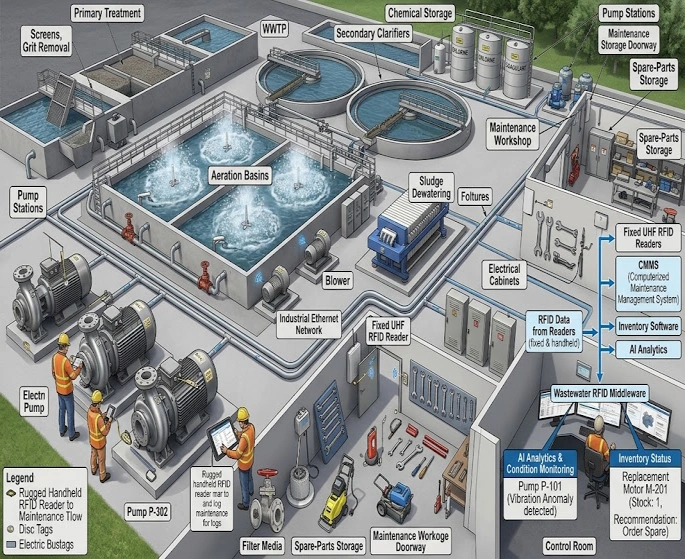
This photorealistic engineering visualization shows a modern municipal wastewater treatment plant with a comprehensive RFID deployment. Rugged RFID tags are physically affixed to large metal pumps, motors, valves, tools, and spare parts throughout primary and secondary treatment areas, pump stations, and a maintenance workshop. Data flows via an industrial network from fixed UHF readers at doorways and a handheld reader used by a technician to identify equipment. This data aggregates into an integrated control room with middleware connecting to CMMS, inventory software, and AI analytics for maintenance recommendations. The illustration clearly distinguishes physical equipment, network infrastructure, and software-driven operational insights, providing a technically credible overview of the end-to-end system.
Engineering Considerations for Wastewater RFID and AI Deployment
RFID Tag Selection and Mounting
Tag selection should start with the physical asset and environmental conditions rather than the reader. Metal surfaces often require RFID tags designed for metal mounting because conventional labels may experience significant performance degradation when attached directly to conductive surfaces.
Wastewater facilities also expose equipment to moisture, chemicals, temperature changes, ultraviolet radiation, mechanical impact, cleaning operations, and outdoor conditions. Critical tags should therefore be evaluated for enclosure durability and expected service life. Pilot testing should measure actual performance on representative pumps, motors, valves, tools, cabinets, containers, and other target assets.
Read-Zone Engineering
RFID systems should be designed around defined business events rather than attempting unrestricted facility-wide reading. A receiving doorway, spare-parts cabinet, maintenance workshop entrance, or inspection station can have a clearly defined read zone. Controlled read zones reduce unintended reads and make the resulting data easier for AI and business software to interpret.
Reader power, antenna orientation, tag orientation, mounting distance, nearby metal structures, cable routing, and electromagnetic conditions should all be tested during commissioning.
Data Quality and AI Model Reliability
AI models are only as useful as the data supplied to them. Wastewater utilities should establish data-quality controls for asset identifiers, timestamps, facility locations, equipment hierarchies, maintenance codes, and RFID events.
Common data problems include:
- Duplicate asset identifiers
- Missing equipment relationships
- Incorrect facility assignments
- Inconsistent maintenance terminology
- Duplicate RFID observations
- Unvalidated asset movements
- Missing work-order closure information
- Incomplete failure records
Data normalization should occur before AI models are used for high-impact maintenance or operational decisions.
OT and IT Integration
Wastewater utilities typically operate a mixture of operational technology and information technology. SCADA, PLCs, process instrumentation, motor controls, historians, CMMS applications, ERP software, GIS, laboratory systems, and corporate networks may have different availability and cybersecurity requirements.
RFID infrastructure should therefore be integrated without unnecessarily exposing critical control systems. A common design is to process identification events through a controlled middleware or edge layer and exchange only the required information with business applications. AI applications that influence operational decisions should similarly be separated from direct control functions unless a specific automation use case has undergone appropriate engineering validation and safety review.
Environmental and Safety Constraints
Wastewater facilities contain confined spaces, biological hazards, chemical hazards, energized equipment, moving machinery, wet environments, and areas requiring specialized PPE and access procedures.
RFID deployment should not interfere with established safety practices. Installation and maintenance activities should follow applicable electrical, hazardous-area, lockout/tagout, confined-space, and facility-specific requirements. Wireless equipment should also be selected and installed according to the applicable environmental and electrical requirements of the installation location.
Wastewater Utility AI and RFID Implementation Lifecycle
Operational Assessment
Begin by mapping the specific workflow that needs improvement. Suitable starting points can include critical-spare inventory, maintenance-tool management, pump inspection, field-service verification, or asset reconciliation. Document asset types, quantities, movement patterns, operating environments, existing identifiers, maintenance processes, and current software systems.
Use-Case Prioritization
Prioritize applications according to operational value, technical feasibility, data availability, and deployment complexity. A useful first deployment usually has:
- A clearly defined operational problem
- Measurable baseline performance
- A manageable number of asset types
- Existing digital records
- A clear business owner
- A practical method for validating results
A high-value wastewater application is preferable to tagging thousands of low-value objects without a defined operational purpose.
RFID Site Survey and Tag Testing
Conduct an onsite survey before selecting final hardware quantities. Test representative tags on actual pumps, motors, valves, containers, tools, electrical equipment, and other assets. Measure read performance under realistic conditions, including wet surfaces, equipment in normal operating positions, crowded storage locations, and technician handling.
GAO’s experience supplying RFID hardware and systems can support evaluation of readers, antennas, tags, and handheld equipment against specific operating requirements.
System Configuration and Integration
Configure asset identifiers, reader locations, event rules, middleware, user permissions, interfaces, and data mappings. Integration testing should confirm that a physical event creates the intended software event. For example, an RFID read at a spare-parts receiving station should not merely appear as an unreadable tag number. It should be associated with the correct inventory item, facility, transaction type, timestamp, and relevant business process.
Commissioning and Acceptance Testing
Acceptance testing should use predefined engineering criteria. Relevant measurements may include:
- Read accuracy
- False-read rate
- Duplicate-event rate
- Event-processing latency
- Asset-location accuracy
- Inventory reconciliation accuracy
- Integration success rate
- Network availability
- Reader uptime
- Tag durability
Testing should cover normal operation and realistic failure conditions, including temporary network outages and unavailable backend services.
Optimization and Expansion
After commissioning, analyze operational data and technician feedback. Adjust reader placement, tag mounting, event filters, software rules, and AI models where required. Expansion should follow validated operating patterns. A design that works for a controlled warehouse may require different tag types, antenna arrangements, and event logic when applied to an outdoor lift station or dense mechanical area.
AI-Enabled RFID Deployment Lifecycle for Wastewater Utilities: From Assessment to Scaling
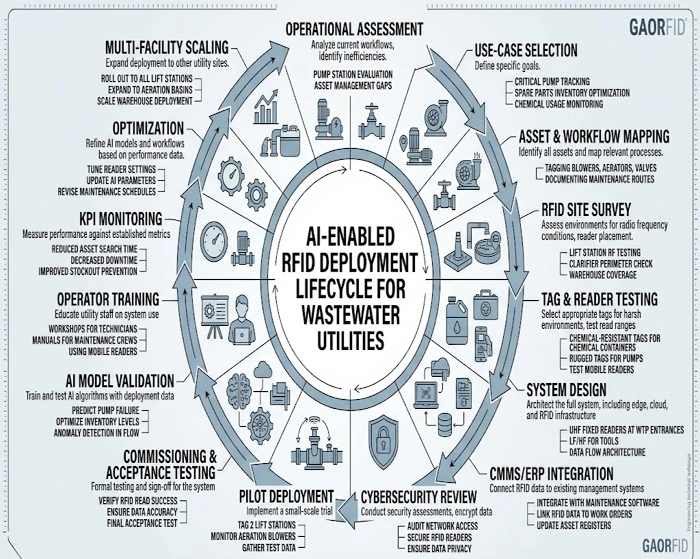
A comprehensive circular lifecycle diagram illustrating the implementation phases of AI-enabled RFID systems for wastewater utilities, progressing from operational assessment and system design to pilot deployment, AI validation, and multi-facility scaling. Each stage features wastewater-specific technical examples to provide practical guidance.
KPIs for AI-Enabled Wastewater Asset Management
Performance measurement should connect RFID and AI deployment to measurable wastewater utility outcomes rather than focusing only on the number of tagged assets. Relevant KPIs include:
- Critical asset location accuracy
- RFID read success rate
- Asset identification time
- Inventory record accuracy
- Critical-spare stockout rate
- Inventory carrying cost
- Emergency procurement frequency
- Mean time to repair
- Mean time between failures
- Preventive-maintenance compliance
- Predictive-maintenance alert precision
- Unplanned equipment downtime
- Work-order completion time
- Inspection completion rate
- Calibration compliance
- Tool search time
- Asset reconciliation time
- RFID event processing latency
- System availability
- AI recommendation acceptance rate
The correct KPI set depends on the original operational problem. A tool-tracking project should not be evaluated using the same primary metrics as a predictive-maintenance project.
Standards, Regulations, and Compliance Considerations
Wastewater utilities operate within regulatory and engineering environments that vary by jurisdiction, facility type, discharge permit, ownership structure, and treatment process. AI and RFID systems should therefore support existing compliance processes rather than being treated as independent compliance mechanisms.
Relevant regulatory and standards considerations may include:
- U.S. Environmental Protection Agency wastewater regulations and NPDES requirements
- State and local wastewater discharge requirements
- Clean Water Act requirements applicable to the facility
- Occupational Safety and Health Administration requirements for workplace safety
- Electrical and equipment safety requirements applicable to installed hardware
- ANSI and ISO asset-management and information-management practices where applicable
- IEC and ISA practices relevant to industrial automation and control environments
- NIST cybersecurity guidance where adopted or referenced by the utility
- Utility-specific cybersecurity, data-retention, access-control, and audit requirements
- Hazardous-location requirements where RFID equipment is installed in regulated areas
RFID does not itself establish regulatory compliance. Its value is supporting traceability, documentation, inspection evidence, inventory control, and operational accountability when implemented within the utility’s established procedures.
Cybersecurity for AI and RFID in Wastewater Utilities
Cybersecurity should cover the complete information path from RFID readers and handheld devices to edge gateways, middleware, databases, AI services, and connected business systems.
Practical controls include:
- Unique user identities
- Role-based access control
- Secure device configuration
- Encrypted network communications
- Network segmentation
- Firewall controls
- API authentication
- Audit logging
- Software and firmware patch management
- Backup and recovery procedures
- Credential rotation
- Endpoint protection where applicable
- Monitoring for unusual device or network behavior
AI systems also introduce model-specific considerations. Utilities should protect training data, validate model outputs, monitor changes in data quality, and maintain human review for recommendations affecting critical equipment or safety-sensitive operations.
AI and RFID Procurement Considerations for Wastewater Utilities
Procurement teams should evaluate the complete solution rather than selecting RFID readers or tags based solely on unit price. Important evaluation criteria include:
- Compatibility with existing asset identifiers
- Tag performance on actual wastewater equipment
- Environmental durability
- Reader and antenna performance
- Handheld usability for field technicians
- Supported communication interfaces
- Edge-processing capabilities
- Middleware functionality
- CMMS and ERP integration
- API availability
- Cloud and privately hosted deployment options
- Cybersecurity controls
- Software maintenance requirements
- Hardware replacement availability
- Technical support
- Installation and commissioning requirements
- Scalability across treatment plants and remote facilities
GAO’s role as a supplier of RFID, BLE, and IoT hardware products and systems can be relevant where utilities require technically evaluated identification hardware supported by engineering assistance. GAO’s sister companies, GAO Research Inc. and GAO Tek Inc., together form GAO Group, with operations based in New York City and Toronto, Canada. For three decades, the group has served U.S. and Canadian customers that include Fortune 500 companies, leading research and development organizations, universities, and government agencies.
Practical Recommendations for Wastewater Utility Deployment
Successful implementation depends more on workflow design and engineering validation than on the quantity of RFID hardware installed. Recommended practices include:
- Begin with a defined wastewater operational problem rather than a technology-first deployment
- Prioritize critical assets and high-value workflows
- Test RFID tags on actual equipment before final procurement
- Design read zones around meaningful business events
- Use durable tags appropriate for moisture, chemicals, metal, and outdoor exposure
- Normalize asset identifiers before introducing AI analytics
- Integrate RFID events with CMMS, ERP, inventory, laboratory, GIS, or other relevant systems
- Keep operational technology and business systems appropriately segmented
- Validate AI models using historical and current wastewater utility data
- Maintain human review for consequential maintenance decisions
- Establish measurable KPIs before deployment
- Conduct commissioning and acceptance testing
- Train maintenance, operations, warehouse, laboratory, and IT personnel according to their responsibilities
- Establish procedures for failed tags, replaced equipment, retired assets, and transferred assets
- Scale to additional facilities only after the initial workflow has demonstrated measurable value
Building the Future of Industrial AI and IoT with Aperture Venture Studio and GAO RFID Inc.
For more than three decades, GAO Group of Companies has invested heavily in R&D for industrial RFID, BLE, and IoT. As AI has become increasingly useful in industrial applications, we have advanced AI and IoT solutions that connect physical assets, operational data, and intelligent decision support, while founding Aperture Venture Studio to develop AI and IoT solutions relevant to specialized fields such as wastewater utilities.
Aperture has attracted AI and IoT technical experts, entrepreneurial and operational executives, investors, and leading companies. We have also developed Aperture Ventures Summit and TekSummit to advance discussions on AI and IoT.
These efforts have helped build technical communities around industrial AI and IoT.
We welcome you to join us as:
- Advisors, Co-founders, or Employees
- Investors
- Customers