
AI and RFID for Clinical Research
AI-Enabled Clinical Research Tracking and Laboratory Operations
Artificial intelligence is changing clinical research by turning operational data from laboratories, clinical trial sites, biobanks, pharmacies, and research facilities into actionable intelligence. When AI is combined with connected identification technologies such as UHF RFID, HF RFID, and LF RFID, research organizations can automate the identification and movement of specimens, investigational products, laboratory equipment, study materials, and other controlled assets. AI models can analyze these events alongside laboratory information management system (LIMS) records, electronic laboratory notebooks (ELN), clinical trial management system (CTMS) data, environmental readings, and study schedules. The result is more reliable chain-of-custody visibility, faster exception detection, improved inventory accuracy, and better coordination of time-sensitive research workflows. For clinical research organizations, the value is not simply automatic identification. The greater opportunity is using continuously captured operational data to predict delays, identify anomalies, reduce manual reconciliation, and support evidence-based decisions while maintaining data integrity, access control, and study-specific compliance requirements.
RFID-to-AI Clinical Research Workflow for Connected Trial Operations
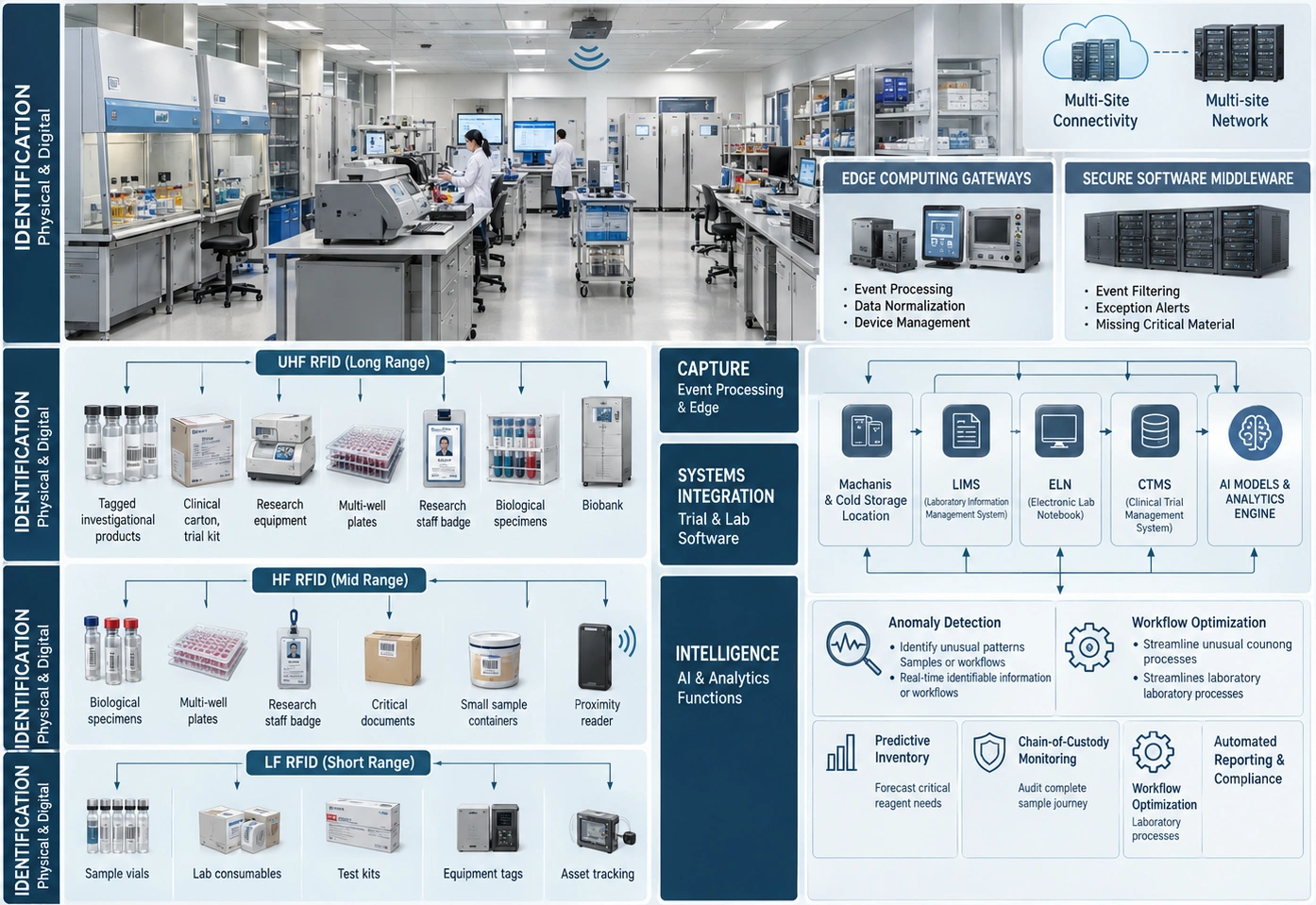
An enterprise workflow infographic illustrating the end-to-end integration of RFID technology and AI within a clinical research environment. The diagram tracks assets from physical identification using UHF, HF, and LF RFID to data capture via edge devices, leading into clinical trial software systems and advanced AI models for operational intelligence.
What AI-Driven RFID Means for Clinical Research
Clinical research generates large volumes of operational events that are difficult to reconcile when personnel depend primarily on barcode scans, spreadsheets, paper records, or manual inventory counts. A specimen may pass through accessioning, aliquoting, processing, storage, retrieval, analysis, shipment, and archival stages. Investigational products may move through receipt, quarantine, dispensing, accountability, return, and reconciliation. Research equipment can move between laboratories, controlled rooms, study teams, and maintenance locations.
AI-enabled identification provides a mechanism for connecting these physical events with the digital records that govern clinical research operations.
RFID supplies the machine-readable identity and location events, while AI adds interpretation and decision support. A UHF RFID reader can detect multiple tagged items without requiring individual line-of-sight scans, making it useful for inventory zones, storage areas, staging points, and movement monitoring. HF RFID can be appropriate for shorter-range identification and controlled workstation or item-level interactions. LF RFID can serve specialized proximity or access-oriented applications where its propagation characteristics are suitable.
The AI layer can correlate identification events with expected workflow states. For example, if a specimen container enters a processing area but remains there substantially longer than the expected processing interval, an AI model can flag the event for investigation. If study materials are repeatedly moved to an incorrect location, analytics can identify the pattern. If inventory consumption differs significantly from the expected study schedule, predictive models can support replenishment planning.
GAO supplies RFID and related IoT hardware products and systems that can serve as the physical data-capture layer for these clinical research workflows. The appropriate configuration depends on item materials, tag placement, read distance, room layout, interference sources, throughput, and the required level of identification accuracy.
Clinical Research Use Cases for AI-Enabled Identification
Biological Specimen and Sample Tracking
Clinical research specimens can move through numerous custody points, including collection, accessioning, centrifugation, aliquoting, analysis, temporary storage, biobank storage, shipment, and long-term retention. RFID identification can associate a specimen container or storage unit with machine-readable identity events, while AI can evaluate whether observed movements correspond with the expected study workflow.
Useful capabilities include:
- Automated identification of specimen containers and storage units
- Detection of unexpected movement between laboratory zones
- Chain-of-custody event reconstruction
- Identification of missing or delayed processing events
- Monitoring of specimen throughput by laboratory area
- Correlation of RFID events with LIMS records
- Detection of unusual specimen-handling patterns
- Support for inventory reconciliation in biobanks and research laboratories
AI does not replace validated laboratory records. Instead, it can operate as an operational intelligence layer that identifies discrepancies and directs personnel toward records or physical items requiring investigation.
Investigational Product and Study Material Tracking
Clinical trials require strict accountability for investigational medicinal products, comparator products, study kits, ancillary supplies, and other controlled materials. RFID can provide automated identification at receiving docks, storage areas, dispensing points, staging locations, and return areas.
AI can compare observed movements with study schedules, inventory levels, expected dispensing patterns, and defined workflow rules. This can help identify potential shortages, unusual consumption, delayed replenishment, or unexplained inventory movements.
For controlled environments, RFID deployment should be designed around validated processes, appropriate access controls, audit trails, and established procedures for reconciliation. RFID should not be treated as an independent source of truth when the regulated workflow requires a validated application or controlled record system.
Laboratory Equipment and Research Asset Tracking
Clinical research laboratories depend on centrifuges, freezers, refrigerators, incubators, biosafety cabinets, microscopes, analyzers, pipettes, liquid-handling systems, and other research equipment. Missing equipment can interrupt experiments, increase search time, and complicate maintenance activities.
RFID asset identification combined with AI analytics can support:
- Equipment location monitoring
- Utilization analysis
- Maintenance workflow coordination
- Calibration status monitoring
- Movement history
- Asset availability analysis
- Detection of equipment remaining outside an authorized zone
- Identification of underutilized or frequently relocated equipment
AI can combine RFID movement information with computerized maintenance management system (CMMS) records, calibration schedules, laboratory booking data, and equipment status information.
RFID-Enabled Clinical Research Laboratory with AI Asset Tracking and Analytics
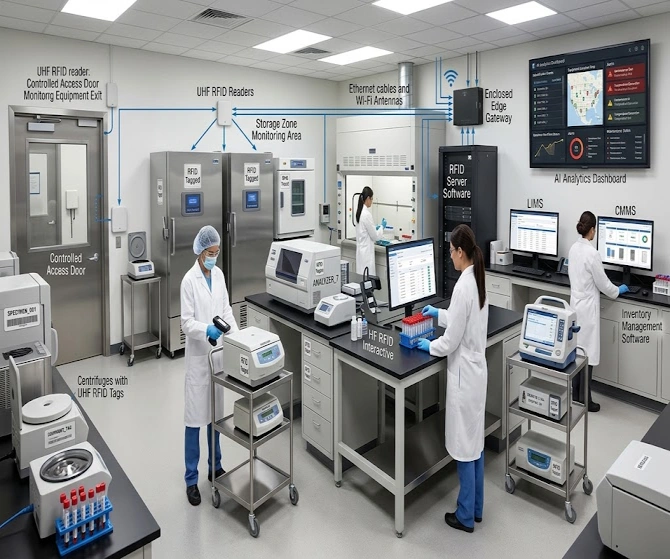
A photorealistic illustration of a functional clinical research laboratory, demonstrating a comprehensive RFID asset tracking system in action. The scene includes tagged assets, UHF and HF RFID readers, a research staff member interacting with tagged equipment, and a network of digital software systems, including an AI analytics dashboard.
Biobank and Cryogenic Storage Operations
Biobanks present particularly demanding tracking requirements because specimens may be stored in racks, boxes, shelves, cryogenic tanks, mechanical freezers, or other highly organized storage systems. A tracking solution must account for dense item arrangements, metal surfaces, liquids, low temperatures, condensation, and restricted physical access.
AI can help prioritize retrieval operations, identify storage anomalies, forecast capacity requirements, and detect discrepancies between expected and observed inventory states. RFID tag selection becomes particularly important because ordinary tags may not perform reliably in liquid-rich or cryogenic environments.
A practical implementation should validate tag performance at the actual operating temperature and with the exact specimen containers, racks, boxes, freezer geometry, and reader configuration used in production.
Clinical Trial Site Logistics
Research sites must coordinate study kits, specimens, investigational products, laboratory supplies, documents, equipment, and shipment containers. AI-enabled RFID can provide operational visibility across receiving, staging, preparation, dispatch, and return workflows.
The resulting event history can help research coordinators and operations teams identify delayed shipments, unexpected material movements, inventory imbalances, and study-site replenishment requirements.
Clinical Research Workflow from RFID Events to AI Decisions
A complete AI-enabled clinical research solution begins with physical event capture and ends with an operational action. The data path normally includes several interconnected layers.
Physical Data Acquisition
RFID tags are attached to appropriate research assets, containers, kits, equipment, storage units, or other trackable objects. Reader selection depends on required range, item density, material composition, environmental conditions, read-zone geometry, and workflow speed.
UHF RFID is generally useful where longer read ranges and multi-item identification are required. HF RFID can support controlled short-range interactions, while LF RFID can be considered for specialized proximity applications.
Edge Processing and Event Filtering
Readers transmit identification events to an edge computer, gateway, or local processing service. Raw reads can contain duplicates, transient detections, and signals from nearby zones. Event processing therefore becomes important.
Filtering logic can aggregate repeated observations and convert raw reads into meaningful events such as:
- Specimen entered accessioning
- Study kit entered staging
- Equipment moved into laboratory room
- Storage box removed from freezer zone
- Asset crossed a controlled boundary
- Shipment container entered dispatch area
This event normalization reduces unnecessary data volume and gives downstream software a consistent operational representation.
Middleware and Data Integration
RFID middleware can connect readers and edge systems with clinical research applications. Depending on the deployment, integration may use REST APIs, web services, message queues, database interfaces, or other approved integration mechanisms.
The middleware layer can associate RFID identifiers with business objects such as specimen IDs, equipment IDs, study-kit IDs, storage locations, or shipment records. Careful identifier mapping is essential because the RFID tag identifier itself may not represent the complete business identity required by a LIMS or clinical trial system.
AI Analytics and Decision Support
Once normalized events are available, AI models can identify patterns that are difficult to detect manually. Potential methods include:
- Machine learning for anomaly detection
- Time-series models for workflow-duration analysis
- Predictive models for inventory demand
- Classification models for operational exceptions
- Clustering for identifying unusual movement patterns
- Computer vision where visual confirmation is required
- Generative AI for controlled operational summaries and natural-language queries
- Rule-based decision logic for validated workflow constraints
AI outputs should be traceable to the underlying events. Clinical research personnel should be able to understand why an alert was generated and inspect the supporting data before taking an operational action.
RFID, AI Software, and Deployment Components for Clinical Research
A clinical research deployment normally combines identification hardware, edge computing, integration software, enterprise applications, AI services, databases, networking, and security controls. The exact configuration should be determined by study requirements, laboratory processes, data governance, and validation obligations.
UHF, HF, and LF RFID Hardware
UHF RFID is often considered for room-level or zone-level tracking because it can support longer read distances and rapid identification of multiple tagged objects. Clinical research applications may include equipment tracking, supply inventory, staging areas, specimen transport containers, and storage-zone monitoring.
HF RFID operates at shorter distances and can be useful for controlled item interactions, workstation identification, selected laboratory workflows, and applications where close-range confirmation is desirable.
LF RFID offers different coupling and propagation characteristics and can be appropriate for specialized proximity identification, access-related applications, or environments where its characteristics match the physical deployment.
Tag construction is a major engineering consideration. Water-rich specimen environments, metal equipment, cryogenic storage, dense shelving, and medical or laboratory plastics can affect read performance. Testing should therefore use representative containers and equipment rather than relying solely on laboratory specifications.
Edge Computing and Local Server Processing
Edge processing can reduce unnecessary transmission of raw RFID observations and provide rapid local responses. A local server can also maintain operations when connectivity to a central service is temporarily unavailable.
Server-based deployment can be appropriate for research organizations requiring direct control over software, databases, networking, and security boundaries. The server may reside in a customer-managed data center, private data center, research facility, or other controlled infrastructure.
Cloud Deployment
Cloud-hosted software can support centralized management across geographically distributed clinical research sites, contract research organizations, laboratories, and biobank facilities. Cloud deployment can simplify centralized analytics and provide a common operational view across multiple locations.
The appropriate model depends on organizational policies, data classification, connectivity, integration requirements, cybersecurity controls, and applicable contractual or regulatory requirements. A cloud deployment should not be selected simply because it is easier to provision. Clinical research organizations should evaluate where operational data is stored, how it is transmitted, who can access it, how long it is retained, and how audit records are protected.
Clinical Research Software Integration
RFID event data can become substantially more useful when connected to existing clinical research systems. Relevant software may include:
- Laboratory information management systems
- Electronic laboratory notebooks
- Clinical trial management systems
- Electronic data capture systems
- Biobank management systems
- Inventory management software
- Warehouse or clinical supply management systems
- Computerized maintenance management systems
- Calibration management software
- Quality management systems
- Data historians and analytical databases
- Identity and access management systems
GAO’s RFID and IoT hardware can serve as an input layer to these environments, while system integrators can implement the application-specific interfaces and workflow logic required by individual research organizations.
Security and Data Governance
Security must cover the complete path from RFID reader to application. Relevant controls include network segmentation, encrypted communications, role-based access control, credential management, device authentication, audit logging, software patching, backup procedures, and monitoring of unusual access behavior.
RFID itself generally does not contain enough context to serve as a complete clinical record. A secure implementation should separate tag identifiers, operational metadata, study information, and sensitive research records according to the organization’s data-governance model.
Engineering Considerations for Clinical Research RFID Deployment
Clinical research environments require more than simply installing readers and tags. The physical and operational design should be validated against the actual research workflow.
Key engineering considerations include:
- Read-zone definition: Reader coverage should correspond to meaningful workflow boundaries such as accessioning stations, storage rooms, controlled doors, staging areas, and dispatch points.
- Tag placement: Placement should be standardized for specimen containers, equipment, racks, boxes, kits, and other assets to improve read consistency.
- Material effects: Water, biological fluids, metal, foil packaging, cryogenic containers, and laboratory equipment can influence RF performance.
- Reader density: Excessive reader overlap can generate unwanted reads and complicate event interpretation.
- Event logic: Software should distinguish presence, movement, transition, and confirmed workflow events rather than treating every RFID read as a separate business event.
- Network resilience: Critical laboratory workflows should have an operational strategy for network outages or temporary loss of cloud connectivity.
- System validation: RFID-generated events should be tested against defined acceptance criteria and existing clinical research procedures.
- Traceability: Each important operational event should remain attributable to the relevant item, location, timestamp, system component, and authorized user or process where required.
- Change control: Modifications to readers, tag formats, middleware, integrations, AI models, or workflow logic should follow the organization’s established change-control procedures.
AI introduces an additional engineering consideration: model outputs should be monitored for false positives, false negatives, data drift, and changes in workflow behavior. A useful anomaly-detection model is not necessarily the one that generates the largest number of alerts. Clinical research operations generally benefit from alerts that are explainable, actionable, and prioritized according to operational risk.
AI-Driven Clinical Research Workflow Optimization
The strongest business case for AI-enabled identification emerges when RFID events are combined with clinical research process data rather than treated as isolated tracking records. A laboratory manager can use historical movement data to understand bottlenecks in accessioning or sample processing. A biobank manager can analyze retrieval patterns and storage utilization. A clinical supply team can compare study enrollment forecasts with material consumption. A research operations manager can identify equipment that spends excessive time unavailable or outside its designated location.
These capabilities support a shift from retrospective reconciliation toward proactive operational management. Instead of discovering a missing item during an inventory count, personnel can receive an exception when an expected movement does not occur. Instead of discovering recurring processing delays through manual review, analytics can identify workflow stages with abnormal cycle times.
The practical objective is not to automate every clinical research decision. It is to give qualified personnel better operational evidence while preserving established laboratory controls, quality procedures, and accountable human oversight.
GAO’s experience supplying RFID, BLE, and IoT hardware products and systems to organizations in the United States and Canada provides a foundation for addressing the physical identification and connected-device aspects of these deployments. GAO Group companies have served Fortune 500 companies, leading R&D organizations, universities, and government agencies for three decades, supported by substantial product and system R&D, quality assurance processes, and remote or onsite technical support.
Clinical Research Benefits of AI-Enabled RFID Systems
Combining AI with automated identification can improve clinical research operations because physical events become measurable, searchable, and available for analysis. The value depends on the quality of the underlying data and the way those events are connected to validated research processes.
Improved Specimen Chain of Custody
Automated identification can reduce dependence on manual scans during specimen movement. When properly engineered, RFID events provide timestamps and location observations that help reconstruct where a research specimen or container moved through defined laboratory zones.
AI can compare observed movements against expected processing sequences and identify exceptions such as an unexpected location transition, prolonged dwell time, or missing workflow event. This can help laboratory personnel investigate discrepancies earlier rather than discovering them during later reconciliation.
Faster Laboratory Workflow
Research laboratories frequently lose time searching for equipment, locating samples, reconciling storage records, or manually checking inventory. Automated location and movement events can reduce these activities.
AI can further analyze workflow durations to identify recurring bottlenecks. For example, if a sample-processing stage consistently takes longer during particular periods or under certain workload conditions, analytics can help operations managers investigate staffing, equipment availability, queue length, or process design.
More Accurate Research Inventory
AI-driven inventory management can combine RFID observations with historical consumption, study schedules, laboratory workload, and replenishment records. This supports more accurate forecasts for reagents, consumables, study kits, specimen containers, and other research materials.
Predictive inventory models can identify materials approaching expected depletion before a shortage disrupts laboratory operations. This is particularly valuable when replacement lead times are long or when a study depends on specialized materials.
Better Equipment Utilization
RFID-generated equipment-location events can provide the operational data required to understand how laboratory assets are actually used. AI can analyze utilization, movement frequency, downtime, maintenance history, and booking information.
Such analysis can reveal equipment that is heavily utilized and potentially creating workflow bottlenecks, as well as assets that remain underused. The resulting information can support maintenance planning, resource allocation, laboratory layout decisions, and procurement analysis.
Earlier Detection of Operational Exceptions
AI-based anomaly detection can identify deviations from established clinical research workflows. Examples include:
- A specimen remaining in a processing zone longer than expected
- A research asset entering an unauthorized area
- A study kit being staged for an unexpected period
- Inventory consumption deviating from historical patterns
- A storage location showing an unexpected inventory change
- Equipment movement inconsistent with its maintenance status
- Repeated workflow delays at the same processing point
Alert thresholds should be tuned to the actual research process. Excessive alerts can create alarm fatigue and reduce the practical value of the system.
Multi-Site Research Visibility
Clinical research organizations operating across multiple laboratories, trial sites, storage facilities, or biobank locations can use centralized analytics to compare operational performance.
A cloud deployment can provide centralized reporting when organizational policies permit it, while server-based deployments can provide greater local control where research data or network policies require privately managed infrastructure.
The objective should be consistent operational definitions rather than forcing every research site into an identical physical configuration. A freezer room, clinical trial site, and analytical laboratory may require different RFID hardware and event rules while still contributing standardized information to centralized reporting.
Clinical Research KPIs for AI and RFID Implementations
Technology deployment should be evaluated through operational measurements rather than reader counts or tag quantities alone. Clinical research organizations should establish baseline measurements before implementation and compare them with post-deployment performance.
Relevant KPIs include:
- Specimen location accuracy
- Specimen reconciliation time
- Chain-of-custody exception rate
- Sample processing cycle time
- Average specimen dwell time by workflow stage
- Inventory accuracy
- Inventory reconciliation time
- Study-kit availability
- Stockout frequency
- Inventory carrying requirements
- Equipment search time
- Equipment utilization rate
- Equipment downtime
- Maintenance compliance
- Calibration compliance
- Unauthorized asset movement events
- Biobank retrieval time
- Freezer or storage-capacity utilization
- Shipment preparation time
- Clinical supply exception rate
- RFID read accuracy within defined zones
- False-read rate
- Missed-read rate
- AI alert precision
- AI alert response time
- Mean time to resolve operational exceptions
- Integration transaction success rate
- System availability
- Data synchronization latency
- User response to workflow alerts
The most useful KPI set should reflect the clinical research process being improved. A biobank may prioritize retrieval time and inventory reconciliation, while a clinical trial supply operation may place greater emphasis on kit availability, shipment exceptions, and inventory forecasting.
Standards, Regulations, and Compliance Considerations
Clinical research RFID deployments should be designed within the applicable regulatory and quality framework rather than treating RFID or AI as separate from existing research controls. Requirements vary according to the type of research, jurisdiction, organization, product, data involved, and intended use of the system.
Relevant frameworks and regulations may include:
- U.S. Food and Drug Administration requirements applicable to regulated clinical investigations and electronic records
- 21 CFR Part 11 considerations for electronic records and electronic signatures where applicable
- Good Clinical Practice requirements, including ICH E6
- Good Laboratory Practice requirements where applicable
- Good Manufacturing Practice requirements where research activities intersect with regulated manufacturing
- HIPAA requirements where protected health information is processed by covered entities or applicable business associates
- FDA guidance concerning computerized systems and electronic data in clinical research
- FDA data-integrity expectations applicable to regulated records
- EU GDPR requirements where applicable to personal data
- ISO 27001 information-security management practices
- ISO 9001 quality management practices where adopted by the organization
- ISO 13485 where medical-device quality systems are relevant
- ISO/IEC 17025 where laboratory accreditation requirements apply
- NIST cybersecurity guidance and controls
- NIST AI Risk Management Framework as a useful AI governance reference
- ASTM standards relevant to laboratory, clinical, or material-handling processes where applicable
- GS1 identification and data standards where supply-chain identification is involved
- Applicable U.S. Department of Health and Human Services requirements
- Applicable Canadian privacy and research requirements
- Institutional review board and research ethics requirements
- Organizational SOPs governing specimen handling and research records
- Computer system validation and computerized system assurance procedures
Not every requirement applies to every RFID installation. A system used solely for locating laboratory equipment can have a different compliance profile from a system that contributes directly to a regulated electronic record. The intended use, data flow, system functions, and degree of reliance on automated decisions should therefore be documented during project planning.
AI models also require governance. Research organizations should establish controls for model versioning, training-data provenance, performance monitoring, access permissions, validation, change management, and human review.
Clinical Research Cybersecurity and Data Integrity
Cybersecurity should be considered across RFID readers, gateways, servers, cloud services, databases, APIs, user accounts, and connected laboratory systems.
A practical security design can include:
- Network segmentation for RFID readers and IoT devices
- Unique credentials for connected devices
- Role-based access control
- Multi-factor authentication for administrative access
- Encrypted communications between system components
- Secure API authentication
- Audit logging
- Centralized security monitoring
- Vulnerability and patch management
- Backup and recovery procedures
- Controlled administrative privileges
- Device inventory and lifecycle management
- Secure decommissioning of readers and gateways
- Retention policies for operational event data
- Monitoring for abnormal device behavior
Data integrity also requires consistency between physical events and digital records. If an RFID reader reports that a container entered a laboratory but the LIMS contains no corresponding specimen record, the software should flag the mismatch rather than silently creating an incorrect record.
AI-generated recommendations should similarly remain distinguishable from authoritative source records. A generated summary can help personnel understand operational conditions, but the underlying LIMS, CTMS, quality system, or other designated system of record should retain the authoritative information where required.
Implementation Roadmap for Clinical Research RFID and AI
Successful implementation usually begins with a narrowly defined operational problem rather than an attempt to tag every item in a research organization.
Process Assessment
Document the current workflow from the physical movement of research materials to the corresponding digital record. Identify manual scans, paper records, spreadsheet reconciliation, repeated searches, inventory discrepancies, delayed processing stages, and other sources of operational friction.
The assessment should identify which events genuinely require automated capture. Not every movement needs an RFID reader.
RFID Site Survey and Tag Testing
Conduct a physical survey of laboratories, storage rooms, biobank areas, staging locations, receiving areas, and controlled access points. Testing should evaluate:
- Required read distance
- Reader antenna orientation
- Tag placement
- Metal interference
- Liquid interaction
- Cryogenic conditions
- Reader-to-reader interference
- Item density
- Human movement
- Storage geometry
- Read-zone boundaries
- Network availability
Representative samples, containers, racks, equipment, and packaging should be used during testing.
Integration Design
Define how RFID events will connect to existing research software. The project should establish authoritative identifiers, event schemas, timestamps, location codes, exception states, and integration error handling.
A robust integration should also define what happens when an event cannot be delivered to the downstream application. Local buffering and retry mechanisms can prevent temporary network problems from becoming permanent data gaps.
Commissioning and Validation
Commissioning should confirm that readers, tags, gateways, software, databases, integrations, and AI functions operate according to the defined requirements.
Test scenarios should include both normal and abnormal conditions. Examples include expected specimen movement, unexpected movement, duplicate reads, missing reads, network interruption, reader failure, incorrect tag placement, unauthorized movement, and integration failure.
AI functions should be evaluated using representative historical or controlled operational data. Performance should be measured against defined acceptance criteria rather than assuming that an algorithm is effective because it produces plausible results.
Optimization and Lifecycle Management
RFID deployments require ongoing tuning. Laboratory layouts change, equipment is relocated, storage configurations evolve, and new research programs introduce different materials and workflows.
Maintenance should therefore include reader health monitoring, tag replacement procedures, firmware management, software updates, integration monitoring, cybersecurity reviews, AI model performance assessment, and periodic KPI evaluation.
Practical Design Recommendations for Clinical Research
Several implementation principles consistently improve the reliability of AI-enabled RFID systems.
- Begin with a measurable clinical research workflow problem.
- Define the system of record before designing integrations.
- Select RFID tags based on actual specimen, equipment, packaging, and storage conditions.
- Treat reader placement as a physical engineering problem rather than simply a software configuration.
- Design read zones around workflow boundaries.
- Convert raw RFID observations into meaningful operational events.
- Use AI for anomaly detection, prediction, prioritization, and analysis rather than replacing accountable research personnel.
- Maintain traceability from AI alerts back to underlying operational events.
- Validate critical workflows using representative conditions.
- Establish clear ownership of RFID hardware, middleware, integrations, AI services, and cybersecurity.
- Monitor false reads and missed reads after commissioning.
- Establish procedures for damaged, replaced, or retired RFID tags.
- Use role-based access and authenticated device connections.
- Plan for network outages and integration failures.
- Monitor AI model performance as research workflows and operating conditions change.
- Measure business outcomes such as reconciliation time, processing cycle time, inventory accuracy, retrieval time, and exception resolution rather than technology deployment volume.
Why GAO RFID Technology Matters for Clinical Research
GAO provides RFID, BLE, and other IoT hardware products and systems that can support connected research environments, including identification, asset tracking, inventory visibility, and location-oriented applications. Its products can be incorporated into solutions designed around laboratory workflows, research equipment, specimen-related operations, and clinical supply processes.
Headquartered in New York City and Toronto, Canada, GAO is ranked among the top 10 leading B2B and B2G, with a lesser degree of B2B2C and B2D, BLE and RFID suppliers globally. Its position is supported by extensive product and system development rather than by a single technology category.
GAO Group, comprising GAO, GAO Research Inc., and GAO Tek Inc., has served customers in the United States and Canada for three decades. Its customers have included Fortune 500 companies, leading R&D organizations, prestigious universities, and U.S. and Canadian government agencies.
Substantial investment in R&D, stringent quality assurance processes, and remote or onsite technical support are important considerations when deploying connected hardware into technically demanding research environments. For clinical research organizations, the hardware supplier should be evaluated not only on product specifications but also on its ability to support system design, deployment, integration, troubleshooting, and lifecycle requirements.
Key Takeaways for AI and RFID in Clinical Research
AI-enabled RFID can provide clinical research organizations with a continuous stream of operational information about specimens, research assets, study materials, laboratory equipment, storage locations, and clinical supply processes. The greatest value comes from connecting that information to existing research software and applying AI to detect exceptions, predict operational requirements, analyze workflow performance, and support timely decisions.
A successful implementation requires accurate tag selection, engineered reader placement, reliable event processing, secure integration, appropriate deployment infrastructure, validated workflows, and measurable KPIs. Organizations should also distinguish operational intelligence from authoritative regulated records and establish appropriate human oversight of AI outputs.
GAO can support organizations seeking RFID and IoT hardware products and systems for clinical research applications, from identification and asset tracking to connected operational workflows. Readers, system integrators, laboratory technology teams, and procurement professionals can explore the relevant GAO technologies and determine which configuration best matches their research environment, workflow requirements, and deployment model.
Building the Future of Industrial AI and IoT with Aperture Venture Studio and GAO RFID Inc.
For more than three decades, GAO Group of Companies has invested heavily in R&D of industrial RFID, BLE, and IoT. As generative AI became increasingly useful in industrial applications, we expanded our work across AI and IoT technologies, including RFID and BLE, and founded Aperture Venture Studio to build, launch, and scale next-generation AI and IoT companies and solutions relevant to fields such as clinical research and life sciences.
Aperture has attracted AI and IoT technical experts, entrepreneurial and operational executives, influential investors, and leading companies. We have also developed the Aperture Ventures Summit and TekSummit to discuss advanced AI and IoT topics. We welcome advisors, co-founders or employees, investors, and customers to participate in these initiatives.