
AI and RFID for Environmental Laboratories
AI-Driven Environmental Laboratory Operations with RFID Traceability
AI for environmental laboratories uses machine learning, computer vision, anomaly detection, predictive analytics, and connected laboratory data to improve sample management, chain of custody, quality assurance, equipment utilization, and analytical decision-making. RFID provides machine-readable identity and location data for sample containers, coolers, racks, storage bins, laboratory equipment, and other controlled assets. Together, these technologies can connect physical laboratory activities with LIMS, ELN, QMS, inventory software, environmental monitoring systems, and analytical instruments.
For environmental laboratories handling drinking water, wastewater, soil, sediment, air, hazardous waste, industrial discharge, and other environmental samples, reliable identification and timing of physical samples are essential. AI can correlate RFID events with accession records, test schedules, storage conditions, analytical results, and quality-control observations to identify exceptions before they become reportable errors. GAO supplies RFID, BLE, IoT, and related hardware products and systems that can support these laboratory workflows, while the resulting data can be integrated into the laboratory’s existing software and quality processes.
AI-Enabled Environmental Laboratory Operations with RFID
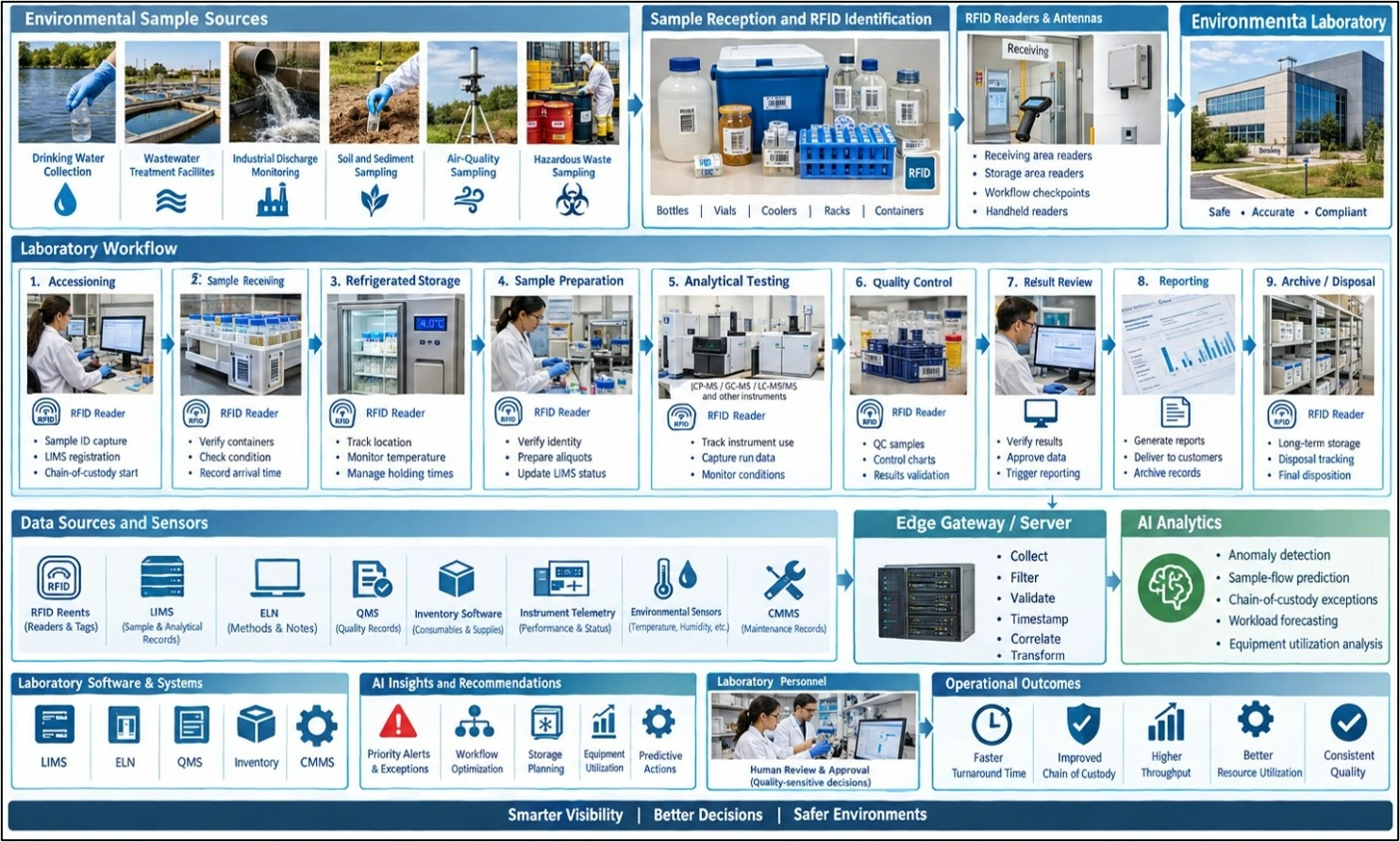
This visual illustrates how RFID-tagged environmental samples move through receiving, accessioning, refrigerated storage, preparation, analytical testing, quality control, review, reporting, and archiving. It also shows how RFID events, laboratory instruments, environmental sensors, LIMS, QMS, ELN, CMMS, and inventory data feed edge processing and AI analytics to support faster turnaround, stronger chain-of-custody visibility, improved resource utilization, and consistent laboratory quality.
Why Environmental Laboratories Need AI-Assisted Sample Intelligence
Environmental laboratory operations depend on maintaining sample identity, preservation conditions, analytical schedules, custody records, method requirements, and quality-control evidence across multiple handoffs. A single environmental sample can pass through receiving, accessioning, storage, preparation, extraction, digestion, incubation, analysis, review, reporting, and retention or disposal. Each transition creates an opportunity for misidentification, delay, incorrect storage, duplicate handling, or incomplete documentation.
AI becomes valuable when these physical events are combined with laboratory information rather than treated as isolated RFID reads. A machine-learning model can compare expected sample movement with observed movement and identify unusual dwell times. A rules engine can detect an RFID-tagged sample entering a storage area inconsistent with its preservation requirement. Predictive analytics can estimate upcoming workload from sample intake patterns, scheduled projects, analytical turnaround requirements, and instrument availability.
Environmental laboratories can apply these capabilities to several important operational areas:
- Sample accessioning: RFID identification can reduce manual transcription when receiving bottles, containers, coolers, and sample batches. AI can compare observed identities and timestamps with expected submission records and flag discrepancies for laboratory personnel.
- Chain-of-custody control: RFID event records can provide additional machine-generated evidence of when identified sample containers or batches enter and leave designated laboratory zones. AI can identify unusual custody sequences, missing transitions, or excessive dwell times for review.
- Sample preservation: Refrigerated samples, frozen materials, volatile organic compound samples, microbiological samples, and other preservation-sensitive materials can be associated with storage locations and environmental measurements. AI can correlate identity, temperature history, elapsed time, and test scheduling to identify preservation risks.
- Laboratory sample routing: AI can analyze sample queues, required analytical methods, instrument availability, preparation requirements, and turnaround targets to recommend efficient routing between preparation and analytical areas.
- Analytical workload management: Environmental laboratories frequently operate multiple analytical disciplines, including metals, inorganic chemistry, organic chemistry, microbiology, radiochemistry, and physical testing. AI can forecast workload and identify potential bottlenecks around instruments, preparation rooms, analysts, or review queues.
- Quality assurance and quality control: AI can identify unusual relationships among sample identity, batch membership, blanks, duplicates, matrix spikes, calibration events, control samples, and analytical results. Such models should support qualified laboratory personnel rather than independently override established quality procedures.
- Equipment utilization: RFID identification of portable instruments, sampling equipment, extraction apparatus, calibration tools, mobile carts, and other assets can provide utilization information that supports maintenance planning and resource allocation.
- Sample storage and retention: AI can analyze storage capacity, sample age, project status, retention requirements, and disposal schedules to identify congestion and prioritize laboratory actions.
GAO’s RFID hardware can be used at controlled laboratory checkpoints, storage locations, work areas, and asset-handling points to create additional operational data for these AI applications.
Environmental Laboratory Workflows Where AI Creates Measurable Value
Sample Receiving and Accessioning
Environmental samples can arrive from municipal water systems, wastewater facilities, industrial sites, environmental consultants, government monitoring programs, research projects, and field sampling teams. Receiving personnel may process coolers containing numerous individual containers with different analyses, preservation requirements, collection times, and custody documentation.
An RFID-enabled receiving process can associate an electronic identity with the physical container or sample package and capture its movement through defined checkpoints. LIMS remains the authoritative system for sample registration, analytical work orders, and laboratory records. RFID provides additional physical-event data that can be correlated with those records.
AI can compare expected sample composition against observed identities, detect unusual receiving patterns, estimate accession workload, and prioritize exceptions requiring human verification.
Chain of Custody and Sample Movement
Chain of custody is particularly important where analytical results support regulatory reporting, environmental compliance investigations, remediation programs, litigation, or public-sector monitoring. RFID should therefore be implemented as a supporting evidence mechanism rather than treated as a replacement for validated laboratory records or established custody procedures.
AI can evaluate sequences such as:
- Sample received
- Identity verified
- Preservation checked
- Storage location assigned
- Sample preparation initiated
- Aliquot created
- Analytical method started
- Instrument result generated
- Technical review completed
- Final result approved
- Sample retained or disposed
A deviation from the expected sequence can generate an exception for laboratory personnel. For example, an RFID event may show that a sample container remained in an uncontrolled staging area longer than the laboratory’s defined operating threshold. The AI system can correlate that event with temperature records, sample type, method requirements, and elapsed time before presenting an exception for review.
Refrigerated and Controlled Sample Storage
Environmental laboratories may maintain refrigerators, freezers, cold rooms, chemical storage areas, microbiological incubation environments, and other controlled locations. Storage requirements vary according to sample matrix, analytical method, preservation procedure, and laboratory SOP.
RFID can identify which samples or containers are physically present in a designated storage location. Environmental sensors can provide temperature and other relevant measurements. AI can correlate these streams to distinguish a general refrigeration excursion from an excursion affecting a specific group of samples.
This distinction is operationally important. A temperature event affecting an empty storage position should not necessarily receive the same response priority as an event affecting high-priority samples approaching a method-specific holding-time limit.
Sample Preparation and Analytical Testing
Preparation activities can include digestion, extraction, filtration, dilution, aliquoting, incubation, concentration, derivatization, and other method-specific procedures. Environmental laboratories may use analytical technologies such as ICP-OES, ICP-MS, GC-MS, GC-FID, LC-MS/MS, ion chromatography, spectrophotometry, TOC analyzers, microbiological systems, and other instrumentation.
RFID can associate containers, racks, aliquots, mobile carts, and reusable laboratory assets with work areas. Instrument data can be integrated through available interfaces or laboratory middleware. AI can then examine relationships between sample routing, instrument utilization, analytical batches, quality-control results, and turnaround performance.
A practical implementation should preserve the distinction between physical observation, system inference, and analytical result. An RFID read indicates that an identified object was detected at a reader location. It does not by itself prove that an analytical procedure was completed or that a sample result is valid.
AI-Enabled Environmental Laboratory Sample-to-Result Workflow
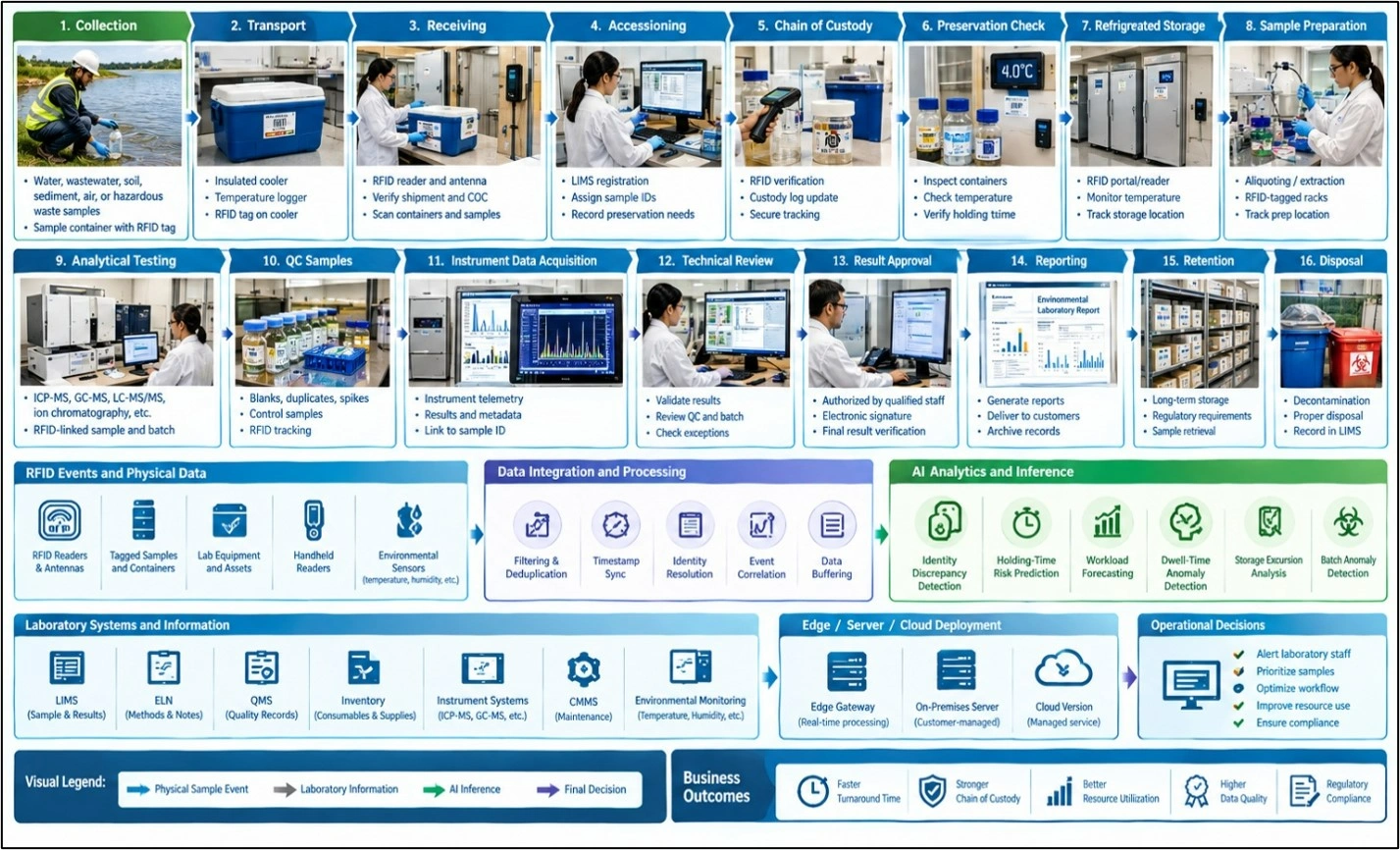
This workflow illustrates the complete journey of an environmental sample from field collection and transport through RFID-enabled receiving, accessioning, preservation, storage, preparation, analytical testing, QC, technical review, reporting, retention, and disposal. It shows how RFID events, LIMS, laboratory instruments, environmental sensors, and other operational data are processed through edge, server, or cloud systems to support AI-driven exception detection, holding-time risk prediction, workload forecasting, and laboratory decision-making.
Quality Control, Review, and Reporting
AI should augment rather than replace laboratory quality systems. Environmental laboratory quality programs commonly require documented procedures, qualified personnel, calibration and maintenance records, method-specific QC, proficiency activities, corrective actions, document control, and traceable records.
AI can support this environment by identifying patterns that merit investigation. Examples include repeated delays associated with a specific workflow, unusual instrument utilization, recurring preparation bottlenecks, unexpected relationships between QC outcomes and operational conditions, or repeated manual corrections to sample identities.
The laboratory’s validated procedures and quality personnel remain responsible for determining whether an identified condition constitutes a quality event, nonconformance, corrective action, or reportable issue.
AI and RFID Use Cases Across Environmental Laboratory Operations
| Environmental Laboratory Area | RFID-Supported Data | AI Application | Operational Outcome |
|---|---|---|---|
| Sample receiving | Container, cooler, rack, and batch identity | Accession discrepancy detection | Fewer manual identification errors |
| Chain of custody | Zone transitions and timestamps | Sequence anomaly detection | Faster exception investigation |
| Cold storage | Sample identity plus location | Preservation and excursion risk analysis | Better prioritization of affected samples |
| Sample preparation | Aliquot, rack, cart, and workstation events | Workflow bottleneck analysis | Improved sample throughput |
| Analytical testing | Sample and batch movement plus instrument events | Workload and turnaround prediction | Better scheduling |
| QC workflows | QC sample identity and batch relationships | Pattern and anomaly detection | Earlier investigation of recurring issues |
| Equipment management | Instrument and asset movement | Utilization and maintenance analytics | Better resource planning |
| Sample retention | Stored sample identity and age | Retention and capacity forecasting | Better storage utilization |
| Inventory | Consumables and laboratory supply movement | Consumption forecasting | Reduced stockout risk |
| Laboratory safety | Asset and material movement | Unusual movement detection | Additional operational awareness |
Technical Foundation for AI-Enabled Environmental Laboratory Solutions
A practical solution combines RFID hardware, laboratory software, environmental sensors, analytical instrument data, connectivity, middleware, and AI processing. The design should begin with the laboratory workflow and data requirements rather than with RFID hardware alone.
RFID Hardware for Sample and Asset Identification
RFID selection depends on the physical characteristics of the laboratory objects, required read range, metal or liquid interference, tag attachment method, read-zone geometry, and desired automation level.
- UHF RFID: Suitable for longer-range identification of sample racks, transport containers, coolers, equipment, carts, storage bins, and other objects where portal or zone-level detection is useful. Liquids and metal can affect performance, so tag selection and antenna placement require testing.
- HF RFID: Useful for shorter-range controlled identification where deliberate proximity between a tagged object and reader is desirable. It can be appropriate for selected laboratory workstations and controlled identification points.
- LF RFID: Useful for specialized short-range identification requirements where low-frequency operation is appropriate, although its lower data rate and shorter read range can limit suitability for dense laboratory tracking applications.
RFID tags should not be assumed to replace printed labels, barcodes, or human-readable identifiers. A robust environmental laboratory design can use multiple identification methods where each provides operational value.
Edge Processing, Middleware, and AI
RFID readers generate observations that normally require filtering, validation, deduplication, timestamping, identity resolution, and event correlation before AI models consume them. Middleware can transform repeated raw reads into meaningful events such as “sample rack entered refrigerated storage” or “cooler arrived at receiving.”
An edge server can perform local event processing when laboratories require low latency, continued operation during WAN interruptions, or tighter control over sensitive operational data. AI inference can run locally for selected use cases, while historical analytics and model training can use centralized computing resources.
Laboratory Software Integration
The solution should integrate with systems already responsible for laboratory records and operations.
Common integration targets include:
- LIMS: Sample accessioning, work orders, sample status, test assignments, results, and chain-of-custody records.
- ELN: Experimental and analytical documentation where applicable.
- QMS: Deviations, corrective actions, document control, audits, and quality records.
- Instrument data systems: Analytical measurements, instrument status, calibration information, and batch data.
- Inventory software: Reagents, consumables, standards, reference materials, containers, and laboratory supplies.
- Environmental monitoring systems: Refrigerators, freezers, incubators, cold rooms, and other controlled environments.
- CMMS or maintenance software: Instrument maintenance, calibration scheduling, service history, and equipment availability.
- Identity and access management: Authentication, role-based access, and controlled access to laboratory applications.
Communication can use Ethernet, Wi-Fi, industrial wireless networks where appropriate, MQTT, HTTPS, REST APIs, OPC UA for compatible equipment environments, and vendor-specific instrument interfaces. The selected interface should reflect the actual capabilities and validation requirements of the laboratory.
Cloud Version and Server Version for Environmental Laboratories
A Cloud Version uses cloud-hosted software and infrastructure managed as a cloud service. This approach can simplify centralized analytics across multiple environmental laboratory sites and support broader aggregation of operational information. It is particularly useful when laboratory networks have reliable outbound connectivity and organizational policies permit relevant data to leave the facility.
A Server Version runs software on customer-managed infrastructure, which may include laboratory edge servers, privately hosted servers, private data centers, or other customer-controlled computing environments. It can be preferable when environmental laboratories require local processing, tighter data-residency control, reduced WAN dependency, or integration with isolated laboratory networks.
A hybrid design can place RFID event processing and selected AI inference close to the laboratory while sending approved historical or aggregated information to centralized cloud or private-server analytics. The decision should consider latency, connectivity, cybersecurity, data governance, validation requirements, multi-site operation, disaster recovery, model management, and the laboratory’s existing IT policies.
AI and RFID Data Flow for Environmental Laboratories
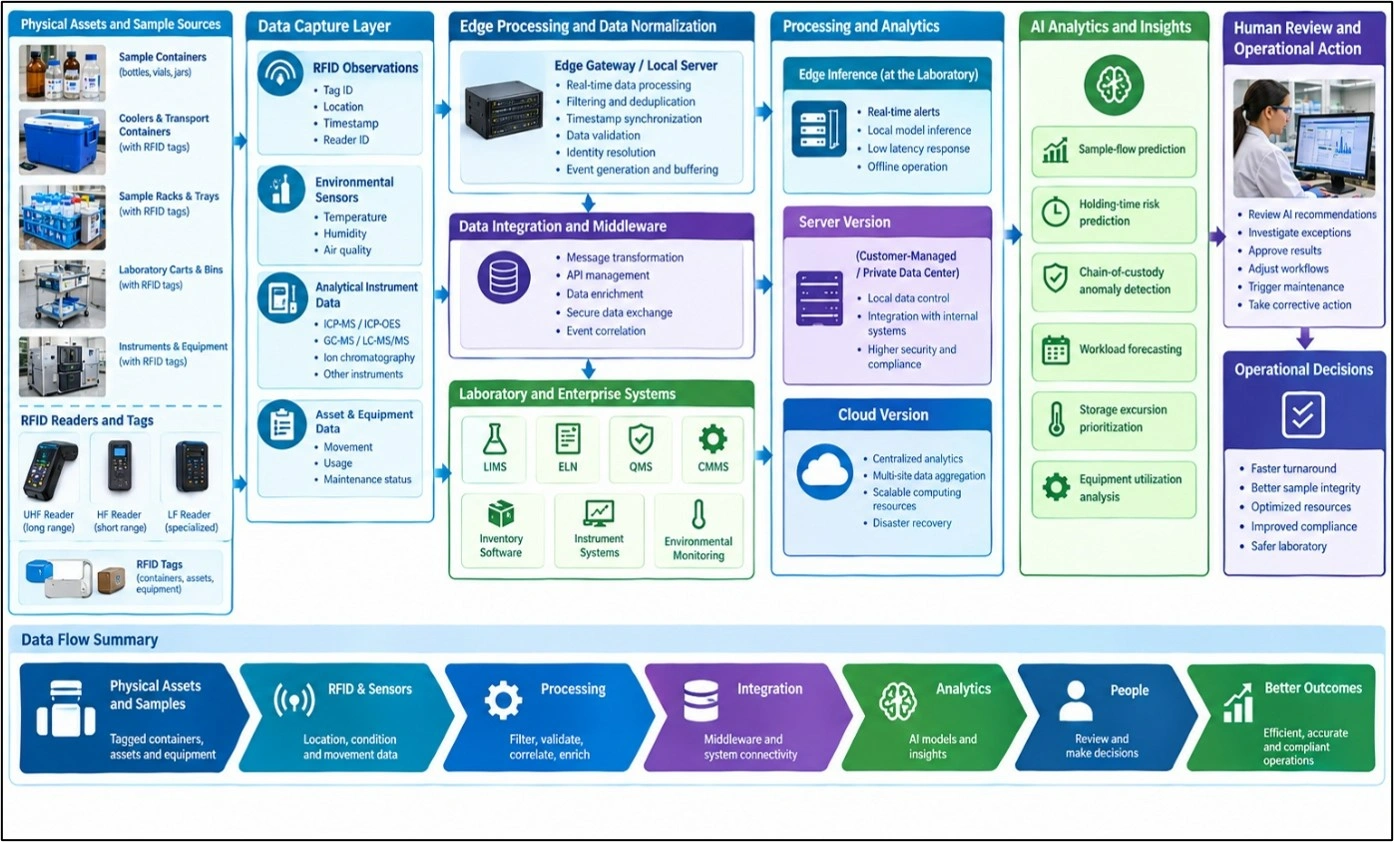
This engineering block diagram shows how RFID-tagged environmental laboratory samples, containers, racks, carts, instruments, and equipment generate physical data that moves through RFID readers, environmental sensors, edge processing, middleware, laboratory software, and AI analytics. It illustrates UHF, HF, and LF RFID, data validation, identity resolution, event generation, Server Version and Cloud Version processing, and AI outputs such as holding-time risk prediction, chain-of-custody anomaly detection, workload forecasting, and equipment utilization analysis.
Engineering Considerations for Environmental Laboratory Deployment
RFID deployment in environmental laboratories requires more than attaching tags and installing readers. Sample containers frequently contain liquids, chemical residues, metal components, or shielding materials that can affect radio-frequency performance. Refrigerator doors, stainless-steel benches, cabinets, racks, laboratory equipment, and dense storage arrangements can also create multipath and read-zone challenges.
A controlled site survey should evaluate:
- Sample container materials and geometries
- Glass, plastic, metal, and liquid interactions
- Refrigerator and freezer construction
- Reader and antenna mounting positions
- Required read zones and exclusion zones
- Read-rate requirements at receiving and storage checkpoints
- Tag attachment and chemical compatibility
- Potential interference from laboratory equipment
- Network availability and segmentation
- RFID reader authentication and device management
- Data retention and laboratory record requirements
- LIMS and QMS integration points
- Validation and acceptance-test requirements
Environmental laboratories should also distinguish location evidence from sample custody evidence. A reader detecting a tagged container establishes a machine-generated observation within the configured read environment. The laboratory should define how that observation is interpreted, retained, reviewed, and correlated with formal custody records.
GAO can support organizations by supplying RFID readers, tags, antennas, handheld equipment, BLE and IoT hardware, and related systems for laboratory and other controlled operational environments. Successful deployment depends on selecting hardware according to the physical laboratory process and validating the resulting event data under actual operating conditions.
RFID Deployment for Environmental Laboratory Sample Tracking
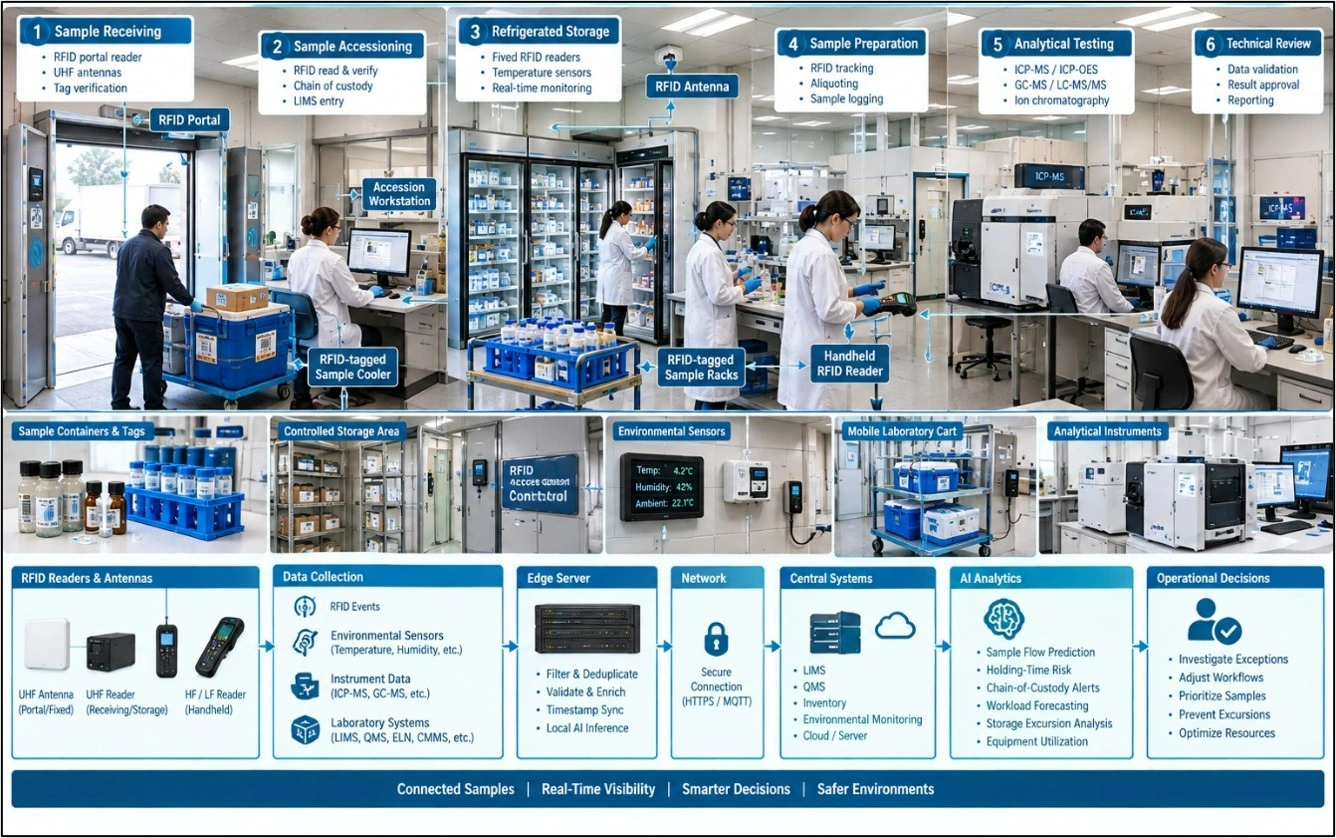
This deployment illustration shows RFID-enabled environmental laboratory operations from sample receiving and accessioning through refrigerated storage, sample preparation, analytical testing, and technical review. It highlights fixed UHF RFID readers, RFID antennas, handheld readers, tagged sample containers and racks, environmental sensors, laboratory instruments, an edge server, secure connectivity, LIMS, QMS, inventory and environmental monitoring systems, and AI analytics for sample-flow prediction, holding-time risk, chain-of-custody alerts, workload forecasting, and equipment utilization.
Security and Data Integrity for AI-Enabled Environmental Laboratories
Environmental laboratory systems may contain regulated records, customer information, project information, analytical results, quality records, and operational data. RFID infrastructure therefore needs to be incorporated into the laboratory’s broader cybersecurity controls rather than operated as an isolated technology layer.
Practical controls can include network segmentation, authenticated reader access, encrypted application interfaces, role-based access, centralized logging, controlled firmware management, secure credentials, vulnerability management, and monitoring of unexpected device behavior. Where MQTT is used, TLS and authenticated clients should be considered according to the laboratory’s network design.
AI data pipelines also require integrity controls. Raw RFID observations should be retained separately from interpreted events where traceability is important. Changes to event-processing rules, model versions, thresholds, and identity mappings should be auditable. AI-generated alerts should identify the underlying evidence and provide laboratory personnel with enough context to determine whether an operational response is justified.
Environmental laboratories should validate the complete chain from physical observation through software processing before relying on AI-generated information for regulated or quality-sensitive decisions.
AI Capabilities That Improve Environmental Laboratory Performance
Combining AI with RFID-generated operational data gives environmental laboratories a way to move from retrospective recordkeeping toward earlier detection of workflow and sample-management risks. The greatest value generally comes from correlating physical sample events with LIMS records, analytical schedules, preservation data, instrument status, and quality information.
Sample Identity and Chain-of-Custody Intelligence
AI can establish expected movement patterns for different sample categories and compare them with observed RFID events. This is useful when a laboratory handles large numbers of water, wastewater, soil, sediment, air, and industrial environmental samples simultaneously.
Potential AI outputs include:
- Identification of unexpected sample or container movements
- Detection of missing or duplicated physical-event sequences
- Recognition of abnormal dwell times between laboratory stages
- Prioritization of chain-of-custody exceptions for human investigation
- Correlation of physical sample events with LIMS accession records
- Detection of recurring process deviations by location, workflow, or shift
The model should provide evidence rather than simply produce a binary “valid” or “invalid” conclusion. Laboratory personnel should be able to review the underlying RFID observations, timestamps, LIMS status, and applicable SOP before taking corrective action.
Holding-Time and Preservation Risk Prediction
Environmental analytical methods can impose specific requirements for sample preservation and processing time. AI can combine collection time, laboratory receipt time, storage conditions, sample category, analytical assignment, and current workflow status to estimate which samples are approaching operational risk thresholds.
This creates a more useful intervention mechanism than a simple chronological queue. A sample that has been waiting for several hours may have a very different risk profile from another sample with the same dwell time because preservation requirements and analytical methods differ.
AI can therefore help laboratory managers prioritize work according to risk-adjusted urgency, rather than simply processing samples on a first-in, first-out basis.
Workload Forecasting and Turnaround Management
Environmental laboratories often experience variable sample volumes caused by regulatory monitoring schedules, industrial sampling programs, storm events, seasonal conditions, remediation projects, and customer submission patterns.
Machine-learning models can analyze historical accession volumes, analytical method demand, instrument availability, staffing patterns, and current queues to forecast workload.
Useful outputs include:
- Expected sample volume by analytical discipline
- Predicted preparation bottlenecks
- Instrument workload forecasts
- Potential turnaround-time exceptions
- Expected refrigerator or freezer capacity requirements
- Staffing demand by laboratory function
- Recommended prioritization of analytical batches
GAO-supported RFID infrastructure can contribute physical workflow information that conventional LIMS data may not capture, particularly where sample containers, racks, carts, or equipment move between physically separated laboratory areas.
Analytical Equipment Utilization and Predictive Maintenance
Environmental laboratories rely on expensive analytical instruments whose availability can directly affect throughput. Examples include ICP-MS, ICP-OES, GC-MS, LC-MS/MS, ion chromatographs, spectrophotometers, TOC analyzers, and specialized microbiological equipment.
AI can combine equipment status, operating history, maintenance records, analytical workload, and RFID-derived asset movement to identify utilization patterns and potential maintenance priorities.
The objective is not to predict instrument failure solely from an RFID event. Instead, RFID can provide contextual information such as where equipment is located, whether mobile equipment has moved between work areas, and how supporting assets are being used. Instrument telemetry and CMMS records provide the technical evidence required for condition-based or predictive maintenance models.
Environmental Laboratory AI and RFID Performance Benefits
Faster Sample Handling
Automated identification reduces repeated manual scanning and transcription activities at selected checkpoints. AI adds prioritization by identifying samples requiring attention because of holding-time, preservation, workflow, or scheduling conditions.
Better Chain-of-Custody Visibility
Time-stamped physical observations provide an additional source of evidence for investigating sample movement. AI can identify unusual sequences and focus personnel attention on exceptions rather than requiring them to manually review every event.
Reduced Storage Congestion
AI can forecast incoming sample volumes and analyze current storage occupancy. RFID can provide information about which tagged containers, racks, or coolers are physically present. Together, these data sources can support better refrigerator, freezer, and controlled-storage planning.
Improved Laboratory Throughput
Workflow analytics can identify recurring bottlenecks around accessioning, sample preparation, analytical instruments, review, or reporting. Managers can use these insights to adjust schedules, staffing, work allocation, or equipment availability.
Stronger Asset Utilization
RFID-based equipment visibility can reduce time spent searching for mobile laboratory assets. AI can identify underused or heavily utilized equipment and support more informed allocation and maintenance decisions.
More Consistent Quality Operations
AI can identify recurring patterns in workflow exceptions, manual corrections, delays, and QC-related operational conditions. These observations can support laboratory quality teams when investigating root causes and improvement opportunities.
Scalable Multi-Site Analytics
Organizations operating several environmental laboratories can aggregate appropriately governed operational information for cross-site comparison. A centralized system can identify differences in turnaround performance, storage utilization, workflow bottlenecks, and equipment use while allowing individual laboratories to retain appropriate local controls.
Cloud and Server Deployment Choices for Environmental Laboratories
The appropriate computing model depends on laboratory network design, data governance, operational continuity, integration requirements, and the organization’s IT policies.
| Requirement | Cloud Version | Server Version |
|---|---|---|
| Sample-event processing | Centralized processing where connectivity is reliable | Local processing close to RFID readers |
| WAN dependency | Higher | Lower for local operations |
| Multi-site analytics | Strong fit | Requires inter-site connectivity or centralized private infrastructure |
| Data residency | Depends on cloud region and organizational policy | Greater customer control |
| Local outage tolerance | Requires suitable offline buffering and recovery design | Well suited to continued local operation |
| AI inference | Centralized or distributed depending on implementation | Local inference can reduce network dependency |
| Integration with isolated laboratory networks | May require controlled gateways | Often easier where systems remain privately hosted |
| Centralized model management | Convenient for multiple sites | Requires managed deployment processes |
| Cybersecurity | Cloud security controls plus customer configuration | Customer controls infrastructure and security stack |
| Disaster recovery | Cloud infrastructure can simplify centralized recovery | Customer must design backup and recovery mechanisms |
| Best fit | Connected multi-site laboratories and centralized analytics | Controlled networks, local processing, and stringent infrastructure requirements |
A hybrid implementation is often technically attractive. RFID readers and middleware can operate close to the laboratory, while selected AI inference runs locally and aggregated information is transferred to a central environment. This arrangement can preserve operational continuity while supporting cross-site analytics.
The final choice should be made after evaluating network topology, LIMS interfaces, data classification, laboratory validation requirements, cybersecurity policies, recovery objectives, and expected sample volumes.
Implementation Lifecycle for AI-Enabled Environmental Laboratories
Define the Laboratory Objective
Start with a measurable operational problem rather than selecting RFID hardware first. Suitable objectives might include reducing sample accession errors, improving chain-of-custody visibility, reducing storage-search time, predicting holding-time risks, improving turnaround time, or increasing analytical equipment utilization.
Map the Physical Workflow
Document how samples and associated assets actually move through the laboratory. Include receiving docks or counters, accessioning stations, refrigerators, freezers, sample preparation rooms, analytical laboratories, QC areas, review stations, storage areas, and disposal locations.
Map exceptions as well as normal processes. Emergency samples, reanalysis, sample splits, rejected containers, corrected accession records, and manually relocated samples can materially affect system design.
Define Identities and Data Relationships
Establish authoritative identifiers for samples, containers, coolers, racks, aliquots, work orders, instruments, storage locations, and other tracked objects.
A critical design principle is maintaining relationships between physical and logical identities. RFID identifiers should map to laboratory identifiers through controlled middleware rather than becoming an independent replacement for the LIMS identity model.
Conduct an RFID Site Survey
Test representative containers and materials under actual laboratory conditions.
The survey should evaluate:
- UHF performance around liquids and metal
- Tag placement on bottles, racks, coolers, and carts
- Refrigerator and freezer read behavior
- Antenna orientation and coverage
- Reader-zone boundaries
- False reads between adjacent work areas
- Handheld reader usability
- Network connectivity
- Reader installation constraints
- Electromagnetic conditions around analytical equipment
Build the Data and Integration Layer
Define how RFID observations enter middleware and how they are transformed into meaningful laboratory events. The integration design should specify APIs, message formats, timestamps, sample identifiers, event types, error handling, buffering, and audit requirements.
LIMS should remain the authoritative source for laboratory sample and analytical records unless the laboratory has deliberately defined another system of record.
Develop and Validate AI Models
AI models should be trained using representative historical and operational data where available. Data quality must be assessed before model development because inconsistent timestamps, duplicate events, missing sample identities, or incomplete workflow records can produce misleading predictions.
Validation should evaluate both false positives and false negatives. An alert that generates excessive unnecessary investigations can become operationally ineffective even when the underlying model appears statistically accurate.
Commission the Solution
Commissioning should test the complete chain from physical sample movement through RFID detection, event processing, software integration, AI inference, alert delivery, human response, and record retention.
Acceptance tests should use real or appropriately representative laboratory workflows rather than relying solely on simulated RFID reads.
Establish Production Monitoring
Production monitoring should cover both technology and laboratory performance.
Monitor:
- RFID read reliability
- Reader connectivity
- Event-processing latency
- Identity-matching errors
- Missing-event rates
- AI alert volume
- False-positive rates
- Model drift
- LIMS integration failures
- Storage occupancy
- Sample turnaround time
- Chain-of-custody exceptions
- Instrument utilization
- System availability
Scale by Validated Use Case
Once the first use case demonstrates stable performance, the laboratory can expand to additional workflows. A controlled rollout may progress from receiving and sample tracking to storage intelligence, workload forecasting, equipment management, and more advanced AI applications.
This approach limits implementation risk because each additional workflow can be evaluated against defined laboratory procedures, data quality requirements, cybersecurity controls, and measurable KPIs.
KPIs for AI-Enabled Environmental Laboratory Operations
A successful deployment should be measured through laboratory outcomes rather than RFID read counts alone.
| KPI | What It Measures | AI/RFID Contribution |
|---|---|---|
| Sample accessioning time | Time from receipt to registered sample | Automated identification and workflow analysis |
| Chain-of-custody exception rate | Frequency of custody discrepancies | Event-sequence anomaly detection |
| Sample holding-time risk | Samples approaching critical processing thresholds | Predictive prioritization |
| Sample turnaround time | Receipt-to-result performance | Workload and bottleneck forecasting |
| Storage utilization | Refrigerator/freezer capacity usage | Physical inventory plus capacity prediction |
| Sample search time | Time required to locate samples | RFID location visibility |
| Instrument utilization | Productive versus available instrument time | Asset and workflow correlation |
| QC exception frequency | Operational conditions associated with QC issues | Pattern detection and root-cause support |
| Manual data corrections | Frequency of identity or record corrections | Automated identification and discrepancy detection |
| Workflow dwell time | Time spent between laboratory stages | RFID event analytics |
| AI alert precision | Percentage of alerts judged actionable | Model performance monitoring |
| System availability | Availability of tracking and analytics services | Infrastructure monitoring |
KPI baselines should be established before production deployment whenever practical. Otherwise, an organization may know that a system generates more visibility without being able to demonstrate whether laboratory performance actually improved.
Practical Recommendations for Environmental Laboratory Deployment
Successful AI-enabled environmental laboratory projects generally depend on disciplined engineering rather than the quantity of connected devices.
- Start with a workflow where physical visibility can materially improve a measurable laboratory outcome.
- Use representative sample containers, coolers, racks, and storage equipment during RFID testing.
- Keep LIMS, QMS, and analytical systems authoritative for their defined records.
- Treat RFID observations as operational evidence that must be interpreted through controlled event logic.
- Separate raw RFID observations from derived events and AI predictions to preserve traceability.
- Use edge processing where local continuity, latency, or network isolation is important.
- Select Cloud Version or Server Version according to actual laboratory IT, cybersecurity, data-governance, and connectivity requirements.
- Validate AI models with laboratory personnel and representative operational data.
- Design exception handling before deploying automated alerts.
- Include cybersecurity, authentication, network segmentation, logging, and firmware management in the initial design.
- Establish measurable laboratory KPIs before scaling beyond the initial deployment.
- Expand incrementally from sample visibility into predictive workload, storage, equipment, and quality-support applications.
GAO has supplied RFID, BLE, and IoT hardware products and systems to organizations requiring identification, tracking, sensing, and connected operational workflows. Our broader experience supporting customers in the United States and Canada includes Fortune 500 companies, research and development organizations, universities, and government agencies. GAO’s product and system work is supported by substantial R&D investment, quality-assurance processes, and remote or onsite technical support.
GAO’s Technical Perspective on AI for Environmental Laboratories
Environmental laboratory AI should be designed around the laboratory’s actual sample lifecycle, analytical methods, quality procedures, and information systems. RFID is most valuable when it provides reliable physical observations that complement LIMS, analytical instrument data, environmental monitoring, QMS, and maintenance records.
A technically sound implementation does not attempt to automate every laboratory decision. Instead, it identifies where machine-generated identity, location, timing, and pattern information can reduce manual effort or expose operational risks earlier. AI then transforms those observations into prioritized information that qualified laboratory personnel can evaluate.
GAO’s headquarters in New York City and Toronto, Canada, support customers across North American markets through a combination of technology products, systems engineering, R&D, and technical support. GAO RFID Inc., GAO Research Inc., and GAO Tek Inc. form GAO Group, providing a broader technical foundation for RFID, BLE, IoT, and related technologies.
Building the Future of Industrial AI and IoT with Aperture Venture Studio and GAO RFID Inc.
For more than three decades, GAO Group of Companies has invested heavily in R&D for industrial RFID, BLE, and IoT. As generative AI became increasingly useful for industrial applications, we expanded our work into AI-enabled IoT solutions, including applications that combine RFID, laboratory data, and intelligent analytics. We have also founded Aperture Venture Studio to build, launch, and scale AI and IoT companies relevant to operational fields such as environmental laboratory technology.
Aperture has attracted AI and IoT technical experts, entrepreneurial and operational executives, influential investors, and leading companies. We have also developed the Aperture Ventures Summit and TekSummit to discuss advanced AI and IoT topics.
These activities have helped develop technical communities around AI and IoT. We welcome participation as:
- Advisors, co-founders, or employees
- Investors
- Customers
GAO welcomes environmental laboratories, laboratory technology teams, system integrators, and organizations evaluating AI-enabled sample management to learn more about our RFID, BLE, IoT hardware products, systems, and technical support.