
AI and RFID for Medical Equipment Rental
AI-Powered RFID Solutions for Medical Equipment Rental
A medical equipment rental warehouse showing RFID portal readers at the dock door, a sterilization station with an RFID-tagged infusion pump, and a dashboard tracking fleet location, cleaning status, and calibration due dates.
RFID-Enabled Medical Equipment Rental Warehouse Operations
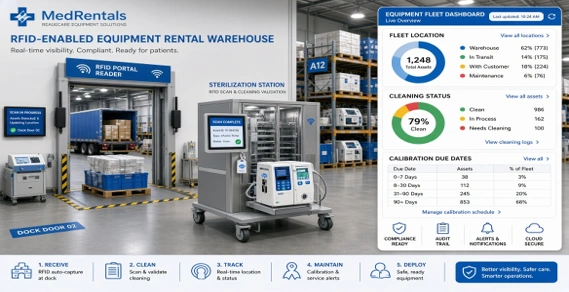
Clean healthcare-adjacent view of a medical equipment rental warehouse featuring RFID portal readers at a dock door, a sterilization station scanning an RFID-tagged infusion pump, and a live dashboard displaying fleet location, cleaning status, and calibration due dates.
AI-Driven Fleet Visibility and Compliance for Medical Equipment Rental
Medical equipment rental companies maintain fleets of wheelchairs, hospital beds, infusion pumps, patient monitors, oxygen concentrators, and other durable medical equipment that move constantly between the warehouse, hospitals, clinics, and patients’ homes. Artificial intelligence combined with RFID readers, tags, and antennas gives rental providers continuous visibility into where each unit is, whether it has completed its required cleaning and disinfection cycle, and whether its preventive maintenance or calibration is current. Instead of relying on a technician’s paper checklist or a spreadsheet updated at the end of a shift, AI systems draw on real-time RFID read data to flag overdue returns, skipped sterilization steps, and equipment approaching a calibration deadline before it goes back out on rental.
For medical equipment rental providers accountable to hospital infection control standards, FDA device recall obligations, and tight rental turnaround expectations, this shift from manual asset logs toward AI-driven, RFID-enabled visibility has become a practical way to close the gap between what a cleaning or maintenance procedure requires and what actually happened to a specific unit before it reached the next patient. GAO supplies the RFID hardware that makes this visibility possible.
Understanding AI and RFID in Medical Equipment Rental Operations
Medical equipment rental differs from general equipment rental in how much a single unit’s history matters. A wheelchair or infusion pump does not just need to be located, it needs a documented chain of custody showing who used it last, whether it was disinfected to the required standard between rentals, and whether it is due for its next preventive maintenance or safety inspection under standards such as IEC 60601 for electrical medical equipment. A rental fleet can include thousands of individually serialized units moving between a central warehouse, multiple satellite depots, hospital loading docks, and patients’ homes, often with several units of the same model in different stages of cleaning, repair, or availability at any given moment.
RFID tags, readers, and antennas give this environment a way to track individual, serialized units without manual scanning at every handoff. Tags attached to each piece of equipment broadcast or respond with a unique identifier, portal readers at warehouse dock doors and depot entrances capture that identifier as equipment moves in and out, and readers at sterilization and inspection stations confirm which specific unit passed through which required step. Artificial Intelligence of Things, or AIoT, is the pairing of AI analytics with this kind of connected asset and process data, and it turns a raw stream of read events into decisions: which unit is overdue for return, which unit skipped a disinfection scan before being marked available, and which unit’s maintenance interval is approaching.
For medical equipment rental providers, this relationship matters because so much of both patient safety and rental profitability depends on knowing a unit’s exact status the moment it is needed for the next rental, rather than discovering a gap in its cleaning or maintenance record after it has already reached a patient. GAO has spent more than three decades supplying RFID and industrial IoT hardware to manufacturing and asset-intensive operations across North America and is ranked among the top 10 B2B and B2G BLE and RFID suppliers worldwide, giving rental providers a proven hardware foundation to build AI-driven visibility on top of.
Fleet scale is a real factor in how rental providers evaluate this technology. A regional medical equipment rental company can manage several thousand serialized units across dozens of equipment categories, each with different cleaning protocols, maintenance intervals, and rental durations, a combination that makes manual tracking practically impossible to sustain accurately once a fleet passes a few hundred units. AI-driven RFID tracking scales with the fleet rather than against it, since adding a new equipment category or depot location follows the same tagging and reader pattern as the original rollout.
Key Applications of AI-Powered RFID in Medical Equipment Rental
AI and RFID pair up across several distinct points in a medical equipment rental provider’s operations, each addressing a different compliance or efficiency challenge.
Rental Fleet Asset Tracking
RFID-tagged equipment moving through warehouse zones, delivery vehicles, and customer sites lets AI confirm exactly which unit is where at any moment, replacing the barcode-and-clipboard tracking many rental operations still rely on. Engineering considerations here center on tag placement on equipment with metal housings or hinged components, such as hospital beds, which can affect read reliability, so tag selection and placement need to be validated per equipment category rather than assumed uniform across the fleet.
Sterilization and Turnaround Tracking
RFID readers at disinfection and sterilization stations confirm that a specific serialized unit passed through the required cleaning step before AI marks it available for the next rental, closing a gap that manual sign-off sheets are prone to, a technician marking a batch of units clean without scanning each one individually. This is one of the highest-value applications in medical equipment rental, since a skipped cleaning step carries direct infection control risk.
Preventive Maintenance and Calibration Compliance
AI models track each unit’s maintenance and calibration history against its required interval, flagging equipment approaching a due date so it can be pulled from available inventory and serviced before it is rented out overdue. For devices such as infusion pumps and patient monitors, where calibration directly affects clinical accuracy, this shifts maintenance from a periodic fleet-wide sweep to a unit-specific, date-driven process.
Recall and Chain-of-Custody Traceability
When a manufacturer issues a recall or safety notice tied to a specific model or serial range, RFID-based tracking lets a rental provider immediately identify which units are affected and where each one currently is, whether in the warehouse, at a hospital, or in a patient’s home, turning what would otherwise be a manual records search into a query against continuously updated location data.
Home Healthcare Delivery and Return Tracking
For durable medical equipment delivered directly to patients’ homes, RFID scans at the point of delivery and pickup create a timestamped record of exactly when a unit left the warehouse and when it returned, supporting accurate rental billing and giving the provider an early flag when a home delivery unit becomes significantly overdue for return.
Battery and Consumable Readiness
For battery-powered equipment such as infusion pumps, syringe pumps, and portable oxygen concentrators, RFID tracking combined with battery status data lets AI confirm a unit was fully charged and consumable-stocked before being marked available, reducing the number of units that reach a patient site only to be found undercharged or missing a required accessory.
Headquartered in New York City and Toronto, Canada, GAO RFID Inc. is ranked among the top 10 leading B2B and B2G BLE and RFID suppliers in the world. GAO RFID Inc. and its sister companies, GAO Research Inc. and GAO Tek Inc., form GAO Group, all based in New York City and the City of Toronto, Canada. For three decades, GAO Group has served customers across the U.S. and Canada, including Fortune 500 manufacturers, leading R&D firms, prestigious universities, and government agencies, backed by heavy investment in product R&D, stringent quality assurance, and expert support delivered remotely or onsite.
RFID-Tracked Medical Equipment Rental Flow with AI Analytics
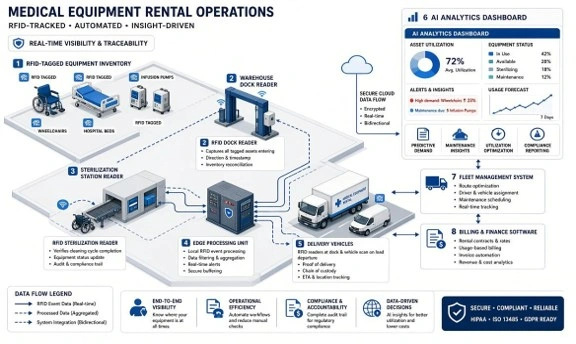
Isometric overview of a medical equipment rental operation featuring RFID-tagged wheelchairs, hospital beds, and infusion pumps moving through a warehouse dock reader, sterilization station reader, and delivery vehicles, all connected via an edge processing unit to an AI analytics dashboard integrated with fleet management and billing software.
From Reader to Software: The AI and RFID Data Workflow for Medical Equipment Rental
The path from an RFID read to an AI-driven decision on a medical equipment rental fleet follows a consistent data flow, even though the specific trigger, a warehouse dock scan, a sterilization station read, or a maintenance due-date check, changes by process.
Data capture starts at the point of handling: an RFID tag on a piece of equipment is read by a portal reader at a warehouse dock door, a handheld reader during a cleaning or inspection step, or a fixed reader at a depot entrance. These readers pass tag identifiers, along with the location and process context, over the rental provider’s network to either a local gateway or directly to cloud-hosted or server-based middleware. Edge processing at or near the reader filters noise and resolves which unit and which process step a read belongs to, applying basic rules such as confirming a unit passed through sterilization before checking whether it is due for maintenance, before anything reaches a central system, which keeps status updates fast even during high-volume return periods.
From there, the readings move into middleware that normalizes RFID data against each unit’s maintenance schedule, cleaning protocol, and rental history, then into cloud-hosted or server-based AI software for deeper analysis: overdue-return prediction, maintenance interval tracking, and fleet utilization analysis across equipment categories. Results integrate back into the rental provider’s fleet management and billing software, so a completed sterilization scan automatically marks a unit available and an approaching calibration date automatically pulls a unit from available inventory rather than relying on a staff member remembering to check. GAO’s RFID readers, tags, and antennas sit at the front end of this workflow, supplying the location and status data that AI analytics and fleet management software depend on.
RFID Hardware, AI Software, and Deployment Options for Medical Equipment Rental
A working AI and RFID setup for a medical equipment rental fleet rests on three hardware layers. RFID tags, attached to each individual piece of rental equipment, broadcast or respond with a unique identifier durable enough to survive repeated cleaning and disinfection cycles. RFID readers, mounted as portals at warehouse dock doors and depot entrances or used as handhelds during sterilization and inspection, capture that identifier at each process step. RFID antennas extend read range and coverage at high-traffic points such as loading docks where multiple units may move through in quick succession. Frequency choice matters for this sub-industry: UHF RFID supports the longer-range, bulk reads useful at warehouse dock doors and vehicle loading points, while HF RFID is often preferred for close-range reads at individual sterilization or inspection stations where precise, one-unit-at-a-time confirmation matters more than read range.
On the software side, AI models process the combined tag, location, and process data stream: overdue return prediction, maintenance interval tracking, and utilization forecasting by equipment category. This software can run in two deployment options. The Cloud Version hosts AI analytics and RFID data processing in cloud-managed infrastructure, which suits rental providers operating multiple depots that want a single consolidated view of fleet status without maintaining local servers at each location. The Server Version runs the same AI software on customer-managed servers, whether at a central warehouse, a private data center, or other privately hosted infrastructure, which suits providers with strict data handling requirements tied to healthcare partnerships or existing investments in on-site fleet management infrastructure.
Security and privacy mechanisms apply to both deployment options: encrypted communication between readers and backend software, role-based access to fleet and maintenance records, and audit logging tied to every equipment status change for compliance and recall investigations. Because rental equipment history can sometimes be associated with patient rental records, access controls should also reflect any applicable HIPAA privacy obligations connected to home healthcare delivery accounts. GAO, headquartered in New York City and Toronto, Canada, supplies the RFID readers, tags, and antennas that form the hardware layer of this setup, giving medical equipment rental providers a consistent hardware base whether they choose a cloud-hosted or server-based deployment for their AI and RFID software.
Engineering Considerations Before Deployment
Medical equipment rental providers should start an AI and RFID rollout with the equipment categories that carry the highest compliance risk or the highest rental volume, rather than tagging the entire fleet at once. Operations, quality, and biomedical engineering staff should agree on which decisions the RFID data needs to support, such as sterilization confirmation or calibration tracking, before selecting tag type and reader placement.
Important planning considerations include:
- Tag durability and placement for equipment that undergoes repeated disinfection cycles, including chemical and autoclave-compatible tag options where required
- Read reliability on equipment with metal housings or hinged components, such as hospital beds and wheelchairs
- Frequency mix (UHF for dock and bulk reads, HF for close-range sterilization and inspection confirmation)
- Existing fleet management and billing software integrations that RFID data must feed
- Reader placement density at warehouse dock doors, depot entrances, and sterilization stations
- Cloud versus Server Version requirements based on data handling agreements with hospital or healthcare partners
- AI model validation criteria for overdue-return and maintenance-due prediction against real rental history before full rollout
- KPI definitions such as fleet utilization rate, sterilization compliance rate, and maintenance compliance rate
- Alarm and exception-management requirements for units returned without a required sterilization scan
- Cybersecurity and privacy controls for fleet data that may be associated with patient rental accounts
- Scalability across additional depots, equipment categories, or geographic service areas
A pilot rollout on one or two high-volume, high-compliance-risk equipment categories, such as infusion pumps or hospital beds, should validate tag durability and read reliability under real cleaning and handling conditions before extending RFID tracking across the full fleet. GAO’s experience supplying RFID and IoT hardware to manufacturing and asset-intensive operations across North America supports a deployment approach that treats hardware selection, integration, and long-term technical support as one connected decision rather than isolated purchases.
AI Capabilities for Medical Equipment Rental
AI adds value to RFID-collected data by interpreting equipment location, process, and maintenance history in ways a manual checklist or spreadsheet cannot.
Overdue Return Prediction
AI models trained on typical rental durations by equipment category and customer type can flag a unit trending toward an overdue return before the formal due date passes, giving the rental provider time to follow up proactively rather than discovering the gap during a fleet audit.
Sterilization Compliance Verification
By requiring an RFID read at the sterilization station before a unit’s status can change to available, AI enforces a hard compliance gate rather than relying on staff to follow a paper checklist consistently, closing one of the most safety-critical gaps in rental equipment turnaround.
Predictive Maintenance Scheduling
Forecasting models trained on equipment usage hours and calibration history predict when a unit is likely to need service before its next rental cycle, letting biomedical engineering staff schedule maintenance around fleet demand rather than pulling a unit unexpectedly from available inventory.
Fleet Utilization and Demand Forecasting
Sensor fusion across RFID location data and rental booking history lets AI forecast which equipment categories are likely to be in high demand at a given depot, supporting purchasing and fleet redistribution decisions that keep the right equipment available where it is needed.
Benefits of AI-Powered RFID for Medical Equipment Rental Providers
Pairing AI with RFID tags, readers, and antennas delivers a set of compliance and business benefits that compound across a rental fleet:
- Stronger infection control compliance: enforced sterilization scanning closes the gap between what a cleaning protocol requires and what is documented for each unit
- Faster recall response: immediate identification of affected units and their current location replaces a manual records search when a manufacturer issues a recall
- Higher fleet utilization: real-time visibility into available, in-cleaning, and in-maintenance units reduces the idle inventory a provider needs to carry as a buffer against uncertainty
- Fewer compliance gaps at maintenance intervals: date-driven, unit-specific tracking replaces periodic fleet-wide maintenance sweeps that can miss individual units
- Reduced equipment loss: continuous location tracking cuts the number of units that go missing or become significantly overdue, particularly for home healthcare deliveries
- Scalability across depots and equipment categories: because RFID tags and readers are inexpensive to add unit by unit, a provider can expand tracking coverage without a large upfront hardware commitment, and the Cloud Version option lets a multi-depot provider standardize AI analytics across locations without duplicating server infrastructure at each site
These gains are backed by GAO’s quality assurance processes and remote or onsite technical support, so medical equipment rental providers adopting AI and RFID tracking have both the hardware reliability and the engineering support needed to keep the system running as fleet coverage expands.
Key Benefits for Medical Equipment Rental
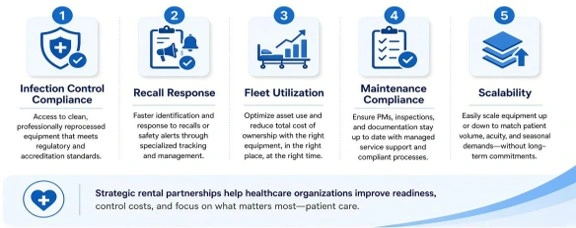
Clean blue-and-white flat infographic highlighting five core benefits for medical equipment rental operations—infection control compliance, faster recall response, improved fleet utilization, maintenance compliance, and scalability—in a professional healthcare-adjacent enterprise style.
Measuring Performance: KPIs for AI and RFID in Medical Equipment Rental
Medical equipment rental providers typically track a consistent set of KPIs once AI and RFID tracking is in place. Sterilization compliance rate, the share of units with a confirmed cleaning scan before being marked available, becomes a directly measurable figure instead of relying on staff sign-off. Maintenance compliance rate tracks the share of units serviced within their required interval, while fleet utilization rate shows how much of the total fleet is generating rental revenue at any given time versus sitting idle or in cleaning and repair. Average turnaround time between rental returns, overdue-return rate, and mean time to locate a specific unit during a recall all become visible in near real time rather than through periodic manual audits, giving operations and quality teams a data-backed basis for both compliance reporting and fleet investment decisions.
Integrating AI and RFID Data With Rental and Healthcare Systems
Fleet Management and Rental Billing System Integration
RFID-derived location and status data feeds the rental provider’s fleet management and billing software directly, so a confirmed sterilization scan automatically updates unit availability and a delivery or pickup scan automatically supports accurate rental duration billing.
Biomedical Maintenance and Quality System Integration
Maintenance and calibration history tied to each unit’s RFID identifier feeds the provider’s biomedical maintenance and quality system, supporting the documented service records that healthcare facility accreditation reviews and internal quality audits expect.
Hospital and Healthcare Partner System Integration
For rental providers embedded in hospital supply chains, RFID-based equipment status can integrate with the hospital’s own asset or supply chain systems, giving hospital staff visibility into rented equipment availability without a separate manual request process.
Business Intelligence and Reporting Dashboards
Aggregated RFID and AI data supports fleet-wide dashboards covering utilization, sterilization compliance, and maintenance status by depot and equipment category, giving operations managers a single view instead of separate spreadsheets per location.
Cybersecurity, Data Governance, and Privacy for Medical Equipment Rental
AI and RFID tracking in medical equipment rental touches fleet, compliance, and in some cases patient association data, which makes security and privacy governance part of the deployment rather than an add-on. Communication between readers and backend software should run encrypted, and readers should authenticate to the network rather than accepting data from unverified devices. Role-based access should limit who can view or export maintenance and sterilization compliance records, and audit logging should tie every status change to a user identity, supporting both internal quality reviews and manufacturer recall investigations.
Where rental records are associated with a specific home healthcare patient, providers should apply HIPAA-appropriate access controls and data handling practices to that association, treating patient-linked rental data with the same care as other protected health information, separate from the equipment-level tracking data itself. GAO designs its RFID readers, tags, and antennas with these compliance-sensitive environments in mind, and encourages rental providers to pair the hardware with their own access and retention policies rather than relying on hardware defaults alone.
Regulatory and Standards Context for Medical Equipment Rental
Medical equipment rental operates under a denser compliance backdrop than general equipment rental, and AI and RFID tracking is most valuable when built around these requirements rather than layered on afterward. The FDA’s Unique Device Identification system assigns a distinct identifier to many medical device models, and RFID-based serialized tracking complements this by tying that device-level identity to a specific, physical rental unit’s real-time location and service history. Electrical safety expectations under IEC 60601 and healthcare facility requirements under NFPA 99 both depend on equipment being properly maintained and inspected, records that RFID-enforced maintenance tracking produces automatically rather than through a periodic manual sweep.
Rental providers serving hospitals accredited by the Joint Commission or subject to CMS conditions of participation should also expect their equipment maintenance and cleaning documentation to be reviewed during accreditation surveys, making an automatically generated, unit-specific compliance record a meaningful advantage over paper logs during an audit. Providers should confirm which specific standards apply to each equipment category and each healthcare partner, since requirements can vary between acute care hospitals, long-term care facilities, and home healthcare delivery.
Implementing AI and RFID in Your Medical Equipment Rental Operations
Medical equipment rental providers considering AI and RFID tracking generally see the fastest return by starting narrow: a single high-value use case, such as sterilization compliance verification or overdue return prediction, on one or two equipment categories before expanding to full fleet tracking and maintenance scheduling. Choosing between the Cloud Version and Server Version early, based on healthcare partner data handling requirements, avoids a costly re-platforming step later, and involving operations, biomedical engineering, and quality teams from the start keeps the RFID data flow aligned with both fleet management software and compliance documentation needs.
GAO’s sister companies, GAO Research Inc. and GAO Tek Inc., join GAO to serve manufacturing and asset-intensive customers across the United States and Canada, including Fortune 500 companies, leading research and development firms, universities, and government agencies, giving medical equipment rental providers a supplier with three decades of experience behind the hardware. Readers evaluating AI and RFID tracking for their own rental fleets are welcome to reach out to GAO’s technical team to discuss hardware selection, deployment options, and integration with existing fleet management software.
Frequently Asked Questions About AI and RFID for Medical Equipment Rental
What is the difference between UHF and HF RFID for medical equipment rental?
UHF RFID supports longer-range, higher-volume reads useful at warehouse dock doors and vehicle loading points where many units may move through at once, while HF RFID is often preferred at close-range sterilization or inspection stations where confirming one specific unit at a time matters more than read range. Many rental fleets use both, depending on the process step.
Can RFID tags survive repeated cleaning and disinfection cycles?
Yes, with the right tag selection. Tags intended for medical equipment rental should be rated for the specific disinfection chemicals or, where applicable, autoclave cycles a rental provider uses, and tag durability should be validated during a pilot on the equipment categories with the most frequent cleaning cycles before fleet-wide rollout.
Does AI and RFID tracking replace a rental provider’s existing fleet management software?
No. RFID-derived location and status data typically feeds an existing fleet management and billing system rather than replacing it, so staff continue using the platform they already know while gaining automated, unit-level tracking data feeding into it.
How does RFID help with a manufacturer equipment recall?
Because each unit carries a unique RFID identifier tied to its model and serial information, a rental provider can immediately query which specific units are affected by a recall and where each one currently is, whether in the warehouse, at a hospital, or in a patient’s home, rather than manually searching paper or spreadsheet records.
What RFID hardware does a medical equipment rental fleet typically need?
A typical deployment uses RFID tags on each piece of equipment, portal readers at warehouse dock doors and depot entrances, and handheld or fixed readers at sterilization and inspection stations. The exact mix depends on fleet size, equipment categories, and the number of depot locations.
How does this system support infection control requirements?
By requiring a confirmed RFID read at the sterilization station before a unit’s status can change to available, the system enforces a documented cleaning step for every unit rather than relying on staff to follow a paper checklist consistently, which is particularly valuable for high-turnover equipment categories like wheelchairs and hospital beds.
Can RFID tracking support home healthcare delivery and pickup?
Yes. RFID scans at the point of delivery and pickup create a timestamped record for equipment sent to a patient’s home, supporting accurate billing and flagging equipment that becomes significantly overdue for return without requiring a manual follow-up call as the first line of tracking.
How should providers handle data privacy for patient-associated rental records?
Providers should apply HIPAA-appropriate access controls to any rental record associated with a specific home healthcare patient, keeping that association separate from general equipment-level tracking data and limiting access to staff who need it for billing or care coordination purposes.
AI and RFID Deployment Lifecycle for Medical Equipment Rental Providers
Planning and Site Assessment
A site assessment maps warehouse layout, depot locations, equipment categories, and existing fleet management software before any hardware is ordered.
Hardware Selection and Installation
Tags, readers, and antennas are selected based on equipment categories and cleaning protocols, starting with a pilot on one or two high-priority categories before broader rollout.
Commissioning and Calibration
Commissioning confirms that reads map correctly to the intended unit at each process step, and that tag durability holds up under real cleaning and handling conditions.
Integration Testing
Integration testing validates that sterilization confirmations and maintenance flags correctly reach the fleet management and billing systems before the pilot is declared successful.
Optimization
Once live, AI thresholds for overdue-return and maintenance-due prediction are tuned against real rental history, and reader placement is adjusted if read gaps appear under full operational volume.
Maintenance and Scaling
Ongoing maintenance covers tag replacement for damaged or worn units and reader health checks, while scaling extends the same validated design to additional equipment categories and depot locations.
Practical Engineering Recommendations for Medical Equipment Rental Providers
Providers evaluating AI and RFID tracking generally see the fastest, lowest-risk path to value by following a small set of practical recommendations:
- Start with the equipment categories carrying the highest compliance risk or highest rental volume, such as infusion pumps or hospital beds, rather than tagging the entire fleet at once
- Validate tag durability against the actual disinfection chemicals or autoclave cycles used before committing to a fleet-wide tag standard
- Require an RFID sterilization scan as a hard gate before a unit’s status can change to available, rather than treating it as an optional confirmation step
- Choose between the Cloud Version and Server Version early based on healthcare partner data handling requirements
- Involve operations, biomedical engineering, and quality teams together from the start so RFID data flow stays aligned with both fleet software and compliance documentation needs
- Validate AI overdue-return and maintenance-due thresholds against real rental history during a pilot period before relying on fully automated flags
Applying AI and RFID to Safer, More Efficient Medical Equipment Rental
AI and RFID tracking gives medical equipment rental providers a way to move from manual asset logs and periodic compliance sweeps toward continuous, unit-by-unit verification. Starting with a single high-value use case, validating tag durability and AI thresholds on a pilot equipment category, and integrating results into existing fleet management and quality systems lets providers reach reliable sterilization compliance, maintenance tracking, and recall readiness without slowing rental turnaround. GAO supplies the RFID hardware foundation providers need to build this level of fleet-wide visibility.
Why GAO for RFID Medical Equipment Rental Solutions
Medical equipment rental providers choosing an RFID hardware supplier are choosing a partner whose tag and reader reliability directly affects patient safety and regulatory compliance, not just operational convenience. GAO has supplied RFID and industrial IoT hardware to manufacturing and asset-intensive operations across North America for more than three decades and is ranked among the top 10 B2B and B2G BLE and RFID suppliers worldwide. That track record includes the quality assurance processes and remote or onsite technical support that rental providers need as fleet coverage expands from a pilot category to a full, multi-depot deployment, giving medical equipment rental providers a hardware foundation built specifically for compliance-sensitive environments rather than adapted from general asset tracking use cases.
Building the Future of Industrial AI and IoT with Aperture Venture Studio and GAO RFID Inc.
For more than three decades, GAO Group of Companies has invested heavily in the research and development of industrial RFID and IoT hardware. Since generative AI proved its value in healthcare and asset-intensive settings, we have been extending our RFID technologies into AI-enabled solutions, and we have founded Aperture Venture Studio to build, launch, and scale next-generation AI and IoT companies serving sectors such as medical equipment rental. Aperture has attracted top AI and IoT technical experts, operational executives, and investors, and through the Aperture Ventures Summit and TekSummit, we bring together a technical community focused on advancing AI and IoT across industries. We welcome medical equipment rental providers and technology partners to join us as advisors, co-founders, employees, investors, or customers.