
AI and RFID for Pulp & Paper
AI-Driven Pulp & Paper Mill Operations and Material Visibility
AI and IoT solutions for Pulp & Paper mills combine machine data, production information, connected equipment, computer vision, and RFID identification to improve how mills track raw materials, manage production, monitor assets, and make operational decisions. RFID provides persistent identification for pulp bales, paper rolls, chemical containers, reusable transport assets, spare parts, and mobile equipment, while AI analyzes production, maintenance, quality, inventory, and logistics data to identify patterns and recommend actions.
For pulp and paper manufacturers, the business value extends beyond simple asset identification. AI can correlate machine conditions with production schedules, furnish quality, moisture measurements, roll characteristics, equipment utilization, and maintenance history. RFID can associate physical materials with production orders and enterprise records as they move through receiving, stock preparation, pulping, papermaking, converting, warehousing, and shipment. This combination creates better material traceability, faster inventory reconciliation, improved maintenance planning, reduced manual data entry, and stronger production visibility across the mill.
How AI and RFID Improve Pulp & Paper Mill Operations
Pulp and paper production involves continuous-process equipment, large material inventories, high-speed machinery, wet environments, chemical handling, extensive utilities, and multiple internal material flows. A disconnected view of these operations can make it difficult to determine where materials are located, why production conditions changed, or which assets require attention.
AI and RFID address different but complementary parts of this problem.
- RFID gives physical objects a machine-readable identity that can be associated with material, location, production order, asset, maintenance record, or shipment information.
- AI evaluates production and operational data to detect anomalies, forecast equipment conditions, optimize processes, and support decisions.
- IoT devices and connected industrial equipment provide operating measurements such as temperature, vibration, pressure, flow, motor current, speed, moisture, and energy consumption.
- Edge processing can evaluate time-sensitive mill data close to machines and production areas.
- Enterprise software can combine RFID events and AI results with MES, ERP, CMMS or EAM, WMS, quality management, and transportation systems.
GAO supplies RFID, BLE, and other IoT hardware products and systems that can be incorporated into these mill workflows, allowing engineers to select identification and connectivity technologies according to material type, operating environment, read distance, equipment construction, and process requirements.
Pulp & Paper Workflows for AI-Enabled Material Management
Wood Receiving and Raw Material Management
Wood chips, pulpwood, recovered fiber, and other furnish materials enter the mill through receiving and material handling operations. AI can analyze receiving quantities, supplier information, moisture measurements, quality results, and production demand to improve furnish planning.
RFID can identify reusable containers, transport equipment, inspection assets, and other tagged resources associated with receiving operations. Where suitable tag attachment points exist, identification events can associate physical resources with receiving transactions and inventory records.
Chip Handling, Storage, and Conveying
Chip piles, conveyors, reclaimers, screens, and feeders create complex material flows between receiving and pulping operations. AI can use inventory measurements, conveyor conditions, production demand, and historical consumption to improve material availability and reduce unexpected shortages.
RFID can provide identification for mobile equipment, maintenance assets, containers, and selected material-handling resources. Readers positioned at controlled transfer points can create event records without requiring operators to manually record every movement.
Stock Preparation and Pulping
Stock preparation may include screening, cleaning, refining, chemical preparation, mixing, and related processes. Operating conditions can vary according to furnish, grade, production schedule, and equipment condition.
AI models can identify relationships among process parameters, furnish characteristics, energy consumption, and output quality. RFID can associate production support assets, chemical-handling equipment, reusable containers, and maintenance resources with operating areas and work orders.
Bleaching and Chemical Handling
Bleaching operations involve chemical storage, dosing, piping, pumps, instrumentation, and controlled process conditions. Accurate identification of chemical containers, handling equipment, and maintenance resources can support inventory accountability and work-order execution.
RFID selection requires careful consideration of chemical exposure, mounting surfaces, enclosure requirements, and reading conditions. AI can use process measurements to detect abnormal dosing behavior, identify deviations, and support process optimization.
Papermaking and Paper Machine Operations
The paper machine represents one of the most information-intensive areas of a mill. Stock approach systems, headboxes, forming sections, presses, dryers, calenders, reels, drives, steam systems, and vacuum equipment operate as an interconnected production process.
AI can evaluate machine conditions, production parameters, energy consumption, vibration, temperature, speed, moisture, basis weight, and quality measurements. Computer vision can identify web defects or surface conditions where appropriate.
RFID is particularly useful around supporting assets and production identification rather than attempting to replace machine instrumentation. Tags can identify maintenance tools, spare components, inspection equipment, roll-handling assets, and selected production-related resources.
Reel and Roll Identification
Finished paper reels and rolls must be associated with grade, basis weight, dimensions, production order, customer requirements, quality status, and storage location. Manual identification can become difficult when large numbers of rolls are staged across a mill or distribution warehouse.
RFID can provide an electronic identity for rolls or their associated handling units when tag durability and read performance have been validated for the application. AI can combine roll information with production and quality records to support inventory allocation, order fulfillment, and exception handling.
Converting and Finishing
Converting operations may include slitting, rewinding, sheeting, coating, laminating, packaging, and other downstream processes depending on the mill and product portfolio.
AI can analyze production rates, waste, downtime, order characteristics, machine settings, and quality information to identify opportunities for improving throughput and yield. RFID can maintain identity relationships between parent reels, converted rolls, finished products, and handling units.
Warehousing and Finished Goods
Finished rolls, sheets, pulp bales, packaging materials, and other products may move through warehouses and staging areas before shipment. Inventory accuracy becomes increasingly important when products have similar physical appearances but different grades, dimensions, customers, or quality statuses.
RFID read zones can automatically record selected receiving, storage, staging, and shipping events. AI can use inventory history, order priorities, storage dwell time, and shipment schedules to recommend material movements and identify potential fulfillment exceptions.
Shipping and Load Verification
Truck and rail shipments require accurate association among customer orders, finished products, shipping documents, and physical loads.
RFID can support load verification by identifying tagged handling units as they pass designated shipment points. AI can analyze shipment schedules, order status, warehouse locations, and historical loading patterns to improve staging and reduce shipment delays.
AI and RFID for Pulp and Paper Mill Operations
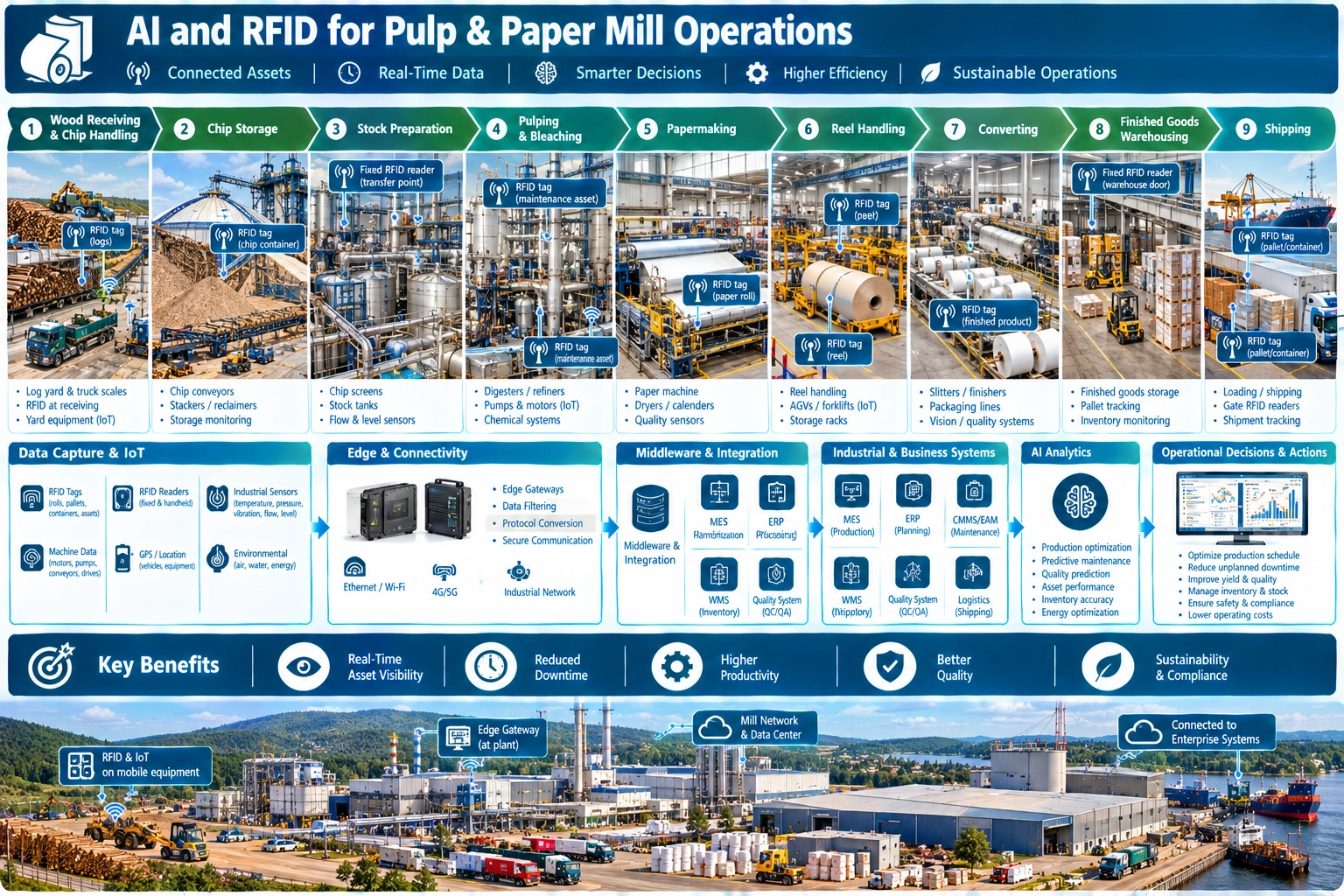
This infographic follows pulp and paper production from wood receiving and chip handling through pulping, papermaking, converting, warehousing, and shipping. RFID, IoT sensors, machine data, edge gateways, enterprise software, and AI analytics support production, maintenance, quality, inventory, and operational decisions.
Priority AI and RFID Applications in Pulp & Paper
AI applications should be selected according to measurable mill problems rather than added simply because data is available. RFID becomes most valuable where physical identification, location events, chain-of-custody records, or automated transaction capture are difficult to achieve manually.
- AI predictive maintenance for paper machines, refiners, pumps, motors, fans, compressors, conveyors, drives, and other critical equipment.
- AI-based anomaly detection for process variables, machine behavior, energy consumption, and production conditions.
- AI production optimization using grade schedules, machine constraints, furnish characteristics, quality requirements, and historical operating data.
- AI quality analysis for basis weight, moisture, formation, caliper, coating performance, web defects, and other applicable product characteristics.
- RFID roll and bale traceability from production through warehouse staging and shipment.
- RFID identification of maintenance tools, inspection equipment, reusable containers, and mobile assets.
- RFID spare-parts tracking for motors, bearings, valves, instrumentation components, drives, pumps, and other MRO inventory.
- AI inventory forecasting for chemicals, pulp, recovered fiber, packaging materials, spare parts, and finished products.
- AI energy optimization for steam systems, dryers, vacuum systems, motors, compressed air, pumps, and other major energy consumers.
- RFID-enabled warehouse and staging visibility for finished rolls, pulp bales, and handling units.
- AI-assisted production scheduling based on customer orders, grade changes, machine capacity, maintenance windows, and material availability.
- RFID-supported shipment verification for finished goods and outbound handling units.
Pulp & Paper Mill Operational Challenges
Pulp and paper mills introduce engineering conditions that significantly affect AI and RFID deployment. A technically capable system can still produce poor operational results if tag selection, reader placement, data quality, network availability, or process integration are not addressed during engineering.
Wet, Chemical, and Contaminated Environments
Pulping, stock preparation, bleaching, wastewater treatment, and other mill areas can expose equipment to water, chemicals, fibers, dust, heat, and contamination. RFID hardware therefore may require rugged housings, suitable ingress protection, appropriate mounting materials, and application-specific tag construction.
Metal Equipment and RF Propagation
Paper machines, conveyors, tanks, structural steel, motors, piping, racks, and other metallic structures can alter RFID read performance. Reflections and multipath effects may create read zones that differ substantially from laboratory conditions.
A site survey should evaluate antenna orientation, polarization, tag placement, reader power, shielding, interference, conveyor speed, and the physical geometry of the target area before production deployment.
High-Speed Continuous Production
Paper machines operate continuously and can move materials rapidly through production and finishing areas. RFID event capture must therefore be designed around actual process speed, tag orientation, reader dwell time, and expected read-zone behavior rather than nominal reader specifications.
Legacy Mill Control Systems
Many mills operate a mixture of PLCs, SCADA systems, DCS environments, historians, MES software, ERP systems, CMMS or EAM software, and specialized quality systems. AI and RFID deployments should integrate with these systems instead of creating isolated operational databases.
Data Quality and Context
AI models depend on reliable contextual data. A vibration reading without equipment identity, production state, operating load, or maintenance history has limited diagnostic value. RFID can contribute physical identity and movement context, while MES, CMMS, ERP, historians, and IoT systems provide the operational context required for meaningful analytics.
Network Availability
Production areas may have different levels of wired and wireless connectivity. Edge gateways can buffer RFID events and machine data locally when connectivity to central systems is temporarily unavailable. Store-and-forward processing can prevent short network interruptions from becoming missing operational records.
End-to-End Pulp & Paper Data-to-Decision Workflow
A practical AI and RFID solution for a pulp and paper mill should connect physical operations with business decisions through clearly defined data stages.
- Physical data acquisition begins with RFID readers, antennas, IoT devices, machine controllers, PLCs, DCS systems, SCADA, machine vision, weigh systems, laboratory systems, and equipment telemetry.
- Edge gateways collect and normalize data close to receiving areas, production equipment, warehouses, or shipping zones.
- RFID middleware filters duplicate reads, validates tag identities, applies read-zone logic, and converts raw reader events into useful business events.
- Communication infrastructure transfers data using industrial Ethernet, TCP/IP, MQTT, HTTPS, REST APIs, OPC UA, or other interfaces appropriate to the existing mill environment.
- Server or cloud software stores operational records and makes data available to analytics and enterprise applications.
- AI models evaluate production conditions, maintenance indicators, quality information, energy data, inventory status, and historical trends.
- Business rules combine AI outputs with production schedules, work orders, inventory policies, quality requirements, and customer orders.
- Operational users receive recommendations, alerts, exceptions, dashboards, or automated transactions.
- Mill personnel then take actions such as inspecting equipment, changing maintenance priorities, moving inventory, adjusting production parameters, correcting a shipment, or escalating a quality issue.
- The resulting operational outcome is recorded and becomes additional data for performance analysis and model improvement.
Realistic RFID Deployment in Pulp and Paper Mill Operations
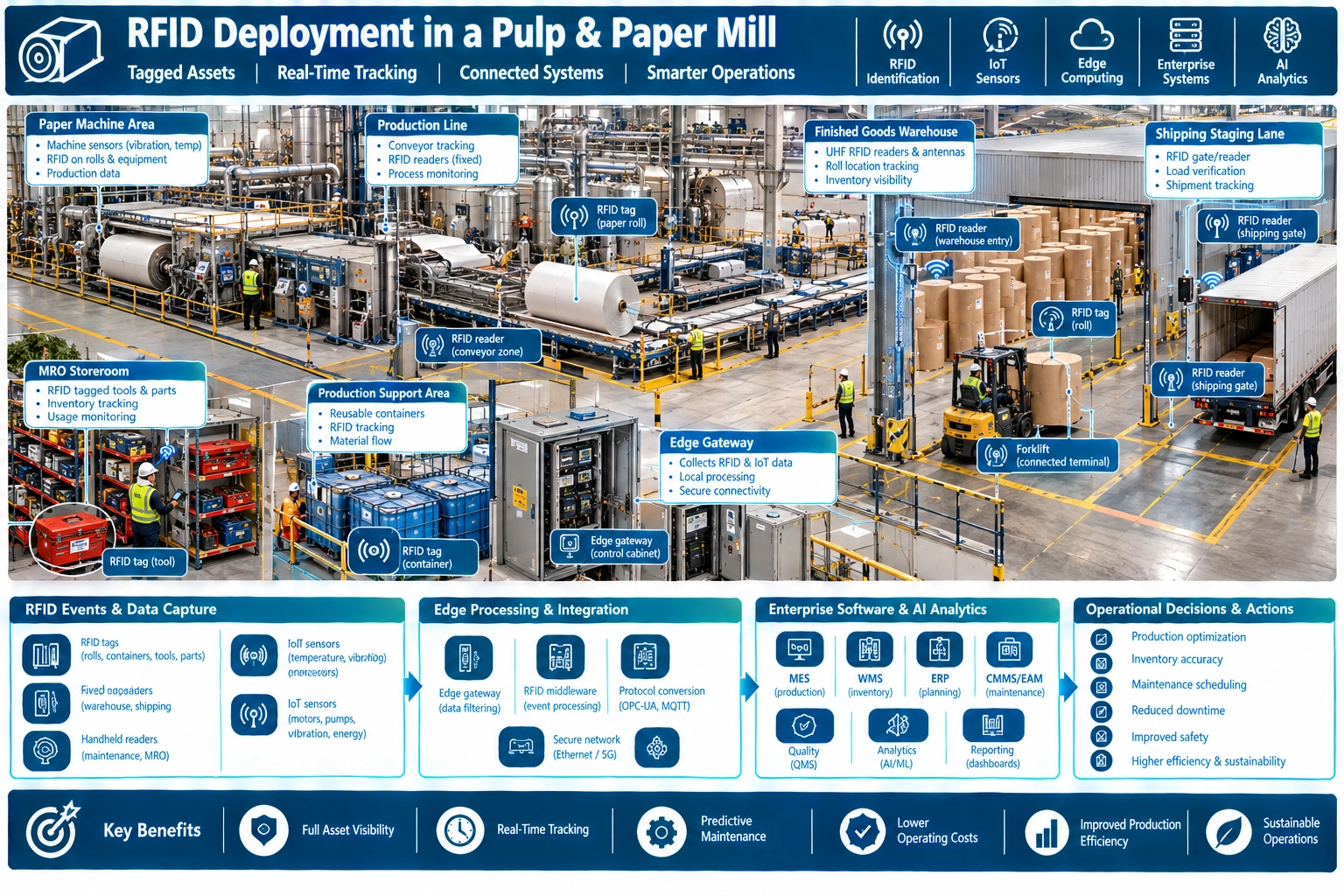
This visual shows RFID deployed across paper production, finished-roll warehousing, MRO storage, production support, and shipping. Fixed readers, tagged rolls and tools, forklifts, and edge gateways connect RFID events with MES, ERP, WMS, CMMS/EAM, and AI analytics to support tracking, maintenance, inventory, and operational decisions.
Technical System Foundation for Pulp & Paper RFID and AI
A reliable mill deployment starts with physical identification and data acquisition engineered around the material and operating environment.
UHF RFID for Mill Material and Asset Tracking
UHF RFID is generally appropriate for applications requiring longer read distances and faster identification of multiple tagged objects. Pulp and paper applications can include finished-roll handling units, warehouse movements, reusable containers, mobile assets, MRO inventory, and controlled shipping read zones.
EPC Gen2 / ISO 18000-63-compatible equipment can be considered where applicable. Actual read performance depends on tag design, mounting surface, orientation, reader configuration, antenna placement, and the surrounding mill environment.
HF RFID for Short-Range Identification
HF RFID can be useful where controlled short-range reads are preferable. Potential mill applications include tool cabinets, maintenance stations, inspection points, controlled access to specific equipment records, and other locations where close-proximity identification is desirable.
HF deployments should use tags and readers selected for the required operating frequency, read distance, mounting environment, and application workflow.
LF RFID for Specialized Identification
LF RFID can support specialized short-range identification applications where its operating characteristics fit the mill requirement. It may be considered for selected equipment or controlled identification points rather than assumed to be the default choice for every mill tracking problem.
Rugged RFID Hardware
RFID readers, antennas, tags, gateways, industrial computers, and network equipment should be selected according to temperature, moisture, dust, chemical exposure, mechanical impact, cleaning practices, vibration, and mounting conditions.
Tag selection is particularly important. Paper, pulp, water, metal, packaging materials, and composite handling units can all affect RFID performance. A tag that performs well on a cardboard test surface may behave differently when attached near steel structures or machinery.
RFID Read-Zone Engineering
Read zones should correspond to actual mill transactions such as receiving, production handoff, warehouse entry, staging, or shipping. Reader placement should minimize unintended reads from adjacent lanes or storage positions.
Engineering validation should measure read accuracy under realistic conditions, including forklift movement, roll orientation, tag placement, conveyor speed, nearby metal, and simultaneous tagged objects.
AI Data and Model Foundation
AI models may use supervised learning, anomaly detection, time-series forecasting, computer vision, optimization algorithms, or hybrid statistical and machine-learning methods. Selection depends on the mill problem.
Predictive maintenance models can use vibration, temperature, current, pressure, speed, lubrication information, alarm history, and maintenance records. Production models can combine process variables with grade, furnish, machine state, quality measurements, and production schedules.
Enterprise Data Foundation
The physical RFID identity should map to a controlled master-data record. Depending on the application, this can include roll ID, bale ID, asset ID, equipment number, spare-part number, production order, location, customer order, maintenance work order, or shipment reference.
This identity relationship is what allows RFID events to become useful operational information rather than isolated reader transactions.
Part 2 continues with advanced AI applications, cloud and server deployment, communications and integration, cybersecurity, enterprise integration, implementation and commissioning, KPIs, regulations, business benefits, engineering trade-offs, additional visual recommendations, GAO capabilities and credibility, recommendations, key insights, and the required Aperture Venture Studio closing section.
Advanced AI Applications for Pulp & Paper Production
AI becomes most valuable when mill data is connected to specific production, quality, maintenance, and material decisions. Pulp and paper operations generate large volumes of process data, but the objective is not simply to collect more information. The objective is to identify conditions that affect throughput, yield, quality, energy consumption, equipment reliability, and customer fulfillment.
AI Production Yield Optimization
AI can analyze furnish characteristics, production parameters, machine speed, basis weight, moisture, energy consumption, grade changes, and historical production results to identify operating conditions associated with better yield.
For pulp production, models can evaluate relationships among furnish quality, chemical consumption, refining conditions, bleaching parameters, and pulp characteristics. For paper production, AI can correlate machine operating conditions with basis weight, caliper, moisture, formation, strength, and production losses.
RFID adds physical identity to the analysis by associating rolls, handling units, reusable assets, or production resources with production orders and downstream transactions.
AI-Based Grade and Product-Mix Optimization
Frequent grade changes can create production losses through machine preparation, transition material, quality stabilization, cleaning, and setup activities. AI can evaluate historical grade sequences, order requirements, machine constraints, inventory positions, and production schedules to identify lower-loss sequencing options.
The resulting recommendations can help planners reduce unnecessary grade changes while maintaining customer delivery requirements and product specifications.
AI Quality and Defect Detection
Computer vision and machine-learning models can support inspection of paper surfaces, web defects, wrinkles, breaks, coating irregularities, edge conditions, and other detectable characteristics.
AI can correlate detected defects with machine conditions, process variables, raw-material characteristics, and production periods. This can help engineers investigate recurring quality problems rather than treating each defective roll as an isolated event.
RFID can preserve the identity of affected rolls and handling units, allowing quality information to remain associated with the physical product during warehouse and shipping operations.
AI Kiln and Drying Optimization
Where pulp and paper operations include wood drying or other thermal drying processes, AI can evaluate temperature, moisture, airflow, energy consumption, residence time, and production conditions to identify inefficient drying patterns.
For paper-machine dryer sections, models can evaluate steam demand, moisture profiles, machine speed, condensate conditions, and product requirements. The objective is to achieve required moisture specifications while avoiding unnecessary thermal energy consumption or production constraints.
Predictive Maintenance for Mill Equipment
Critical equipment such as pumps, motors, gearboxes, refiners, compressors, fans, rolls, bearings, drives, conveyors, and paper-machine components can generate measurable indicators before failure.
AI predictive-maintenance models can compare vibration, temperature, current, pressure, speed, operating load, alarm history, and maintenance records against normal operating patterns. Anomalies can then be prioritized according to equipment criticality and production impact.
RFID can associate replacement components, tools, inspection resources, and maintenance work orders with specific equipment, creating a stronger connection between condition monitoring and physical maintenance execution.
[Visual Recommendation 3]
Visual Type: AI and RFID Data-to-Decision Workflow Diagram
Ideal Placement: After the advanced AI applications section.
Purpose: Explain how physical mill events and process data become AI-assisted production, maintenance, quality, inventory, and logistics decisions.
Generation Prompt: Create a clean enterprise engineering flow diagram for “AI and RFID Data-to-Decision Workflow in Pulp & Paper.” Begin with physical sources including wood chips, pulp, chemicals, paper machines, pumps, motors, refiners, conveyors, finished paper rolls, forklifts, maintenance tools, and spare parts. Show RFID readers, IoT devices, PLCs, DCS, SCADA, machine vision, laboratory systems, and weigh systems collecting data. Route information through edge gateways and RFID middleware for filtering, validation, normalization, and event generation. Show communications using industrial Ethernet, TCP/IP, MQTT, OPC UA, HTTPS, and REST APIs where appropriate. Continue to server or cloud processing, AI models, time-series analytics, computer vision, predictive maintenance, production optimization, quality analytics, and inventory intelligence. Connect outputs to MES, ERP, CMMS/EAM, WMS, quality management, and transportation systems. End with practical decisions such as maintenance intervention, production adjustment, inventory movement, quality hold, shipment verification, and schedule changes.
Note: After the visual is created, generate Visual Title, Short Description of 1–4 sentences, and 80–125 character Alt Text based on the completed visual rather than this recommendation.
Cloud and Server Deployment for Pulp & Paper
Pulp and paper mills have different requirements for data location, latency, connectivity, cybersecurity, integration, and operational ownership. The appropriate deployment model should therefore be selected according to mill operations rather than treated as a universal software decision.
Cloud Version
The Cloud Version is a cloud-hosted SaaS deployment managed within cloud infrastructure. It can be appropriate when mill management wants centralized access across multiple production sites, centralized software maintenance, scalable analytics resources, and consolidated operational reporting.
Cloud deployment can support enterprise-wide analysis of production performance, maintenance history, inventory, quality, and logistics when reliable connectivity exists between mills and cloud services.
Time-sensitive functions should still be evaluated carefully. RFID event processing, safety-related controls, and certain machine decisions may require local edge processing so that mill operations do not depend on continuous wide-area connectivity.
Server Version
The Server Version places software on edge servers, customer-managed servers, private data centers, factory servers, or other privately hosted enterprise infrastructure. It is not limited to traditional on-premises deployment.
This model can be appropriate when a pulp and paper organization requires greater control over data location, integration with private industrial networks, local processing, or connectivity to existing mill systems. It can also be useful where production areas have restricted external connectivity.
Hybrid Deployment
A hybrid model can place RFID event processing, machine-data collection, and selected AI functions near mill operations while transferring selected records and analytics results to centralized infrastructure.
This approach can provide local resilience while allowing corporate engineering, maintenance, production, and supply-chain teams to compare performance across multiple pulp and paper facilities.
Pulp & Paper Communication and Integration Infrastructure
AI and RFID systems must exchange information with the systems already used to operate the mill. Integration should therefore be designed around established operational interfaces and controlled data ownership.
- Industrial Ethernet can connect readers, gateways, PLCs, industrial computers, and other equipment within production networks.
- TCP/IP provides the underlying network communication used by many RFID readers, gateways, servers, and enterprise systems.
- MQTT can support lightweight event and telemetry exchange where the mill’s communication design permits it.
- OPC UA can provide structured machine-data integration with compatible industrial control and data systems.
- HTTPS and REST APIs can exchange RFID events, inventory transactions, production information, and AI results with business software.
- RFID middleware can filter duplicate reads, apply location logic, validate tag identities, and convert raw observations into meaningful business events.
- Edge gateways can provide protocol conversion, local buffering, device management, and preliminary analytics.
MES and Production-System Integration
MES software can provide production-order, work-center, routing, product, and production-status context. RFID events can then be associated with the correct production transaction instead of remaining as independent tag observations.
AI outputs can also be presented alongside production status so operators and production engineers can distinguish normal process variation from conditions requiring intervention.
ERP Integration
ERP systems generally manage orders, procurement, inventory, customers, financial transactions, and other business records. RFID can provide physical movement events while AI can provide forecasting and exception information.
The integration should establish clear ownership of master data so that roll IDs, product codes, locations, production orders, and customer references do not become inconsistent across systems.
CMMS and EAM Integration
Maintenance systems contain equipment hierarchies, preventive-maintenance schedules, work orders, spare parts, technician assignments, and maintenance history.
AI predictive-maintenance alerts can create or prioritize maintenance activities, while RFID can identify equipment, tools, components, and spare parts used during the work.
Warehouse and Transportation Integration
WMS or yard-management software can use RFID events to improve finished-roll and pulp-bale visibility. Transportation systems can use shipment status and load information to improve outbound coordination.
A properly designed integration can connect physical shipment verification with customer order status and transportation scheduling.
[Visual Recommendation 4]
Visual Type: Pulp & Paper Roll and Bale Traceability Workflow
Ideal Placement: After the enterprise integration discussion.
Purpose: Show how physical product identity follows pulp and paper materials from production through storage, quality release, order allocation, and shipment.
Generation Prompt: Create a detailed process workflow titled “Pulp & Paper RFID Traceability from Production to Shipment.” Show production of paper reels, converted rolls, and pulp bales, followed by quality inspection, RFID identification, warehouse receiving, storage location assignment, inventory status, customer order allocation, shipment staging, truck or rail loading, and final dispatch. Include RFID tag encoding, fixed reader zones, handheld readers, forklift activity, warehouse locations, production-order data, quality-hold status, ERP records, WMS records, and transportation information. Show AI analyzing inventory dwell time, order priority, shipment schedules, and product availability to identify exceptions. Distinguish physical material movement from digital transaction flow. Use realistic pulp and paper mill and warehouse terminology and avoid generic retail inventory imagery.
Note: After the visual is created, generate Visual Title, Short Description of 1–4 sentences, and 80–125 character Alt Text based on the completed visual rather than this recommendation.
Pulp & Paper Cybersecurity and System Security
Connecting RFID readers, edge gateways, industrial equipment, AI software, and enterprise applications increases the number of systems that exchange operational information. Security engineering should therefore be incorporated before deployment rather than added after commissioning.
Industrial Network Security
RFID readers and edge gateways should be placed within appropriately controlled network segments. Firewall rules, network segmentation, secure remote access, credential management, and device hardening can reduce unnecessary exposure.
Production-control networks should be separated appropriately from business networks while retaining only the communication paths required for approved integrations.
Data Protection
Production, maintenance, customer-order, inventory, and quality information should be protected according to organizational data policies. TLS-protected communication, VPN connectivity where appropriate, controlled API access, and role-based access control can protect information moving between mill systems.
AI Data Governance
AI models should use controlled datasets with documented sources, timestamps, equipment identities, operating states, and data-quality rules. Model outputs should be traceable to the underlying operational information when engineers need to investigate an alert or recommendation.
Pulp & Paper Implementation and Commissioning
Successful implementation depends as much on process engineering as on hardware selection. A mill should define the operational transaction first and then determine how RFID and AI can reliably support it.
Process Definition
Identify the specific problem, such as finished-roll location uncertainty, maintenance-tool loss, spare-parts stock discrepancies, shipment errors, excessive equipment downtime, or production-quality variation.
Define the current process, manual transactions, decision points, failure modes, and required improvement.
RFID Site Survey
A physical survey should examine metal structures, paper rolls, machinery, conveyor paths, forklift lanes, warehouse racks, antenna mounting points, electrical interference, tag orientation, and operator movement.
Testing should occur under actual operating conditions rather than relying exclusively on laboratory specifications.
Tagging Strategy
Each asset or material class should have a defined identity model, tag type, mounting location, encoding convention, read-zone requirement, and replacement procedure.
Not every physical object needs an RFID tag. Instrumentation, PLC data, machine vision, barcode identification, BLE, GNSS, or other technologies may be more appropriate for particular mill processes.
Integration Validation
Integration testing should verify that an RFID event produces the expected business transaction and that AI outputs reach the correct operational user.
Testing should include duplicate reads, missed reads, disconnected devices, invalid tag IDs, network interruptions, incorrect material locations, production-order changes, and shipment exceptions.
Production Commissioning
Commissioning should begin with controlled operating zones before expanding to additional production areas. Read accuracy, event latency, network resilience, data quality, and operator response should be measured using actual mill conditions.
GAO can support organizations with RFID, BLE, and IoT hardware products and systems that can be evaluated during site-specific deployment planning, testing, and integration.
Pulp & Paper Performance Optimization
Operational optimization requires continuous measurement after deployment. RFID performance and AI performance should both be evaluated against business outcomes rather than technology metrics alone.
RFID Performance
Relevant measurements include read accuracy, missed-event rate, duplicate-event rate, false-read rate, event latency, reader availability, tag durability, and read-zone containment.
A read rate that looks strong in an isolated test may not remain strong when forklifts, rolls, metal structures, operators, and changing inventory positions are introduced.
AI Model Performance
AI models should be evaluated using metrics appropriate to the problem. Predictive-maintenance systems may emphasize precision, recall, lead time, false-alert frequency, and avoided downtime. Quality models may use defect-detection accuracy and false-positive rates. Forecasting models can use error measurements appropriate to inventory or production demand.
Model performance should also be monitored as equipment, products, operating conditions, and production schedules change.
Key Performance Indicators for AI and RFID in Pulp & Paper
AI and RFID programs should connect technical measurements to mill performance indicators.
- Pulp and paper production throughput
- Overall equipment effectiveness
- Paper-machine availability
- Machine utilization
- Unplanned downtime
- Mean time between failures
- Mean time to repair
- Preventive-maintenance compliance
- Maintenance backlog
- Production schedule adherence
- Grade-change duration
- Production yield
- Fiber recovery
- Broke rate
- Product quality compliance
- Basis-weight consistency
- Moisture compliance
- Finished-roll inventory accuracy
- Pulp-bale inventory accuracy
- Material traceability accuracy
- Warehouse dwell time
- Shipment verification accuracy
- Truck turnaround time
- Forklift utilization
- MRO inventory accuracy
- Spare-parts stockout frequency
- RFID read accuracy
- AI prediction accuracy
- Manual transaction reduction
- Energy consumption per unit of production
Regulations, Standards, and Pulp & Paper Governance
Requirements vary according to mill location, process, equipment, chemical usage, emissions, transportation activities, and certification commitments. Engineering teams should verify applicable federal, state, provincial, territorial, and local requirements before implementation.
Relevant areas can include:
- OSHA requirements for applicable U.S. workplace safety conditions
- Machine guarding requirements
- Lockout/tagout procedures
- Hazard communication requirements
- Combustible-dust and housekeeping controls where applicable
- Environmental permits and wastewater requirements
- Air-emission requirements
- Chemical storage and handling requirements
- Hazardous-material transportation requirements where applicable
- DOT and FMCSA requirements for applicable U.S. transportation operations
- Canadian federal, provincial, and territorial occupational-safety requirements
- Radio-frequency equipment requirements applicable to deployed RFID hardware
- Data protection and cybersecurity requirements applicable to organizational systems
- FSC certification requirements where applicable
- PEFC certification requirements where applicable
- SFI certification requirements where applicable
RFID deployment should never interfere with machine guarding, emergency controls, lockout/tagout procedures, chemical-handling requirements, or other established mill safety controls.
Business Benefits of AI-Enabled Pulp & Paper Operations
The strongest business case comes from connecting measurable mill problems with specific operational improvements.
- Better material traceability results from associating physical rolls, bales, assets, or handling units with digital records.
- Higher inventory accuracy results from replacing selected manual transactions with validated movement events.
- Lower unplanned downtime can result when AI identifies equipment degradation early enough for maintenance intervention.
- Better production yield can result when AI identifies process conditions associated with improved furnish utilization and lower production losses.
- Reduced shipment errors can result when physical load contents are verified against order and shipping records.
- Faster maintenance execution can result when technicians can identify equipment, tools, and spare parts without manually searching multiple records.
- Improved production visibility results when machine data, RFID events, quality information, and enterprise records are correlated.
- Better scalability results when standardized tagging, integration, and data models can be extended from one mill area to additional production and logistics zones.
Engineering Trade-Offs for Pulp & Paper RFID and AI Deployment
No single RFID or AI configuration is appropriate for every mill. Engineering decisions should reflect physical conditions and operational priorities.
- UHF RFID generally provides longer-range identification, but metal structures, tag orientation, liquid content, and dense storage can complicate read-zone control.
- HF RFID can provide controlled short-range identification where close-proximity transactions are preferable.
- LF RFID can fit specialized short-range identification requirements but is generally less suitable for high-volume long-range material tracking.
- Fixed readers can automate controlled transitions, while handheld readers provide flexibility for inventory audits, maintenance, and exception handling.
- Edge processing reduces dependence on wide-area connectivity, while cloud processing can simplify centralized multi-site analytics.
- Server deployment can provide greater control over private mill infrastructure, while cloud deployment can support centralized administration and scalable analytics.
- AI can identify complex patterns, but poor-quality data, incomplete maintenance history, and inconsistent equipment identity can reduce model value.
- RFID can automate physical identification, but tagging every object may add unnecessary cost and operational complexity.
Sawmill-to-Mill Engineering Lessons Applied to Pulp & Paper
Pulp and paper operations require a process-first approach. RFID should be deployed where physical identity and movement events solve a defined operational problem, while AI should be applied where sufficient process history and contextual data exist to support a measurable decision.
A practical deployment often begins with one high-value workflow, such as finished-roll traceability, MRO inventory, maintenance-tool management, or equipment condition monitoring. Once read-zone performance, data quality, integration, and operator workflows have been validated, the solution can expand to additional mill areas.
This approach reduces commissioning risk and gives engineering teams measurable evidence before wider deployment.
[Visual Recommendation 5]
Visual Type: AI Predictive Maintenance for Pulp & Paper Equipment
Ideal Placement: After the engineering trade-offs section.
Purpose: Show how AI uses machine-condition data and maintenance history to predict equipment problems and support planned intervention.
Generation Prompt: Create a detailed industrial engineering illustration of AI predictive maintenance inside a pulp and paper mill. Show a paper machine, electric motors, bearings, pumps, gearboxes, refiners, fans, conveyors, and rotating equipment with IoT devices measuring vibration, temperature, current, pressure, and speed. Show PLC and SCADA data flowing into an edge gateway and time-series data system. Display an AI analytics layer identifying abnormal vibration and predicting bearing or motor degradation. Connect the result to CMMS/EAM software showing a prioritized maintenance work order. Include an RFID-tagged spare motor, bearing, or maintenance component and an RFID-enabled MRO storeroom transaction linking the physical part to the maintenance order. Show maintenance technicians receiving the alert, identifying the equipment, retrieving the required part, and completing the intervention. Use realistic pulp and paper machinery and avoid generic predictive-maintenance imagery.
Note: After the visual is created, generate Visual Title, Short Description of 1–4 sentences, and 80–125 character Alt Text based on the completed visual rather than this recommendation.
How GAO Supports AI and RFID for Pulp & Paper
GAO provides RFID, BLE, and other IoT hardware products and systems that can support identification, asset visibility, inventory management, and connected industrial workflows. For pulp and paper applications, hardware selection can be aligned with the physical characteristics of rolls, bales, containers, tools, machinery, warehouses, production areas, and mobile equipment.
Engineering considerations include tag attachment, reader placement, antenna configuration, environmental protection, connectivity, data interfaces, and integration requirements. GAO’s role can therefore extend from hardware selection to supporting the technical evaluation required to determine whether a particular RFID configuration is suitable for a mill environment.
GAO Experience in RFID and Connected Industrial Systems
Headquartered in New York City and Toronto, Canada, GAO RFID Inc. is ranked among the world’s top 10 leading B2B and B2G, and to a lesser degree B2B2C and B2D, BLE and RFID suppliers. This experience provides a substantial technical base for organizations evaluating RFID and connected IoT requirements across complex operational environments.
For pulp and paper organizations, the practical relevance is the ability to evaluate RFID identification alongside BLE, IoT connectivity, edge computing, and enterprise software requirements rather than treating each technology as an isolated component.
GAO Group Research, Quality, and Technical Support
GAO RFID Inc., GAO Research Inc., and GAO Tek Inc. form GAO Group, with operations based in New York City and Toronto, Canada. For three decades, GAO Group has served customers across the United States and Canada, including Fortune 500 companies, leading R&D organizations, prestigious universities, and U.S. and Canadian government agencies.
GAO Group has invested heavily in research and development, maintains stringent quality-assurance processes, and provides expert technical support remotely or onsite. These capabilities are relevant to pulp and paper deployments where hardware reliability, environmental suitability, integration, and commissioning support can materially affect project performance.
Practical Recommendations for Pulp & Paper Mills
A pulp and paper organization evaluating AI and RFID should establish the operational objective before selecting hardware or software.
- Start with a measurable problem such as finished-roll traceability, inventory accuracy, equipment downtime, maintenance execution, or shipment verification.
- Map the physical material flow and identify every location where a business event occurs.
- Determine which objects actually require persistent RFID identity.
- Select UHF, HF, or LF RFID according to read distance, material characteristics, environment, and transaction requirements.
- Test tags on actual paper products, pulp containers, metal equipment, racks, and handling units before committing to a large deployment.
- Use edge processing where local mill operations must continue during network interruptions.
- Define the relationship among RFID IDs, equipment numbers, production orders, product codes, locations, and customer orders.
- Integrate with MES, ERP, CMMS/EAM, WMS, quality, and transportation systems using controlled interfaces.
- Establish cybersecurity requirements before connecting readers and gateways to production networks.
- Measure RFID accuracy and AI performance continuously after commissioning.
- Expand only after the initial workflow demonstrates measurable operational value.
Key Insights and Business Value for Pulp & Paper
AI and RFID can address different parts of the same pulp and paper operational problem. RFID identifies physical products, assets, tools, containers, and movement events, while AI interprets production, quality, maintenance, inventory, and process data to support better decisions.
The highest-value deployments are usually those tied directly to measurable mill outcomes. Finished-roll traceability, pulp-bale identification, MRO visibility, predictive maintenance, quality analysis, production optimization, energy management, and shipment verification are practical areas where the technologies can complement existing mill systems.
Successful implementation depends on physical site engineering, reliable data, appropriate integration, cybersecurity, and disciplined commissioning. Pulp and paper organizations can reduce implementation risk by beginning with a controlled workflow, validating performance under actual mill conditions, and expanding after measurable results are established.
GAO’s RFID, BLE, and IoT hardware products and systems can provide part of the technical foundation for these deployments, while engineering evaluation and technical support can help organizations select solutions appropriate to their operating requirements.
Building the Future of Industrial AI and IoT with Aperture Venture Studio and GAO RFID Inc.
For more than three decades, GAO Group of Companies has invested heavily in R&D involving industrial RFID, BLE, and IoT. As generative AI became useful in industrial applications, we expanded our work in AI and IoT, including RFID and BLE, and founded Aperture Venture Studio to advance practical AI and IoT solutions for industries such as Pulp & Paper. Aperture brings together AI and IoT technical experts, operational executives, investors, and leading companies. We also support technical discussions through Aperture Ventures Summit and TekSummit. We welcome advisors, employees, investors, and customers interested in advancing AI and IoT for Pulp & Paper operations.