
AI and BLE for Hospitality Operations
AI and BLE for Hospitality Operations in Hospitality Operations Manufacturing
AI is changing hospitality operations by turning data from guests, staff, rooms, equipment, inventory, and service workflows into actionable operational intelligence. AI and BLE for Hospitality Operations can help hotels, resorts, casinos, conference facilities, restaurants, and other hospitality environments improve room readiness, staff coordination, asset visibility, inventory control, maintenance, and service response. BLE provides practical location and proximity data, while RFID can complement these capabilities for item-level identification and tracking. When connected with property management systems, computerized maintenance management systems, workforce applications, point-of-sale systems, and analytics software, these technologies provide a continuous flow of operational data. AI can then identify patterns, predict operational requirements, prioritize exceptions, and support faster decisions across hospitality operations.
How AI Is Transforming Hospitality Operations
Hospitality operations depend on the coordination of people, rooms, amenities, equipment, supplies, food and beverage inventory, housekeeping activities, engineering services, security, and guest requests. Many of these processes generate operational data, but the data is often distributed across separate systems or captured manually.
AI and BLE for Hospitality Operations provides a way to connect physical operational activity with digital decision-making. BLE beacons, gateways, mobile devices, and location-aware equipment can provide proximity and presence information, while RFID can identify tagged linens, uniforms, housekeeping supplies, maintenance tools, food-service assets, and other physical items. AI models can combine these signals with operational information from property management systems, CMMS software, workforce management applications, inventory systems, and service-request systems.
The result is not simply automated tracking. The greater value comes from using operational data to answer questions such as:
- Which guest rooms are ready for inspection or release?
- Where are housekeeping teams and service personnel during active shifts?
- Which carts, tools, linens, or equipment are unavailable or misplaced?
- Which maintenance assets require attention before they affect guest service?
- Which inventory items are approaching replenishment thresholds?
- Which operational delays are recurring across shifts?
- Which service requests require immediate intervention?
- Where are bottlenecks developing in housekeeping, maintenance, food service, or facilities operations?
GAO supports hospitality applications by supplying RFID, BLE, and IoT hardware products and systems that can provide the physical data layer required for these workflows.
Hospitality Operations Workflows Supported by AI and BLE
AI becomes most useful when it is connected to specific operational workflows rather than deployed as a standalone analytics function. Hospitality Operations Manufacturing environments can apply AI and BLE across several interconnected processes.
AI-Powered Room Readiness and Housekeeping Operations
Room turnover requires coordination among front desk personnel, housekeeping attendants, supervisors, inspectors, and maintenance staff. BLE-enabled mobile devices or location infrastructure can provide operational visibility into staff movement and task activity where appropriate, while connected systems provide room status information.
AI can analyze housekeeping assignments, historical cleaning durations, occupancy patterns, maintenance events, and current room status to identify likely delays. A room that normally requires additional engineering attention, for example, can be flagged before it disrupts check-in schedules.
RFID can supplement this workflow by tracking reusable housekeeping assets such as linen carts, cleaning equipment, uniforms, and other tagged items. Combining asset identity with operational events helps managers distinguish between a room-readiness problem caused by staffing, maintenance, missing supplies, or physical asset availability.
AI-Driven Maintenance and Engineering Operations
Hotel engineering departments manage HVAC equipment, pumps, boilers, electrical systems, elevators, kitchen equipment, refrigeration systems, laundry equipment, lighting systems, and other building infrastructure. Maintenance activities directly affect guest comfort and operational continuity.
AI can analyze maintenance records, equipment telemetry, work orders, inspection results, and operational history to identify recurring failures or prioritize preventive maintenance. BLE-enabled sensors can provide proximity or condition-related data for selected assets, while RFID identification can associate maintenance activity with the correct equipment, tool, or replacement component.
A CMMS can receive identified asset information and maintenance events, allowing technicians to access the relevant asset record and work order. This reduces reliance on manually identifying equipment and helps maintain a more consistent maintenance history.
AI-Based Asset and Linen Management
Hospitality properties operate large inventories of mobile and reusable assets. These may include linen, towels, uniforms, housekeeping equipment, banquet equipment, maintenance tools, luggage carts, kitchen equipment, and other operational resources.
AI can use historical consumption, movement, loss, utilization, and replenishment information to identify unusual patterns. RFID can provide item or batch identification where required, while BLE can provide location or proximity information for movable assets.
The combination can help operations teams distinguish between an asset that is genuinely unavailable and one that has simply moved to another operating area. This distinction is particularly important in large hotels, resorts, convention facilities, and properties with multiple buildings.
AI for Food and Beverage Operations
Food and beverage operations require continuous coordination of inventory, preparation, storage, service, cleaning, and replenishment. AI can analyze sales patterns, consumption rates, inventory movements, preparation schedules, and historical demand to support purchasing and replenishment decisions.
RFID can assist with identification and traceability of selected inventory categories, containers, equipment, or reusable food-service assets. BLE can provide location or proximity information for mobile equipment and operational resources.
AI can use these inputs to identify abnormal consumption, predict replenishment requirements, and highlight discrepancies between expected and observed inventory movement. The objective is to provide operational staff with earlier visibility into exceptions rather than relying exclusively on end-of-shift reconciliation.
From Physical Activity to AI-Driven Hospitality Decisions
A practical AI and BLE solution for hospitality operations consists of several connected layers. Physical events originate from BLE devices, RFID tags and readers, sensors, mobile devices, connected equipment, and existing hospitality systems.
The resulting data can pass through gateways or local network infrastructure to edge processing resources, middleware, or centralized software. Data normalization is important because hospitality operations commonly involve different identifiers for rooms, employees, assets, work orders, inventory items, and service requests.
AI services can then process the normalized information. Depending on the application, these services may include machine learning models, anomaly detection, predictive models, optimization algorithms, natural-language processing, computer vision, or generative AI interfaces.
The resulting insight should lead to a defined operational action. Examples include creating a maintenance work order, changing a housekeeping priority, alerting a supervisor, initiating an inventory replenishment workflow, or escalating a service exception.
This diagram illustrates how BLE, RFID, sensors, and hospitality activities generate operational data that flows through gateways, edge processing, middleware, and hotel management systems. AI analytics transform the data into actionable insights for room readiness, maintenance, asset tracking, inventory planning, and workforce operations.
Hotel AI and BLE-Enabled Operational Data Flow
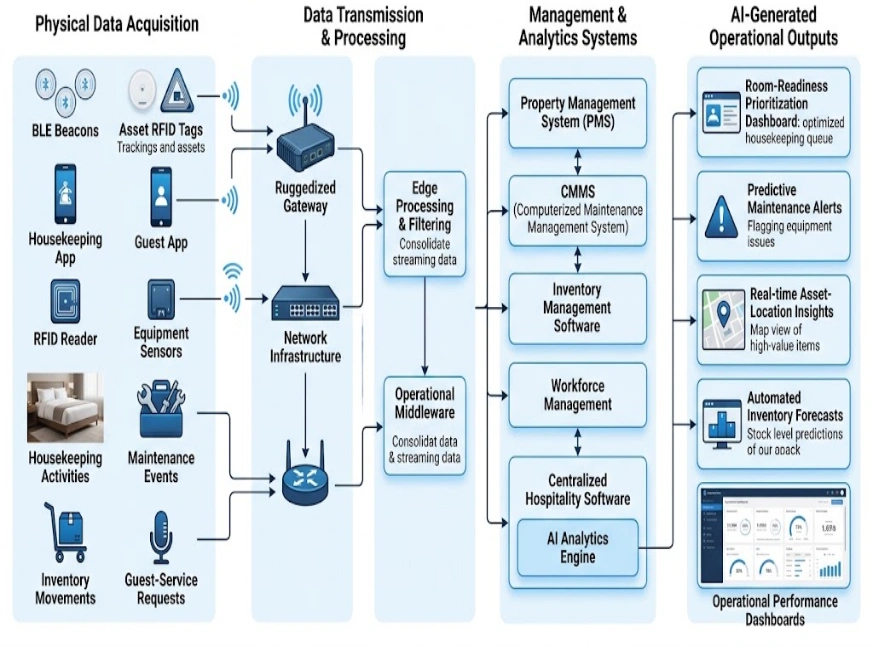
This diagram illustrates how BLE, RFID, sensors, and hospitality activities generate operational data that flows through gateways, edge processing, middleware, and hotel management systems. AI analytics transform the data into actionable insights for room readiness, maintenance, asset tracking, inventory planning, and workforce operations.
AI, BLE, and RFID Technology Stack for Hospitality Operations
Hospitality deployments require more than tags, beacons, or AI software. The system must reliably connect physical assets and operational events with the software used by housekeeping, engineering, facilities, food and beverage, front-office, security, and management teams.
BLE Devices and Location Infrastructure
BLE can provide short-range wireless communication for beacons, sensors, mobile devices, and location-aware equipment. Depending on the application, BLE may support proximity detection, asset location, staff workflow visibility, environmental sensing, or equipment monitoring.
The deployment should account for room density, building materials, elevator shafts, mechanical areas, interference, battery life, gateway placement, and required location accuracy. A proximity-based application has substantially different infrastructure requirements from one requiring room-level or zone-level location.
RFID for Asset Identification
RFID provides a complementary identification mechanism. UHF RFID is useful for longer-range reading of multiple tagged items, making it relevant to linen handling, inventory processes, equipment identification, and asset movement. HF RFID can support shorter-range identification scenarios where controlled read distances are preferable. LF RFID can be appropriate for selected identification applications where its characteristics match the operating environment.
RFID selection should be based on the material being tagged, read distance, tag orientation, metal or liquid interference, required throughput, and the physical workflow. Hospitality environments frequently contain textiles, liquids, metal equipment, dense storage areas, and human movement, so tag and reader selection should be validated under actual operating conditions.
Edge Processing and Network Connectivity
BLE and RFID events may be processed through gateways, readers, local servers, or other network-connected devices. Edge processing can reduce latency and allow selected decisions to continue even when connectivity to centralized software is temporarily unavailable.
Network design should consider Wi-Fi coverage, Ethernet connectivity, VLAN segmentation, gateway placement, device management, bandwidth, authentication, and resilience. High-density properties may require careful radio planning to prevent excessive interference or unreliable device communication.
Hospitality Software Integration
The operational value of connected data depends heavily on software integration. Relevant systems may include:
- Property management systems for guest and room status
- Computerized maintenance management systems for engineering work orders
- Workforce management systems for staff scheduling and task allocation
- Inventory management systems for supplies and consumables
- Point-of-sale systems for food and beverage transactions
- Building management systems for facilities and environmental control
- Security systems for controlled operational areas
- Service-request applications for guest and internal requests
- Business intelligence software for management reporting
Middleware can normalize device events and map physical identifiers to hospitality-specific records. For example, an RFID reader event should ultimately be associated with the correct asset, location, process, and business transaction rather than remaining an isolated hardware event.
AI Models for Hospitality Operations
Different hospitality workflows require different AI methods. Forecasting models can estimate demand for rooms, supplies, labor, or maintenance resources. Anomaly detection can identify unusual asset movements or consumption patterns. Classification models can prioritize operational exceptions. Optimization methods can help assign tasks or resources under changing conditions.
Natural-language interfaces can also make operational data easier for supervisors and managers to query. A manager could ask which maintenance categories generated the most repeat work orders or which operational areas experienced unusual delays during a particular period.
AI outputs should remain connected to measurable operational processes. A prediction that does not trigger a useful decision has limited practical value.
Cloud and Server Deployment for Hospitality Operations
Hospitality organizations can deploy AI and connected-device software using cloud-hosted services, privately hosted servers, edge servers, or combinations of these models.
Cloud Version
A cloud-hosted SaaS deployment can centralize operational data from multiple hotels, resorts, restaurants, or facilities. This approach is useful when management teams require centralized reporting, remote administration, cross-property analytics, and scalable computing resources.
Cloud deployment can also simplify software updates and provide centralized AI model management. However, connectivity dependency, data governance, network reliability, integration security, and property-level operational requirements must be considered during implementation.
Server Version
A server deployment can place software on customer-managed servers, private data centers, property-level servers, or edge computing infrastructure. This approach can be appropriate when hospitality organizations require greater control over data processing, integration with private systems, or continued operation of selected functions during connectivity disruptions.
Edge servers can process time-sensitive events locally while synchronizing selected data with centralized systems. This hybrid approach can be useful for large properties where local operational continuity is important.
The choice between cloud and server deployment should therefore be based on property size, connectivity, integration requirements, cybersecurity policies, data governance, latency requirements, IT resources, and the number of properties being managed.
Operational Capabilities and Business Value of AI-Enabled Hospitality Systems
The value of AI in hospitality operations comes from connecting operational signals with decisions that affect service quality, resource utilization, maintenance performance, and operating cost. BLE and RFID provide useful physical-world data, but AI determines how that information can be interpreted and acted upon.
Predictive Housekeeping and Labor Coordination
AI can analyze room occupancy, expected departures, historical cleaning durations, room characteristics, staff availability, and current task status to help supervisors prioritize housekeeping activities. BLE-based location information can provide additional context about staff and mobile equipment when location monitoring is operationally justified.
Rather than assigning tasks solely according to a static schedule, an AI-supported system can identify changing priorities. For example, rooms associated with early arrivals may receive higher priority when the expected cleaning workload is unusually high. Supervisors can also identify areas where housekeeping productivity is consistently affected by supply shortages, equipment availability, or maintenance delays.
Predictive Maintenance for Hotel Engineering
Predictive maintenance can help hospitality engineering teams move from predominantly calendar-based maintenance toward condition- and risk-based intervention. AI models can identify patterns across work orders, equipment operating conditions, failure history, inspection records, and maintenance intervals.
BLE sensors can provide selected environmental or equipment measurements, while RFID can identify the physical equipment associated with inspection or maintenance events. The resulting information can be passed to a CMMS so that maintenance personnel receive a specific asset reference rather than an ambiguous equipment description.
This approach is particularly valuable for equipment whose failure can directly affect guest experience, such as HVAC units, refrigeration systems, laundry equipment, elevators, pumps, boilers, and kitchen equipment.
Inventory Forecasting and Loss Reduction
Hospitality inventory is affected by occupancy, events, seasonality, food and beverage demand, housekeeping requirements, maintenance consumption, and property-specific operating practices.
AI forecasting can identify expected consumption and compare it with actual inventory movement. RFID can improve item identification at receiving, storage, issue, return, or transfer points, while BLE can help locate selected reusable equipment.
Anomalies can be investigated when actual consumption differs materially from historical patterns. The system can distinguish potential demand changes from operational exceptions such as misplaced assets, incorrect stock transactions, excessive consumption, or delayed returns.
Faster Service-Request Response
Guest and internal service requests can generate large numbers of operational events. AI can classify requests by urgency, location, service category, historical resolution time, and available personnel.
BLE-based location information can provide context about nearby authorized staff or mobile resources where the deployment is designed for such use. The system can then recommend task assignments based on availability and operational priority.
The objective is not to automate every service decision. Instead, AI should reduce the amount of manual coordination required for repetitive decisions while leaving exceptions and high-impact situations under human supervision.
Improved Asset Utilization
Asset utilization is an important consideration for large hotels, resorts, convention centers, and multi-building properties. Equipment may spend significant amounts of time in storage, service areas, guest floors, banquet rooms, kitchens, laundry facilities, or maintenance workshops.
RFID can establish asset identity and movement events, while BLE can provide more continuous location or proximity information for selected mobile assets. AI can analyze these records to identify underused equipment, recurring bottlenecks, abnormal movement patterns, or areas where additional equipment may be required.
Hospitality Deployment Engineering and Implementation Considerations
Successful implementation depends on treating the deployment as an operational engineering project rather than simply installing connected devices.
Define the Operational Event Model
The first step is to define which events matter to the hospitality workflow. Examples include asset entering a laundry area, linen leaving a storage room, maintenance technician beginning work on a specific asset, housekeeping task starting, room inspection being completed, or equipment entering a service area.
Each event should have a consistent identifier, timestamp, location or zone where appropriate, source device, and business context. This makes the resulting information usable by AI models and downstream applications.
Select Devices According to the Physical Environment
RFID and BLE hardware should be selected according to the actual hospitality environment.
Hotels contain guest rooms, corridors, elevators, kitchens, laundry facilities, mechanical rooms, parking areas, outdoor spaces, storage rooms, and conference facilities. These environments differ significantly in radio propagation, interference, temperature, humidity, metal density, and traffic patterns.
RFID tag selection should consider textiles, liquids, metal surfaces, washing processes, heat exposure, and repeated handling. BLE devices should be evaluated for battery life, mounting method, environmental rating, communication range, and required location accuracy.
GAO can support this stage by providing RFID and BLE hardware suitable for different asset-identification, sensing, and location requirements.
Establish Identifier and Data Governance
Hospitality software frequently uses different identifiers for the same physical object. A room may have a room number, PMS identifier, housekeeping identifier, and building-management identifier. A piece of equipment may have an asset number, manufacturer serial number, CMMS identifier, and RFID or BLE device identifier.
A reliable solution should establish mappings among these identifiers. Without this normalization, AI models may receive fragmented or duplicate information and produce unreliable conclusions.
Validate Radio Performance Before Full Deployment
A pilot deployment should test actual read rates and location behavior before the system is expanded throughout the property.
Testing should include:
- RFID read performance around metal carts, laundry equipment, shelving, and liquid-containing environments
- BLE coverage across guest floors, corridors, service areas, mechanical rooms, and storage locations
- Gateway connectivity and network resilience
- Battery performance under actual transmission intervals
- Reader and gateway placement
- Interference from Wi-Fi and other radio systems
- False detections and missed events
- Performance during peak operational activity
The objective is to validate the physical data layer before AI models are trained or operational decisions are automated.
Integrate With Existing Hospitality Systems
Replacing established hospitality software is usually unnecessary when the connected-device system can exchange information with existing applications.
Integration may use APIs, webhooks, message brokers, database interfaces, middleware, or other supported interfaces. The integration design should define which system remains the authoritative source for each type of information.
For example, a PMS may remain authoritative for room status, while a CMMS remains authoritative for maintenance work orders. The AI system can consume information from both while generating recommendations that are returned to the appropriate operational application.
Smart Hotel IoT and AI Operations Architecture
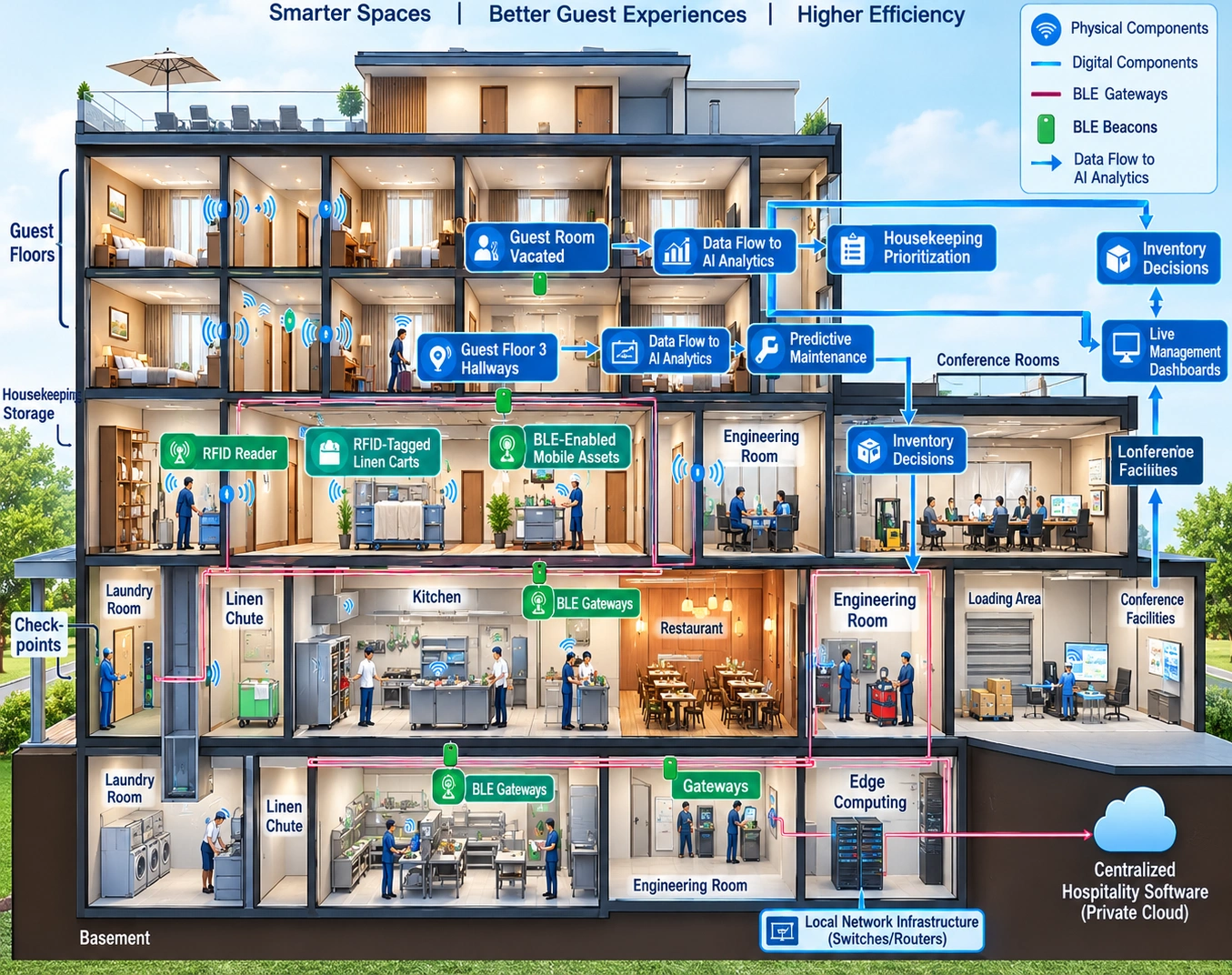
This detailed cutaway diagram illustrates a multi-story hotel with various functional areas, including guest rooms, housekeeping, kitchen, and engineering. It visualizes the integration of physical components like BLE beacons and RFID tags with digital systems, showing data flows for AI analytics, predictive maintenance, housekeeping prioritization, and inventory decisions. The diagram highlights how localized edge computing and network infrastructure connect to a centralized hospitality cloud, providing live management dashboards for hyper-efficient operations.
Cybersecurity, Privacy, and Operational Resilience
Connected hospitality systems can process information about employees, operational assets, building infrastructure, service requests, and potentially guest-related activities. Security therefore needs to be considered throughout device deployment, networking, software integration, AI processing, and data retention.
Device authentication should prevent unauthorized hardware from joining the operational network. Network segmentation can isolate RFID readers, BLE gateways, IoT devices, building systems, and administrative systems according to the organization’s security requirements.
Access control should follow least-privilege principles. Housekeeping supervisors, engineering managers, IT administrators, and executives do not necessarily require access to the same information.
Data encryption should be applied where supported and appropriate for communications and stored information. Device credentials, API keys, certificates, and administrative accounts should be managed securely and rotated according to organizational policy.
Hospitality organizations should also distinguish operational asset tracking from employee or guest monitoring. If BLE location information is associated with identifiable personnel, organizations should establish appropriate policies covering purpose limitation, access, retention, transparency, and applicable privacy requirements.
AI systems require additional controls. Training data should be governed, model outputs should be monitored, and high-impact operational decisions should include human review where inappropriate automation could affect safety, employee management, guest service, or regulatory obligations.
Operational resilience is equally important. Critical local functions should have appropriate fallback behavior if cloud connectivity, a gateway, a reader, or another component becomes unavailable. Buffered events, local processing, redundant connectivity, and controlled recovery procedures can reduce the effect of temporary failures.
Standards and Regulatory Considerations for Hospitality Deployments
Hospitality deployments should be evaluated against the regulations and technical standards applicable to the property, jurisdiction, data types, and use case. Requirements can vary substantially between the United States, Canada, and other markets.
Relevant areas can include:
- Privacy and personal-data protection requirements applicable to guest and employee information
- Payment-card security requirements for systems connected to payment environments
- Building and fire-safety requirements
- Electrical and equipment safety requirements
- Wireless and radio-frequency regulations
- Cybersecurity requirements imposed by the organization or contractual partners
- Accessibility requirements
- Food safety and traceability requirements for applicable food-service operations
- Occupational health and safety requirements
- Data retention and records-management requirements
For U.S. hospitality deployments, organizations may need to consider requirements and guidance associated with the FCC, FDA Food Code where applicable, OSHA, PCI DSS, state privacy laws, and relevant building and fire codes.
Canadian deployments may require consideration of ISED requirements, applicable provincial privacy legislation, federal privacy requirements where applicable, payment-security requirements, and provincial building, fire, and occupational-safety requirements.
The specific compliance profile should be determined during project planning rather than assumed from the technology itself. RFID and BLE hardware does not automatically make an operation compliant or non-compliant. Compliance depends on how the technology is deployed, what information is collected, how it is processed, and the operational context.
KPIs for Measuring AI and BLE Hospitality Performance
A hospitality deployment should be evaluated using measurable operational indicators rather than device counts alone.
Useful KPIs can include:
- Average room turnaround time
- Percentage of rooms ready before scheduled check-in
- Housekeeping task completion time
- Maintenance response time
- Mean time to repair
- Preventive maintenance completion rate
- Equipment downtime
- Asset utilization rate
- Linen loss rate
- Linen cycle time
- Inventory variance
- Inventory stockout frequency
- Food and beverage inventory waste
- Service-request response time
- Service-request resolution time
- Labor utilization
- Repeat maintenance rate
- RFID read accuracy
- BLE location accuracy
- Event-processing latency
- System availability
- Battery replacement interval
- False-event rate
- AI prediction accuracy
- Exception detection rate
- Percentage of AI recommendations acted upon
The correct KPI set depends on the operational objective. A linen-tracking project should not be evaluated using the same primary metrics as a predictive-maintenance deployment.
Scaling AI and BLE Across Hotels, Resorts, and Multi-Property Operations
A successful pilot should be designed for repeatable deployment without assuming that every property has the same physical configuration.
A multi-property organization may have hotels with different building layouts, network infrastructure, room counts, operating procedures, and legacy software. Standardization should therefore focus on identifiers, event models, integration interfaces, cybersecurity controls, reporting definitions, and AI governance.
Physical deployment can remain property-specific. Reader placement, BLE gateway density, tag selection, and network configuration should be engineered according to each site’s physical conditions.
Centralized analytics can compare properties using common KPIs while preserving local operational differences. This makes it possible to identify recurring maintenance problems, housekeeping bottlenecks, inventory anomalies, or asset-utilization patterns across multiple properties.
GAO’s experience supplying RFID, BLE, and IoT hardware systems can support organizations that require different device configurations across hospitality locations while maintaining consistent technology objectives.
Hotel IoT-to-Cloud Architecture: Site-Specific Edge, Shared AI Platform
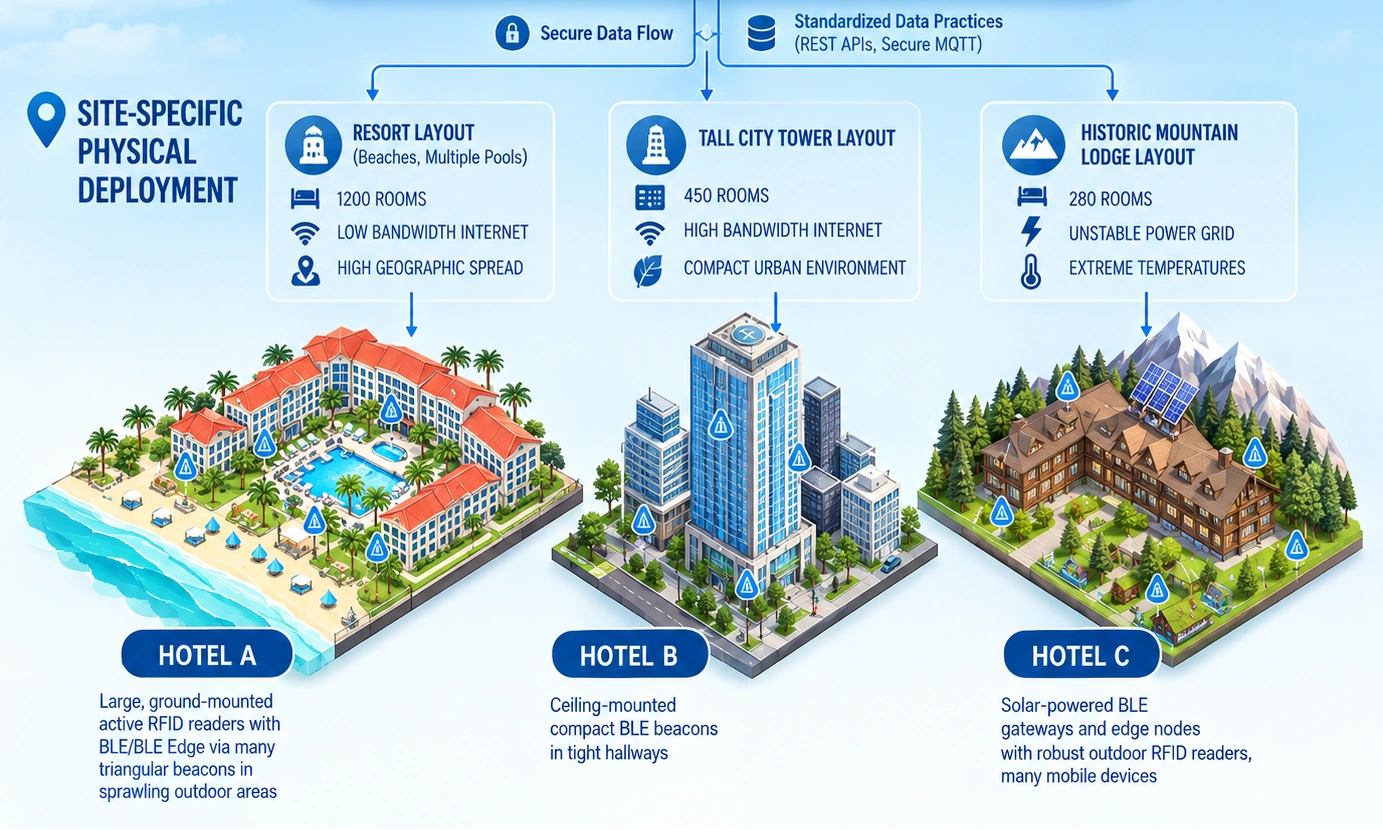
This comprehensive diagram illustrates a modern hospitality technology model that integrates site-specific physical IoT deployments at individual properties with a standardized, shared centralized software cloud. On the left, it details the custom edge computing and RFID/BLE network infrastructure required for unique environments like sprawling beach resorts, urban towers, and rugged mountain lodges. On the right, it connects all properties via secure data flows to a common software core encompassing shared data practices, unified KPI definitions, centralized AI analytics, and portfolio-wide management reporting.
Practical Implementation Roadmap for Hospitality Operations
A controlled implementation should progress from an operational problem to measurable deployment rather than beginning with hardware procurement.
- Define the business problem and target operational workflow.
- Identify the physical assets, personnel workflows, rooms, zones, and systems involved.
- Establish baseline KPIs before deployment.
- Define the required event and identifier model.
- Select RFID, BLE, sensor, gateway, and network technologies according to environmental requirements.
- Conduct a controlled site survey and proof of concept.
- Validate read performance, location behavior, connectivity, and data quality.
- Integrate device events with the appropriate hospitality software.
- Establish cybersecurity, privacy, access-control, and data-retention requirements.
- Develop and validate AI models using representative operational data.
- Introduce human-reviewed recommendations before automating selected actions.
- Measure operational performance against the baseline.
- Correct device placement, data mappings, workflows, and model behavior.
- Expand to additional departments or properties only after the initial workflow demonstrates measurable value.
The most effective implementations generally start with a clearly defined operational bottleneck. Technology selection should follow the workflow requirement rather than the other way around.
Why AI-Enabled Hospitality Operations Require an Integrated Approach
AI can provide substantial value to hospitality operations when physical-world information is accurate, timely, and connected to the systems where operational decisions are made. BLE can contribute location and proximity information, while RFID can establish reliable identification of physical assets and inventory. Sensors and existing hospitality applications add additional context.
The critical engineering challenge is connecting these data sources without creating another isolated system. Data identifiers, network connectivity, middleware, software integration, cybersecurity, AI governance, and operational workflows must be considered together.
For hospitality operators, the practical objective is straightforward: identify operational conditions earlier, make better-informed decisions, reduce avoidable delays, and allocate people and physical resources more effectively.
GAO provides RFID, BLE, and IoT hardware products and systems that can serve as components of these hospitality solutions, with deployment choices adapted to the operational and physical requirements of each application.
Building the Future of Industrial AI and IoT with Aperture Venture Studio and GAO RFID Inc.
For more than three decades, GAO Group of Companies has invested heavily in R&D for industrial RFID, BLE, and IoT technologies. As AI has become increasingly useful in operational applications, we have continued developing AI and IoT technologies that connect physical assets, operational data, and intelligent decision-making.
We have founded Aperture Venture Studio to support the development of AI and IoT solutions addressing practical industry requirements, including hospitality operations where asset visibility, operational intelligence, automation, and service efficiency are increasingly important.
Aperture brings together technical experts, operational leaders, investors, and industry participants around advanced AI and IoT applications. We also support technical discussion through initiatives such as the Aperture Ventures Summit and TekSummit.
GAO welcomes organizations interested in working with us as customers, advisors, employees, co-founders, or investors to explore practical AI and IoT opportunities.