
AI and RFID for Home Healthcare
AI-Driven Home Healthcare Management with RFID
Artificial intelligence is helping home healthcare providers coordinate caregivers, medical equipment, supplies, medication-related workflows, and patient-care activities across distributed residential environments. RFID provides machine-readable identification and location or event data that AI software can use to improve asset visibility, inventory control, workflow compliance, and operational decision-making. In home healthcare, UHF RFID, HF RFID, and LF RFID can be selected according to read range, environment, tag size, and identification requirements. AI can then correlate RFID events with electronic health records, electronic medication administration records, scheduling systems, mobile applications, and other care-management software. This combination supports more informed decisions about equipment availability, replenishment, caregiver workflows, and exception management. GAO supplies RFID hardware products and systems that can support organizations implementing connected workflows across home healthcare operations.
AI-Powered RFID Ecosystem for Intelligent Home Healthcare Operations
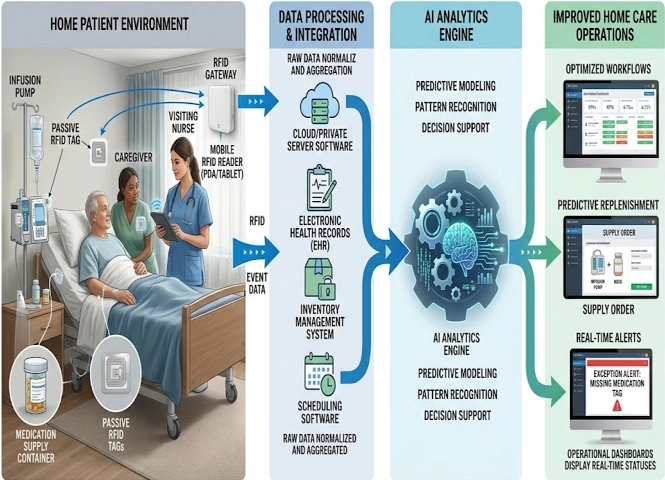
This professional infographic illustrates a comprehensive ecosystem where AI uses RFID data to streamline home healthcare operations. From the home environment where assets are tagged, data flows through readers and systems into an AI analytics engine. This intelligence drives tangible operational improvements, such as optimized caregiver scheduling, automatic supply replenishment, and missing medication alerts, improving both efficiency and patient safety.
What AI and RFID Mean for Home Healthcare
Home healthcare differs from hospital-based care because clinical services, equipment, supplies, and caregivers move between centralized offices and individual residences. Medical equipment may remain in patient homes for days or weeks, while other assets circulate among nurses, therapists, durable medical equipment teams, warehouses, vehicles, and administrative locations. This distributed operating model makes conventional spreadsheets, manual barcode scans, and periodic inventory checks difficult to maintain accurately.
AI can convert operational data into predictions, classifications, recommendations, and exception alerts. RFID supplies one important source of that data by identifying tagged objects without requiring every item to be individually scanned. The resulting AI-enabled system can support home healthcare asset tracking, medical supply inventory management, equipment utilization analysis, caregiver workflow optimization, and operational risk detection.
The practical objective is not to make RFID itself intelligent. Rather, RFID acts as an identification and event-capture mechanism, while AI analyzes RFID events together with other home healthcare data sources.
Why AI Matters to Distributed Home Healthcare Operations
AI becomes particularly useful when home healthcare organizations manage large numbers of geographically distributed patients, caregivers, devices, supplies, and service visits.
Relevant applications include:
- AI asset tracking for wheelchairs, infusion equipment, oxygen-related equipment, patient monitoring devices, therapy equipment, and other reusable medical assets
- AI inventory management for wound-care supplies, disposable medical products, PPE, catheter supplies, diagnostic consumables, and caregiver kits
- Predictive demand forecasting based on patient census, care plans, historical consumption, geographic demand, and seasonal patterns
- Caregiver route and workload analysis using scheduling, location, visit duration, and operational event data
- Exception detection for equipment that remains assigned to a residence longer than expected
- Supply replenishment recommendations based on consumption patterns and planned visits
- Equipment utilization analysis to identify underused, unavailable, or excessively allocated equipment
- Workflow monitoring that identifies missing handoffs or unusual delays between equipment dispatch, delivery, deployment, return, cleaning, and redeployment
- Operational forecasting that helps home healthcare organizations anticipate equipment and supply requirements
These applications become more valuable when RFID events are linked with other data sources instead of being analyzed in isolation.
Home Healthcare Use Cases for AI-Enabled RFID
Medical Equipment Tracking Across Patient Homes
Reusable medical equipment represents a significant operational challenge because assets can move between warehouses, vehicles, caregiver teams, patient residences, service centers, and other locations.
RFID tags can provide a persistent identity for each equipment item. AI software can combine those identification events with assignment records, service schedules, equipment status, and utilization history.
A home healthcare organization can use this information to identify:
- Which equipment is currently assigned to a patient
- Which equipment is available for another care episode
- Which assets have not returned after an expected service period
- Which equipment requires inspection or preventive maintenance
- Which geographic areas have shortages or excess inventory
- Which assets have unusually low utilization
- Which equipment movements do not match expected workflows
This is particularly useful for equipment pools containing durable medical equipment, mobility aids, therapy equipment, monitoring devices, and other reusable resources.
Home Healthcare Supply and Inventory Management
Supply availability directly affects caregiver productivity and the ability to complete scheduled visits. Manual inventory counts at central stores or caregiver locations may provide only periodic visibility.
RFID-enabled inventory processes can capture item identity and movement events at warehouses, supply rooms, distribution points, vehicles, or designated care locations. AI can then analyze consumption trends and planned patient services to estimate future requirements.
For example, an AI model can correlate scheduled wound-care visits with historical consumption of dressings and related supplies. The resulting forecast can help determine whether a caregiver kit should be replenished before a series of visits.
GAO can support these workflows by supplying RFID readers, tags, antennas, and related hardware that organizations integrate with their own inventory and care-management software.
Medication-Related Workflow Support
Medication management remains primarily a clinical and regulatory responsibility, so RFID should be positioned as an identification and workflow-support mechanism rather than a replacement for clinical judgment.
HF RFID can be useful for short-range identification workflows where controlled reading distance is desirable, while other RFID configurations may be appropriate for tracking packaged supplies or medication-related inventory at distribution and storage points.
AI can analyze authorized operational data to identify discrepancies such as:
- Unexpected inventory changes
- Missing medication-related items
- Unusual consumption patterns
- Supply shortages
- Workflow events that differ from expected procedures
Clinical decisions should remain subject to applicable professional procedures, organizational policies, and healthcare regulations.
Caregiver Kit and Mobile Equipment Management
Home healthcare organizations often issue nurses, therapists, aides, and other personnel with equipment or standardized care kits. Items may be transferred between staff members, vehicles, storage locations, and patient homes.
RFID can establish machine-readable identities for kit contents and reusable equipment. AI can compare expected kit configurations with actual inventory events and highlight exceptions.
This can reduce time spent manually searching for equipment and help operations teams determine whether missing items are actually lost, temporarily assigned, awaiting return, or incorrectly recorded.
AI-Based Exception Detection for Home Visits
Home healthcare workflows contain numerous expected events: a caregiver is scheduled, supplies are prepared, equipment is assigned, the caregiver travels to the residence, care is delivered, equipment may remain at the residence, and subsequent visits occur.
AI can establish expected operational patterns from historical data and identify deviations. RFID events can provide objective evidence of equipment or inventory movements that would otherwise depend on manual records.
Potential exceptions include:
- Equipment dispatched without a corresponding care assignment
- Equipment remaining assigned beyond its expected service period
- Reusable assets appearing in unexpected locations
- Missing kit components before scheduled visits
- Inventory consumption that differs significantly from historical patterns
- Repeated delays in equipment return
- Unusual movement sequences between storage and patient-care locations
Such alerts should support operational investigation rather than automatically assigning blame to caregivers or making clinical determinations.
From RFID Events to AI-Driven Home Healthcare Decisions
A practical AI-enabled home healthcare system typically begins with physical objects and operational activities and progressively converts them into structured data.
Data Acquisition at the Care and Supply Level
RFID tags provide unique identifiers for selected equipment, containers, supplies, kits, or other trackable objects. The appropriate tag type depends on the object and operating environment.
UHF RFID is generally useful where longer-range identification and faster reading of multiple tagged items are required. HF RFID is better suited to shorter-range, controlled identification interactions. LF RFID can be appropriate for certain proximity-based identification applications where its characteristics fit the equipment and environment.
RFID should not automatically be applied to every object. Tag selection must consider:
- Equipment material and construction
- Presence of liquids or metal
- Required read distance
- Tag mounting position
- Required identification speed
- Reader placement
- Privacy considerations
- Cleaning and disinfection procedures
- Expected temperature, moisture, and handling conditions
- Whether item-level or container-level identification is required
RFID Readers, Mobile Devices, and Gateways
Fixed RFID readers can monitor controlled transition points such as supply rooms, equipment dispatch areas, or warehouse exits. Mobile readers can support caregiver or field-service workflows where equipment is identified during preparation, delivery, return, or inventory verification.
Reader events normally contain information such as tag identity, reader identity, antenna or read point, timestamp, and signal-related information. Middleware can transform these low-level observations into meaningful operational events.
Edge Processing and Data Normalization
Raw RFID reads can contain duplicates, intermittent detections, and transient observations. Sending every raw event directly into an AI model can create unnecessary data volume and reduce analytical quality.
Edge or local processing can therefore perform functions such as:
- Duplicate-read filtering
- Read-event aggregation
- Reader health monitoring
- Timestamp normalization
- Location or zone association
- Tag-to-asset identity resolution
- Basic rule evaluation
- Temporary data buffering during network interruptions
The processed events can then be transmitted to centralized software for historical analysis and AI processing.
AI Analytics and Operational Decision-Making
AI software can combine RFID events with home healthcare scheduling, patient-care plans where appropriately authorized, equipment records, inventory transactions, maintenance records, geographic information, and workforce data.
Machine learning methods can include:
- Time-series forecasting for supply and equipment demand
- Classification models for operational exception categories
- Anomaly detection for unusual equipment movement or consumption
- Predictive models for equipment return or utilization patterns
- Optimization algorithms for inventory allocation and caregiver logistics
- Natural-language processing for authorized operational notes and service records
- Computer vision where visual inspection or object recognition is appropriate and privacy controls permit it
The final output should normally be an operational recommendation, alert, forecast, or prioritized work item that a responsible employee can review and act upon.
Technology and Deployment Design for AI-Enabled Home Healthcare
An effective home healthcare solution requires more than RFID readers and tags. The implementation normally combines identification hardware, communication infrastructure, middleware, databases, AI software, integration interfaces, security controls, and operational applications. The correct configuration depends on whether the organization needs centralized visibility, local processing, mobile workflows, or a combination of these capabilities.
Selecting UHF, HF, and LF RFID for Home Healthcare
UHF RFID is often appropriate for home healthcare equipment and inventory applications where longer read distances and multi-tag identification provide operational value. Examples include equipment dispatch, supply inventory, caregiver kit verification, and controlled warehouse or distribution areas.
HF RFID operates at shorter range and can be useful for deliberate identification interactions. Its controlled read zone can be advantageous where an item should be identified only when intentionally presented to a reader.
LF RFID is primarily relevant to proximity-based identification scenarios where longer reading distances are unnecessary and its specific operating characteristics fit the application.
RFID frequency should therefore be selected from the workflow backward, rather than selecting hardware first and attempting to redesign the workflow around it.
RFID Hardware for Distributed Care Operations
A deployment can combine several hardware categories:
- Fixed RFID readers at central inventory, dispatch, receiving, or controlled transition points
- Handheld RFID readers for mobile equipment and supply verification
- RFID antennas selected according to required coverage and physical installation conditions
- UHF, HF, or LF tags matched to equipment surfaces and operating environments
- RFID printers and encoders for organizations producing their own labeled assets
- Edge gateways or industrial computing devices where local processing is required
- Barcode or QR code readers where RFID is not technically or economically appropriate
- Mobile computing devices for caregivers and field personnel
- Network infrastructure supporting secure communication between field locations and central software
GAO’s RFID hardware products can be incorporated into such solutions according to application requirements, reader placement, tag characteristics, and integration needs.
Middleware, Databases, and Integration Software
RFID middleware provides an important separation between physical reader events and business applications. It can normalize data from multiple reader types, remove redundant reads, associate tags with asset records, and publish standardized events to downstream software.
Integration may connect RFID data with:
- Home healthcare management software
- Electronic health record systems
- Electronic medication administration systems where applicable
- Inventory management software
- Durable medical equipment management systems
- Computerized maintenance management systems
- Workforce scheduling software
- Warehouse management systems
- Transportation and route-management software
- Procurement systems
- Business intelligence and reporting software
APIs, message queues, database interfaces, and healthcare interoperability mechanisms can be selected according to the systems already used by the organization.
Cloud Version and Server Version for Home Healthcare
A Cloud Version can centralize RFID event processing, AI analytics, dashboards, software updates, and data management across geographically distributed home healthcare operations. This approach can be appropriate when multiple branches need shared visibility and the organization wants centralized software management.
A Server Version can run on customer-managed servers, private data centers, branch infrastructure, or other privately hosted computing environments. This model may be preferred when an organization requires greater control over data location, network connectivity, integration boundaries, or internal IT operations.
A hybrid arrangement can also be practical. For example, an RFID gateway may perform local event filtering and temporary buffering while centralized AI services perform forecasting and cross-branch analysis.
The deployment decision should consider network reliability, cybersecurity requirements, integration dependencies, data governance, operational support capabilities, latency requirements, and the organization’s existing healthcare IT environment.
Technical Capabilities and Operational Improvements in Home Healthcare
Combining AI with RFID-generated operational data can improve home healthcare visibility without requiring caregivers to manually record every movement of an asset or supply. The greatest value comes from connecting physical inventory and equipment events with scheduling, maintenance, utilization, and demand data.
More Accurate Medical Equipment Visibility
RFID can provide automated identification at defined operational checkpoints, while AI can interpret the resulting history over time. This allows home healthcare operations teams to distinguish between equipment that is genuinely unavailable and equipment that is simply assigned to a patient or caregiver.
Potential improvements include:
- Faster identification of available durable medical equipment
- Reduced time spent searching for misplaced equipment
- Better visibility into equipment assigned to individual care programs
- More accurate equipment utilization records
- Earlier identification of overdue returns
- Better allocation of equipment among geographically distributed branches
- Improved planning for equipment inspection, maintenance, and redeployment
The system should treat RFID observations as operational evidence rather than assuming that every read represents a permanent physical location. Reader placement, read-zone design, tag orientation, and environmental conditions all influence location accuracy.
Predictive Home Healthcare Inventory Management
AI can analyze historical consumption together with scheduled visits, patient service categories, geographic demand, seasonality, and inventory transactions. RFID adds more frequent and automated observations of physical inventory.
This combination can support:
- Supply demand forecasting
- Automated replenishment recommendations
- Identification of unusually high consumption
- Branch-level inventory balancing
- Caregiver kit preparation
- Reduction of emergency supply requests
- Identification of slow-moving inventory
- More efficient allocation of limited medical equipment
Forecasting accuracy depends heavily on data quality. Organizations should establish consistent item master records, unit-of-measure definitions, tag-to-item relationships, and transaction rules before expecting AI models to produce reliable recommendations.
Improved Caregiver Workflow Management
Home healthcare caregivers spend time traveling, preparing equipment, retrieving supplies, documenting services, and coordinating with centralized operations teams. AI can analyze these workflows to identify recurring operational bottlenecks.
RFID can provide supporting evidence for equipment preparation, kit verification, dispatch, return, and inventory processes.
For example, if a caregiver is scheduled for a sequence of visits requiring specific equipment, the system can check whether the necessary assets have been prepared and whether they are available before dispatch. An exception can be generated when an expected item is missing.
The goal is not to automate clinical decisions. The goal is to reduce administrative friction surrounding clinical work.
Security, Privacy, and Reliability for Home Healthcare RFID Systems
Home healthcare introduces special security considerations because operational data may intersect with protected health information, employee information, residential locations, equipment assignments, and care schedules.
Identity and Access Management
Access to RFID and AI-generated information should follow least-privilege principles. A warehouse employee may need access to equipment inventory but not clinical information, while a care coordinator may require access to scheduling and assignment information.
Recommended controls include:
- Role-based access control
- Strong authentication
- Privileged-account management
- Centralized identity management where appropriate
- Session timeout and device controls
- Audit logging
- Separation of administrative and operational privileges
RFID tag identifiers should not unnecessarily encode sensitive patient information. A pseudonymous asset identifier linked to a protected database record is generally more appropriate than placing sensitive information directly on a tag.
Data Protection and Network Security
RFID readers, mobile devices, gateways, servers, APIs, and cloud services should be treated as components of the organization’s overall security boundary.
Technical controls may include:
- Encryption in transit
- Encryption at rest
- Network segmentation
- Secure API authentication
- Device certificates where appropriate
- Firewall controls
- Endpoint protection
- Centralized logging
- Security monitoring
- Backup and recovery procedures
- Firmware and software patch management
Healthcare organizations should also evaluate applicable federal, state, provincial, and local requirements according to where they operate and what information their system processes.
RFID Reliability and False Events
RFID implementations can generate technically valid reads that are operationally misleading. A tag may be detected near a doorway without actually leaving a building. Metal surfaces can affect UHF RFID performance, while liquids can influence RF behavior. Multiple readers can also detect the same tag.
Engineering teams should therefore establish event-confidence rules.
For example, an equipment departure event could require a combination of:
- Detection by a designated reader
- Detection within a defined time window
- Expected asset status
- Directional or zone information
- Matching dispatch transaction
- Appropriate workflow state
AI can improve anomaly detection, but it should not be used to compensate for poorly engineered RFID coverage.
Implementation Lifecycle for AI and RFID in Home Healthcare
Successful deployment normally requires progressive engineering rather than immediate organization-wide installation.
Operational Assessment and Use-Case Definition
The first step is identifying where missing visibility creates measurable operational problems.
Useful assessment questions include:
- Which medical equipment is difficult to locate?
- Which supplies experience frequent shortages?
- Where do equipment handoffs fail?
- Which inventory transactions remain manual?
- Which equipment has uncertain utilization?
- Where are returns delayed?
- Which caregiver workflows consume disproportionate administrative time?
- Which existing software systems must receive RFID events?
- Which locations require fixed readers and which require mobile identification?
A pilot should focus on a clearly measurable operational problem rather than attempting to RFID-enable every asset.
Tag and Reader Engineering
Tag selection should be validated against actual equipment rather than manufacturer specifications alone.
Testing should evaluate:
- Read range
- Orientation sensitivity
- Metal and liquid interaction
- Tag attachment method
- Cleaning and disinfection exposure
- Mechanical durability
- Reader antenna positioning
- Simultaneous tag reading
- False-read behavior
- Interference from nearby equipment
- Mobile-reader ergonomics
A tag that performs well on cardboard inventory may perform poorly when attached to a metal medical device.
System Integration and Commissioning
After hardware selection, RFID middleware and business software should be integrated with the organization’s existing workflows.
Commissioning should verify:
- Every reader has a unique identity
- Every tag is associated with the correct asset record
- Reader events contain accurate timestamps
- Duplicate events are handled correctly
- Asset status transitions occur only under valid conditions
- Offline operation is handled appropriately
- Network interruptions do not silently lose critical events
- APIs reject malformed or unauthorized data
- User permissions correspond to job responsibilities
- AI models receive validated data
Operational users should participate in acceptance testing because a technically correct RFID event can still be unsuitable for a real caregiver workflow.
AI Model Validation
AI models should be evaluated against known operational outcomes before being used for automated recommendations.
Useful measurements include:
- Forecast error
- False-positive rate
- False-negative rate
- Alert precision
- Alert response time
- Equipment utilization prediction accuracy
- Inventory forecast accuracy
- Recommendation acceptance rate
- Human override frequency
AI recommendations should initially operate with human review. Organizations can increase automation only after demonstrating consistent performance and establishing appropriate controls.
Scaling Across Home Healthcare Branches
Once a pilot demonstrates measurable value, deployment can expand by location, asset class, or workflow.
A controlled expansion should standardize:
- RFID tag naming and asset identification
- Reader configuration
- Middleware event formats
- Integration interfaces
- User roles
- Security policies
- Data retention
- AI model monitoring
- Equipment maintenance
- Technical support procedures
Standardization makes it easier to compare operational KPIs across branches without forcing every location into an identical physical deployment.
KPIs for AI-Enabled Home Healthcare Operations
The success of an AI and RFID implementation should be measured through operational outcomes rather than the number of readers installed or tags applied.
Equipment Management KPIs
Relevant measurements can include:
- Equipment location accuracy
- Equipment utilization rate
- Average equipment search time
- Equipment turnaround time
- Overdue equipment return rate
- Equipment loss rate
- Maintenance compliance
- Average time from return to redeployment
Inventory and Supply KPIs
Home healthcare supply operations can monitor:
- Inventory accuracy
- Stockout frequency
- Emergency replenishment frequency
- Inventory turnover
- Forecast accuracy
- Order fulfillment rate
- Expired or obsolete inventory
- Caregiver kit completeness
- Average replenishment cycle time
Workforce and Workflow KPIs
Operational teams can evaluate:
- Caregiver preparation time
- Equipment retrieval time
- Visit-related supply exceptions
- Administrative documentation time
- Route-related delays
- Unplanned equipment requests
- Workflow exception resolution time
- Percentage of automated versus manual inventory transactions
AI should improve measurable operational performance rather than simply increase the volume of data collected.
Standards and Regulatory Considerations for Home Healthcare
Home healthcare deployments should be reviewed against the requirements applicable to the organization’s jurisdiction, services, data, and equipment.
Potentially relevant frameworks and regulations include:
- HIPAA Privacy Rule and Security Rule for applicable U.S. covered entities and business associates
- HITECH Act requirements relevant to electronic protected health information
- FDA requirements where RFID-enabled equipment forms part of regulated medical-device workflows
- U.S. Food and Drug Administration medical device cybersecurity requirements where applicable
- Federal Communications Commission requirements applicable to radio-frequency equipment
- NIST Cybersecurity Framework for cybersecurity risk management
- NIST guidance relevant to identity, access, encryption, and information security
- ISO/IEC 27001 for information security management where adopted by the organization
- ISO/IEC 27701 for privacy information management where applicable
- ISO 13485 where an organization is involved in applicable medical-device quality systems
- State privacy and healthcare-data requirements
- Canadian PIPEDA requirements where applicable to personal information under federal jurisdiction
- Provincial privacy and healthcare information legislation where applicable
- Applicable electronic health information interoperability requirements
- Organizational policies governing patient privacy, device management, clinical documentation, and data retention
RFID itself does not make a system compliant. Compliance depends on the complete combination of technology, software configuration, organizational procedures, access controls, data handling, contracts, and governance.
GAO Expertise in RFID-Based Home Healthcare Systems
GAO RFID products and systems can support home healthcare organizations that need dependable identification, inventory, equipment tracking, and connected operational workflows. Our work across RFID and IoT applications includes supplying hardware products and systems to organizations that integrate physical identification with software-based business processes.
Headquartered in New York City and Toronto, Canada, GAO is ranked among the top 10 leading B2B and B2G, with a lesser degree of B2B2C and B2D, BLE and RFID suppliers globally. GAO’s product and engineering capabilities cover RFID, BLE, and related IoT technologies that can be evaluated according to the requirements of specific home healthcare workflows.
GAO, together with GAO Research Inc. and GAO Tek Inc., forms GAO Group, with operations based in New York City and Toronto. For three decades, GAO Group has served U.S. and Canadian customers, including Fortune 500 companies, leading R&D organizations, prestigious universities, and government agencies.
The group’s substantial investment in research and development is complemented by stringent quality assurance processes and expert technical support that can be provided remotely or onsite. For home healthcare organizations, this experience can be relevant when selecting RFID hardware, evaluating tags and readers, integrating systems, and troubleshooting deployment-specific conditions.
Practical Recommendations for Home Healthcare AI and RFID Deployment
A technically sound deployment should begin with the operational workflow rather than the RFID hardware.
- Select a measurable home healthcare problem such as equipment loss, inventory inaccuracy, caregiver kit shortages, or delayed equipment returns.
- Establish a reliable asset master containing unique identifiers, equipment categories, ownership, status, maintenance information, and applicable assignment records.
- Test RFID tags against the actual materials and surfaces of medical equipment and supplies.
- Use UHF RFID where longer-range and multi-item identification provide clear operational value.
- Use HF or LF RFID where controlled proximity identification is more appropriate.
- Design reader locations around physical workflows rather than simply maximizing RF coverage.
- Validate read accuracy under normal operating conditions, including equipment movement, cleaning, storage, and caregiver handling.
- Filter and normalize RFID events before feeding them into AI models.
- Integrate RFID data with inventory, equipment, scheduling, maintenance, and other authorized operational systems.
- Protect patient-related and workforce information through appropriate identity, access, encryption, logging, and data-governance controls.
- Begin AI recommendations with human review and measure model performance before introducing higher levels of automation.
- Establish clear KPIs before deployment so operational improvements can be compared against the baseline.
- Expand successful pilots gradually and standardize configurations, integrations, security controls, and support procedures.
- Select cloud-hosted or privately hosted server deployment according to data governance, connectivity, integration, latency, and IT-management requirements.
- Maintain RFID readers, tags, gateways, software, AI models, and integrations as an ongoing operational system rather than treating deployment as a one-time project.
RFID-Enabled AI Architecture for Intelligent Home Healthcare Operations
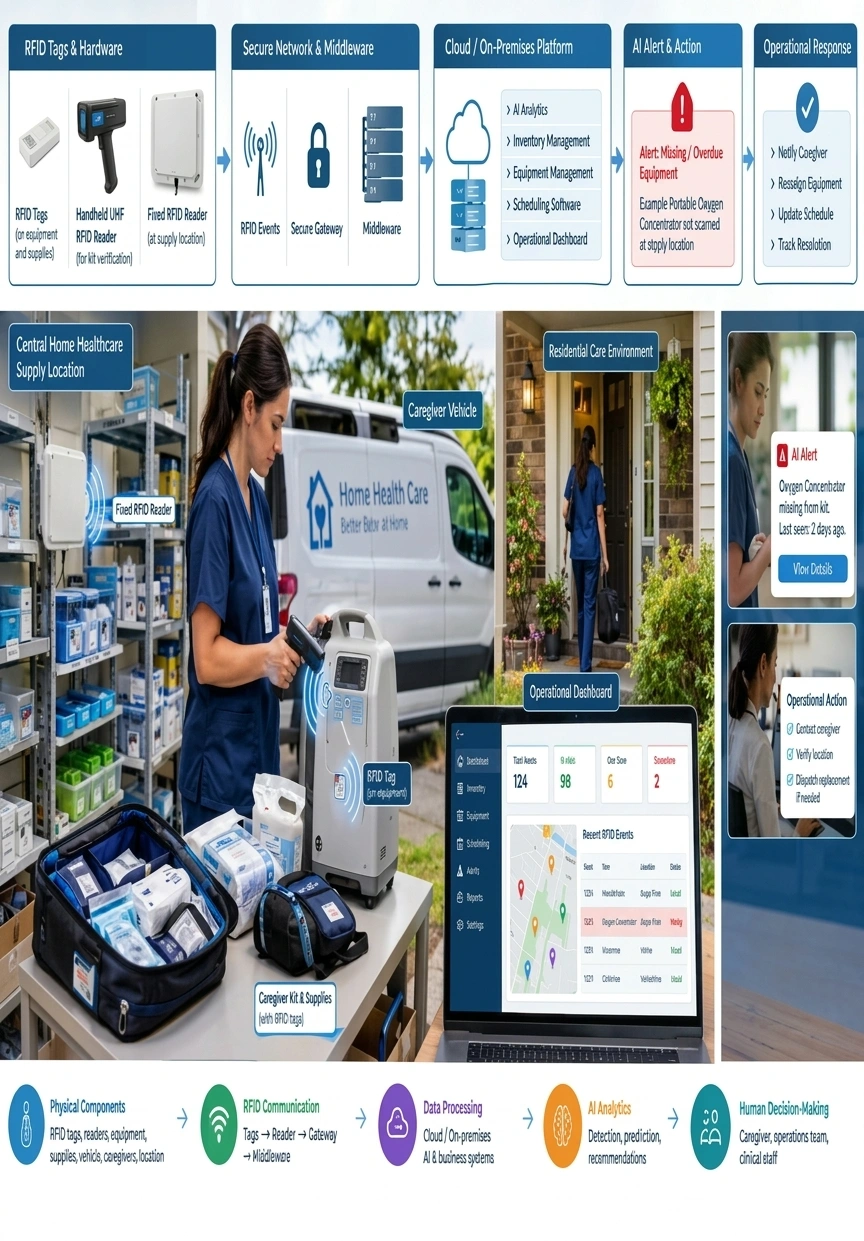
A realistic enterprise visualization of RFID-enabled home healthcare operations, showing caregivers, tagged medical equipment, handheld and fixed RFID readers, a supply location, and a caregiver vehicle. The visual connects RFID events through secure middleware to cloud or on-premises platforms, AI analytics, inventory and equipment management, scheduling, alerts, and operational decision-making.
Applying AI to Measurable Home Healthcare Problems
AI-enabled home healthcare systems can turn equipment, supply, scheduling, and workflow data into actionable operational intelligence. RFID provides a practical identification layer for selected physical assets, while AI can forecast demand, detect exceptions, analyze utilization, and prioritize operational actions. Successful implementations depend on accurate asset records, carefully engineered RFID read zones, secure integrations, validated AI models, and measurable KPIs.
GAO can help organizations evaluate RFID hardware and connected systems according to the physical and operational requirements of home healthcare. Readers, system integrators, IT teams, supply chain managers, and healthcare decision-makers can explore GAO’s RFID and IoT technologies and technical support when developing or expanding these applications.
Building the Future of Industrial AI and IoT with Aperture Venture Studio and GAO RFID Inc.
For more than three decades, GAO Group of Companies has invested heavily in R&D for industrial RFID, BLE, and IoT. As AI became increasingly useful for connected operations, we developed AI and IoT technologies and founded Aperture Venture Studio to advance practical AI and IoT solutions, including technologies relevant to home healthcare operations.
Aperture brings together AI and IoT experts, executives, investors, and leading companies while supporting technical communities through the Aperture Ventures Summit and TekSummit. We welcome qualified professionals and organizations to engage with us as advisors, employees, investors, or customers.