
AI and RFID for Bridge Construction
AI-Powered Bridge Construction Using RFID for Intelligent Project Delivery
Bridge construction projects involve thousands of structural components, specialized construction equipment, temporary works, inspection activities, material deliveries, and highly coordinated field operations occurring simultaneously across large and often geographically constrained construction sites. Delays caused by misplaced bridge girders, missing reinforcement cages, equipment downtime, inaccurate material inventories, or poor communication between construction teams can significantly increase project costs while affecting schedules, quality, and safety. Artificial intelligence combined with RFID-enabled asset identification transforms bridge construction by providing continuous visibility into materials, equipment, workforce activities, and construction progress, enabling project teams to make faster and more informed operational decisions.
Unlike conventional tracking methods that rely heavily on manual inspections, paperwork, barcode scanning, or periodic reporting, AI-driven bridge construction solutions continuously analyze RFID-generated operational data to identify scheduling conflicts, predict equipment shortages, optimize material logistics, improve quality assurance, and reduce project risks. RFID serves as the trusted data acquisition layer, while AI converts operational data into actionable recommendations for project managers, site engineers, quality inspectors, and construction executives. This combination supports digital construction management by improving traceability across every phase of bridge construction, from fabrication and transportation to erection, inspection, commissioning, and long-term maintenance.
For more than three decades, GAO has supplied RFID, BLE, and Industrial IoT hardware products and systems to organizations throughout North America, helping engineering firms, government agencies, research organizations, and infrastructure operators deploy reliable identification and sensing technologies for demanding operational environments.
AI and RFID Workflow for Bridge Girder Fabrication, Logistics, Installation, and Construction Analytics
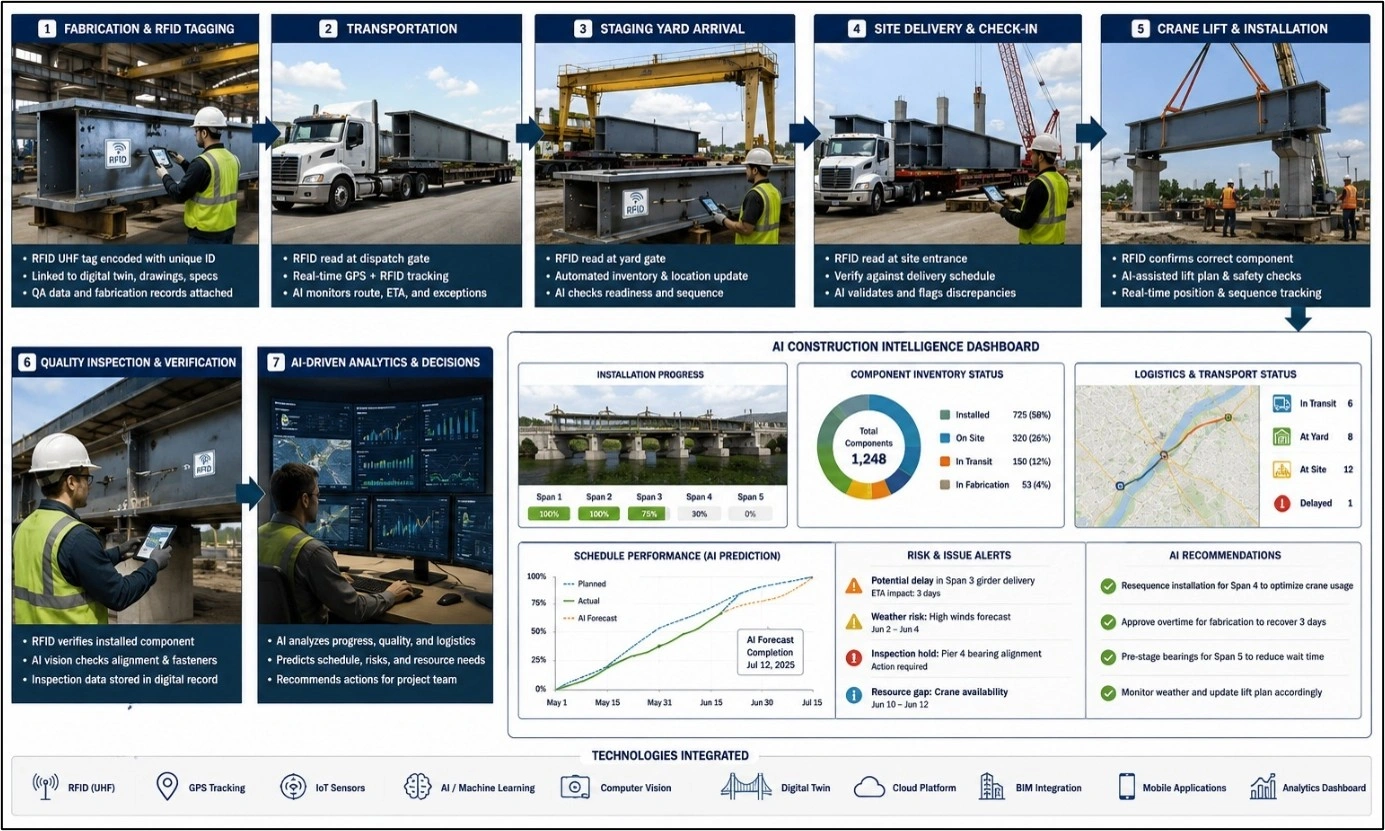
This workflow diagram illustrates the complete lifecycle of an RFID-tagged steel bridge girder within a bridge construction project. It shows the sequence from fabrication and RFID tagging through transportation, staging yard processing, crane installation, quality inspection, and AI-driven analytics that provide real-time progress monitoring, logistics visibility, installation verification, and schedule forecasting for bridge construction managers.
Understanding AI-Driven Bridge Construction with RFID
Bridge construction increasingly depends on digital technologies capable of coordinating large volumes of engineering information across multiple contractors, fabrication facilities, suppliers, transportation providers, inspection agencies, and construction teams. AI-powered bridge construction integrates machine learning, Industrial AI, and AIoT technologies with RFID identification systems to create a continuously updated representation of physical construction activities.
Rather than functioning as an isolated identification technology, RFID supplies trusted real-time information about the location, movement, identity, condition, and status of construction resources. AI consumes these datasets to automate operational analysis that traditionally required manual supervision.
Typical bridge construction assets monitored include:
- Structural steel girders
- Prestressed concrete beams
- Reinforcement cages
- Bearing assemblies
- Stay cables
- Expansion joints
- Formwork systems
- Falsework components
- Temporary supports
- Heavy lifting equipment
- Mobile cranes
- Tower cranes
- Launching gantries
- Segment lifters
- Concrete batching equipment
- Welding machines
- Survey instruments
- Safety equipment
- Inspection tools
- Prefabricated bridge segments
Instead of manually verifying inventory across multiple staging yards and fabrication facilities, AI continuously evaluates RFID observations to determine whether construction activities are progressing according to schedule while identifying bottlenecks before they affect downstream operations.
Bridge construction particularly benefits because projects typically involve:
- Long project durations
- Distributed work zones
- Multiple subcontractors
- Complex logistics
- Strict engineering tolerances
- Regulatory inspections
- Continuous quality verification
- High-value structural components
- Critical-path scheduling
- Significant safety requirements
These operational characteristics generate enormous quantities of construction data that AI can analyze far more rapidly than traditional reporting processes.
Why Artificial Intelligence Is Reshaping Bridge Construction
Modern bridge projects generate information from numerous sources including RFID readers, drones, laser scanners, GNSS survey systems, structural health sensors, BIM software, scheduling applications, quality management systems, procurement software, and construction documentation. Without AI, much of this information remains fragmented across independent software systems.
AI enables bridge construction organizations to convert disconnected operational datasets into coordinated decision support.
Examples include:
- Predicting material shortages before erection activities begin
- Forecasting crane utilization based on historical lifting operations
- Identifying delayed prefabricated segment deliveries
- Detecting abnormal equipment movement patterns
- Optimizing storage yard layouts
- Prioritizing bridge inspections
- Predicting concrete curing timelines
- Monitoring workforce access compliance
- Improving fabrication scheduling
- Detecting supply chain disruptions
Instead of reacting after delays occur, AI identifies patterns that indicate future operational risks, allowing project teams to implement corrective actions earlier.
For bridge owners, transportation authorities, engineering contractors, and EPC firms, these predictive capabilities reduce cost overruns while improving schedule certainty and construction quality.
AI Asset Tracking Applications Throughout Bridge Construction
Bridge construction uses numerous parallel workflows where accurate identification of materials and equipment directly affects productivity. RFID-supported AI solutions improve operational visibility throughout these workflows.
Structural Component Tracking
Every bridge component progresses through fabrication, inspection, transportation, staging, installation, and final acceptance.
RFID tags attached to steel members, precast concrete segments, reinforcement cages, bearings, and cable assemblies establish digital identities for each component.
AI correlates fabrication records, inspection reports, transportation schedules, and installation progress to identify:
- Missing components
- Incorrect installation sequences
- Delivery delays
- Fabrication bottlenecks
- Inventory imbalances
- Material shortages
Heavy Equipment Visibility
Bridge construction relies on expensive equipment that frequently moves between work zones.
Examples include:
- Crawler cranes
- Mobile cranes
- Hydraulic excavators
- Concrete pumps
- Pile driving rigs
- Drilling equipment
- Bridge inspection units
- Lifting frames
- Launching systems
- Mobile generators
RFID-enabled equipment identification combined with AI improves:
- Fleet utilization
- Preventive maintenance scheduling
- Equipment allocation
- Fuel consumption analysis
- Downtime prediction
- Operator assignment
- Equipment availability forecasting
Rather than searching manually for equipment distributed across multiple bridge approaches or staging areas, supervisors receive real-time equipment availability supported by AI-generated operational recommendations.
AI-Enabled Bridge Construction Deployment Scenarios
Every bridge project presents a unique combination of structural design, environmental conditions, logistics constraints, and regulatory requirements. Consequently, AI-supported RFID solutions should be designed around specific construction workflows rather than deployed as isolated identification systems. Successful implementations integrate material traceability, equipment visibility, workforce accountability, quality assurance, and project controls into a unified operational solution that continuously provides decision-makers with timely, data-driven insights.
Highway Bridge Construction
Highway bridge projects often involve multiple spans, staged traffic management, accelerated bridge construction (ABC), and strict completion deadlines. RFID enables continuous identification of fabricated girders, reinforcement assemblies, precast deck panels, bearings, and expansion joints from manufacturing through installation.
AI analyzes these data streams to:
- Predict delivery delays affecting the critical path.
- Recommend optimal staging yard layouts.
- Prioritize crane scheduling.
- Forecast material shortages.
- Detect installation sequence deviations.
- Improve traffic phase planning.
- Identify schedule risks before they impact milestones.
Railway Bridge Construction
Railway bridge construction frequently operates within limited possession windows where every hour of construction must be carefully coordinated to minimize service disruption.
RFID allows engineers to verify that all structural components, lifting equipment, welding systems, and maintenance tools are available before possession begins.
AI assists by:
- Optimizing possession schedules.
- Predicting installation durations.
- Coordinating multiple construction crews.
- Detecting resource conflicts.
- Improving lifting operation sequencing.
- Supporting rapid project recovery after unexpected delays.
Cable-Stayed and Suspension Bridges
Large-span bridges introduce highly specialized construction activities involving stay cables, anchor systems, strand installation, tension monitoring, and heavy lifting operations.
RFID identification supports complete lifecycle traceability for:
- Cable anchor assemblies.
- Stay cable components.
- Hydraulic stressing equipment.
- Structural monitoring sensors.
- Temporary lifting frames.
- Specialized inspection equipment.
AI correlates construction progress with structural engineering models, enabling project teams to identify abnormal installation patterns before they affect structural integrity.
Bridge Rehabilitation and Expansion
Rehabilitation projects introduce additional complexity because new construction activities occur alongside existing infrastructure.
AI-assisted RFID systems improve:
- Identification of reusable components.
- Tracking demolition materials.
- Monitoring temporary supports.
- Managing replacement bearings.
- Coordinating lane closures.
- Scheduling inspection activities.
- Monitoring structural strengthening operations.
By maintaining accurate records throughout rehabilitation, bridge owners obtain improved documentation for future maintenance and regulatory compliance.
Complete Operational Workflow for AI-Powered Bridge Construction
Successful bridge construction depends on accurate information flowing from physical operations to engineering decision-makers. RFID serves as the primary identification technology throughout this workflow, while AI continuously evaluates operational data to support planning, execution, and quality management.
Component Identification and Data Acquisition
The operational process begins during fabrication. Structural members, reinforcement cages, precast bridge segments, bearings, expansion joints, cable assemblies, and temporary works receive RFID tags appropriate for their operating environment.
Depending on environmental conditions and read distance requirements, projects may deploy:
- UHF RFID for long-range identification in fabrication yards and staging areas.
- HF RFID where close-range verification improves inspection accuracy.
- LF RFID for specialized environments affected by moisture, embedded metal, or harsh construction conditions.
Each RFID tag is linked to comprehensive engineering records, including:
- Fabrication batch.
- Material certificates.
- Weld inspection reports.
- Concrete strength documentation.
- Supplier information.
- Quality assurance records.
- Transportation schedules.
- Installation sequence.
- Inspection history.
- Asset ownership.
This digital identity remains associated with the component throughout its operational lifecycle.
Communication Infrastructure
Fixed RFID readers positioned at fabrication exits, storage yards, transportation checkpoints, site entrances, lifting zones, and installation areas automatically capture asset movement without requiring manual data entry.
Mobile readers carried by inspectors, crane operators, logistics coordinators, and quality engineers provide additional flexibility during field operations.
Captured information is transmitted through secure communication networks that may include:
- Industrial Ethernet.
- Private LTE.
- 5G.
- Wi-Fi 6.
- Fiber backhaul.
- VPN connections.
- Edge gateways.
Reliable communication infrastructure ensures project information remains synchronized across engineering offices, field teams, suppliers, and construction managers.
Edge Processing and Data Validation
Before operational data reaches centralized software, edge computing devices validate RFID observations to eliminate duplicate reads, incomplete records, and inconsistent timestamps.
Edge processing also supports:
- Local filtering.
- Event aggregation.
- Temporary offline storage.
- Reader health monitoring.
- Communication fault detection.
- Immediate operational alerts.
Processing data closer to construction activities reduces network traffic while enabling faster operational responses during time-sensitive lifting, concrete placement, and inspection activities.
Enterprise Software Integration
Validated RFID data integrates with software already used by bridge construction organizations, ensuring AI recommendations reflect current project conditions.
Common integration targets include:
- Building Information Modeling (BIM).
- Project scheduling software.
- Enterprise Resource Planning (ERP).
- Construction Management Information Systems (CMIS).
- Computerized Maintenance Management Systems (CMMS).
- Procurement software.
- Quality Management Systems (QMS).
- Document Management Systems.
- Digital inspection software.
- Geographic Information Systems (GIS).
This integration eliminates duplicate data entry while creating a consistent source of operational information for engineers, planners, procurement teams, and project executives.
GAO has supported organizations deploying RFID hardware and Industrial IoT solutions that integrate with existing construction software, enabling infrastructure projects to enhance operational visibility without replacing established business systems.
AI Analytics and Decision Support
Once operational information has been consolidated, AI continuously evaluates construction performance using machine learning, predictive analytics, computer vision outputs, historical project data, and real-time RFID observations.
Examples of AI-generated insights include:
- Predicting fabrication bottlenecks before they delay bridge erection.
- Forecasting equipment shortages several days in advance.
- Identifying abnormal inventory consumption.
- Optimizing delivery sequencing for prefabricated bridge elements.
- Detecting idle equipment with unusually low utilization.
- Prioritizing quality inspections based on construction risk.
- Estimating project completion dates using current productivity trends.
- Recommending workforce reallocations during schedule recovery efforts.
- Identifying supplier performance deviations.
- Predicting weather-related construction impacts when combined with environmental data.
Rather than producing static reports, AI delivers continuously updated recommendations that enable bridge construction managers to respond proactively to changing site conditions, improving schedule reliability, construction quality, and resource utilization.
RFID Technologies, AI Methods, Software, and Infrastructure for Intelligent Bridge Construction
Bridge construction environments place unique demands on identification technologies. Reinforced concrete, structural steel, large fabrication yards, mobile equipment, adverse weather, and geographically distributed work zones all influence how RFID solutions should be designed. Rather than selecting a single RFID technology for the entire project, successful deployments combine multiple RFID frequencies with AI-driven analytics to address different operational requirements throughout the bridge construction lifecycle.
Selecting the Appropriate RFID Technology
The choice of RFID technology depends on the construction asset, environmental conditions, required reading distance, and workflow.
UHF RFID for Long-Range Construction Visibility
Ultra High Frequency (UHF) RFID is commonly deployed where assets must be identified over greater distances without requiring workers to stop construction activities.
Typical bridge construction applications include:
- Tracking structural steel girders moving through fabrication
plants. - Monitoring precast concrete segment deliveries.
- Identifying crane attachments.
- Managing bridge deck formwork.
- Monitoring material storage yards.
- Tracking temporary traffic control equipment.
- Locating lifting beams and spreader bars.
- Monitoring scaffold inventory.
- Managing contractor equipment across multiple work zones.
Because UHF RFID enables rapid identification of multiple tagged assets simultaneously, AI receives continuous operational data that supports logistics optimization and construction scheduling.
HF RFID for Quality Assurance
High Frequency (HF) RFID is better suited to applications requiring deliberate close-range verification.
Bridge construction teams frequently use HF RFID during:
- Reinforcement inspections.
- Weld verification.
- Quality control documentation.
- Material certification validation.
- Concrete batch verification.
- Inspection checkpoints.
- Laboratory testing.
- Commissioning documentation.
HF RFID provides an additional layer of confidence where engineers must verify individual components before installation.
LF RFID for Challenging Construction Conditions
Low Frequency (LF) RFID remains valuable in environments where moisture, embedded metal, dirt, or harsh weather reduce the effectiveness of higher-frequency systems.
Typical applications include:
- Embedded concrete components.
- Underground utility identification.
- Foundation construction.
- Pile installation records.
- Wet construction environments.
- Temporary underground services.
- Equipment operating in muddy conditions.
Selecting the correct RFID technology for each operational requirement improves overall read reliability while reducing unnecessary infrastructure costs.
AI Models Supporting Bridge Construction Decision-Making
RFID supplies accurate operational data, but AI determines how that information can improve project performance. Multiple AI techniques are typically combined to support engineering, logistics, quality, and construction management.
Machine Learning
Machine learning identifies recurring operational patterns from previous bridge projects and continuously improves prediction accuracy as additional construction data becomes available.
Common applications include:
- Equipment utilization forecasting.
- Material consumption prediction.
- Productivity estimation.
- Resource allocation.
- Delivery scheduling.
- Procurement forecasting.
- Labor planning.
- Concrete placement optimization.
Predictive Analytics
Predictive analytics evaluates historical trends alongside real-time RFID observations to estimate future project outcomes.
Bridge construction teams use predictive analytics for:
- Forecasting project completion dates.
- Identifying schedule slippage.
- Predicting crane maintenance.
- Estimating fabrication delays.
- Forecasting inventory depletion.
- Anticipating weather-related disruptions.
- Predicting subcontractor resource requirements.
Rather than responding after delays occur, project managers receive early warnings that allow proactive corrective action.
Computer Vision
Computer vision complements RFID by analyzing visual information collected from drones, fixed cameras, and mobile inspection devices.
Typical bridge construction applications include:
- Monitoring erection progress.
- Detecting missing safety barriers.
- Verifying personal protective equipment compliance.
- Measuring concrete curing progress.
- Identifying structural defects.
- Comparing installed components against BIM models.
- Supporting automated inspection documentation.
Combining computer vision with RFID improves confidence because physical identification and visual verification reinforce one another.
Edge AI
Certain construction activities require immediate responses that cannot depend on cloud connectivity.
Edge AI processes operational data near the construction activity, supporting:
- Real-time lifting safety alerts.
- Unauthorized equipment movement detection.
- Restricted-area access monitoring.
- Temporary traffic management.
- Immediate quality inspection notifications.
- Reader fault detection.
This approach minimizes communication latency while improving operational resilience in remote bridge construction locations.
Communication Infrastructure Supporting RFID-Enabled Bridge Construction
Reliable communication is essential because bridge projects often span large geographical areas, include multiple staging locations, and involve numerous subcontractors operating simultaneously.
Typical communication technologies include:
- Industrial Ethernet connecting site offices.
- Fiber optic backbones linking project headquarters with
fabrication facilities. - Private LTE supporting mobile field operations.
- 5G connectivity for high-bandwidth construction sites.
- Wi-Fi 6 within fabrication plants and maintenance compounds.
- Bluetooth Low Energy for nearby sensor communication.
- Secure VPN tunnels connecting remote engineering offices.
- Edge gateways aggregating RFID observations before
forwarding operational events.
The communication solution should provide redundancy, fault tolerance, and secure transmission to ensure continuous operational awareness throughout the construction project.
Cloud Software and Server Software Deployment
Bridge construction organizations differ significantly in their information technology requirements. Some organizations prefer cloud-hosted software to simplify deployment across multiple project locations, while others require privately managed infrastructure because of contractual obligations, cybersecurity policies, or government procurement requirements.
Cloud Deployment
Cloud-hosted software is particularly appropriate for bridge construction organizations managing multiple projects across different regions.
Advantages include:
- Centralized project visibility.
- Rapid deployment.
- Simplified software updates.
- Easier collaboration between contractors.
- Remote engineering access.
- Elastic computing resources for AI model training.
- Reduced infrastructure management.
Cloud deployments are especially valuable where project participants include owners, consultants, fabricators, transportation agencies, and multiple construction contractors working from separate locations.
Server Deployment
Many transportation authorities, defense infrastructure projects, and government bridge programs require software to operate within privately managed servers.
Server deployments offer:
- Greater control over operational data.
- Compliance with organizational cybersecurity policies.
- Integration with existing private information systems.
- Local processing for remote construction sites.
- Reduced dependence on public internet connectivity.
- Flexible deployment within private data centers or regional engineering
offices.
For bridge construction organizations operating under strict regulatory frameworks, privately managed server deployments often simplify governance and long-term operational control.
Cybersecurity and Operational Security
Protecting bridge construction data is essential because project information includes structural designs, procurement records, contractor identities, equipment inventories, inspection documentation, and infrastructure security details.
An effective security strategy should include:
- Strong identity and access management.
- Multi-factor authentication for project personnel.
- Role-based authorization.
- Encryption of RFID communications where appropriate.
- Secure APIs for software integration.
- Continuous monitoring of network activity.
- RFID reader authentication.
- Secure firmware management.
- Backup and disaster recovery procedures.
- Audit logging for regulatory compliance.
Cybersecurity should be incorporated from the earliest stages of project planning rather than introduced after deployment. Organizations working with public infrastructure should also consider applicable transportation, government, and critical infrastructure security requirements when designing AI-supported RFID solutions.
GAO has supplied RFID and Industrial IoT hardware for organizations requiring dependable identification technologies, supporting deployments that prioritize operational reliability, integration with existing construction software, and secure data handling throughout infrastructure projects.
Technical Capabilities and Operational Advantages of AI-Driven Bridge Construction
Bridge construction organizations increasingly evaluate digital technologies based on measurable operational outcomes rather than standalone technical features. RFID provides reliable identification of construction assets, while AI transforms that operational data into recommendations that improve planning, execution, quality assurance, safety, and resource utilization. Together, these technologies enable bridge contractors, transportation authorities, engineering consultants, and EPC firms to improve project predictability throughout the construction lifecycle.
Complete Lifecycle Traceability of Structural Components
Every structural component used in bridge construction passes through numerous stages before becoming part of the finished structure. These stages commonly include raw material procurement, fabrication, non-destructive testing, coating, transportation, temporary storage, lifting, installation, inspection, and final acceptance.
RFID establishes a persistent digital identity for each component, while AI correlates information generated throughout these activities.
Operational improvements include:
- Complete fabrication history for every bridge component.
- Automated verification before installation.
- Digital inspection records linked directly to individual assets.
- Faster retrieval of material certificates.
- Improved audit readiness.
- Simplified warranty management.
- Better long-term asset documentation for bridge owners.
This traceability significantly reduces the administrative effort required to verify compliance with engineering specifications and contractual quality requirements.
Improved Material Logistics and Supply Chain Coordination
Bridge projects often depend on just-in-time delivery of prefabricated structural elements because storage space near construction sites is limited. Delayed deliveries may halt crane operations, disrupt concrete placement schedules, or delay installation crews.
AI continuously analyzes RFID observations collected from fabrication plants, transportation vehicles, logistics hubs, and construction sites to optimize material flow.
Benefits include:
- Reduced material shortages.
- Better staging yard organization.
- Improved delivery scheduling.
- Fewer transportation conflicts.
- Lower inventory carrying costs.
- Increased visibility into supplier performance.
- Better coordination between fabrication facilities and field operations.
Rather than relying on manual inventory counts, project managers receive continuously updated information regarding material availability and delivery status.
Traditional vs. AI-Enabled RFID Logistics in Bridge Construction
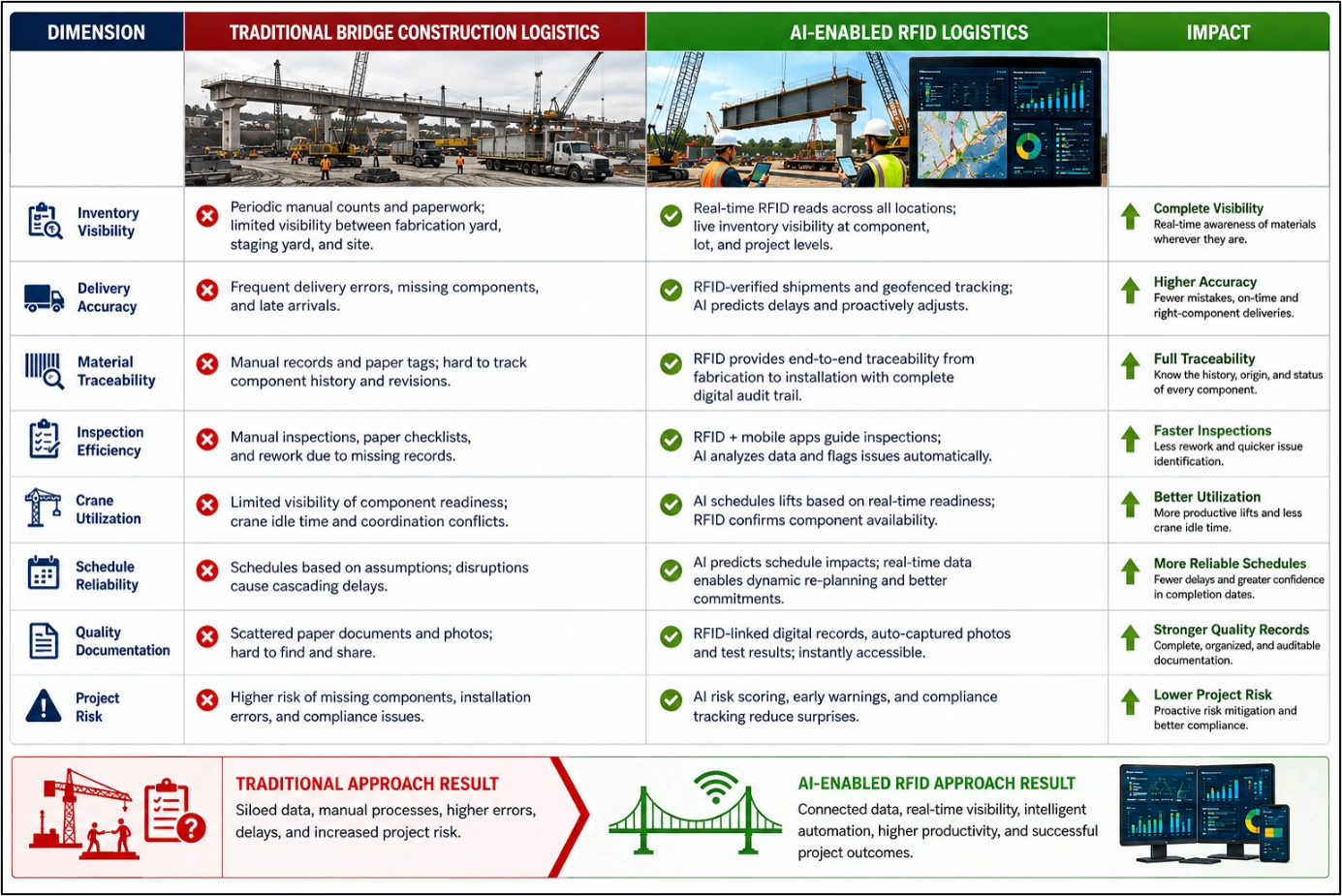
This comparison visual contrasts conventional bridge construction logistics with AI-enabled RFID logistics across key operational dimensions, including inventory visibility, delivery accuracy, material traceability, inspection efficiency, crane utilization, schedule reliability, quality documentation, and project risk. The completed visual demonstrates how RFID data capture combined with AI analytics improves real-time visibility, predictive planning, compliance tracking, and construction productivity throughout the bridge construction lifecycle. The key takeaway is that AI-supported RFID logistics significantly reduce delays, errors, and coordination risks while improving schedule confidence and digital quality records.
Better Equipment Utilization
Heavy construction equipment represents one of the largest operational costs on bridge projects. Idle cranes, underutilized lifting systems, unavailable generators, or misplaced specialized tools reduce productivity while increasing operating expenses.
AI-supported RFID monitoring enables project teams to:
- Measure actual equipment utilization.
- Identify idle assets.
- Recommend equipment redistribution.
- Forecast future equipment demand.
- Coordinate maintenance schedules.
- Optimize equipment sharing across multiple bridge projects.
- Improve contractor resource planning.
These capabilities reduce unnecessary equipment rentals while increasing utilization of existing assets.
Enhanced Quality Assurance
Quality management in bridge construction requires continuous verification that construction activities comply with engineering drawings, inspection procedures, and applicable design standards.
AI supports quality assurance by correlating RFID identification with inspection records, fabrication documentation, laboratory testing, and installation history.
Quality improvements include:
- Automatic verification of component identity before installation.
- Faster inspection documentation.
- Reduced manual transcription errors.
- Improved non-destructive testing traceability.
- Better concrete batch tracking.
- Easier retrieval of historical inspection records.
- Earlier identification of quality deviations.
This integrated approach improves confidence that every installed structural element can be traced back to its manufacturing and inspection history.
Increased Worker Safety
Bridge construction presents numerous safety risks, including heavy lifting operations, work at height, confined spaces, traffic management, and operation of specialized machinery.
AI combined with RFID contributes to safer construction environments by supporting:
- Restricted-area access monitoring.
- Verification of worker certifications.
- Tracking emergency response equipment.
- Monitoring safety inspection schedules.
- Identifying unauthorized equipment usage.
- Supporting evacuation accountability during emergencies.
- Detecting unusual operational activity that may indicate elevated risk.
These capabilities complement existing safety management procedures rather than replacing established construction safety practices.
Scalability Across Bridge Construction Programs
Many transportation agencies simultaneously manage dozens or even hundreds of bridge projects. AI-enabled RFID solutions should therefore support expansion beyond a single construction site.
Scalable implementations allow organizations to standardize operational processes while maintaining flexibility for different bridge types, contract sizes, and construction methodologies.
Scalability considerations include:
- Supporting multiple fabrication facilities.
- Coordinating regional equipment pools.
- Standardizing material identification.
- Managing multiple contractors.
- Integrating with agency-wide project controls.
- Consolidating operational reporting.
- Sharing engineering lessons across projects.
- Supporting future bridge maintenance programs.
Because each bridge project generates valuable operational data, AI models continue improving as additional projects contribute new information.
Engineering Design Considerations
Successful AI-supported RFID deployments depend on thoughtful engineering decisions made during project planning rather than after construction begins.
Key considerations include:
RFID Tag Selection
Engineers should select RFID tags according to:
- Expected service life.
- Exposure to ultraviolet radiation.
- Mechanical vibration.
- Temperature extremes.
- Moisture exposure.
- Concrete embedding.
- Metallic interference.
- Chemical resistance.
- Required read distance.
Selecting inappropriate tags may reduce read reliability and increase maintenance requirements.
Reader Placement
Reader locations should maximize operational visibility without interfering with construction activities.
Typical installation points include:
- Fabrication exits.
- Loading areas.
- Transportation checkpoints.
- Site entrances.
- Material storage yards.
- Crane lifting zones.
- Temporary access gates.
- Inspection stations.
- Equipment compounds.
- Final installation areas.
Reader placement should be validated through field testing before full-scale deployment.
Data Governance
Bridge construction projects generate information from owners, contractors, consultants, suppliers, and government agencies.
Data governance policies should define:
- Data ownership.
- Access permissions.
- Information retention.
- Audit requirements.
- Regulatory compliance.
- Software integration responsibilities.
- Backup procedures.
- Cybersecurity controls.
Clear governance ensures operational information remains accurate, secure, and accessible throughout the project lifecycle.
Key Performance Indicators for AI-Supported Bridge Construction
Organizations implementing AI-driven bridge construction should measure success using objective performance indicators aligned with project goals.
Common KPIs include:
- Structural component traceability rate.
- On-time material delivery percentage.
- Crane utilization rate.
- Equipment idle time.
- Inventory accuracy.
- Installation productivity.
- Inspection completion time.
- Non-conformance rate.
- Material loss percentage.
- Rework frequency.
- Schedule variance.
- Cost variance.
- Safety incident frequency.
- Worker certification compliance.
- Mean equipment downtime.
- Procurement lead time.
- Supplier delivery performance.
- Bridge segment installation cycle time.
- Quality documentation completion rate.
- Project milestone achievement.
Tracking these indicators enables organizations to quantify operational improvements and continuously refine AI models using actual project performance data.
Implementation Recommendations for AI-Enabled Bridge Construction
Deploying AI-supported RFID solutions successfully requires more than selecting hardware or software. Bridge construction organizations should establish a structured implementation strategy that aligns technology deployment with engineering workflows, project objectives, and long-term infrastructure management. Incremental implementation reduces deployment risk while allowing construction teams to validate operational improvements before expanding the solution across additional projects.
Conduct an Operational Assessment
Implementation should begin with a comprehensive assessment of existing bridge construction processes.
The assessment should identify:
- Critical material flows.
- Equipment movement patterns.
- Existing identification methods.
- Manual documentation processes.
- Inspection workflows.
- Procurement activities.
- Communication bottlenecks.
- Data quality issues.
- Current software systems.
- Regulatory reporting requirements.
Understanding these workflows enables engineers to determine where RFID-generated data will provide the greatest operational value.
Define Clear Business Objectives
Technology deployment should be guided by measurable operational goals rather than adopting AI solely because it is available.
Typical objectives include:
- Improving structural component traceability.
- Reducing project delays.
- Increasing crane utilization.
- Lowering equipment search time.
- Improving inspection efficiency.
- Reducing material waste.
- Enhancing worker safety.
- Increasing schedule predictability.
- Improving quality documentation.
- Supporting long-term bridge asset management.
Clearly defined objectives simplify project evaluation and help prioritize future enhancements.
Begin with a Pilot Project
Rather than deploying across an entire infrastructure program immediately, organizations should validate the solution on a representative bridge project.
A pilot implementation allows teams to:
- Verify RFID read performance.
- Optimize reader placement.
- Validate software integration.
- Measure AI prediction accuracy.
- Train construction personnel.
- Identify operational improvements.
- Refine data governance procedures.
Lessons learned from the pilot can then be incorporated into larger regional or national bridge construction programs.
Common Deployment Challenges and Engineering Considerations
Although AI-supported RFID solutions deliver significant operational benefits, bridge construction environments present several engineering challenges that should be addressed during planning and commissioning.
Metallic Structures and Signal Performance
Bridge construction sites contain extensive quantities of structural steel, reinforcing bars, lifting equipment, and temporary steel works. These materials can influence RFID read performance if tag selection and reader placement are not carefully engineered.
Engineering teams should conduct field testing to determine:
- Appropriate tag mounting methods.
- Optimal reader orientation.
- Required antenna coverage.
- Read-zone boundaries.
- Environmental interference levels.
Selecting RFID tags specifically designed for metallic environments helps improve identification accuracy throughout fabrication and installation.
Harsh Environmental Conditions
Bridge projects are frequently exposed to:
- Heavy rainfall.
- Dust.
- Extreme temperatures.
- Ultraviolet radiation.
- Vibration.
- Concrete slurry.
- Salt spray in coastal regions.
- Snow and ice in cold climates.
RFID hardware should therefore be selected with suitable ingress protection ratings, ruggedized enclosures, and mounting systems capable of withstanding demanding construction environments.
Workforce Adoption
Technology adoption depends on the confidence of engineers, inspectors, equipment operators, and construction supervisors.
Successful organizations typically provide:
- Role-specific training.
- Standard operating procedures.
- Clear responsibilities.
- Hands-on demonstrations.
- Technical support during commissioning.
- Continuous feedback mechanisms.
When field personnel understand how AI recommendations and RFID identification simplify daily operations, adoption rates improve substantially.
Future Trends in AI-Powered Bridge Construction
Bridge construction continues to evolve as artificial intelligence, connected sensing technologies, and digital engineering become increasingly integrated. RFID will remain a foundational identification technology, while AI capabilities will expand beyond operational monitoring into predictive and autonomous decision support.
Several developments are expected to shape future bridge construction projects.
Digital Twins for Bridge Construction
Digital twin technology enables engineers to maintain a continuously updated digital representation of a bridge project by combining RFID observations, BIM models, survey information, IoT sensor data, and construction progress.
AI can compare the digital twin with planned construction activities to:
- Detect schedule deviations.
- Identify missing structural components.
- Predict resource conflicts.
- Evaluate construction sequencing.
- Support progress reporting.
- Improve commissioning readiness.
Digital twins also provide valuable information for bridge owners after construction, supporting maintenance planning and future rehabilitation activities.
AI-Enabled RFID Digital Twin Architecture for Bridge Construction Asset Tracking
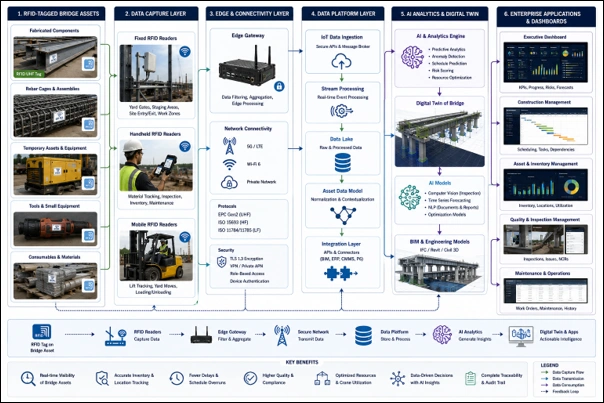
This architecture diagram illustrates how RFID-tagged bridge components, mobile and fixed RFID readers, edge gateways, secure communication networks, AI analytics engines, BIM software, and digital twin models work together to support bridge construction operations. The visual highlights the end-to-end data flow from field asset identification through real-time processing, predictive analytics, engineering coordination, and project management dashboards. The key takeaway is that integrating RFID with AI and BIM creates a continuously updated digital representation of bridge assets that improves traceability, scheduling, inspection management, and data-driven decision-making.
Autonomous Inspection Support
Future bridge projects are expected to increase the use of autonomous inspection technologies.
Examples include:
- Drone-based visual inspections.
- Robotic bridge crawlers.
- Automated dimensional verification.
- AI-assisted crack detection.
- Remote structural monitoring.
- Intelligent maintenance planning.
RFID will provide verified asset identities, while AI combines inspection findings with historical maintenance records to prioritize engineering actions.
Predictive Infrastructure Management
Bridge owners increasingly seek to extend the value of construction data throughout the operational life of infrastructure assets.
By preserving RFID-linked records created during construction, future maintenance teams can access:
- Fabrication histories.
- Material certifications.
- Inspection records.
- Installation dates.
- Component replacement history.
- Supplier information.
- Warranty documentation.
AI can use these historical datasets to predict maintenance requirements, prioritize inspections, and optimize long-term asset management strategies.
Practical Engineering Lessons
Organizations that achieve the greatest value from AI-enabled bridge construction typically follow several engineering best practices developed through practical deployment experience.
These include:
- Treat RFID as a trusted source of operational data rather than simply an inventory technology.
- Design identification workflows around bridge construction processes instead of adapting construction activities to technology limitations.
- Integrate RFID observations with existing engineering software to minimize duplicate data entry.
- Validate AI recommendations against field conditions before automating operational decisions.
- Standardize tagging procedures across fabrication facilities and construction sites.
- Conduct periodic reader performance testing throughout the project lifecycle.
- Establish clear cybersecurity and data governance policies before deployment.
- Measure operational improvements using well-defined project KPIs rather than anecdotal observations.
- Expand deployments incrementally using lessons learned from pilot projects.
Organizations adopting these practices are better positioned to improve schedule reliability, quality assurance, workforce productivity, and infrastructure documentation over successive bridge construction programs.
AI-Enabled RFID Bridge Construction Site Deployment with Digital Twin Monitoring
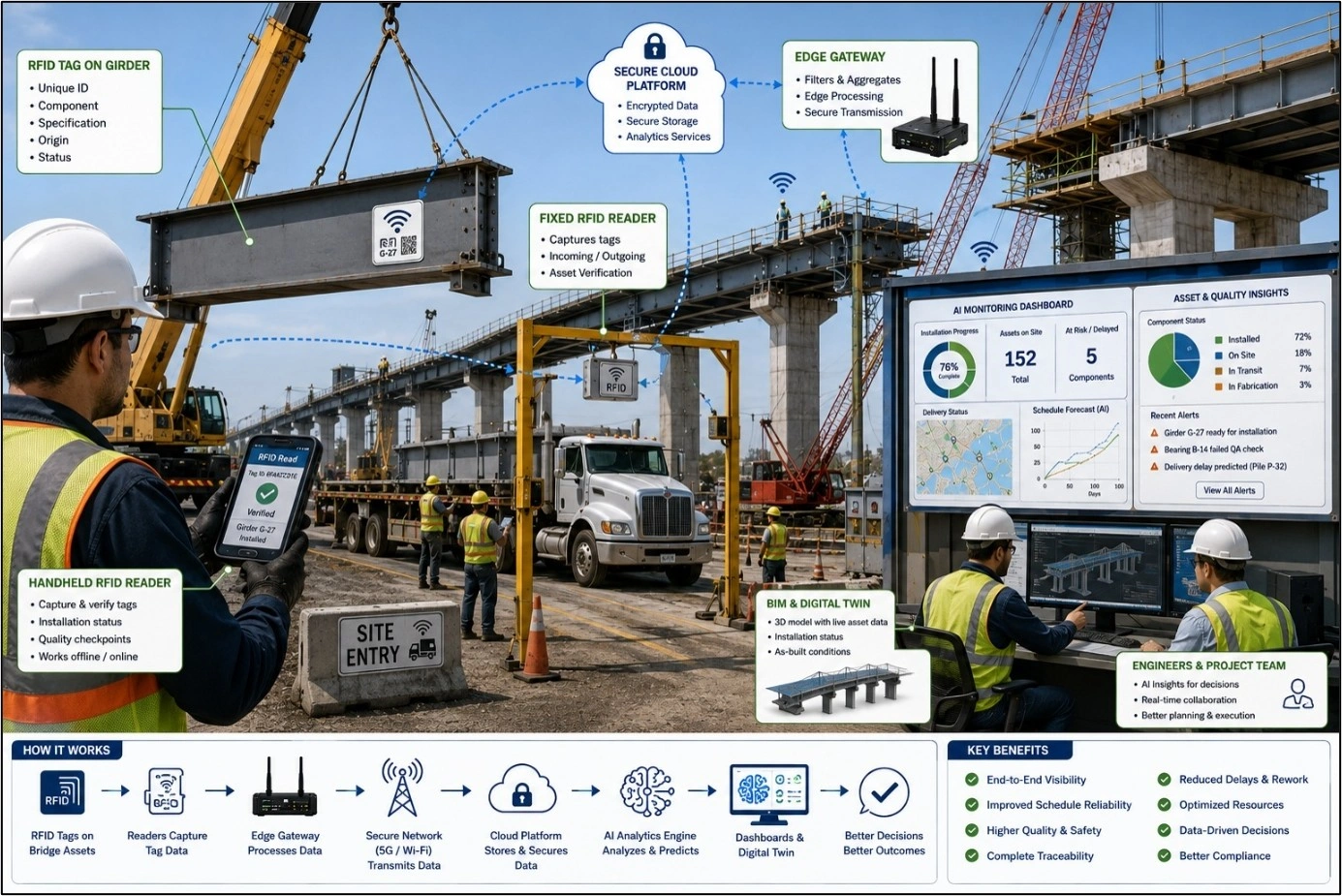
This realistic deployment illustration shows an active bridge construction site where RFID-tagged steel girders are tracked through fixed and handheld RFID readers, edge gateways, secure wireless networks, AI analytics dashboards, and BIM-based digital twin systems. The visual demonstrates how field data is captured, transmitted, analyzed, and synchronized with engineering and project management systems in real time. The key takeaway is that integrating RFID, AI analytics, and BIM coordination creates a connected bridge construction environment that improves asset traceability, installation verification, schedule reliability, quality control, and data-driven decision-making.
Summary and Recommendations for AI-Enabled Bridge Construction
AI-powered bridge construction supported by RFID enables infrastructure organizations to move beyond isolated tracking systems toward data-driven project execution. RFID provides accurate identification of structural components, construction equipment, inspection assets, and workforce resources, while AI transforms those operational observations into predictive insights that improve planning, logistics, quality assurance, safety, and schedule performance.
Successful implementations depend on more than deploying RFID hardware. They require careful engineering design, integration with existing construction software, secure communication infrastructure, robust cybersecurity controls, and governance policies that ensure operational data remains accurate throughout the project lifecycle. Organizations that align AI models with established bridge construction workflows can improve material traceability, optimize equipment utilization, reduce project delays, strengthen regulatory compliance, and enhance collaboration among owners, designers, fabricators, contractors, and inspectors.
Recommended implementation practices include:
- Define measurable operational objectives before selecting hardware or software.
- Conduct a comprehensive assessment of bridge construction workflows and information flows.
- Select UHF, HF, and LF RFID technologies according to asset type, environmental conditions, and required read performance.
- Integrate RFID-generated operational data with BIM, ERP, CMIS, QMS, GIS, and project scheduling software to create a consistent source of project information.
- Validate AI models using historical bridge construction data before relying on automated recommendations.
- Deploy secure communication networks with redundancy, authentication, encryption, and continuous monitoring.
- Establish standardized RFID tagging procedures across fabrication facilities, suppliers, logistics providers, and construction sites.
- Measure implementation success using project-specific KPIs such as schedule adherence, equipment utilization, inventory accuracy, inspection completion, and structural component traceability.
- Expand deployments progressively after successful pilot implementations while incorporating engineering lessons learned into future bridge programs.
As bridge construction becomes increasingly digital, AI-enabled RFID solutions will continue to support digital twins, predictive maintenance, intelligent inspection, automated reporting, and lifecycle asset management. Organizations that invest in interoperable identification systems and high-quality operational data today will be better positioned to improve construction efficiency and support long-term bridge performance throughout the asset lifecycle.
GAO has helped organizations across North America deploy RFID, BLE, and Industrial IoT hardware products and systems for demanding operational environments. Headquartered in New York City and Toronto, Canada, GAO is recognized among the world’s leading B2B and B2G suppliers of RFID and BLE technologies. Through decades of investment in research and development, stringent quality assurance, and expert remote and onsite technical support, GAO has assisted Fortune 500 companies, leading research institutions, universities, and government agencies in implementing dependable identification and sensing solutions for infrastructure, transportation, and industrial applications.
Building the Future of Industrial AI and IoT with Aperture Venture Studio and GAO
For more than three decades, GAO has invested extensively in research and development for industrial RFID, BLE, and IoT technologies. As artificial intelligence has matured into a practical tool for infrastructure engineering and bridge construction, we have expanded our AI and IoT capabilities to help organizations deploy intelligent identification, sensing, and analytics solutions that improve project execution and long-term asset management. To further accelerate innovation across AI and Industrial IoT, we founded Aperture Venture Studio to help advance and scale AI-driven and IoT-based technology initiatives that address complex operational challenges across infrastructure and other industries.
Aperture has attracted highly experienced AI researchers, IoT specialists, engineering professionals, operational executives, respected investors, and leading organizations working to advance practical industrial technologies. We have also developed the Aperture Ventures Summit and TekSummit, bringing together technical experts and industry leaders to discuss emerging applications of AI, RFID, BLE, Industrial IoT, Edge AI, and intelligent infrastructure systems.
These collaborative initiatives have enabled us to build diverse technical communities that encourage knowledge sharing, applied research, and engineering excellence across AI and IoT.
We welcome professionals and organizations to engage with us as:
- Advisors, co-founders, or employees.
- Investors.
- Customers seeking trusted RFID, BLE, AI, and Industrial IoT solutions for bridge construction and other infrastructure applications.
AI-Enabled RFID Bridge Construction Lifecycle and Digital Twin Management
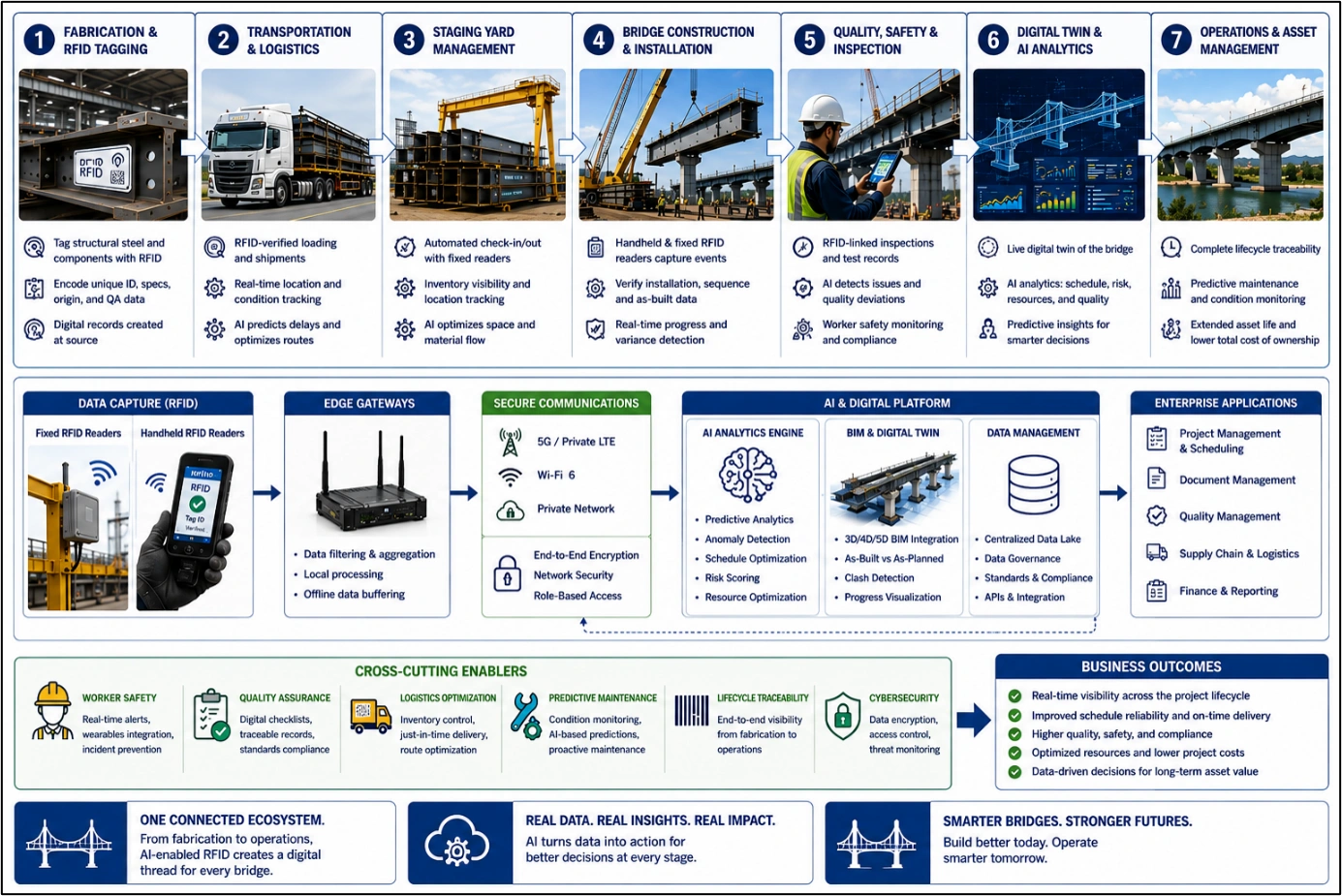
This enterprise infographic illustrates the complete AI-enabled bridge construction lifecycle, beginning with RFID-tagged structural steel fabrication and continuing through transportation logistics, staging yard management, bridge installation, quality inspection, AI analytics, BIM integration, digital twin synchronization, and long-term bridge asset management. The completed visual demonstrates how RFID data capture, edge gateways, secure communications, AI-driven analytics, and enterprise management systems create a connected digital thread across the entire bridge lifecycle. The key takeaway is that integrating RFID with AI, BIM, and digital twin technologies enables real-time visibility, predictive decision-making, stronger quality assurance, improved worker safety, optimized logistics, and more reliable long-term infrastructure management.