
AI and BLE for Wireless Network Operators
AI and BLE Architecture for Wireless Network Operators
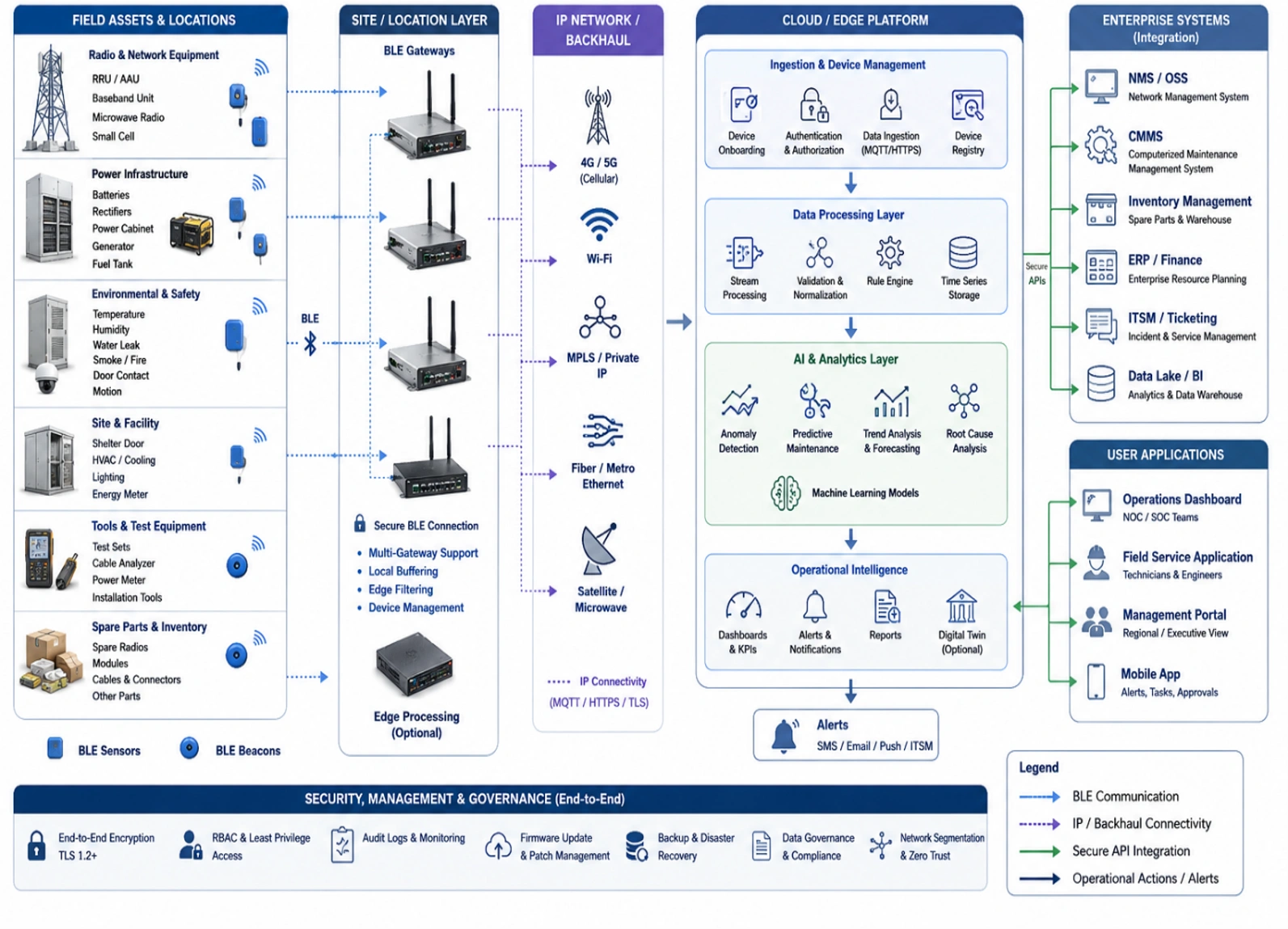
This architecture diagram shows how BLE sensors and beacons attached to wireless network assets send data through BLE gateways and IP backhaul to cloud or edge systems. It illustrates data ingestion, processing, AI analytics, operational intelligence, enterprise-system integration, alerts, and end-to-end security controls.
Why AI and BLE Matter to Wireless Network Operators
Wireless network operators maintain infrastructure that is distributed across thousands of locations and may include macro cell sites, small cells, rooftop installations, remote radio locations, edge facilities, switching facilities, data centers, warehouses, and field-service depots. Physical access to these locations can be expensive and operationally disruptive, making reliable remote asset information valuable.
BLE provides a low-power local connectivity layer for physical assets. BLE sensors can capture temperature, humidity, vibration, door status, battery-related conditions, occupancy, or other measurable parameters. BLE beacons can provide asset identification or location references. BLE gateways collect BLE advertisements and sensor data and can transmit the information to software through Ethernet, cellular connectivity, Wi-Fi, or other IP-connected infrastructure.
AI adds analytical capabilities to these data streams. Instead of treating every sensor event as an isolated alarm, AI software can correlate asset condition, historical measurements, maintenance records, environmental conditions, and operational events. This supports more useful decisions such as identifying abnormal equipment behavior, prioritizing maintenance, detecting repeated environmental problems, or determining which assets require field inspection.
For wireless network operators, the most important engineering principle is integration. BLE should complement existing network-management systems, inventory databases, maintenance systems, ticketing systems, and field-service processes rather than create another disconnected source of information.
Wireless Network Operator Applications for AI and BLE
Telecom Site Asset Identification and Monitoring
BLE beacons can identify radio units, batteries, generators, cabinets, tools, test equipment, and other site assets. BLE sensors can monitor environmental conditions around equipment.
AI can analyze historical readings and identify unusual patterns. For example, repeated temperature excursions at a particular site can be correlated with maintenance records and equipment alarms to help determine whether a cooling, ventilation, cabinet, or power-related problem deserves investigation.
Battery and Power Infrastructure Monitoring
Backup batteries, rectifiers, power distribution equipment, generators, and associated infrastructure are critical to network availability. BLE sensors can provide localized condition information, while gateways can aggregate readings from multiple devices.
AI models can identify deviations from normal operating patterns and help maintenance teams prioritize sites. This does not replace manufacturer-specific battery-management or power-control systems. Instead, BLE and AI can provide supplementary operational information where appropriate.
Field Asset and Tool Tracking
Wireless operators and contractors often move test instruments, spare radio equipment, batteries, installation tools, and other assets between warehouses, vehicles, field sites, and repair facilities.
BLE beacons attached to mobile assets can provide identification and location-related events when detected by gateways. AI can analyze movement history to identify unusual asset movements, prolonged inactivity, recurring shortages, or inefficient equipment allocation.
Site Access and Environmental Monitoring
BLE sensors can monitor doors, cabinets, environmental conditions, and other site-level events. Combined with existing access-control and security systems, these data can help operations personnel investigate abnormal events.
AI can correlate multiple signals instead of relying on a single sensor event. For example, a door event combined with unexpected environmental changes or asset movement can receive a different operational priority from an isolated door event.
Warehouse and Spare-Parts Operations
Wireless network operators maintain large inventories of replacement equipment and installation materials. BLE identification can supplement barcode or RFID processes for selected assets and workflows.
AI can analyze inventory movement, demand history, maintenance requirements, and network expansion activity to improve spare-parts planning. BLE is particularly useful when operators need frequent visibility of mobile equipment or want automated detection within defined areas.
AI and BLE Operations Workflow for Wireless Network Operators
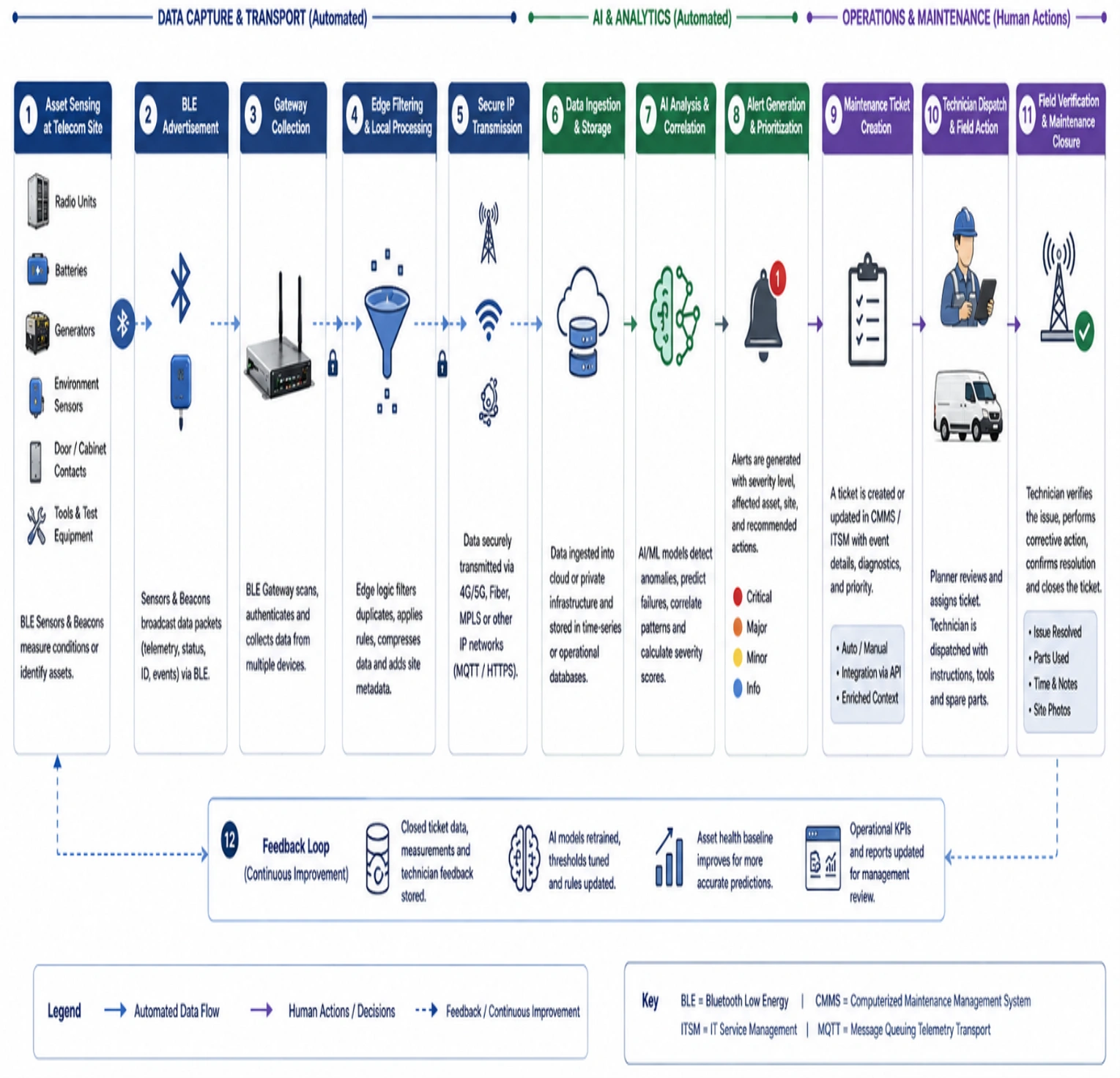
This workflow diagram illustrates the complete operational process from BLE-based asset sensing at telecom sites through gateway collection, edge processing, secure IP transmission, AI analysis, alert prioritization, maintenance ticket creation, technician dispatch, and field verification. It also shows the feedback loop used to improve AI models, asset health baselines, and operational KPIs.
From BLE Data Capture to AI-Driven Network Operations
A practical AI and BLE solution for wireless network operators normally begins at the physical asset.
BLE sensors collect measurements or state changes. BLE beacons transmit identifiers and other configured information. A nearby BLE gateway scans for authorized devices and collects their advertisements. Gateway software can filter duplicate messages, normalize payloads, apply basic rules, and attach gateway or site information before forwarding selected data.
The gateway then communicates through an IP-connected network. Depending on the deployment, this may use Ethernet, Wi-Fi, cellular connectivity, or another available network connection. Network operators should evaluate connectivity availability, backhaul cost, power consumption, security requirements, and site conditions before selecting the gateway communication method.
Edge processing can reduce unnecessary traffic and provide faster local responses. Cloud or privately hosted server software can aggregate data from many sites and maintain historical records. A message broker, API layer, database, or IoT data service can provide communication between gateway software and enterprise applications.
AI processing can operate on historical or streaming data. Appropriate techniques may include anomaly detection, classification, time-series analysis, clustering, forecasting, and rules combined with machine-learning models. The correct method depends on the operational problem and the quantity and quality of available training data.
The final stage is an operational action. An AI-generated observation might appear in an operations dashboard, create an alert, influence maintenance prioritization, update an asset record, or support a technician’s investigation. Human review remains important for high-impact maintenance and network-availability decisions.
AI and BLE Data Flow for Wireless Network Operations
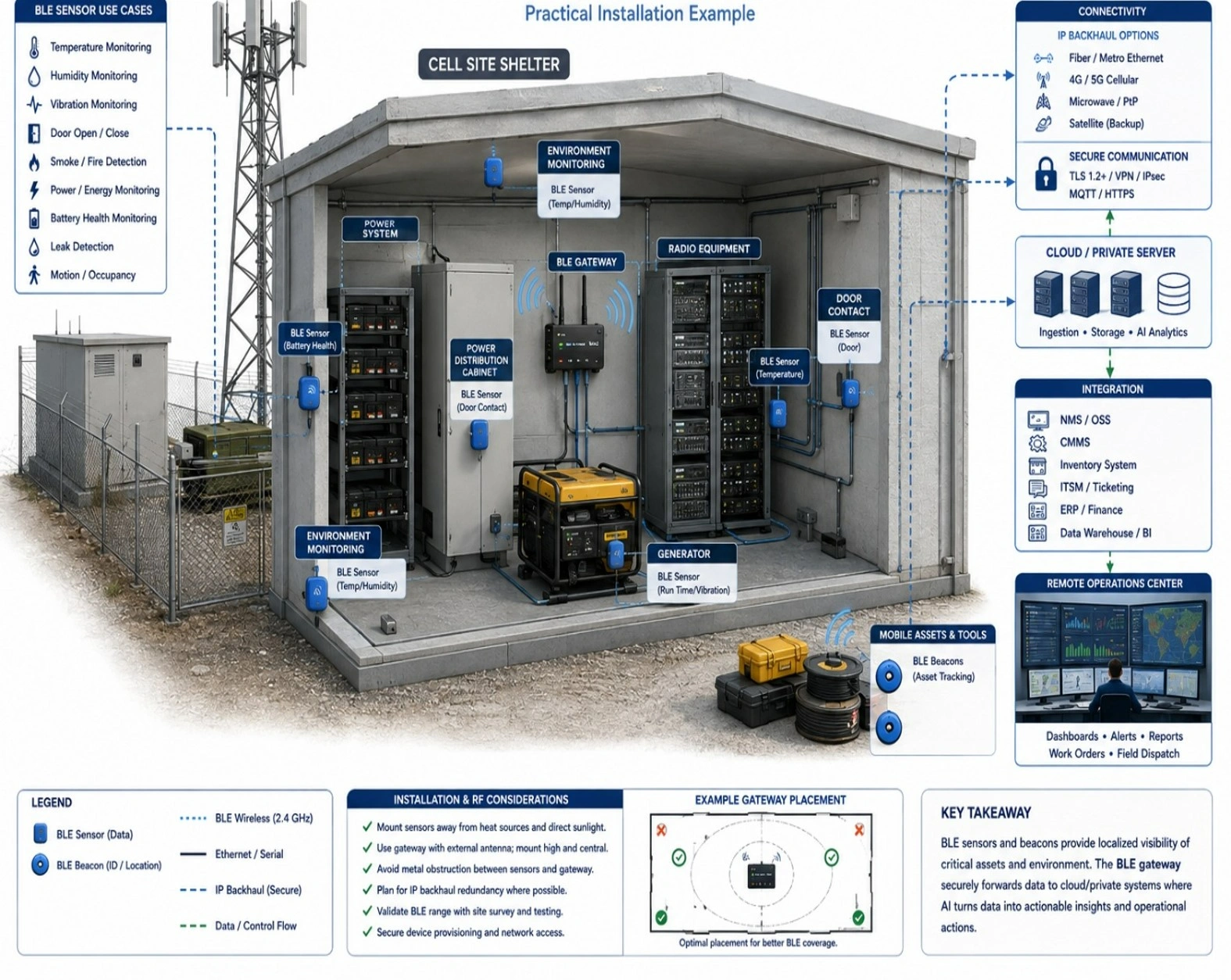
This data-flow diagram shows how BLE sensors and beacons transmit operational data to BLE gateways, where it is filtered and securely forwarded through IP networks to cloud or privately hosted servers. It illustrates data storage, AI analytics, enterprise-system integration, alerts, work orders, technician actions, and the feedback loop that improves future predictions and operational decisions.
BLE Hardware, AI Software, and Deployment Models
BLE Sensors and Beacons
BLE sensors are appropriate when the wireless operator needs measured data such as temperature, humidity, vibration, motion, contact status, or other supported parameters. BLE beacons are better suited to identification, proximity, zone, or location-related applications.
Battery life is an important design parameter at remote telecom sites. Transmission interval, radio power, sensor sampling frequency, environmental conditions, and battery chemistry all influence maintenance requirements. Operators should avoid selecting sensor configurations based only on nominal battery-life specifications because actual site conditions can materially affect performance.
BLE Gateways
BLE gateways provide the connection between local BLE devices and IP-connected software. A gateway may support multiple BLE devices and can be installed inside telecom shelters, equipment rooms, warehouses, vehicles, or other controlled locations.
Gateway selection should consider BLE range, antenna characteristics, enclosure requirements, operating temperature, power availability, Ethernet or cellular connectivity, remote management, security features, local storage, and software update capabilities.
GAO supplies BLE and IoT hardware products and systems that can support asset monitoring and data-collection requirements across distributed operational environments. The appropriate configuration should be selected according to the wireless operator’s site conditions, asset types, connectivity, and integration requirements.
AI Analytics
AI software should be selected according to the operational question rather than applied simply because sensor data are available. Anomaly detection can identify deviations from learned normal behavior. Classification can categorize events. Time-series models can analyze trends. Forecasting can support maintenance planning where sufficient historical data exist.
Data quality is fundamental. Missing measurements, inconsistent timestamps, gateway outages, duplicated advertisements, sensor drift, and poorly maintained asset records can reduce model reliability. Data validation and operational feedback should therefore be treated as part of the AI implementation rather than as an afterthought.
Cloud Version
A cloud-hosted SaaS deployment is appropriate when wireless network operators need centralized management across many geographically distributed sites. Cloud deployment can simplify centralized software updates, provide elastic data processing, and support multi-site dashboards.
Cloud connectivity must still be engineered carefully. Remote sites may experience intermittent connectivity, so gateways should have appropriate buffering or store-and-forward capabilities where required. Security controls should include authenticated devices, encrypted communications, controlled APIs, role-based access, logging, and appropriate credential management.
Server Version
A Server Version can run on customer-managed edge servers, private data centers, network operations facilities, or other privately hosted infrastructure. This approach can be appropriate when the operator requires greater control over data location, integration with private systems, network isolation, or local processing.
A private server deployment may also reduce dependence on continuous external connectivity for selected applications. However, the operator becomes responsible for server capacity, operating-system maintenance, application updates, backups, monitoring, cybersecurity, and disaster recovery.
Communication and Integration Considerations
BLE operates locally, while wireless network operators normally depend on IP-based communications for site-to-server connectivity. MQTT and HTTPS can be appropriate application-layer mechanisms depending on the software implementation. REST APIs can connect AI and BLE software with maintenance, asset, inventory, and operational applications.
The solution should also account for existing telecommunications management environments, including network management systems, operations support systems, inventory databases, computerized maintenance management systems, enterprise resource planning systems, ticketing software, and field-service applications.
Cybersecurity and Operational Resilience
BLE deployments should use appropriate device authentication, controlled pairing or provisioning, encrypted communications where supported, secure gateway configuration, access control, logging, and controlled firmware updates. Gateway credentials should not be shared across sites, and unused interfaces and services should be disabled where practical.
Wireless operators should also establish procedures for lost devices, compromised credentials, sensor replacement, gateway replacement, software updates, and decommissioning. Security requirements should cover the entire data path from the BLE device through the gateway and server to enterprise applications.
Engineering Considerations for Distributed Wireless Sites
Wireless network operators should begin with a defined operational problem rather than deploying BLE sensors indiscriminately. A site survey should identify asset density, radio environment, physical obstructions, gateway mounting locations, power availability, backhaul connectivity, temperature range, and maintenance access.
BLE propagation can be affected by metal cabinets, concrete structures, equipment racks, and other physical obstacles commonly found at telecommunications facilities. Gateway placement should therefore be validated through site testing rather than determined only from theoretical radio range.
Another important consideration is data volume. A deployment containing thousands of frequently transmitting BLE devices can generate substantial event traffic. Local filtering, sensible advertising intervals, aggregation, and event thresholds can reduce unnecessary network traffic while preserving operational information.
AI and BLE Site Deployment for Telecom Cell Sites
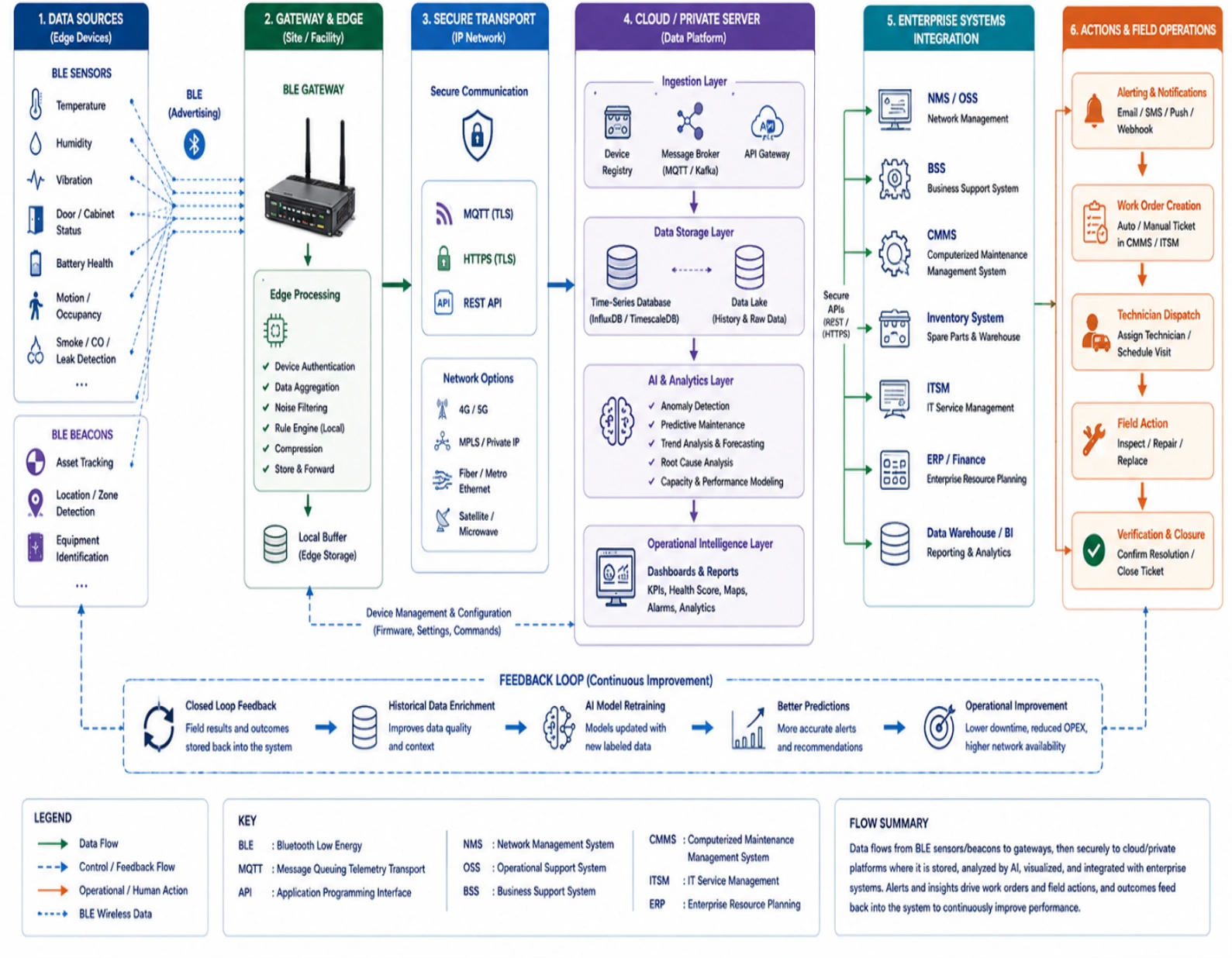
This technical illustration shows a practical BLE deployment inside a telecommunications cell-site shelter, including sensors on batteries, power equipment, generators, cabinets, doors, and environmental monitoring points. It also shows BLE gateway placement, mobile asset beacons, secure IP backhaul, cloud or private-server processing, enterprise integrations, and remote operations-center connectivity.
Operational Benefits of AI and BLE for Wireless Network Operators
AI and BLE can improve wireless network operations when the deployment is designed around measurable operational requirements. The strongest results typically come from connecting physical asset data with existing maintenance, inventory, network operations, and field-service workflows.
Improved Asset Visibility
BLE beacons provide a practical identification mechanism for mobile and fixed assets. Wireless network operators can associate beacon identifiers with asset records and use gateway detections to determine whether equipment is present within defined sites or operational zones.
This can improve visibility of spare radio units, test equipment, installation tools, batteries, generators, and other field assets. AI can analyze historical movement patterns to identify unusual asset behavior or recurring operational bottlenecks.
Faster Detection of Site Conditions
BLE sensors can provide frequent information about temperature, humidity, vibration, cabinet status, power conditions, and other measurable parameters. AI can compare incoming measurements with historical operating patterns and identify abnormal conditions.
This approach can reduce dependence on periodic manual inspection for selected monitoring tasks. It does not eliminate physical inspections where inspection is required for safety, regulatory, warranty, or maintenance reasons.
Predictive and Condition-Based Maintenance
Traditional maintenance programs may rely on fixed schedules or alarms generated by individual devices. AI can add another layer by analyzing trends across sensor measurements, maintenance records, equipment history, environmental conditions, and previous incidents.
A useful predictive-maintenance model should produce an actionable output. For wireless network operators, that may mean identifying a site requiring inspection, prioritizing a maintenance ticket, recommending additional diagnostic testing, or identifying an asset whose condition is changing faster than expected.
Better Maintenance Prioritization
Not every anomaly requires an immediate truck roll. AI can help rank events according to severity, persistence, asset criticality, historical behavior, and potential operational impact.
A temperature deviation at a non-critical warehouse location may receive a different priority from a persistent environmental anomaly associated with critical radio or power equipment. Combining AI analysis with existing operational rules can help network operations teams allocate field resources more effectively.
Reduced Manual Data Collection
Field technicians often spend time recording asset identifiers, equipment conditions, environmental observations, and maintenance information. BLE-based identification and automated sensing can reduce selected manual data-entry tasks.
Accurate automated records also provide better historical information for subsequent maintenance analysis, asset management, and AI model development.
Scalable Multi-Site Monitoring
A centralized software system can aggregate BLE information from distributed network sites. This is particularly useful for wireless network operators managing large numbers of geographically dispersed locations.
Scalability depends on more than server capacity. Operators should also consider BLE device provisioning, gateway management, network connectivity, data retention, API throughput, device replacement, firmware management, cybersecurity, and operational support.
KPIs for AI and BLE Wireless Network Operations
Wireless network operators should define measurable KPIs before deployment. The selected KPIs should connect directly to operational objectives rather than simply measuring the number of BLE devices installed.
Relevant measures can include:
- Asset identification accuracy
- BLE gateway availability
- BLE device reporting success rate
- Sensor data completeness
- Data latency from site to server
- Mean time to detect operational anomalies
- Mean time to acknowledge alerts
- Mean time to repair
- Mean time between failures
- Preventive versus corrective maintenance ratio
- Repeat maintenance incidents per site
- Field dispatches avoided through remote diagnosis
- Truck rolls per network site
- Maintenance ticket closure time
- Spare-parts availability
- Asset search time
- Asset utilization
- Battery replacement frequency for BLE devices
- Gateway uptime
- Gateway communication failure rate
- AI alert precision
- AI false-positive rate
- AI false-negative rate
- Predictive-maintenance lead time
- Network-site environmental compliance rate
- Critical-site monitoring coverage
- Data retention availability
- API integration success rate
- Firmware update success rate
- Security-event detection and response time
AI performance should be evaluated together with operational performance. A model with high statistical accuracy but poor maintenance relevance may have less practical value than a simpler model that reliably helps technicians make better decisions.
Standards, Protocols, and Interoperability
AI and BLE deployments for wireless network operators should be designed around interoperable technologies wherever practical. BLE provides the local wireless connectivity mechanism, while IP networking provides the broader communications path between sites and software systems.
Relevant technologies and standards can include:
- Bluetooth Low Energy for local wireless communication
- Bluetooth GATT-based services and characteristics where applicable
- IPv4 and IPv6 for IP connectivity
- Ethernet for wired site connectivity
- Wi-Fi for appropriate local connectivity scenarios
- 4G and 5G cellular backhaul
- MQTT for telemetry messaging where supported
- HTTPS and REST APIs for secure application communication
- TLS for encrypted communications
- VPN or IPsec technologies for appropriate network-security designs
- NTP or equivalent time synchronization mechanisms
- JSON or other structured formats for application data exchange
- REST APIs and webhooks for enterprise-system integration
Interoperability should be tested rather than assumed. Wireless network operators may operate multi-vendor environments containing radio equipment, power systems, network-management software, maintenance systems, inventory databases, and field-service applications from different suppliers.
API documentation, data dictionaries, asset identifiers, timestamps, site identifiers, device identifiers, and event-severity definitions should be established before large-scale integration.
Cybersecurity for AI and BLE Deployments
BLE and AI introduce additional connected devices and data pathways into wireless network operations. Security therefore needs to cover sensors, beacons, gateways, communications networks, servers, APIs, databases, AI services, and user applications.
Device Security
BLE sensors and beacons should be provisioned according to an established device-management process. Operators should maintain an inventory of device identifiers and associated assets and should define procedures for lost, replaced, retired, or compromised devices.
Gateway firmware should be maintained through controlled update procedures. Default credentials should be replaced, unnecessary services disabled, and administrative interfaces protected.
Network Security
Data moving from gateways to servers should use appropriate encryption and authentication. Operators should segment IoT traffic according to their network-security policies and restrict gateway communication to required destinations and services.
Where cellular, private IP, VPN, MPLS, fiber, or other connectivity is used, security controls should reflect the operator’s existing network design.
Application and API Security
Enterprise integrations should use authenticated APIs and least-privilege access. API credentials should be managed securely, rotated according to policy, and monitored for abnormal use.
Role-based access control can limit who can view sensor information, configure gateways, modify asset records, approve maintenance actions, or manage AI models.
AI Security and Data Governance
AI systems should maintain traceability between analytical outputs and their underlying data. Operators should know which data were used to generate important recommendations and should maintain appropriate logs.
AI-generated recommendations should not automatically trigger high-impact network actions without appropriate validation. Human approval can remain necessary for maintenance actions that could affect critical infrastructure or network availability.
Deployment Lifecycle for Wireless Network Operators
Planning and Site Assessment
Begin by identifying the operational problem, affected assets, existing systems, required measurements, and expected business or operational outcome.
Site surveys should examine:
- Asset locations and physical layout
- BLE radio conditions
- Metal structures and equipment cabinets
- Sensor mounting locations
- Gateway mounting locations
- Power availability
- Backhaul connectivity
- Environmental conditions
- Existing network segmentation
- Maintenance access
- Existing NMS, OSS, BSS, CMMS, ITSM, inventory, and ERP interfaces
Proof of Concept
A controlled proof of concept should include representative sites and asset types. Operators should test BLE range, gateway placement, reporting reliability, data quality, connectivity resilience, integration behavior, and alert performance.
The objective should not simply be to demonstrate that BLE devices can transmit data. The proof of concept should demonstrate that the resulting information supports an actual wireless-operations workflow.
Hardware Selection
Hardware should be selected according to site requirements. Important criteria include:
- BLE transmission characteristics
- Sensor accuracy and measurement range
- Battery life under the intended reporting configuration
- Operating temperature
- Enclosure requirements
- Gateway capacity
- Gateway connectivity
- Local storage
- Remote device management
- Firmware update capabilities
- Physical mounting requirements
- Security capabilities
- Vendor support and lifecycle availability
GAO’s experience supplying BLE, RFID, and IoT hardware products and systems can be relevant when organizations evaluate hardware for asset identification, monitoring, and connected operational workflows.
Integration and Testing
Integration testing should validate the complete data path rather than testing each component independently.
Test scenarios should include:
- Normal sensor transmission
- Missing sensor data
- Gateway communication failure
- Duplicate messages
- Incorrect timestamps
- Sensor replacement
- Gateway replacement
- Network outage
- Server outage
- API failure
- Alert escalation
- Maintenance-ticket creation
- Technician feedback
- Data recovery after connectivity restoration
Commissioning
Commissioning should verify device identity, site association, gateway configuration, connectivity, security settings, sensor readings, data timestamps, enterprise integrations, and alert thresholds.
A formal commissioning record can help operations teams distinguish between installation problems and later operational failures.
Optimization and Scaling
After commissioning, operators should analyze actual operational data. Reporting intervals, gateway placement, thresholds, AI models, retention policies, and alert priorities may require adjustment.
Scaling should occur after the operator has established repeatable installation, provisioning, security, monitoring, maintenance, and support processes.
Practical Implementation Recommendations
Wireless network operators considering AI and BLE should focus on operational value, data quality, and lifecycle management rather than device count.
- Start with high-value operational problems such as asset visibility, environmental monitoring, maintenance prioritization, or field-equipment tracking.
- Select BLE sensors and beacons according to actual measurement and identification requirements.
- Conduct RF and physical site surveys before finalizing gateway placement.
- Design for intermittent connectivity at remote sites where applicable.
- Use edge filtering and buffering when reducing network traffic or maintaining local resilience is important.
- Establish consistent site, asset, sensor, gateway, and event identifiers.
- Integrate BLE information with existing maintenance and inventory workflows.
- Treat AI output as an operational decision-support capability rather than an independent replacement for engineering judgment.
- Establish cybersecurity requirements before device deployment.
- Define device provisioning, firmware update, replacement, and decommissioning procedures.
- Measure AI accuracy and operational KPIs separately.
- Validate APIs and data mappings before large-scale deployment.
- Maintain historical data that can support future AI model development.
- Test failure conditions before production commissioning.
- Design cloud, private-server, or hybrid deployment according to connectivity, data-control, integration, and operational requirements.
- Establish a support model for gateways, sensors, software, AI models, and enterprise integrations.
GAO and Practical AI and BLE Solutions for Wireless Network Operators
GAO provides BLE, RFID, and IoT hardware products and systems that can be incorporated into asset monitoring, identification, sensing, and connected operational solutions. For wireless network operators, these technologies can support use cases ranging from telecom-site environmental monitoring and equipment identification to mobile asset tracking and field-service workflows.
Headquartered in New York City and Toronto, Canada, GAO is recognized among the leading B2B and B2G BLE and RFID suppliers globally. GAO and its sister companies, GAO Research and GAO Tek, form GAO Group, with operations based in New York City and Toronto.
For three decades, GAO Group has served organizations across the United States and Canada, including Fortune 500 companies, R&D organizations, universities, and government agencies. Its work has included substantial research and development investment, quality-assurance processes, and technical support delivered remotely or onsite.
The practical value for wireless network operators is the ability to combine appropriate BLE hardware with gateways, software, AI analytics, communications infrastructure, and enterprise-system integration rather than treating sensing as an isolated technology purchase.
AI and BLE Deployment Model Decision Tree for Wireless Network Operators
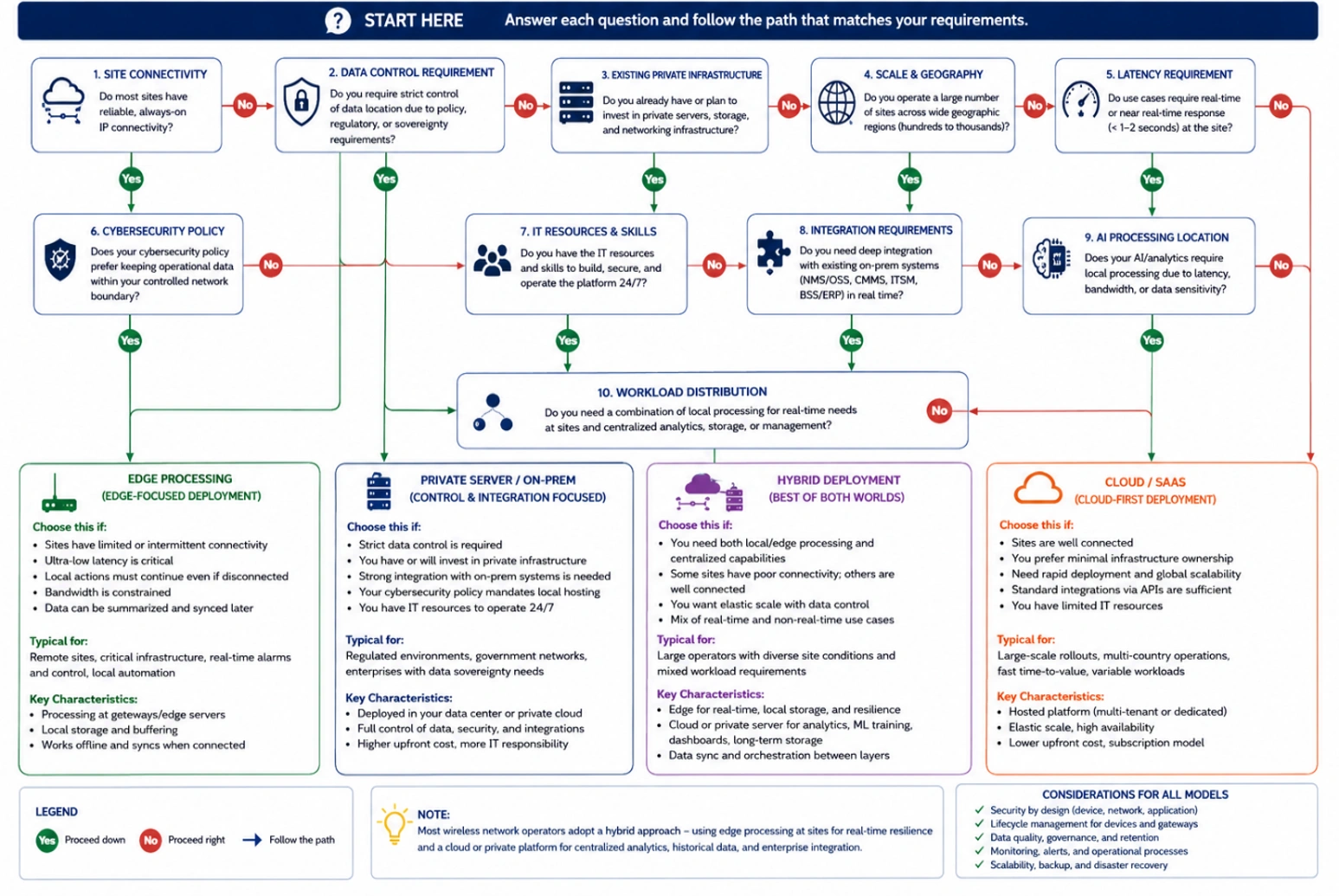
This decision tree helps wireless network operators select an appropriate AI and BLE deployment model by evaluating site connectivity, data-control requirements, private infrastructure, scale, latency, cybersecurity policies, IT resources, integration needs, and AI processing requirements. It guides decision-makers toward edge processing, private server/on-premises, cloud/SaaS, or hybrid deployment.
Key Takeaways for AI and BLE in Wireless Network Operations
AI and BLE can connect physical telecom assets with digital operational workflows. BLE sensors provide localized measurements, BLE beacons provide asset identification and location-related information, and BLE gateways connect these devices to IP-based systems.
AI becomes most valuable when sensor data are combined with operational context. Maintenance history, site criticality, environmental conditions, equipment information, asset records, and technician feedback can transform raw BLE events into useful operational insights.
Wireless network operators should therefore evaluate AI and BLE as part of a complete operational system covering sensing, connectivity, edge processing, data management, AI analytics, cybersecurity, enterprise integration, field operations, and lifecycle support.
Successful implementation depends on disciplined site surveys, appropriate hardware selection, reliable data capture, secure connectivity, well-defined integrations, meaningful KPIs, and continuous optimization.
GAO can support organizations evaluating BLE, RFID, and IoT hardware products and systems for wireless network operations. Technical teams can explore suitable solutions, discuss deployment requirements, and evaluate how BLE sensing and identification technologies can fit existing network and maintenance environments.
Building the Future of Industrial AI and IoT with Aperture Venture Studio and GAO RFID Inc.
For more than three decades, GAO Group of Companies has invested heavily in R&D covering industrial BLE, RFID, and IoT technologies. As generative AI has become increasingly useful for industrial applications, we have expanded our work in AI and IoT, including AI-enabled BLE and RFID solutions relevant to connected wireless network operations. We have also founded Aperture Venture Studio to support the development of technologies and companies addressing practical AI and IoT requirements across industries, including connected asset monitoring and intelligent operational systems.
Aperture has attracted AI and IoT technical experts, entrepreneurial and operational executives, influential investors, and leading companies. We have also developed the Aperture Ventures Summit and TekSummit to discuss advanced AI and IoT topics.
These activities contribute to technical communities and collaborative relationships around AI and IoT. We welcome participation as:
- Advisors, co-founders, or employees
- Investors
- Customers