
AI and BLE for Resort Management
AI-Driven Resort Management with BLE-Based Sensing and Automation
Artificial intelligence is changing resort management by turning operational data from guest areas, facilities, mobile assets, staff workflows, and connected equipment into actionable decisions. AI-enabled resort management can use machine learning, Edge AI, computer vision, predictive analytics, and AIoT methods to improve guest experience while controlling maintenance, energy, asset, security, and workforce costs. BLE gateways, beacons, and sensors provide a practical source of location, proximity, environmental, and equipment data across villas, guest rooms, pools, spas, restaurants, conference facilities, back-of-house areas, and outdoor resort spaces. For resort operators, the value is not simply knowing where an asset or person is located. The objective is to connect operational events with property-management software, computerized maintenance management systems, security systems, housekeeping workflows, and business analytics so that staff can respond before service quality is affected. GAO supplies BLE, RFID, and IoT hardware and systems that can support these connected resort-management applications.
AI and BLE-Enabled Resort Management Operations System
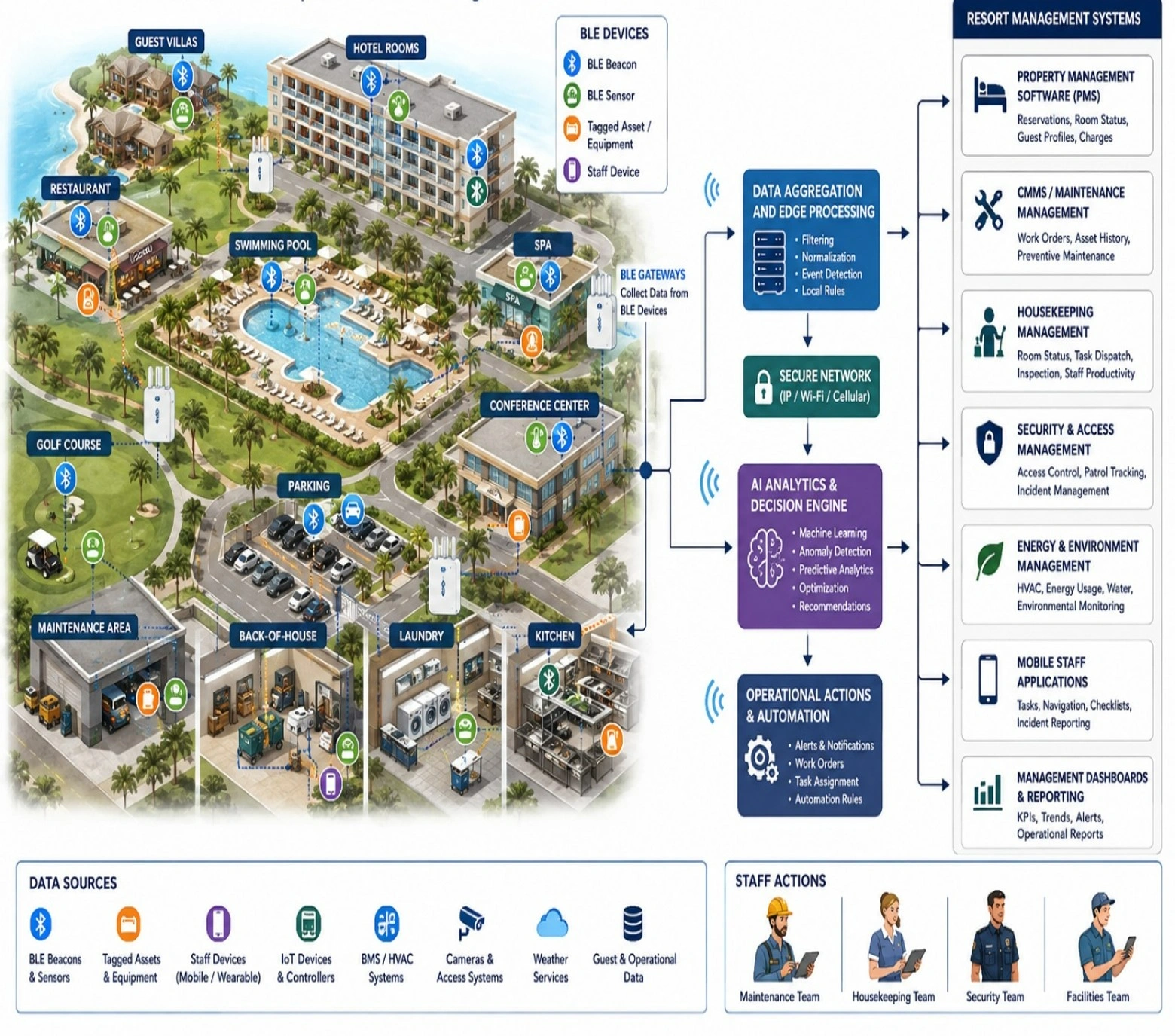
This infographic illustrates how BLE beacons, sensors, tagged assets, staff devices, and other IoT data sources support AI-enabled resort management. Data is collected through BLE gateways, filtered and processed at the edge, transferred through secure networks, and analyzed using machine learning, anomaly detection, predictive analytics, and optimization. The resulting insights connect with property management software, CMMS, housekeeping, security, energy management, mobile staff applications, and management dashboards. The visual demonstrates how connected resort data moves from physical operations to AI-driven decisions, alerts, work orders, task assignments, and operational actions across guest, facilities, maintenance, and back-of-house areas.
What AI-Enabled Resort Management Means
AI-enabled resort management combines artificial intelligence with connected resort equipment, BLE devices, operational software, and IoT data sources. The resulting AIoT system can continuously observe selected operational conditions and identify patterns that would be difficult for resort personnel to detect manually.
BLE is particularly useful where resort operators need low-power proximity and location information without installing a dedicated wired connection for every monitored item. BLE beacons can identify zones or provide proximity references, while BLE sensors can report conditions such as temperature, humidity, motion, occupancy-related events, door status, or equipment conditions. BLE gateways collect this information and forward it to local servers or cloud software.
AI adds the decision-making layer. Historical and real-time information can be analyzed to predict maintenance requirements, identify abnormal operating conditions, optimize housekeeping dispatch, improve asset utilization, detect unusual movement patterns, and support personalized guest services where appropriate and legally permitted.
The important engineering distinction is that BLE does not independently provide AI. BLE supplies data and connectivity. AI models interpret that data and produce predictions, classifications, recommendations, alerts, or automated actions.
GAO’s experience supplying connected hardware and IoT systems provides a foundation for deploying BLE sensing in operational environments where device selection, gateway placement, radio coverage, battery management, interoperability, and integration with existing resort software are important engineering considerations.
Resort Management Applications for AI and BLE
AI-Based Guest Service and Location-Aware Operations
Guest service teams can use location and proximity information to understand operational demand around selected resort areas. BLE-enabled equipment or approved guest-service devices can generate events when they enter or leave defined zones.
AI can correlate those events with reservations, service requests, staffing schedules, and historical demand. A resort may use this information to prioritize housekeeping requests, coordinate luggage movement, identify frequently requested service areas, or improve response times for facilities such as pools, spas, restaurants, and conference spaces.
Location-aware services must be designed around explicit business requirements and privacy controls. A resort should not collect precise individual location information merely because the technology makes it technically possible. Data minimization, consent where applicable, retention policies, role-based access, and clear operational purposes should be defined before deployment.
AI Asset Tracking for Resort Operations
Resorts manage a large inventory of mobile and semi-mobile assets, including housekeeping carts, maintenance tools, linen carts, wheelchairs, luggage equipment, AV equipment, pool-service equipment, kitchen equipment, and selected high-value items.
BLE tags or beacon-enabled devices can provide location and movement information through strategically deployed gateways. AI can analyze utilization patterns and identify assets that are frequently misplaced, underused, or concentrated in particular operational areas.
For example, if housekeeping carts repeatedly remain in service corridors after shifts, an AI-supported workflow can identify the pattern and recommend changes to storage locations or staff procedures. Maintenance teams can also use asset histories to understand where equipment spends most of its operational life.
Predictive Maintenance for Resort Facilities
Resort facilities contain HVAC equipment, pumps, chillers, boilers, refrigeration systems, elevators, water-treatment equipment, laundry machinery, kitchen equipment, electrical systems, and other assets whose failure can directly affect guest satisfaction.
BLE sensors can contribute condition data where appropriate, while existing building-management systems and equipment controllers provide additional sources. AI models can combine temperature, vibration where supported, operating cycles, fault events, maintenance history, and environmental conditions to identify abnormal behavior.
Predictive maintenance does not mean replacing established preventive-maintenance schedules with an AI model. A practical deployment uses AI as an additional decision-support mechanism. Maintenance managers can compare model-generated risk scores with manufacturer recommendations, inspection findings, technician observations, and CMMS history before scheduling intervention.
AI Housekeeping and Service Workflow Optimization
Housekeeping is highly dependent on room status, occupancy patterns, check-in and check-out schedules, staffing availability, room priorities, and service requests.
AI can combine these operational variables to recommend task assignments and sequencing. BLE-enabled staff devices or equipment can provide additional information about movement between zones, while BLE sensors can help identify selected operational conditions.
A useful implementation focuses on reducing unnecessary travel and improving task visibility rather than monitoring employees continuously. The AI system can prioritize rooms requiring attention, identify bottlenecks, and help supervisors allocate available staff based on operational requirements.
AI Energy and Environmental Management
Energy consumption is a major operational concern for resorts because guest rooms, villas, restaurants, pools, spas, kitchens, laundry facilities, and recreational areas can have significantly different load profiles.
BLE temperature and environmental sensors can supplement data from HVAC controls and building-management systems. AI can identify abnormal consumption patterns, correlate energy use with occupancy and weather conditions, and recommend operational adjustments.
For example, a model can identify rooms or facilities where cooling demand remains unusually high after occupancy changes. Maintenance personnel can then investigate insulation, HVAC performance, doors, windows, controls, or sensor problems instead of treating the energy increase as a generic consumption issue.
AI-Enabled Safety and Security Operations
Resort security teams manage entrances, parking areas, restricted service corridors, equipment rooms, guest facilities, and large outdoor spaces. BLE proximity data can support selected access and asset-location workflows when integrated with appropriate access-control and security systems.
AI can help detect unusual operational patterns, such as equipment entering a restricted zone or a tagged maintenance asset remaining outside its authorized area. Computer vision, access-control logs, alarms, and BLE events can be analyzed together when a more comprehensive security workflow is justified.
Safety-related automation should use human verification for consequential decisions. BLE proximity alone should not be treated as proof of identity, authorization, or an emergency condition.
AI Conference, Event, and Recreation Management
Large resorts frequently host conferences, weddings, corporate retreats, sporting activities, and entertainment events. BLE-enabled zone sensing can help operators understand equipment movement, staff deployment, room utilization, and selected event-service requirements.
AI can analyze historical event information to forecast staffing and equipment requirements. Event managers can use the resulting recommendations to prepare rooms, allocate AV equipment, coordinate catering operations, and manage transitions between event spaces.
Resort Operational Workflow from BLE Data to AI Decisions
An AI-enabled resort-management system should be designed as an operational chain rather than as an isolated sensor deployment.
- Data acquisition: BLE sensors, beacons, tagged assets, staff devices, equipment interfaces, access systems, property-management software, CMMS records, building-management systems, and other approved sources generate operational data.
- BLE communication: BLE sensors and beacons communicate with nearby BLE gateways. Gateway placement must account for walls, reinforced structures, outdoor spaces, radio interference, equipment density, and the required location accuracy.
- Edge processing: Gateways or nearby edge computers can perform initial filtering, buffering, protocol conversion, event detection, and data normalization. Edge processing becomes particularly useful when connectivity to cloud infrastructure is intermittent or when immediate local response is required.
- Data transport: Normalized events can be transmitted using IP-based networks and appropriate application protocols to cloud or privately hosted systems. Network segmentation should separate IoT devices from sensitive resort business systems where practical.
- Middleware and integration: A middleware layer can normalize device information and expose operational events to property-management software, CMMS, workforce applications, security systems, energy-management software, and analytics tools.
- AI processing: Machine-learning models can classify events, identify anomalies, forecast maintenance requirements, estimate demand, detect operational patterns, and generate recommendations.
- Decision support: Dashboards and mobile applications present prioritized actions to engineering managers, housekeeping supervisors, security personnel, facilities teams, and resort management.
- Business action: Staff investigate alerts, dispatch resources, schedule maintenance, adjust operating procedures, or automate low-risk actions according to predefined rules.
- Feedback and optimization: Completed work orders, maintenance results, service outcomes, and operator confirmations are returned to the system. These records improve reporting and can provide additional training data for appropriately governed AI models.
BLE Hardware, AI Software, and Resort Integration
BLE deployment for resort management normally includes three core hardware categories: BLE beacons, BLE sensors, and BLE gateways.
BLE Beacons
BLE beacons transmit identifiers or telemetry that can establish proximity or zone-level location information. They can be attached to mobile assets, installed at fixed locations, or incorporated into selected operational devices.
Resort deployments should determine the required location accuracy before choosing beacon density. Zone-level identification may require substantially fewer devices than room-level or fine-grained indoor positioning. Battery replacement schedules and environmental exposure should also be considered, especially for outdoor recreation areas, pool facilities, and service locations.
BLE Sensors
BLE sensors provide operational measurements such as temperature, humidity, motion, door status, occupancy-related signals, and other available parameters. Sensor selection should be based on the actual resort process rather than simply on the availability of a particular sensor type.
A kitchen refrigeration application, for example, may require reliable temperature measurement and alerting, while a linen-storage application may benefit more from environmental monitoring and inventory-related sensing.
BLE Gateways
BLE gateways receive signals from nearby beacons and sensors and forward data to processing systems. Gateway deployment is one of the most important engineering decisions because coverage, interference, physical obstructions, power availability, network connectivity, and maintenance access affect system performance.
Outdoor resorts may require different gateway placement strategies for villas, landscaped areas, parking facilities, golf operations, pool complexes, and service roads. A radio survey and pilot deployment should be completed before committing to large-scale installation.
Resort BLE Coverage and Gateway Placement Plan
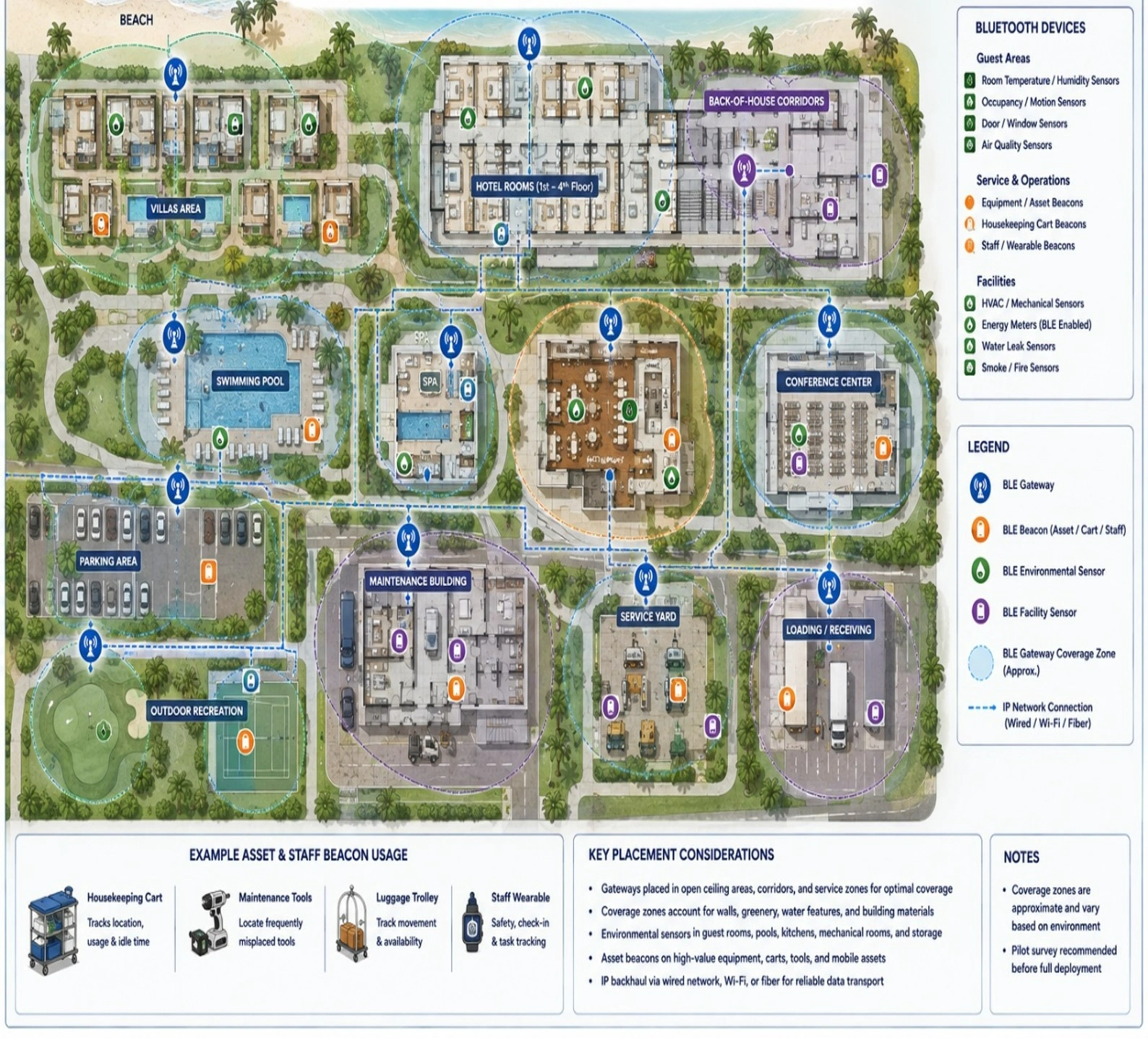
This technical site-plan illustrates how BLE gateways, beacons, and sensors can be strategically deployed across a resort to support location tracking, environmental monitoring, asset management, and operational workflows. It maps coverage zones across villas, hotel rooms, back-of-house corridors, pools, spas, restaurants, conference facilities, parking, outdoor recreation, maintenance buildings, service yards, and loading areas. The diagram also shows IP network connections between BLE gateways and the wider resort network. Example applications include tracking housekeeping carts, maintenance tools, luggage equipment, staff devices, HVAC conditions, energy use, water leaks, and facility conditions. Coverage areas account for physical obstructions, outdoor conditions, and building materials, highlighting the importance of site surveys before full deployment.
AI Models and Analytics
AI software should be selected according to the operational problem. An anomaly-detection model may be appropriate for identifying unusual equipment behavior, while time-series forecasting can support demand and energy prediction. Classification models can categorize operational events, and optimization methods can help with staff dispatch or maintenance scheduling.
Resort operators should avoid deploying an AI model simply because a data source exists. The model should have a measurable operational objective, a defined input dataset, an acceptable error rate, and a process for human review.
Cloud Version and Server Version
A Cloud Version can host resort-management analytics, dashboards, data storage, AI models, and integration services within cloud infrastructure. This approach can simplify centralized management for resort groups operating multiple properties and can support software updates, aggregated analytics, and geographically distributed deployments.
A Server Version can run on customer-managed edge servers, private data centers, resort servers, or other privately hosted infrastructure. This option may be preferable when a resort has strict data-governance requirements, limited external connectivity, existing private computing resources, or operational requirements for local processing.
A hybrid deployment can place time-sensitive processing near the resort while sending selected historical data to centralized cloud infrastructure. The appropriate model depends on network reliability, data sensitivity, integration requirements, operational staffing, and the resort group’s IT policies.
Communication, Security, and Enterprise Integration
BLE is only one part of the communication chain. Gateways may use Ethernet, Wi-Fi, cellular connectivity, or other IP-based networking to communicate with server infrastructure. Application interfaces and middleware should normalize device data before it reaches operational software.
Security controls should include device authentication where supported, encrypted communications, network segmentation, controlled gateway administration, least-privilege access, secure credential management, firmware management, logging, and defined data-retention policies.
Integration with property-management systems, CMMS, building-management systems, access control, housekeeping software, workforce applications, and business intelligence tools should be based on documented interfaces rather than direct database manipulation whenever possible.
GAO can support organizations evaluating BLE hardware and IoT system requirements, including device selection, gateway deployment, integration considerations, and remote or onsite technical support.
Cloud vs. Server Deployment for AI and BLE Resort Management
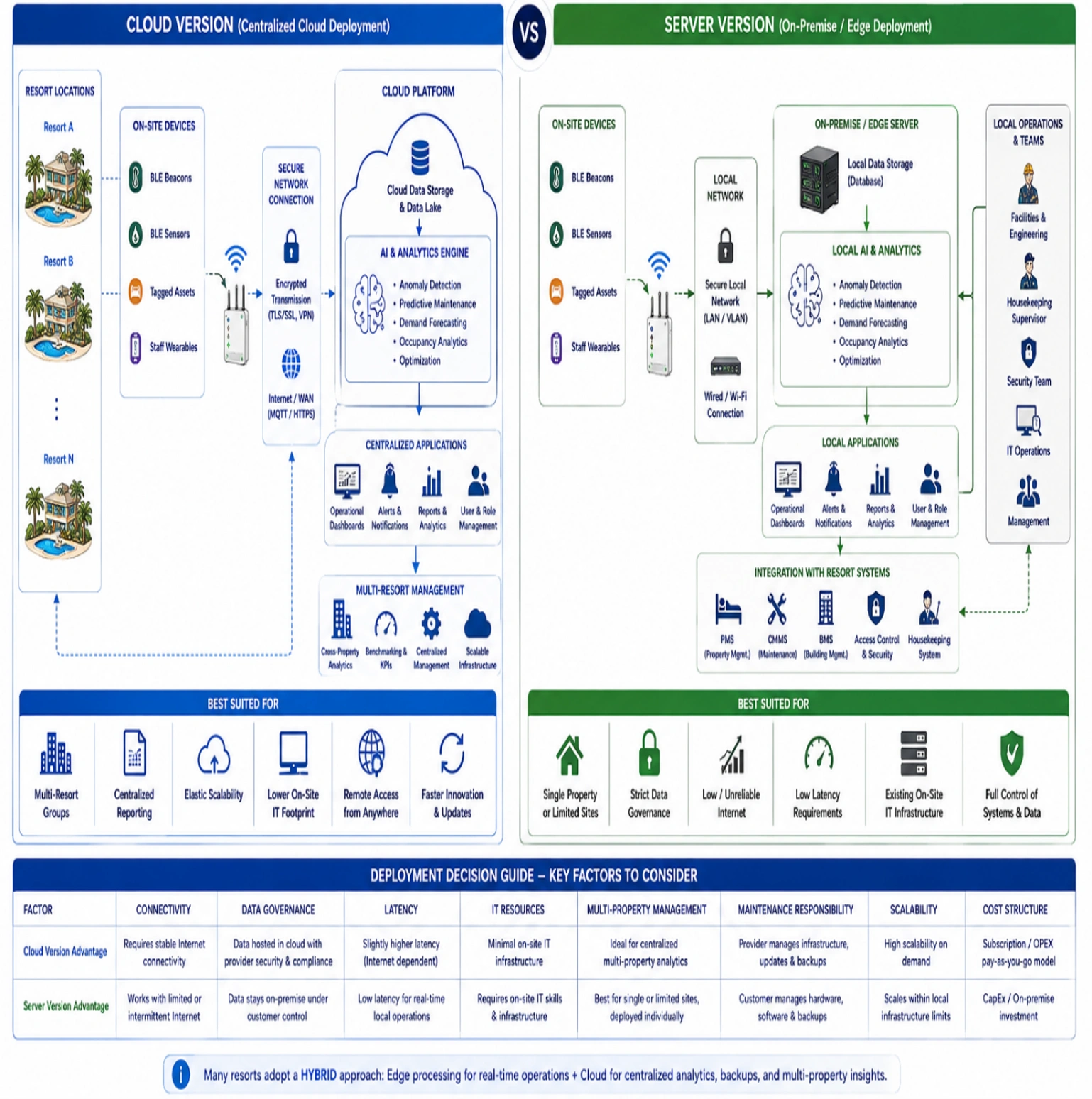
This comparison diagram presents two deployment approaches for AI-enabled resort management using BLE gateways, beacons, sensors, tagged assets, and staff devices. The Cloud Version connects resort locations through secure networks to centralized cloud storage, AI analytics, dashboards, and multi-resort reporting, making it suitable for distributed resort groups and centralized management. The Server Version processes data through local networks and privately hosted edge or customer-managed servers, supporting local AI analytics, applications, and integration with resort systems. The decision guide compares connectivity, data governance, latency, IT resources, multi-property management, maintenance responsibility, scalability, and cost structure, helping resort IT and engineering teams select an appropriate deployment model or hybrid approach.
Engineering Considerations Before Resort Deployment
Successful deployment requires more than installing BLE devices throughout a property. Resort environments introduce several conditions that can affect sensing and location performance.
- Radio propagation: Concrete walls, metal structures, elevators, kitchen equipment, dense vegetation, water features, and building layouts can influence BLE signal behavior.
- Coverage planning: Gateway quantity should be based on the required service area and positioning accuracy rather than a fixed device-per-room assumption.
- Battery management: Battery-powered beacons and sensors require an inventory of device locations, expected battery life, replacement procedures, and maintenance ownership.
- Outdoor conditions: Pool areas, landscaping zones, parking facilities, golf operations, and exposed service areas may require hardware with suitable environmental protection.
- Data quality: AI performance depends on reliable timestamps, device identifiers, sensor calibration, missing-data handling, and consistent operational records.
- Integration reliability: Resort systems should define how events are exchanged, what happens when a connected system is unavailable, and how duplicate or delayed events are handled.
- Privacy governance: Guest and employee-related data requires clear purpose limitation, access controls, retention rules, and compliance review appropriate to the deployment location.
- Operational ownership: Engineering, IT, housekeeping, security, and guest-service teams should have clearly defined responsibilities for responding to AI-generated alerts.
Resort AI and BLE Deployment Decision Tree
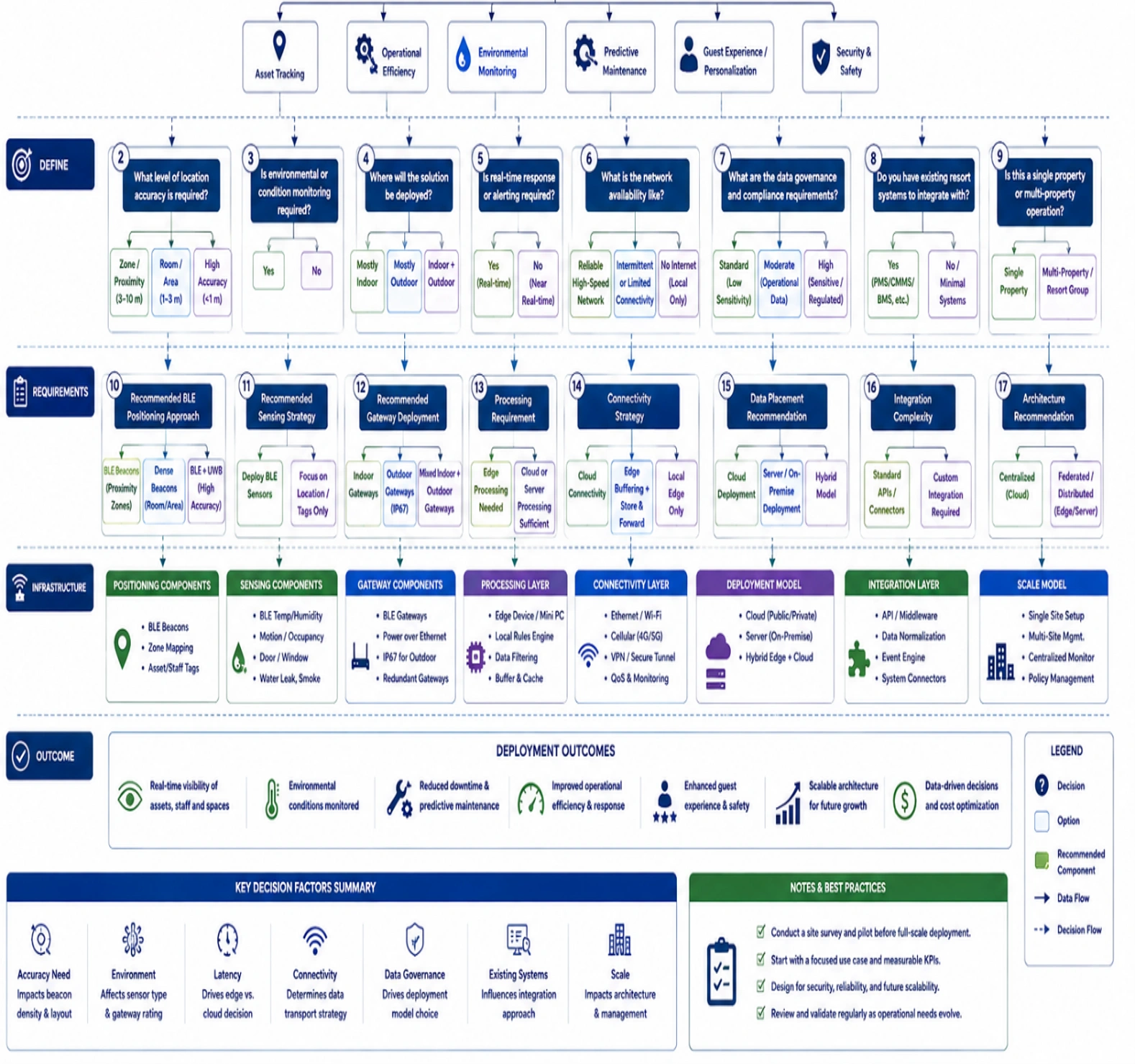
This decision tree provides a practical framework for selecting AI and BLE deployment components according to specific resort-management requirements. It begins with the operational objective, such as asset tracking, environmental monitoring, predictive maintenance, guest services, or security, then evaluates location accuracy, sensing needs, indoor or outdoor deployment, real-time response, network availability, data governance, existing resort systems, and property scale. The resulting recommendations cover BLE beacons, sensors, gateways, edge processing, cloud or server deployment, connectivity, and software integration. The visual also identifies key infrastructure components, deployment models, scalability considerations, and expected outcomes, helping resort IT and engineering teams plan a measured and technically appropriate implementation.
Measuring AI-Enabled Resort Management Performance
Before deployment, resort operators should establish measurable KPIs tied to actual operating processes. Relevant metrics can include:
- Guest service response time
- Housekeeping task completion time
- Maintenance response time
- Mean time between failures for monitored equipment
- Mean time to repair
- Preventive maintenance compliance
- Asset search time
- Asset utilization rate
- Unplanned equipment downtime
- Energy consumption per occupied room
- HVAC fault detection rate
- Refrigeration temperature excursion response time
- Staff travel time between assigned tasks
- False-alert rate
- AI prediction accuracy
- BLE gateway availability
- Sensor data completeness
- Battery replacement frequency
- System integration uptime
- Operational cost per monitored asset
These KPIs should be measured before and after implementation where possible. A pilot should establish a baseline so that management can distinguish actual operational improvement from changes caused by occupancy, seasonal demand, staffing levels, renovations, or other external variables.
Implementation Roadmap for AI-Enabled Resort Management
A resort should normally begin with a narrowly defined operational problem rather than attempting to instrument every guest and service area simultaneously. A phased deployment reduces technical risk and provides measurable evidence before broader investment.
Operational Assessment and Use-Case Selection
The first stage identifies where operational delays, asset losses, maintenance failures, energy waste, or service inconsistencies are affecting resort performance.
Relevant stakeholders can include:
- Resort operations management
- Facilities and engineering teams
- Housekeeping management
- IT and cybersecurity teams
- Security personnel
- Guest-services teams
- Procurement and facilities management
- Finance and business analytics teams
Each proposed use case should have a defined operational owner, measurable KPI, required data sources, expected response time, and escalation procedure.
A useful pilot might focus on maintenance assets, housekeeping workflows, environmental monitoring, or equipment condition rather than attempting simultaneous deployment across the entire property.
Site Survey and BLE Engineering Design
A physical survey should document floor plans, construction materials, gateway mounting locations, network availability, electrical power, environmental conditions, and areas where BLE coverage may be affected.
The design should determine:
- Required BLE coverage
- Target positioning accuracy
- Beacon and sensor density
- Gateway locations
- Gateway backhaul connectivity
- Power requirements
- Battery replacement access
- Outdoor environmental requirements
- Network segmentation
- Data-processing locations
- Integration points with existing resort software
Pilot testing should occur in representative locations. A guest-room corridor alone may not represent the radio conditions around a commercial kitchen, basement plant room, outdoor pool, parking structure, or landscaped resort area.
Hardware Selection and Commissioning
BLE devices should be selected according to operating environment and measurement requirements.
Sensors installed near refrigeration equipment, pool facilities, kitchens, mechanical rooms, or outdoor areas may have substantially different environmental requirements from devices installed in administrative spaces.
Commissioning should verify device identity, signal reception, gateway connectivity, timestamps, sensor measurements, battery status, firmware configuration, and expected event transmission.
A device inventory should associate each physical device with a unique identifier and its operational location. This becomes important when maintenance personnel replace sensors or relocate tagged assets.
AI Model Development and Validation
AI development should begin after the operational data structure is understood. Historical maintenance records, service requests, equipment events, occupancy information, energy records, and BLE-generated events may require normalization before they are suitable for modeling.
Model validation should use data that represents actual resort conditions rather than relying only on synthetic test cases.
Important measures include:
- Prediction accuracy
- False-positive rate
- False-negative rate
- Alert latency
- Data completeness
- Model drift
- Human override frequency
- Operational savings or service improvement
A model that generates many technically valid anomalies but produces excessive false alarms may reduce staff confidence rather than improve operations.
Integration and Pilot Deployment
The pilot should connect the selected BLE and AI solution with the minimum number of existing systems necessary to demonstrate the business process.
Depending on the use case, integrations may involve property-management software, CMMS, building-management systems, access-control software, housekeeping applications, energy-management systems, or management dashboards.
The integration should be tested under normal conditions as well as failure scenarios. For example, the team should verify what happens when a gateway loses network connectivity, a sensor stops reporting, an API becomes unavailable, or an AI service cannot process an event.
Operational Acceptance and Scale-Up
A successful pilot should produce measurable results against the original baseline. The resort can then determine whether to expand the solution to additional buildings, asset categories, departments, or properties.
Scaling should preserve standardized device identifiers, naming conventions, security controls, integration interfaces, data models, and maintenance procedures.
Multi-property resort groups can also aggregate appropriately governed operational data to identify recurring maintenance problems, energy patterns, asset-utilization trends, and service bottlenecks across locations.
Cybersecurity and Data Governance for Connected Resorts
Connected resort systems expand the number of devices and software interfaces that require security controls. BLE gateways are particularly important because they connect local wireless devices to IP networks and potentially to cloud or privately hosted systems.
A resort’s cybersecurity design should address device, network, application, identity, and data controls.
- Device security: Maintain an inventory of gateways, sensors, beacons, firmware versions, and administrative credentials.
- Network security: Place IoT infrastructure into appropriately segmented network zones and restrict unnecessary communication paths.
- Identity and access: Apply role-based access to dashboards, gateway administration, operational software, and management reports.
- Data protection: Protect sensitive operational and guest-related information during transmission and storage according to applicable organizational requirements.
- Firmware management: Establish procedures for security updates, configuration changes, device replacement, and vulnerability response.
- Logging: Record significant authentication events, configuration changes, gateway failures, device events, and administrative activity.
- Retention: Retain only the information needed for the defined operational purpose and establish deletion procedures.
Guest-related location information deserves particular attention. A technical capability to derive location does not automatically establish a business justification for collecting or retaining that information. Resort operators should define the purpose, access requirements, retention period, and applicable privacy obligations before deployment.
AI introduces additional governance requirements. Model outputs should be traceable to appropriate data sources, operational staff should understand the meaning and limitations of alerts, and high-impact actions should include suitable human oversight.
Interoperability with Resort Management Systems
AI and BLE systems generate the most operational value when their information reaches the systems already used by resort personnel.
Property-management software can provide room status, reservations, occupancy-related information, and guest-service events. CMMS software can provide work orders, maintenance histories, asset records, and technician activities. Building-management systems can provide HVAC and facility information. Housekeeping systems can provide task assignments and room-service workflows.
BLE-generated events can supplement these systems rather than replacing them.
A practical integration model can normalize information into common event structures such as:
- Asset identifier
- Device identifier
- Resort location
- Timestamp
- Event type
- Sensor measurement
- Confidence or signal information where applicable
- Alert status
- Assigned operational team
- Work-order reference
- Resolution status
Consistent identifiers are particularly important. If an HVAC asset has one identifier in a CMMS, another identifier in a building-management system, and a third identifier associated with its BLE sensor, AI analytics can produce unreliable asset histories unless those references are mapped correctly.
API-based integration, message brokers, middleware, or other documented interfaces can reduce dependence on proprietary point-to-point connections. The appropriate method depends on the interfaces exposed by the existing resort systems.
GAO can help organizations evaluate BLE hardware and connected IoT system requirements while considering how those devices fit into broader operational software and infrastructure.
AI-Enabled BLE Resort Systems Integration Architecture
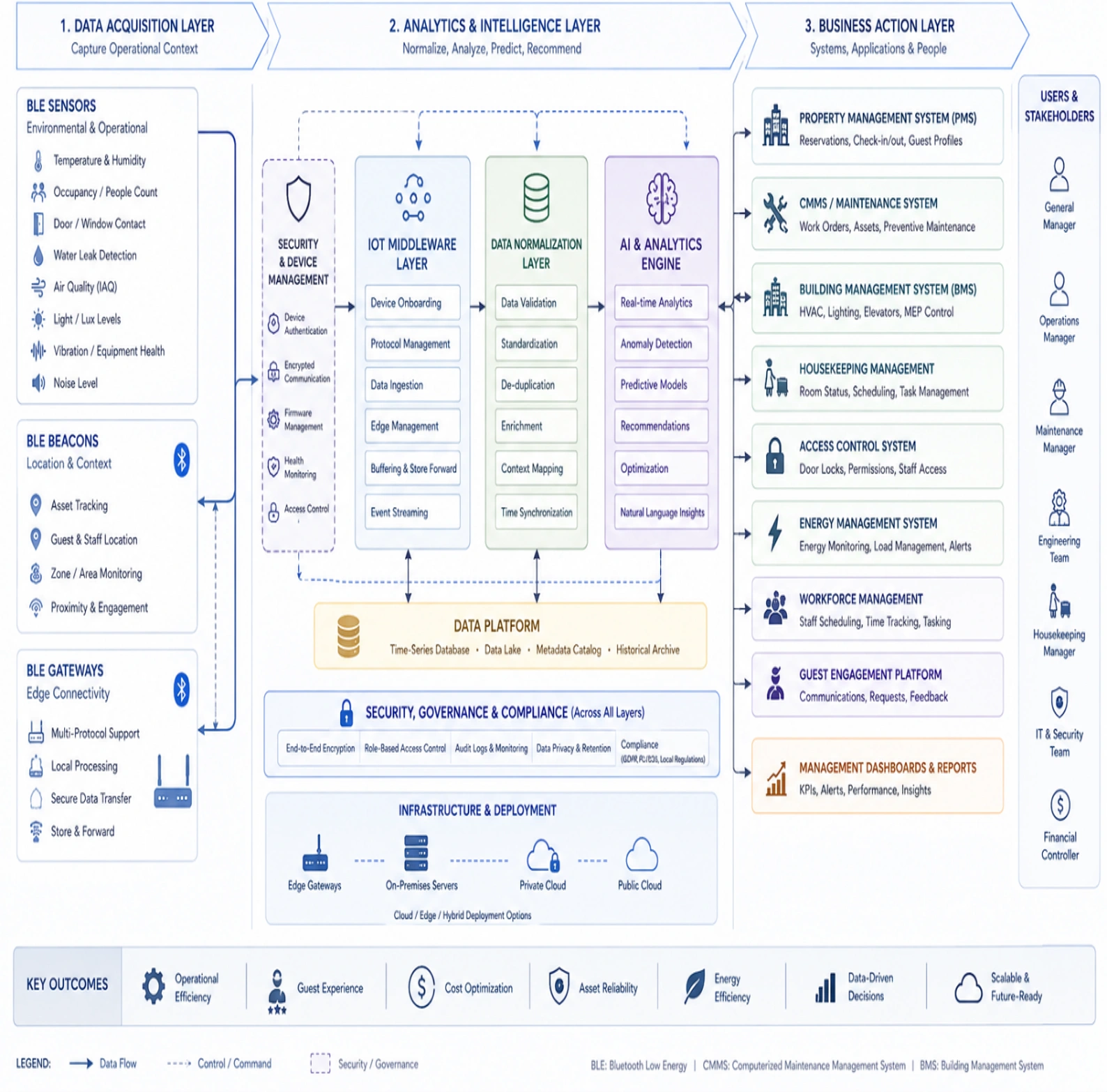
Block diagram illustrating how BLE sensors, beacons, and gateways feed normalized data into IoT middleware and AI analytics, which then connects with core resort software and management systems.
Practical Trade-Offs in Resort AI and BLE Deployment
Technology selection should reflect the physical and operational characteristics of the property.
BLE provides an attractive option for low-power sensing and proximity applications, but it should not automatically be selected for every location problem. The required accuracy, update frequency, environmental conditions, battery life, network availability, and application requirements should determine the appropriate technology.
Similarly, cloud deployment can simplify centralized management, but some applications benefit from local processing when network latency, connectivity, or data-governance requirements make external processing undesirable.
AI can improve operational decisions, but model complexity should be justified by measurable business value. A simple rules engine may outperform a machine-learning model for a straightforward threshold alert, while predictive maintenance or demand forecasting may justify more sophisticated modeling.
Automation should also be proportional to operational risk. Automatically generating a maintenance work order from a high-confidence equipment anomaly may be reasonable. Automatically disabling critical resort equipment based solely on an AI prediction may require substantially stronger validation and human authorization.
These trade-offs should be documented during solution design rather than discovered after deployment.
How AI and BLE Improve Resort Management
Combining AI with BLE-enabled sensing can produce improvements across several resort functions.
Faster Operational Response
Real-time or near-real-time events can reduce the delay between an operational condition occurring and staff becoming aware of it. AI can prioritize events so that personnel focus on conditions with the greatest operational impact.
Better Asset Utilization
Location and movement information can show how mobile assets are actually used. Managers can use these patterns to improve storage arrangements, asset allocation, procurement decisions, and maintenance scheduling.
Predictive Rather Than Reactive Maintenance
AI can identify patterns preceding equipment problems, allowing engineering teams to investigate before a failure affects guest facilities. This is particularly valuable for equipment supporting rooms, kitchens, pools, spas, laundry, refrigeration, and mechanical systems.
Improved Staff Allocation
AI can combine demand patterns, operational workload, and available resources to recommend staff assignments. BLE-derived location information can provide additional context without requiring every task to be manually logged.
Reduced Energy Waste
Environmental sensing and operational data can help identify equipment operating outside expected conditions. AI can distinguish normal demand fluctuations from potentially actionable abnormalities.
Greater Operational Visibility
Management dashboards can consolidate information that would otherwise remain distributed across maintenance records, property-management software, facility controls, staff reports, and individual devices.
The resulting visibility allows resort managers to evaluate performance using measured operational data rather than relying exclusively on periodic manual reports.
Scaling AI-Enabled Resort Management Across Properties
Multi-property organizations should establish common technical standards before deploying AI and BLE beyond the initial site.
A scalable deployment should define:
- Standard BLE device categories
- Device naming and identification conventions
- Gateway configuration standards
- Network and cybersecurity requirements
- Data schemas
- Integration interfaces
- AI model governance
- KPI definitions
- Maintenance responsibilities
- Battery replacement procedures
- Firmware management
- Staff training
- Operational escalation procedures
Not every property needs identical hardware. A coastal resort, mountain property, urban hotel-resort, and large destination resort can have substantially different construction, climate, connectivity, and operational requirements.
Standardizing the underlying data and management processes while allowing site-specific hardware configurations can provide a better balance between consistency and engineering practicality.
AI models should also be evaluated for site-specific differences. A maintenance model trained using equipment behavior from one property may not perform identically at another property with different equipment brands, climate conditions, operating schedules, or maintenance practices.
GAO’s Role in AI and BLE Resort Management Solutions
GAO provides BLE, RFID, and IoT hardware products and systems that can support connected resort-management applications. Its capabilities are relevant to organizations that need BLE beacons, sensors, gateways, and related IoT technologies as components of broader operational solutions.
GAO’s sister companies, GAO Research and GAO Tek, together form GAO Group, with operations based in New York City and Toronto, Canada. For three decades, GAO Group has served organizations in the United States and Canada, including Fortune 500 companies, research and development organizations, universities, and government agencies. The group emphasizes product research and development, quality assurance, and technical support.
For resort operators, the practical objective is to select technology that fits existing operations. GAO can support that process through hardware selection, technical consultation, connected-system requirements, and remote or onsite technical assistance.
Building a Practical AIoT Program for Resort Operations
AI-enabled resort management is most effective when technology follows a clearly defined operational problem. BLE beacons, sensors, and gateways can provide useful data for asset visibility, environmental monitoring, equipment condition, housekeeping workflows, service operations, and selected security processes. AI can then convert that information into predictions, anomaly detection, prioritization, and operational recommendations.
Resort operators should begin with measurable use cases, validate BLE performance in representative areas, establish data and cybersecurity controls, integrate with existing management systems, and measure results against a baseline before scaling.
GAO’s BLE, RFID, and IoT technologies can form part of these deployments, supported by technical expertise in connected hardware and system implementation. Organizations evaluating AI-enabled resort management can explore relevant GAO technologies, define their operational requirements, and develop a deployment plan based on actual property conditions.
Building the Future of Industrial AI and IoT with Aperture Venture Studio and GAO RFID Inc.
For more than three decades, GAO Group of Companies has invested heavily in R&D for industrial BLE, RFID, and IoT technologies. As generative AI became increasingly useful for practical industrial applications, we expanded our work across AI and IoT, including BLE and RFID, with a focus on applications such as connected resort operations, asset visibility, intelligent maintenance, and operational analytics.
Aperture Venture Studio brings together AI and IoT technical expertise, entrepreneurial and operational experience, investors, and leading companies. Its related initiatives, including Aperture Ventures Summit and TekSummit, provide forums for discussing advanced AI and IoT topics.
We welcome participation as:
- Advisors, co-founders, or employees
- Investors
- Customers